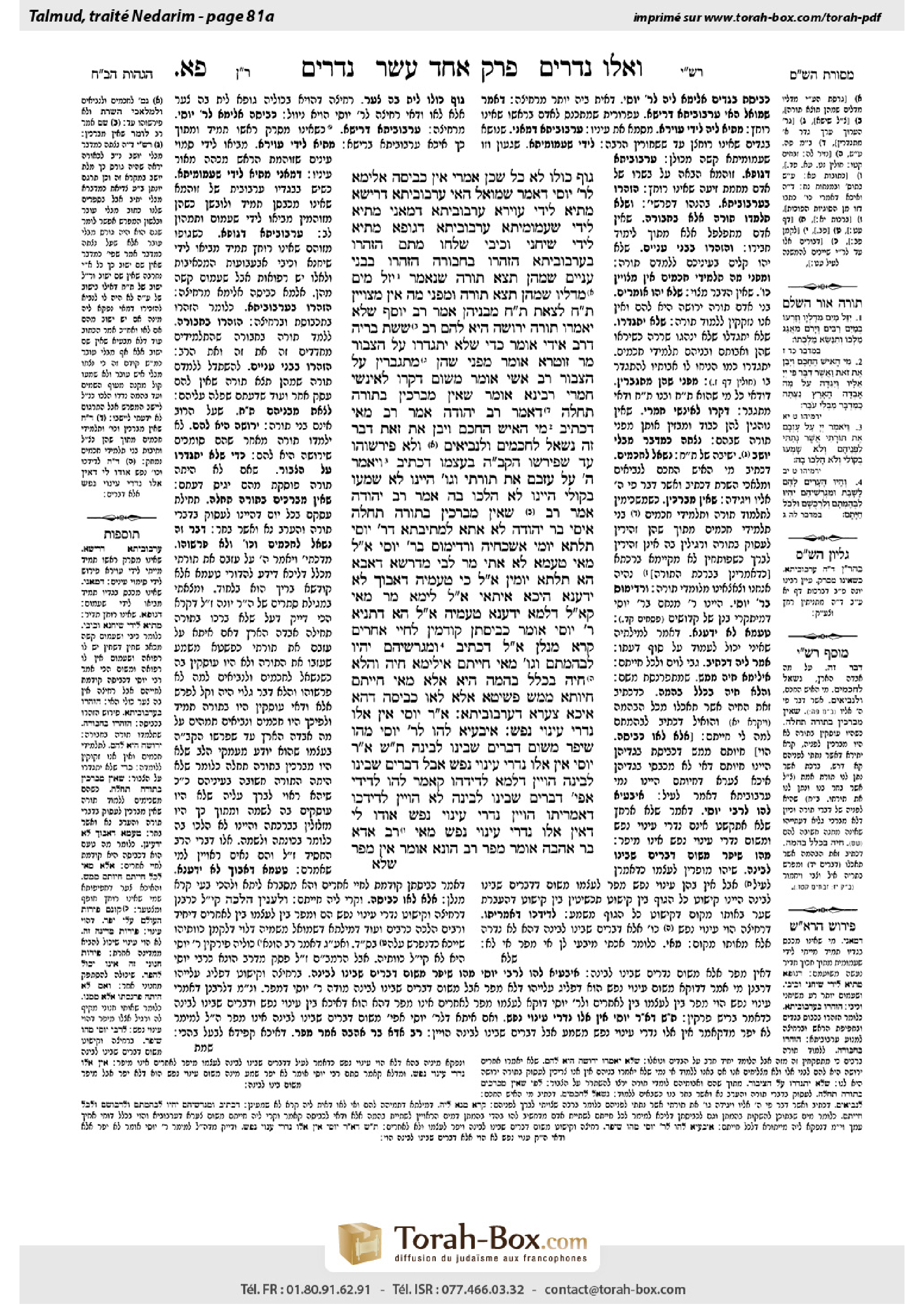
Nedarim 81a: Talmud study for Daf Yomi
Daf Yomi is the daily study of one Talmud folio. Explore 37 tractates with scans, Hebrew text, Sefaria English and AI-generated French translations where annotated.
Passage selection and English or AI-generated French translation are available where the scan has annotations. Daf Study is independent of Torah-Box and Sefaria.
Browse Nedarim · נדרים · All tractatesNedarim 81a text and translations
This page of Nedarim includes the Aramaic text, an English translation and an AI-generated French translation, alongside the scan above.
נדרים פ״א א · Aramaic and Hebrew text
גּוּף כּוּלּוֹ לֹא כׇּל שֶׁכֵּן?! אָמְרִי: אִין, כְּבִיסָה אַלִּימָא לְרַבִּי יוֹסֵי. דְּאָמַר שְׁמוּאֵל: הַאי עַרְבּוּבִיתָא דְרֵישָׁא — מַתְיָא לִידֵי עֲוִירָא, עַרְבּוּבִיתָא דְמָאנֵי — מַתְיָא לִידֵי שַׁעְמוּמִיתָא, עַרְבּוּבִיתָא דְגוּפָא — מַתְיָא לִידֵי שִׁיחְנֵי וְכִיבֵי.
שְׁלַחוּ מִתָּם: הִזָּהֲרוּ בְּעַרְבּוּבִיתָא. הִזָּהֲרוּ בַּחֲבוּרָה. הִזָּהֲרוּ בִּבְנֵי עֲנִיִּים, שֶׁמֵּהֶן תֵּצֵא תּוֹרָה, שֶׁנֶּאֱמַר: ״יִזַּל מַיִם מִדַּלָּיו״, שֶׁמֵּהֶן תֵּצֵא תּוֹרָה.
וּמִפְּנֵי מָה אֵין מְצוּיִין תַּלְמִידֵי חֲכָמִים לָצֵאת תַּלְמִידֵי חֲכָמִים מִבְּנֵיהֶן? אָמַר רַב יוֹסֵף, שֶׁלֹּא יֹאמְרוּ: תּוֹרָה יְרוּשָּׁה הִיא לָהֶם. רַב שֵׁשֶׁת בְּרֵיהּ דְּרַב אִידִי אוֹמֵר: כְּדֵי שֶׁלֹּא יִתְגַּדְּרוּ עַל הַצִּבּוּר. מָר זוּטְרָא אוֹמֵר: מִפְּנֵי שֶׁהֵן מִתְגַּבְּרִין עַל הַצִּבּוּר. רַב אָשֵׁי אוֹמֵר: מִשּׁוּם דְּקָרוּ לְאִינָשֵׁי ״חֲמָרֵי״.
רָבִינָא אוֹמֵר: שֶׁאֵין מְבָרְכִין בַּתּוֹרָה תְּחִלָּה. דְּאָמַר רַב יְהוּדָה אָמַר רַב: מַאי דִּכְתִיב: ״מִי הָאִישׁ הֶחָכָם וְיָבֵן אֶת זֹאת״ — דָּבָר זֶה נִשְׁאַל לַחֲכָמִים וְלַנְּבִיאִים וְלֹא פֵּירְשׁוּהוּ,
עַד שֶׁפֵּירְשׁוֹ הַקָּדוֹשׁ בָּרוּךְ הוּא בְּעַצְמוֹ, דִּכְתִיב: ״וַיֹּאמֶר ה׳ עַל עׇזְבָם אֶת תּוֹרָתִי וְגוֹ׳״. הַיְינוּ ״לֹא שָׁמְעוּ בְּקוֹלִי״, הַיְינוּ ״לֹא הָלְכוּ בָּהּ״! אָמַר רַב יְהוּדָה אָמַר רַב: שֶׁאֵין מְבָרְכִין בַּתּוֹרָה תְּחִלָּה.
אִיסִי בַּר יְהוּדָה לָא אֲתָא לִמְתִיבְתָּא דְּרַבִּי יוֹסֵי תְּלָתָא יוֹמֵי. אַשְׁכְּחֵיהּ וַרְדִּימוֹס בְּרַבִּי יוֹסֵי, אֲמַר לֵיהּ: מַאי טַעְמָא לָא אָתֵי מָר לְבֵי מִדְרְשָׁא דְּאַבָּא הָא תְּלָתָא יוֹמִין? אֲמַר לֵיהּ: כִּי טַעְמֵיהּ דַּאֲבוּךְ לָא יָדַעְנָא, הֵיכָא אֵיתָאי? אֲמַר לֵיהּ: לֵימָא מָר מַאי קָאָמַר לֵיהּ, דִּלְמָא יָדַעְנָא טַעְמֵיהּ. אֲמַר לֵיהּ: הָא דְּתַנְיָא, רַבִּי יוֹסֵי אוֹמֵר: כְּבִיסָתָן קוֹדְמִין לְחַיֵּי אֲחֵרִים, קְרָא מְנָלַן?
אֲמַר לֵיהּ, דִּכְתִיב: ״וּמִגְרְשֵׁיהֶם יִהְיוּ לִבְהֶמְתָּם וְגוֹ׳״. מַאי ״חַיָּיתָם״? אִילֵּימָא חַיָּה — וַהֲלֹא חַיָּה בִּכְלַל בְּהֵמָה הִיא. אֶלָּא מַאי ״חַיָּיתָם״ — חַיּוּתָא מַמָּשׁ. פְּשִׁיטָא! אֶלָּא לָאו כְּבִיסָה, דְּהָא אִיכָּא צַעְרָא דְעַרְבּוּבִיתָא.
אָמַר רַבִּי יוֹסֵי: אֵין אֵלּוּ נִדְרֵי עִינּוּי נֶפֶשׁ. אִיבַּעְיָא לְהוּ: לְרַבִּי יוֹסֵי, מַהוּ שֶׁיָּפֵר מִשּׁוּם דְּבָרִים שֶׁבֵּינוֹ לְבֵינָהּ? תָּא שְׁמַע, אָמַר רַבִּי יוֹסֵי: אֵין אֵלּוּ נִדְרֵי עִינּוּי נֶפֶשׁ. אֲבָל דְּבָרִים שֶׁבֵּינוֹ לְבֵינָהּ הָוַיִין.
דִּלְמָא לְדִידְהוּ קָאָמַר לְהוּ. לְדִידִי אֲפִילּוּ דְּבָרִים שֶׁבֵּינוֹ לְבֵינָהּ לָא הָוַיִין. לְדִידְכוּ, דְּאָמְרִיתוּ הָוַיִין נִדְרֵי עִינּוּי נֶפֶשׁ — אוֹדוֹ לִי דְּאֵין אֵלּוּ נִדְרֵי עִינּוּי נֶפֶשׁ.
מַאי? רַב אַדָּא בַּר אַהֲבָה אוֹמֵר: מֵפֵר, רַב הוּנָא אוֹמֵר: אֵין מֵפֵר,
Nedarim 81a · English translation
is it not all the more so the case that if one does not bathe, which affects the entire body, Rabbi Yosei would agree that he will suffer pain? The Gemara refutes this argument: The Sages say in response: Yes, the pain of refraining from laundering one’s clothes is stronger, according to Rabbi Yosei, than the pain of not washing one’s body. As Shmuel said: Grime on one’s head leads to blindness, and grime on one’s clothes leads to madness, whereas grime on one’s body leads to boils and sores, which are less serious than madness and blindness. Based on this it may be suggested that according to Rabbi Yosei, soiled clothing presents a greater danger than an unwashed body.
§ With regard to this issue, the Gemara relates that the Sages sent the following message from there, i.e., Eretz Yisrael, to Babylonia: Be careful with regard to grime, as it can lead to disease and sickness. Be careful to learn Torah in the company of others, rather than study it alone. And be careful with regard to the education of the sons of paupers, as it is from them that the Torah will issue forth. As it is stated: “Water shall flow from his branches [midalyav]” (Numbers 24:7), which is expounded to mean: From the poor ones [midalim] among him, as it is from them that the Torah, which may be compared to water, will issue forth.
With regard to a similar matter, the Gemara inquires: And for what reason is it not common for Torah scholars to give rise to Torah scholars from among their sons? Why are Torah scholars generally born to paupers, who are not Torah scholars themselves? Rav Yosef said: This is so that they should not say the Torah is their inheritance. Therefore, it is unusual to find that all the sons of a Torah scholar are also Torah scholars. Rav Sheshet, son of Rav Idi, said: This is so that they should not be presumptuous [yitgadderu] toward the community, with the knowledge that they will be Torah scholars like their fathers. Mar Zutra said: Because they take advantage of their fathers’ standing to lord over the community and are punished for their conduct. Rav Ashi said: Because they call ordinary people donkeys.
Ravina says: They are punished because they do not first recite a blessing over the Torah before commencing their studies. As Rav Yehuda said that Rav said: What is the meaning of that which is written: “Who is the wise man that may understand this, and who is he to whom the mouth of the Lord has spoken, that he may declare it, for what the land is perished and laid waste like a wilderness, so that none passes through” (Jeremiah 9:11)? This matter, the question as to why Eretz Yisrael was destroyed, was asked of the Sages, i.e., “the wise man,” and of the prophets, “he to whom the mouth of the Lord has spoken,” but they could not explain it.
The matter remained a mystery until the Holy One, Blessed be He, Himself explained why Eretz Yisrael was laid waste, as it is written in the next verse: “And the Lord said: Because they have forsaken My Torah which I set before them, and have not obeyed My voice, nor walked therein” (Jeremiah 9:12). It would appear that “have not obeyed My voice” is the same as “nor walked therein.” Rav Yehuda said that Rav said: The expression “nor walked therein” means that they do not first recite a blessing over the Torah, and they are therefore liable to receive the severe punishments listed in the verse.
§ Returning to the issue of laundering clothes, the Gemara relates that it once happened that Isi bar Yehuda did not come to the academy of Rabbi Yosei for three straight days. Vardimus, son of Rabbi Yosei, found him and said to him: What is the reason that the Master did not come to Father’s academy these three days? He said to him: When I do not know your father’s reasoning, how can I come? Vardimus said to him: Let the Master say what he, my father, is saying to him; perhaps I know his reasoning. He said to him: With regard to that which is taught in a baraita: Rabbi Yosei says that their own laundry takes precedence over the lives of others, from where do we have a verse that teaches this halakha?
Vardimus said to him: As it is written with regard to the Levite cities: “And their open land shall be for their animals and for their substance, and for all their beasts” (Numbers 35:3). What is the meaning of “their beasts”? If we say an actual beast, there is a difficulty, as isn’t a beast included in the category of animal, which has already been mentioned in the verse? Rather, what is the meaning of “their beasts [ḥayyatam]”? It means their actual lives [ḥiyyuta]. This, however, is difficult, as it is obvious that the Levites received their cities in order to live their lives there. Rather, is it not referring to laundering clothes, as there is the pain caused by the grime on one’s unwashed clothes? Since it is vitally necessary for their well-being, laundering the clothing of the city’s residents takes precedence over the lives of others.
§ With regard to the vows: If I bathe, and: If I do not bathe, and: If I adorn myself, and: If I do not adorn myself, Rabbi Yosei said in the mishna that these are not vows of affliction. A dilemma was raised before the Sages: According to Rabbi Yosei, what is the halakha as to whether the husband can nullify these vows as matters that adversely affect the relationship between him and her? The Gemara suggests: Come and hear a resolution to this question from what Rabbi Yosei said: These are not vows of affliction, which indicates, however, that they are matters that affect the relationship between him and her.
The Gemara refutes this proof: Perhaps Rabbi Yosei was speaking to the Rabbis in accordance with their own opinion, as follows: According to my opinion, they are not even matters that affect the relationship between him and her. But according to your opinion, that you say that they are vows of affliction, agree with me at least that these are not vows of affliction. In other words, one should not infer from the phrasing of Rabbi Yosei’s response to the Rabbis that he holds that these vows are concerning matters that affect the relationship between him and her, as he was merely countering the claim of the Rabbis that they are vows of affliction.
The question therefore remains: What does Rabbi Yosei maintain in this regard? Rav Adda bar Ahava says: He can nullify these vows as matters between him and her, whereas Rav Huna says: He cannot nullify them.
Nedarim 81a · Traduction française (IA)
N’est-ce pas à plus forte raison le cas si l’on ne se baigne pas, ce qui affecte tout le corps : Rabbi Yossei conviendrait alors que l’on en souffre ? La Guemara réfute cet argument. Les Sages répondent : Oui, selon Rabbi Yossei, la souffrance causée par le fait de ne pas laver ses vêtements est plus grande que celle causée par le fait de ne pas laver son corps. En effet, Shmuel a dit : La saleté sur la tête rend aveugle, celle sur les vêtements rend fou, tandis que celle sur le corps provoque des furoncles et des plaies, qui sont moins graves que la folie et la cécité. On peut donc suggérer que, selon Rabbi Yossei, des vêtements sales présentent un danger plus grand qu’un corps qui n’a pas été lavé.
§ À ce sujet, la Guemara rapporte que les Sages envoyèrent de là-bas, c’est-à-dire d’Eretz Israël, le message suivant à Babylone : Prenez garde à la saleté, car elle peut provoquer des maladies et des affections. Prenez garde à étudier la Torah en compagnie d’autres personnes, plutôt que de l’étudier seul. Prenez garde aussi à l’instruction des fils des pauvres, car c’est d’eux que la Torah sortira. Comme il est dit : « L’eau coulera de ses branches [midalyav] » (Nombres 24:7), ce qui est interprété ainsi : « de ses pauvres [midalim] », car c’est d’eux que sortira la Torah, qui peut être comparée à l’eau.
À propos d’un sujet semblable, la Guemara demande : Pour quelle raison les érudits en Torah n’ont-ils généralement pas de fils qui soient eux-mêmes des érudits en Torah ? Pourquoi les érudits en Torah naissent-ils généralement dans des familles pauvres, dont les membres ne sont pas eux-mêmes érudits en Torah ? Rav Yossef dit : C’est afin qu’ils ne disent pas que la Torah est leur héritage. Voilà pourquoi il est inhabituel que tous les fils d’un érudit en Torah soient eux aussi des érudits en Torah. Rav Sheshet, fils de Rav Idi, dit : C’est afin qu’ils ne deviennent pas arrogants [yitgadderu] envers la communauté, sachant qu’ils seront des érudits en Torah comme leurs pères. Mar Zutra dit : C’est parce qu’ils tirent parti du statut de leurs pères pour dominer la communauté et qu’ils sont punis pour leur conduite. Rav Ashi dit : C’est parce qu’ils traitent les gens ordinaires d’ânes.
Ravina dit : Ils sont punis parce qu’ils ne récitent pas d’abord une bénédiction sur la Torah avant de commencer leur étude. En effet, Rav Yehouda a dit au nom de Rav : Quel est le sens de ce qui est écrit : « Quel est l’homme sage qui comprendra cela, et à qui la bouche de l’Éternel a parlé, pour qu’il le déclare : pourquoi le pays a-t-il péri et a-t-il été dévasté comme un désert, où nul ne passe ? » (Jérémie 9:11). Cette question — pourquoi Eretz Israël a été détruite — fut posée aux Sages, c’est-à-dire à « l’homme sage », et aux prophètes, « à qui la bouche de l’Éternel a parlé », mais ils ne purent l’expliquer.
La question resta un mystère jusqu’à ce que le Saint, béni soit-Il, explique Lui-même pourquoi Eretz Israël avait été dévastée, comme il est écrit au verset suivant : « Et l’Éternel dit : Parce qu’ils ont abandonné Ma Torah que J’avais placée devant eux, qu’ils n’ont pas obéi à Ma voix et n’ont pas marché en elle » (Jérémie 9:12). Il semblerait que « ils n’ont pas obéi à Ma voix » signifie la même chose que « n’ont pas marché en elle ». Rav Yehouda a dit au nom de Rav : L’expression « n’ont pas marché en elle » signifie qu’ils ne récitent pas d’abord une bénédiction sur la Torah ; ils sont donc passibles des lourdes sanctions énumérées dans le verset.
§ Revenant à la question du lavage des vêtements, la Guemara rapporte qu’Isi bar Yehouda ne vint pas à l’académie de Rabbi Yossei pendant trois jours consécutifs. Vardimus, fils de Rabbi Yossei, le rencontra et lui dit : Pour quelle raison le Maître n’est-il pas venu à l’académie de mon père ces trois derniers jours ? Il lui répondit : Si je ne connais pas le raisonnement de ton père, comment pourrais-je venir ? Vardimus lui dit : Que le Maître me dise ce que mon père lui dit ; peut-être en connaîtrai-je le raisonnement. Il lui répondit : À propos de ce qui est enseigné dans une baraïta — Rabbi Yossei dit que le lavage de leurs propres vêtements prime sur la vie d’autrui —, quel verset nous enseigne cette halakha ?
Vardimus lui dit : Comme il est écrit au sujet des villes des Lévites : « Leur terrain découvert sera pour leur bétail, pour leurs biens et pour toutes leurs bêtes » (Nombres 35:3). Que signifie « leurs bêtes » ? Si nous disons qu’il s’agit de bêtes au sens propre, une difficulté se pose : une bête n’est-elle pas incluse dans la catégorie du bétail, déjà mentionnée dans le verset ? Que signifie donc « leurs bêtes [ḥayyatam] » ? Cela désigne leur vie même [ḥiyyuta]. Cela pose toutefois une difficulté, car il est évident que les Lévites reçurent leurs villes afin d’y vivre. Ne s’agit-il donc pas du lavage des vêtements, puisqu’il y a une souffrance causée par la saleté des vêtements non lavés ? Puisque cela est indispensable à leur bien-être, le lavage des vêtements des habitants de la ville prime sur la vie d’autrui.
§ Concernant les vœux « Si je me baigne », « Si je ne me baigne pas », « Si je me pare » et « Si je ne me pare pas », Rabbi Yossei a dit dans la Michna que ce ne sont pas des vœux de souffrance. Les Sages soulevèrent une question : selon Rabbi Yossei, quelle est la halakha quant à la possibilité pour le mari d’annuler ces vœux en tant que sujets qui nuisent à la relation entre lui et elle ? La Guemara propose : Venez et entendez une réponse à cette question d’après ce que Rabbi Yossei a dit : « Ce ne sont pas des vœux de souffrance », ce qui indique toutefois qu’il s’agit de sujets qui nuisent à la relation entre lui et elle.
La Guemara réfute cette preuve : Peut-être Rabbi Yossei s’adressait-il aux Rabbins selon leur propre opinion, de la manière suivante : Selon mon opinion, il ne s’agit même pas de sujets qui nuisent à la relation entre lui et elle. Mais selon votre opinion, puisque vous dites que ce sont des vœux de souffrance, accordez-moi au moins qu’ils ne sont pas des vœux de souffrance. Autrement dit, il ne faut pas déduire de la formulation de la réponse de Rabbi Yossei aux Rabbins qu’il considère que ces vœux portent sur des sujets qui nuisent à la relation entre lui et elle, car il ne faisait que réfuter l’affirmation des Rabbins selon laquelle ce sont des vœux de souffrance.
La question demeure donc : quelle est la position de Rabbi Yossei à cet égard ? Rav Adda bar Ahava dit : Il peut annuler ces vœux en tant que sujets concernant leur relation. Rav Houna dit, quant à lui : Il ne peut pas les annuler.
Traduction française générée par IA à partir de l’édition anglaise de Sefaria. Vérifie toujours un passage avec le texte source.
Text from Sefaria: William Davidson Edition - Vocalized Aramaic (CC BY NC); William Davidson Edition - English (CC BY NC).