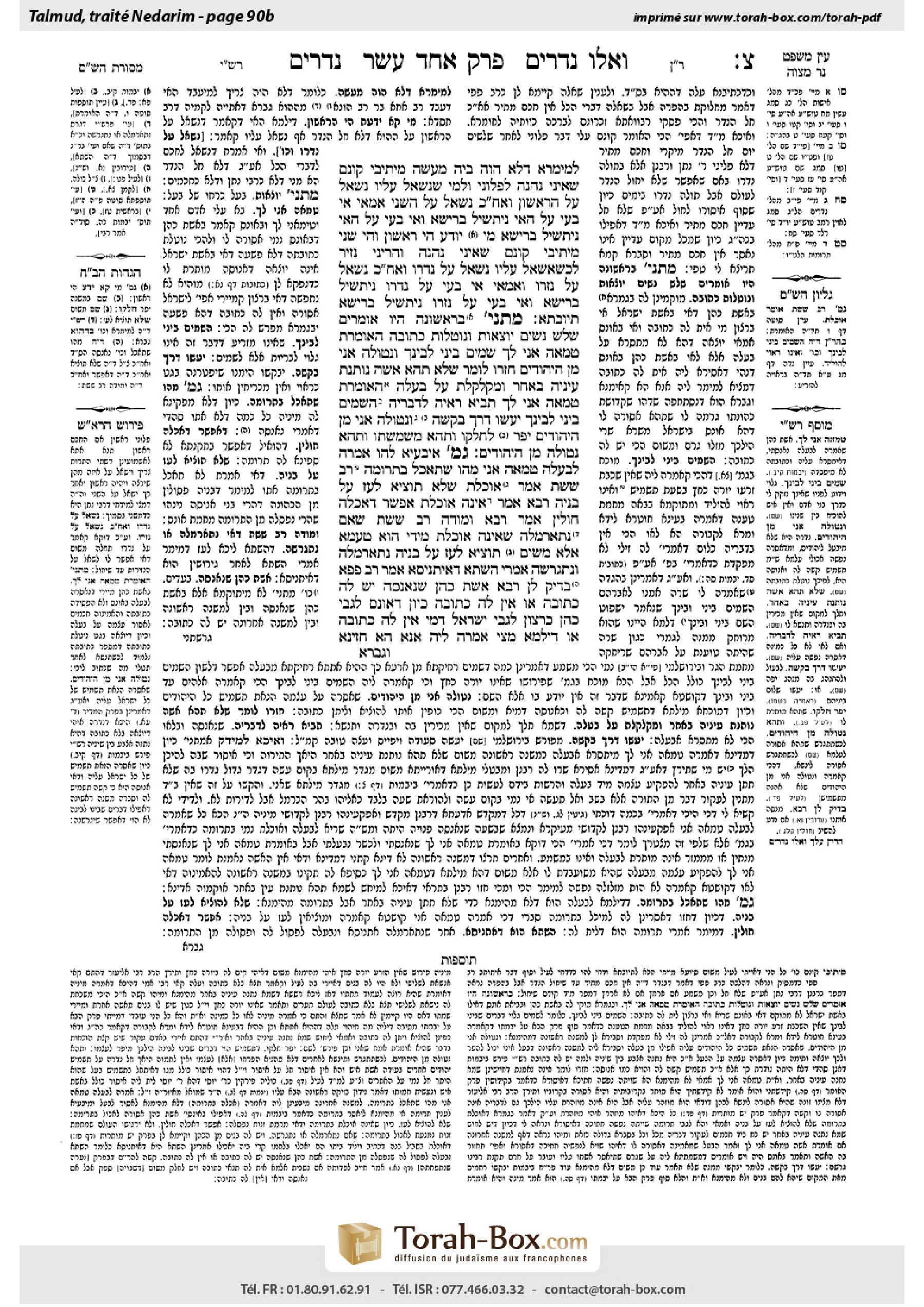
Nedarim 90b: Talmud study for Daf Yomi
Daf Yomi is the daily study of one Talmud folio. Explore 37 tractates with scans, Hebrew text, Sefaria English and AI-generated French translations where annotated.
Passage selection and English or AI-generated French translation are available where the scan has annotations. Daf Study is independent of Torah-Box and Sefaria.
Browse Nedarim · נדרים · All tractatesNedarim 90b text and translations
This page of Nedarim includes the Aramaic text, an English translation and an AI-generated French translation, alongside the scan above.
נדרים צ׳ ב · Aramaic and Hebrew text
לְמֵימְרָא דְּלָא הֲוָה בֵּיהּ מַעֲשֶׂה.
מֵיתִיבִי: ״קֻוֽנָּם שֶׁאֵינִי נֶהֱנֶה לִפְלוֹנִי וּלְמִי שֶׁנִּשְׁאָל עָלָיו״ — נִשְׁאָל עַל הָרִאשׁוֹן, וְאַחַר כָּךְ נִשְׁאָל עַל הַשֵּׁנִי. אַמַּאי? אִי בָּעֵי — עַל הַאי נִיתְּשִׁיל בְּרֵישָׁא, וְאִי בָּעֵי — עַל הַאי נִיתְּשִׁיל בְּרֵישָׁא!
מִי יוֹדֵעַ הֵי רִאשׁוֹן וְהֵי שֵׁנִי?
מֵתִיבִי: ״קֻוֽנָּם שֶׁאֵינִי נֶהֱנֶה וַהֲרֵינִי נָזִיר לִכְשֶׁאֶשָּׁאֵל עָלָיו״ — נִשְׁאָל עַל נִדְרוֹ, וְאַחַר כָּךְ נִשְׁאָל עַל נִזְרוֹ. וְאַמַּאי? אִי בָּעֵי — עַל נִדְרוֹ נִיתְּשִׁיל בְּרֵישָׁא, וְאִי בָּעֵי — עַל נִזְרוֹ נִיתְּשִׁיל בְּרֵישָׁא! תְּיוּבְתָּא.
מַתְנִי׳ בָּרִאשׁוֹנָה הָיוּ אוֹמְרִים: שָׁלֹשׁ נָשִׁים יוֹצְאוֹת וְנוֹטְלוֹת כְּתוּבָה: הָאוֹמֶרֶת ״טְמֵאָה אֲנִי לָךְ״, ״שָׁמַיִם בֵּינִי לְבֵינָךְ״, וּ״נְטוּלָה אֲנִי מִן הַיְּהוּדִים״.
חָזְרוּ לוֹמַר, שֶׁלֹּא תְּהֵא אִשָּׁה נוֹתֶנֶת עֵינֶיהָ בְּאַחֵר וּמְקַלְקֶלֶת עַל בַּעְלָהּ: הָאוֹמֶרֶת ״טְמֵאָה אֲנִי לָךְ״ — תָּבִיא רְאָיָה לִדְבָרֶיהָ. ״הַשָּׁמַיִם בֵּינִי לְבֵינָךְ״ — יַעֲשׂוּ דֶּרֶךְ בַּקָּשָׁה. וּ״נְטוּלָה אֲנִי מִן הַיְּהוּדִים״ — יָפֵר לְחֶלְקוֹ, וּתְהֵא מְשַׁמַּשְׁתּוֹ, וּתְהֵא נְטוּלָה מִן הַיְּהוּדִים.
גְּמָ׳ אִיבַּעְיָא לְהוּ: אָמְרָה לְבַעְלָהּ ״טְמֵאָה אֲנִי״, מַהוּ שֶׁתֹּאכַל בִּתְרוּמָה? רַב שֵׁשֶׁת אָמַר: אוֹכֶלֶת, שֶׁלֹּא תּוֹצִיא לַעַז עַל בָּנֶיהָ. רָבָא אָמַר: אֵינָהּ אוֹכֶלֶת, אֶפְשָׁר דְּאָכְלָה חוּלִּין.
אָמַר רָבָא: וּמוֹדֶה רַב שֵׁשֶׁת שֶׁאִם נִתְאַרְמְלָה שֶׁאֵינָהּ אוֹכֶלֶת. מִידֵּי הוּא טַעְמָא אֶלָּא מִשּׁוּם תּוֹצִיא לַעַז עַל בָּנֶיהָ. נִתְאַרְמְלָה וְנִתְגָּרְשָׁה, אָמְרִי: הַשְׁתָּא דְּאִיתְּנִיסָא.
אָמַר רַב פָּפָּא, בָּדֵיק לַן רָבָא: אֵשֶׁת כֹּהֵן שֶׁנֶּאֶנְסָה, יֵשׁ לָהּ כְּתוּבָּה אוֹ אֵין לָהּ כְּתוּבָּה? כֵּיוָן דְּאוֹנֶס לְגַבֵּי כֹּהֵן כְּרָצוֹן לְגַבֵּי יִשְׂרָאֵל דָּמֵי, אֵין לָהּ כְּתוּבָּה. אוֹ דִילְמָא מָצֵי אָמְרָה לֵיהּ: אֲנָא הָא חֲזֵינָא,
Nedarim 90b · English translation
That is to say that there was not yet any action but only speech, and even so the halakhic authority can dissolve the vow.
The Gemara raises an objection against this version of the tannaitic dispute from the aforementioned baraita: If one says: The property of so-and-so is konam for me, and for that reason I will not benefit from it, and deriving benefit from he who I will request dissolution for the vow is also konam for me, if he desires to dissolve the vows he must first request dissolution with regard to the first vow, and afterward he can request dissolution with regard to the second. But according to what was stated above, that all agree that a vow can be dissolved even before it has taken effect, why is this so? If he so wishes, he can first request dissolution with regard to this vow, and if he wishes, he can first request dissolution with regard to that one.
The Gemara answers: Does he know which vow is first and which is the second? The wording of the baraita is not at all clear on this point. Perhaps, if he so wishes, he can first request dissolution of the vow not to derive benefit from the halakhic authority from whom he will request dissolution of his vow.
The Gemara raises a further objection from the second baraita cited above: If one says: The property of so-and-so is konam for me, and for that reason I will not benefit from it, and I am hereby a nazirite for when I will request dissolution of this vow, if he desires to dissolve the vows he must first request dissolution with regard to his vow that rendered benefit from a particular person forbidden, and afterward he can request dissolution with regard to his vow of naziriteship that he accepted upon himself should he request dissolution of his first vow. But why must he proceed in this manner? If he so wishes he can first request dissolution with regard to his vow not to derive benefit from that other person, and if he wishes he can first request dissolution with regard to his vow of naziriteship. The fact that the baraita does not say this indicates that a vow can be dissolved only once it has gone into effect. The Gemara concludes: Here is a conclusive refutation of this version of the dispute between Rabbi Natan and the Rabbis.
MISHNA: Initially the Sages would say that three women are divorced even against their husbands’ will, and nevertheless they receive payment of what is due to them according to their marriage contract. The first is the wife of a priest who says to her husband: I am defiled to you, i.e., she claims that she had been raped, so that she is now forbidden to her husband. The second is a woman who says to her husband: Heaven is between me and you, i.e., she declares that he is impotent, a claim she cannot prove, as the truth of it is known only to God. And the third is a woman who takes a vow, stating: I am removed from the Jews, i.e., benefit from sexual intercourse with any Jew, including my husband, is forbidden to me.
They subsequently retracted their words and said that in order that a married woman should not cast her eyes on another man and to that end ruin her relationship with her husband and still receive payment of her marriage contract, these halakhot were modified as follows: A priest’s wife who says to her husband: I am defiled to you, must bring proof for her words that she was raped. As for a woman who says: Heaven is between me and you, the court must act and deal with the matter by way of a request, rather than force the husband to divorce his wife. And with regard to a woman who says: I am removed from the Jews, her husband must nullify his part, i.e., the aspect of the vow that concerns him, so that she should be permitted to him, and she may engage in sexual intercourse with him, but she is removed from all other Jews, so that if he divorces her she is forbidden to all.
GEMARA: A dilemma was raised before the Sages, based on the second ruling of the mishna: If the wife of a priest said to her husband: I am defiled to you, what is the halakha with regard to whether she may partake of teruma? Is the halakha that just as she is not believed with regard to divorce, so she is not believed with regard to teruma, or is the halakha that with regard to teruma she is believed, and therefore it is prohibited for her to partake of teruma, as is the halakha of a woman married to a priest who engages in sexual intercourse with a man other than her husband? Rav Sheshet said: She may partake of teruma, so that she not cast aspersions on her children. If she is barred from partaking of teruma, people will see this as supporting her claim that she had been raped, and rumors will circulate that her sons are unfit for the priesthood. Rava said: She may not partake of teruma, as she can partake of non-sacred food, and it is preferable that her claim that she is no longer permitted to eat teruma be taken into account.
Rava said: And Rav Sheshet concedes that if this wife of the priest who claimed to have been raped was then widowed from him, she may not continue to partake of teruma. Why? Isn’t the reason that she is permitted to partake of teruma only that she should not cast aspersions on her children? This being the case, if she was widowed or divorced, people will say that only now it occurred that she was raped, i.e., the entire incident occurred after she was no longer married to her husband. Therefore, rumors will not circulate that the children that she bore him beforehand are unfit.
§ Rav Pappa said: Rava tested us with the following question: As for the wife of a priest who was raped in the presence of witnesses, is she entitled to receive payment of her marriage contract or is she not entitled to receive payment of her marriage contract? The Gemara explains the two sides of the question: Is the halakha that since rape with regard to a woman married to a priest is like willing sexual intercourse with regard to a woman married to an Israelite, as the wife of a priest who was raped is obligated to leave her husband, just as the wife of an Israelite who willingly engaged in sexual intercourse with another man is obligated to leave her husband, she is therefore not entitled to receive payment of her marriage contract? Or perhaps she can say to him: I am fit to continue being married, as, if her husband were an Israelite she would not be forbidden to him after being raped.
Nedarim 90b · Traduction française (IA)
Cela signifie qu’il n’y avait pas encore eu d’acte, mais seulement des paroles ; malgré cela, l’autorité halakhique peut délier le vœu.
La Guemara soulève une objection contre cette version du désaccord entre les tannaïm à partir de la baraïta déjà citée : si quelqu’un dit : « Les biens d’Untel me sont konam, et c’est pourquoi je n’en tirerai aucun profit », puis ajoute : « Tirer profit de celui auprès de qui je demanderai la dissolution de mon vœu m’est également konam », s’il souhaite faire délier les vœux, il doit d’abord demander la dissolution du premier vœu, puis celle du second. Mais, selon ce qui a été dit plus haut, à savoir que tous conviennent qu’un vœu peut être délié même avant d’avoir pris effet, pourquoi en est-il ainsi ? S’il le souhaite, il peut d’abord demander la dissolution de ce vœu, ou, s’il le souhaite, d’abord celle de l’autre.
La Guemara répond : Sait-il quel vœu est le premier et lequel est le second ? La formulation de la baraïta n’est pas du tout claire sur ce point. Peut-être peut-il, s’il le souhaite, demander d’abord la dissolution du vœu de ne pas tirer profit de l’autorité halakhique auprès de laquelle il demandera la dissolution de son vœu.
La Guemara soulève une autre objection à partir de la seconde baraïta citée plus haut : si quelqu’un dit : « Les biens d’Untel me sont konam, et c’est pourquoi je n’en tirerai aucun profit », puis ajoute : « Me voici nazir pour le moment où je demanderai la dissolution de ce vœu », s’il souhaite faire délier les vœux, il doit d’abord demander la dissolution du vœu par lequel il s’est interdit de tirer profit d’une personne donnée, puis celle de son vœu de naziréat, qu’il a prononcé pour le cas où il demanderait la dissolution de son premier vœu. Mais pourquoi doit-il procéder ainsi ? S’il le souhaite, il peut d’abord demander la dissolution de son vœu de ne pas tirer profit de cette autre personne ou, s’il le souhaite, d’abord celle de son vœu de naziréat. Le fait que la baraïta ne dise pas cela indique qu’un vœu ne peut être délié qu’une fois entré en vigueur. La Guemara conclut : Voici une réfutation décisive de cette version du désaccord entre Rabbi Natan et les Sages.
Michna : Au début, les Sages disaient que trois femmes pouvaient être divorcées même contre la volonté de leur mari, tout en recevant néanmoins ce qui leur était dû au titre de leur contrat de mariage. La première est l’épouse d’un prêtre qui dit à son mari : « Je te suis interdite », c’est-à-dire qu’elle affirme avoir été violée et être désormais interdite à son mari. La deuxième est une femme qui dit à son mari : « Le Ciel est entre nous », c’est-à-dire qu’elle déclare qu’il est impuissant, ce qu’elle ne peut prouver, puisque seul Dieu en connaît la vérité. La troisième est une femme qui prononce un vœu en déclarant : « Je suis séparée des Juifs », c’est-à-dire qu’elle s’interdit tout rapport sexuel avec un Juif, y compris son mari.
Par la suite, ils revinrent sur leurs propos et dirent que, pour éviter qu’une femme mariée ne jette son dévolu sur un autre homme, ne ruine ainsi sa relation avec son mari et ne reçoive malgré tout le paiement de son contrat de mariage, ces halakhot devaient être modifiées comme suit : l’épouse d’un prêtre qui dit à son mari : « Je te suis interdite », doit apporter la preuve de ses paroles, à savoir qu’elle a été violée. Quant à la femme qui dit : « Le Ciel est entre nous », le tribunal doit intervenir et traiter l’affaire par la persuasion, plutôt que de contraindre le mari à divorcer de sa femme. Enfin, la femme qui dit : « Je suis séparée des Juifs » voit son mari annuler la partie du vœu qui le concerne, afin qu’elle lui soit permise et puisse avoir des rapports sexuels avec lui ; mais elle reste séparée de tous les autres Juifs, si bien que, s’il la divorce, elle leur est interdite à tous.
Guemara : Une question fut posée aux Sages à partir de la deuxième règle de la Michna : si l’épouse d’un prêtre dit à son mari : « Je te suis interdite », quelle est la halakha quant à savoir si elle peut consommer de la terouma ? La halakha est-elle que, de même qu’on ne la croit pas en ce qui concerne le divorce, on ne la croit pas non plus en ce qui concerne la terouma ? Ou bien la croit-on en ce qui concerne la terouma, de sorte qu’il lui est interdit d’en consommer, comme c’est le cas d’une femme mariée à un prêtre qui a des rapports sexuels avec un homme autre que son mari ? Rav Sheshet a dit : Elle peut consommer de la terouma, afin qu’elle ne jette pas le discrédit sur ses enfants. Si on lui interdit d’en consommer, les gens y verront une confirmation de son affirmation selon laquelle elle a été violée, et des rumeurs circuleront selon lesquelles ses fils seraient inaptes à la prêtrise. Rava a dit : Elle ne peut pas consommer de terouma, car elle peut manger des aliments profanes ; mieux vaut donc tenir compte de son affirmation selon laquelle elle n’est plus autorisée à consommer de la terouma.
Rava a dit : Rav Sheshet reconnaît que si cette épouse de prêtre, qui a affirmé avoir été violée, devient ensuite veuve, elle ne peut plus consommer de terouma. Pourquoi ? N’est-ce pas uniquement pour qu’elle ne jette pas le discrédit sur ses enfants qu’on lui permet de consommer de la terouma ? Dans ce cas, si elle devient veuve ou divorcée, les gens diront que le viol n’a eu lieu qu’à ce moment-là, c’est-à-dire que tout l’incident s’est produit après qu’elle n’était plus mariée à son mari. Par conséquent, aucune rumeur ne circulera selon laquelle les enfants qu’elle lui a donnés seraient inaptes.
§ Rav Pappa a dit : Rava nous mit à l’épreuve en nous posant la question suivante : l’épouse d’un prêtre qui a été violée en présence de témoins a-t-elle droit au paiement de son contrat de mariage ? La Guemara expose les deux possibilités : la halakha est-elle que, puisque le viol d’une femme mariée à un prêtre équivaut à un rapport sexuel consenti pour une femme mariée à un Israélite — car l’épouse d’un prêtre qui a été violée doit quitter son mari, tout comme l’épouse d’un Israélite qui a volontairement eu des rapports sexuels avec un autre homme doit quitter son mari —, elle n’a donc pas droit au paiement de son contrat de mariage ? Ou peut-être peut-elle lui dire : « Je suis apte à rester mariée, car si mon mari était un Israélite, le viol ne m’aurait pas rendue interdite à lui. »
Traduction française générée par IA à partir de l’édition anglaise de Sefaria. Vérifie toujours un passage avec le texte source.
Text from Sefaria: William Davidson Edition - Vocalized Aramaic (CC BY NC); William Davidson Edition - English (CC BY NC).