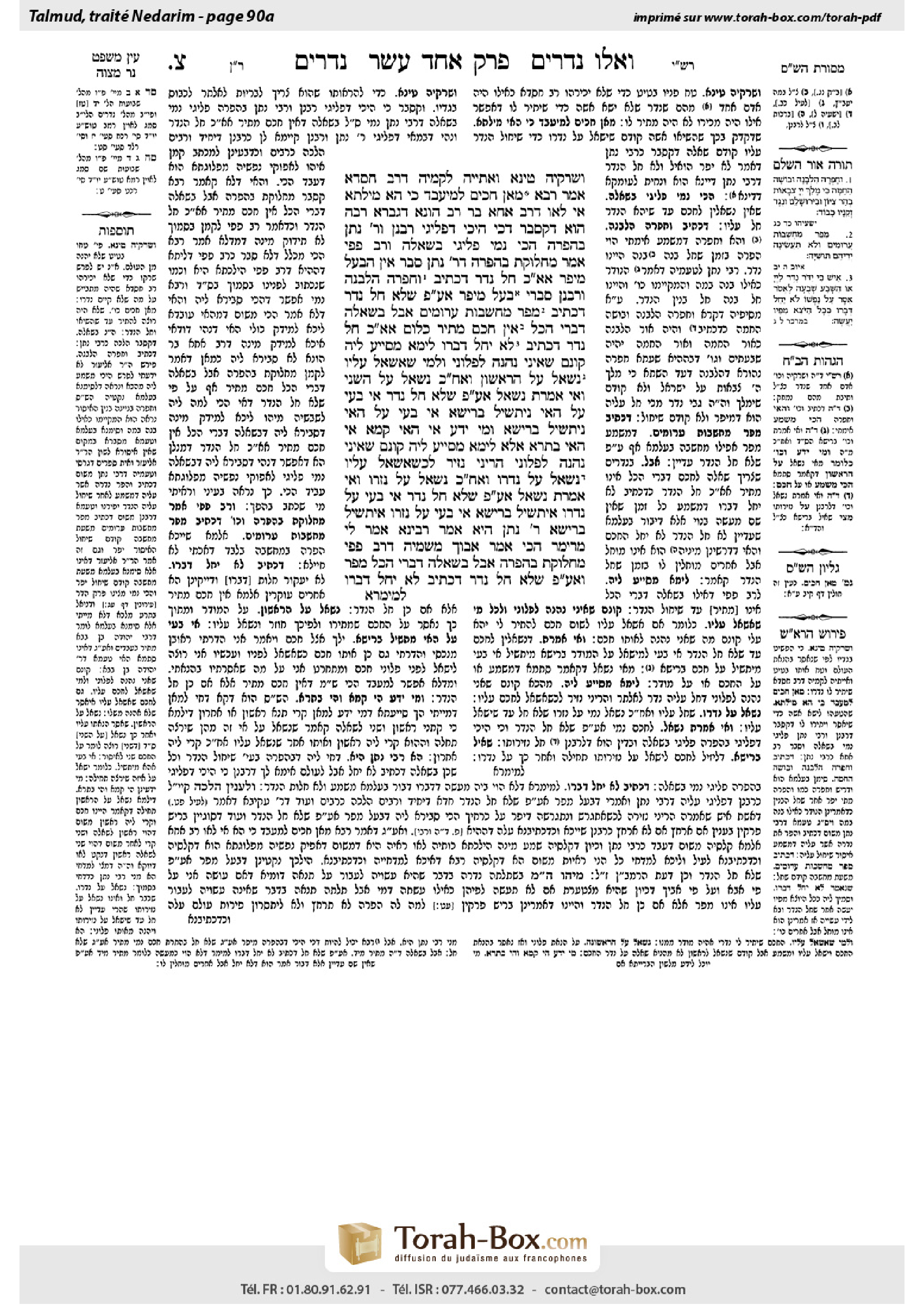
Nedarim 90a: Talmud study for Daf Yomi
Daf Yomi is the daily study of one Talmud folio. Explore 37 tractates with scans, Hebrew text, Sefaria English and AI-generated French translations where annotated.
Passage selection and English or AI-generated French translation are available where the scan has annotations. Daf Study is independent of Torah-Box and Sefaria.
Browse Nedarim · נדרים · All tractatesNedarim 90a text and translations
This page of Nedarim includes the Aramaic text, an English translation and an AI-generated French translation, alongside the scan above.
נדרים צ׳ א · Aramaic and Hebrew text
וְשַׁרְקֵיהּ טִינָא, וְאַתְיֵיהּ לְקַמֵּיהּ דְּרַב חִסְדָּא. אָמַר רָבָא: מַאן חַכִּים לְמִיעְבַּד כִּי הָא מִילְּתָא אִי לָאו דְּרַב אַחָא בַּר רַב הוּנָא, דְּגַבְרָא רַבָּה הוּא. דְּקָסָבַר דְּכִי הֵיכִי דִּפְלִיגִי רַבָּנַן וְרַבִּי נָתָן בַּהֲפָרָה — הָכִי נָמֵי פְּלִיגִי בִּשְׁאֵלָה.
וְרַב פַּפִּי אָמַר: מַחֲלוֹקֶת בַּהֲפָרָה, דְּרַבִּי נָתָן סָבַר: אֵין הַבַּעַל מֵיפֵר אֶלָּא אִם כֵּן חָל נֶדֶר, דִּכְתִיב: ״וְחָפְרָה הַלְּבָנָה״. וְרַבָּנַן סָבְרִי: בַּעַל מֵיפֵר אַף עַל פִּי שֶׁלֹּא חָל נֶדֶר, דִּכְתִיב: ״מֵפֵר מַחְשְׁבוֹת עֲרוּמִים״.
אֲבָל בִּשְׁאֵלָה — דִּבְרֵי הַכֹּל אֵין חָכָם מַתִּיר כְּלוּם אֶלָּא אִם כֵּן חָל נֶדֶר, דִּכְתִיב: ״לֹא יַחֵל דְּבָרוֹ״.
לֵימָא מְסַיַּיע לֵיהּ: ״קֻוֽנָּם שֶׁאֵינִי נֶהֱנֶה לִפְלוֹנִי, וּלְמִי שֶׁאֶשָּׁאֵל עָלָיו״ — נִשְׁאָל עַל הָרִאשׁוֹן, וְאַחַר כָּךְ נִשְׁאָל עַל הַשֵּׁנִי. וְאִי אָמְרַתְּ נִשְׁאָל אַף עַל פִּי שֶׁלֹּא חָל נֶדֶר, אִי בָּעֵי — עַל הַאי נִיתְּשִׁיל בְּרֵישָׁא, אִי בָּעֵי — עַל הַאי נִיתְּשִׁיל בְּרֵישָׁא.
וּמִי יָדַע אִי הַאי קַמָּא אִי הַאי בָּתְרָא?
אֶלָּא לֵימָא מְסַיַּיע לֵיהּ: ״קֻוֽנָּם שֶׁאֵינִי נֶהֱנֶה לִפְלוֹנִי, הֲרֵינִי נָזִיר לִכְשֶׁאֶשָּׁאֵל עָלָיו״ — נִשְׁאָל עַל נִדְרוֹ, וְאַחַר כָּךְ נִשְׁאָל עַל נִזְרוֹ.
וְאִי אָמְרַתְּ נִשְׁאָל אַף עַל פִּי שֶׁלֹּא חָל נֶדֶר, אִי בָּעֵי — עַל נִדְרוֹ אִיתְּשִׁיל בְּרֵישָׁא, אִי בָּעֵי — עַל נִזְרוֹ אִיתְּשִׁיל בְּרֵישָׁא! רַבִּי נָתָן הִיא.
אָמַר רָבִינָא: אָמַר לִי מָרִימָר, הָכִי אֲמַר אֲבוּךְ מִשְּׁמֵיהּ דְּרַב פַּפִּי: מַחֲלוֹקֶת בַּהֲפָרָה, אֲבָל בִּשְׁאֵלָה — דִּבְרֵי הַכֹּל מֵפֵר וְאַף עַל פִּי שֶׁלֹּא חָל נֶדֶר, דִּכְתִיב ״לֹא יַחֵל דְּבָרוֹ״.
Nedarim 90a · English translation
And Rav Aḥa bar Rav Huna then smeared him with clay to protect him from the elements, as it was now prohibited for him to benefit from the world by wearing clothes. And he then brought him before Rav Ḥisda, to dissolve his vow. Rava said: Who is wise enough to act in this manner, if not Rav Aḥa bar Rav Huna, who is a great man? As he holds that just as the Rabbis and Rabbi Natan disagree with regard to nullification, whether it is possible to nullify a vow that has yet to take effect, so too, they disagree with regard to a request made to a halakhic authority to dissolve a vow, whether it is possible to request dissolution of such a vow. Rav Aḥa bar Rav Huna’s plan was to have the vow go into effect, so that the man could request that it be dissolved.
And Rav Pappi said with regard to this issue: The dispute between Rabbi Natan and the Rabbis is with regard to nullification only, as Rabbi Natan holds that a husband can nullify a vow only once the vow has taken effect, as it is written: “And the moon shall be confounded [ḥafera]” (Isaiah 24:23). He employs this phrase as an allusion, interpreting the word ḥafera as if it were hafara, nullification, and concludes from here that only a vow that already exists, like the moon, can be nullified. And the Rabbis hold that a husband can nullify a vow even though the vow has not yet taken effect, as it is written: “He nullifies the thoughts of the crafty” (Job 5:12), implying that nullification pertains even to thoughts, to prevent them from going into effect.
But with regard to a request made to a halakhic authority to dissolve a vow, everyone, both Rabbi Natan and the Rabbis, agrees that a halakhic authority cannot dissolve anything unless the vow has already taken effect, as it is written: “He shall not profane his word” (Numbers 30:3), which indicates that the person himself who took the vow cannot profane his words and dissolve his vow, but a halakhic authority may do so. This, however, applies only if the vow has already gone into effect, as it says: “His word.”
The Gemara suggests: Let us say that the following baraita supports Rav Pappi’s opinion: If one says: The property of so-and-so is konam for me, and for that reason I will not benefit from it, and deriving benefit from he who I will request dissolution for the vow is also konam for me, then, if he desires to dissolve the vows he must first request dissolution with regard to the first vow, and afterward he can request dissolution with regard to the second. And if you say that one can request dissolution of a vow even though the vow has not yet taken effect, why must he request dissolution of his two vows in the above order? If he so wishes, he can first request dissolution with regard to this vow, and if he wishes, he can first request dissolution with regard to that one.
The Gemara refutes this argument: And does he know if this vow is first or if that vow is last? The baraita does not specify which vow is first and which is last. Perhaps first and last is referring not to the order in which the two vows were taken, but rather to the order in which they are dissolved, so that if he so wishes, he can first request dissolution of the vow not to derive benefit from the halakhic authority from whom he will request dissolution of his vow.
Rather, let us say that a different baraita supports Rav Pappi’s opinion: If one says: The property of so-and-so is konam for me, and for that reason I will not benefit from it, and I am hereby a nazirite for when I will request dissolution of this vow, if he desires to dissolve the vows he must first request dissolution with regard to his vow not to derive benefit from a particular person, and afterward he can request dissolution with regard to his vow of naziriteship that he accepted upon himself should he request dissolution of his first vow.
And if you say that one can request dissolution of a vow even though the vow has not yet taken effect, why must the two vows be dissolved in that order? If he so wishes, he can first request dissolution with regard to his vow not to derive benefit from that other person, and if he wishes, he can first request dissolution with regard to his vow of naziriteship. The Gemara rejects this argument: This is no proof, as it is possible that the baraita is taught in accordance with the opinion of Rabbi Natan, who maintains that a vow can be nullified only after it has gone into effect. The Rabbis, however, dispute this view.
Ravina said: Mareimar said to me: This is what your father said in the name of Rav Pappi: The dispute between Rabbi Natan and the Rabbis is with regard to nullification only, as Rabbi Natan holds that a husband can nullify a vow only once the vow has taken effect, whereas the Rabbis hold that a husband can nullify a vow even though the vow has not yet taken effect. But with regard to a request made to a halakhic authority to dissolve a vow, everyone, both Rabbi Natan and the Rabbis, agrees, that he can dissolve the vow even though the vow has not yet taken effect. As it is written: “He shall not profane his word” (Numbers 30:3), which Ravina expounds as follows:
Nedarim 90a · Traduction française (IA)
Rav Aḥa bar Rav Huna l’enduisit alors d’argile afin de le protéger des intempéries, car il lui était désormais interdit de tirer profit du monde en portant des vêtements. Puis il le conduisit devant Rav Ḥisda pour qu’il délie son vœu. Rava dit : « Qui aurait été assez sage pour agir ainsi, sinon Rav Aḥa bar Rav Huna, qui est un grand homme ? » Il estime en effet que, de même que les Rabbins et Rabbi Natan sont en désaccord au sujet de l’annulation — à savoir s’il est possible d’annuler un vœu qui n’a pas encore pris effet —, ils sont également en désaccord au sujet d’une demande adressée à une autorité halakhique pour délier un vœu : peut-on demander la dissolution d’un vœu qui n’a pas encore pris effet ? Le plan de Rav Aḥa bar Rav Huna consistait à faire prendre effet au vœu afin que l’homme puisse demander qu’il soit délié.
Rav Pappi dit à propos de cette question : Le désaccord entre Rabbi Natan et les Rabbins ne porte que sur l’annulation. Rabbi Natan estime qu’un mari ne peut annuler un vœu qu’une fois que celui-ci a pris effet, ainsi qu’il est écrit : « Et la lune sera confondue [ḥafera] » (Isaïe 24:23). Il emploie cette expression comme une allusion, interprétant le mot ḥafera comme s’il s’agissait de hafara, « annulation », et en déduit que seul un vœu qui existe déjà, comme la lune, peut être annulé. Les Rabbins, eux, estiment qu’un mari peut annuler un vœu même si celui-ci n’a pas encore pris effet, ainsi qu’il est écrit : « Il déjoue les desseins des hommes rusés » (Job 5:12), ce qui implique que l’annulation peut concerner même de simples pensées, afin d’empêcher qu’elles ne prennent effet.
Mais, lorsqu’il s’agit d’une demande adressée à une autorité halakhique pour délier un vœu, tous, Rabbi Natan comme les Rabbins, conviennent qu’une autorité halakhique ne peut rien délier tant que le vœu n’a pas déjà pris effet, ainsi qu’il est écrit : « Il ne profanera pas sa parole » (Nombres 30:3). Cela indique que celui qui a prononcé le vœu ne peut pas lui-même profaner sa parole et délier son vœu, mais qu’une autorité halakhique peut le faire. Toutefois, cela ne s’applique que si le vœu a déjà pris effet, comme le montre l’expression « sa parole ».
La Guemara propose : Disons que la baraïta suivante appuie l’opinion de Rav Pappi : si quelqu’un dit : « Les biens d’untel me sont konam, et, pour cette raison, je n’en tirerai aucun profit », puis ajoute : « Tirer profit de celui auprès duquel je demanderai la dissolution du vœu me sera également interdit », alors, s’il souhaite faire délier ses vœux, il doit d’abord demander la dissolution du premier vœu, puis celle du second. Et si l’on dit qu’il est possible de demander la dissolution d’un vœu même avant qu’il ait pris effet, pourquoi doit-il faire délier ses deux vœux dans l’ordre indiqué ? S’il le souhaite, il peut d’abord demander la dissolution de ce vœu et, s’il le souhaite, commencer par l’autre.
La Guemara réfute cet argument : sait-il lequel de ces vœux est le premier et lequel est le dernier ? La baraïta ne précise pas lequel des deux vœux a été prononcé en premier ni lequel l’a été en dernier. Peut-être que « premier » et « dernier » ne désignent pas l’ordre dans lequel les deux vœux ont été prononcés, mais plutôt l’ordre dans lequel ils sont déliés. Ainsi, s’il le souhaite, il peut d’abord demander la dissolution du vœu de ne pas tirer profit de l’autorité halakhique auprès de laquelle il demandera la dissolution de son vœu.
Disons plutôt qu’une autre baraïta appuie l’opinion de Rav Pappi : si quelqu’un dit : « Les biens d’untel me sont konam, et, pour cette raison, je n’en tirerai aucun profit ; et je fais vœu de naziréat pour le moment où je demanderai la dissolution de ce vœu », alors, s’il souhaite faire délier ses vœux, il doit d’abord demander la dissolution de son vœu de ne pas tirer profit d’une personne en particulier, puis celle de son vœu de naziréat, qu’il a contracté au cas où il demanderait la dissolution de son premier vœu.
Et si l’on dit qu’il est possible de demander la dissolution d’un vœu même avant qu’il ait pris effet, pourquoi faut-il délier les deux vœux dans cet ordre ? S’il le souhaite, il peut d’abord demander la dissolution de son vœu de ne pas tirer profit de cette autre personne et, s’il le souhaite, commencer par celle de son vœu de naziréat. La Guemara rejette cet argument : cela ne prouve rien, car il est possible que la baraïta ait été enseignée selon l’opinion de Rabbi Natan, qui soutient qu’un vœu ne peut être annulé qu’après avoir pris effet. Les Rabbins contestent toutefois cette opinion.
Ravina dit : « Mareimar m’a dit : Voici ce que ton père a dit au nom de Rav Pappi : Le désaccord entre Rabbi Natan et les Rabbins ne porte que sur l’annulation. Rabbi Natan estime qu’un mari ne peut annuler un vœu qu’une fois que celui-ci a pris effet, tandis que les Rabbins estiment qu’un mari peut annuler un vœu même si celui-ci n’a pas encore pris effet. Mais, lorsqu’il s’agit d’une demande adressée à une autorité halakhique pour délier un vœu, tous, Rabbi Natan comme les Rabbins, conviennent qu’elle peut délier le vœu même avant qu’il ait pris effet. Ainsi qu’il est écrit : “Il ne profanera pas sa parole” (Nombres 30:3), ce que Ravina interprète comme suit :»
Traduction française générée par IA à partir de l’édition anglaise de Sefaria. Vérifie toujours un passage avec le texte source.
Text from Sefaria: William Davidson Edition - Vocalized Aramaic (CC BY NC); William Davidson Edition - English (CC BY NC).