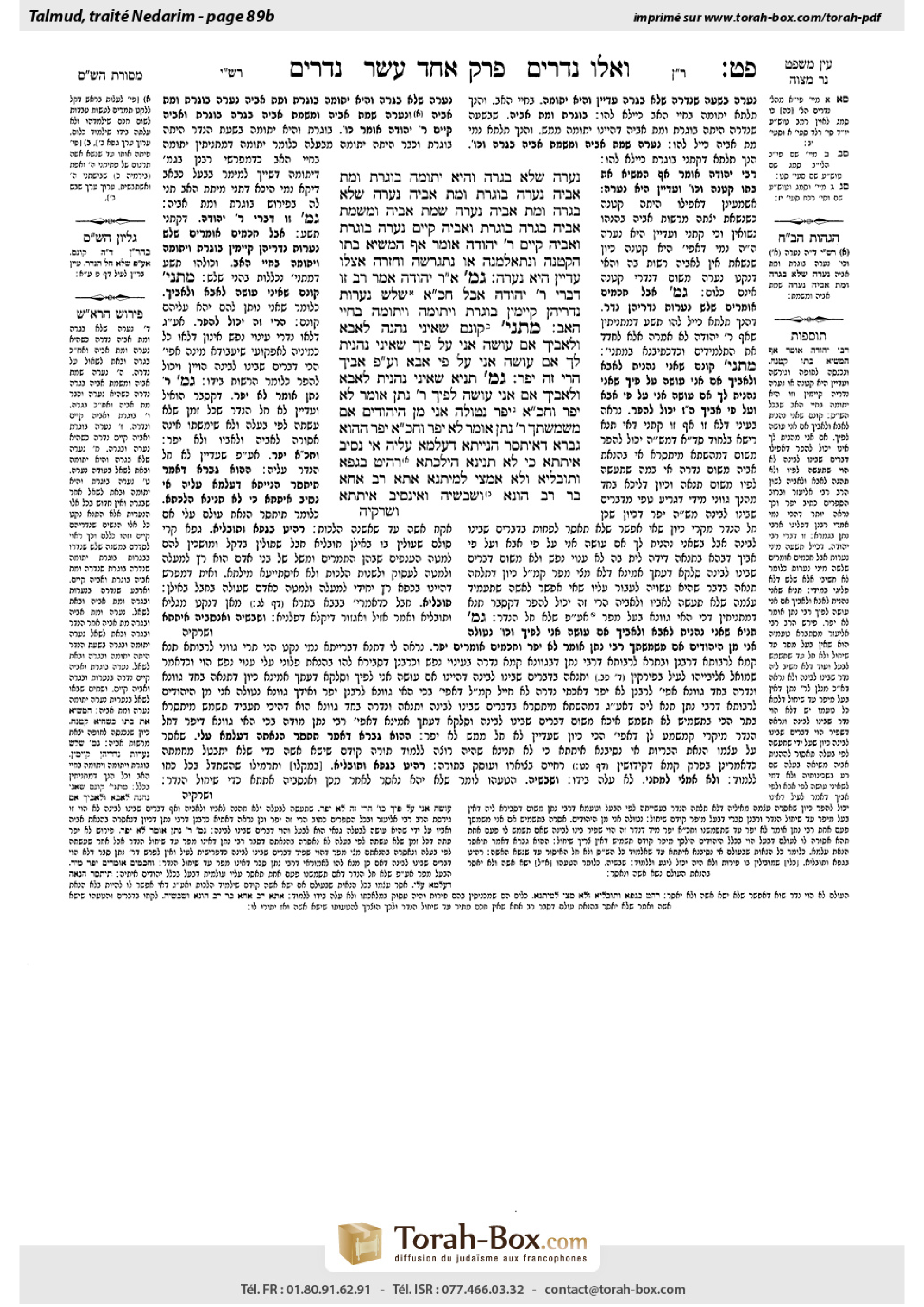
Nedarim 89b: Talmud study for Daf Yomi
Daf Yomi is the daily study of one Talmud folio. Explore 37 tractates with scans, Hebrew text, Sefaria English and AI-generated French translations where annotated.
Passage selection and English or AI-generated French translation are available where the scan has annotations. Daf Study is independent of Torah-Box and Sefaria.
Browse Nedarim · נדרים · All tractatesNedarim 89b text and translations
This page of Nedarim includes the Aramaic text, an English translation and an AI-generated French translation, alongside the scan above.
נדרים פ״ט ב · Aramaic and Hebrew text
נַעֲרָה שֶׁלֹּא בָּגְרָה וְהִיא יְתוֹמָה. בּוֹגֶרֶת וּמֵת אָבִיהָ. נַעֲרָה בּוֹגֶרֶת וּמֵת אָבִיהָ. נַעֲרָה שֶׁלֹּא בָּגְרָה וּמֵת אָבִיהָ. נַעֲרָה שֶׁמֵּת אָבִיהָ וּמִשֶּׁמֵּת אָבִיהָ בָּגְרָה. בּוֹגֶרֶת וְאָבִיהָ קַיָּים. נַעֲרָה בּוֹגֶרֶת וְאָבִיהָ קַיָּים. רַבִּי יְהוּדָה אוֹמֵר: אַף הַמַּשִּׂיא בִּתּוֹ הַקְּטַנָּה וְנִתְאַלְמְנָה אוֹ נִתְגָּרְשָׁה וְחָזְרָה אֶצְלוֹ — עֲדַיִין הִיא נַעֲרָה.
גְּמָ׳ אָמַר רַב יְהוּדָה אָמַר רַב: זוֹ דִּבְרֵי רַבִּי יְהוּדָה. אֲבָל חֲכָמִים אוֹמְרִים, שָׁלֹשׁ נְעָרוֹת נִדְרֵיהֶן קַיָּימִין: בּוֹגֶרֶת, וִיתוֹמָה, וִיתוֹמָה בְּחַיֵּי הָאָב.
מַתְנִי׳ ״קֻוֽנָּם שֶׁאֵינִי נֶהֱנֶה לְאַבָּא וּלְאָבִיךָ אִם עוֹשָׂה אֲנִי עַל פִּיךָ״, ״שֶׁאֵינִי נֶהֱנֵית לְךָ אִם עוֹשָׂה אֲנִי עַל פִּי אַבָּא וְעַל פִּי אָבִיךָ״ — הֲרֵי זֶה יָפֵר.
גְּמָ׳ תַּנְיָא: ״שֶׁאֵינִי נֶהֱנֵית לְאַבָּא וּלְאָבִיךְ אִם אֲנִי עוֹשָׂה לְפִיךָ״, רַבִּי נָתָן אוֹמֵר: לֹא יָפֵר. וַחֲכָמִים אוֹמְרִים: יָפֵר.
״נְטוּלָה אֲנִי מִן הַיְּהוּדִים אִם מְשַׁמַּשְׁתֶּךָ״, רַבִּי נָתָן אוֹמֵר: לֹא יָפֵר. וַחֲכָמִים אוֹמְרִים: יָפֵר.
הָהוּא גַּבְרָא דְּאִיתְּסַר הֲנָיָיתָא דְּעָלְמָא עֲלֵיהּ אִי נָסֵיב אִיתְּתָא כִּי לָא תָּנֵינָא הִילְכְתָא. רָהֵיט בְּגַפָּא וְתוּבַלְיָא וְלָא אִמְּצִי לְמִיתְנֵא. אֲתָא רַב אַחָא בַּר רַב הוּנָא וְשַׁבְּשֵׁיהּ וְאִינְּסִיב אִיתְּתָא,
Nedarim 89b · English translation
if she took a vow when she was a young woman who had not yet reached her majority, and she is an orphan; if she took a vow when she was a grown woman and her father died; if she took a vow when she was a young woman, and she became a grown woman, and her father died; if she took a vow when she was a young woman who had not reached her majority, and her father died; if she took a vow when she was a young woman, and her father died, and after her father died she reached her majority; if she took a vow when she was a grown woman and her father is still alive; and if she took a vow when she was a young woman, and she became a grown woman, and her father is still alive. Rabbi Yehuda says: With regard to even one who married off his minor daughter, and she was widowed or divorced and she returned to him, and according to her age she still is in the category of a young woman, her vows cannot be nullified.
GEMARA: Rav Yehuda said that Rav said: This mishna is the statement of Rabbi Yehuda, who spelled out all the cases and listed nine young women whose vows are upheld. But the Rabbis say that it is unnecessary to go into such detail. Instead, they simply said: There are three young women whose vows are upheld and cannot be nullified: A grown woman, and an orphan, and an orphan in her father’s lifetime, i.e., a young woman who was divorced or widowed while her father was still alive and is considered an orphan in that her father no longer has jurisdiction over her.
MISHNA: If a woman said to her husband: Deriving benefit from my father or from your father is konam for me if I will prepare anything for you; or if she said: Deriving benefit from you is konam for me if I will prepare anything for my father or for your father, the husband can nullify this vow.
GEMARA: It is taught in a baraita: If a woman said to her husband: Deriving benefit from my father or from your father is konam for me if I will prepare anything for you, Rabbi Natan says her husband cannot nullify the vow. She must prepare food for him, as she is obligated to do so by virtue of their being married, and it is prohibited for her to benefit from their respective fathers. The husband cannot nullify a vow that has not yet taken effect and that depends on the fulfillment of a certain condition. And the Rabbis say that even in such a case he can nullify her vow.
The baraita continues: If the woman said to her husband: I am removed from the Jews, i.e., the benefit of my engaging in sexual intercourse will be forbidden to all Jews, if I engage in sexual intercourse with you, Rabbi Natan says he cannot nullify the vow. Rather, she must engage in sexual intercourse with her husband, as she is obligated to do so by virtue of their marriage, and she will be forbidden to all other Jews. And the Rabbis say he can nullify her vow.
§ It is related that there was a certain man who took a vow that all benefit from the world should be forbidden to him if he marries a woman when he has not yet learned halakha. He would run up a ladder and rope but was not able to learn the material, i.e., despite all his efforts he failed in his studies. Rav Aḥa bar Rav Huna came and misled him, allowing him to understand that even if he took a vow, the vow would not take effect, and so he married a woman.
Nedarim 89b · Traduction française (IA)
si elle a fait un vœu alors qu’elle était une jeune fille qui n’avait pas encore atteint la majorité et qu’elle est orpheline ; si elle a fait un vœu alors qu’elle était majeure et que son père est mort ; si elle a fait un vœu alors qu’elle était jeune fille, puis qu’elle est devenue majeure et que son père est mort ; si elle a fait un vœu alors qu’elle était une jeune fille qui n’avait pas encore atteint la majorité et que son père est mort ; si elle a fait un vœu alors qu’elle était jeune fille, que son père est mort, puis qu’elle a atteint la majorité après sa mort ; si elle a fait un vœu alors qu’elle était majeure et que son père est encore en vie ; et si elle a fait un vœu alors qu’elle était jeune fille, qu’elle est devenue majeure et que son père est encore en vie. Rabbi Yehouda dit : même dans le cas d’une jeune fille mineure que son père a mariée, qui est devenue veuve ou a été répudiée, puis est revenue chez lui, et qui, compte tenu de son âge, relève encore de la catégorie des jeunes filles, ses vœux ne peuvent pas être annulés.
GUEMARA : Rav Yehouda a dit au nom de Rav : Cette Michna est l’opinion de Rabbi Yehouda, qui a détaillé tous les cas et énuméré neuf jeunes femmes dont les vœux sont maintenus. Mais, selon les Rabbins, il n’est pas nécessaire d’entrer dans de telles précisions. Ils ont simplement dit : Il y a trois jeunes femmes dont les vœux sont maintenus et ne peuvent être annulés : une femme majeure, une orpheline et une orpheline du vivant de son père, c’est-à-dire une jeune femme qui a été répudiée ou est devenue veuve alors que son père était encore en vie, et qui est considérée comme orpheline parce que son père n’a plus autorité sur elle.
MICHNA : Si une femme dit à son mari : « Tirer profit de mon père ou de ton père me sera interdit comme konam si je te prépare quoi que ce soit » ; ou si elle dit : « Tirer profit de toi me sera interdit comme konam si je prépare quoi que ce soit pour mon père ou pour ton père », le mari peut annuler ce vœu.
GUEMARA : Il est enseigné dans une baraïta : Si une femme dit à son mari : « Tirer profit de mon père ou de ton père me sera interdit comme konam si je te prépare quoi que ce soit », Rabbi Natan dit que son mari ne peut pas annuler le vœu. Elle doit lui préparer de la nourriture, car le mariage l’y oblige, et il lui est interdit de tirer profit de leurs pères respectifs. Le mari ne peut pas annuler un vœu qui n’est pas encore entré en vigueur et dont la prise d’effet dépend de la réalisation d’une condition. Les Rabbins disent que, même dans un tel cas, il peut annuler son vœu.
La baraïta poursuit : Si la femme dit à son mari : « Je suis interdite aux Juifs », c’est-à-dire que tous les Juifs ne pourront pas tirer profit de mes relations sexuelles, « si j’ai des relations sexuelles avec toi », Rabbi Natan dit qu’il ne peut pas annuler le vœu. Elle doit plutôt avoir des relations sexuelles avec son mari, car le mariage l’y oblige, et elle sera interdite à tous les autres Juifs. Les Rabbins disent qu’il peut annuler son vœu.
§ Il est rapporté qu’un homme avait fait le vœu que tout profit tiré du monde lui soit interdit s’il épousait une femme avant d’avoir appris la halakha. Il courait sur une échelle et une corde, mais ne parvenait pas à apprendre la matière ; autrement dit, malgré tous ses efforts, il échouait dans ses études. Rav Aḥa bar Rav Huna vint et le trompa, lui faisant croire que même s’il avait fait un vœu, celui-ci ne prendrait pas effet ; l’homme épousa donc une femme.
Traduction française générée par IA à partir de l’édition anglaise de Sefaria. Vérifie toujours un passage avec le texte source.
Text from Sefaria: William Davidson Edition - Vocalized Aramaic (CC BY NC); William Davidson Edition - English (CC BY NC).