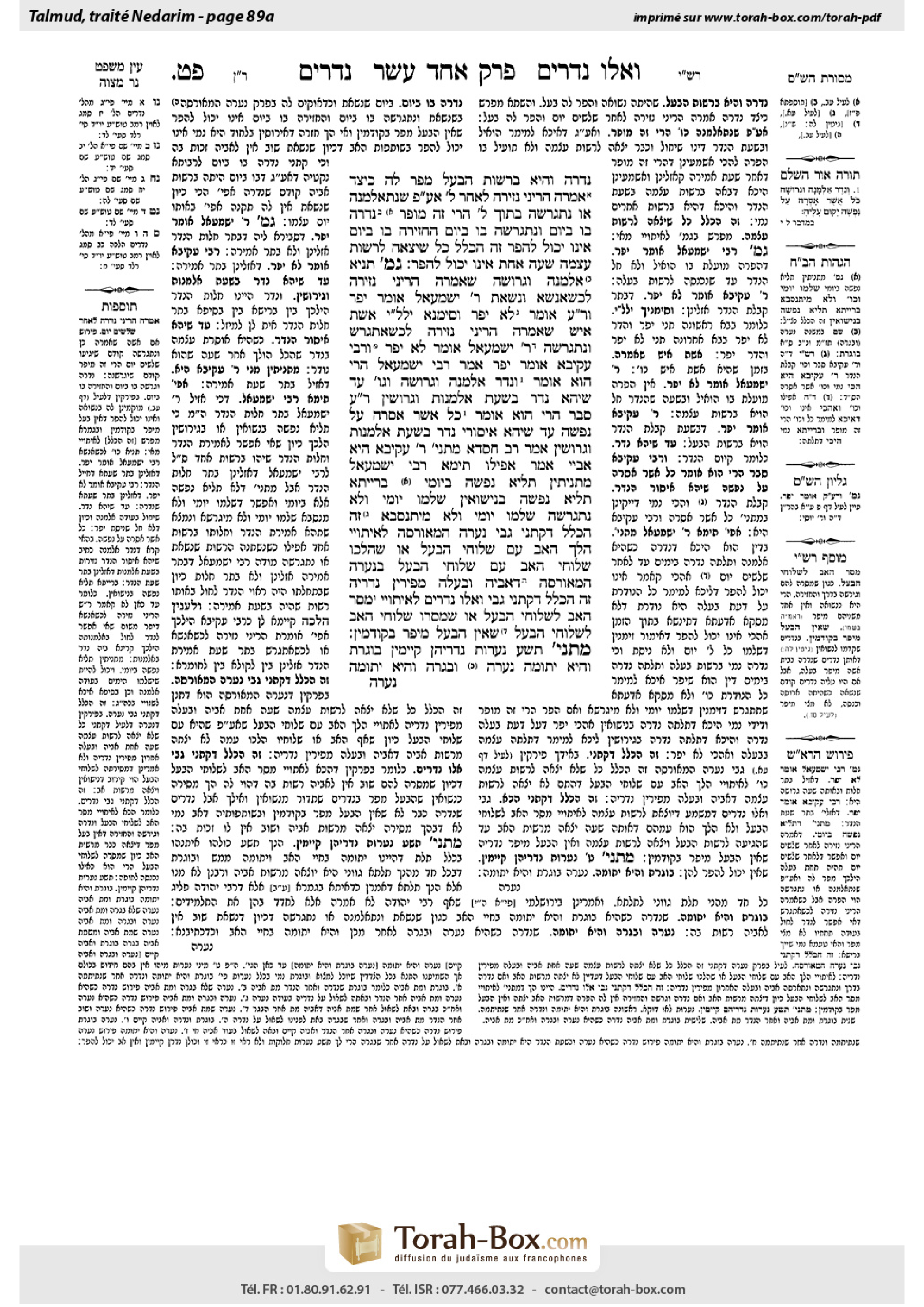
Nedarim 89a: Talmud study for Daf Yomi
Daf Yomi is the daily study of one Talmud folio. Explore 37 tractates with scans, Hebrew text, Sefaria English and AI-generated French translations where annotated.
Passage selection and English or AI-generated French translation are available where the scan has annotations. Daf Study is independent of Torah-Box and Sefaria.
Browse Nedarim · נדרים · All tractatesNedarim 89a text and translations
This page of Nedarim includes the Aramaic text, an English translation and an AI-generated French translation, alongside the scan above.
נדרים פ״ט א · Aramaic and Hebrew text
נָדְרָה וְהִיא בִּרְשׁוּת הַבַּעַל — מֵפֵר לָהּ. כֵּיצַד? אָמְרָה ״הֲרֵינִי נְזִירָה לְאַחַר שְׁלֹשִׁים״, אַף עַל פִּי שֶׁנִּתְאַלְמְנָה אוֹ נִתְגָּרְשָׁה בְּתוֹךְ שְׁלֹשִׁים — הֲרֵי זֶה מוּפָר. נָדְרָה בּוֹ בַּיּוֹם וְנִתְגָּרְשָׁה בּוֹ בַּיּוֹם, הֶחְזִירָה בּוֹ בְּיוֹם — אֵינוֹ יָכוֹל לְהָפֵר. זֶה הַכְּלָל: כׇּל שֶׁיָּצְאָה לִרְשׁוּת עַצְמָהּ שָׁעָה אַחַת — אֵינוֹ יָכוֹל לְהָפֵר.
גְּמָ׳ תַּנְיָא: אַלְמָנָה וּגְרוּשָׁה שֶׁאָמְרָה ״הֲרֵינִי נְזִירָה לִכְשֶׁאִנָּשֵׂא״ וְנִשֵּׂאת, רַבִּי יִשְׁמָעֵאל אוֹמֵר: יָפֵר, וְרַבִּי עֲקִיבָא אוֹמֵר: לֹא יָפֵר. וְסִימָנָא: יְלֵלִי. אֵשֶׁת אִישׁ שֶׁאָמְרָה ״הֲרֵינִי נְזִירָה לִכְשֶׁאֶתְגָּרֵשׁ״ וְנִתְגָּרְשָׁה, רַבִּי יִשְׁמָעֵאל אוֹמֵר: לֹא יָפֵר, וְרַבִּי עֲקִיבָא אוֹמֵר: יָפֵר.
אָמַר רַבִּי יִשְׁמָעֵאל: הֲרֵי הוּא אוֹמֵר ״וְנֵדֶר אַלְמָנָה וּגְרוּשָׁה וְגוֹ׳״, עַד שֶׁיְּהֵא נֶדֶר בִּשְׁעַת אַלְמָנוּת וְגֵרוּשִׁין. רַבִּי עֲקִיבָא סָבַר: הֲרֵי הוּא אוֹמֵר ״כֹּל אֲשֶׁר אָסְרָה עַל נַפְשָׁהּ״, עַד שֶׁיְּהֵא אִיסּוּרֵי נֶדֶר בִּשְׁעַת אַלְמָנוּת וְגֵרוּשִׁין.
אָמַר רַב חִסְדָּא: מַתְנִיתִין — רַבִּי עֲקִיבָא הִיא. אַבָּיֵי אָמַר: אֲפִילּוּ תֵּימָא רַבִּי יִשְׁמָעֵאל, מַתְנִיתִין תָּלְיָא נַפְשַׁהּ בְּיוֹמֵי, בָּרַיְיתָא תָּלְיָא נַפְשַׁהּ בְּנִישּׂוּאִין.
שָׁלְמוּ יוֹמֵי וְלָא נִתְגָּרְשָׁה, שָׁלְמוּ יוֹמֵי וְלָא מִיתְנַסְבָא.
״זֶה הַכְּלָל״ דְּקָתָנֵי גַּבֵּי ״נַעֲרָה הַמְאוֹרָסָה״ — לְאֵיתוֹיֵי הָלַךְ הָאָב עִם שְׁלוּחֵי הַבַּעַל אוֹ שֶׁהָלְכוּ שְׁלוּחֵי הָאָב עִם שְׁלוּחֵי הַבַּעַל, בְּנַעֲרָה הַמְאוֹרָסָה, דְּאָבִיהָ וּבַעְלָהּ מְפִירִין נְדָרֶיהָ.
״זֶה הַכְּלָל״ דְּקָתָנֵי גַּבֵּי ״וְאֵלּוּ נְדָרִים״, לְאֵיתוֹיֵי מָסַר הָאָב לִשְׁלוּחֵי הַבַּעַל אוֹ שֶׁמָּסְרוּ שְׁלוּחֵי הָאָב לִשְׁלוּחֵי הַבַּעַל, שֶׁאֵין הַבַּעַל מֵיפֵר בַּקּוֹדְמִין.
מַתְנִי׳ תֵּשַׁע נְעָרוֹת נִדְרֵיהֶן קַיָּימִין: בּוֹגֶרֶת וְהִיא יְתוֹמָה. נַעֲרָה וּבָגְרָה וְהִיא יְתוֹמָה.
Nedarim 89a · English translation
If she took a vow while she was under the jurisdiction of her husband, he can nullify the vow for her. How so? If she said when she was still married: I am hereby a nazirite for after thirty days, and her husband nullified the vow, then even if she was widowed or divorced within the thirty-day period, the vow is nullified. If she took a vow on that, i.e., one, day and was divorced on that same day, then even if her husband took her back as his wife on that same day, he cannot nullify her previous vows. This is the principle: Once she has left and gone into her own jurisdiction for even a single hour, then after they are remarried her husband can no longer nullify any vow she uttered during their first marriage.
GEMARA: It is taught in a baraita: With regard to a widow or a divorcée who said: I am hereby a nazirite for when I will get married, and she was married, Rabbi Yishmael says her husband can nullify her vow, whereas Rabbi Akiva says he cannot nullify it. And the mnemonic device for the opinions of Rabbi Yishmael and Rabbi Akiva with regard to this halakha and the following one is the Hebrew acronym yod, lamed, lamed, yod: Yafer, lo yafer; lo yafer, yafer, i.e., he can nullify, he cannot nullify; he cannot nullify, he can nullify. As for a married woman who said while she was married: I am hereby a nazirite for when I will get divorced, and she was divorced, Rabbi Yishmael says her husband cannot nullify her vow, whereas Rabbi Akiva says he can nullify it.
Rabbi Yishmael said: It says: “But every vow of a widow, and of her that is divorced…shall be upheld against her” (Numbers 30:10), which means that the practical application of the vow must be in the time of the woman’s widowhood or divorce. Only when the vow is to take effect when she is a widow or a divorcée shall it be upheld against her, since then it is impossible to nullify. Rabbi Akiva, by contrast, maintains: It says: “But every vow…with which she has bound her soul, shall be upheld against her,” which means that the binding of the vow, i.e., the taking of the vow creating the prohibition, must be at the time of the woman’s widowhood or divorce.
Rav Ḥisda said: The mishna that links the possibility of nullification to the time of the taking of the vow is the opinion of Rabbi Akiva. Abaye said: Even if you say that the mishna follows the opinion of Rabbi Yishmael, there is no difficulty, for the mishna is referring to a woman who made her vow dependent on days, i.e., she specified that the vow should take effect after a fixed period of time. By contrast, the baraita is referring to a woman who made her vow dependent on marriage.
In the case of the baraita, since the woman explicitly connected the application of her vow to her marital status, the possibility of nullifying the vow depends on the time that the vow takes effect. But in the case of the mishna, where the application of the vow is tied to a particular date, it is possible that the days will be completed and she was not divorced, or that the days will be completed and she was not married. Since there is no inherent connection between her marriage and the vow, Rabbi Yishmael agrees that the possibility of nullification depends on the time when the vow was pronounced.
§ The mishna in the previous chapter (71a) teaches that as long as a betrothed young woman has not gone out into her own jurisdiction for a single moment, her father and her husband can nullify her vows. The mishna in this chapter teaches the principle in the reverse: If she has gone out for even a single hour, her husband cannot nullify her vows. The Gemara addresses this repetition. The mishna of: This is the principle, which is taught in the chapter called: A betrothed young woman, serves to include a case where the father went with the messengers of the husband after handing over his daughter in marriage and a case where the messengers of the father went with the messengers of the husband. In the case of a betrothed young woman, since the father or his messengers were still with her, she has not yet left her father’s jurisdiction, and nevertheless the mishna teaches that her father and her husband can nullify her vows.
The mishna of: This is the principle, which is taught in this chapter, called: And these are the vows, serves to include a case where the father handed over his daughter to the messengers of the husband, or a case where the messengers of the father handed her over to the messengers of the husband. Although neither the father nor his messengers accompanied her, and therefore she has been fully handed over to her husband, nevertheless, the mishna teaches that the husband cannot nullify previous vows, i.e., vows that preceded their marriage.
MISHNA: There are nine young women whose vows are upheld and cannot be nullified: If she took a vow when she was a grown woman and she is an orphan; if she took a vow when she was a young woman, and has reached her majority, and she is an orphan;
Nedarim 89a · Traduction française (IA)
Si elle a prononcé un vœu alors qu’elle relevait de l’autorité de son mari, celui-ci peut l’annuler pour elle. Comment cela ? Si, alors qu’elle était encore mariée, elle a dit : « Je serai naziréenne à partir de dans trente jours », et que son mari a annulé le vœu, celui-ci est annulé même si elle est devenue veuve ou a été répudiée au cours de ces trente jours. Si elle a prononcé un vœu ce jour-là et a été répudiée le même jour, alors, même si son mari l’a reprise comme épouse ce même jour, il ne peut pas annuler ses vœux antérieurs. Tel est le principe : dès qu’elle a quitté son autorité et est passée sous sa propre autorité, ne serait-ce que pendant une heure, son mari ne peut plus, après leur remariage, annuler aucun vœu qu’elle a prononcé pendant leur premier mariage.
GUEMARA : Il est enseigné dans une baraïta : À propos d’une veuve ou d’une divorcée qui a dit : « Je serai naziréenne lorsque je me marierai », puis s’est mariée, Rabbi Yishmaël dit que son mari peut annuler son vœu, tandis que Rabbi Akiva dit qu’il ne peut pas l’annuler. Le moyen mnémotechnique des opinions de Rabbi Yishmaël et de Rabbi Akiva concernant cette halakha et la suivante est l’acronyme hébreu yod, lamed, lamed, yod : Yafer, lo yafer ; lo yafer, yafer, c’est-à-dire : il peut annuler, il ne peut pas annuler ; il ne peut pas annuler, il peut annuler. Quant à une femme mariée qui a dit, alors qu’elle était mariée : « Je serai naziréenne lorsque je serai répudiée », puis a été répudiée, Rabbi Yishmaël dit que son mari ne peut pas annuler son vœu, tandis que Rabbi Akiva dit qu’il peut l’annuler.
Rabbi Yishmaël a dit : Il est écrit : « Mais tout vœu d’une veuve et d’une femme répudiée… sera maintenu contre elle » (Nombres 30, 10), ce qui signifie que le vœu doit prendre effet pendant que la femme est veuve ou divorcée. Ce n’est que lorsque le vœu doit prendre effet alors qu’elle est veuve ou divorcée qu’il sera maintenu contre elle, puisqu’il est alors impossible de l’annuler. Rabbi Akiva, en revanche, soutient qu’il est écrit : « Mais tout vœu… par lequel elle a lié son âme sera maintenu contre elle », ce qui signifie que l’engagement du vœu, c’est-à-dire le moment où elle le prononce et crée l’interdit, doit avoir lieu alors que la femme est veuve ou divorcée.
Rav Ḥisda a dit : La Michna qui fait dépendre la possibilité d’annuler le vœu du moment où celui-ci a été prononcé exprime l’opinion de Rabbi Akiva. Abayé a dit : Même si tu dis que la Michna suit l’opinion de Rabbi Yishmaël, il n’y a pas de difficulté, car la Michna parle d’une femme qui a fait dépendre son vœu du nombre de jours, c’est-à-dire qu’elle a précisé que le vœu prendrait effet après une période déterminée. La baraïta, en revanche, parle d’une femme qui a fait dépendre son vœu de son mariage.
Dans le cas de la baraïta, puisque la femme a explicitement lié la prise d’effet de son vœu à son statut matrimonial, la possibilité d’annuler le vœu dépend du moment où celui-ci prend effet. Dans le cas de la Michna, en revanche, où la prise d’effet du vœu est liée à une date précise, il est possible que les jours s’écoulent sans qu’elle ait été répudiée, ou sans qu’elle se soit mariée. Puisqu’il n’existe pas de lien intrinsèque entre son mariage et le vœu, Rabbi Yishmaël convient que la possibilité d’annuler dépend du moment où le vœu a été prononcé.
§ La Michna du chapitre précédent (71a) enseigne que tant qu’une jeune fille fiancée n’est pas passée sous sa propre autorité, ne serait-ce qu’un instant, son père et son mari peuvent annuler ses vœux. La Michna de ce chapitre énonce le principe inverse : si elle est passée sous sa propre autorité, ne serait-ce qu’une heure, son mari ne peut pas annuler ses vœux. La Guemara explique cette répétition. La Michna qui énonce « Tel est le principe », dans le chapitre intitulé « La jeune fille fiancée », inclut le cas où le père a accompagné les émissaires du mari après avoir remis sa fille en mariage, ainsi que le cas où les émissaires du père ont accompagné ceux du mari. Dans le cas d’une jeune fille fiancée, puisque son père ou ses émissaires sont encore avec elle, elle n’a pas encore quitté l’autorité de son père ; pourtant, la Michna enseigne que son père et son mari peuvent annuler ses vœux.
La Michna qui énonce « Tel est le principe », dans ce chapitre intitulé « Et voici les vœux », inclut le cas où le père a remis sa fille aux émissaires du mari, ou celui où les émissaires du père l’ont remise aux émissaires du mari. Bien que ni le père ni ses émissaires ne l’aient accompagnée, et qu’elle ait donc été entièrement remise à son mari, la Michna enseigne néanmoins que le mari ne peut pas annuler ses vœux antérieurs, c’est-à-dire les vœux qu’elle a prononcés avant leur mariage.
MICHNA : Il y a neuf jeunes femmes dont les vœux sont maintenus et ne peuvent pas être annulés : si elle a prononcé un vœu alors qu’elle était majeure et qu’elle est orpheline ; si elle a prononcé un vœu alors qu’elle était une jeune fille, qu’elle a atteint sa majorité et qu’elle est orpheline ;
Traduction française générée par IA à partir de l’édition anglaise de Sefaria. Vérifie toujours un passage avec le texte source.
Text from Sefaria: William Davidson Edition - Vocalized Aramaic (CC BY NC); William Davidson Edition - English (CC BY NC).