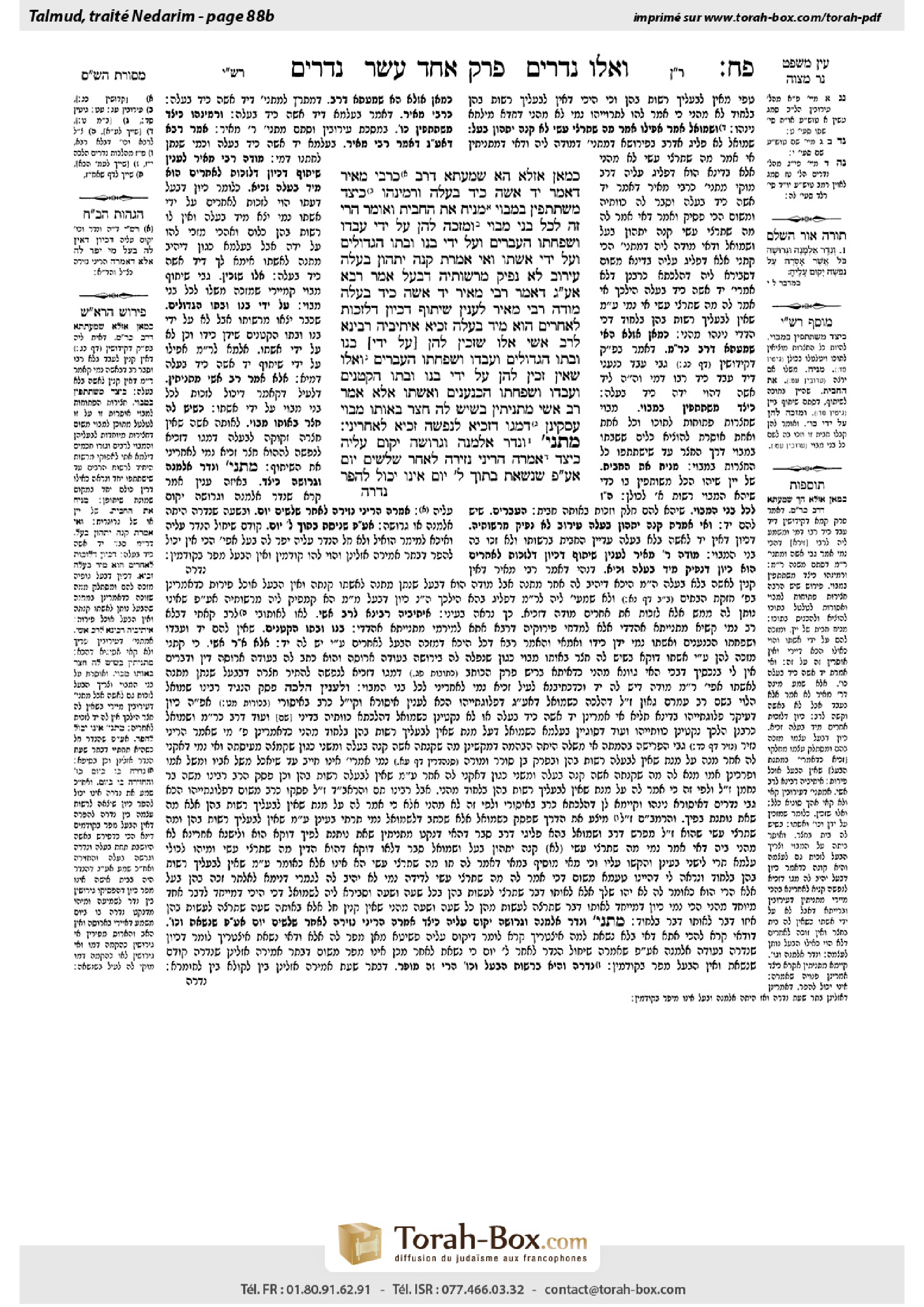
Nedarim 88b: Talmud study for Daf Yomi
Daf Yomi is the daily study of one Talmud folio. Explore 37 tractates with scans, Hebrew text, Sefaria English and AI-generated French translations where annotated.
Passage selection and English or AI-generated French translation are available where the scan has annotations. Daf Study is independent of Torah-Box and Sefaria.
Browse Nedarim · נדרים · All tractatesNedarim 88b text and translations
This page of Nedarim includes the Aramaic text, an English translation and an AI-generated French translation, alongside the scan above.
נדרים פ״ח ב · Aramaic and Hebrew text
כְּמַאן אָזְלָא הָא שְׁמַעְתָּא דְּרַב — כְּרַבִּי מֵאִיר, דְּאָמַר: יַד אִשָּׁה כְּיַד בַּעְלָהּ.
וּרְמִינְהוּ: כֵּיצַד מִשְׁתַּתְּפִין בְּמָבוֹי? מַנִּיחַ אֶת הֶחָבִית וְאוֹמֵר: הֲרֵי זֶה לְכׇל בְּנֵי מָבוֹי. וּמְזַכֶּה לָהֶן עַל יְדֵי עַבְדּוֹ וְשִׁפְחָתוֹ הָעִבְרִים, וְעַל יְדֵי בְּנוֹ וּבִתּוֹ הַגְּדוֹלִים, וְעַל יְדֵי אִשְׁתּוֹ.
וְאִי אָמְרַתְּ קְנָה יָתְהוֹן בַּעְלַהּ, עֵירוּב לָא נָפֵיק מֵרְשׁוּתֵיהּ דְּבַעַל!
אָמַר רָבָא: אַף עַל גַּב דְּאָמַר רַבִּי מֵאִיר יַד אִשָּׁה כְּיַד בַּעְלָהּ, מוֹדֶה רַבִּי מֵאִיר לְעִנְיַן שִׁיתּוּף, דְּכֵיוָן דִּלְזַכּוֹת לַאֲחֵרִים הוּא מִיַּד בַּעְלָהּ — זָכְיָא.
אֵיתִיבֵיהּ רָבִינָא לְרַב אָשֵׁי: אֵלּוּ שֶׁזָּכִין לָהֶן: [עַל יְדֵי] בְּנוֹ וּבִתּוֹ הַגְּדוֹלִים, וְעַבְדּוֹ וְשִׁפְחָתוֹ הָעִבְרִים. וְאֵלּוּ שֶׁאֵין זָכִין לָהֶן: עַל יְדֵי בְּנוֹ וּבִתּוֹ הַקְּטַנִּים, וְעַבְדּוֹ וְשִׁפְחָתוֹ הַכְּנַעֲנִים, וְאִשְׁתּוֹ!
אֶלָּא אָמַר רַב אָשֵׁי: מַתְנִיתִין בְּשֶׁיֵּשׁ לָהּ חָצֵר בְּאוֹתוֹ מָבוֹי עָסְקִינַן, דְּמִגּוֹ דְּזָכְיָא לְנַפְשַׁהּ — זָכְיָא לְאַחֲרִינֵי.
מַתְנִי׳ ״וְנֵדֶר אַלְמָנָה וּגְרוּשָׁהּ יָקוּם עָלֶיהָ״, כֵּיצַד? אָמְרָה ״הֲרֵינִי נְזִירָה לְאַחַר שְׁלֹשִׁים יוֹם״, אַף עַל פִּי שֶׁנִּשֵּׂאת בְּתוֹךְ שְׁלֹשִׁים יוֹם — אֵינוֹ יָכוֹל לְהָפֵר.
Nedarim 88b · English translation
In accordance with whose opinion among the tanna’im does Rav’s halakha correspond? It is in accordance with the opinion of Rabbi Meir, who said as a principle that the hand of a woman is like the hand of her husband. According to Rabbi Meir, a slave has no independent right of acquisition, and anything given to a slave belongs to his master even if it was stipulated otherwise (see Kiddushin 23b). Rav assumes that similarly, a married woman has no independent right of acquisition, but rather, anything that she attempts to acquire for herself is automatically acquired by her husband.
Rabbi Zeira continues: And raise a contradiction from an unattributed mishna (Eiruvin 73b), which presumably follows the opinion of Rabbi Meir: How does one merge the courtyards that open into an alleyway in order to permit its residents to carry on Shabbat from one courtyard to another in the same alley, if a person wishes to act on behalf of all the residents of the alleyway? He places a barrel filled with his own food or wine and says: This is for all the residents of the alleyway. For this gift to be acquired by the others, someone must accept it on their behalf, and the tanna therefore teaches that he may transfer possession to them even by means of his Hebrew slave or maidservant, whom he does not own, and likewise by means of his adult son or daughter, and similarly by means of his wife. These people may acquire the eiruv food on behalf of all the residents of the alleyway.
Rabbi Zeira states the contradiction: And if you say that a woman’s husband acquires anything given to her, the eiruv food has consequently not left the husband’s domain when he gives it to his wife, for anything she acquires belongs to him. Rather, it can be seen from here that Rabbi Meir does not extend his principle from a slave to a married woman, in opposition of the ruling of Rav.
Rava said in response: Even though Rabbi Meir said that in general the hand of a woman is like the hand of her husband, in accordance with the ruling of Rav, Rabbi Meir nevertheless concedes with regard to the merging of alleyways that since it is her aim to acquire the eiruv food for others from the hand of her husband, and not to acquire it for herself, she can acquire it from him for this purpose.
Ravina raised an objection to Rav Ashi from the following baraita: These are the people who can acquire eiruv food on behalf of others: The eiruv food can be acquired by means of his adult son or daughter, and by means of his Hebrew slave or maidservant. And these are the people who cannot acquire an eiruv on behalf of others: The eiruv food cannot be acquired by means of his minor son or daughter, or by means of his Canaanite slave or maidservant, or by means of his wife. This indicates that a married woman does not have an independent right of acquisition to acquire the eiruv food on behalf of others, in opposition to the ruling of the mishna.
Rather, Rav Ashi said: In the mishna in Eiruvin, we are dealing with a woman who possesses a courtyard of her own in that alleyway, i.e., it is a case where the husband had earlier stipulated that she should have property of her own, to which he renounces all his rights. As, since she acquires the eiruv food for herself by virtue of the courtyard that she owns in that alleyway, she likewise acquires it for others.
MISHNA: The Torah states: “But every vow of a widow, and of her that is divorced, with which she has bound her soul, shall stand against her” (Numbers 30:10). How so? If a widow or divorced woman said: I am hereby a nazirite after thirty days, then even if she was married within thirty days, her new husband cannot nullify her vow.
Nedarim 88b · Traduction française (IA)
Selon l’opinion de quel tanna la halakha de Rav est-elle conforme ? À celle de Rabbi Meïr, qui a posé en principe que la main d’une femme est comme celle de son mari. Selon Rabbi Meïr, un esclave n’a aucun droit d’acquisition indépendant, et tout ce qui lui est donné appartient à son maître, même si une stipulation prévoit le contraire (voir Kiddouchin 23b). Rav suppose que, de même, une femme mariée n’a aucun droit d’acquisition indépendant : tout ce qu’elle tente d’acquérir pour elle-même est automatiquement acquis par son mari.
Rabbi Zeïra poursuit : Soulevons une contradiction à partir d’une Michna anonyme (Erouvin 73b), qui suit vraisemblablement l’opinion de Rabbi Meïr. Comment fait-on l’érouv des cours qui s’ouvrent sur une ruelle, afin de permettre à leurs habitants de transporter des objets le Chabbat d’une cour à une autre dans cette même ruelle, lorsqu’une personne souhaite agir au nom de tous les habitants de la ruelle ? Elle place un tonneau rempli de ses propres aliments ou de son propre vin et dit : « Ceci est pour tous les habitants de la ruelle. » Pour que les autres acquièrent ce don, quelqu’un doit l’accepter en leur nom. Le tanna enseigne donc qu’il peut leur en transférer la possession par l’intermédiaire de son esclave hébreu ou de sa servante hébraïque, qui ne lui appartiennent pas, ainsi que par l’intermédiaire de son fils ou de sa fille adultes, et également de son épouse. Ces personnes peuvent acquérir la nourriture de l’érouv au nom de tous les habitants de la ruelle.
Rabbi Zeïra formule la contradiction : Si l’on dit que le mari acquiert tout ce qui est donné à sa femme, alors la nourriture de l’érouv n’a pas quitté le domaine du mari lorsqu’il la donne à son épouse, puisque tout ce qu’elle acquiert lui appartient. Il ressort plutôt de là que Rabbi Meïr n’étend pas à une femme mariée le principe qu’il applique à un esclave, contrairement à la décision de Rav.
Rava répondit : Bien que Rabbi Meïr ait dit qu’en règle générale la main d’une femme est comme celle de son mari, conformément à la décision de Rav, il reconnaît néanmoins, concernant l’érouv des ruelles, que puisqu’elle entend acquérir auprès de son mari la nourriture de l’érouv pour d’autres personnes, et non pour elle-même, elle peut l’acquérir de lui à cette fin.
Ravina souleva une objection à Rav Ashi à partir de la baraïta suivante : Voici les personnes qui peuvent acquérir la nourriture de l’érouv au nom d’autres personnes : elle peut être acquise par l’intermédiaire de son fils ou de sa fille adultes, ainsi que par l’intermédiaire de son esclave hébreu ou de sa servante hébraïque. Et voici les personnes qui ne peuvent pas acquérir un érouv au nom d’autres personnes : la nourriture de l’érouv ne peut être acquise par l’intermédiaire de son fils ou de sa fille mineurs, ni par l’intermédiaire de son esclave ou de sa servante cananéens, ni par l’intermédiaire de son épouse. Cela indique qu’une femme mariée ne dispose pas d’un droit d’acquisition indépendant lui permettant d’acquérir la nourriture de l’érouv au nom d’autres personnes, contrairement à l’enseignement de la Michna.
Rav Ashi répondit plutôt : Dans la Michna d’Erouvin, il s’agit d’une femme qui possède sa propre cour dans cette ruelle, c’est-à-dire d’un cas où son mari avait stipulé auparavant qu’elle aurait des biens à elle, sur lesquels il renonce à tous ses droits. En effet, puisqu’elle acquiert la nourriture de l’érouv pour elle-même en vertu de la cour qu’elle possède dans cette ruelle, elle l’acquiert également pour d’autres personnes.
MICHNA : La Torah dit : « Mais tout vœu d’une veuve ou d’une femme divorcée, par lequel elle s’est liée, sera maintenu contre elle » (Nombres 30:10). Comment cela s’applique-t-il ? Si une veuve ou une femme divorcée a dit : « Je serai naziréenne dans trente jours », alors, même si elle se marie dans les trente jours, son nouveau mari ne peut pas annuler son vœu.
Traduction française générée par IA à partir de l’édition anglaise de Sefaria. Vérifie toujours un passage avec le texte source.
Text from Sefaria: William Davidson Edition - Vocalized Aramaic (CC BY NC); William Davidson Edition - English (CC BY NC).