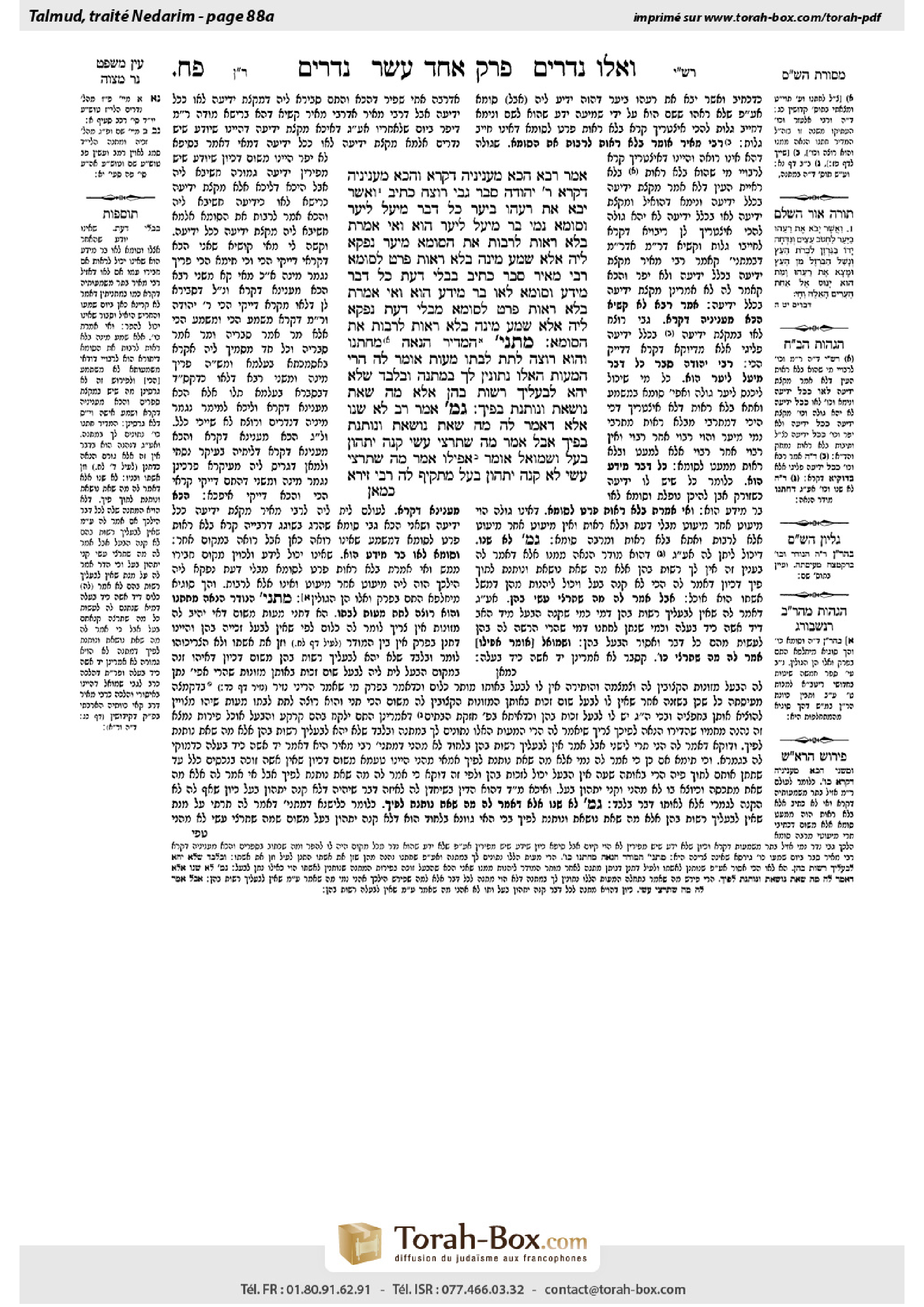
Nedarim 88a: Talmud study for Daf Yomi
Daf Yomi is the daily study of one Talmud folio. Explore 37 tractates with scans, Hebrew text, Sefaria English and AI-generated French translations where annotated.
Passage selection and English or AI-generated French translation are available where the scan has annotations. Daf Study is independent of Torah-Box and Sefaria.
Browse Nedarim · נדרים · All tractatesNedarim 88a text and translations
This page of Nedarim includes the Aramaic text, an English translation and an AI-generated French translation, alongside the scan above.
נדרים פ״ח א · Aramaic and Hebrew text
אָמַר רָבָא: הָכָא מֵעִנְיָנֵיהּ דִּקְרָא וְהָכָא מֵעִנְיָנֵיהּ דִּקְרָא. רַבִּי יְהוּדָה סָבַר: גַּבֵּי רוֹצֵחַ כְּתִיב ״וַאֲשֶׁר יָבֹא אֶת רֵעֵהוּ בַיַּעַר״ — כׇּל דְּבַר מֵיעַל לְיַעַר, וְסּוֹמֵא נָמֵי בַּר מֵיעַל לְיַעַר הוּא. וְאִי אָמְרַתְּ ״בְּלֹא רְאוֹת״ לְרַבּוֹת אֶת הַסּוֹמֵא — מִ״יַּעַר״ נָפְקָא לֵיהּ. אֶלָּא שְׁמַע מִינַּהּ: ״בְּלֹא רְאוֹת״ פְּרָט לְסּוֹמֵא.
רַבִּי מֵאִיר סָבַר: כְּתִיב ״בִּבְלִי דַעַת״ — כׇּל דְּבַר מִידָּע, וְסּוֹמֵא לָאו בַּר מִידָּע הוּא. וְאִי אָמְרַתְּ ״בְּלֹא רְאוֹת״ פְּרָט לַסּוֹמֵא — מִ״בְּלִי דַעַת״ נָפְקָא לֵיהּ. אֶלָּא שְׁמַע מִינַּהּ: ״בְּלֹא רְאוֹת״ לְרַבּוֹת אֶת הַסּוֹמֵא.
מַתְנִי׳ הַמַּדִּיר הֲנָאָה מֵחֲתָנוֹ, וְהוּא רוֹצֶה לָתֵת לְבִתּוֹ מָעוֹת, אוֹמֵר לָהּ: הֲרֵי הַמָּעוֹת הָאֵלּוּ נְתוּנִין לָךְ בְּמַתָּנָה, וּבִלְבַד שֶׁלֹּא יְהֵא לְבַעְלִיךְ רְשׁוּת בָּהֶן, אֶלָּא מָה שֶׁאַתְּ נוֹשֵׂאת וְנוֹתֶנֶת בְּפִיךְ.
גְּמָ׳ אָמַר רַב: לֹא שָׁנוּ אֶלָּא דְּאָמַר לַהּ ״מָה שֶׁאַתְּ נוֹשֵׂאת וְנוֹתֶנֶת בְּפִיךְ״, אֲבָל אָמַר ״מַה שֶּׁתִּרְצִי עֲשִׂי״, קְנָה יָתְהוֹן בַּעַל. וּשְׁמוּאֵל אוֹמֵר: אֲפִילּוּ אָמַר ״מַה שֶּׁתִּרְצִי עֲשִׂי״ — לָא קְנָה יָתְהוֹן בַּעַל. מַתְקֵיף לַהּ רַבִּי זֵירָא:
Nedarim 88a · English translation
Rava said: There is no contradiction here, as the dispute with regard to an unintentional killing is based on divergent interpretations of the verse. Here, the ruling follows from the context of the verse, and there, the ruling follows from the context of the verse. Rabbi Yehuda maintains that with regard to the exile of an unintentional killer it is written: “And a man who goes into the forest with his neighbor to hew wood” (Deuteronomy 19:5), which serves to include anyone who is capable of entering a forest, and a blind person is also capable of entering a forest. And if you say that the phrase “without seeing” serves to include a blind person, this is already derived from the word “forest,” as he too can enter a forest. Rather, learn from it that the phrase “without seeing” serves to exclude a blind person from the category of unintentional killers who are exiled to a city of refuge.
By contrast, Rabbi Meir maintains: It is written in that same section: “One who strikes his neighbor without knowledge” (Deuteronomy 19:4), which indicates that the halakha applies to anyone who is capable of knowing the precise location of the people standing about him, but a blind person is not capable of knowing this. And if you say that the phrase “without seeing” serves to exclude a blind person, this is already derived from the words “without knowledge.” Rather, learn from it that the phrase “without seeing” serves to include a blind person in the halakha of exile, not to exclude him.
MISHNA: With regard to one who vows that benefit from him is forbidden to his son-in-law, but he nevertheless wishes to give his daughter, i.e., the wife of that same son-in-law, money, then, though he cannot do so directly, as anything acquired by a woman belongs to her husband, he should say to her: This money is hereby given to you as a gift, provided that your husband has no rights to it, but the gift includes only that which you pick up and place in your mouth.
GEMARA: Rav said that they taught this halakha only in a case where he actually said to her: That which you pick up and place in your mouth is yours. But if he said: Do as you please with the money, his stipulation is of no effect, and the husband acquires the money. And Shmuel says that even if he said: Do as you please with the money, the husband does not acquire it. Rabbi Zeira objects to this statement of Rav:
Nedarim 88a · Traduction française (IA)
Rava dit : Il n’y a pas de contradiction, car la controverse concernant l’homicide involontaire repose sur des interprétations divergentes du verset. Dans un cas, la décision découle du contexte du verset, et dans l’autre, elle découle également du contexte du verset. Rabbi Yehouda considère qu’au sujet de l’exil de l’auteur d’un homicide involontaire, il est écrit : « Un homme qui va dans la forêt avec son prochain pour couper du bois » (Deutéronome 19, 5), ce qui inclut toute personne capable d’entrer dans une forêt ; un aveugle est lui aussi capable d’y entrer. Et si tu dis que l’expression « sans voir » sert à inclure un aveugle, cela se déduit déjà du mot « forêt », puisqu’il peut lui aussi entrer dans une forêt. Il faut donc en conclure que l’expression « sans voir » sert à exclure un aveugle de la catégorie des auteurs d’homicides involontaires exilés dans une ville de refuge.
En revanche, Rabbi Meïr considère qu’il est écrit dans ce même passage : « Celui qui frappe son prochain sans le savoir » (Deutéronome 19, 4), ce qui indique que la halakha s’applique à toute personne capable de connaître l’emplacement précis des personnes qui se tiennent autour d’elle, mais qu’un aveugle n’est pas capable de le connaître. Et si tu dis que l’expression « sans voir » sert à exclure un aveugle, cela se déduit déjà des mots « sans le savoir ». Il faut donc en conclure que l’expression « sans voir » sert à inclure un aveugle dans la halakha de l’exil, et non à l’en exclure.
MICHNA : Celui qui fait le vœu d’interdire à son gendre de tirer profit de lui, mais souhaite néanmoins donner de l’argent à sa fille, c’est-à-dire à l’épouse de ce même gendre, ne peut le faire directement, puisque tout ce qu’une femme acquiert revient à son mari. Il doit lui dire : « Cet argent t’est donné en cadeau, à condition que ton mari n’ait aucun droit sur lui », mais le cadeau ne comprend que ce que tu ramasses et mets dans ta bouche.
GUEMARA : Rav dit qu’ils n’ont enseigné cette halakha que dans le cas où il lui a effectivement dit : « Ce que tu ramasses et mets dans ta bouche est à toi. » Mais s’il lui a dit : « Fais ce que tu veux de cet argent », sa condition est sans effet et le mari acquiert l’argent. Chmouel dit que même s’il lui a dit : « Fais ce que tu veux de cet argent », le mari ne l’acquiert pas. Rabbi Zeïra objecte à cette déclaration de Rav :
Traduction française générée par IA à partir de l’édition anglaise de Sefaria. Vérifie toujours un passage avec le texte source.
Text from Sefaria: William Davidson Edition - Vocalized Aramaic (CC BY NC); William Davidson Edition - English (CC BY NC).