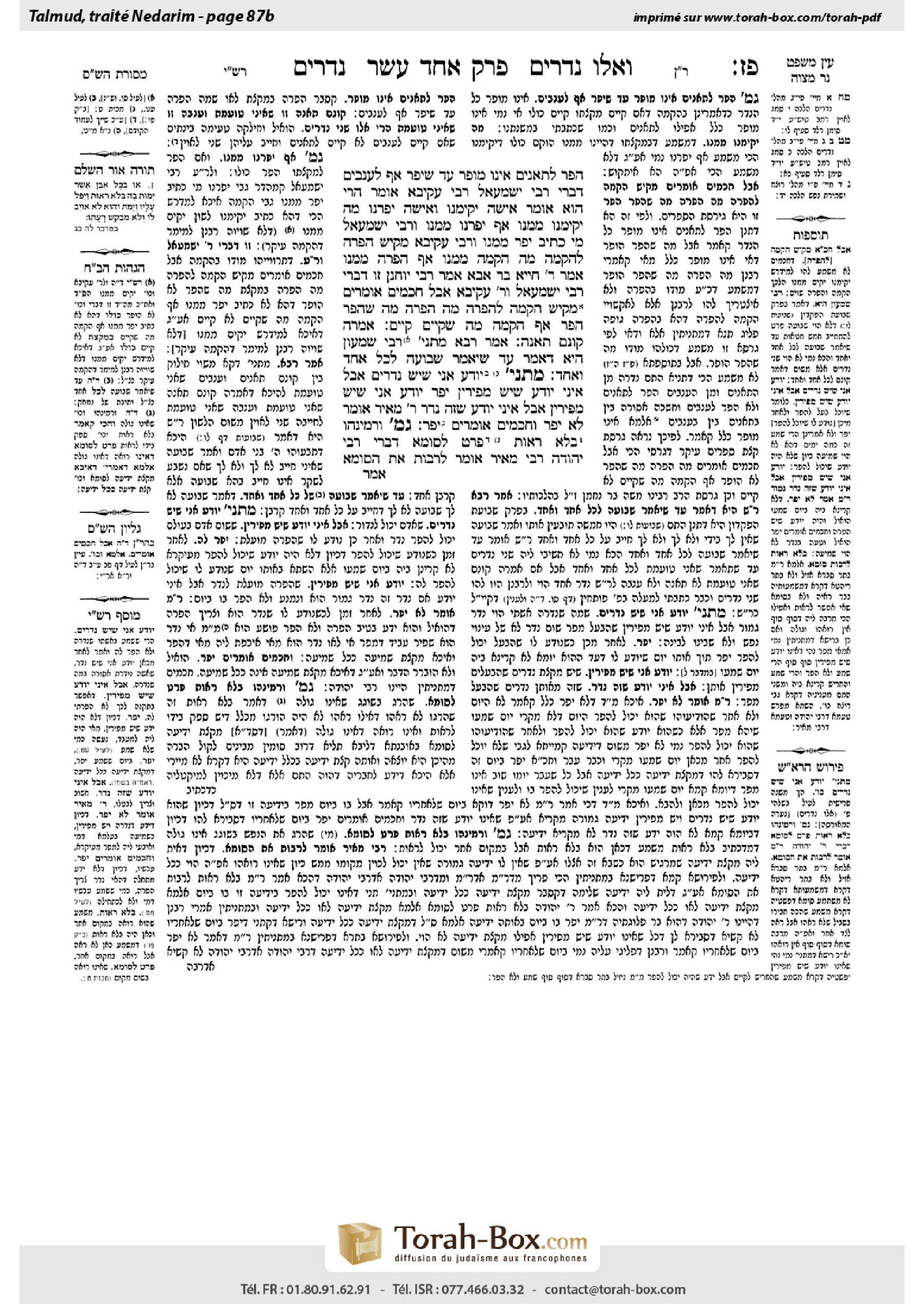
Nedarim 87b: Talmud study for Daf Yomi
Daf Yomi is the daily study of one Talmud folio. Explore 37 tractates with scans, Hebrew text, Sefaria English and AI-generated French translations where annotated.
Passage selection and English or AI-generated French translation are available where the scan has annotations. Daf Study is independent of Torah-Box and Sefaria.
Browse Nedarim · נדרים · All tractatesNedarim 87b text and translations
This page of Nedarim includes the Aramaic text, an English translation and an AI-generated French translation, alongside the scan above.
נדרים פ״ז ב · Aramaic and Hebrew text
הֵפֵר לִתְאֵנִים — אֵינוֹ מוּפָר עַד שֶׁיָּפֵר אַף לַעֲנָבִים, דִּבְרֵי רַבִּי יִשְׁמָעֵאל. רַבִּי עֲקִיבָא אוֹמֵר: הֲרֵי הוּא אוֹמֵר ״אִישָׁהּ יְקִימֶנּוּ וְאִישָׁהּ יְפֵרֶנּוּ״, מָה ״יְקִימֶנּוּ״ — מִמֶּנּוּ, אַף ״יְפֵרֶנּוּ״ — מִמֶּנּוּ. וְרַבִּי יִשְׁמָעֵאל: מִי כְּתִיב ״יָפֵר מִמֶּנּוּ״? וְרַבִּי עֲקִיבָא: מַקִּישׁ הֲפָרָה לַהֲקָמָה, מָה הֲקָמָה — מִמֶּנּוּ, אַף הֲפָרָה — מִמֶּנּוּ.
אָמַר רַבִּי חִיָּיא בַּר אַבָּא אָמַר רַבִּי יוֹחָנָן: זוֹ דִּבְרֵי רַבִּי יִשְׁמָעֵאל וְרַבִּי עֲקִיבָא, אֲבָל חֲכָמִים אוֹמְרִים: מַקִּישׁ הֲקָמָה לַהֲפָרָה; מָה הֲפָרָה — מַה שֶּׁהֵפֵר הֵפֵר, אַף הֲקָמָה — מַה שֶּׁקִּיֵּים קִיֵּים.
אָמְרָה ״קֻוֽנָּם תְּאֵנָה״, אָמַר רָבָא: מַתְנִיתִין רַבִּי שִׁמְעוֹן הִיא. דְּאָמַר: עַד שֶׁיֹּאמַר ״שְׁבוּעָה״ לְכׇל אֶחָד וְאֶחָד.
מַתְנִי׳ ״יוֹדֵעַ אֲנִי שֶׁיֵּשׁ נְדָרִים, אֲבָל אֵינִי יוֹדֵעַ שֶׁיֵּשׁ מְפִירִין״, יָפֵר. ״יוֹדֵעַ אֲנִי שֶׁיֵּשׁ מְפִירִין, אֲבָל אֵינִי יוֹדֵעַ שֶׁזֶּה נֶדֶר״, רַבִּי מֵאִיר אוֹמֵר: לֹא יָפֵר, וַחֲכָמִים אוֹמְרִים: יָפֵר.
גְּמָ׳ וּרְמִינְהוּ: ״בְּלֹא רְאוֹת״, פְּרָט לַסּוֹמֵא. דִּבְרֵי רַבִּי יְהוּדָה. רַבִּי מֵאִיר אוֹמֵר: לְרַבּוֹת אֶת הַסּוֹמֵא.
Nedarim 87b · English translation
But if he nullified it with regard to figs, it is not nullified until he will also nullify the vow for grapes. This is the statement of Rabbi Yishmael. Rabbi Akiva says that the verse states: “Her husband may uphold it, or her husband may nullify it.” Just as the words “may uphold it” [yekimennu] should be understood as if they read: He may uphold part of it [yakim mimmennu], implying that if he upheld part of the vow he has upheld all of it, so too, the words “he may nullify it” [yeferennu] should be understood as if they read: He may nullify part of it [yafer mimmennu]. And Rabbi Yishmael retorts: Is it written: He may nullify part of it, with a mem, as it is written with respect to a husband who upholds the vow? And Rabbi Akiva replies: The verse juxtaposes nullification to upholding; just as upholding means part of it, so too, nullification means part of it.
Rabbi Ḥiyya bar Abba said that Rabbi Yoḥanan said: This opinion, that a vow is treated as a single unit, so that the entire vow is upheld even if the husband upheld only a part of it, is the statement of Rabbi Yishmael and Rabbi Akiva. But the Rabbis say: The verse juxtaposes upholding to nullification; just as with regard to nullification, that which he nullified he has nullified, so too, with regard to upholding, that which he upheld he has upheld, but no more.
The mishna teaches that if a woman said: Tasting a fig and tasting a grape are konam for me, these are viewed as two separate vows. Rava said: The mishna is in accordance with the opinion of Rabbi Shimon, as Rabbi Shimon said that one is not liable to bring multiple offerings for taking false oaths to multiple people in the same utterance, for example, if he says: I take an oath that I do not have your item, nor yours, nor yours, unless he states an expression of an oath to each and every one of the creditors, for example by stating: I take an oath I do not have yours; I take an oath I do not have yours. Here too, only if she says: Tasting, with respect to each fruit are they viewed as two separate vows.
MISHNA: If a man’s wife or daughter took a vow and he failed to nullify the vow on the day he heard it, but afterward he said: I know that there are vows, but I don’t know that there are those who can nullify them, i.e., he was unaware of the possibility of nullifying vows, he can nullify the vow of his wife or his daughter on the day he learned that he can nullify vows. If, however, he said: I know there are those who can nullify vows, but I refrained from nullifying the vow that I heard because I do not know that this is considered a vow, Rabbi Meir says he cannot nullify the vow at this point, but the Rabbis say that even in this case he can nullify the vow on the day that he learned of his mistake.
GEMARA: The Gemara raises a contradiction from the following baraita: With regard to one who kills unintentionally, the verse states: “Without seeing” (Numbers 35:23), which serves to exclude a blind person from the category of those who are exiled to a city of refuge due to having killed unintentionally, as the verse indicates that it was only in this instance that he did not see, but he is generally able to see. A blind person who kills another unintentionally is considered a victim of circumstances beyond his control. This is the statement of Rabbi Yehuda. Rabbi Meir says the verse serves to include a blind person in the category of those who are exiled, as he too does not see. This shows that Rabbi Meir does not distinguish between different kinds of lack of knowledge, whereas the mishna suggests that he does accept such a distinction. The opposite is true of Rabbi Yehuda, who, unless it is otherwise indicated, is assumed to be Rabbi Meir’s disputant in all places.
Nedarim 87b · Traduction française (IA)
Mais s’il a annulé le vœu concernant les figues, celui-ci n’est pas annulé tant qu’il n’a pas également annulé le vœu concernant les raisins. Telle est la position de Rabbi Yishmael. Rabbi Akiva dit que le verset déclare : « Son mari peut le confirmer ou son mari peut l’annuler. » De même que les mots « peut le confirmer » [yekimennu] doivent être compris comme s’ils se lisaient : « Il peut en confirmer une partie » [yakim mimmennu], ce qui implique que s’il a confirmé une partie du vœu, il l’a confirmé tout entier, de même les mots « il peut l’annuler » [yeferennu] doivent être compris comme s’ils se lisaient : « Il peut en annuler une partie » [yafer mimmennu]. Rabbi Yishmael rétorque : Est-il écrit : « Il peut en annuler une partie », avec un mem, comme cela est écrit à propos d’un mari qui confirme le vœu ? Rabbi Akiva répond : Le verset met l’annulation en parallèle avec la confirmation ; de même que la confirmation porte sur une partie, l’annulation porte elle aussi sur une partie.
Rabbi Ḥiyya bar Abba a dit au nom de Rabbi Yoḥanan : Cette opinion, selon laquelle un vœu est traité comme un tout, si bien que le vœu entier est confirmé même si le mari n’en a confirmé qu’une partie, est celle de Rabbi Yishmael et de Rabbi Akiva. Mais les Sages disent : Le verset met la confirmation en parallèle avec l’annulation ; de même que, pour l’annulation, ce qu’il a annulé est annulé, et rien de plus, de même, pour la confirmation, ce qu’il a confirmé est confirmé, et rien de plus.
La Michna enseigne que si une femme a dit : « Goûter une figue et goûter un raisin me sont konam », ces expressions sont considérées comme deux vœux distincts. Rava dit : La Michna suit l’opinion de Rabbi Shimon, car Rabbi Shimon a dit qu’on n’est pas tenu d’apporter plusieurs sacrifices pour avoir prêté de faux serments à plusieurs personnes dans une seule et même déclaration ; par exemple, s’il dit : « Je jure que je n’ai pas votre objet, ni le vôtre, ni le vôtre », à moins qu’il n’énonce une formule de serment pour chacun des créanciers, par exemple : « Je jure que je n’ai pas le vôtre ; je jure que je n’ai pas le vôtre. » Ici aussi, ce n’est que si elle dit « goûter » à propos de chaque fruit que ces expressions sont considérées comme deux vœux distincts.
Michna : Si la femme ou la fille d’un homme a fait un vœu et qu’il ne l’a pas annulé le jour où il l’a entendu, mais qu’il a déclaré par la suite : « Je sais qu’il existe des vœux, mais je ne savais pas qu’il y avait des personnes habilitées à les annuler », c’est-à-dire qu’il ignorait qu’il était possible d’annuler les vœux, il peut annuler le vœu de sa femme ou de sa fille le jour où il apprend qu’il peut annuler les vœux. En revanche, s’il a dit : « Je sais qu’il y a des personnes habilitées à annuler les vœux, mais je me suis abstenu d’annuler le vœu que j’avais entendu parce que je ne savais pas que cela était considéré comme un vœu », Rabbi Meïr dit qu’il ne peut plus annuler le vœu à ce stade, mais les Sages disent que même dans ce cas, il peut l’annuler le jour où il apprend qu’il s’était trompé.
Guemara : La Guemara soulève une contradiction à partir de la baraïta suivante : Au sujet de celui qui tue involontairement, le verset déclare : « Sans l’avoir vu » (Nombres 35, 23), ce qui exclut l’aveugle de la catégorie de ceux qui sont exilés dans une ville de refuge pour avoir tué involontairement, car le verset indique que, dans cette circonstance seulement, il n’a pas vu, mais qu’en général il est capable de voir. Un aveugle qui tue quelqu’un involontairement est considéré comme victime de circonstances indépendantes de sa volonté. Telle est la position de Rabbi Yehouda. Rabbi Meïr dit que le verset sert à inclure l’aveugle parmi ceux qui sont exilés, car lui aussi ne voit pas. Cela montre que Rabbi Meïr ne distingue pas les différentes formes d’ignorance, tandis que la Michna semble indiquer qu’il admet une telle distinction. C’est l’inverse pour Rabbi Yehouda, qui, sauf indication contraire, est considéré comme l’opposant de Rabbi Meïr en tout lieu.
Traduction française générée par IA à partir de l’édition anglaise de Sefaria. Vérifie toujours un passage avec le texte source.
Text from Sefaria: William Davidson Edition - Vocalized Aramaic (CC BY NC); William Davidson Edition - English (CC BY NC).