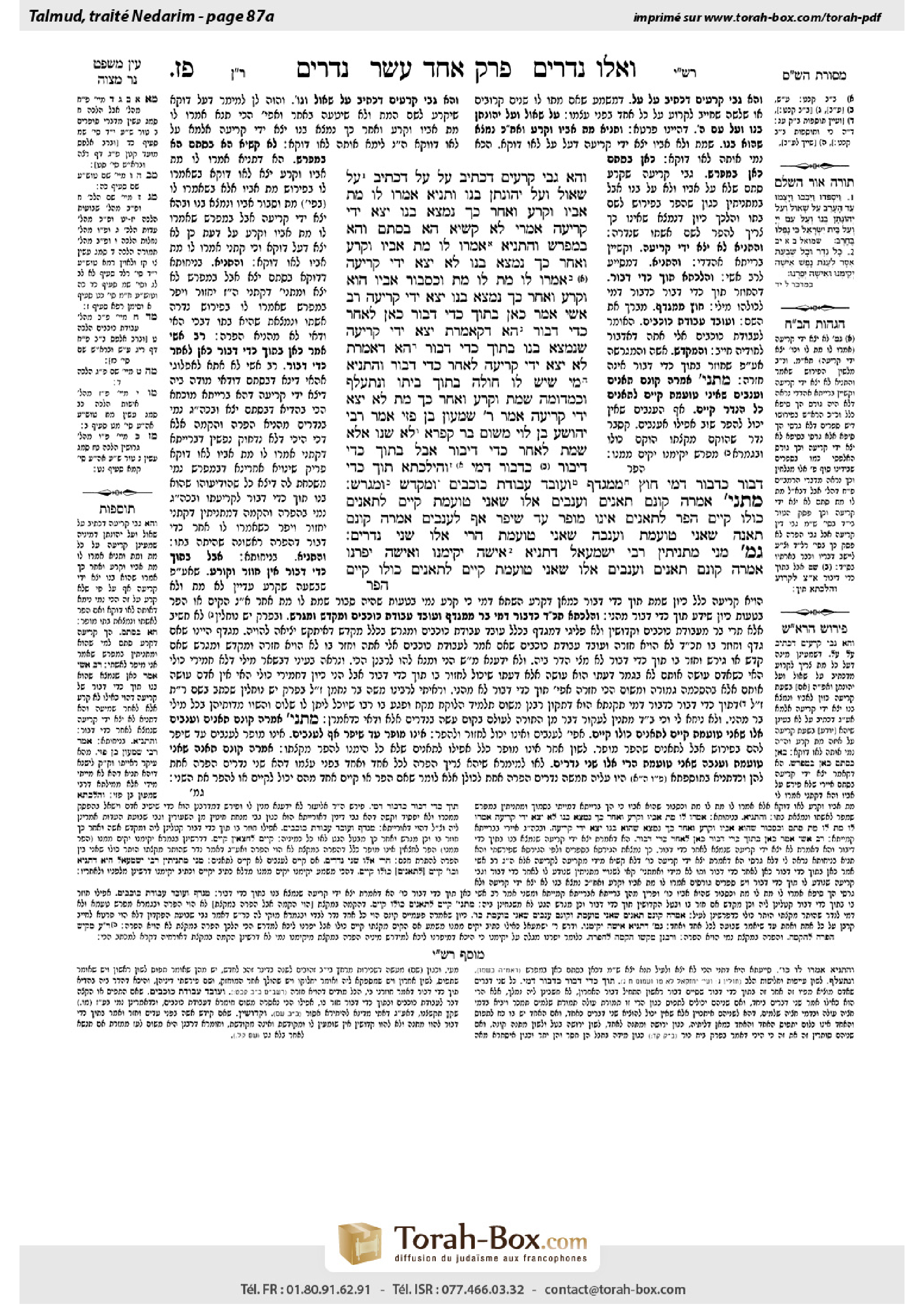
Nedarim 87a: Talmud study for Daf Yomi
Daf Yomi is the daily study of one Talmud folio. Explore 37 tractates with scans, Hebrew text, Sefaria English and AI-generated French translations where annotated.
Passage selection and English or AI-generated French translation are available where the scan has annotations. Daf Study is independent of Torah-Box and Sefaria.
Browse Nedarim · נדרים · All tractatesNedarim 87a text and translations
This page of Nedarim includes the Aramaic text, an English translation and an AI-generated French translation, alongside the scan above.
נדרים פ״ז א · Aramaic and Hebrew text
וְהָא גַּבֵּי קְרָעִים דִּכְתִיב ״עַל״ ״עַל״, דִּכְתִיב: ״עַל שָׁאוּל וְעַל יְהוֹנָתָן בְּנוֹ״.
וְתַנְיָא: אָמְרוּ לוֹ ״מֵת אָבִיו״ וְקָרַע, וְאַחַר כָּךְ נִמְצָא בְּנוֹ — יָצָא יְדֵי קְרִיעָה.
אָמְרִי, לָא קַשְׁיָא: הָא בִּסְתָם, וְהָא בִּמְפָרֵשׁ.
וְהָתַנְיָא: אָמְרוּ לוֹ ״מֵת אָבִיו״ וְקָרַע, וְאַחַר כָּךְ נִמְצָא בְּנוֹ — לֹא יָצָא יְדֵי קְרִיעָה. אָמְרוּ לוֹ ״מֵת לוֹ מֵת״, וּכְסָבוּר אָבִיו הוּא וְקָרַע, וְאַחַר כָּךְ נִמְצָא בְּנוֹ — יָצָא יְדֵי קְרִיעָה.
רַב אָשֵׁי אָמַר: כָּאן בְּתוֹךְ כְּדֵי דִבּוּר, כָּאן לְאַחַר כְּדֵי דִבּוּר.
הָא דְּקָאָמְרַתְּ יָצָא יְדֵי קְרִיעָה — שֶׁנִּמְצָא בְּנוֹ בְּתוֹךְ כְּדֵי דִבּוּר. הָא דְּאָמְרַתְּ לֹא יָצָא יְדֵי קְרִיעָה — לְאַחַר כְּדֵי דִבּוּר.
וְהָתַנְיָא: מִי שֶׁיֵּשׁ לוֹ חוֹלֶה בְּתוֹךְ בֵּיתוֹ וְנִתְעַלֵּף, וְכִמְדוּמֶּה שֶׁמֵּת, וְקָרַע, וְאַחַר כָּךְ מֵת — לֹא יָצָא יְדֵי קְרִיעָה. אָמַר רַבִּי שִׁמְעוֹן בֶּן פַּזִּי אָמַר רַבִּי יְהוֹשֻׁעַ בֶּן לֵוִי מִשּׁוּם בַּר קַפָּרָא: לֹא שָׁנוּ אֶלָּא שֶׁמֵּת לְאַחַר כְּדֵי דִיבּוּר, אֲבָל בְּתוֹךְ כְּדֵי דִיבּוּר — כְּדִבּוּר דָּמֵי.
וְהִילְכְתָא: תּוֹךְ כְּדֵי דִבּוּר — כְּדִבּוּר דָּמֵי, חוּץ מִמְּגַדֵּף וְעוֹבֵד עֲבוֹדָה זָרָה וּמְקַדֵּשׁ וּמְגָרֵשׁ.
מַתְנִי׳ אָמְרָה ״קֻוֽנָּם תְּאֵנִים וַעֲנָבִים אֵלּוּ שֶׁאֲנִי טוֹעֶמֶת״, קִיֵּים לִתְאֵנִים — כּוּלּוֹ קַיָּים, הֵפֵר לִתְאֵנִים — אֵינוֹ מוּפָר עַד שֶׁיָּפֵר אַף לַעֲנָבִים. אָמְרָה ״קֻוֽנָּם תְּאֵנָה שֶׁאֲנִי טוֹעֶמֶת וַעֲנָבָה שֶׁאֲנִי טוֹעֶמֶת״ — הֲרֵי אֵלּוּ שְׁנֵי נְדָרִים.
גְּמָ׳ מַנִּי מַתְנִיתִין? רַבִּי יִשְׁמָעֵאל, דְּתַנְיָא: ״אִישָׁהּ יְקִימֶנּוּ וְאִישָׁהּ יְפֵרֶנּוּ״, אָמְרָה ״קֻוֽנָּם תְּאֵנִים וַעֲנָבִים אֵלּוּ שֶׁאֲנִי טוֹעֶמֶת״, קִיֵּים לִתְאֵנִים — כּוּלּוֹ קַיָּים,
Nedarim 87a · English translation
The Gemara comments: But is it not so that with regard to the tears in one’s clothing that are made for the dead, as it is written “for,” “for,” and about which is written: “And David took hold of his garments and rent them, and likewise all the men that were with him, and they wailed, and wept, and fasted until the evening, for Saul, and for Jonathan his son, and for the people of the Lord, and for the house of Israel, because they were fallen by the sword” (II Samuel 1:11–12). The use of the word “for” with regard to each of them indicates that one must make a separate tear in his garment for each person who died.
The Gemara asks: And yet it is taught in a baraita: If they said to him that his father had died and he rent his garment over his death, and afterward it was discovered that it was not his father who died, but his son, he has fulfilled his obligation of rending his garment. This shows that even if a person mistakenly tore his garment for the wrong person he has nevertheless fulfilled the obligation. Here too, if a man nullified the vow of his wife, thinking that it was the vow of his daughter, his nullification should be effective.
The Gemara responds: The apparent contradiction is not difficult. That baraita refers to a case where he received a non-specific report, i.e., he was told that an unspecified relative died. In such a case his obligation to rend his garment has been discharged. And this mishna refers to a case where the bearer of the news mistakenly specified that his daughter had taken the vow, when in reality his wife had. In such a case, his nullification is ineffective.
And it is taught similarly in the following baraita: If they said to him that his father had died and he rent his garment over his death, and afterward it was discovered that it was not his father who died, but his son, he has not fulfilled his obligation of rending his garment. If, however, they said to him that a relative of his had died, and he thought it was his father and he rent his garment over his death, and afterward it was discovered that it was not his father who died, but his son, he has fulfilled his obligation of rending his garment. This proves that a distinction is made between one who rends his garment relying on a specific report and one who does so following a non-specific report.
Rav Ashi says that the discrepancy between the baraitot with regard to the rending of garments can be reconciled in a different manner: Here, the person who rent his garment for the wrong relative realized his error within the time required for speaking the short phrase: Greetings to you, my teacher. Until that time has passed his action is seen as incomplete and can therefore still be modified. There, the mistake was noted only after the time required for speaking a short phrase.
This case, where you said that he has fulfilled his obligation of rending his garment even though he had initially been told explicitly that his father died, deals with a situation where it was discovered within the time required for speaking a short phrase, i.e., immediately after he rent his garment, that the deceased was his son. However, that case, where you said that he has not fulfilled his obligation of rending his garment, deals with a situation where he became aware of his mistake after the time required for speaking a short phrase, i.e., a short while later.
And it is taught in the following baraita: One who has an ill relative in his house, and the latter fainted and lost consciousness, and it seemed to him that the ill person had died and therefore he rent his garment over his assumed death, if it turned out that he had not yet actually died at that point and it was only afterward that he died, the relative has not fulfilled his obligation of rending his garment. And with regard to this baraita, Rabbi Shimon ben Pazi said that Rabbi Yehoshua ben Levi said in the name of Bar Kappara: They taught that he has not fulfilled his obligation of rending only if the ill person died after the time required for speaking a short phrase. But if he passed away within the time required for speaking a short phrase, it is all considered like continuous speech, and his relative has fulfilled his obligation. That is to say, his act of rending is not viewed as complete until the time required for saying a short phrase has elapsed, and until that time has passed the act can still be modified.
The Gemara concludes: And the halakha is: The legal status of a pause or retraction within the time required for speaking a short phrase is like that of continuous speech, and so a person can retract what he first said if he issues the retraction within this period of time after he finished speaking. This principle holds true in almost every area of halakha, except for the case of one who blasphemes God; or in the case of an idol worshipper, who verbally accepts an idol as his god; or one who betroths a woman; or one who divorces his wife. In these four cases, a person cannot undo his action, even if he immediately retracts what he said within the time required for saying a short phrase.
MISHNA: If a woman said: Tasting these figs and grapes is konam for me, and her husband upheld her vow with regard to figs, the entire vow is upheld, but if he nullified it with regard to figs it is not nullified until he also nullifies the vow with regard to grapes. If she said: Tasting a fig and tasting a grape are konam for me, these are viewed as two separate vows; if the husband upholds one of the vows it has no effect on the other one.
GEMARA: Whose opinion is expressed in the mishna? The Gemara answers: It follows the opinion of Rabbi Yishmael, as it is taught in a baraita: The verse concerning vows that states: “Her husband may uphold it, or her husband may nullify it” (Numbers 30:14), may be expounded as follows. If a woman said: Tasting these figs and grapes is konam for me, and her husband upheld her vow with regard to figs, the entire vow is upheld.
Nedarim 87a · Traduction française (IA)
La Guemara fait remarquer : Mais n’est-il pas vrai que, pour les déchirures des vêtements faites en l’honneur des morts, le texte emploie le mot « pour » à plusieurs reprises, et qu’il est écrit : « David saisit ses vêtements et les déchira, et tous les hommes qui étaient avec lui firent de même ; ils se lamentèrent, pleurèrent et jeûnèrent jusqu’au soir, pour Saül, pour Jonathan son fils, pour le peuple de l’Éternel et pour la maison d’Israël, parce qu’ils étaient tombés sous l’épée » (II Samuel 1, 11-12) ? L’emploi du mot « pour » à propos de chacun d’eux indique qu’il faut faire une déchirure distincte dans son vêtement pour chaque personne décédée.
La Guemara demande : Pourtant, une baraïta enseigne : Si on lui annonça la mort de son père et qu’il déchira son vêtement à cause de sa mort, puis qu’on découvrit que ce n’était pas son père qui était mort, mais son fils, il s’est acquitté de son obligation de déchirer son vêtement. Cela montre que même si quelqu’un déchire son vêtement par erreur pour la mauvaise personne, il s’est néanmoins acquitté de son obligation. Ici aussi, si un homme a annulé le vœu de sa femme en pensant qu’il s’agissait du vœu de sa fille, son annulation devrait être efficace.
La Guemara répond : La contradiction apparente n’est pas difficile à résoudre. Cette baraïta traite d’un cas où il a reçu une annonce non précise, c’est-à-dire qu’on lui a dit qu’un de ses proches était mort, sans préciser lequel. Dans ce cas, il s’est acquitté de son obligation de déchirer son vêtement. Cette Michna, en revanche, traite d’un cas où le messager a indiqué par erreur que sa fille avait fait le vœu, alors qu’en réalité c’était sa femme. Dans ce cas, son annulation est sans effet.
Et une baraïta enseigne de même : Si on lui annonça la mort de son père et qu’il déchira son vêtement à cause de sa mort, puis qu’on découvrit que ce n’était pas son père qui était mort, mais son fils, il ne s’est pas acquitté de son obligation de déchirer son vêtement. En revanche, si on lui annonça qu’un de ses proches était mort, qu’il pensa que c’était son père et déchira son vêtement à cause de sa mort, puis qu’on découvrit que ce n’était pas son père qui était mort, mais son fils, il s’est acquitté de son obligation de déchirer son vêtement. Cela prouve qu’on distingue celui qui déchire son vêtement sur la foi d’une annonce précise de celui qui le fait à la suite d’une annonce non précise.
Rav Ashi dit que la divergence entre les baraïtot concernant les déchirures des vêtements peut être résolue autrement : ici, celui qui a déchiré son vêtement pour le mauvais proche s’est rendu compte de son erreur dans le délai nécessaire pour prononcer la courte formule : « Je te salue, mon maître ». Tant que ce délai n’est pas écoulé, son acte est considéré comme inachevé et peut donc encore être modifié. Là-bas, il ne s’est aperçu de son erreur qu’après le délai nécessaire pour prononcer une courte formule.
Ce cas, où tu as dit qu’il s’est acquitté de son obligation de déchirer son vêtement bien qu’on lui ait d’abord annoncé explicitement la mort de son père, concerne une situation où l’on a découvert, dans le délai nécessaire pour prononcer une courte formule, c’est-à-dire juste après qu’il eut déchiré son vêtement, que le défunt était son fils. En revanche, ce cas, où tu as dit qu’il ne s’est pas acquitté de son obligation de déchirer son vêtement, concerne une situation où il n’a pris connaissance de son erreur qu’après le délai nécessaire pour prononcer une courte formule, c’est-à-dire un peu plus tard.
Et la baraïta suivante enseigne : Celui qui a chez lui un proche malade, lequel s’évanouit et perd connaissance, et qui croit que le malade est mort et déchire donc son vêtement en raison de sa mort présumée, ne s’est pas acquitté de son obligation de déchirer son vêtement s’il s’avère que le malade n’était pas encore réellement mort à ce moment-là et qu’il n’est mort que par la suite. À propos de cette baraïta, Rabbi Shimon ben Pazi dit que Rabbi Yehoshua ben Levi a dit au nom de Bar Kappara : Ils ont enseigné qu’il ne s’est pas acquitté de son obligation de déchirer son vêtement uniquement si le malade est mort après le délai nécessaire pour prononcer une courte formule. Mais s’il est mort dans ce délai, tout est considéré comme une parole continue, et son proche s’est acquitté de son obligation. Autrement dit, son acte de déchirure n’est pas considéré comme achevé avant que le délai nécessaire pour prononcer une courte formule ne se soit écoulé ; jusqu’à ce moment, l’acte peut encore être modifié.
La Guemara conclut : Et la halakha est la suivante : Une pause ou une rétractation dans le délai nécessaire pour prononcer une courte formule a le même statut qu’une parole continue ; une personne peut donc revenir sur ce qu’elle a dit d’abord si elle se rétracte dans ce délai après avoir fini de parler. Ce principe s’applique dans presque tous les domaines de la halakha, à l’exception du cas de celui qui blasphème contre Dieu ; de l’adorateur d’idoles qui reconnaît verbalement une idole comme son dieu ; de celui qui fiance une femme ; et de celui qui répudie sa femme. Dans ces quatre cas, une personne ne peut pas revenir sur son acte, même si elle se rétracte aussitôt après, dans le délai nécessaire pour prononcer une courte formule.
MICHNA : Si une femme dit : « Goûter ces figues et ces raisins m’est interdit comme un konam », et que son mari confirme son vœu concernant les figues, l’ensemble du vœu est confirmé ; mais s’il l’annule concernant les figues, il n’est annulé que lorsqu’il annule aussi le vœu concernant les raisins. Si elle dit : « Goûter une figue et goûter un raisin m’est interdit comme un konam », ces paroles sont considérées comme deux vœux distincts ; si le mari confirme l’un des vœux, cela n’a aucun effet sur l’autre.
GUEMARA : Quelle opinion est exprimée dans la Michna ? La Guemara répond : Elle suit l’opinion de Rabbi Yishmael, comme l’enseigne une baraïta : Le verset concernant les vœux qui dit : « Son mari peut le confirmer, ou son mari peut l’annuler » (Nombres 30, 14), peut être interprété ainsi. Si une femme dit : « Goûter ces figues et ces raisins m’est interdit comme un konam », et que son mari confirme son vœu concernant les figues, l’ensemble du vœu est confirmé.
Traduction française générée par IA à partir de l’édition anglaise de Sefaria. Vérifie toujours un passage avec le texte source.
Text from Sefaria: William Davidson Edition - Vocalized Aramaic (CC BY NC); William Davidson Edition - English (CC BY NC).