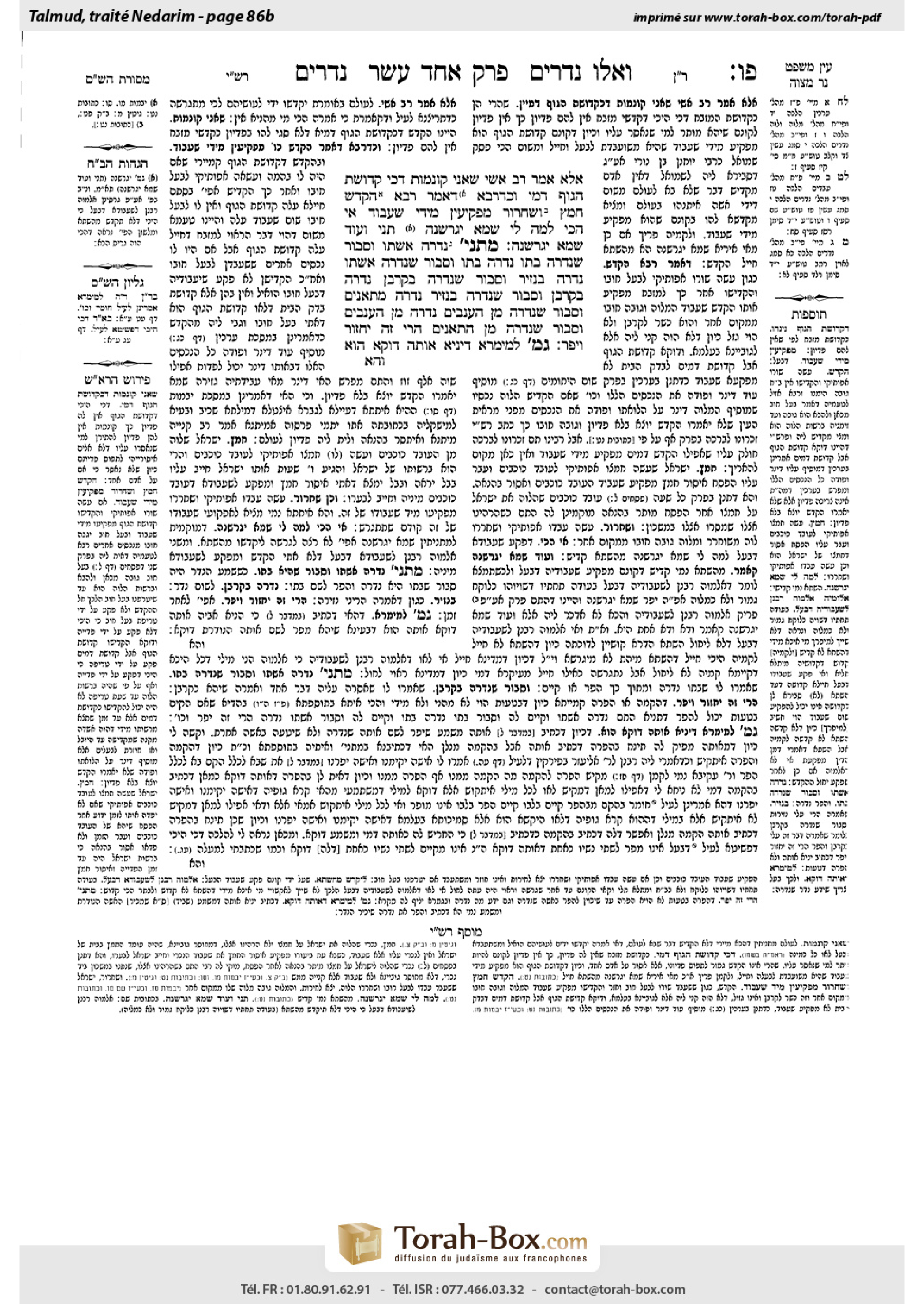
Nedarim 86b: Talmud study for Daf Yomi
Daf Yomi is the daily study of one Talmud folio. Explore 37 tractates with scans, Hebrew text, Sefaria English and AI-generated French translations where annotated.
Passage selection and English or AI-generated French translation are available where the scan has annotations. Daf Study is independent of Torah-Box and Sefaria.
Browse Nedarim · נדרים · All tractatesNedarim 86b text and translations
This page of Nedarim includes the Aramaic text, an English translation and an AI-generated French translation, alongside the scan above.
נדרים פ״ו ב · Aramaic and Hebrew text
אֶלָּא אָמַר רַב אָשֵׁי: שָׁאנֵי קוּנָּמוֹת, דְּכִי קְדוּשַּׁת הַגּוּף דָּמֵי, וְכִדְרָבָא.
דְּאָמַר רָבָא: הֶקְדֵּשׁ, חָמֵץ וְשִׁחְרוּר — מַפְקִיעִין מִידֵי שִׁעְבּוּד.
אִי הָכִי לְמָה לִי שֶׁמָּא יְגָרְשֶׁנָּה? תְּנִי: וְעוֹד שֶׁמָּא יְגָרְשֶׁנָּה.
מַתְנִי׳ נָדְרָה אִשְׁתּוֹ וְסָבוּר שֶׁנָּדְרָה בִּתּוֹ, נָדְרָה בִּתּוֹ וְסָבוּר שֶׁנָּדְרָה אִשְׁתּוֹ, נָדְרָה בְּנָזִיר וְסָבוּר שֶׁנָּדְרָה בְּקׇרְבָּן, נָדְרָה בְּקׇרְבָּן וְסָבוּר שֶׁנָּדְרָה בְּנָזִיר, נָדְרָה מִתְּאֵנִים וְסָבוּר שֶׁנָּדְרָה מִן הָעֲנָבִים, נָדְרָה מִן הָעֲנָבִים וְסָבוּר שֶׁנָּדְרָה מִן הַתְּאֵנִים — הֲרֵי זֶה יַחְזוֹר וְיָפֵר.
גְּמָ׳ לְמֵימְרָא דְּ״יָנִיא אוֹתָהּ״ דַּוְקָא הוּא?
Nedarim 86b · English translation
Rather, Rav Ashi said that this is the reason Shmuel ruled in accordance with the opinion of Rabbi Yoḥanan ben Nuri: Although a person cannot consecrate an entity that has not yet come into the world, konamot are different. They are stringent and take effect in all cases, as their prohibited status is considered akin to inherent sanctity. When one person prohibits another from deriving benefit from a particular item by means of a konam, the forbidden item is treated as if it has inherent sanctity. It cannot be redeemed and can never become permitted. Because of its severity, a woman can forbid her handiwork to her husband by means of a konam, even though she is obligated to hand over the fruits of her labor to him. And this is in accordance with the opinion of Rava.
As Rava said: Consecration of an item to the Temple, becoming subject to the prohibition of leavened bread on Passover, and the emancipation of a slave abrogate any lien that exists upon them. The lien on that property does not prevent the consecration, the prohibition of leavened bread, or the emancipation of the slave from taking effect. In all three cases, the debtor loses his ownership of the liened property. The same halakha applies to a konam, whose prohibition has the severity of inherent sanctity. Even though the husband has a right to his wife’s handiwork, which could be described as a lien on her hands, that lien is abrogated when she renders her handiwork forbidden to him by means of a konam, and therefore the vow must be nullified.
The Gemara asks: If so, why do I need Rabbi Yoḥanan ben Nuri’s stated reason: Perhaps he will one day divorce her? If the woman’s konam abrogates the husband’s lien, the prohibition should take effect immediately. The Gemara answers: Teach that the vow takes effect right away, which is why the husband must nullify it. And furthermore, adds Rabbi Yoḥanan ben Nuri, even if you maintain that the Sages strengthened a husband’s lien so that the vow does not take effect immediately, there is another reason to nullify the vow, as perhaps he will one day divorce her.
MISHNA: If a man’s wife took a vow and he thought that it was his daughter who had taken a vow, or if his daughter took a vow and he thought that it was his wife who had taken a vow, or if his wife vowed to be a nazirite and he thought that she had vowed to bring an offering, or if she vowed to bring an offering and he thought that she had vowed to be a nazirite, or if she took a vow that figs are forbidden to her and he thought that she had taken a vow that grapes are forbidden to her, or if she took a vow that grapes are forbidden to her and he thought that she had taken a vow that figs are forbidden to her, and he nullified any of these vows, in each case, when he realizes his error with regard to the vow, he must repeat the action and nullify the vow a second time.
GEMARA: With regard to the mishna’s ruling that if a man’s wife took a vow, but he thought that it was his daughter who had taken the vow and he nullified the vow, he must nullify the vow a second time, the Gemara asks: Is this to say that the phrase “But if her husband disallowed her [otah]” (Numbers 30:9) is precise? In other words, does the use of the word her, otah, indicate that a man can nullify a vow only for the specific woman who took it?
Nedarim 86b · Traduction française (IA)
Rav Ashi dit plutôt que telle est la raison pour laquelle Shmuel a statué conformément à l’opinion de Rabbi Yoḥanan ben Nuri : bien qu’une personne ne puisse pas consacrer une chose qui n’est pas encore venue au monde, les konamot font exception. Ils sont rigoureux et prennent effet dans tous les cas, car leur interdiction est considérée comme comparable à une sainteté intrinsèque. Lorsqu’une personne interdit à une autre de tirer profit d’un objet particulier au moyen d’un konam, l’objet interdit est traité comme s’il était doté d’une sainteté intrinsèque. Il ne peut être racheté et ne peut jamais devenir permis. En raison de la rigueur de cette interdiction, une femme peut interdire à son mari, au moyen d’un konam, de tirer profit du fruit de son travail, bien qu’elle soit tenue de lui remettre le produit de son travail. Cela est conforme à l’opinion de Rava.
Comme l’a dit Rava : la consécration d’un objet au Temple, son assujettissement à l’interdiction du pain levé pendant Pessa’h et l’affranchissement d’un esclave annulent tout privilège de créancier qui les grève. Ce privilège sur ces biens n’empêche pas la consécration, l’interdiction du pain levé ou l’affranchissement de l’esclave de prendre effet. Dans les trois cas, le débiteur perd son droit de propriété sur le bien grevé. La même halakha s’applique au konam, dont l’interdiction a la rigueur d’une sainteté intrinsèque. Bien que le mari ait un droit sur le produit du travail de son épouse, droit qui pourrait être décrit comme un privilège sur ses mains, ce privilège est annulé lorsqu’elle lui interdit de tirer profit du produit de son travail au moyen d’un konam ; le vœu doit donc être annulé.
La Guemara demande : si c’est ainsi, pourquoi faut-il invoquer le motif avancé par Rabbi Yoḥanan ben Nuri, selon lequel il est possible qu’un jour il la divorce ? Si le konam de la femme annule le privilège du mari, l’interdiction devrait prendre effet immédiatement. La Guemara répond : enseigne que le vœu prend effet immédiatement, et c’est pourquoi le mari doit l’annuler. En outre, ajoute Rabbi Yoḥanan ben Nuri, même si tu soutiens que les Sages ont renforcé le privilège du mari de sorte que le vœu ne prenne pas effet immédiatement, il y a une autre raison de l’annuler : il est possible qu’un jour il la divorce.
MICHNA : Si l’épouse d’un homme a fait un vœu et qu’il a cru que c’était sa fille qui l’avait fait, ou si sa fille a fait un vœu et qu’il a cru que c’était son épouse qui l’avait fait, ou si son épouse a fait vœu de devenir naziréenne et qu’il a cru qu’elle avait fait vœu d’apporter une offrande, ou si elle a fait vœu d’apporter une offrande et qu’il a cru qu’elle avait fait vœu de devenir naziréenne, ou si elle a fait vœu que les figues lui soient interdites et qu’il a cru qu’elle avait fait vœu que les raisins lui soient interdits, ou si elle a fait vœu que les raisins lui soient interdits et qu’il a cru qu’elle avait fait vœu que les figues lui soient interdites, et qu’il a annulé l’un de ces vœux, dans chaque cas, lorsqu’il se rend compte de son erreur au sujet du vœu, il doit recommencer et annuler le vœu une seconde fois.
GUEMARA : À propos de la décision de la Michna selon laquelle, si l’épouse d’un homme a fait un vœu, mais qu’il a cru que c’était sa fille qui l’avait fait et qu’il a annulé le vœu, il doit l’annuler une seconde fois, la Guemara demande : faut-il en conclure que l’expression « Mais si son mari l’a désavouée [otah] » (Nombres 30:9) doit être prise au sens strict ? Autrement dit, l’emploi du mot « elle », otah, indique-t-il qu’un homme ne peut annuler un vœu que pour la femme précise qui l’a fait ?
Traduction française générée par IA à partir de l’édition anglaise de Sefaria. Vérifie toujours un passage avec le texte source.
Text from Sefaria: William Davidson Edition - Vocalized Aramaic (CC BY NC); William Davidson Edition - English (CC BY NC).