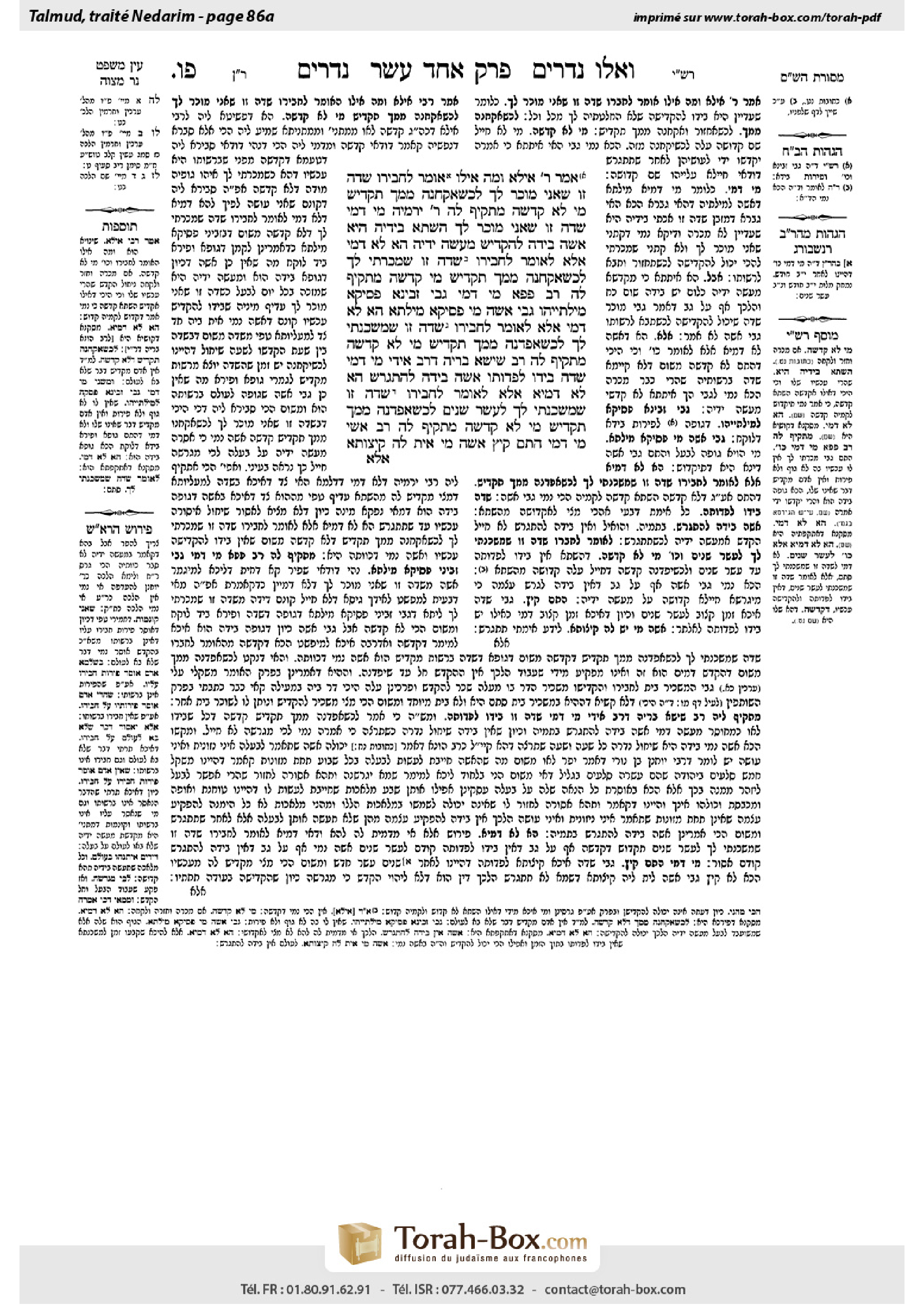
Nedarim 86a: Talmud study for Daf Yomi
Daf Yomi is the daily study of one Talmud folio. Explore 37 tractates with scans, Hebrew text, Sefaria English and AI-generated French translations where annotated.
Passage selection and English or AI-generated French translation are available where the scan has annotations. Daf Study is independent of Torah-Box and Sefaria.
Browse Nedarim · נדרים · All tractatesNedarim 86a text and translations
This page of Nedarim includes the Aramaic text, an English translation and an AI-generated French translation, alongside the scan above.
נדרים פ״ו א · Aramaic and Hebrew text
אָמַר רַבִּי אִילָא: וּמָה אִילּוּ אוֹמֵר לַחֲבֵירוֹ ״שָׂדֶה זוֹ שֶׁאֲנִי מוֹכֵר לְךָ, לִכְשֶׁאֶקָּחֶנָּה מִמְּךָ — תִּקָּדֵישׁ״, מִי לָא קָדְשָׁה?
מַתְקֵיף לַהּ רַבִּי יִרְמְיָה: מִי דָּמֵי? ״שָׂדֶה זוֹ שֶׁאֲנִי מוֹכֵר לְךָ״ — הַשְׁתָּא בִּידֵיהּ הִיא. אִשָּׁה, בְּיָדָהּ לְהַקְדִּישׁ מַעֲשֵׂה יָדֶיהָ?! הָא לָא דָּמֵי אֶלָּא לָאוֹמֵר לַחֲבֵירוֹ ״שָׂדֶה זוֹ שֶׁמָּכַרְתִּי לְךָ, לִכְשֶׁאֶקָּחֶנָּה מִמְּךָ — תִּקָּדֵישׁ״, מִי קָדְשָׁה?
מַתְקֵיף לַהּ רַב פָּפָּא: מִי דָּמֵי?! גַּבֵּי זְבִינָא — פְּסִיקָא מִילְּתַיְיהוּ. גַּבֵּי אִשָּׁה מִי פְּסִיקָא מִילְּתָא? הָא לָא דָּמֵי אֶלָּא לָאוֹמֵר לַחֲבֵירוֹ ״שָׂדֶה זוֹ שֶׁמִּשְׁכַּנְתִּי לְךָ, לִכְשֶׁאֶפְדֶּנָּה מִמְּךָ — תִּקָּדֵישׁ״, מִי לָא קָדְשָׁה?
מַתְקֵיף לַהּ רַב שִׁישָׁא בְּרֵיהּ דְּרַב אִידִי: מִי דָּמֵי? שָׂדֶה בְּיָדוֹ לִפְדּוֹתוֹ. אִשָּׁה בְּיָדָהּ לְהִתְגָּרֵשׁ?! הָא לָא דָּמְיָא אֶלָּא לָאוֹמֵר לַחֲבֵירוֹ ״שָׂדֶה זוֹ שֶׁמִּשְׁכַּנְתִּי לְךָ לְעֶשֶׂר שָׁנִים, לִכְשֶׁאֶפְדֶּנָּה מִמְּךָ — תִּקָּדֵישׁ״, מִי לָא קָדְשָׁה?
מַתְקֵיף לַהּ רַב אָשֵׁי: מִי דָּמֵי?! הָתָם קִיץ. אִשָּׁה מִי אִית לַהּ קִיצּוּתָא?
Nedarim 86a · English translation
Rabbi Ila said: And what is the halakha if one person says to another before selling him a field: This field that I am selling to you now, when I will buy it back from you, let it be consecrated? Is the field not consecrated when it is repurchased? In similar fashion, a woman can consecrate her future handiwork, even though the sanctity cannot presently take effect.
Rabbi Yirmeya objects to this comparison: Are the two cases comparable? When a person says: Let this field that I am selling to you now be consecrated when I buy it back from you, now at least the field is still in his possession, and he can therefore consecrate it now, stipulating that the consecration should take effect only when it returns to his ownership. As for the woman, however, is it currently in her power to consecrate her handiwork? At present it does not belong to her. This case is comparable only to that of one who said to another: With regard to this field that I sold to you in the past, when I will buy it back from you, let it be consecrated. In such a case, is the field consecrated when it is repurchased?
Rav Pappa objects to this comparison: Are the cases comparable? In the case of the sale of a field, the matter is clear-cut, i.e., it is evident that the field belongs absolutely to its new owner, the buyer. In contrast, in the case of a woman, is the matter clear-cut? Even though the husband has rights to his wife’s handiwork, he does not own her body. Therefore, this case of a woman is comparable only to that of one person who said to another: With regard to this field that I pledged to you, when I will redeem it back from you, let it be consecrated. Here, the owner retains possession of the field itself, but another person enjoys the right to its fruit. In this case, is the field not consecrated when it is redeemed? Here too, a woman retains ownership of her body and she can consecrate her handiwork, stipulating that the consecration should take effect only after she is divorced.
Rav Sheisha, son of Rav Idi, objects to this comparison: Are the cases comparable? In the case of a field, it is in the owner’s power to redeem it immediately by repaying his debt. But as for a woman, is it in her power to be divorced whenever she chooses? Therefore, this case is comparable only to that of one who said to another: With regard to this field that I pledged to you for ten years, when I will redeem it from you, let it be consecrated. In such a case, even though the owner cannot redeem the field for ten years, is it not consecrated once it is redeemed?
Rav Ashi objects to this comparison: Are the cases comparable? There, in the case of a field, there is a fixed time frame of ten years. But in the case of a woman, is there a fixed time limit, so that she can know in advance when she will be divorced and released from her husband’s jurisdiction?
Nedarim 86a · Traduction française (IA)
Rabbi Ila dit : Et quelle est la halakha si quelqu’un dit à un autre, avant de lui vendre un champ : « Ce champ que je te vends maintenant, quand je te le rachèterai, qu’il soit consacré » ? Le champ n’est-il pas consacré lorsqu’il est racheté ? De même, une femme peut consacrer à l’avance le fruit de son travail, même si la consécration ne peut pas prendre effet pour le moment.
Rabbi Yirmeya objecte à cette comparaison : les deux cas sont-ils comparables ? Lorsqu’un homme dit : « Que ce champ que je te vends maintenant soit consacré quand je te le rachèterai », le champ est au moins encore en sa possession à ce moment-là ; il peut donc le consacrer dès maintenant, en stipulant que la consécration ne prendra effet que lorsqu’il sera de nouveau en sa possession. Mais, en ce qui concerne la femme, peut-elle actuellement consacrer le fruit de son travail ? Pour l’instant, celui-ci ne lui appartient pas. Ce cas n’est comparable qu’à celui d’un homme qui aurait dit à un autre : « Quant à ce champ que je t’ai vendu autrefois, quand je te le rachèterai, qu’il soit consacré. » Dans un tel cas, le champ est-il consacré lorsqu’il est racheté ?
Rav Pappa objecte à cette comparaison : les cas sont-ils comparables ? Dans le cas de la vente d’un champ, la situation est claire : il est évident que le champ appartient entièrement à son nouveau propriétaire, l’acheteur. En revanche, dans le cas d’une femme, la situation est-elle claire ? Bien que le mari ait des droits sur le fruit du travail de sa femme, il n’est pas propriétaire de son corps. Le cas de cette femme n’est donc comparable qu’à celui d’un homme qui aurait dit à un autre : « Quant à ce champ que j’ai mis en gage auprès de toi, quand je le rachèterai, qu’il soit consacré. » Ici, le propriétaire conserve la possession du champ lui-même, mais une autre personne a le droit d’en percevoir les fruits. Dans ce cas, le champ n’est-il pas consacré lorsqu’il est racheté ? De même, une femme conserve la propriété de son corps et peut consacrer le fruit de son travail, en stipulant que la consécration ne prendra effet qu’après son divorce.
Rav Sheisha, fils de Rav Idi, objecte à cette comparaison : les cas sont-ils comparables ? Dans le cas d’un champ, le propriétaire peut le racheter immédiatement en remboursant sa dette. Mais, en ce qui concerne une femme, peut-elle être divorcée quand elle le souhaite ? Ce cas n’est donc comparable qu’à celui d’un homme qui aurait dit à un autre : « Quant à ce champ que j’ai mis en gage auprès de toi pour dix ans, quand je le rachèterai, qu’il soit consacré. » Dans un tel cas, bien que le propriétaire ne puisse pas racheter le champ avant dix ans, n’est-il pas consacré une fois racheté ?
Rav Ashi objecte à cette comparaison : les cas sont-ils comparables ? Dans le cas du champ, la durée est fixée à dix ans. Mais, dans le cas d’une femme, y a-t-il une limite de temps fixée, de sorte qu’elle puisse savoir à l’avance quand elle sera divorcée et libérée de l’autorité de son mari ?
Traduction française générée par IA à partir de l’édition anglaise de Sefaria. Vérifie toujours un passage avec le texte source.
Text from Sefaria: William Davidson Edition - Vocalized Aramaic (CC BY NC); William Davidson Edition - English (CC BY NC).