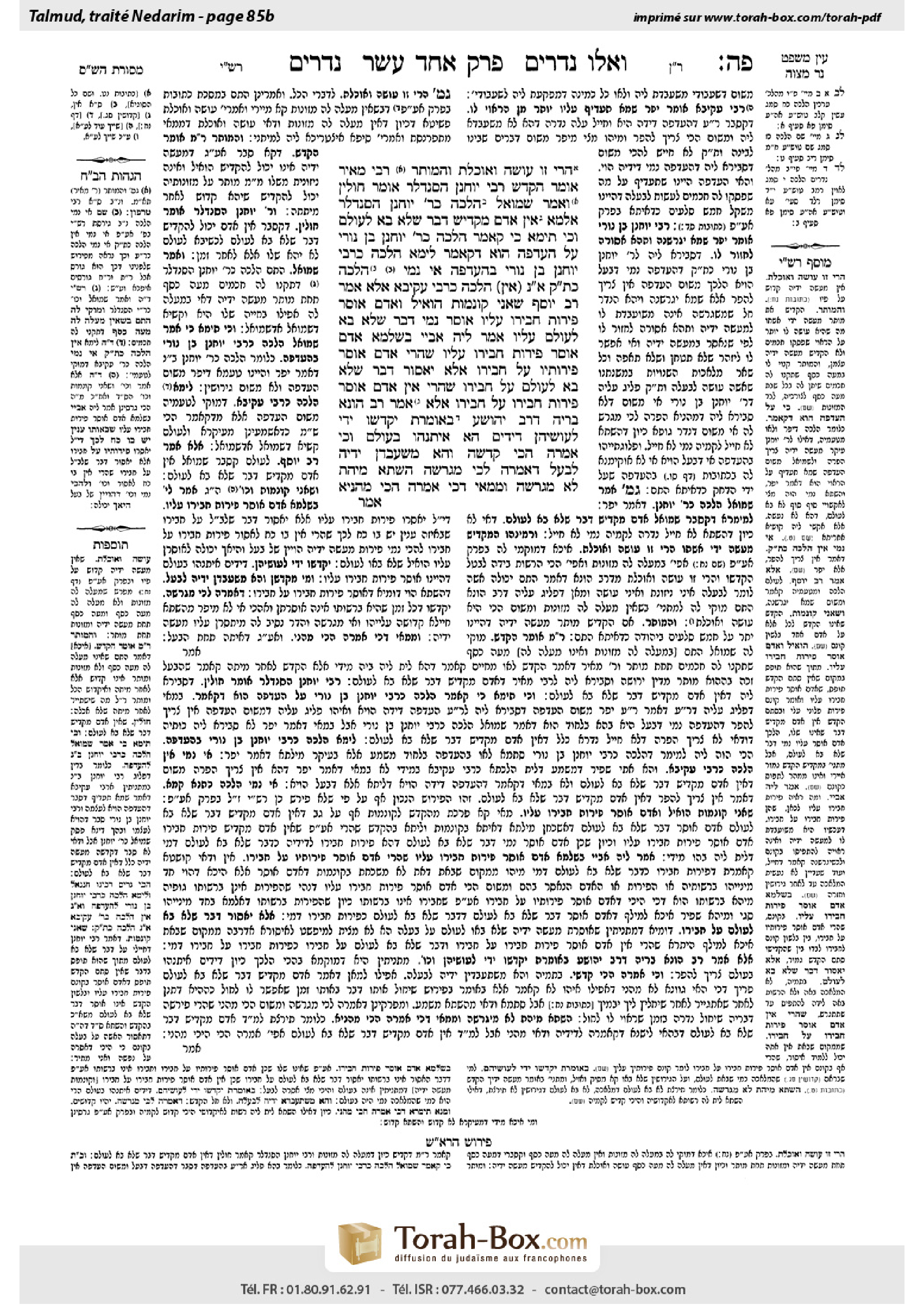
Nedarim 85b: Talmud study for Daf Yomi
Daf Yomi is the daily study of one Talmud folio. Explore 37 tractates with scans, Hebrew text, Sefaria English and AI-generated French translations where annotated.
Passage selection and English or AI-generated French translation are available where the scan has annotations. Daf Study is independent of Torah-Box and Sefaria.
Browse Nedarim · נדרים · All tractatesNedarim 85b text and translations
This page of Nedarim includes the Aramaic text, an English translation and an AI-generated French translation, alongside the scan above.
נדרים פ״ה ב · Aramaic and Hebrew text
הֲרֵי זוֹ עוֹשָׂה וְאוֹכֶלֶת. וְהַמּוֹתָר — רַבִּי מֵאִיר אוֹמֵר: הֶקְדֵּשׁ, רַבִּי יוֹחָנָן הַסַּנְדְּלָר אוֹמֵר: חוּלִּין. וְאָמַר שְׁמוּאֵל: הֲלָכָה כְּרַבִּי יוֹחָנָן הַסַּנְדְּלָר. אַלְמָא אֵין אָדָם מַקְדִּישׁ דָּבָר שֶׁלֹּא בָּא לְעוֹלָם.
וְכִי תֵּימָא: כִּי קָאָמַר הֲלָכָה כְּרַבִּי יוֹחָנָן בֶּן נוּרִי — עַל הַעֲדָפָה הוּא דְּקָאָמַר.
לֵימָא: הֲלָכָה כְּרַבִּי יוֹחָנָן בֶּן נוּרִי בְּהַעֲדָפָה. אִי נָמֵי: הֲלָכָה כְּתַנָּא קַמָּא. אִי נָמֵי: (אֵין) הֲלָכָה כְּרַבִּי עֲקִיבָא!
אֶלָּא אָמַר רַב יוֹסֵף: שָׁאנֵי קוּנָּמוֹת, הוֹאִיל וְאָדָם אוֹסֵר פֵּירוֹת חֲבֵירוֹ עָלָיו, אוֹסֵר נָמֵי דָּבָר שֶׁלֹּא בָּא לְעוֹלָם עָלָיו.
אֲמַר לֵיהּ אַבָּיֵי: בִּשְׁלָמָא אָדָם אוֹסֵר פֵּירוֹת חֲבֵירוֹ עָלָיו, שֶׁהֲרֵי אָדָם אוֹסֵר פֵּירוֹתָיו עַל חֲבֵירוֹ. אֶלָּא יֶאֱסוֹר דָּבָר שֶׁלֹּא בָּא לְעוֹלָם עַל חֲבֵירוֹ, שֶׁהֲרֵי אֵין אָדָם אוֹסֵר פֵּירוֹת חֲבֵירוֹ עַל חֲבֵירוֹ!
אֶלָּא אָמַר רַב הוּנָא בְּרֵיהּ דְּרַב יְהוֹשֻׁעַ: בְּאוֹמֶרֶת ״יִקְדְּשׁוּ יָדַי לְעוֹשֵׂיהֶן״, דְּיָדַיִם הָא אִיתַנְהוּ בָּעוֹלָם.
וְכִי אָמְרָה הָכִי — קָדְשָׁה? וְהָא מְשַׁעְבְּדָן יְדַיהּ לְבַעַל! דְּאָמְרָה: לְכִי מִגָּרְשָׁה. הַשְׁתָּא מִיהַת לָא מִגָּרְשָׁה, וּמִמַּאי דְּכִי אַמְרַהּ הָכִי מַהְנְיָא?
Nedarim 85b · English translation
she may work and sustain herself from her earnings, as the consecration is ineffective. And with regard to the surplus earnings, i.e., if she produced more than she needs for her sustenance, Rabbi Meir says the surplus becomes consecrated property, whereas Rabbi Yoḥanan HaSandlar says that it is non-sacred. And Shmuel said that the halakha is in accordance with the opinion of Rabbi Yoḥanan HaSandlar. Apparently, Shmuel’s opinion is that a person cannot consecrate an entity that has not yet come into the world, and therefore a man cannot consecrate earnings that his wife will produce only in the future.
And if you would say that when Shmuel is saying that the halakha is in accordance with the opinion of Rabbi Yoḥanan ben Nuri he was saying only that the halakha is such with regard to the surplus, there is a difficulty. One might say that since Rabbi Yoḥanan ben Nuri disagrees with Rabbi Akiva, he apparently maintains that a woman’s surplus earnings belong to her husband, and therefore she cannot render them forbidden to him through a vow, and it is only with respect to this point that Shmuel said that the halakha is in accordance with the opinion of Rabbi Yoḥanan ben Nuri. If this is the case, there is no contradiction between his ruling here and his ruling in Ketubot that the halakha with regard to one who consecrates his wife’s earnings is in accordance with the opinion of Rabbi Yoḥanan HaSandlar.
But if so, let Shmuel clearly say: The halakha is in accordance with the opinion of Rabbi Yoḥanan ben Nuri with regard to the surplus. Alternatively, he could have said that the halakha is in accordance with the opinion of the first tanna, who also maintains that the surplus belongs to the husband. Alternatively, he could have said that the halakha is not in accordance with the opinion of Rabbi Akiva, who asserts that the surplus belongs to the wife.
Rather, Rav Yosef said that the apparent contradiction between Shmuel’s rulings can be resolved in the following manner: Although one cannot consecrate an entity that has not yet come into the world, konamot are different; since a person can prohibit to himself another’s produce by means of a konam, even though one cannot consecrate another’s produce to the Temple, he can also prohibit to himself an entity that has not yet come into the world. With regard to consecration, however, a person cannot dedicate to the Temple treasury something that is not currently in his possession, and he cannot consecrate an entity that has not yet entered the world, either.
Abaye said to him: This is no proof at all. Granted, a person can prohibit another’s produce to himself, since a person can prohibit his own produce to another. But does it follow that he can also prohibit an entity that has not yet come into the world to another person, seeing that a person cannot prohibit another’s produce to that other person, as he has jurisdiction neither over the produce nor over the person to whom he wishes to prohibit it? Yet in the mishna here the woman prohibits her future earnings, which do not yet exist, to another person, i.e., her husband.
Rather, Rav Huna, son of Rav Yehoshua, said: Here the mishna is dealing with a woman who says: My hands are consecrated to the One Who made them. Therefore, the case does not involve the issue of an entity that has not yet come into the world, as her hands are already in the world.
The Gemara challenges this interpretation: And if she said her vow like this, are they consecrated and forbidden? But aren’t her hands pledged to her husband, to do the work she is obligated to perform for him? The Gemara answers: The mishna is referring to a woman who said: The vow will take effect when I become divorced. The Gemara raises a difficulty: She is not divorced now in any event, and from where is it learned that when she says her vow like this, the vow is effective? How is it learned that she can consecrate something in such a manner that it will become consecrated only in the future?
Nedarim 85b · Traduction française (IA)
Elle peut travailler et subvenir à ses besoins grâce à ses gains, car la consécration est sans effet. Quant au surplus de ses gains, c’est-à-dire si elle produit davantage que ce dont elle a besoin pour sa subsistance, Rabbi Meïr dit que le surplus devient un bien consacré, tandis que Rabbi Yoḥanan HaSandlar dit qu’il reste profane. Shmuel a dit que la halakha suit l’opinion de Rabbi Yoḥanan HaSandlar. Il semble donc que, selon Shmuel, une personne ne peut pas consacrer une chose qui n’est pas encore entrée dans le monde ; un homme ne peut donc pas consacrer les gains que sa femme ne produira qu’à l’avenir.
Et si l’on dit que, lorsque Shmuel affirme que la halakha suit l’opinion de Rabbi Yoḥanan ben Nuri, il ne parle que du surplus, une difficulté se pose. On pourrait dire que, puisque Rabbi Yoḥanan ben Nuri est en désaccord avec Rabbi Akiva, il estime manifestement que le surplus des gains d’une femme appartient à son mari ; elle ne peut donc pas les lui interdire par un vœu. Shmuel aurait alors dit que la halakha suit l’opinion de Rabbi Yoḥanan ben Nuri uniquement sur ce point. Dans ce cas, il n’y a aucune contradiction entre cette décision et celle qu’il a rendue dans Ketoubot : la halakha concernant celui qui consacre les gains de sa femme suit l’opinion de Rabbi Yoḥanan HaSandlar.
Mais alors, que Shmuel dise clairement : « La halakha suit l’opinion de Rabbi Yoḥanan ben Nuri en ce qui concerne le surplus. » Il aurait aussi pu dire que la halakha suit l’opinion du premier tanna, qui estime lui aussi que le surplus appartient au mari. Ou encore, il aurait pu dire que la halakha ne suit pas l’opinion de Rabbi Akiva, qui affirme que le surplus appartient à la femme.
Rav Yosef dit plutôt que la contradiction apparente entre les décisions de Shmuel peut être résolue ainsi : bien qu’on ne puisse pas consacrer une chose qui n’est pas encore entrée dans le monde, les konamot font exception. Puisqu’une personne peut s’interdire les produits d’autrui au moyen d’un konam, bien qu’elle ne puisse pas consacrer au Temple les produits d’autrui, elle peut aussi s’interdire une chose qui n’est pas encore entrée dans le monde. En revanche, en matière de consécration, une personne ne peut pas dédier au trésor du Temple une chose qui n’est pas actuellement en sa possession, ni consacrer une chose qui n’est pas encore entrée dans le monde.
Abaye lui dit : « Cela ne prouve absolument rien. Certes, une personne peut s’interdire les produits d’autrui, puisqu’elle peut interdire à autrui ses propres produits. Mais s’ensuit-il qu’elle peut aussi interdire à une autre personne une chose qui n’est pas encore entrée dans le monde, alors qu’une personne ne peut pas interdire à autrui les produits d’un tiers, puisqu’elle n’a d’autorité ni sur les produits ni sur la personne à laquelle elle veut les interdire ? Pourtant, dans notre Michna, la femme interdit à une autre personne ses gains futurs, qui n’existent pas encore, c’est-à-dire à son mari.»
Rav Houna, fils de Rav Yehoshoua, dit plutôt : ici, la Michna traite d’une femme qui dit : « Mes mains sont consacrées à Celui qui les a faites. » Le cas ne soulève donc pas la question d’une chose qui n’est pas encore entrée dans le monde, car ses mains existent déjà.
La Guemara conteste cette interprétation : « Si elle a formulé son vœu ainsi, ses mains sont-elles consacrées et interdites ? Mais ses mains ne sont-elles pas engagées envers son mari, pour accomplir le travail qu’elle est tenue de faire pour lui ? » La Guemara répond : « La Michna parle d’une femme qui a dit : “Le vœu prendra effet lorsque je serai divorcée.” » La Guemara soulève une difficulté : « Elle n’est pas encore divorcée ; d’où sait-on donc que, si elle formule son vœu ainsi, celui-ci prend effet ? Comment sait-on qu’elle peut consacrer une chose de manière qu’elle ne devienne consacrée qu’à l’avenir ? »
Traduction française générée par IA à partir de l’édition anglaise de Sefaria. Vérifie toujours un passage avec le texte source.
Text from Sefaria: William Davidson Edition - Vocalized Aramaic (CC BY NC); William Davidson Edition - English (CC BY NC).