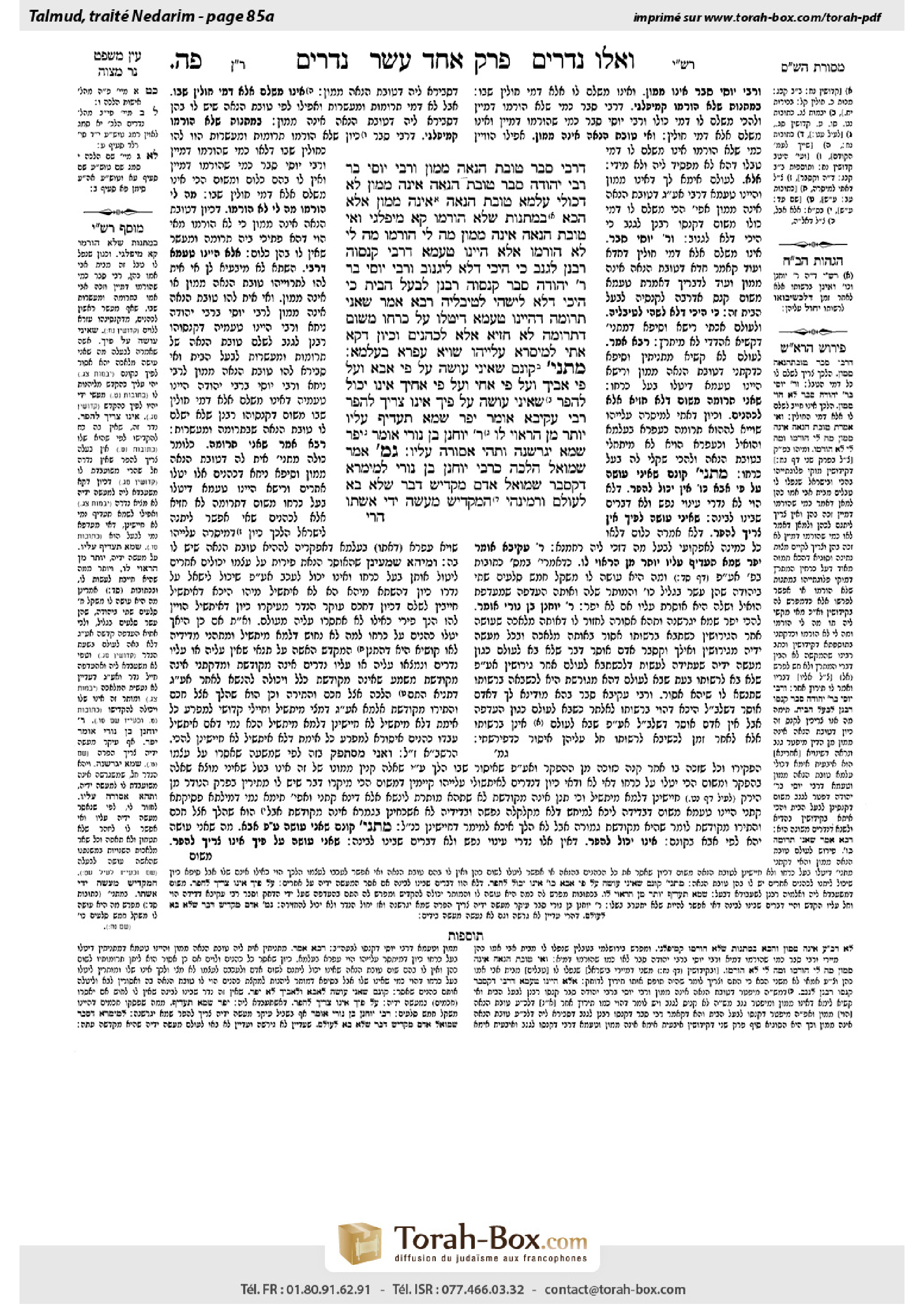
Nedarim 85a: Talmud study for Daf Yomi
Daf Yomi is the daily study of one Talmud folio. Explore 37 tractates with scans, Hebrew text, Sefaria English and AI-generated French translations where annotated.
Passage selection and English or AI-generated French translation are available where the scan has annotations. Daf Study is independent of Torah-Box and Sefaria.
Browse Nedarim · נדרים · All tractatesNedarim 85a text and translations
This page of Nedarim includes the Aramaic text, an English translation and an AI-generated French translation, alongside the scan above.
נדרים פ״ה א · Aramaic and Hebrew text
דְּרַבִּי סָבַר: טוֹבַת הֲנָאָה מָמוֹן, וְרַבִּי יוֹסֵי בַּר רַבִּי יְהוּדָה סָבַר: טוֹבַת הֲנָאָה אֵינָהּ מָמוֹן?
לָא, דְּכוּלֵּי עָלְמָא טוֹבַת הֲנָאָה אֵינָהּ מָמוֹן. אֶלָּא הָכָא בְּמַתָּנוֹת שֶׁלֹּא הוּרְמוּ קָא מִיפַּלְגִי.
וְאִי טוֹבַת הֲנָאָה אֵינָהּ מָמוֹן — מָה לִי הוּרְמוּ, מָה לִי לֹא הוּרְמוּ?
אֶלָּא, הַיְינוּ טַעְמָא דְרַבִּי: קַנְסוּהּ רַבָּנַן לְגַנָּב כִּי הֵיכִי דְּלָא לִיגְנוֹב. וְרַבִּי יוֹסֵי בַּר רַבִּי יְהוּדָה סָבַר: קַנְסוּהּ רַבָּנַן לְבַעַל הַבַּיִת, כִּי הֵיכִי דְּלָא לִישַׁהֵי לְטִיבְלֵיהּ.
רָבָא אָמַר: שָׁאנֵי תְּרוּמָה, דְּהַיְינוּ טַעְמָא דְּיִטְּלוּ עַל כׇּרְחוֹ — מִשּׁוּם דִּתְרוּמָה לָא חַזְיָא אֶלָּא לְכֹהֲנִים, וְכֵיוָן דְּקָא אָתֵי לְמֵיסְרָא עֲלַיְיהוּ, שַׁוְּיָא עַפְרָא בְּעָלְמָא.
מַתְנִי׳ ״קֻוֽנָּם שֶׁאֵינִי עוֹשָׂה עַל פִּי אַבָּא״, וְ״עַל פִּי אָבִיךָ״, וְ״עַל פִּי אָחִי״, וְ״עַל פִּי אָחִיךָ״ — אֵינוֹ יָכוֹל לְהָפֵר. ״שֶׁאֵינִי עוֹשָׂה עַל פִּיךָ״ — אֵינוֹ צָרִיךְ לְהָפֵר.
רַבִּי עֲקִיבָא אוֹמֵר: יָפֵר, שֶׁמָּא תַּעֲדִיף עָלָיו יוֹתֵר מִן הָרָאוּי לוֹ.
רַבִּי יוֹחָנָן בֶּן נוּרִי אוֹמֵר: יָפֵר, שֶׁמָּא יְגָרְשֶׁנָּה וּתְהִי אֲסוּרָה עָלָיו.
גְּמָ׳ אָמַר שְׁמוּאֵל: הֲלָכָה כְּרַבִּי יוֹחָנָן בֶּן נוּרִי. לְמֵימְרָא דְּקָסָבַר שְׁמוּאֵל אָדָם מַקְדִּישׁ דָּבָר שֶׁלֹּא בָּא לְעוֹלָם? וּרְמִינְהִי: הַמַּקְדִּישׁ מַעֲשֵׂה יְדֵי אִשְׁתּוֹ —
Nedarim 85a · English translation
That Rabbi Yehuda HaNasi holds that the benefit of discretion is considered to have monetary value, and therefore a thief must pay the full value of the untithed produce. The owner has monetary rights in the priestly and Levitical gifts, by virtue of the fact that he may give his teruma and tithes to the priest and Levite of his choice. And Rabbi Yosei, son of Rabbi Yehuda, holds that the benefit of discretion is not considered to have monetary value, meaning that the owner of the produce has no monetary rights whatsoever in the teruma and tithes included in the untithed produce.
The Gemara rejects this explanation: No, as everyone agrees that the benefit of discretion is not considered to have monetary value. Rather, here they disagree with regard to whether priestly and Levitical gifts that have not yet been separated are considered as if they have already been separated, meaning the dispute is whether the untithed produce is categorized as a mixture of regular produce and tithes, or as a non-sacred category in and of itself. If they are not seen as having already been separated, the thief must restore everything he took. But if they are regarded as having already been separated, then the thief returns only the non-sacred portion of the produce, as the priestly and Levitical gifts did not belong to the owner.
The Gemara counters this argument: But if the benefit of discretion is not considered to have monetary value, what is the difference to me if the gifts have already been separated, and what is the difference to me if they have not yet been separated? Either way, the owner of the produce has no monetary rights in the portions of teruma and tithes contained in the untithed produce.
Rather, one must explain that this is the reasoning of Rabbi Yehuda HaNasi: The Sages penalized the thief so that he would not steal again by requiring him to repay the full value of what he stole, despite the fact that the owner of the untithed produce has no monetary rights in the teruma and tithes included in it. And Rabbi Yosei, son of Rabbi Yehuda, holds that the Sages penalized the owner of the produce, awarding him only the value of the non-sacred portion of the produce, so that in the future he would not delay with his untithed produce, but rather separate its teruma and tithes as soon as the produce is harvested. Had he set aside and distributed the gifts promptly they would not have been stolen.
Rava said that there is another way to reconcile the apparent contradiction in the mishna: As stated, the second case, where the person prohibits specific priests and Levites from benefiting from him, indicates that the benefit of discretion is considered to have monetary value. However, teruma is different, as this is the reason that priests can take teruma from him against his will in a case where one prohibited all priests from deriving benefit from him: Because teruma is fit only for priests, and since he came to render it prohibited to them, he made it, for him, like mere dust. If this teruma, which certainly cannot be eaten by Israelites, is now forbidden to priests as well, the owner has effectively removed it from his own possession. Therefore, the priests do not derive any benefit from him if they take it.
MISHNA: If a woman said: I will not produce anything for my father, as that is konam for me, or: For your father, or: For my brother, or: For your brother, her husband cannot nullify such vows, as they do not fall under the category of vows that adversely affect the relationship between him and her. By contrast, if she said: I will not produce anything for you, including the work that she is obligated to do for him according to the terms of her marriage contract, as that is konam for me, her husband need not nullify the vow at all. It is automatically void, since she is obligated to perform those tasks.
Rabbi Akiva says: He should nevertheless nullify the vow, as perhaps she will exceed the required amount of work and do more for him than is fitting for him to receive. If she does more than the fixed amount of work that a woman is obligated to perform for her husband, the vow will be valid with respect to the excess to which he is not entitled, and he might inadvertently come to benefit from something that is forbidden to him.
Rabbi Yoḥanan ben Nuri also says that he should nullify the vow, but for a different reason: Perhaps he will one day divorce her, at which point the vow will take effect and she will then be forbidden to him forever, i.e., he will be unable to remarry her, lest he come to benefit from her labor.
GEMARA: Shmuel said: The halakha is in accordance with the opinion of Rabbi Yoḥanan ben Nuri. The Gemara asks: Is this to say that Shmuel maintains that a person can consecrate an entity that has not yet come into the world? According to Rabbi Yoḥanan ben Nuri, her vow is valid with respect to things she will do after her divorce, even though at present she is not divorced and she has not yet produced anything. And the Gemara raises a contradiction from a mishna (Ketubot 58b): If one consecrates his wife’s earnings,
Nedarim 85a · Traduction française (IA)
Rabbi Yehouda HaNassi estime que le bénéfice lié au choix du destinataire a une valeur monétaire ; un voleur doit donc payer la valeur totale des produits non encore soumis aux dîmes. Le propriétaire détient des droits pécuniaires sur les dons destinés aux prêtres et aux Lévites, puisqu’il peut donner sa terouma et ses dîmes au prêtre et au Lévite de son choix. Rabbi Yossé, fils de Rabbi Yehouda, estime quant à lui que le bénéfice lié au choix du destinataire n’a pas de valeur monétaire ; autrement dit, le propriétaire des produits ne détient aucun droit pécuniaire sur la terouma et les dîmes comprises dans les produits non encore soumis aux dîmes.
La Guemara rejette cette explication : non, tous s’accordent à dire que le bénéfice lié au choix du destinataire n’a pas de valeur monétaire. Leur désaccord porte plutôt sur la question de savoir si les dons destinés aux prêtres et aux Lévites qui n’ont pas encore été prélevés sont considérés comme s’ils l’avaient déjà été ; autrement dit, le débat porte sur la question de savoir si les produits non encore soumis aux dîmes sont considérés comme un mélange de produits ordinaires et de dîmes, ou comme une catégorie profane à part entière. S’ils ne sont pas considérés comme déjà prélevés, le voleur doit restituer tout ce qu’il a pris. Mais s’ils sont considérés comme déjà prélevés, le voleur ne restitue que la part profane des produits, car les dons destinés aux prêtres et aux Lévites n’appartenaient pas au propriétaire.
La Guemara objecte : mais si le bénéfice lié au choix du destinataire n’a pas de valeur monétaire, quelle différence cela fait-il que les dons aient déjà été prélevés ou non ? Dans les deux cas, le propriétaire des produits ne détient aucun droit pécuniaire sur les parts de terouma et de dîmes contenues dans les produits non encore soumis aux dîmes.
Il faut plutôt expliquer ainsi le raisonnement de Rabbi Yehouda HaNassi : les Sages ont pénalisé le voleur afin qu’il ne recommence pas à voler, en lui imposant de rembourser la valeur totale de ce qu’il a volé, bien que le propriétaire des produits non encore soumis aux dîmes ne détienne aucun droit pécuniaire sur la terouma et les dîmes qu’ils contiennent. Rabbi Yossé, fils de Rabbi Yehouda, estime quant à lui que les Sages ont pénalisé le propriétaire des produits : ils ne lui accordent que la valeur de leur part profane, afin qu’à l’avenir il ne tarde pas à traiter ses produits non encore soumis aux dîmes, mais en prélève la terouma et les dîmes dès la récolte. S’il avait prélevé et distribué les dons sans tarder, ils n’auraient pas été volés.
Rava dit qu’il existe une autre manière de résoudre la contradiction apparente dans la Michna : comme cela a été dit, le deuxième cas, où la personne interdit à des prêtres et à des Lévites déterminés de tirer profit d’elle, indique que le bénéfice lié au choix du destinataire a une valeur monétaire. Cependant, le cas de la terouma est différent, car voici pourquoi les prêtres peuvent la prendre chez lui contre son gré, lorsqu’il a interdit à tous les prêtres de tirer profit de lui : la terouma ne convient qu’aux prêtres et, puisqu’il a voulu la leur interdire, il l’a rendue, à ses yeux, semblable à de la poussière. Si cette terouma, que les Israélites ne peuvent certainement pas consommer, est désormais également interdite aux prêtres, le propriétaire l’a de fait retirée de sa propre possession. Par conséquent, les prêtres ne tirent aucun profit de lui en la prenant.
Michna : Si une femme a dit : « Que rien de ce que je produis ne profite à mon père, car cela m’est konam », ou : « à ton père », ou : « à mon frère », ou : « à ton frère », son mari ne peut pas annuler de tels vœux, car ils ne relèvent pas de la catégorie des vœux qui nuisent à leur relation. En revanche, si elle a dit : « Que rien de ce que je produis ne te profite, car cela m’est konam », y compris le travail qu’elle est tenue d’accomplir pour lui selon les clauses de son contrat de mariage, son mari n’a pas besoin d’annuler le vœu : il est automatiquement nul, puisqu’elle est tenue d’effectuer ces tâches.
Rabbi Akiva dit : il doit néanmoins annuler le vœu, car peut-être accomplira-t-elle plus de travail que la quantité requise et fera-t-elle pour lui davantage que ce qu’il est en droit de recevoir. Si elle fait plus que la quantité fixe de travail qu’une femme est tenue d’accomplir pour son mari, le vœu sera valide pour ce surplus auquel il n’a pas droit, et il pourrait, par inadvertance, tirer profit d’une chose qui lui est interdite.
Rabbi Yoḥanan ben Nouri dit lui aussi qu’il doit annuler le vœu, mais pour une autre raison : peut-être la répudiera-t-il un jour ; le vœu prendra alors effet et elle lui sera interdite à jamais, c’est-à-dire qu’il ne pourra pas l’épouser de nouveau, de peur qu’il ne tire profit de son travail.
Guemara : Shmouel dit : la halakha suit l’opinion de Rabbi Yoḥanan ben Nouri. La Guemara demande : faut-il en conclure que Shmouel estime qu’une personne peut consacrer une chose qui n’est pas encore venue au monde ? Selon Rabbi Yoḥanan ben Nouri, son vœu est valide pour les choses qu’elle fera après son divorce, bien qu’à présent elle ne soit pas divorcée et n’ait encore rien produit. La Guemara soulève une contradiction à partir d’une Michna (Ketoubot 58b) : si quelqu’un consacre les revenus du travail de sa femme,
Traduction française générée par IA à partir de l’édition anglaise de Sefaria. Vérifie toujours un passage avec le texte source.
Text from Sefaria: William Davidson Edition - Vocalized Aramaic (CC BY NC); William Davidson Edition - English (CC BY NC).