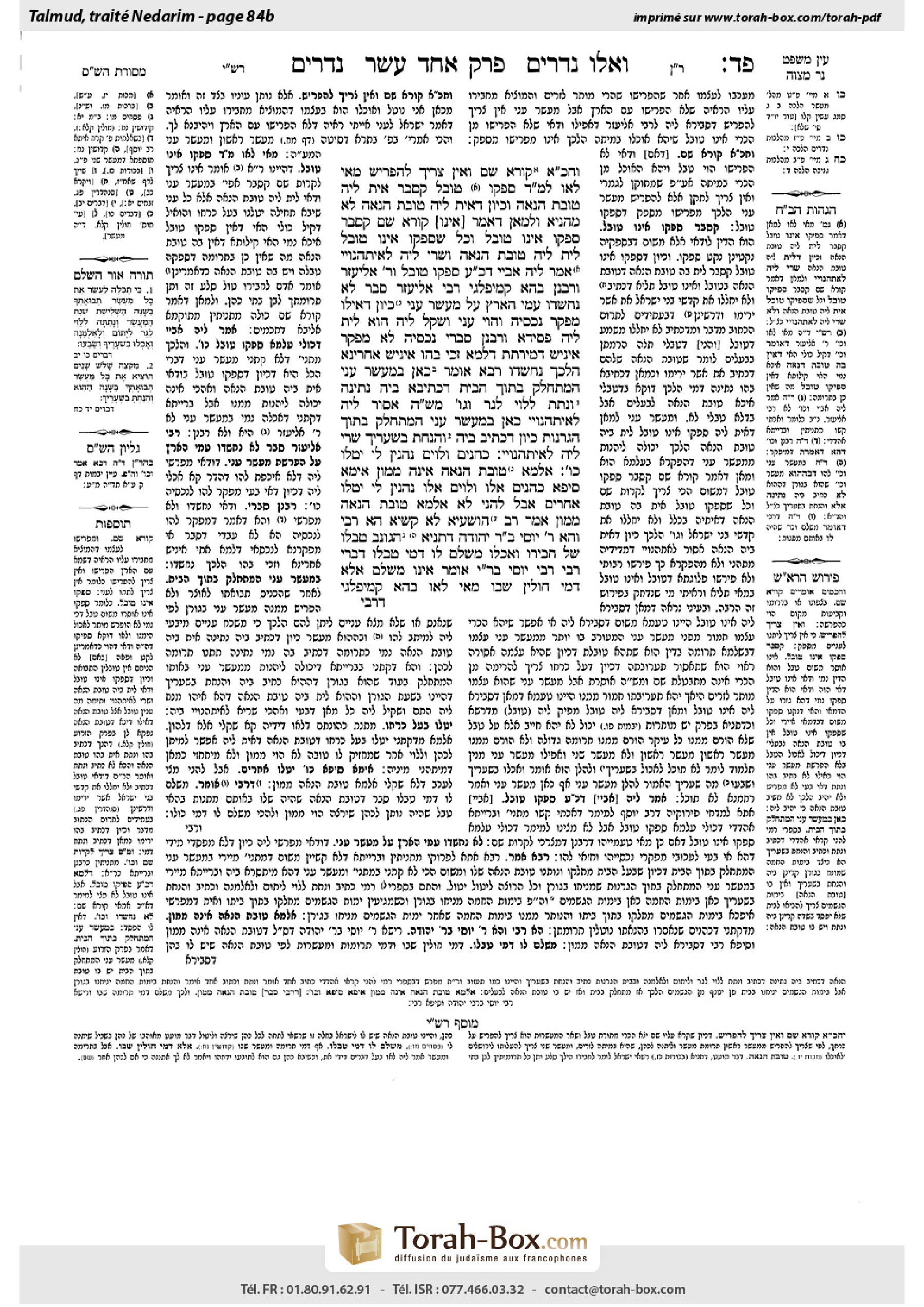
Nedarim 84b: Talmud study for Daf Yomi
Daf Yomi is the daily study of one Talmud folio. Explore 37 tractates with scans, Hebrew text, Sefaria English and AI-generated French translations where annotated.
Passage selection and English or AI-generated French translation are available where the scan has annotations. Daf Study is independent of Torah-Box and Sefaria.
Browse Nedarim · נדרים · All tractatesNedarim 84b text and translations
This page of Nedarim includes the Aramaic text, an English translation and an AI-generated French translation, alongside the scan above.
נדרים פ״ד ב · Aramaic and Hebrew text
וַחֲכָמִים אוֹמְרִים: קוֹרֵא שֵׁם, וְאֵין צָרִיךְ לְהַפְרִישׁ. מַאי לָאו, לְמַאן דְּאָמַר סְפֵקוֹ טוֹבֵל, קָסָבַר: אִית לֵיהּ טוֹבַת הֲנָאָה, וְכֵיוָן דְּאִית לֵיהּ טוֹבַת הֲנָאָה — לָא מַהְנְיָא.
וּלְמַאן דְּאָמַר [אֵינוֹ] קוֹרֵא שֵׁם, קָסָבַר: סְפֵקוֹ אֵינוֹ טוֹבֵל, וְכׇל שֶׁסְּפֵקוֹ אֵינוֹ טוֹבֵל — לֵית לֵיהּ טוֹבַת הֲנָאָה, וּשְׁרֵי לֵיהּ לְאִיתְהֲנוֹיֵי.
אֲמַר לֵיהּ אַבָּיֵי: דְּכוּלֵּי עָלְמָא סְפֵקוֹ טוֹבֵל, וְרַבִּי אֱלִיעֶזֶר וְרַבָּנַן בְּהָא קָמִיפַּלְגִי. רַבִּי אֱלִיעֶזֶר סָבַר: לֹא נֶחְשְׁדוּ עַמֵּי הָאָרֶץ עַל מַעְשַׂר עָנִי. כֵּיוָן דְּאִילּוּ מַפְקַר נִכְסֵיהּ וְהָוֵי עָנִי וְשָׁקֵל לֵיהּ הוּא — לֵית לֵיהּ פְּסֵידָא.
וְרַבָּנַן סָבְרִי: נִכְסֵיהּ לָא מַפְקַר אִינִישׁ, דְּמִירְתַת דִּלְמָא זָכֵי בְּהוּ אִינִישׁ אַחֲרִינָא. הִלְכָּךְ — נֶחְשְׁדוּ.
רָבָא אוֹמֵר: כָּאן בְּמַעְשַׂר עָנִי הַמִּתְחַלֵּק בְּתוֹךְ הַבַּיִת, דִּכְתִיבָא בֵּיהּ נְתִינָה: ״וְנָתַתָּה לַלֵּוִי לַגֵּר וְגוֹ׳״ — מִשּׁוּם הָכִי אָסוּר לֵיהּ לְאִיתְהֲנוֹיֵי.
כָּאן בְּמַעְשַׂר עָנִי הַמִּתְחַלֵּק בְּתוֹךְ הַגֳּרָנוֹת. כֵּיוָן דִּכְתִיב בֵּיהּ ״וְהִנַּחְתָּ בִּשְׁעָרֶיךָ״, שְׁרֵי לֵיהּ לְאִיתְהֲנוֹיֵי.
כֹּהֲנִים וּלְוִיִּם נֶהֱנִין לִי יִטְּלוּ כּוּ׳. אַלְמָא טוֹבַת הֲנָאָה אֵינָהּ מָמוֹן.
אֵימָא סֵיפָא: ״כֹּהֲנִים אֵלּוּ וּלְוִיִּם אֵלּוּ נֶהֱנִין לִי״ — יִטְּלוּ אֲחֵרִים, אֲבָל לְהָנֵי — לָא. אַלְמָא טוֹבַת הֲנָאָה מָמוֹן!
אָמַר רַב הוֹשַׁעְיָא: לָא קַשְׁיָא, הָא רַבִּי, וְהָא רַבִּי יוֹסֵי בְּרַבִּי יְהוּדָה. דְּתַנְיָא: הַגּוֹנֵב טִבְלוֹ שֶׁל חֲבֵירוֹ וַאֲכָלוֹ — מְשַׁלֵּם לוֹ דְּמֵי טִבְלוֹ, דִּבְרֵי רַבִּי. רַבִּי יוֹסֵי בְּרַבִּי יְהוּדָה אוֹמֵר: אֵינוֹ מְשַׁלֵּם אֶלָּא דְּמֵי חוּלִּין שֶׁבּוֹ. מַאי לָאו בְּהָא קָמִיפַּלְגִי,
Nedarim 84b · English translation
And the Rabbis say: He must designate poor man’s tithe by name, but he need not actually set it aside and give it to anyone, as a poor person cannot claim the tithe without bringing proof that he has a right to it. Rav Yosef now suggests: What, is it not that according to the one, i.e., the Rabbis, who says that the uncertainty as to whether or not poor man’s tithe had been separated by the am ha’aretz renders the produce forbidden as untithed produce [tevel], and therefore the owner of the produce must designate the poor man’s tithe by name, he holds that the owner of the produce has the benefit of discretion, meaning that he may give the poor man’s tithe to the poor person of his choice. And since he has the benefit of discretion, the option that a woman who vowed not to benefit from people should take poor man’s tithe is ineffective, as she would be receiving benefit from the owner of the tithe, since he could have given it to someone else.
Rav Yosef continues: And according to the one, i.e., Rabbi Eliezer, who says that he need not designate poor man’s tithe by name, he holds that the uncertainty as to whether or not poor man’s tithe had been separated by the am ha’aretz does not render the produce forbidden as untithed produce. And whenever the case is that uncertainty does not render the produce forbidden as untithed produce, the owner does not have the benefit of discretion and does not choose to which poor person he will give it. And therefore one who vowed not to benefit from people is permitted to derive benefit from poor man’s tithe, as he is not receiving it from anyone.
Abaye said to him: This proof is not conclusive, as it may be that everyone agrees that the uncertainty as to whether or not poor man’s tithe had been separated by the am ha’aretz renders the produce forbidden as untithed produce, and that Rabbi Eliezer and the Rabbis disagree with regard to this issue: Rabbi Eliezer maintains that amei ha’aretz are not suspected of failing to set aside poor man’s tithe. Therefore, one who purchases demai from an am ha’aretz need not be concerned that its poor man’s tithe might not have been set aside. Rabbi Eliezer maintains this opinion because were the am ha’aretz to declare all his property ownerless and therefore become a poor man, and then take the poor man’s tithe himself, he would suffer no loss when he set aside this tithe, and therefore it is assumed that he separated it.
And the Rabbis maintain that while it is theoretically possible for one to avoid having to actually part from his poor man’s tithe, this is uncommon, as a person does not ordinarily declare his property ownerless for this purpose, as he is afraid that perhaps someone else will acquire it in the meantime. Consequently, one who sets aside poor man’s tithe from his produce is assumed to incur a loss, and therefore amei ha’aretz are suspected with regard to this tithe. Accordingly, no satisfactory explanation has yet been given as to why the baraita permits a woman who vowed not to derive benefit from people to take poor man’s tithe.
Rava says that it is possible to explain the apparent contradiction between the sources with regard to benefit from poor man’s tithe without recourse to a tannaitic dispute: Here, the mishna is referring to poor man’s tithe distributed in the owner’s house, i.e., poor man’s tithe that had not been distributed in the threshing floor but was brought home and must now be distributed to the poor who visit the house, as the term giving is written in the verse with regard to such a tithe: “And you shall give to the Levite, to the stranger, to the orphan, and to the widow” (Deuteronomy 26:12), and the owner is entitled to give the tithe to the poor man of his choice, as the benefit of discretion is conferred upon him. Due to that reason, it is prohibited for one who vowed not to derive benefit from people to derive benefit from this type of poor man’s tithe.
There, however, the baraita is referring to poor man’s tithe that is distributed in the threshing floor. Since with regard to such a tithe it is written: “And you shall leave it at your gates” (Deuteronomy 14:28), the owner cannot designate it for a particular person, and any poor person who comes by may take it from him. As the owner lacks the benefit of discretion, one who vows not to benefit from people is permitted to benefit from this poor man’s tithe.
§ The mishna teaches that if one said: I will not let priests and Levites benefit from me, they can take the priestly and Levitical gifts from him against his will. The Gemara notes: Apparently, the benefit of discretion to give his teruma and tithes to the priest or Levite of his choice is not considered to have monetary value. The priests and Levites can take the gifts from the owner of the produce against his will, and the latter is not regarded as having conferred benefit upon them.
But say the latter clause of the mishna, which states that if the person said: I will not let these specific priests and these specific Levites benefit from me, these gifts are taken by others. But these priests and Levites specified in his vow may not take these gifts. Apparently, this ruling indicates that the benefit of discretion is considered to have monetary value, and therefore the owner can prohibit specific priests or Levites from deriving benefit from him.
Rav Hoshaya said: This is not difficult; this second ruling is in accordance with the opinion of Rabbi Yehuda HaNasi, and that first ruling is in accordance with the opinion of Rabbi Yosei, son of Rabbi Yehuda, as it is taught in a baraita: If one steals another’s untithed produce and eats it, he must pay him the value of his untithed produce, i.e., the full value of what he stole. This is the statement of Rabbi Yehuda HaNasi. Rabbi Yosei, son of Rabbi Yehuda, disagrees and says: He pays him only the value of the non-sacred produce it contained. The thief does not have to pay him the value of the teruma and tithe included in the untithed produce, as these portions do not belong to the owner of the produce. What, is it not the case that they disagree about this:
Nedarim 84b · Traduction française (IA)
Et les Sages disent : il doit désigner la première dîme du pauvre, mais il n’est pas nécessaire qu’il la mette effectivement de côté et la donne à quelqu’un, car un pauvre ne peut réclamer cette dîme sans prouver qu’il y a droit. Rav Yossef avance alors : n’est-ce pas que celui qui dit — c’est-à-dire les Sages — que l’incertitude quant au fait que l’am ha’aretz ait ou non prélevé la dîme du pauvre rend les produits interdits comme produits non soumis à la dîme [tevel], et que le propriétaire doit donc désigner la dîme du pauvre, considère que le propriétaire des produits bénéficie d’un pouvoir discrétionnaire, c’est-à-dire qu’il peut donner la dîme du pauvre à celui des pauvres qu’il choisit ? Puisqu’il bénéficie de ce pouvoir discrétionnaire, la solution consistant à laisser une femme ayant fait vœu de ne tirer aucun profit des gens prendre la dîme du pauvre est inopérante : elle recevrait un avantage du propriétaire de la dîme, qui aurait pu la donner à quelqu’un d’autre.
Rav Yossef poursuit : et selon celui qui dit — c’est-à-dire Rabbi Eliezer — qu’il n’est pas nécessaire de désigner la dîme du pauvre, l’incertitude quant au fait que l’am ha’aretz l’ait ou non prélevée ne rend pas les produits interdits comme produits non soumis à la dîme. Or, chaque fois que l’incertitude ne rend pas les produits interdits comme produits non soumis à la dîme, le propriétaire ne bénéficie pas d’un pouvoir discrétionnaire et ne choisit pas à quel pauvre donner la dîme. Par conséquent, celui qui a fait vœu de ne tirer aucun profit des gens est autorisé à tirer profit de la dîme du pauvre, puisqu’il ne la reçoit de personne.
Abayé lui dit : cette preuve n’est pas concluante, car il se peut que tous conviennent que l’incertitude quant au fait que l’am ha’aretz ait ou non prélevé la dîme du pauvre rende les produits interdits comme produits non soumis à la dîme, et que Rabbi Eliezer et les Sages divergent sur ce point : Rabbi Eliezer soutient que les amei ha’aretz ne sont pas soupçonnés de ne pas prélever la dîme du pauvre. Par conséquent, celui qui achète du demaï à un am ha’aretz n’a pas à craindre que la dîme du pauvre n’ait pas été prélevée. Rabbi Eliezer soutient cette opinion parce que, si l’am ha’aretz déclarait tous ses biens sans propriétaire, devenait ainsi pauvre, puis prélevait lui-même la dîme du pauvre, il ne subirait aucune perte en la prélevant. On présume donc qu’il l’a prélevée.
Les Sages, quant à eux, soutiennent que, bien qu’il soit théoriquement possible d’éviter de se dessaisir effectivement de la dîme du pauvre, cela est inhabituel : une personne ne déclare pas ordinairement ses biens sans propriétaire à cette fin, car elle craint que quelqu’un d’autre ne les acquière entre-temps. Par conséquent, on présume que celui qui prélève la dîme du pauvre sur ses produits subit une perte ; les amei ha’aretz sont donc soupçonnés de ne pas l’avoir prélevée. Ainsi, aucune explication satisfaisante n’a encore été donnée pour expliquer pourquoi la baraïta autorise une femme ayant fait vœu de ne tirer aucun profit des gens à prendre la dîme du pauvre.
Rava dit qu’il est possible d’expliquer la contradiction apparente entre les sources concernant le fait de tirer profit de la dîme du pauvre sans recourir à un désaccord entre tannaim : ici, la Michna parle de la dîme du pauvre distribuée dans la maison du propriétaire, c’est-à-dire d’une dîme qui n’a pas été distribuée sur l’aire de battage, mais rapportée à la maison pour être distribuée aux pauvres qui s’y présentent. En effet, le verset emploie le terme « donner » à propos d’une telle dîme : « Et tu la donneras au Lévite, à l’étranger, à l’orphelin et à la veuve » (Deutéronome 26, 12). Le propriétaire a le droit de donner la dîme au pauvre de son choix, car il bénéficie d’un pouvoir discrétionnaire. Pour cette raison, celui qui a fait vœu de ne tirer aucun profit des gens n’a pas le droit de tirer profit de cette forme de dîme du pauvre.
Là-bas, en revanche, la baraïta parle de la dîme du pauvre distribuée sur l’aire de battage. Puisqu’il est écrit à propos d’une telle dîme : « Et tu la laisseras à tes portes » (Deutéronome 14, 28), le propriétaire ne peut pas la réserver à une personne en particulier ; tout pauvre qui passe peut la prendre. Comme le propriétaire ne bénéficie pas d’un pouvoir discrétionnaire, celui qui fait vœu de ne tirer aucun profit des gens est autorisé à tirer profit de cette dîme du pauvre.
§ La Michna enseigne que si quelqu’un a dit : « Je ne laisserai pas les prêtres et les Lévites tirer profit de moi », ils peuvent prendre contre son gré les dons sacerdotaux et lévitiques. La Guemara relève : apparemment, le pouvoir discrétionnaire de donner sa terouma et ses dîmes au prêtre ou au Lévite de son choix n’est pas considéré comme ayant une valeur monétaire. Les prêtres et les Lévites peuvent prendre ces dons au propriétaire des produits contre son gré, sans que l’on considère que celui-ci leur ait accordé un avantage.
Mais considérons la dernière partie de la Michna, qui dit que si la personne a dit : « Je ne laisserai pas ces prêtres-ci et ces Lévites-ci tirer profit de moi », les dons sont pris par d’autres. En revanche, les prêtres et les Lévites visés par son vœu ne peuvent pas prendre ces dons. Apparemment, cette décision indique que le pouvoir discrétionnaire est considéré comme ayant une valeur monétaire ; le propriétaire peut donc empêcher certains prêtres ou Lévites de tirer profit de lui.
Rav Hoshaya dit : il n’y a pas de difficulté ; cette seconde décision est conforme à l’opinion de Rabbi Yehouda HaNassi, tandis que la première est conforme à l’opinion de Rabbi Yossi, fils de Rabbi Yehouda, comme l’enseigne une baraïta : si quelqu’un vole les produits non soumis à la dîme d’autrui et les mange, il doit lui payer la valeur de ces produits, c’est-à-dire la valeur totale de ce qu’il a volé. Telle est la déclaration de Rabbi Yehouda HaNassi. Rabbi Yossi, fils de Rabbi Yehouda, n’est pas d’accord et dit : il ne lui paie que la valeur des produits profanes qu’ils contiennent. Le voleur n’a pas à lui payer la valeur de la terouma et de la dîme comprises dans les produits non soumis à la dîme, car ces parts n’appartiennent pas au propriétaire des produits. N’est-ce pas sur ce point qu’ils divergent :
Traduction française générée par IA à partir de l’édition anglaise de Sefaria. Vérifie toujours un passage avec le texte source.
Text from Sefaria: William Davidson Edition - Vocalized Aramaic (CC BY NC); William Davidson Edition - English (CC BY NC).