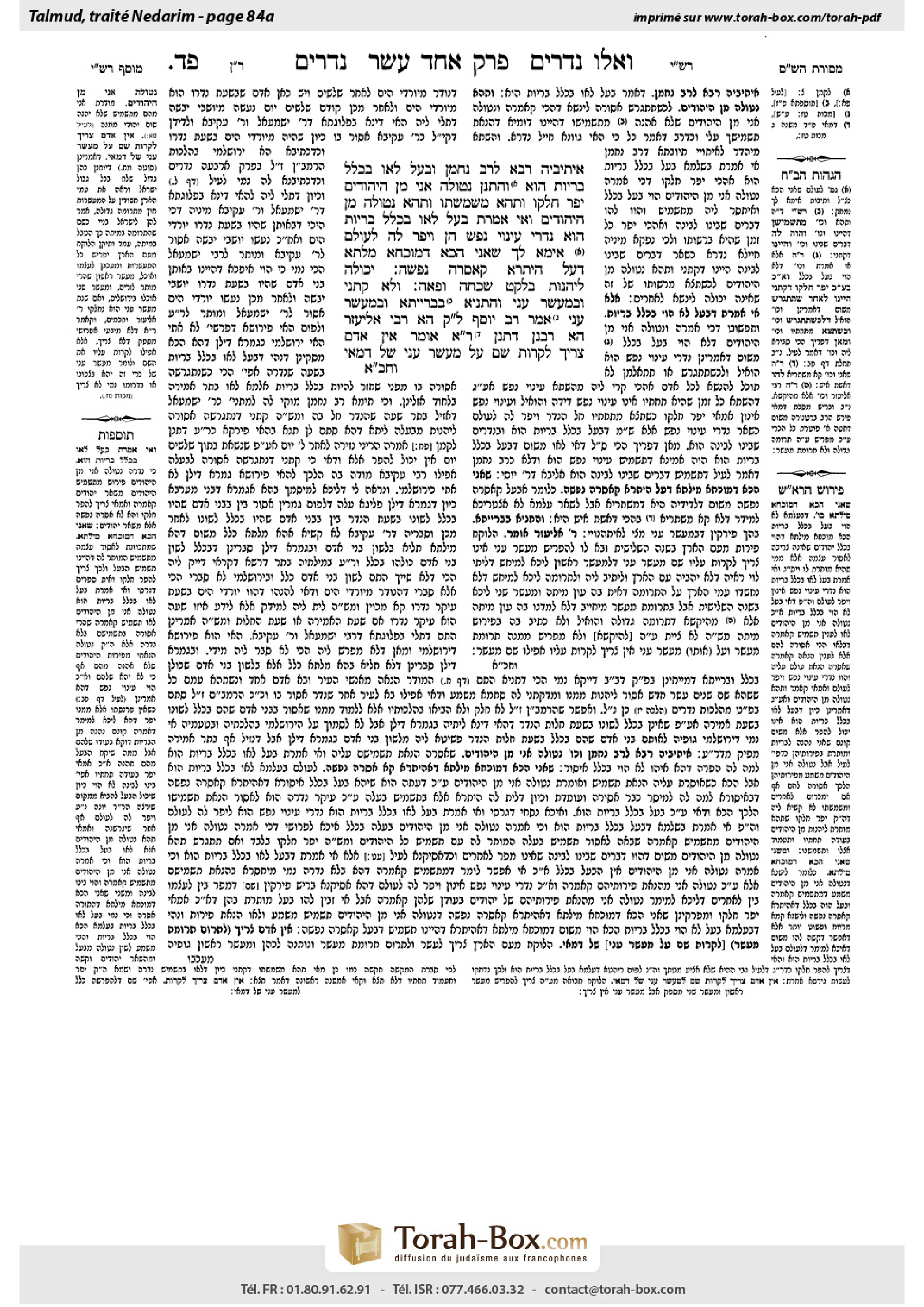
Nedarim 84a: Talmud study for Daf Yomi
Daf Yomi is the daily study of one Talmud folio. Explore 37 tractates with scans, Hebrew text, Sefaria English and AI-generated French translations where annotated.
Passage selection and English or AI-generated French translation are available where the scan has annotations. Daf Study is independent of Torah-Box and Sefaria.
Browse Nedarim · נדרים · All tractatesNedarim 84a text and translations
This page of Nedarim includes the Aramaic text, an English translation and an AI-generated French translation, alongside the scan above.
נדרים פ״ד א · Aramaic and Hebrew text
אֵיתִיבֵיהּ רָבָא לְרַב נַחְמָן: וּבַעַל לָאו בִּכְלַל בְּרִיּוֹת הוּא? וְהָתְנַן: ״נְטוּלָה אֲנִי מִן הַיְּהוּדִים״ — יָפֵר חֶלְקוֹ, וּתְהֵא מְשַׁמַּשְׁתּוֹ, וּתְהֵא נְטוּלָה מִן הַיְּהוּדִים.
וְאִי אָמְרַתְּ בַּעַל לָאו בִּכְלַל ״בְּרִיּוֹת״ הוּא, נִדְרֵי עִינּוּי נֶפֶשׁ הֵן, וְיָפֵר לָהּ לְעוֹלָם!
אֵימָא לָךְ: שָׁאנֵי הָכָא, דְּמוֹכְחָא מִלְּתָא דְּעַל הֶיתֵּרָא קָאָסְרָה נַפְשַׁהּ.
יְכוֹלָה לֵיהָנוֹת בְּלֶקֶט שִׁכְחָה וּפֵאָה. וְלָא קָתָנֵי וּבְמַעְשַׂר עָנִי. וְהָתַנְיָא בְּבָרַיְיתָא: וּבְמַעְשַׂר עָנִי!
אָמַר רַב יוֹסֵף: לָא קַשְׁיָא הָא — רַבִּי אֱלִיעֶזֶר, הָא — רַבָּנַן. דִּתְנַן, רַבִּי אֱלִיעֶזֶר אוֹמֵר: אֵין אָדָם צָרִיךְ לִקְרוֹת שֵׁם עַל מַעְשַׂר עָנִי שֶׁל דְּמַאי.
Nedarim 84a · English translation
Rava raised an objection to the opinion of Rav Naḥman: And is a husband not included in her reference to people? But didn’t we learn otherwise in a mishna (90b): If a woman said: I am removed from the Jews, i.e., the benefit of intercourse with me is prohibited to all Jews, her husband must nullify his part, i.e., the part that affects him. She would be permitted to him, and she may engage in intercourse with him, but she is removed from all other Jews, so that if he divorces her, she is forbidden to all.
The Gemara explains the difficulty: If you say that the husband is included in this vow, it follows that he can nullify his part, as it is a vow that adversely affects the relationship between him and her, but the vow is not permanently nullified; if they divorce she is removed from all Jews, including him. But if you say a husband is not included in her reference to people, then it is not a vow that touches upon their personal relationship, but rather it is a vow of affliction, and he can nullify it for her forever.
Rav Naḥman responded: I could say to you that in general a husband is not included in her reference to people, but here it is different, as it is clear that the woman means to include her husband in the vow, as she means to render forbidden to herself a matter that is otherwise permitted to her and not to render forbidden to herself intercourse with men other than her husband, which is in any case forbidden to her. Therefore, she certainly intended to render herself forbidden to her husband.
§ The mishna teaches that if a woman took a vow prohibiting herself from benefiting from people, she may nevertheless benefit from gleanings, forgotten sheaves, and pe’a. The Gemara notes that the mishna does not teach that she may benefit from these gifts and also from poor man’s tithe. The Gemara asks: But isn’t it taught in a baraita that she may benefit from these gifts and also from poor man’s tithe?
Rav Yosef said: This is not difficult, as the matter is the subject of a tannaitic dispute. This baraita that says that the woman may derive benefit even from poor man’s tithe reflects the opinion of Rabbi Eliezer, whereas that mishna, which does not mention poor man’s tithe, reflects the opinion of the Rabbis, as we learned in a mishna (Demai 4:3): Rabbi Eliezer says: A person need not actually set aside, nor even designate by name, the poor man’s tithe of doubtfully tithed produce [demai], i.e., produce purchased from an am ha’aretz, one who is not diligent in separating tithes, as poor man’s tithe has no sanctity, and a poor man cannot claim it from him, since he cannot offer proof that this produce in fact has the status of poor man’s tithe.
Nedarim 84a · Traduction française (IA)
Rava objecta à l’opinion de Rav Naḥman : un mari n’est-il donc pas inclus dans ce qu’elle désigne par « les gens » ? Pourtant, n’avons-nous pas appris le contraire dans une Michna (90b) : si une femme dit : « Je suis interdite aux Juifs », c’est-à-dire que le bénéfice de relations conjugales avec elle est interdit à tous les Juifs, son mari doit annuler la part du vœu qui le concerne. Elle lui serait permise et pourrait avoir des relations avec lui, mais elle est interdite à tous les autres Juifs, de sorte que, s’il la divorce, elle est interdite à tous.
La Guemara explique la difficulté : si tu dis que le mari est inclus dans ce vœu, il s’ensuit qu’il peut annuler la part qui le concerne, puisqu’il s’agit d’un vœu qui porte atteinte à leur relation, mais le vœu n’est pas annulé définitivement ; s’ils divorcent, elle est interdite à tous les Juifs, lui compris. En revanche, si tu dis que le mari n’est pas inclus dans ce qu’elle désigne par « les gens », alors le vœu ne touche pas à leur relation personnelle, mais constitue un vœu d’affliction, qu’il peut annuler définitivement pour elle.
Rav Naḥman répondit : je pourrais te dire qu’en général, un mari n’est pas inclus dans ce qu’elle désigne par « les gens », mais qu’ici, c’est différent, car il est clair que la femme entend inclure son mari dans le vœu. En effet, elle entend s’interdire une chose qui lui est autrement permise, et non s’interdire les relations avec des hommes autres que son mari, qui lui sont de toute façon interdites. Par conséquent, elle a certainement l’intention de se rendre interdite à son mari.
§ La Michna enseigne que si une femme a fait le vœu de s’interdire de tirer profit des gens, elle peut néanmoins bénéficier des glanures, des gerbes oubliées et de la pe’a. La Guemara relève que la Michna n’enseigne pas qu’elle peut également bénéficier de ces dons et de la dîme des pauvres. La Guemara demande : pourtant, n’est-il pas enseigné dans une baraïta qu’elle peut bénéficier de ces dons ainsi que de la dîme des pauvres ?
Rav Yosef dit : il n’y a pas de difficulté, car la question fait l’objet d’un désaccord entre les tannaïm. Cette baraïta, selon laquelle la femme peut tirer profit même de la dîme des pauvres, reflète l’opinion de Rabbi Eliezer, tandis que cette Michna, qui ne mentionne pas la dîme des pauvres, reflète l’opinion des Rabbins, comme nous l’avons appris dans une Michna (Demai 4:3) : Rabbi Eliezer dit : une personne n’a pas besoin de prélever effectivement, ni même de désigner explicitement, la dîme des pauvres sur des produits dont le statut est douteux [demai], c’est-à-dire des produits achetés à un am ha’aretz, quelqu’un qui ne veille pas à prélever les dîmes. En effet, la dîme des pauvres n’a pas de sainteté et un pauvre ne peut pas la lui réclamer, puisqu’il ne peut pas prouver que ces produits ont effectivement le statut de dîme des pauvres.
Traduction française générée par IA à partir de l’édition anglaise de Sefaria. Vérifie toujours un passage avec le texte source.
Text from Sefaria: William Davidson Edition - Vocalized Aramaic (CC BY NC); William Davidson Edition - English (CC BY NC).