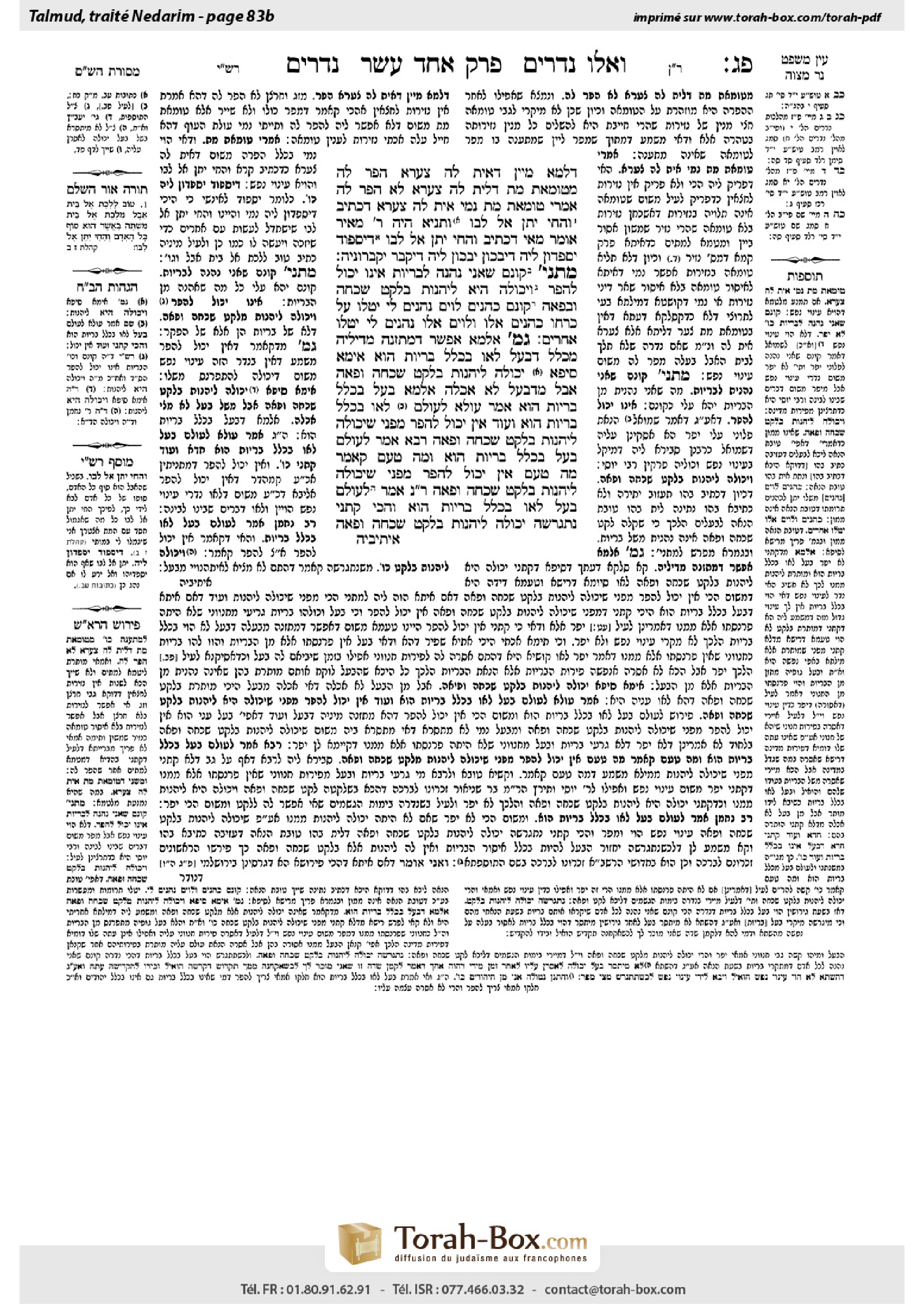
Nedarim 83b: Talmud study for Daf Yomi
Daf Yomi is the daily study of one Talmud folio. Explore 37 tractates with scans, Hebrew text, Sefaria English and AI-generated French translations where annotated.
Passage selection and English or AI-generated French translation are available where the scan has annotations. Daf Study is independent of Torah-Box and Sefaria.
Browse Nedarim · נדרים · All tractatesNedarim 83b text and translations
This page of Nedarim includes the Aramaic text, an English translation and an AI-generated French translation, alongside the scan above.
נדרים פ״ג ב · Aramaic and Hebrew text
דִּלְמָא מִיַּיִן דְּאִית לַהּ צַעֲרָא — הֵפֵר לָהּ, מִטּוּמְאַת מֵת, דְּלֵית לַהּ צַעֲרָא — לֹא הֵפֵר לָהּ?
אָמְרִי: מִטּוּמְאַת מֵת נָמֵי אִית לַהּ צַעֲרָא — דִּכְתִיב: ״וְהַחַי יִתֵּן אֶל לִבּוֹ״, וְתַנְיָא, הָיָה רַבִּי מֵאִיר אוֹמֵר: מַאי דִּכְתִיב ״וְהַחַי יִתֵּן אֶל לִבּוֹ״, דְּיִסְפּוֹד — יִסְפְּדוּן לֵיהּ, דְּיִבְכּוּן — יִבְכּוּן לֵיהּ, דְּיִקְבַּר — יִקְבְּרוּנֵיהּ.
מַתְנִי׳ ״קֻוֽנָּם שֶׁאֲנִי נֶהֱנֶה לַבְּרִיּוֹת״ — אֵינוֹ יָכוֹל לְהָפֵר, וִיכוֹלָה הִיא לֵיהָנוֹת בְּלֶקֶט, שִׁכְחָה, וּבְפֵאָה.
״קֻוֽנָּם כֹּהֲנִים לְוִיִּם נֶהֱנִים לִי״ — יִטְּלוּ עַל כׇּרְחוֹ. ״כֹּהֲנִים אֵלּוּ וּלְוִיִּם אֵלּוּ נֶהֱנִים לִי״ — יִטְּלוּ אֲחֵרִים.
גְּמָ׳ אַלְמָא אֶפְשָׁר דְּמִתַּזְנָה מִדִּילֵיהּ, מִכְּלָל דְּבַעַל לָאו בִּכְלַל ״בְּרִיּוֹת״ הוּא. אֵימָא סֵיפָא: יְכוֹלָה לֵיהָנוֹת בְּלֶקֶט שִׁכְחָה וּפֵאָה, אֲבָל מִדְּבַעַל לָא אָכְלָה, אַלְמָא בַּעַל בִּכְלַל ״בְּרִיּוֹת״ הוּא!
אָמַר עוּלָּא: לְעוֹלָם לָאו בִּכְלַל ״בְּרִיּוֹת״ הוּא, וְעוֹד: אֵין יָכוֹל לְהָפֵר — מִפְּנֵי שֶׁיְּכוֹלָה לֵיהָנוֹת בְּלֶקֶט שִׁכְחָה וּפֵאָה.
רָבָא אָמַר: לְעוֹלָם בַּעַל בִּכְלַל ״בְּרִיּוֹת״ הוּא, וּ״מָה טַעַם״ קָאָמַר: מָה טַעַם אֵין יָכוֹל לְהָפֵר? מִפְּנֵי שֶׁיְּכוֹלָה לֵיהָנוֹת בְּלֶקֶט שִׁכְחָה וּפֵאָה.
רַב נַחְמָן אָמַר: לְעוֹלָם בַּעַל לָאו בִּכְלַל ״בְּרִיּוֹת״ הוּא. וְהָכִי קָתָנֵי: נִתְגָּרְשָׁה, יְכוֹלָה לֵיהָנוֹת בְּלֶקֶט שִׁכְחָה וּפֵאָה.
Nedarim 83b · English translation
Perhaps the husband nullified for her the vow that rendered wine forbidden to her, as she suffers pain when she refrains from drinking it. But as for her vow that impurity imparted by the dead is forbidden to her, he did not nullify it for her, as she suffers no pain by not becoming impure through contact with the dead. Why, then, does she not bring the offerings that must be brought by a nazirite who became ritually impure through contact with the dead? This implies that since the husband can nullify a vow with regard to a matter that would cause her to deprive herself, he can also nullify a vow with regard to a matter that would not cause her to deprive herself.
The Gemara rejects this argument: The Sages say in response that a woman who vows that impurity imparted by the dead is forbidden to her also suffers pain as a result. How so? As it is written: “And the living shall lay it to his heart” (Ecclesiastes 7:2), and it is taught in a baraita that Rabbi Meir would say: What is the meaning of that which is written: “And the living shall lay it to his heart”? This means that one who eulogizes others when they die will in turn be eulogized when he himself dies; one who weeps for others will be wept for when he himself passes away; and one who buries others will himself be buried upon his passing. A woman who cannot participate in the funerals of others because she is barred from contracting impurity through contact with a corpse is distressed by the thought that she will receive similar treatment when she dies. Therefore, her vow involves affliction and can be nullified by her husband. The conclusion is that this case does not present a difficulty for Rabbi Yoḥanan.
MISHNA: If a woman vowed: The property of other people is konam for me, and for that reason I will not benefit from it, her husband cannot nullify her vow, but nevertheless, if she is poor, she may benefit from the agricultural gifts that must be left for the poor: Gleanings, i.e., isolated stalks that fell during the harvest; forgotten sheaves; and produce of the corners [pe’a] of the field that the owner is obligated to leave for the poor. Enjoyment of these gifts is not considered as benefit derived from people, as these gifts are not given voluntarily out of the kindness of the donors, but in the performance of a mitzva.
If one said: I will not let priests and Levites benefit from me, as that is konam for me, they can take the priestly and Levitical gifts from him against his will. If, however, he said: I will not let these specific priests and these specific Levites benefit from me, as that is konam for me, they are taken by others.
GEMARA: The mishna teaches that if a woman vowed not to derive benefit from people, her husband cannot nullify her vow. The Gemara infers from this halakha: Apparently, this is because the woman can be sustained from his, i.e., her husband’s, property, without having to take from others. This proves by inference that in this context a husband is not included in her reference to people, as, although she mentioned people in her vow, she did not mean to prohibit herself from deriving benefit from her husband. The Gemara asks: But say the latter clause of that same part of the mishna, which states: But she may benefit from gleanings, forgotten sheaves, and pe’a. This implies that she may derive benefit from the gifts given to the poor, but she may not eat from property belonging to her husband. Apparently, a husband is in fact included in her reference to people, and she may not benefit from him either.
Ulla said: Actually, a husband is not included in her reference to people, and there is no contradiction. Rather, the mishna provides two reasons why he cannot nullify his wife’s vow. The first reason, which is merely implied by the mishna, is that she can be sustained by her husband. And furthermore there is the stated reason, that he cannot nullify the vow because she may benefit from gleanings, forgotten sheaves, and pe’a.
Rava said the opposite: Actually, a husband is included in her reference to people, and therefore his wife may not benefit from him. And when the mishna states the halakha, it employs the style known as: What is the reason, and it should be understood as follows: What is the reason that the husband cannot nullify his wife’s vow? Because she may benefit from gleanings, forgotten sheaves, and pe’a.
Rav Naḥman said: Actually, a husband is not included in her reference to people, and her vow not to derive benefit from all people does not include him, which is why he cannot nullify it. And this is what the mishna is teaching: The husband cannot nullify his wife’s vow, because even if she becomes divorced and can no longer derive benefit from her husband, as he is now included in her reference to people, she may still benefit from gleanings, forgotten sheaves, and pe’a.
Nedarim 83b · Traduction française (IA)
Peut-être le mari a-t-il annulé pour elle le vœu qui lui interdisait le vin, car elle souffre lorsqu’elle s’abstient d’en boire. Mais il n’a pas annulé pour elle son vœu lui interdisant de contracter l’impureté au contact des morts, car elle ne souffre pas de ne pas devenir impure de cette manière. Pourquoi, alors, n’apporte-t-elle pas les sacrifices qu’une naziréenne devenue rituellement impure au contact des morts doit apporter ? Cela implique que, puisque le mari peut annuler un vœu portant sur une chose dont la privation la ferait souffrir, il peut également annuler un vœu portant sur une chose dont la privation ne la ferait pas souffrir.
La Guemara rejette cet argument : les Sages répondent qu’une femme qui fait vœu de s’interdire l’impureté transmise par les morts souffre elle aussi de cette situation. Comment cela ? Il est écrit : « Le vivant le prendra à cœur » (Ecclésiaste 7, 2), et une baraïta enseigne que Rabbi Meïr disait : Quel est le sens de ce qui est écrit : « Le vivant le prendra à cœur » ? Cela signifie que celui qui prononce l’éloge funèbre d’autrui lorsqu’il meurt sera à son tour honoré par un éloge funèbre à sa propre mort ; celui qui pleure autrui sera lui-même pleuré à son décès ; et celui qui enterre autrui sera lui-même enterré à sa mort. Une femme qui ne peut pas participer aux funérailles d’autrui parce qu’il lui est interdit de contracter l’impureté au contact d’un cadavre est affligée à l’idée qu’on lui réservera le même traitement lorsqu’elle mourra. Son vœu entraîne donc une souffrance et son mari peut l’annuler. Il en ressort que ce cas ne pose pas de difficulté à Rabbi Yoḥanan.
MICHNA : Si une femme fait vœu que les biens d’autrui lui soient konam, de sorte qu’elle ne puisse en tirer aucun profit, son mari ne peut pas annuler son vœu. Toutefois, si elle est pauvre, elle peut bénéficier des dons agricoles qui doivent être laissés aux pauvres : les glanures, c’est-à-dire les épis isolés tombés pendant la moisson ; les gerbes oubliées ; et les produits des angles [pe’a] du champ que le propriétaire est tenu de laisser aux pauvres. Jouir de ces dons n’est pas considéré comme tirer profit d’autrui, car ils ne sont pas remis volontairement par bonté par les donateurs, mais dans l’accomplissement d’une mitsva.
Si quelqu’un dit : « Que les prêtres et les lévites ne tirent aucun profit de moi, car cela m’est konam », ils peuvent prendre contre son gré les dons sacerdotaux et lévitiques qui lui reviennent. En revanche, s’il dit : « Que ces prêtres-ci et ces lévites-ci ne tirent aucun profit de moi, car cela m’est konam », ces dons sont pris par d’autres.
GUEMARA : La Michna enseigne que si une femme a fait vœu de ne tirer aucun profit des gens, son mari ne peut pas annuler son vœu. La Guemara déduit de cette halakha qu’apparemment, c’est parce que la femme peut être entretenue par les biens de son mari, sans avoir à recevoir quoi que ce soit d’autrui. Cela implique qu’ici, le mari n’est pas inclus dans la référence aux « gens » : bien qu’elle ait mentionné les gens dans son vœu, elle n’entendait pas s’interdire de tirer profit de son mari. La Guemara demande : Mais considérons la suite de cette même partie de la Michna, qui dit : « Mais elle peut bénéficier des glanures, des gerbes oubliées et de la pe’a. » Cela implique qu’elle peut tirer profit des dons destinés aux pauvres, mais qu’elle ne peut pas consommer les biens appartenant à son mari. Apparemment, son mari est bien inclus dans sa référence aux gens, et elle ne peut donc pas non plus tirer profit de lui.
Oulla dit : En réalité, le mari n’est pas inclus dans sa référence aux gens, et il n’y a pas de contradiction. La Michna donne plutôt deux raisons pour lesquelles il ne peut pas annuler le vœu de sa femme. La première raison, seulement sous-entendue par la Michna, est qu’elle peut être entretenue par son mari. À cela s’ajoute la raison explicitement énoncée : il ne peut pas annuler le vœu parce qu’elle peut bénéficier des glanures, des gerbes oubliées et de la pe’a.
Rava dit le contraire : en réalité, le mari est inclus dans sa référence aux gens, et sa femme ne peut donc pas tirer profit de lui. Lorsque la Michna énonce cette halakha, elle emploie la tournure « quelle en est la raison ? », qu’il faut comprendre ainsi : quelle est la raison pour laquelle le mari ne peut pas annuler le vœu de sa femme ? C’est parce qu’elle peut bénéficier des glanures, des gerbes oubliées et de la pe’a.
Rav Naḥman dit : En réalité, le mari n’est pas inclus dans sa référence aux gens, et son vœu de ne tirer aucun profit de qui que ce soit ne l’inclut pas ; c’est pourquoi il ne peut pas l’annuler. Voici ce que la Michna enseigne : le mari ne peut pas annuler le vœu de sa femme, car même si elle divorce et ne peut plus tirer profit de son mari, puisque celui-ci est alors inclus dans sa référence aux gens, elle peut toujours bénéficier des glanures, des gerbes oubliées et de la pe’a.
Traduction française générée par IA à partir de l’édition anglaise de Sefaria. Vérifie toujours un passage avec le texte source.
Text from Sefaria: William Davidson Edition - Vocalized Aramaic (CC BY NC); William Davidson Edition - English (CC BY NC).