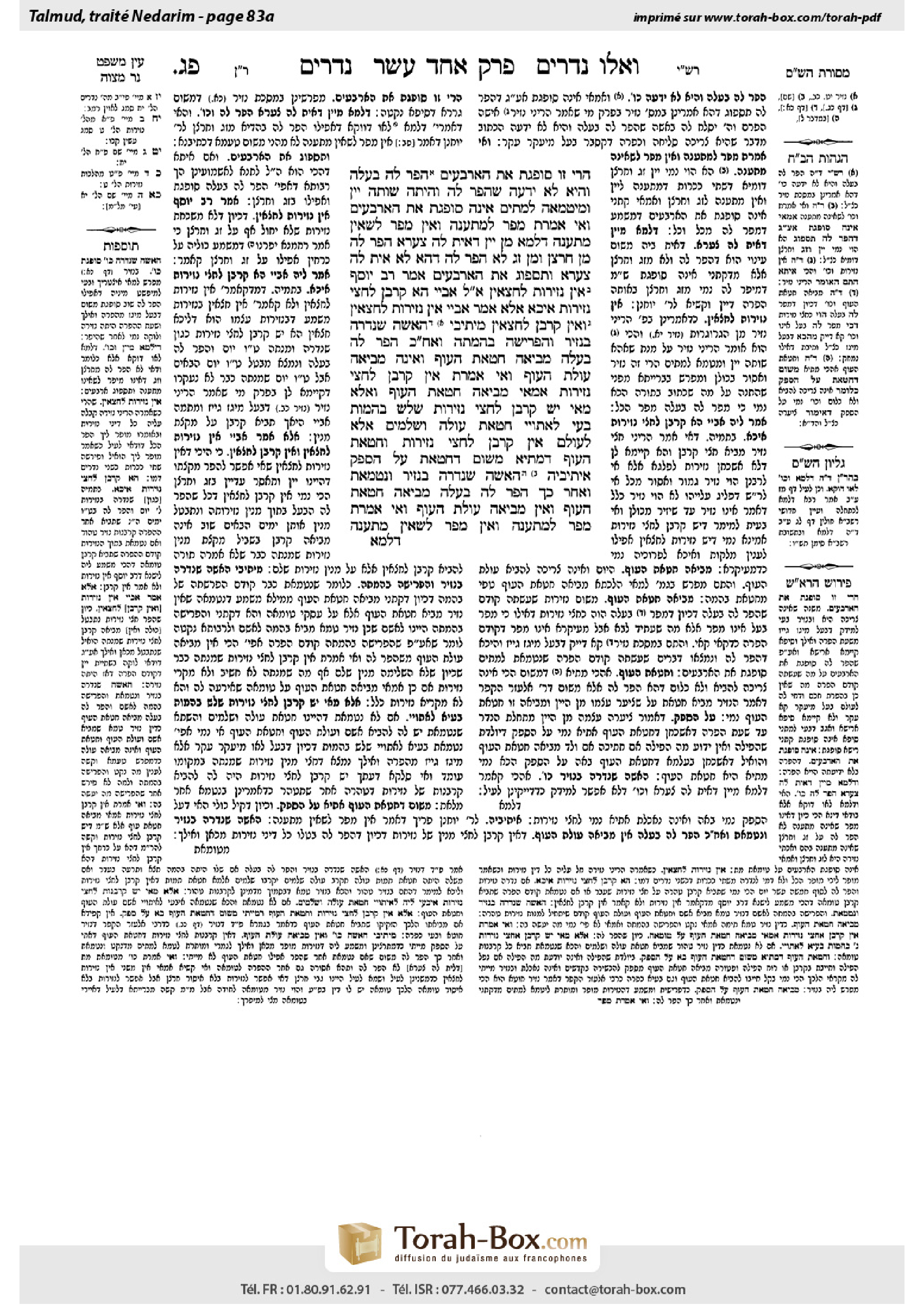
Nedarim 83a: Talmud study for Daf Yomi
Daf Yomi is the daily study of one Talmud folio. Explore 37 tractates with scans, Hebrew text, Sefaria English and AI-generated French translations where annotated.
Passage selection and English or AI-generated French translation are available where the scan has annotations. Daf Study is independent of Torah-Box and Sefaria.
Browse Nedarim · נדרים · All tractatesNedarim 83a text and translations
This page of Nedarim includes the Aramaic text, an English translation and an AI-generated French translation, alongside the scan above.
נדרים פ״ג א · Aramaic and Hebrew text
הֲרֵי זוֹ סוֹפֶגֶת אֶת הָאַרְבָּעִים. הֵפֵר לָהּ בַּעְלָהּ וְהִיא לֹא יָדְעָה שֶׁהֵפֵר לָהּ, וְהָיְתָה שׁוֹתָה יַיִן וּמִיטַּמְּאָהּ לְמֵתִים — אֵינָהּ סוֹפֶגֶת אֶת הָאַרְבָּעִים.
וְאִי אָמְרַתְּ מֵפֵר לַמִּתְעַנָּה וְאֵין מֵפֵר לְשֶׁאֵין מִתְעַנָּה, דִּלְמָא מִן יַיִן דְּאִית לַהּ צַעֲרָא — הֵפֵר לָהּ, מִן חַרְצָן וּמִן זַג — לֹא הֵפֵר לָהּ, דְּהָא לָא אִית לַהּ צַעֲרָא. וְתִסְפּוֹג אֶת הָאַרְבָּעִים!
אָמַר רַב יוֹסֵף: אֵין נְזִירוּת לַחֲצָאִין.
אֲמַר לֵיהּ אַבָּיֵי: הָא קׇרְבָּן לַחֲצִי נְזִירוּת אִיכָּא?! אֶלָּא אָמַר אַבָּיֵי: אֵין נְזִירוּת לַחֲצָאִין, וְאֵין קׇרְבָּן לַחֲצָאִין.
מֵיתִיבִי: הָאִשָּׁה שֶׁנָּדְרָה בְּנָזִיר וְהִפְרִישָׁה בְּהֶמְתָּהּ וְאַחַר כָּךְ הֵפֵר לָהּ בַּעְלָהּ — מְבִיאָה חַטַּאת הָעוֹף, וְאֵינָהּ מְבִיאָה עוֹלַת הָעוֹף. וְאִי אָמְרַתְּ אֵין קׇרְבָּן לַחֲצִי נְזִירוּת, אַמַּאי מְבִיאָה חַטָּאת הָעוֹף?
וְאֶלָּא מַאי — יֵשׁ קׇרְבָּן לַחֲצִי נְזִירוּת? שָׁלֹשׁ בְּהֵמוֹת בָּעֵי לְאֵתוֹיֵי: חַטָּאת, עוֹלָה, וּשְׁלָמִים! אֶלָּא, לְעוֹלָם אֵין קׇרְבָּן לַחֲצִי נְזִירוּת. וְחַטַּאת הָעוֹף דְּמַתְיָא — מִשּׁוּם דְּחַטָּאת עַל הַסָּפֵק.
אֵיתִיבֵיהּ: הָאִשָּׁה שֶׁנָּדְרָה בְּנָזִיר וְנִטְמֵאת, וְאַחַר כָּךְ הֵפֵר לָהּ בַּעְלָהּ — מְבִיאָה חַטַּאת הָעוֹף, וְאֵין מְבִיאָה עוֹלַת הָעוֹף. וְאִי אָמְרַתְּ מֵפֵר לַמִּתְעַנָּה וְאֵין מֵפֵר לְשֶׁאֵין מִתְעַנָּה,
Nedarim 83a · English translation
she incurs [sofeget] the forty lashes, the penalty for one who transgresses a Torah prohibition, as she violated the terms of her nazirite vow. If her husband nullified the vow for her, but she did not know that he nullified it for her, and she drank wine or became impure through contact with the dead, she does not incur the forty lashes. She did not commit a transgression, as her nazirite vow was nullified.
And if you say that the husband can nullify the vow with regard to the loaf that would cause her to deprive herself, but he cannot nullify the vow with regard to the loaf that would not cause her to deprive herself, the same reasoning should apply to a nazirite vow: Perhaps the husband nullified for her the vow that rendered wine forbidden to her, as she suffers pain when she refrains from drinking it. But as for her vow that rendered grape seeds and grape skins forbidden to her, he did not nullify it for her, as she suffers no pain when she abstains from them. And since even grape seeds and grape skins are forbidden to a nazirite, if the woman ate of them, she should receive the forty lashes, even if her husband nullified her vow.
Rav Yosef said: Here it is different, as naziriteship cannot take effect partially. Since one cannot be a nazirite and accept only some of the prohibitions of naziriteship, the husband’s nullification cancels the entire vow. In the case of an ordinary vow, on the other hand, the husband can nullify only the part that causes his wife suffering.
Abaye said to him: The wording of your statement suggests that naziriteship cannot take effect partially, but that an offering is brought for partial observance of naziriteship. Rather, Abaye said that one should say as follows: Naziriteship cannot take effect partially, and no offering is brought for partial observance of naziriteship.
The Gemara raises an objection from the following statement: With regard to a woman who vowed to be a nazirite and she designated her animal for her nazirite offering, and afterward her husband nullified her vow for her, she must bring a bird sin-offering but she does not bring a bird burnt-offering. And if you say that no offering is brought for partial observance of naziriteship, why must she bring a bird sin-offering?
The Gemara rejects this argument: But rather, what will you say? That an offering is brought for partial observance of naziriteship? If so, she should be required to bring three animals as offerings, a sin-offering, a burnt-offering, and a peace-offering, in accordance with the halakha governing a nazirite who has completed the period of his vow. Rather, say as follows: Actually, no offering is brought for partial observance of naziriteship, and as for the bird sin-offering that she must bring, this is because a bird sin-offering can be brought in a case of uncertainty. She must therefore bring a sin-offering for the partial naziriteship that she observed.
Rav Asi raised an objection against the opinion of Rabbi Yoḥanan from the following baraita: With regard to a woman who vowed to be a nazirite and she became ritually impure through contact with the dead, and afterward her husband nullified her vow for her, she must bring a bird sin-offering but does not bring a bird burnt-offering. And if you say that the husband can nullify the vow with regard to the loaf that would cause her to deprive herself, but he cannot nullify the vow with regard to the loaf that would not cause her to deprive herself, the same reasoning should apply here:
Nedarim 83a · Traduction française (IA)
elle encourt [sofeget] les quarante coups de fouet, peine infligée à celui qui transgresse une interdiction de la Torah, car elle a enfreint les termes de son vœu de naziréat. Si son mari a annulé son vœu, mais qu’elle ne le sait pas et qu’elle boit du vin ou se rend impure au contact d’un mort, elle n’encourt pas les quarante coups de fouet. Elle n’a commis aucune transgression, puisque son vœu de naziréat a été annulé.
Et si tu dis que le mari peut annuler le vœu concernant le pain dont l’absence la ferait souffrir, mais qu’il ne peut pas l’annuler concernant le pain dont l’absence ne la ferait pas souffrir, le même raisonnement devrait s’appliquer au vœu de naziréat : peut-être le mari a-t-il annulé le vœu qui lui interdisait le vin, car elle souffre lorsqu’elle s’abstient d’en boire. Mais quant au vœu qui lui interdisait les pépins et les peaux de raisin, il ne l’a pas annulé, car elle ne souffre pas lorsqu’elle s’en abstient. Or, puisque les pépins et les peaux de raisin sont eux aussi interdits au nazir, si la femme en a mangé, elle devrait recevoir les quarante coups de fouet, même si son mari a annulé son vœu.
Rav Yosef a dit : Ici, le cas est différent, car le naziréat ne peut pas prendre effet partiellement. Puisqu’on ne peut pas être nazir et n’accepter que certaines des interdictions du naziréat, l’annulation du mari porte sur l’ensemble du vœu. En revanche, dans le cas d’un vœu ordinaire, le mari peut n’en annuler que la partie qui fait souffrir son épouse.
Abayé lui dit : La formulation de ton propos laisse entendre que le naziréat ne peut pas prendre effet partiellement, mais qu’une offrande est apportée pour une observance partielle du naziréat. Abayé dit plutôt qu’il faut formuler les choses ainsi : le naziréat ne peut pas prendre effet partiellement, et aucune offrande n’est apportée pour une observance partielle du naziréat.
La Guemara soulève une objection à partir de l’énoncé suivant : Une femme a fait vœu de devenir nazir, a désigné son animal pour son offrande de naziréat, puis son mari a annulé son vœu. Elle doit apporter un sacrifice expiatoire d’oiseau, mais pas d’holocauste d’oiseau. Et si tu dis qu’aucune offrande n’est apportée pour une observance partielle du naziréat, pourquoi doit-elle apporter un sacrifice expiatoire d’oiseau ?
La Guemara rejette cet argument : Mais alors, que diras-tu ? Qu’une offrande est apportée pour une observance partielle du naziréat ? Dans ce cas, elle devrait être tenue d’apporter trois animaux en offrande : un sacrifice expiatoire, un holocauste et un sacrifice de paix, conformément à la halakha qui s’applique au nazir ayant achevé la période de son vœu. Il faut plutôt dire ceci : en réalité, aucune offrande n’est apportée pour une observance partielle du naziréat ; quant au sacrifice expiatoire d’oiseau qu’elle doit apporter, c’est parce qu’un sacrifice expiatoire d’oiseau peut être apporté en cas de doute. Elle doit donc apporter un sacrifice expiatoire pour la partie du naziréat qu’elle a observée.
Rav Asi soulève une objection contre l’opinion de Rabbi Yoḥanan à partir de la baraïta suivante : Une femme a fait vœu de devenir nazir et s’est rendue impure au contact d’un mort ; ensuite, son mari a annulé son vœu. Elle doit apporter un sacrifice expiatoire d’oiseau, mais pas d’holocauste d’oiseau. Et si tu dis que le mari peut annuler le vœu concernant le pain dont l’absence la ferait souffrir, mais qu’il ne peut pas l’annuler concernant le pain dont l’absence ne la ferait pas souffrir, le même raisonnement devrait s’appliquer ici :
Traduction française générée par IA à partir de l’édition anglaise de Sefaria. Vérifie toujours un passage avec le texte source.
Text from Sefaria: William Davidson Edition - Vocalized Aramaic (CC BY NC); William Davidson Edition - English (CC BY NC).