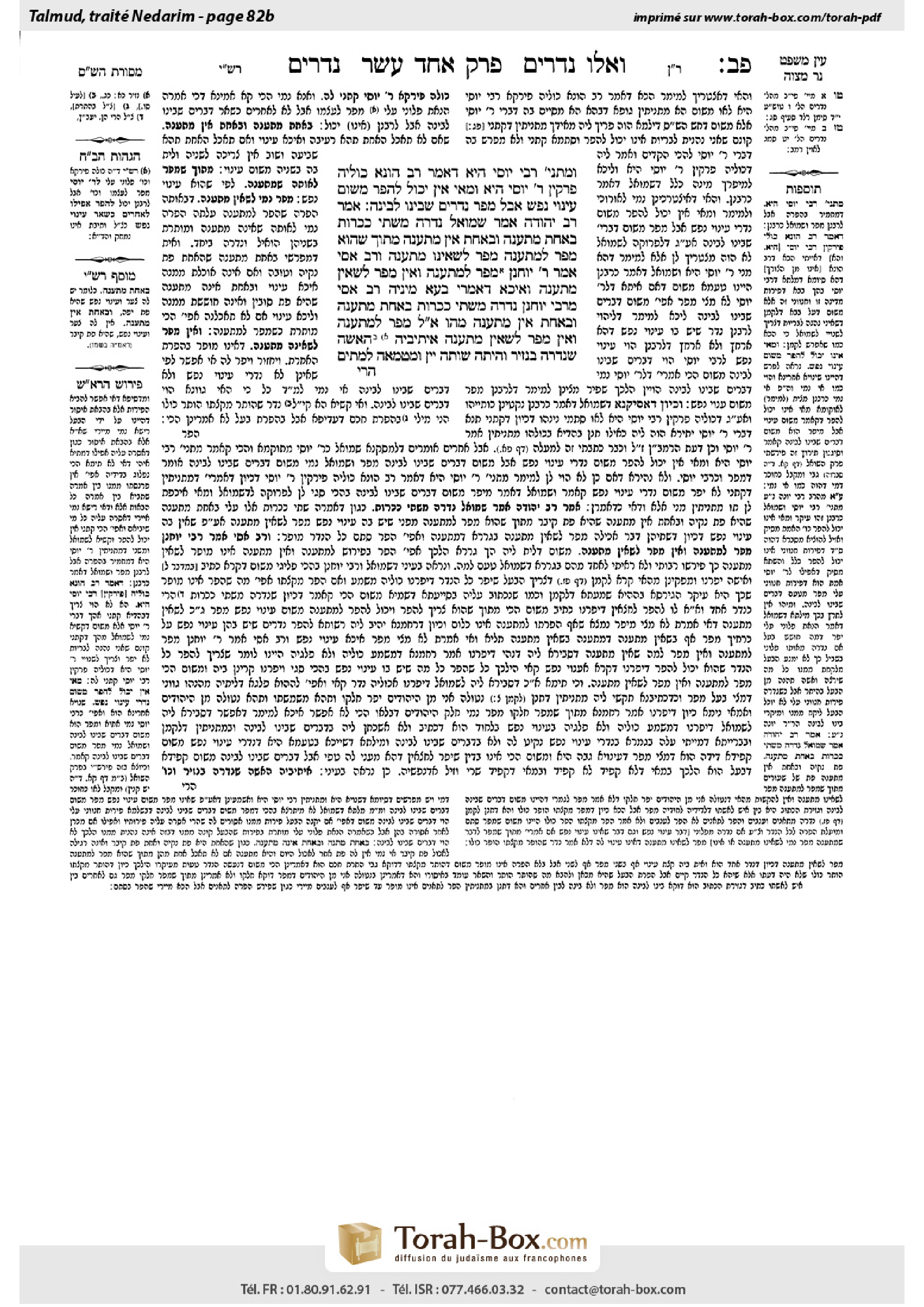
Nedarim 82b: Talmud study for Daf Yomi
Daf Yomi is the daily study of one Talmud folio. Explore 37 tractates with scans, Hebrew text, Sefaria English and AI-generated French translations where annotated.
Passage selection and English or AI-generated French translation are available where the scan has annotations. Daf Study is independent of Torah-Box and Sefaria.
Browse Nedarim · נדרים · All tractatesNedarim 82b text and translations
This page of Nedarim includes the Aramaic text, an English translation and an AI-generated French translation, alongside the scan above.
נדרים פ״ב ב · Aramaic and Hebrew text
וּמַתְנִיתִין רַבִּי יוֹסֵי הִיא. דְּאָמַר רַב הוּנָא: כּוּלֵּיהּ פִּרְקִין רַבִּי יוֹסֵי הִיא. וּמַאי ״אֵין יָכוֹל לְהָפֵר״, מִשּׁוּם עִינּוּי נֶפֶשׁ, אֲבָל מֵפֵר נְדָרִים שֶׁבֵּינוֹ לְבֵינָהּ.
אָמַר רַב יְהוּדָה אָמַר שְׁמוּאֵל: נָדְרָה מִשְׁתֵּי כִכָּרוֹת, בְּאַחַת מִתְעַנָּה, וּבְאַחַת אֵין מִתְעַנָּה, מִתּוֹךְ שֶׁהוּא מֵפֵר לַמִּתְעַנָּה — מֵפֵר לְשֶׁאֵינוֹ מִתְעַנָּה. וְרַב אַסִּי אָמַר רַבִּי יוֹחָנָן: מֵפֵר לַמִּתְעַנָּה, וְאֵין מֵפֵר לְשֶׁאֵין מִתְעַנָּה.
וְאִיכָּא דְּאָמְרִי, בְּעָא מִינֵּיהּ רַב אַסִּי מֵרַבִּי יוֹחָנָן: נָדְרָה מִשְׁתֵּי כִכָּרוֹת, בְּאַחַת מִתְעַנָּה וּבְאַחַת אֵין מִתְעַנָּה, מַהוּ? אֲמַר לֵיהּ: מֵפֵר לַמִּתְעַנָּה וְאֵין מֵפֵר לְשֶׁאֵין מִתְעַנָּה.
אֵיתִיבֵיהּ: הָאִשָּׁה שֶׁנָּדְרָה בְּנָזִיר, וְהָיְתָה שׁוֹתֶה יַיִן, וּמִטַּמְּאָה לְמֵתִים
Nedarim 82b · English translation
And the mishna is in accordance with the opinion of Rabbi Yosei, who is more restrictive in his definition of affliction. As Rav Huna said: Our entire chapter is in accordance with the opinion of Rabbi Yosei. Shmuel, on the other hand, rules in accordance with the opinion of the Rabbis. And what does Rabbi Yosei mean when he says that the husband cannot nullify his wife’s vows? He means that he cannot nullify them as vows of affliction, but he can nullify them as vows that adversely affect the relationship between him and her.
§ Rav Yehuda said that Shmuel said: In a case where a woman vowed that two loaves are forbidden to her, and if she abstains from one of them she would deprive herself, as it is a fine-quality loaf, and if she abstains from the other one she would not deprive herself, as it is a poor-quality loaf, then, since the husband can nullify the vow with regard to the loaf that would cause her to deprive herself, like any other vow of affliction, he can also nullify the vow with regard to the loaf that would not cause her to deprive herself. And Rav Asi said that Rabbi Yoḥanan said: The husband can nullify the vow with regard to the loaf that would cause her to deprive herself, but he cannot nullify the vow with regard to the loaf that would not cause her to deprive herself.
And some say a different version of this dispute, according to which Rav Asi raised a dilemma before Rabbi Yoḥanan: In a case where a woman vowed not to eat from two loaves of bread, and if she abstains from one of them she would deprive herself, and if she abstains from the other one she would not deprive herself, what is the halakha? Rabbi Yoḥanan said to him: The husband can nullify the vow with regard to the loaf that would cause her to deprive herself, but he cannot nullify the vow with regard to the loaf that would not cause her to deprive herself.
Rav Asi raised an objection against Rabbi Yoḥanan from the following mishna (Nazir 23a): With regard to a woman who vowed to be a nazirite, and she transgressed her vow and drank wine or became impure by coming into contact with the dead,
Nedarim 82b · Traduction française (IA)
Et la Michna suit l’opinion de Rabbi Yosei, dont la définition de l’affliction est plus restrictive. En effet, Rav Huna a dit : Tout notre chapitre suit l’opinion de Rabbi Yosei. Shmuel, quant à lui, tranche selon l’opinion des Rabbins. Et que veut dire Rabbi Yosei lorsqu’il affirme que le mari ne peut pas annuler les vœux de sa femme ? Il veut dire qu’il ne peut pas les annuler en tant que vœux d’affliction, mais qu’il peut les annuler en tant que vœux qui nuisent à leur relation.
§ Rav Yehuda a dit au nom de Shmuel : Si une femme a fait le vœu de s’interdire deux pains, et que s’abstenir de l’un d’eux la priverait, car c’est un pain de bonne qualité, tandis que s’abstenir de l’autre ne la priverait pas, car c’est un pain de mauvaise qualité, alors, puisque le mari peut annuler le vœu concernant le pain dont l’absence la priverait, comme tout autre vœu d’affliction, il peut également annuler le vœu concernant le pain dont l’absence ne la priverait pas. Rav Asi a dit au nom de Rabbi Yoḥanan : Le mari peut annuler le vœu concernant le pain dont l’absence la priverait, mais il ne peut pas annuler le vœu concernant le pain dont l’absence ne la priverait pas.
Et certains rapportent une version différente de cette controverse, selon laquelle Rav Asi posa une question à Rabbi Yoḥanan : Si une femme a fait le vœu de ne manger aucun de deux pains, et que s’abstenir de l’un d’eux la priverait, tandis que s’abstenir de l’autre ne la priverait pas, quelle est la halakha ? Rabbi Yoḥanan lui répondit : Le mari peut annuler le vœu concernant le pain dont l’absence la priverait, mais il ne peut pas annuler le vœu concernant le pain dont l’absence ne la priverait pas.
Rav Asi souleva une objection contre Rabbi Yoḥanan à partir de la Michna suivante (Nazir 23a) : Au sujet d’une femme qui a fait le vœu de devenir naziréenne et qui a transgressé son vœu en buvant du vin ou en se rendant impure au contact des morts,
Traduction française générée par IA à partir de l’édition anglaise de Sefaria. Vérifie toujours un passage avec le texte source.
Text from Sefaria: William Davidson Edition - Vocalized Aramaic (CC BY NC); William Davidson Edition - English (CC BY NC).