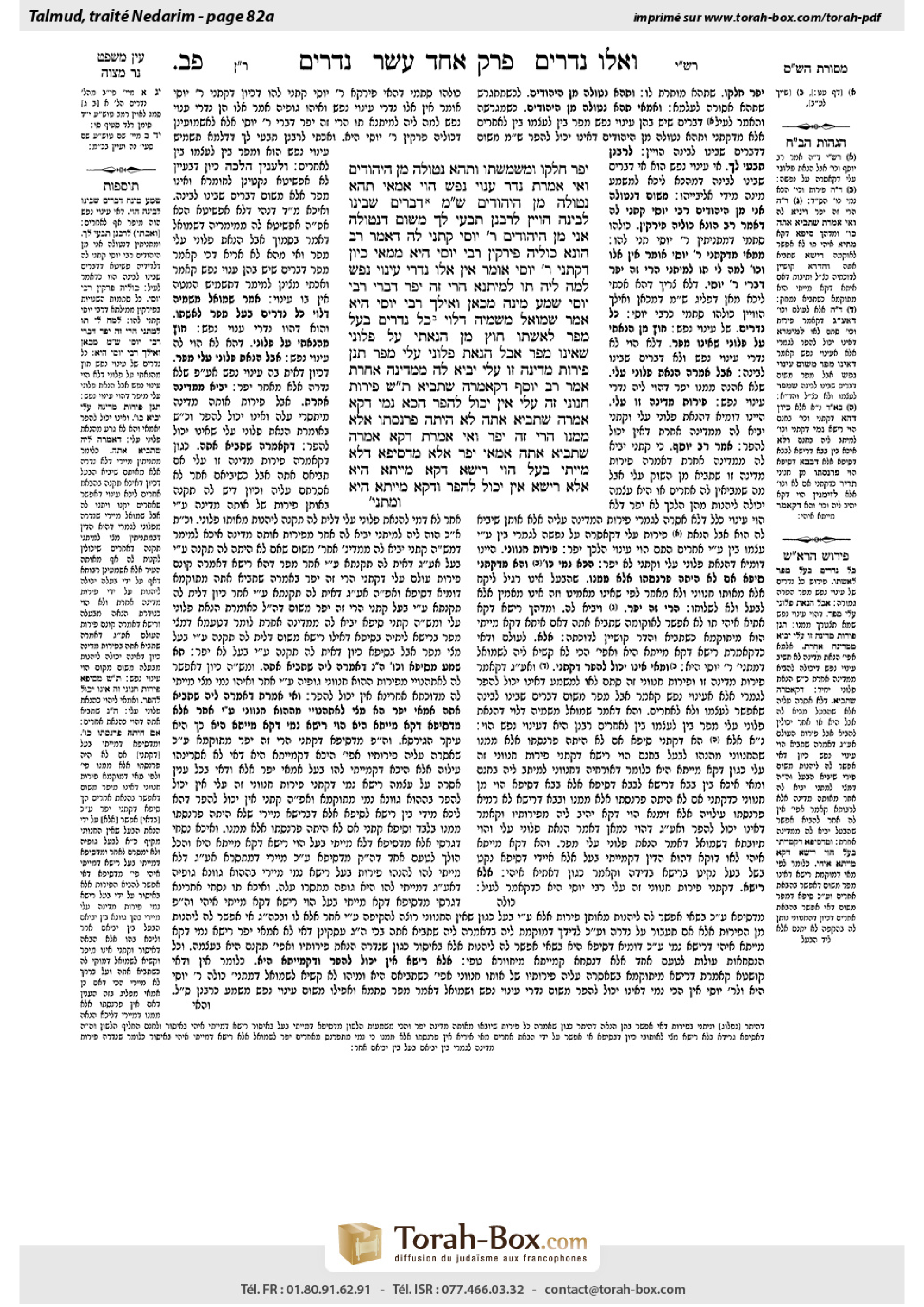
Nedarim 82a: Talmud study for Daf Yomi
Daf Yomi is the daily study of one Talmud folio. Explore 37 tractates with scans, Hebrew text, Sefaria English and AI-generated French translations where annotated.
Passage selection and English or AI-generated French translation are available where the scan has annotations. Daf Study is independent of Torah-Box and Sefaria.
Browse Nedarim · נדרים · All tractatesNedarim 82a text and translations
This page of Nedarim includes the Aramaic text, an English translation and an AI-generated French translation, alongside the scan above.
נדרים פ״ב א · Aramaic and Hebrew text
יָפֵר חֶלְקוֹ, וּמְשַׁמַּשְׁתּוֹ, וּתְהֵא נְטוּלָה מִן הַיְּהוּדִים. וְאִי אָמְרַתְּ נֶדֶר עִנּוּי נֶפֶשׁ הָוֵי, אַמַּאי תְּהֵא נְטוּלָה מִן הַיְּהוּדִים? שְׁמַע מִינַּהּ דְּבָרִים שֶׁבֵּינוֹ לְבֵינָהּ הָוַיִין.
לְרַבָּנַן תִּבְּעֵי לָךְ, מִשּׁוּם דִּ״נְטוּלָה אֲנִי מִן הַיְּהוּדִים״ רַבִּי יוֹסֵי קָתָנֵי לַהּ, דְּאָמַר רַב הוּנָא: כּוּלֵּיהּ פִּירְקִין רַבִּי יוֹסֵי הִיא. מִמַּאי — כֵּיוָן דְּקָתָנֵי: רַבִּי יוֹסֵי אוֹמֵר אֵין אֵלּוּ נִדְרֵי עִינּוּי נֶפֶשׁ, לְמָה לֵיהּ תּוּ לְמִיתְנֵא ״הֲרֵי זֶה יָפֵר, דִּבְרֵי רַבִּי יוֹסֵי״? שְׁמַע מִינַּהּ: מִכָּאן וְאֵילָךְ רַבִּי יוֹסֵי הִיא.
אָמַר שְׁמוּאֵל מִשְּׁמֵיהּ דְּלֵוִי: כׇּל נְדָרִים בַּעַל מֵפֵר לְאִשְׁתּוֹ, חוּץ מִן ״הֲנָאָתִי עַל פְּלוֹנִי״, שֶׁאֵינוֹ מֵפֵר. אֲבָל ״הֲנָאַת פְּלוֹנִי עָלַי״ — מֵפֵר.
תְּנַן: ״פֵּירוֹת מְדִינָה זוֹ עָלַי״ — יָבִיא לָהּ מִמְּדִינָה אַחֶרֶת, אָמַר רַב יוֹסֵף: דְּקָאָמְרָה שֶׁתָּבִיא.
תָּא שְׁמַע: ״פֵּירוֹת חֶנְוָנִי זֶה עָלַי״ — אֵין יָכוֹל לְהָפֵר. הָכָא נָמֵי דְּקָא אָמְרָה שֶׁתָּבִיא אַתָּה.
לֹא הָיְתָה פַּרְנָסָתוֹ אֶלָּא מִמֶּנּוּ — הֲרֵי זֶה יָפֵר. וְאִי אָמְרַתְּ דְּקָא אָמְרָה שֶׁ״תָּבִיא אַתָּה״, אַמַּאי יָפֵר? אֶלָּא מִדְּסֵיפָא דְּלָא מַיְיתֵי בַּעַל הָוֵי, רֵישָׁא דְּקָא מַיְיתָא הִיא!
אֶלָּא: רֵישָׁא אֵין יָכוֹל לְהָפֵר, וּדְקָא מַיְיתָא הִיא.
Nedarim 82a · English translation
her husband must nullify his part, i.e., the part of the vow that affects him, so that she will be permitted to him, and she may engage in intercourse with him, but she is removed from all other Jews, so that if he divorces her, she is forbidden to everyone. And if you say that this is a vow of affliction, why should she be removed from all other Jews? Wasn’t it already established that when a husband nullifies a vow of affliction for his wife, he nullifies it not only with respect to himself but with respect to others as well? Rather, learn from here that such vows are under the category of matters that adversely affect the relationship between him and her, and therefore he can nullify it only with respect to himself.
The Gemara notes: According to the Rabbis, you still have the dilemma, because the mishna dealing with a woman who says: I am removed from the Jews, was taught by Rabbi Yosei. As Rav Huna said: Our entire chapter is in accordance with the opinion of Rabbi Yosei. From where do we know this? Since the mishna teaches: Rabbi Yosei says that these are not vows of affliction, why does it need to teach further, at the end of the mishna: He can nullify the vow; this is the statement of Rabbi Yosei? Learn from this that from this point forward, the rest of the mishna is in accordance with the opinion of Rabbi Yosei. Accordingly, this mishna teaches us only the opinion of Rabbi Yosei, not that of the Rabbis.
§ Shmuel said in the name of Levi: A husband can nullify all vows of affliction for his wife, except for the vow: Benefit from me is konam for so-and-so, which he cannot nullify, as it is entirely between her and another person. But if she says: Benefit derived from so-and-so is konam for me, he can nullify the vow, as it considered a vow of affliction, since she might one day need that person and be unable to avail herself of his services due to her vow.
The Gemara raises an objection from that which we learned in the mishna: If she said: The produce of this country is konam for me, he cannot nullify the vow, as it does not involve affliction, since he can still bring her produce from another country. This vow is similar to a vow by which she prohibits herself from deriving benefit from another person. Why, then, does Shmuel say that the husband cannot nullify it? Rav Yosef said: The mishna is referring to a woman who said in her vow: That you bring. In other words, she did not prohibit herself from deriving benefit from the produce of that country entirely, but only from the produce that her husband himself would bring her. She may still enjoy that produce if it is brought to her by someone else or if she brings it for herself.
The Gemara raises another objection from the next clause of the mishna: Come and hear: If the woman took a vow saying: The produce of this storekeeper is konam for me, her husband cannot nullify the vow. But didn’t Shmuel say that if a woman prohibits herself from benefiting from a certain person, her husband can nullify the vow? The Gemara answers: Here too, the mishna is referring to a case where she said in her vow: The produce that you bring from this storekeeper is konam for me.
The Gemara questions this resolution: But the continuation of the mishna states: But if the husband can obtain his sustenance only from him, i.e., that particular storekeeper, he can nullify his wife’s vow. And if you say that this is referring to a case where the woman said in her vow: The fruit that you bring from this storekeeper is konam for me, why can the husband nullify her vow? Other people can bring her the fruit on his behalf. Rather, from the fact that the latter clause of the mishna must be dealing with a case where the woman renders all fruit forbidden to herself, even that which the husband does not bring her, the first clause must also refer to a case where the woman renders forbidden even the fruit that she herself brings, and nevertheless the husband cannot nullify the vow. Therefore, the objection raised against Shmuel remains.
Rather, the Gemara retracts its previous answer and explains the matter as follows: In the first clause the husband cannot nullify his wife’s vow, and the case is one where she renders forbidden even the fruit that she herself brings.
Nedarim 82a · Traduction française (IA)
Son mari doit annuler sa part, c’est-à-dire la partie du vœu qui le concerne, afin qu’elle lui soit permise et puisse avoir des relations avec lui. Toutefois, elle reste interdite à tous les autres Juifs, de sorte que, s’il la répudie, elle sera interdite à tous. Et si tu dis qu’il s’agit d’un vœu d’affliction, pourquoi serait-elle interdite à tous les autres Juifs ? N’a-t-on pas déjà établi que, lorsqu’un mari annule pour sa femme un vœu d’affliction, il l’annule non seulement à son égard, mais aussi à l’égard des autres ? Apprends plutôt de là que de tels vœux relèvent des choses qui nuisent à la relation entre lui et elle ; il ne peut donc les annuler qu’à son propre égard.
La Guemara fait remarquer : selon les Rabbins, le dilemme subsiste, car la Michna concernant une femme qui dit : « Je suis interdite aux Juifs » a été enseignée par Rabbi Yosei. En effet, Rav Houna a dit : « Tout notre chapitre suit l’opinion de Rabbi Yosei. » D’où le savons-nous ? Puisque la Michna enseigne : « Rabbi Yosei dit que ceux-ci ne sont pas des vœux d’affliction », pourquoi enseigne-t-elle ensuite, à la fin de la Michna : « Il peut annuler le vœu ; telle est l’opinion de Rabbi Yosei » ? Apprends-en que, à partir de là, le reste de la Michna suit l’opinion de Rabbi Yosei. Par conséquent, cette Michna nous enseigne seulement l’opinion de Rabbi Yosei, et non celle des Rabbins.
§ Shmouel a dit au nom de Lévi : Un mari peut annuler pour sa femme tous les vœux d’affliction, à l’exception du vœu : « Que le bénéfice que telle personne tire de moi soit konam », qu’il ne peut pas annuler, puisqu’il concerne entièrement son rapport avec une autre personne. Mais si elle dit : « Que le bénéfice que je tire de telle personne soit konam pour moi », il peut annuler le vœu, car il est considéré comme un vœu d’affliction : elle pourrait un jour avoir besoin de cette personne et ne pas pouvoir recourir à ses services à cause de son vœu.
La Guemara soulève une objection à partir de ce que nous avons appris dans la Michna : Si elle dit : « Que les produits de ce pays soient konam pour moi », il ne peut pas annuler le vœu, car celui-ci n’entraîne pas d’affliction, puisqu’il peut toujours lui apporter des produits d’un autre pays. Ce vœu ressemble à un vœu par lequel elle s’interdit de tirer profit d’une autre personne. Pourquoi, alors, Shmouel dit-il que le mari ne peut pas l’annuler ? Rav Yossef a dit : La Michna parle d’une femme qui a formulé son vœu ainsi : « Ce que tu apporteras. » Autrement dit, elle ne s’est pas interdit de tirer profit de tous les produits de ce pays, mais seulement des produits que son mari lui-même lui apporterait. Elle peut toujours profiter de ces produits si quelqu’un d’autre les lui apporte ou si elle les apporte elle-même.
La Guemara soulève une autre objection à partir de la clause suivante de la Michna : « Viens et écoute : Si la femme prononce un vœu en disant : “Que les produits de ce commerçant soient konam pour moi”, son mari ne peut pas annuler le vœu. » Mais Shmouel n’a-t-il pas dit que si une femme s’interdit de tirer profit d’une personne donnée, son mari peut annuler le vœu ? La Guemara répond : Ici aussi, la Michna parle d’un cas où elle a formulé son vœu ainsi : « Que les produits que tu apporteras de ce commerçant soient konam pour moi. »
La Guemara met en doute cette résolution : Mais la suite de la Michna enseigne : « Mais si le mari ne peut se procurer sa subsistance qu’auprès de lui », c’est-à-dire de ce commerçant en particulier, « il peut annuler le vœu de sa femme ». Or, si tu dis que cela se réfère à un cas où la femme a formulé son vœu ainsi : « Que les fruits que tu apporteras de ce commerçant soient konam pour moi », pourquoi le mari pourrait-il annuler son vœu ? D’autres personnes peuvent lui apporter les fruits à sa place. Il faut donc conclure que, puisque la clause finale de la Michna doit traiter d’un cas où la femme s’interdit tous les fruits, y compris ceux que son mari ne lui apporte pas, la première clause doit également se référer à un cas où elle s’interdit même les fruits qu’elle apporte elle-même ; pourtant, le mari ne peut pas annuler le vœu. L’objection soulevée contre Shmouel demeure donc.
La Guemara revient plutôt sur sa réponse précédente et explique la question ainsi : Dans la première clause, le mari ne peut pas annuler le vœu de sa femme ; il s’agit d’un cas où elle s’interdit même les fruits qu’elle apporte elle-même.
Traduction française générée par IA à partir de l’édition anglaise de Sefaria. Vérifie toujours un passage avec le texte source.
Text from Sefaria: William Davidson Edition - Vocalized Aramaic (CC BY NC); William Davidson Edition - English (CC BY NC).