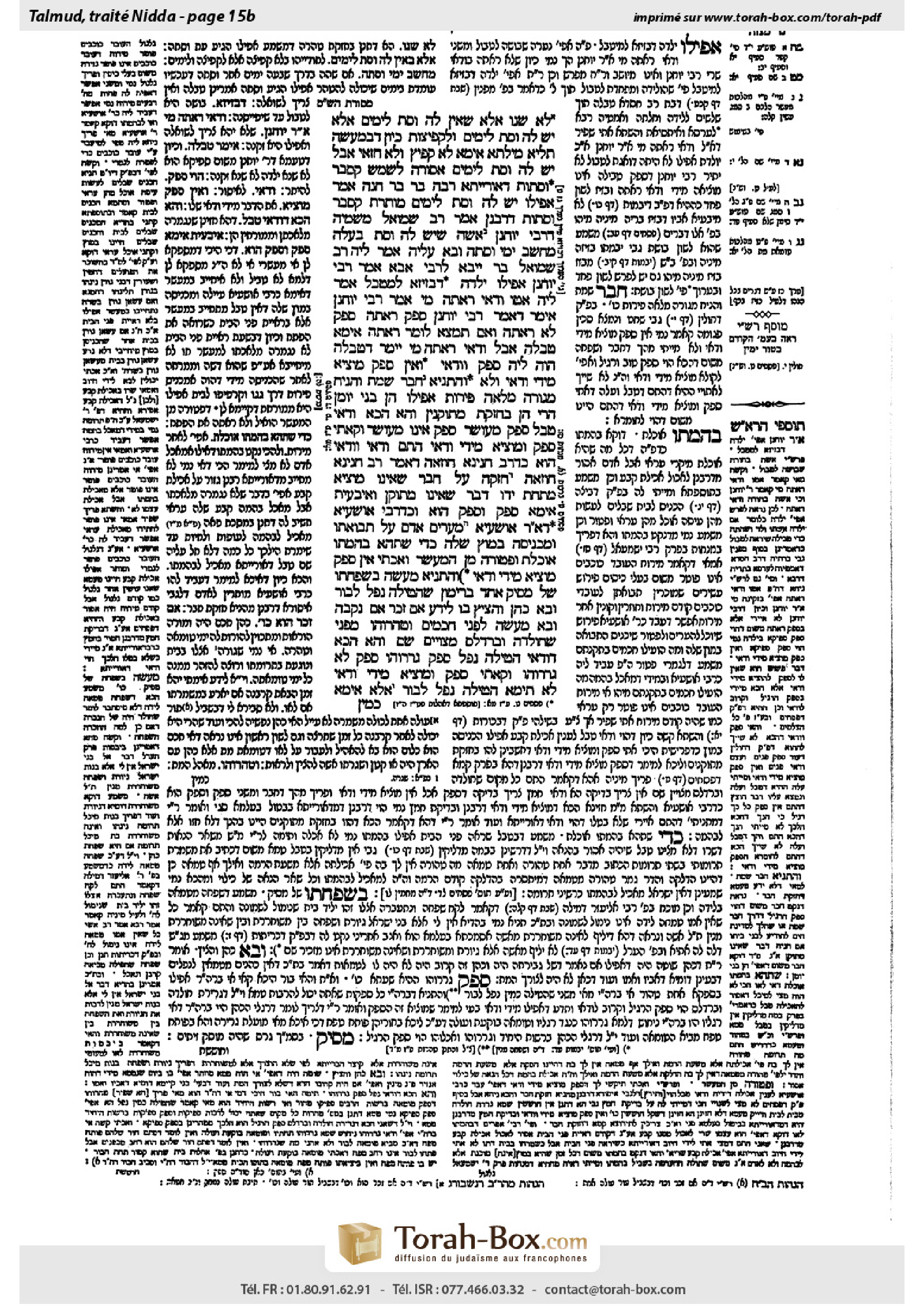
Niddah 15b: Talmud study for Daf Yomi
Daf Yomi is the daily study of one Talmud folio. Explore 37 tractates with scans, Hebrew text, Sefaria English and AI-generated French translations where annotated.
Passage selection and English or AI-generated French translation are available where the scan has annotations. Daf Study is independent of Torah-Box and Sefaria.
Browse Niddah · נידה · All tractatesNiddah 15b text and translations
This page of Niddah includes the Aramaic text, an English translation and an AI-generated French translation, alongside the scan above.
נידה י״ה ב · Aramaic and Hebrew text
לֹא שָׁנוּ אֶלָּא שֶׁאֵין לָהּ וֶסֶת לְיָמִים, אֶלָּא יֵשׁ לָהּ וֶסֶת לְיָמִים וְלִקְפִיצוֹת, כֵּיוָן דִּבְמַעֲשֶׂה תַּלְיָא מִילְּתָא — אֵימָא לָא קְפִיץ וְלָא חֲזַאי, אֲבָל יֵשׁ לָהּ וֶסֶת לְיָמִים — אֲסוּרָה לְשַׁמֵּשׁ.
קָסָבַר וְסָתוֹת דְּאוֹרָיְיתָא.
רַבָּה בַּר בַּר חָנָה אָמַר: אֲפִילּוּ יֵשׁ לָהּ וֶסֶת לְיָמִים — מוּתֶּרֶת, קָסָבַר וְסָתוֹת דְּרַבָּנַן.
אָמַר רַב שְׁמוּאֵל מִשְּׁמֵיהּ דְּרַבִּי יוֹחָנָן: אִשָּׁה שֶׁיֵּשׁ לָהּ וֶסֶת — בַּעְלָהּ מְחַשֵּׁב יְמֵי וִסְתָּהּ, וּבָא עָלֶיהָ.
אֲמַר לֵיהּ רַב שְׁמוּאֵל בַּר יֵיבָא לְרַבִּי אַבָּא: אָמַר רַבִּי יוֹחָנָן אֲפִילּוּ יַלְדָּה דִּבְזִיזָא לְמִטְבַּל?
אֲמַר לֵיהּ: אַטּוּ וַדַּאי רָאֲתָה מִי אָמַר רַבִּי יוֹחָנָן?! אֵימַר דְּאָמַר רַבִּי יוֹחָנָן סָפֵק רָאֲתָה סָפֵק לֹא רָאֲתָה, וְאִם תִּמְצָא לוֹמַר רָאֲתָה — אֵימָא טָבְלָה,
אֲבָל וַדַּאי רָאֲתָה — מִי יֵימַר דְּטָבְלָה? הָוֵה לֵיהּ סָפֵק וּוַדַּאי, וְאֵין סָפֵק מוֹצִיא מִידֵי וַדַּאי.
וְלָא? וְהָתַנְיָא: חָבֵר שֶׁמֵּת וְהִנִּיחַ מְגוּרָה מְלֵאָה פֵּירוֹת, אֲפִילּוּ הֵן בְּנֵי יוֹמָן — הֲרֵי הֵן בְּחֶזְקַת מְתוּקָּנִין. וְהָא הָכָא, וַדַּאי טֶבֶל, סָפֵק מְעוּשָּׂר סָפֵק אֵינוֹ מְעוּשָּׂר, וְקָאָתֵי סָפֵק וּמוֹצִיא מִידֵי וַדַּאי!
הָתָם וַדַּאי וּוַדַּאי הוּא, כִּדְרַב חֲנִינָא חוֹזָאָה, דְּאָמַר רַב חֲנִינָא חוֹזָאָה: חֲזָקָה עַל חָבֵר שֶׁאֵינוֹ מוֹצִיא מִתַּחַת יָדוֹ דָּבָר שֶׁאֵינוֹ מְתוּקָּן.
וְאִיבָּעֵית אֵימָא: סָפֵק וְסָפֵק הוּא, וְכִדְרַבִּי אוֹשַׁעְיָא, דְּאָמַר רַבִּי אוֹשַׁעְיָא: מַעֲרִים אָדָם עַל תְּבוּאָתוֹ וּמַכְנִיסָהּ בַּמּוֹץ שֶׁלָּהּ, כְּדֵי שֶׁתְּהֵא בְּהֶמְתּוֹ אוֹכֶלֶת וּפְטוּרָה מִן הַמַּעֲשֵׂר.
וְאַכַּתִּי אֵין סָפֵק מוֹצִיא מִידֵי וַדַּאי? וְהָתַנְיָא: מַעֲשֶׂה בְּשִׁפְחָתוֹ שֶׁל מַסִּיק אֶחָד בְּרִימּוֹן, שֶׁהֵטִילָה נֵפֶל לְבוֹר, וּבָא כֹּהֵן וְהֵצִיץ בּוֹ לֵידַע אִם זָכָר אִם נְקֵבָה.
וּבָא מַעֲשֶׂה לִפְנֵי חֲכָמִים, וְטִהֲרוּהוּ, מִפְּנֵי שֶׁחוּלְדָּה וּבַרְדְּלָס מְצוּיִים שָׁם.
וְהָא הָכָא, דְּוַדַּאי הֵטִילָה נֵפֶל, סָפֵק גְּרָרוּהוּ סָפֵק לֹא גְּרָרוּהוּ, וְקָאָתֵי סָפֵק וּמוֹצִיא מִידֵי וַדַּאי!
לָא תֵּימָא ״הֵטִילָה נֵפֶל לְבוֹר״, אֶלָּא אֵימָא
Niddah 15b · English translation
The Sages taught this halakha, that a woman has a presumptive status of purity to her husband, only in a case where she does not have a menstrual cycle of days alone, but has a menstrual cycle that is determined both by fixed days and by physical actions she might perform, such as jumps. The reason is that since the matter is also dependent on a particular action, one can say that she did not jump and therefore she did not see blood, and consequently she is presumed to be pure. But with regard to a woman who has a menstrual cycle of days alone, and the projected day of her period arrived, it is prohibited for her to engage in intercourse with her husband.
The Gemara explains that Rav Huna maintains that the concern for impurity of women at the projected time of their periods applies by Torah law. Since she has an uncertain status of impurity by Torah law when the projected day of her period arrives, it is permitted for her to engage in intercourse with her husband only after an examination.
Rabba bar bar Ḥana says: Even if she has a menstrual cycle of days alone, she is permitted to her husband. Rabba bar bar Ḥana maintains that the concern for impurity of women at the projected time of their periods applies by rabbinic law. Consequently, she is not considered to have experienced bleeding, though by rabbinic law she should have examined herself to ascertain if she was pure.
Rav Shmuel says in the name of Rabbi Yoḥanan: With regard to a woman who has a fixed menstrual cycle, and her husband was away for seven days after the expected onset of her period, at which point he returned home, her husband calculates the days of her cycle; and if in the elapsed time it was possible for her to immerse and purify herself, he can presume that she did so, and he may engage in intercourse with her even without asking her whether she is pure.
Rav Shmuel bar Yeiva said to Rabbi Abba: Did Rabbi Yoḥanan state this ruling even with regard to a young girl, who is embarrassed to go and immerse herself, in which case one can claim that if her husband was away she would not have gone to the ritual bath?
Rabbi Abba said to Rav Shmuel bar Yeiva: Is that to say that Rabbi Yoḥanan applied this halakha to all cases? Did Rabbi Yoḥanan say that a woman who definitely saw blood is also permitted to her husband? You can say that Rabbi Yoḥanan said his ruling with regard to a case where it is uncertain whether the woman saw blood and it is uncertain whether she did not see blood, and therefore her husband may engage in intercourse with her, as one can reason as follows: If you say that she saw blood, one can still say that perhaps she immersed.
But if she definitely saw blood, it is not permitted for the husband to engage in intercourse with her. The reason is: Who is to say that she immersed? It is a conflict between an uncertainty as to whether or not she immersed, and a certainty that she saw blood, and there is a principle that an uncertainty does not override a certainty. In the case of a young girl, since it is uncertain whether she saw blood, and it is uncertain whether she immersed, she is permitted to her husband.
The Gemara raises a difficulty with this principle: And does an uncertainty not override a certainty? But isn’t it taught in a baraita: In the case of a ḥaver who died and left a storehouse filled with produce, even if the produce was there only that day, it has the presumptive status of produce that was ritually prepared, i.e., properly tithed. This is due to the presumption that the ḥaver tithed the produce himself or instructed others to do so. The Gemara infers: And here, the produce was definitely untithed at the outset, and there is uncertainty whether the ḥaver tithed it, and there is uncertainty whether he did not tithe it. And despite this conflict, the uncertainty whether it was tithed comes and overrides the certainty that it was untithed produce.
The Gemara rejects this claim: There, the conflict that leads to the question with regard to the produce’s status is between certainty and certainty, as the ḥaver certainly tithed the produce. This presumption is in accordance with the statement of Rav Ḥanina Ḥoza’a; as Rav Ḥanina Ḥoza’a said: There is a presumption with regard to a ḥaver that he does not release an item from his possession that is not ritually prepared.
And if you wish, say instead that in that case the conflict is between uncertainty and uncertainty, as it is possible that there was never an obligation to tithe this produce, in accordance with the opinion of Rabbi Oshaya. As Rabbi Oshaya said: A person can employ artifice to circumvent obligations incumbent upon him in dealing with his grain, and bring it into his courtyard in its chaff, so that his animal may eat from it, and this grain is exempt from tithe. Although the obligation to tithe produce applies even to animal fodder, it is permitted to feed one’s animal untithed produce that was brought into one’s home before being fully processed. Consequently, the case involving produce is a conflict between two uncertain factors, as it is uncertain whether or not the owner was obligated to tithe the produce in the first place, and even if he was required to do so, it is uncertain whether or not he tithed it.
The Gemara challenges: And still, is it correct that an uncertainty does not override a certainty? But isn’t it taught in a baraita: There was an incident involving the maidservant of a certain olive gatherer [massik] in the city of Rimon, who cast a non-viable newborn into a pit, and a priest came and looked into the pit to ascertain whether the baby was male or whether it was female, as the length of time of a woman’s ritual impurity after childbirth, even if she gave birth to a non-viable newborn, depends on whether the child was male or female (see Leviticus, chapter 12).
And the incident came before the Sages to rule whether or not the priest contracted ritual impurity while standing over the corpse, and they deemed him ritually pure. The basis for this ruling was: Due to the fact that martens and hyenas are common there, it is likely that the body was dragged away before the priest arrived at the pit.
The Gemara explains the challenge from this baraita: And here, where it is certain that the maidservant cast the non-viable newborn into the pit, and it is uncertain whether an animal dragged it away and it is uncertain whether no animal dragged it away, the Sages nevertheless ruled that an uncertainty comes and overrides a certainty.
The Gemara rejects this challenge: Do not say in the baraita that the woman certainly cast a non-viable newborn into a pit; rather, say
Niddah 15b · Traduction française (IA)
Les Sages n’ont enseigné cette halakha, selon laquelle une femme est présumée pure à l’égard de son mari, que dans le cas où son cycle menstruel n’est pas déterminé par les seuls jours, mais dépend à la fois de jours fixes et d’actions physiques qu’elle peut accomplir, comme des sauts. En effet, puisque cela dépend aussi d’une action particulière, on peut dire qu’elle n’a pas sauté et qu’elle n’a donc pas vu de sang ; elle est par conséquent présumée pure. En revanche, s’agissant d’une femme dont le cycle menstruel dépend uniquement des jours, lorsque le jour prévu de ses règles arrive, il lui est interdit d’avoir des rapports avec son mari.
La Guemara explique que Rav Houna estime que la préoccupation liée à l’impureté des femmes au moment prévu de leurs règles relève de la Torah. Puisqu’elle se trouve dans une situation d’impureté incertaine selon la Torah lorsque le jour prévu de ses règles arrive, elle ne peut avoir de rapports avec son mari qu’après s’être examinée.
Rabba bar bar Ḥana dit : Même si son cycle menstruel dépend uniquement des jours, elle est autorisée à son mari. Rabba bar bar Ḥana estime que la préoccupation liée à l’impureté des femmes au moment prévu de leurs règles relève de la loi rabbinique. Par conséquent, elle n’est pas considérée comme ayant saigné, bien qu’elle aurait dû, selon la loi rabbinique, s’examiner afin de vérifier si elle était pure.
Rav Shmuel dit au nom de Rabbi Yoḥanan : S’agissant d’une femme qui a un cycle menstruel fixe, si son mari s’est absenté pendant les sept jours qui ont suivi le début prévu de ses règles, puis est rentré chez lui, il compte les jours de son cycle ; si, pendant le temps écoulé, elle a pu s’immerger et se purifier, il peut présumer qu’elle l’a fait et avoir des rapports avec elle sans même lui demander si elle est pure.
Rav Shmuel bar Yeiva dit à Rabbi Abba : Rabbi Yoḥanan a-t-il énoncé cette règle même à propos d’une jeune fille, qui serait gênée d’aller s’immerger, de sorte qu’on pourrait soutenir que, si son mari était absent, elle ne serait pas allée au bain rituel ?
Rabbi Abba dit à Rav Shmuel bar Yeiva : Cela signifie-t-il que Rabbi Yoḥanan a appliqué cette halakha à tous les cas ? Rabbi Yoḥanan a-t-il dit qu’une femme qui a certainement vu du sang est également autorisée à son mari ? On peut dire que Rabbi Yoḥanan a énoncé sa règle dans un cas où l’on ne sait pas si la femme a vu du sang ou si elle n’en a pas vu ; son mari peut donc avoir des rapports avec elle, car on peut raisonner ainsi : même si l’on dit qu’elle a vu du sang, il se peut qu’elle se soit immergée.
Mais si elle a certainement vu du sang, son mari ne peut pas avoir de rapports avec elle. En effet, qui peut affirmer qu’elle s’est immergée ? Il y a, d’un côté, une incertitude quant au fait qu’elle se soit ou non immergée et, de l’autre, la certitude qu’elle a vu du sang ; or, une incertitude ne l’emporte pas sur une certitude. Dans le cas d’une jeune fille, puisqu’on ne sait pas si elle a vu du sang ni si elle s’est immergée, elle est autorisée à son mari.
La Guemara soulève une difficulté à propos de ce principe : Une incertitude ne l’emporte-t-elle donc pas sur une certitude ? N’est-il pas enseigné dans une baraïta : lorsqu’un ḥaver meurt en laissant un entrepôt rempli de produits, même si ces produits n’y étaient que depuis ce jour-là, ils sont présumés avoir été préparés rituellement, c’est-à-dire correctement soumis à la dîme. Cela repose sur la présomption que le ḥaver a lui-même prélevé la dîme sur les produits ou a demandé à d’autres de le faire. La Guemara en déduit : ici, les produits n’étaient certainement pas soumis à la dîme au départ, et l’on ne sait pas si le ḥaver les a soumis à la dîme ou s’il ne l’a pas fait. Pourtant, malgré cette opposition, l’incertitude quant au fait qu’ils aient été soumis à la dîme l’emporte sur la certitude qu’il s’agissait de produits non soumis à la dîme.
La Guemara rejette cette affirmation : dans ce cas, la question du statut des produits oppose une certitude à une certitude, car le ḥaver a certainement prélevé la dîme sur les produits. Cette présomption est conforme à l’enseignement de Rav Ḥanina Ḥoza’a. En effet, Rav Ḥanina Ḥoza’a a dit : on présume qu’un ḥaver ne laisse pas sortir de sa possession un objet qui n’a pas été préparé rituellement.
Et si tu préfères, dis plutôt que, dans ce cas, l’opposition est entre deux incertitudes, car il est possible qu’il n’y ait jamais eu d’obligation de prélever la dîme sur ces produits, conformément à l’opinion de Rabbi Oshaya. Rabbi Oshaya a dit : Une personne peut user d’un subterfuge pour éluder les obligations qui lui incombent concernant son grain : elle peut le faire entrer dans sa cour encore dans sa balle, afin que son animal en mange ; ce grain est alors exempt de la dîme. Bien que l’obligation de prélever la dîme s’applique même au fourrage destiné aux animaux, il est permis de nourrir son animal avec des produits non soumis à la dîme, lorsqu’ils ont été introduits dans sa maison avant d’être entièrement transformés. Par conséquent, dans le cas des produits, deux facteurs sont incertains : on ne sait pas si leur propriétaire était tenu ou non de prélever la dîme au départ et, même s’il y était tenu, on ne sait pas s’il l’a fait ou non.
La Guemara objecte : Et pourtant, est-il exact qu’une incertitude ne l’emporte pas sur une certitude ? N’est-il pas enseigné dans une baraïta : il arriva que la servante d’un certain récolteur d’olives [massik], dans la ville de Rimon, jeta dans une fosse un nouveau-né non viable ; un prêtre vint regarder dans la fosse afin de déterminer si le bébé était de sexe masculin ou féminin, car la durée de l’impureté rituelle d’une femme après l’accouchement, même si elle a donné naissance à un nouveau-né non viable, dépend du sexe de l’enfant (voir Lévitique, chapitre 12).
L’affaire fut portée devant les Sages afin qu’ils statuent sur la question de savoir si le prêtre avait contracté l’impureté rituelle en se tenant au-dessus du cadavre, et ils le déclarèrent rituellement pur. Ils fondèrent leur décision sur le fait que les martres et les hyènes étant fréquentes dans cette région, il était probable qu’elles avaient emporté le corps avant l’arrivée du prêtre près de la fosse.
La Guemara explique l’objection tirée de cette baraïta : ici, alors qu’il est certain que la servante a jeté le nouveau-né non viable dans la fosse, on ne sait pas si un animal l’a emporté ou non ; néanmoins, les Sages ont statué qu’une incertitude l’emporte sur une certitude.
La Guemara rejette cette objection : ne dis pas que, selon la baraïta, la femme a certainement jeté un nouveau-né non viable dans une fosse ; dis plutôt
Traduction française générée par IA à partir de l’édition anglaise de Sefaria. Vérifie toujours un passage avec le texte source.
Text from Sefaria: William Davidson Edition - Vocalized Aramaic (CC BY NC); William Davidson Edition - English (CC BY NC).