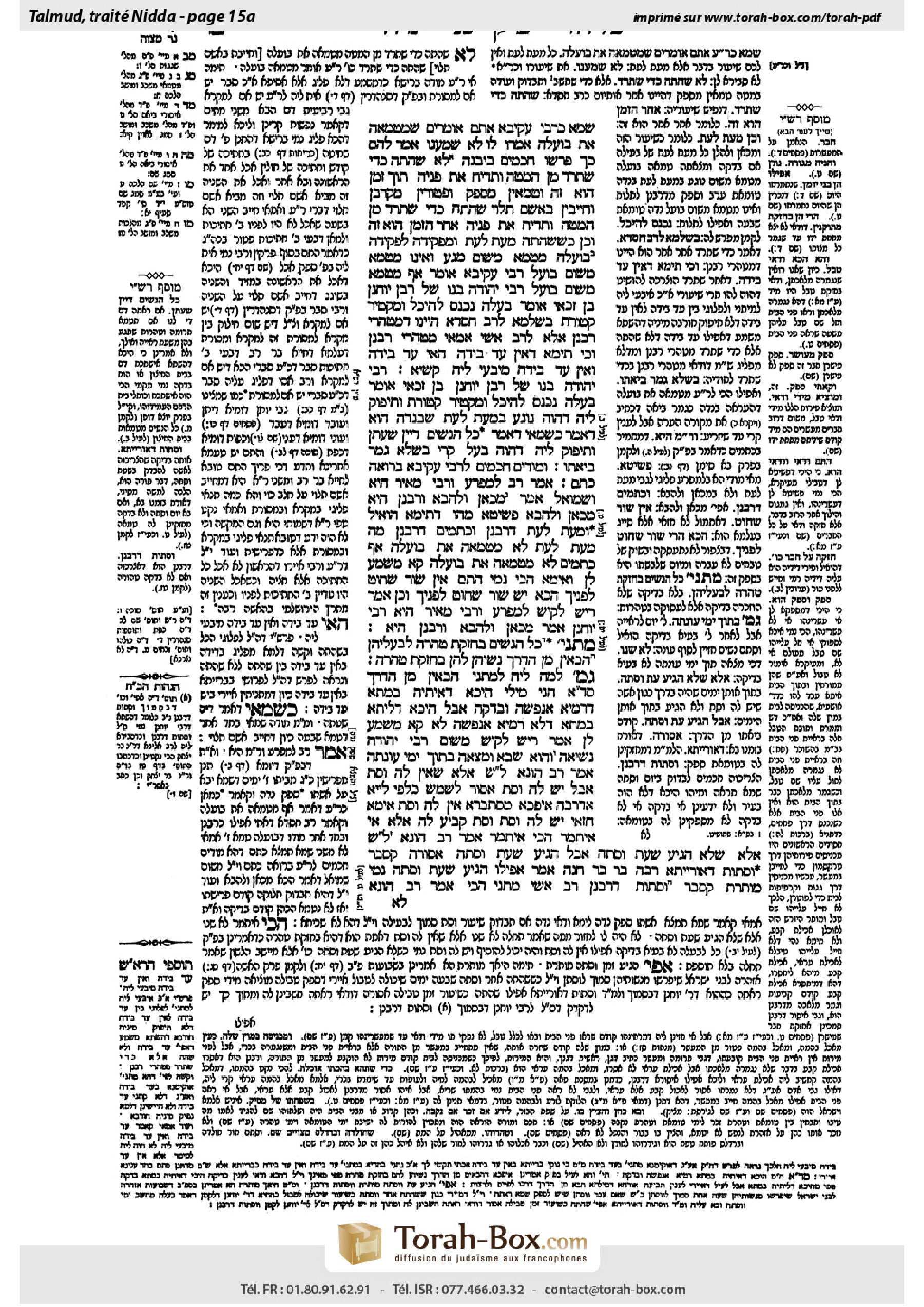
Niddah 15a: Talmud study for Daf Yomi
Daf Yomi is the daily study of one Talmud folio. Explore 37 tractates with scans, Hebrew text, Sefaria English and AI-generated French translations where annotated.
Passage selection and English or AI-generated French translation are available where the scan has annotations. Daf Study is independent of Torah-Box and Sefaria.
Browse Niddah · נידה · All tractatesNiddah 15a text and translations
This page of Niddah includes the Aramaic text, an English translation and an AI-generated French translation, alongside the scan above.
נידה י״ה א · Aramaic and Hebrew text
שֶׁמָּא כְּרַבִּי עֲקִיבָא אַתֶּם אוֹמְרִים שֶׁמְּטַמְּאָה אֶת בּוֹעֲלָהּ? אָמְרוּ לוֹ: לֹא שָׁמַעְנוּ.
אָמַר לָהֶם: כָּךְ פֵּרְשׁוּ חֲכָמִים בְּיַבְנֶה: לֹא שָׁהֲתָה כְּדֵי שֶׁתֵּרֵד מִן הַמִּטָּה וְתָדִיחַ אֶת פָּנֶיהָ — תּוֹךְ זְמַן הוּא זֶה, וּטְמֵאִין מִסָּפֵק, וּפְטוּרִין מִקׇּרְבָּן, וְחַיָּיבִין בְּאָשָׁם תָּלוּי.
שָׁהֲתָה כְּדֵי שֶׁתֵּרֵד מִן הַמִּטָּה וְתָדִיחַ אֶת פָּנֶיהָ — אַחַר הַזְּמַן הוּא זֶה.
וְכֵן כְּשֶׁשָּׁהֲתָה מֵעֵת לְעֵת וּמִפְּקִידָה לִפְקִידָה, בּוֹעֲלָהּ מְטַמֵּא מִשּׁוּם מַגָּע, וְאֵינוֹ מְטַמֵּא מִשּׁוּם בּוֹעֵל. רַבִּי עֲקִיבָא אוֹמֵר: אַף מְטַמֵּא מִשּׁוּם בּוֹעֵל. רַבִּי יְהוּדָה בְּנוֹ שֶׁל רַבָּן יוֹחָנָן בֶּן זַכַּאי אוֹמֵר: בַּעְלָהּ נִכְנַס לַהֵיכָל וּמַקְטִיר קְטוֹרֶת.
בִּשְׁלָמָא לְרַב חִסְדָּא, הַיְינוּ דִּמְטַהֲרִי רַבָּנַן.
אֶלָּא לְרַב אָשֵׁי, אַמַּאי מְטַהֲרִי רַבָּנַן?
וְכִי תֵימָא: דְּאֵין עֵד בְּיָדָהּ, הַאי ״עֵד בְּיָדָהּ״ וְ״אֵין עֵד בְּיָדָהּ״ מִיבְּעֵי לֵיהּ! קַשְׁיָא.
רַבִּי יְהוּדָה בְּנוֹ שֶׁל רַבָּן יוֹחָנָן בֶּן זַכַּאי אוֹמֵר: בַּעְלָהּ נִכְנָס לַהֵיכָל וּמַקְטִיר קְטוֹרֶת. וְתִיפּוֹק לֵיהּ דְּהָוֵה נוֹגֵעַ בְּמֵעֵת לְעֵת שֶׁבְּנִדָּה!
הוּא דְּאָמַר כְּשַׁמַּאי, דְּאָמַר: כׇּל הַנָּשִׁים דַּיָּין שְׁעָתָן.
וְתִיפּוֹק לֵיהּ דְּהָוֵה בַּעַל קֶרִי! בְּשֶׁלֹּא גָּמַר בִּיאָתוֹ.
וּמוֹדִים חֲכָמִים לְרַבִּי עֲקִיבָא בְּרוֹאָה כֶּתֶם, אָמַר רַב לְמַפְרֵעַ, וְרַבִּי מֵאִיר הִיא.
וּשְׁמוּאֵל אָמַר: מִכָּאן וּלְהַבָּא, וְרַבָּנַן הִיא. מִכָּאן וּלְהַבָּא פְּשִׁיטָא!
מַהוּ דְּתֵימָא: הוֹאִיל וּמֵעֵת לְעֵת דְּרַבָּנַן, וּכְתָמִים דְּרַבָּנַן — מָה מֵעֵת לְעֵת לֹא מְטַמְּאָה אֶת בּוֹעֲלָהּ, אַף כְּתָמִים — לֹא מְטַמְּאָה אֶת בּוֹעֲלָהּ, קָא מַשְׁמַע לַן.
וְאֵימָא הָכִי נָמֵי! הָתָם — אֵין ״שׁוֹר שָׁחוּט לְפָנֶיךָ״, הָכָא — יֵשׁ ״שׁוֹר שָׁחוּט לְפָנֶיךָ״.
וְכֵן אָמַר רֵישׁ לָקִישׁ: לְמַפְרֵעַ, וְרַבִּי מֵאִיר הִיא. רַבִּי יוֹחָנָן אָמַר: מִכָּאן וּלְהַבָּא, וְרַבָּנַן הִיא.
מַתְנִי' כׇּל הַנָּשִׁים בְּחֶזְקַת טׇהֳרָה לְבַעְלֵיהֶן, הַבָּאִין מִן הַדֶּרֶךְ — נְשֵׁיהֶן לָהֶן בְּחֶזְקַת טׇהֳרָה.
גְּמָ' לְמָה לֵיהּ לְמִתְנֵי ״הַבָּאִין מִן הַדֶּרֶךְ״? סָלְקָא דַעְתָּךְ אָמֵינָא: הָנֵי מִילֵּי הֵיכָא דְּאִיתֵיהּ בְּמָתָא, דְּרָמְיָא אַנַּפְשַׁהּ וּבָדְקָה, אֲבָל הֵיכָא דְּלֵיתֵיהּ בְּמָתָא, דְּלָא רָמְיָא אַנַּפְשַׁהּ — לָא. קָא מַשְׁמַע לַן.
אָמַר רֵישׁ לָקִישׁ מִשּׁוּם רַבִּי יְהוּדָה נְשִׂיאָה: וְהוּא שֶׁבָּא וּמְצָאָהּ בְּתוֹךְ יְמֵי עוֹנָתָהּ.
אָמַר רַב הוּנָא: לֹא שָׁנוּ אֶלָּא שֶׁאֵין לָהּ וֶסֶת, אֲבָל יֵשׁ לָהּ וֶסֶת — אָסוּר לְשַׁמֵּשׁ.
כְּלַפֵּי לְיָיא? אַדְּרַבָּה, אִיפְּכָא מִסְתַּבְּרָא! אֵין לָהּ וֶסֶת — אֵימָא חֲזַאי, יֵשׁ לָהּ וֶסֶת — וֶסֶת קְבִיעַ לַהּ!
אֶלָּא, אִי אִיתְּמַר הָכִי אִיתְּמַר, אָמַר רַב הוּנָא: לֹא שָׁנוּ אֶלָּא שֶׁלֹּא הִגִּיעַ (שעת) [עֵת] וִסְתָּהּ, אֲבָל הִגִּיעַ (שעת) [עֵת] וִסְתָּהּ — אֲסוּרָה. קָסָבַר: וְסָתוֹת דְּאוֹרָיְיתָא.
רַבָּה בַּר בַּר חַנָּה אָמַר: אֲפִילּוּ הִגִּיעַ שְׁעַת וִסְתָּהּ נָמֵי מוּתֶּרֶת, קָסָבַר: וְסָתוֹת דְּרַבָּנַן.
רַב אָשֵׁי מַתְנֵי הָכִי, אָמַר רַב הוּנָא:
Niddah 15a · English translation
Perhaps you say in accordance with the opinion of Rabbi Akiva, that the woman transmits impurity to the man with whom she engaged in intercourse, just as she retroactively transmits impurity to any pure items she touched in the preceding twenty-four-hour period? The Sages of Usha said to Rabbi Eliezer, son of Rabbi Tzadok: We have not heard this opinion of Rabbi Akiva, i.e., we do not accept it as halakha, and therefore we would like to know what this period of: After time passed, is.
Rabbi Eliezer, son of Rabbi Tzadok, said to them: This is how the Sages of Yavne explained it: As long as the woman did not wait before examining herself after intercourse for a period of time equivalent to the time in which she may descend from the bed and rinse her face, this is considered within the period of time referred to in the mishna as: After time passed. And if blood is found on the cloth she used to examine herself during this period, they are both impure for seven days due to uncertainty, and they are exempt from bringing a sin offering, as this offering is brought only for an unwitting sin that was definitely committed. But they are each obligated to bring a provisional guilt offering.
If she waited before examining herself after intercourse for a period of time equivalent to the time in which she may descend from the bed and rinse her face, this is considered: After time, i.e., after the time frame referred to in the mishna as: After time passed.
In this case, and likewise in a case when she waited for a twenty-four-hour period or from examination to examination, i.e., she examined herself before intercourse and was pure, and then examined herself within twenty-four hours after intercourse and was impure, the man with whom she engaged in intercourse becomes impure until evening due to contact with a menstruating woman, but he does not become impure for seven days as one who engaged in intercourse with a menstruating woman. Rabbi Akiva says: He even becomes impure for seven days as one who engaged in intercourse with a menstruating woman. Rabbi Yehuda, son of Rabban Yoḥanan ben Zakkai, says: In such a case, not only is her husband not impure for seven days, but he is not even deemed impure until evening by rabbinic law. Therefore, if he is a priest he may enter the Sanctuary and burn incense.
The Gemara explains the difficulty with Rav Ashi’s interpretation of the mishna according to this baraita: Granted, according to the opinion of Rav Ḥisda, who maintains that the period of: After time passed, during which if the woman found blood on her cloth the man with whom she engaged in intercourse is rendered impure for seven days, is equivalent to the time it takes for her to extend her hand and examine herself, this is the reason that the Rabbis deem him pure if she discovered blood after this period has passed.
But according to the opinion of Rav Ashi, who holds that if she has a cloth in her hand then she renders the man with whom she engaged in intercourse impure if she discovers blood within the amount of time it takes for her to descend from the bed and rinse or clean her pubic area with the cloth she is holding in her hand, why do the Rabbis deem him pure if the amount of time that has passed is the time it takes for her to descend and clean her pubic area? She should still render him impure during that time span.
And if you would say that the baraita is dealing with a case where the cloth is not in her hand, and for this reason the time period that it is referring to is after the amount of time it would take for the woman to extend her hand and examine herself, this cannot be the case, as if so, the tanna of the baraita should have taught two cases: A cloth is in her hand, and: A cloth is not in her hand, to differentiate between the situations. The Gemara concludes: Indeed, this baraita poses a difficulty to the opinion of Rav Ashi.
§ The baraita teaches that Rabbi Yehuda, son of Rabban Yoḥanan ben Zakkai, says: If the examination took place following this period called: After time passed, her husband is not ritually impure at all, and therefore if he is a priest he may enter the Sanctuary and burn incense. The Gemara asks: And let him derive that the husband is impure because he is one who touched a menstruating woman during the twenty-four-hour period before she discovered blood, as the Sages decreed that pure items touched by a menstruating woman in the twenty-four hours before she noticed the bleeding are impure retroactively.
The Gemara answers that Rabbi Yehuda, son of Rabban Yoḥanan ben Zakkai, who said the ruling, holds like Shammai, who said in a mishna (2a): For all women, their time is sufficient, i.e., women who discern the emergence of menstrual blood do not need to be concerned that the flow of blood began before they noticed it, and they assume ritual impurity status only from that moment.
The Gemara raises another difficulty with the opinion of Rabbi Yehuda, son of Rabban Yoḥanan ben Zakkai: And let him derive that the husband is impure because he is one who experienced a seminal emission. The Gemara answers that he is referring to a case where the husband did not complete his act of intercourse.
§ The mishna states: And the Rabbis concede to Rabbi Akiva in the case of a woman who sees a blood stain, that she transmits seven-day impurity to the man with whom she engaged in intercourse. The Gemara cites a dispute of amora’im in this regard. Rav says that she renders the man with whom she engaged in intercourse impure retroactively, and this is in accordance with the opinion of Rabbi Meir, who maintains that a woman who sees a blood stain renders pure items impure retroactively (see 5a).
And Shmuel says that she does not render him impure retroactively, but only if he engages in intercourse with her from now and onward, i.e., after she sees the blood stain, and this is in accordance with the opinion of the Rabbis, who hold that a woman who sees a blood stain renders pure items impure only from that moment onward. The Gemara raises a difficulty with the opinion of Shmuel: Why does the mishna find it necessary to state that she renders him impure from now and onward? Isn’t it obvious?
The Gemara explains that it was necessary for the mishna to state this ruling, lest you say: Since the woman’s retroactive impurity for a twenty-four-hour period is a decree that applies by rabbinic law, and the impurity of blood stains also applies by rabbinic law, one might claim as follows: Just as her retroactive impurity of a twenty-four-hour period does not render impure the man with whom she engaged in intercourse, so too, her blood stains should not render impure the man with whom she engaged in intercourse. Therefore, the mishna teaches us that she does render him impure from that point onward.
The Gemara asks: But perhaps one can say that indeed, she does not transmit impurity to him? The Gemara explains that there is a difference between the two types of rabbinic impurity: There, with regard to retroactive impurity, it is not a case of: The slaughtered ox is before you, i.e., the evidence of impurity did not exist at the time, as she had yet to experience menstruation. Therefore, the Sages did not apply the stringency of retroactive impurity to the husband. By contrast, here, with regard to the impurity of blood stains, it is a case of: The slaughtered ox is before you, as blood has appeared on the cloth.
The Gemara notes: And Reish Lakish similarly says, like Rav, that the woman transmits impurity to the man with whom she engaged in intercourse retroactively, and this is in accordance with the opinion of Rabbi Meir. But Rabbi Yoḥanan says, like Shmuel: She renders him impure from now and onward, i.e., after she sees the blood stain, and this is in accordance with the opinion of the Rabbis.
MISHNA: All women have the presumptive status of purity for their husbands, and therefore one is not required to ascertain whether his wife is ritually pure before engaging in intercourse with her. Even with regard to husbands returning from a journey, if their wives were ritually pure when they left, their wives have the presumptive status of purity for them.
GEMARA: Why does the tanna of the mishna need to teach the halakha of husbands returning from a journey? In what manner are they different from other husbands? The Gemara explains that it might enter your mind to say: This statement, that women have the presumptive status of purity, applies only in a case where the husband is in the city of his residence, as the woman takes upon herself the responsibility of being ready for her husband at all times, and therefore she examines herself. But in a case where the husband is not in the city, since she does not take upon herself the responsibility of being constantly ready for him, perhaps she should not have the presumptive status of purity. Therefore, the tanna of the mishna teaches us that even in this case she has a presumptive status of purity.
The Gemara notes that in this regard, Reish Lakish says in the name of Rabbi Yehuda Nesia: And this halakha that the wife of a husband returning from a journey has a presumptive status of purity is applicable only in a case where the husband came and found that his wife was within the days of her projected period, i.e., within thirty days of her previous menstruation. In this case he may assume that she has not yet experienced a new period, and therefore he may rely on her presumptive status of purity. But if he arrived after thirty days had elapsed from her previous menstruation, it is assumed that she experienced menstruation at the usual time and therefore it is not permitted for him to engage in intercourse with her unless she examined herself and found herself pure.
§ With regard to the presumptive status of purity of wives, Rav Huna says: The Sages taught this halakha only in the case of a woman who does not have a fixed menstrual cycle. But with regard to a woman who does have a fixed menstrual cycle, it is prohibited for her husband to engage in intercourse with her.
The Gemara asks: Isn’t it the opposite? On the contrary; the reverse claim stands to reason: If the wife does not have a fixed cycle, one can say that perhaps she saw blood, and therefore she should be forbidden to him; whereas if she has a fixed cycle, since her cycle is fixed for her she knows when she will become impure and is presumed to be pure beforehand.
Rather, if Rav Huna’s differentiation was stated, it was stated like this: Rav Huna says: The Sages taught this halakha only in a case when the projected time of the woman’s period had not arrived before her husband returned from his journey. But if the projected time of her period had arrived, she is forbidden to him. Rav Huna maintains that the concern for impurity of women at the projected time of their periods applies by Torah law, as this is a halakha transmitted to Moses from Sinai. If a woman did not examine herself at this time she is presumed to have experienced bleeding, even if she did not sense the emission of blood, though there is no formal obligation to examine herself at this time. Accordingly, a husband returning home from a journey cannot rely on the assumption that his wife has examined herself at the projected time of her period, unless he positively establishes that she has done so.
By contrast, Rabba bar bar Ḥana says: Even if the projected time of her period had arrived, she is permitted to her husband. Rabba bar bar Ḥana maintains that the concern for impurity of women at the projected time of their periods applies by rabbinic law, and therefore she is not considered to have experienced bleeding, though by rabbinic law she must still examine herself to ascertain that she is pure.
Rav Ashi teaches the opinions of Rav Huna and Rabba bar bar Ḥana like this: Rav Huna says:
Niddah 15a · Traduction française (IA)
Peut-être diras-tu que cela est conforme à l’opinion de Rabbi Akiva, selon laquelle la femme transmet l’impureté à l’homme avec qui elle a eu un rapport, tout comme elle transmet rétroactivement l’impureté à tout objet pur qu’elle a touché au cours des vingt-quatre heures précédentes ? Les Sages d’Oucha dirent à Rabbi Eliezer, fils de Rabbi Tsadok : « Nous n’avons pas entendu cette opinion de Rabbi Akiva », c’est-à-dire que nous ne l’acceptons pas comme halakha. Nous voudrions donc savoir quelle durée désigne l’expression de la Michna : « Après qu’un certain temps s’est écoulé ».
Rabbi Eliezer, fils de Rabbi Tsadok, leur répondit : « Voici comment les Sages de Yavné l’ont expliqué : si la femme ne s’est pas examinée après le rapport avant qu’ait passé le temps nécessaire pour descendre du lit et se rincer le visage, on considère qu’elle se trouve encore dans la période que la Michna désigne par les mots : “Après qu’un certain temps s’est écoulé.” Si du sang est trouvé sur le linge dont elle s’est servie pour s’examiner durant cette période, tous deux sont impurs pendant sept jours, en raison du doute, et ils sont dispensés d’apporter un sacrifice expiatoire, car celui-ci n’est apporté que pour une faute commise par inadvertance dont la réalité est certaine. Mais chacun est tenu d’apporter un sacrifice de culpabilité provisoire.
Si elle s’est examinée après le rapport seulement une fois écoulé le temps nécessaire pour descendre du lit et se rincer le visage, on considère qu’il s’agit de « l’après », c’est-à-dire que la période désignée dans la Michna par les mots « après qu’un certain temps s’est écoulé » est passée.
Dans ce cas, et de même lorsqu’elle a attendu vingt-quatre heures ou d’un examen à l’autre — c’est-à-dire qu’elle s’est examinée avant le rapport et était pure, puis s’est examinée dans les vingt-quatre heures suivant le rapport et s’est révélée impure —, l’homme avec qui elle a eu un rapport devient impur jusqu’au soir pour avoir touché une femme menstruée, mais il ne devient pas impur pendant sept jours comme celui qui a eu un rapport avec une femme menstruée. Rabbi Akiva dit : il devient même impur pendant sept jours, comme celui qui a eu un rapport avec une femme menstruée. Rabbi Yehouda, fils de Rabban Yoḥanan ben Zakkaï, dit : dans un tel cas, non seulement son mari n’est pas impur pendant sept jours, mais il n’est même pas considéré comme impur jusqu’au soir selon la loi rabbinique. Par conséquent, s’il est prêtre, il peut entrer dans le Sanctuaire et brûler de l’encens.
La Guemara explique la difficulté que soulève, au regard de cette baraïta, l’interprétation de la Michna par Rav Achi : certes, selon l’opinion de Rav Ḥisda, qui soutient que la période désignée par « après qu’un certain temps s’est écoulé », durant laquelle l’homme avec qui la femme a eu un rapport devient impur pendant sept jours si elle trouve du sang sur son linge, équivaut au temps nécessaire pour qu’elle tende la main et s’examine, on comprend pourquoi les Rabbins le déclarent pur si elle découvre du sang après l’écoulement de cette période.
Mais selon l’opinion de Rav Achi, qui soutient que, si elle a un linge à la main, l’homme avec qui elle a eu un rapport devient impur si elle découvre du sang dans le temps nécessaire pour descendre du lit et se rincer ou se nettoyer la région pubienne avec le linge qu’elle tient à la main, pourquoi les Rabbins le déclarent-ils pur si le temps écoulé équivaut à celui nécessaire pour descendre du lit et se nettoyer la région pubienne ? Elle devrait encore le rendre impur durant cet intervalle.
Et si tu dis que la baraïta traite d’un cas où elle n’a pas le linge à la main et que c’est pour cette raison que la période visée commence après le temps nécessaire à la femme pour tendre la main et s’examiner, cela ne peut pas être le cas. En effet, si tel était le cas, le tanna de la baraïta aurait dû enseigner deux cas — « Le linge est à sa main » et « Le linge n’est pas à sa main » — afin de distinguer les situations. La Guemara conclut : en effet, cette baraïta constitue une difficulté pour l’opinion de Rav Achi.
§ La baraïta enseigne que Rabbi Yehouda, fils de Rabban Yoḥanan ben Zakkaï, dit : si l’examen a eu lieu après la période appelée « après qu’un certain temps s’est écoulé », son mari n’est aucunement impur rituellement ; par conséquent, s’il est prêtre, il peut entrer dans le Sanctuaire et brûler de l’encens. La Guemara demande : ne devrait-on pas déduire que le mari est impur parce qu’il a touché une femme menstruée durant les vingt-quatre heures précédant la découverte du sang, puisque les Sages ont décrété que les objets purs touchés par une femme menstruée au cours des vingt-quatre heures précédant le moment où elle remarque le saignement deviennent rétroactivement impurs ?
La Guemara répond que Rabbi Yehouda, fils de Rabban Yoḥanan ben Zakkaï, qui a formulé cette décision, suit l’opinion de Chammaï, qui a dit dans une Michna (2a) : « Pour toutes les femmes, le moment où elles constatent le sang fait foi. » Autrement dit, les femmes qui constatent l’apparition du sang menstruel n’ont pas à craindre que l’écoulement ait commencé avant qu’elles ne le remarquent, et elles ne sont considérées comme rituellement impures qu’à partir de cet instant.
La Guemara soulève une autre difficulté concernant l’opinion de Rabbi Yehouda, fils de Rabban Yoḥanan ben Zakkaï : ne devrait-on pas déduire que le mari est impur parce qu’il a eu une émission séminale ? La Guemara répond qu’il s’agit d’un cas où le mari n’a pas achevé le rapport.
§ La Michna énonce : « Et les Rabbins reconnaissent l’opinion de Rabbi Akiva dans le cas d’une femme qui voit une tache de sang : elle transmet à l’homme avec qui elle a eu un rapport une impureté de sept jours. » La Guemara rapporte à ce sujet une controverse entre les amoraïm. Rav dit qu’elle rend rétroactivement impur l’homme avec qui elle a eu un rapport, conformément à l’opinion de Rabbi Meïr, selon laquelle une femme qui voit une tache de sang rend rétroactivement impurs les objets purs (voir 5a).
Et Chmouel dit qu’elle ne le rend pas impur rétroactivement, mais seulement s’il a un rapport avec elle à partir de maintenant, c’est-à-dire après qu’elle a vu la tache de sang. Cela est conforme à l’opinion des Rabbins, qui soutiennent qu’une femme qui voit une tache de sang ne rend les objets purs impurs qu’à partir de cet instant. La Guemara soulève une difficulté concernant l’opinion de Chmouel : pourquoi la Michna doit-elle préciser qu’elle le rend impur à partir de maintenant ? N’est-ce pas évident ?
La Guemara explique que la Michna devait énoncer cette décision, de peur que tu ne dises : puisque l’impureté rétroactive de la femme pendant vingt-quatre heures est un décret rabbinique, et que l’impureté due aux taches de sang relève également de la loi rabbinique, on pourrait soutenir ceci : de même que son impureté rétroactive pendant vingt-quatre heures ne rend pas impur l’homme avec qui elle a eu un rapport, ses taches de sang ne devraient pas non plus rendre impur l’homme avec qui elle a eu un rapport. La Michna nous enseigne donc qu’elle le rend bien impur à partir de cet instant.
La Guemara demande : mais ne pourrait-on pas dire qu’en effet, elle ne lui transmet pas l’impureté ? La Guemara explique qu’il existe une différence entre les deux formes d’impureté rabbinique : là, au sujet de l’impureté rétroactive, ce n’est pas un cas où « le bœuf abattu est devant toi », c’est-à-dire que l’indice d’impureté n’existait pas à ce moment-là, puisqu’elle n’avait pas encore eu ses règles. Les Sages n’ont donc pas appliqué au mari la rigueur de l’impureté rétroactive. En revanche, ici, au sujet de l’impureté due aux taches de sang, c’est bien un cas où « le bœuf abattu est devant toi », puisque du sang est apparu sur le linge.
La Guemara note que Reish Lakish dit lui aussi, comme Rav, que la femme transmet rétroactivement l’impureté à l’homme avec qui elle a eu un rapport, conformément à l’opinion de Rabbi Meïr. Mais Rabbi Yoḥanan dit, comme Chmouel : elle le rend impur à partir de maintenant, c’est-à-dire après qu’elle a vu la tache de sang, conformément à l’opinion des Rabbins.
MICHNA : Toutes les femmes sont présumées pures à l’égard de leurs maris ; il n’est donc pas nécessaire de vérifier que son épouse est rituellement pure avant d’avoir un rapport avec elle. Même pour les maris qui reviennent de voyage, si leurs épouses étaient rituellement pures lorsqu’ils sont partis, elles sont présumées pures à leur égard.
GUEMARA : Pourquoi le tanna de la Michna doit-il enseigner la halakha concernant les maris qui reviennent de voyage ? En quoi diffèrent-ils des autres maris ? La Guemara explique que l’on pourrait penser ceci : cette affirmation, selon laquelle les femmes sont présumées pures, ne s’applique que lorsque le mari se trouve dans sa ville de résidence, car la femme se considère tenue d’être prête pour son mari à tout moment et s’examine donc. Mais si le mari n’est pas en ville, puisqu’elle ne se considère pas tenue d’être constamment prête pour lui, peut-être ne devrait-elle pas être présumée pure. Le tanna de la Michna nous enseigne donc que, même dans ce cas, elle est présumée pure.
La Guemara note qu’à ce sujet, Reish Lakish dit au nom de Rabbi Yehouda Nesia : cette halakha, selon laquelle l’épouse d’un homme qui revient de voyage est présumée pure, ne s’applique que si, à son arrivée, le mari constate que son épouse se trouve encore dans sa période de règles projetée, c’est-à-dire dans les trente jours suivant ses dernières règles. Dans ce cas, il peut supposer qu’elle n’a pas encore eu de nouvelles règles et se fier à sa présomption de pureté. Mais s’il arrive après que trente jours se sont écoulés depuis ses dernières règles, on suppose qu’elle a eu ses règles au moment habituel ; il ne lui est donc pas permis d’avoir un rapport avec elle, à moins qu’elle ne se soit examinée et ne se soit trouvée pure.
§ Concernant la présomption de pureté des épouses, Rav Houna dit : les Sages n’ont enseigné cette halakha que dans le cas d’une femme qui n’a pas de cycle menstruel fixe. Mais si une femme a un cycle menstruel fixe, son mari n’a pas le droit d’avoir un rapport avec elle.
La Guemara demande : n’est-ce pas le contraire ? Au contraire, c’est la thèse inverse qui semble logique : si l’épouse n’a pas de cycle fixe, on peut dire qu’elle a peut-être vu du sang et qu’elle devrait donc être interdite à son mari ; tandis que si elle a un cycle fixe, puisqu’elle sait quand elle aura ses règles, elle sait quand elle deviendra impure et est présumée pure auparavant.
En réalité, si la distinction de Rav Houna a été formulée, elle l’a été ainsi : Rav Houna dit que les Sages n’ont enseigné cette halakha que dans le cas où le moment prévu des règles de la femme n’était pas encore arrivé au retour de son mari. Mais si le moment prévu de ses règles était arrivé, elle lui est interdite. Rav Houna soutient que la crainte de l’impureté des femmes au moment prévu de leurs règles relève de la Torah, car il s’agit d’une halakha transmise à Moïse au Sinaï. Si une femme ne s’est pas examinée à ce moment-là, on présume qu’elle a eu un saignement, même si elle n’a pas senti l’écoulement du sang, bien qu’elle ne soit pas formellement tenue de s’examiner à ce moment-là. Par conséquent, un mari qui revient de voyage ne peut pas se fier à l’hypothèse que son épouse s’est examinée au moment prévu de ses règles, à moins qu’il n’ait établi avec certitude qu’elle l’a fait.
À l’inverse, Rabba bar bar Ḥana dit : même si le moment prévu de ses règles était arrivé, elle est permise à son mari. Rabba bar bar Ḥana soutient que la crainte de l’impureté des femmes au moment prévu de leurs règles relève de la loi rabbinique ; elle n’est donc pas considérée comme ayant eu un saignement, même si elle doit encore, selon la loi rabbinique, s’examiner pour vérifier qu’elle est pure.
Rav Achi rapporte ainsi les opinions de Rav Houna et de Rabba bar bar Ḥana : Rav Houna dit :
Traduction française générée par IA à partir de l’édition anglaise de Sefaria. Vérifie toujours un passage avec le texte source.
Text from Sefaria: William Davidson Edition - Vocalized Aramaic (CC BY NC); William Davidson Edition - English (CC BY NC).