Niddah 14b: Talmud study for Daf Yomi
Daf Yomi is the daily study of one Talmud folio. Explore 37 tractates with scans, Hebrew text, Sefaria English and AI-generated French translations where annotated.
Passage selection and English or AI-generated French translation are available where the scan has annotations. Daf Study is independent of Torah-Box and Sefaria.
Browse Niddah · נידה · All tractatesNiddah 14b text and translations
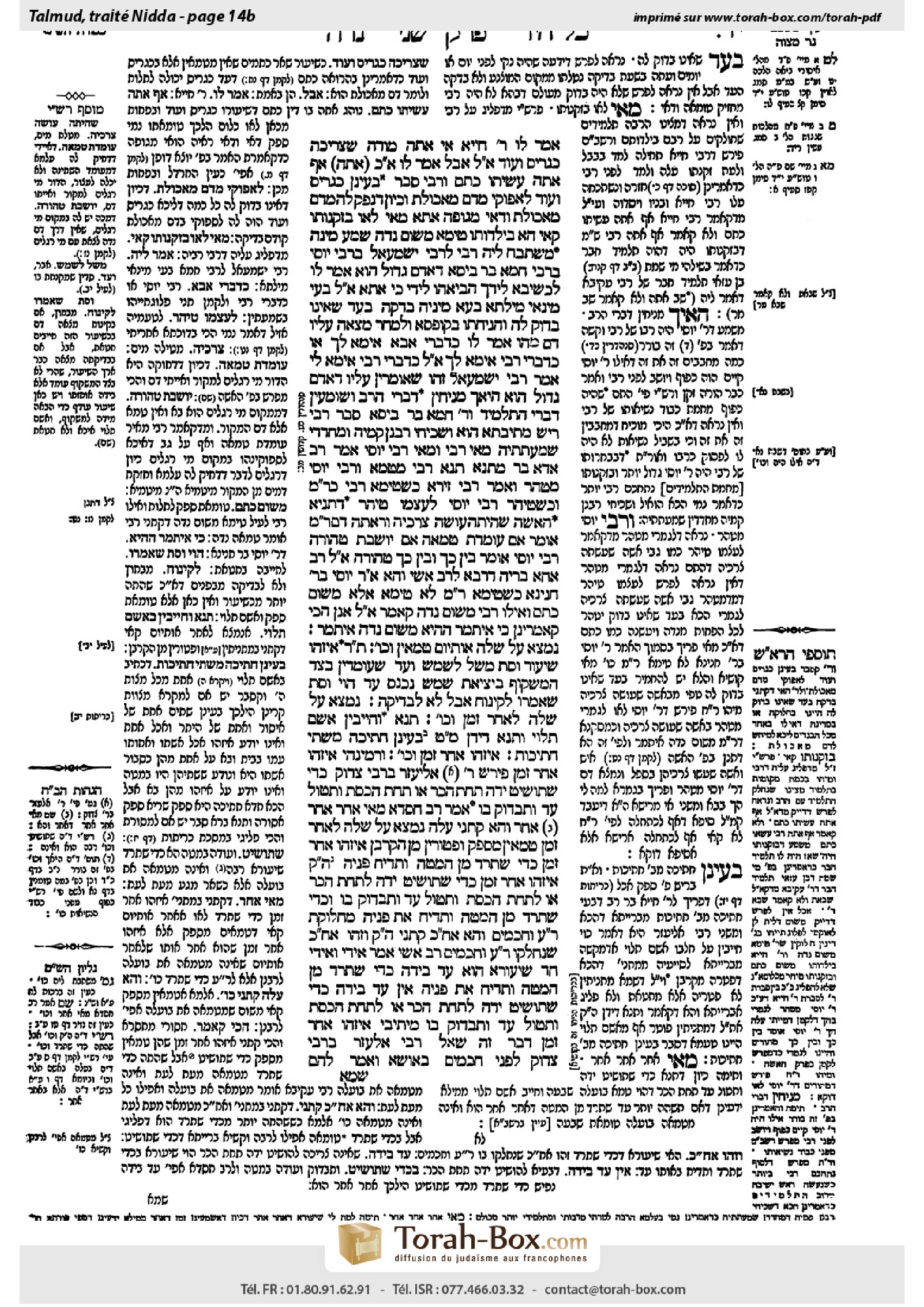
This page of Niddah includes the Aramaic text, an English translation and an AI-generated French translation, alongside the scan above.
נידה י״ד ב · Aramaic and Hebrew text
אָמַר לוֹ רַבִּי חִיָּיא: אִי אַתָּה מוֹדֶה שֶׁצְּרִיכָה כִּגְרִיס וְעוֹד? אָמַר לוֹ: אֲבָל. אָמַר לוֹ: אִם כֵּן, אַף אַתָּה עֲשִׂיתוֹ כֶּתֶם.
וְרַבִּי סָבַר: בָּעֵינַן ״כִּגְרִיס וְעוֹד״ לְאַפּוֹקֵי מִדַּם מַאֲכוֹלֶת, וְכֵיוָן דִּנְפַק לַהּ מִדַּם מַאֲכוֹלֶת — וַדַּאי מִגּוּפַהּ אֲתָא.
מַאי לַָאו בְּזִקְנוּתוֹ קָאֵי? הָא בְּיַלְדוּתוֹ טִימֵּא מִשּׁוּם נִדָּה! שְׁמַע מִינַּהּ.
מִשְׁתַּבַּח לֵיהּ רַבִּי לְרַבִּי יִשְׁמָעֵאל בְּרַבִּי יוֹסֵי בְּרַבִּי חָמָא בַּר בֵּיסָא, דְּאָדָם גָּדוֹל הוּא. אָמַר לוֹ: לִכְשֶׁיָּבֹא לְיָדְךָ, הֲבִיאֵהוּ לְיָדִי.
כִּי אֲתָא, אֲמַר לֵיהּ: בְּעִי מִינַּאי מִילְּתָא. בְּעָא מִינֵּיהּ: בָּדְקָה בְּעֵד שֶׁאֵינוֹ בָּדוּק לָהּ, וְהִנִּיחַתּוּ בְּקוּפְסָא, וּלְמָחָר מָצְאָה עָלָיו דָּם, מַהוּ?
אָמַר לוֹ: כְּדִבְרֵי אַבָּא אֵימָא לָךְ, אוֹ כְּדִבְרֵי רַבִּי אֵימָא לָךְ? אֲמַר לֵיהּ: כְּדִבְרֵי רַבִּי אֵימָא לִי.
אָמַר רַבִּי יִשְׁמָעֵאל: זֶהוּ שֶׁאוֹמְרִין עָלָיו דְּאָדָם גָּדוֹל הוּא? הֵיאַךְ מַנִּיחִין דִּבְרֵי הָרַב וְשׁוֹמְעִין דִּבְרֵי הַתַּלְמִיד?!
וְרַבִּי חָמָא בַּר בֵּיסָא סָבַר: רַבִּי רֵישׁ מְתִיבְתָּא הוּא, וּשְׁכִיחִי רַבָּנַן קַמֵּיהּ, וּמְחַדְּדִי שְׁמַעְתָּתֵיהּ.
מַאי רַבִּי, וּמַאי רַבִּי יוֹסֵי? אָמַר רַב אַדָּא בַּר מַתְנָא, תָּנָא: רַבִּי מְטַמֵּא, וְרַבִּי יוֹסֵי מְטַהֵר.
וְאָמַר רַבִּי זֵירָא: כְּשֶׁטִּימֵּא רַבִּי — כְּרַבִּי מֵאִיר, וּכְשֶׁטִּיהֵר רַבִּי יוֹסֵי — לְעַצְמוֹ טִיהֵר.
דְּתַנְיָא: הָאִשָּׁה שֶׁהָיְתָה עוֹשָׂה צְרָכֶיהָ וְרָאֲתָה דָּם, רַבִּי מֵאִיר אוֹמֵר: אִם עוֹמֶדֶת — טְמֵאָה, אִם יוֹשֶׁבֶת — טְהוֹרָה.
רַבִּי יוֹסֵי אוֹמֵר: בֵּין כָּךְ וּבֵין כָּךְ — טְהוֹרָה.
אֲמַר לֵיהּ רַב אַחָא בְּרֵיהּ דְּרָבָא לְרַב אָשֵׁי: וְהָא אָמַר רַבִּי יוֹסֵי בְּרַבִּי חֲנִינָא, כְּשֶׁטִּימֵּא רַבִּי מֵאִיר לֹא טִימֵּא אֶלָּא מִשּׁוּם כֶּתֶם, וְאִילּוּ רַבִּי מִשּׁוּם נִדָּה קָאָמַר! אֲמַר לֵיהּ: אֲנַן הָכִי קָאָמְרִינַן, כִּי אִיתְּמַר הָהִיא מִשּׁוּם נִדָּה אִיתְּמַר.
נִמְצָא עַל שֶׁלָּהּ אוֹתְיוֹם טְמֵאִין וְכוּ׳. תָּנוּ רַבָּנַן: אֵיזֶהוּ שִׁיעוּר וֶסֶת? מָשָׁל לְשַׁמָּשׁ וָעֵד שֶׁעוֹמְדִין בְּצַד הַמַּשְׁקוֹף, בִּיצִיאַת שַׁמָּשׁ נִכְנָס עֵד.
הֱוֵי וֶסֶת שֶׁאָמְרוּ לְקִינּוּחַ, אֲבָל לֹא לִבְדִיקָה.
נִמְצָא עַל שֶׁלָּהּ לְאַחַר זְמַן וְכוּ׳. תָּנָא: וְחַיָּיבִין אָשָׁם תָּלוּי. וְתַנָּא דִידַן, מַאי טַעְמָא?
בָּעֵינַן חֲתִיכָה מִשְׁתֵּי חֲתִיכוֹת.
אֵיזֶהוּ ״אַחַר זְמַן״ וְכוּ׳. וּרְמִינְהִי: אֵיזֶהוּ ״אַחֵר זְמַן״? פֵּירֵשׁ רַבִּי אֱלִיעֶזֶר בְּרַבִּי צָדוֹק: כְּדֵי שֶׁתּוֹשִׁיט יָדָהּ תַּחַת הַכַּר אוֹ תַּחַת הַכֶּסֶת וְתִטּוֹל עֵד וְתִבְדּוֹק בּוֹ.
אָמַר רַב חִסְדָּא: מַאי ״אַחַר״? אַחַר אַחַר.
וְהָא קָתָנֵי עֲלַהּ: נִמְצָא עַל שֶׁלָּהּ לְאַחַר זְמַן — טְמֵאִין מִסָּפֵק, וּפְטוּרִין מִן הַקׇּרְבָּן. אֵיזֶהוּ ״אַחַר זְמַן״? כְּדֵי שֶׁתֵּרֵד מִן הַמִּטָּה וְתָדִיחַ פָּנֶיהָ.
הָכִי קָאָמַר: אֵיזֶהוּ ״אַחַר זְמַן״? כְּדֵי שֶׁתּוֹשִׁיט יָדָהּ לְתַחַת הַכַּר אוֹ לְתַחַת הַכֶּסֶת וְתִטּוֹל עֵד וְתִבְדּוֹק בּוֹ, וּכְדֵי שֶׁתֵּרֵד מִן הַמִּטָּה וְתָדִיחַ אֶת פָּנֶיהָ — מַחְלוֹקֶת רַבִּי עֲקִיבָא וַחֲכָמִים.
וְהָא ״אַחַר כָּךְ״ קָתָנֵי! הָכִי קָאָמַר: וְזֶהוּ ״אַחַר כָּךְ״ שֶׁנֶּחְלְקוּ רַבִּי עֲקִיבָא וַחֲכָמִים.
רַב אָשֵׁי אָמַר: אִידֵּי וְאִידֵּי חַד שִׁיעוּרָא הוּא, עֵד בְּיָדָהּ — כְּדֵי שֶׁתֵּרֵד מִן הַמִּטָּה וְתָדִיחַ אֶת פָּנֶיהָ, אֵין עֵד בְּיָדָהּ — כְּדֵי שֶׁתּוֹשִׁיט יָדָהּ לְתַחַת הַכַּר אוֹ לְתַחַת הַכֶּסֶת וְתִטּוֹל עֵד וְתִבְדּוֹק בּוֹ.
מֵיתִיבִי: אֵיזֶהוּ ״אַחַר זְמַן״? דָּבָר זֶה שָׁאַל רַבִּי אֶלְעָזָר בְּרַבִּי צָדוֹק לִפְנֵי חֲכָמִים בְּאוּשָׁא, וְאָמַר לָהֶם:
Niddah 14b · English translation
Rabbi Ḥiyya said to Rabbi Yehuda HaNasi: Do you not concede that for her to become ritually impure she requires that the size of the blood stain on the cloth be more than the size of a split bean? If the stain is smaller, it is assumed to have been caused by a squashed louse. Rabbi Yehuda HaNasi said to him: Indeed [aval], that is correct. Rabbi Ḥiyya said to him: If so, you too render this blood found on the cloth in the box a stain, which renders one impure as a matter of uncertainty. If you had considered it definitely impure, there would have been no distinction between a small stain and a large one.
The Gemara comments: And Rabbi Yehuda HaNasi, who deems the woman definitely impure in this case, maintains that although we require that the size of the blood stain be more than the size of a split bean, this is necessary only to exclude the possibility that this is the blood of a louse; and since the possibility that it is the blood of a louse has been excluded, as its size is more than that of a split bean, it certainly came from her body, and therefore she is definitely impure.
The Gemara analyzes this statement of Rabbi Ḥiyya with reference to the dilemma under discussion: What, is it not correct to assume that Rabbi Ḥiyya was in his old age when he disagreed with his teacher, Rabbi Yehuda HaNasi? He would not have done so when he was young. And if he deemed the woman impure as a matter of uncertainty in his old age, it can be inferred that in his youth he would deem her definitely impure as a menstruating woman. The Gemara concludes: Indeed, conclude from here that this is the case.
§ The Gemara relates: Rabbi Yehuda HaNasi would praise Rabbi Ḥama bar Bisa to Rabbi Yishmael, son of Rabbi Yosei, by saying that he is a great man. Rabbi Yishmael said to Rabbi Yehuda HaNasi: When he comes to you, bring him to me.
When Rabbi Ḥama came before him, Rabbi Yishmael said to him: Ask me about a halakhic matter. Rabbi Ḥama asked him: If a woman examined herself with a cloth that was not examined by her before its use, and she placed it in a box, and on the following day she found blood on this cloth, what is the halakha?
Rabbi Yishmael said to him: Shall I say to you an answer in accordance with the statement of father, Rabbi Yosei, or shall I say to you an answer in accordance with the statement of Rabbi Yehuda HaNasi? Which would you prefer? Rabbi Ḥama said to him: Say to me an answer in accordance with the statement of Rabbi Yehuda HaNasi.
Rabbi Yishmael said: Is this the one that Rabbi Yehuda HaNasi says about him that he is a great man? How can he neglect the statement of the teacher, Rabbi Yosei, and listen to the statement of the student, Rabbi Yehuda HaNasi?
The Gemara explains: And Rabbi Ḥama bar Bisa did so because he maintains that the opinion of Rabbi Yehuda HaNasi is preferable, as he is the head of the yeshiva, and the Sages are frequently in his presence, and due to the constant disputes his statements are sharper than those of Rabbi Yosei, despite the fact that Rabbi Yosei was his teacher.
The Gemara asks: What is this statement of Rabbi Yehuda HaNasi, and what is the statement of Rabbi Yosei, referred to by Rabbi Yishmael? Rav Adda bar Mattana says that the reference is to that which was taught in a baraita with regard to this case: Rabbi Yehuda HaNasi deems the woman impure and Rabbi Yosei deems her pure.
And Rabbi Zeira says, in explanation of this dispute: When Rabbi Yehuda HaNasi deemed the woman impure, he ruled in accordance with the line of reasoning of Rabbi Meir, and when Rabbi Yosei deemed her pure, he deemed her pure in accordance with his own line of reasoning.
As it is taught in a mishna (59b): In the case of a woman who was urinating and saw blood mixed in the urine, Rabbi Meir says: If she urinated while standing, she is impure, as the blood could have originated in the uterus. If she was sitting, she is pure, as the blood is clearly from the urethra.
Rabbi Yosei says: Whether she urinates in this manner, standing, or whether she urinates in that manner, sitting, she is pure. Like Rabbi Meir, who disregards the possibility that the blood originated in the urethra in a case where the woman was standing, Rabbi Yehuda HaNasi deems a woman impure in the case where blood is found on the cloth in the box, despite the possibility that it could have been on the cloth before she used it to examine herself. Rabbi Yosei, by contrast, maintains that wherever there is a reasonable uncertainty, the woman is not impure.
Rav Aḥa, son of Rava, said to Rav Ashi: But doesn’t Rabbi Yosei, son of Rabbi Ḥanina, say that when Rabbi Meir deemed the woman impure in the case involving urination, he merely deemed her impure as a matter of uncertainty, due to contact with a blood stain, whereas Rabbi Yehuda HaNasi said that in the case involving a stained cloth the woman is definitely impure as a menstruating woman? Rav Ashi said to Rav Aḥa, son of Rava: This is what we are saying: When that comment of Rabbi Yosei, son of Rabbi Ḥanina, concerning the ruling of Rabbi Meir was stated, it was stated that he deemed the woman impure as a menstruating woman.
§ The mishna states: If blood was found on her cloth immediately after intercourse, the woman and her husband are both ritually impure and are each liable to bring a sin offering. The Sages taught in a baraita: What is the period of time needed for the onset of menstruation, i.e., what is considered to be immediately after intercourse? This is comparable to a male organ and a cloth that are standing alongside the doorpost, i.e., at the entrance to the vagina; at the exit of the organ the cloth immediately enters.
The Gemara comments: This is the period of time concerning which the Sages said: During this period any blood on the cloth renders both the woman and the man ritually impure and liable to bring a sin offering. Yet this period is referring only to an external wipe of the pubic area with the cloth after intercourse, to see if there was a flow of blood during intercourse. But this time frame was not stated with regard to a full internal examination. If the woman conducts a full examination of herself, too much time would have passed since the intercourse for the man to be considered definitely impure.
§ The mishna further states: If blood was found on her cloth after time passed, they are both ritually impure due to uncertainty, as it is possible that the blood appeared only after intercourse, and therefore they are exempt from bringing the sin offering. The Gemara notes that it is taught in a baraita: But they are each liable to bring a provisional guilt offering brought by one who is uncertain as to whether he committed a sin that requires a sin offering. The Gemara asks: And the tanna of our mishna, what is the reason that he does not render each of them liable to bring a provisional guilt offering?
The Gemara answers: The tanna of our mishna holds that one is not liable to bring a provisional guilt offering in every case involving the uncertain violation of a prohibition that, were it certain, would render one liable to bring a sin offering. Rather, we require it to be a case akin to that of one piece from two pieces, e.g., one had two pieces of meat before him, one of which was definitely forbidden while the other was permitted, and he does not know for certain which he ate. But when the uncertainty involves a single item, which may or may not have been forbidden, one does not bring a provisional guilt offering. In the case discussed in the mishna there is only one woman, as it is uncertain whether or not engaging in intercourse with her was permitted, which depends on whether menstruation began before or after intercourse.
§ The mishna states: What is considered after time passed? It is a period of time equivalent to the time needed for the woman to descend from the bed and rinse her pubic area. The Gemara raises a contradiction from a baraita: What is considered after time passed? Rabbi Eliezer, son of Rabbi Tzadok, explained: It is a period equivalent to the time in which she may extend her hand under the cushion or under the blanket and take a cloth and examine herself with it. This is a shorter period than that required for her to get out of bed and rinse her pubic area.
Rav Ḥisda says: What is the meaning of: After, in the mishna? After, after. In other words, this is referring to the period after the period of time mentioned by Rabbi Eliezer, son of Rabbi Tzadok, who said it is after the amount of time it takes for the woman to extend her hand under the cushion and take a cloth and examine herself. The mishna is referring to the period of time that follows the time frame referred to by Rabbi Eliezer, son of Rabbi Tzadok, as: After time passed. If blood is found after this amount of time has elapsed the man is not ritually impure for a seven-day period, but only until evening, according to the Rabbis.
The Gemara raises a difficulty: But isn’t it taught in the mishna with regard to this time period: If blood was found on her cloth after time passed, they are both ritually impure due to uncertainty, and they are exempt from bringing the sin offering. And the mishna continues: What is considered after time passed? It is a period of time equivalent to the time needed for her to descend from the bed and rinse her face, i.e., her pubic area. This indicates that the period of time that follows the ability to perform an immediate examination is that which is mentioned in the mishna, and the mishna is not discussing the third time frame concerning which the husband is impure only until the evening.
The Gemara explains that this is what the mishna is saying: What is considered after time passed? It is a period equivalent to the time in which she may extend her hand under the cushion or under the blanket and take a cloth and examine herself with it, as stated by Rabbi Eliezer, son of Rabbi Tzadok. And with regard to the other time frame, i.e., equivalent to the time needed for her to descend from the bed and rinse her face, i.e., her pubic area, there is a dispute between Rabbi Akiva and the Rabbis as to whether the man is impure for seven days or only until the evening.
The Gemara raises a difficulty: But with regard to the dispute between Rabbi Akiva and the Rabbis, doesn’t the mishna teach: Afterward, which indicates that they disagree concerning blood found in the time period that comes after the period in which she can descend from the bed and rinse her pubic area? The Gemara answers that this is what the mishna is saying: And this time frame, i.e., which is equivalent to the time needed for her to descend from the bed and rinse her pubic area, is that period of time labeled: Afterward, with regard to which Rabbi Akiva and the Rabbis disagree.
Rav Ashi says a different resolution of the apparent contradiction between the mishna and the baraita: Both this and that are one period, as it all depends on the situation. If the cloth is already in her hand, she does not need to extend her hand, and therefore the time frame is as stated in the mishna: Equivalent to the time needed for her to descend from the bed and rinse her face. If the cloth is not in her hand, the period is equivalent to the time in which she may extend her hand under the cushion or under the blanket and take a cloth and examine herself with it, while she is still in bed.
The Gemara raises an objection to Rav Ashi’s interpretation from a baraita: What is considered after time passed, at which point the blood found on the woman’s cloth renders them both impure as a matter of uncertainty for seven days? About this matter Rabbi Elazar, son of Rabbi Tzadok, asked the Sages in Usha, and he said to them:
Niddah 14b · Traduction française (IA)
Rabbi Ḥiyya dit à Rabbi Yehuda HaNasi : Ne reconnais-tu pas que, pour qu’elle devienne rituellement impure, la tache de sang sur le linge doit être plus grande qu’un haricot fendu ? Si elle est plus petite, on suppose qu’elle a été causée par un pou écrasé. Rabbi Yehuda HaNasi lui répondit : En effet [aval], c’est exact. Rabbi Ḥiyya lui dit : Dans ce cas, toi aussi, tu considères ce sang trouvé sur le linge dans la boîte comme une tache qui la rend impure par incertitude. Si tu l’avais considérée comme la rendant définitivement impure, il n’y aurait eu aucune différence entre une petite tache et une grande.
La Guemara commente : Rabbi Yehuda HaNasi, qui considère la femme comme définitivement impure dans ce cas, estime que, bien qu’on exige que la tache de sang soit plus grande qu’un haricot fendu, cette exigence vise seulement à exclure la possibilité qu’il s’agisse du sang d’un pou. Puisque cette possibilité est écartée, car la tache est plus grande qu’un haricot fendu, le sang provient certainement de son corps et elle est donc définitivement impure.
La Guemara examine cette déclaration de Rabbi Ḥiyya à la lumière du dilemme discuté : ne faut-il pas supposer que Rabbi Ḥiyya était âgé lorsqu’il s’opposa à son maître, Rabbi Yehuda HaNasi ? Il ne l’aurait pas fait dans sa jeunesse. Et s’il considérait alors, dans sa vieillesse, la femme comme impure par incertitude, on peut en déduire que, dans sa jeunesse, il l’aurait considérée comme définitivement impure en tant que femme menstruée. La Guemara conclut : En effet, déduis-en que c’est bien le cas.
§ La Guemara rapporte : Rabbi Yehuda HaNasi faisait l’éloge de Rabbi Ḥama bar Bisa auprès de Rabbi Yishmael, fils de Rabbi Yosei, en disant que c’était un grand homme. Rabbi Yishmael dit à Rabbi Yehuda HaNasi : Quand il viendra chez toi, amène-le-moi.
Lorsque Rabbi Ḥama se présenta devant lui, Rabbi Yishmael lui dit : Interroge-moi sur une question de halakha. Rabbi Ḥama lui demanda : Si une femme s’est examinée avec un linge qu’elle n’avait pas vérifié avant de l’utiliser, puis l’a placé dans une boîte et a trouvé du sang sur ce linge le lendemain, quelle est la halakha ?
Rabbi Yishmael lui dit : Veux-tu que je te donne une réponse conforme à l’opinion de mon père, Rabbi Yosei, ou à celle de Rabbi Yehuda HaNasi ? Laquelle préfères-tu ? Rabbi Ḥama lui répondit : Donne-moi une réponse conforme à l’opinion de Rabbi Yehuda HaNasi.
Rabbi Yishmael dit : Est-ce là celui dont Rabbi Yehuda HaNasi dit qu’il est un grand homme ? Comment peut-il écarter l’opinion du maître, Rabbi Yosei, et écouter celle de l’élève, Rabbi Yehuda HaNasi ?
La Guemara explique : Rabbi Ḥama bar Bisa agit ainsi parce qu’il estime que l’opinion de Rabbi Yehuda HaNasi est préférable : celui-ci est à la tête de la yeshiva, les Sages sont souvent en sa présence et, du fait des discussions constantes, ses propos sont plus affûtés que ceux de Rabbi Yosei, bien que celui-ci ait été son maître.
La Guemara demande : Quelles sont les opinions de Rabbi Yehuda HaNasi et de Rabbi Yosei auxquelles Rabbi Yishmael fait référence ? Rav Adda bar Mattana dit qu’il s’agit de ce qui a été enseigné dans une baraïta au sujet de ce cas : Rabbi Yehuda HaNasi considère la femme comme impure, tandis que Rabbi Yosei la considère comme pure.
Et Rav Zeira explique ainsi cette controverse : lorsque Rabbi Yehuda HaNasi a considéré la femme comme impure, il a statué conformément au raisonnement de Rabbi Meïr ; lorsque Rabbi Yosei l’a considérée comme pure, il l’a fait conformément à son propre raisonnement.
Comme il est enseigné dans une Michna (59b) : dans le cas d’une femme qui urinait et a vu du sang mêlé à son urine, Rabbi Meïr dit : si elle a uriné debout, elle est impure, car le sang pourrait provenir de l’utérus. Si elle était assise, elle est pure, car le sang provient manifestement de l’urètre.
Rabbi Yosei dit : qu’elle urine de cette manière, debout, ou de cette autre manière, assise, elle est pure. À l’instar de Rabbi Meïr, qui écarte la possibilité que le sang provienne de l’urètre lorsque la femme était debout, Rabbi Yehuda HaNasi considère la femme comme impure lorsque du sang est trouvé sur le linge dans la boîte, malgré la possibilité qu’il s’y soit trouvé avant qu’elle ne l’utilise pour s’examiner. Rabbi Yosei, au contraire, estime que, dès lors qu’il existe un doute raisonnable, la femme n’est pas impure.
Rav Aḥa, fils de Rava, dit à Rav Ashi : Mais Rabbi Yosei, fils de Rabbi Ḥanina, ne dit-il pas que, lorsque Rabbi Meïr a considéré la femme comme impure dans le cas de l’urination, il l’a seulement considérée comme impure par incertitude, en raison de la possibilité qu’elle ait été en contact avec une tache de sang, tandis que Rabbi Yehuda HaNasi a dit que, dans le cas du linge taché, la femme est définitivement impure en tant que femme menstruée ? Rav Ashi répondit à Rav Aḥa, fils de Rava : Voici ce que nous disons : lorsque ce commentaire de Rabbi Yosei, fils de Rabbi Ḥanina, concernant la décision de Rabbi Meïr a été rapporté, il a été dit qu’il considérait la femme comme impure en tant que femme menstruée.
§ La Michna dit : si du sang a été trouvé sur son linge immédiatement après les rapports sexuels, la femme et son mari sont tous deux rituellement impurs et chacun doit apporter un sacrifice expiatoire. Les Sages ont enseigné dans une baraïta : quelle durée est nécessaire pour qu’apparaissent les règles, c’est-à-dire qu’entend-on par « immédiatement après les rapports sexuels » ? Cela correspond au cas où l’organe masculin et un linge se trouvent côte à côte, près du montant de la porte, c’est-à-dire à l’entrée du vagin : au retrait de l’organe, le linge est introduit immédiatement.
La Guemara commente : il s’agit de la durée au sujet de laquelle les Sages ont dit que, si du sang se trouve sur le linge pendant cet intervalle, la femme et l’homme deviennent tous deux rituellement impurs et doivent chacun apporter un sacrifice expiatoire. Toutefois, cet intervalle ne concerne qu’un essuyage externe de la région pubienne avec le linge après les rapports sexuels, afin de vérifier s’il y a eu un écoulement de sang pendant ceux-ci. Ce délai ne concerne pas un examen interne complet. Si la femme procède à un examen complet d’elle-même, trop de temps se sera écoulé depuis les rapports pour que l’homme soit considéré comme définitivement impur.
§ La Michna dit également : si du sang a été trouvé sur son linge après qu’un certain temps s’est écoulé, ils sont tous deux rituellement impurs par incertitude, puisqu’il est possible que le sang ne soit apparu qu’après les rapports sexuels ; ils sont donc exempts d’apporter le sacrifice expiatoire. La Guemara relève qu’il est enseigné dans une baraïta : mais chacun doit apporter un sacrifice de culpabilité provisoire, que présente celui qui ne sait pas avec certitude s’il a commis un péché exigeant un sacrifice expiatoire. La Guemara demande : pourquoi le tanna de notre Michna ne rend-il pas chacun d’eux passible d’apporter un sacrifice de culpabilité provisoire ?
La Guemara répond : le tanna de notre Michna estime qu’on n’est pas passible d’apporter un sacrifice de culpabilité provisoire dans tous les cas où l’on a enfreint avec incertitude une interdiction qui, si l’infraction était certaine, rendrait passible d’un sacrifice expiatoire. Il faut plutôt que le cas soit comparable à celui d’une pièce parmi deux pièces : par exemple, une personne avait devant elle deux morceaux de viande, dont l’un était certainement interdit et l’autre permis, et elle ne sait pas avec certitude lequel elle a mangé. Mais lorsque le doute porte sur un seul élément, qui était peut-être interdit et peut-être pas, on n’apporte pas de sacrifice de culpabilité provisoire. Dans le cas évoqué par la Michna, il n’y a qu’une seule femme : il est incertain si les rapports sexuels avec elle étaient permis ou non, selon que les règles ont commencé avant ou après les rapports.
§ La Michna dit : qu’entend-on par « après qu’un certain temps s’est écoulé » ? Il s’agit d’un intervalle équivalent au temps nécessaire à la femme pour descendre du lit et rincer sa région pubienne. La Guemara soulève une contradiction à partir d’une baraïta : qu’entend-on par « après qu’un certain temps s’est écoulé » ? Rabbi Eliezer, fils de Rabbi Tzadok, expliqua : il s’agit du temps nécessaire pour qu’elle puisse glisser la main sous le coussin ou sous la couverture, prendre un linge et s’examiner avec. C’est un délai plus court que celui nécessaire pour sortir du lit et rincer sa région pubienne.
Rav Ḥisda dit : que signifie « après » dans la Michna ? « Après », c’est-à-dire après encore. Autrement dit, il s’agit de la période qui suit le délai mentionné par Rabbi Eliezer, fils de Rabbi Tzadok, selon qui il s’agit du temps nécessaire à la femme pour glisser la main sous le coussin, prendre un linge et s’examiner. La Michna vise la période qui suit le délai que Rabbi Eliezer, fils de Rabbi Tzadok, désigne par « après qu’un certain temps s’est écoulé ». Si du sang est trouvé une fois ce délai écoulé, l’homme n’est pas rituellement impur pendant sept jours, mais seulement jusqu’au soir, selon les Rabbins.
La Guemara soulève une difficulté : mais la Michna n’enseigne-t-elle pas, à propos de cette période, que si du sang a été trouvé sur son linge après qu’un certain temps s’est écoulé, ils sont tous deux rituellement impurs par incertitude et exempts d’apporter le sacrifice expiatoire ? Et la Michna poursuit : qu’entend-on par « après qu’un certain temps s’est écoulé » ? Il s’agit du temps nécessaire pour qu’elle descende du lit et rince son visage, c’est-à-dire sa région pubienne. Cela indique que la période qui suit la possibilité de procéder à un examen immédiat est celle mentionnée dans la Michna, et que celle-ci ne parle pas de la troisième période, durant laquelle le mari n’est impur que jusqu’au soir.
La Guemara explique que voici ce que dit la Michna : qu’entend-on par « après qu’un certain temps s’est écoulé » ? Il s’agit du temps nécessaire pour qu’elle puisse glisser la main sous le coussin ou sous la couverture, prendre un linge et s’examiner avec, comme l’a dit Rabbi Eliezer, fils de Rabbi Tzadok. Quant à l’autre délai, c’est-à-dire celui qui correspond au temps nécessaire pour qu’elle descende du lit et rince son visage, autrement dit sa région pubienne, Rabbi Akiva et les Rabbins sont en désaccord : l’homme est-il impur pendant sept jours ou seulement jusqu’au soir ?
La Guemara soulève une difficulté : mais, au sujet de la controverse entre Rabbi Akiva et les Rabbins, la Michna n’enseigne-t-elle pas « ensuite », ce qui indique qu’ils sont en désaccord au sujet du sang trouvé pendant la période qui suit celle où elle peut descendre du lit et rincer sa région pubienne ? La Guemara répond que voici ce que dit la Michna : cette période, c’est-à-dire celle qui correspond au temps nécessaire pour qu’elle descende du lit et rince sa région pubienne, est la période désignée par « ensuite », au sujet de laquelle Rabbi Akiva et les Rabbins sont en désaccord.
Rav Ashi propose une autre solution à la contradiction apparente entre la Michna et la baraïta : ces deux durées correspondent à une seule et même période, car tout dépend de la situation. Si le linge est déjà dans sa main, elle n’a pas besoin d’étendre la main ; le délai est donc celui indiqué dans la Michna, à savoir le temps nécessaire pour descendre du lit et rincer son visage. Si le linge n’est pas dans sa main, le délai correspond au temps nécessaire pour glisser la main sous le coussin ou sous la couverture, prendre un linge et s’examiner avec, alors qu’elle est encore au lit.
La Guemara soulève une objection à l’interprétation de Rav Ashi à partir d’une baraïta : qu’entend-on par « après qu’un certain temps s’est écoulé », délai à l’issue duquel le sang trouvé sur le linge de la femme les rend tous deux impurs par incertitude pendant sept jours ? À ce sujet, Rabbi Elazar, fils de Rabbi Tzadok, interrogea les Sages à Usha et leur dit :
Traduction française générée par IA à partir de l’édition anglaise de Sefaria. Vérifie toujours un passage avec le texte source.
Text from Sefaria: William Davidson Edition - Vocalized Aramaic (CC BY NC); William Davidson Edition - English (CC BY NC).