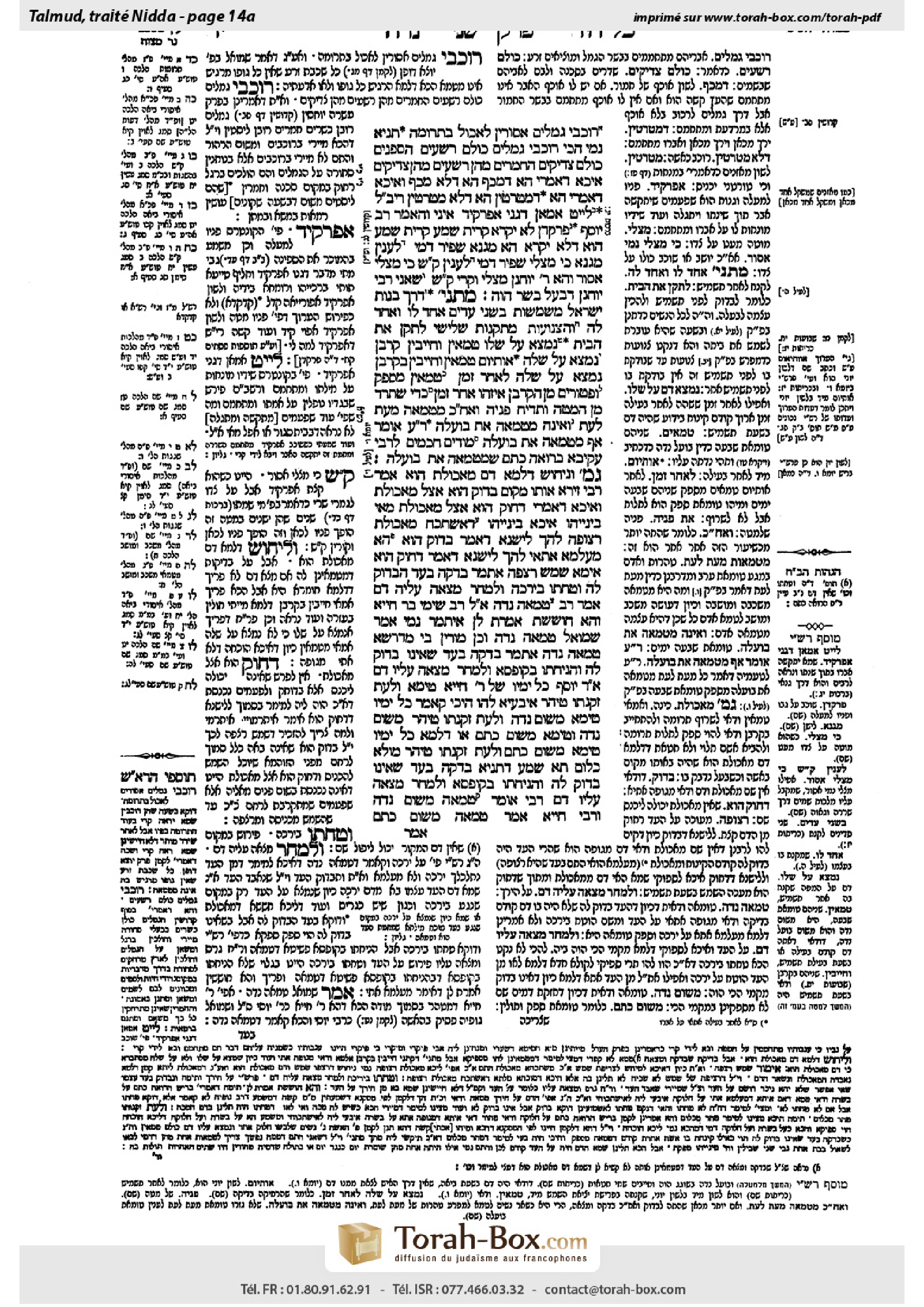
Niddah 14a: Talmud study for Daf Yomi
Daf Yomi is the daily study of one Talmud folio. Explore 37 tractates with scans, Hebrew text, Sefaria English and AI-generated French translations where annotated.
Passage selection and English or AI-generated French translation are available where the scan has annotations. Daf Study is independent of Torah-Box and Sefaria.
Browse Niddah · נידה · All tractatesNiddah 14a text and translations
This page of Niddah includes the Aramaic text, an English translation and an AI-generated French translation, alongside the scan above.
נידה י״ד א · Aramaic and Hebrew text
רוֹכְבֵי גְמַלִּים אֲסוּרִין לֶאֱכוֹל בִּתְרוּמָה. תַּנְיָא נָמֵי הָכִי: רוֹכְבֵי גְמַלִּים — כּוּלָּם רְשָׁעִים, הַסַּפָּנִים — כּוּלָּם צַדִּיקִים,
הַחַמָּרִים — מֵהֶן רְשָׁעִים מֵהֶן צַדִּיקִים. אִיכָּא דְאָמְרִי: הָא דְּמִכַּף, הָא דְּלָא מִכַּף; וְאִיכָּא דְאָמְרִי: הָא דִּמְטַרְטֵין, הָא דְּלָא מְטַרְטֵין.
רַבִּי יְהוֹשֻׁעַ בֶּן לֵוִי לָיֵיט אַמַּאן דְּגָנֵי אַפַּרְקִיד. אִינִי? וְהָאָמַר רַב יוֹסֵף: פְּרַקְדָּן לֹא יִקְרָא ״קְרִיַּת שְׁמַע״ — קְרִיַּת שְׁמַע הוּא דְּלֹא יִקְרָא, הָא מִגְנָא שַׁפִּיר דָּמֵי!
לְעִנְיַן מִגְנָא, כִּי מַצְלֵי — שַׁפִּיר דָּמֵי. לְעִנְיַן קְרִיאַת שְׁמַע, כִּי מַצְלֵי — אָסוּר. וְהָא רַבִּי יוֹחָנָן מַצְלֵי וְקָרֵי קְרִיאַת שְׁמַע! שָׁאנֵי רַבִּי יוֹחָנָן, דְּבַעַל בָּשָׂר הֲוָה.
מַתְנִי' דֶּרֶךְ בְּנוֹת יִשְׂרָאֵל מְשַׁמְּשׁוֹת בִּשְׁנֵי עֵדִים, אֶחָד לוֹ וְאֶחָד לָהּ, וְהַצְּנוּעוֹת מְתַקְּנוֹת שְׁלִישִׁי לְתַקֵּן אֶת הַבַּיִת.
נִמְצָא עַל שֶׁלּוֹ — טְמֵאִין וְחַיָּיבִין קׇרְבָּן. נִמְצָא עַל שֶׁלָּהּ אוֹתְיוֹם — טְמֵאִין וְחַיָּיבִין בְּקׇרְבָּן. נִמְצָא עַל שֶׁלָּהּ לְאַחַר זְמַן — טְמֵאִין מִסָּפֵק, וּפְטוּרִין מִן הַקׇּרְבָּן.
אֵיזֶהוּ אַחַר זְמַן? כְּדֵי שֶׁתֵּרֵד מִן הַמִּטָּה וְתָדִיחַ פָּנֶיהָ, וְאַחַר כָּךְ מְטַמְּאָה מֵעֵת לְעֵת, וְאֵינָהּ מְטַמְּאָה אֶת בּוֹעֲלָהּ. רַבִּי עֲקִיבָא אוֹמֵר: אַף מְטַמְּאָה אֶת בּוֹעֲלָהּ.
מוֹדִים חֲכָמִים לְרַבִּי עֲקִיבָא בְּרוֹאָה כֶּתֶם שֶׁמְּטַמְּאָה אֶת בּוֹעֲלָהּ.
גְּמָ' וְנֵיחוּשׁ דִּלְמָא דַּם מַאֲכוֹלֶת הוּא? אָמַר רַבִּי זֵירָא: אוֹתוֹ מָקוֹם בָּדוּק הוּא אֵצֶל מַאֲכוֹלֶת. וְאִיכָּא דְּאָמְרִי: דָּחוּק הוּא אֵצֶל מַאֲכוֹלֶת.
מַאי בֵּינַיְיהוּ? אִיכָּא בֵּינַיְיהוּ דְּאִשְׁתְּכַח מַאֲכוֹלֶת רְצוּפָה. לְהָךְ לִישָּׁנָא דְּאָמַר ״בָּדוּק הוּא״ — הָא מֵעָלְמָא אֲתַאי, לְהָךְ לִישָּׁנָא דְּאָמַר ״דָּחוּק הוּא״ — אֵימָא שַׁמָּשׁ רְצָפָהּ.
אִתְּמַר: בָּדְקָה בְּעֵד הַבָּדוּק לָהּ, וְטָחַתּוּ בִּירֵכָהּ, וּלְמָחָר מָצָאתָה עָלָיו דָּם. אָמַר רַב: טְמֵאָה נִדָּה. אֲמַר לֵיהּ רַב שִׁימִי בַּר חִיָּיא: וְהָא ״חוֹשֶׁשֶׁת״ אֲמַרְתְּ לַן!
אִיתְּמַר נָמֵי, אָמַר שְׁמוּאֵל: טְמֵאָה נִדָּה. וְכֵן מוֹרִין בֵּי מִדְרְשָׁא: טְמֵאָה נִדָּה.
אִתְּמַר: בָּדְקָה בְּעֵד שֶׁאֵינוֹ בָּדוּק לָהּ, וְהִנִּיחַתּוּ בְּקוּפְסָא, וּלְמָחָר מָצְאָה עָלָיו דָּם. אָמַר רַב יוֹסֵף: כׇּל יָמָיו שֶׁל רַבִּי חִיָּיא טִימֵּא, וּלְעֵת זִקְנָתוֹ טִיהֵר.
אִיבַּעְיָא לְהוּ: הֵיכִי קָאָמַר? כׇּל יָמָיו טִימֵּא מִשּׁוּם נִדָּה, וּלְעֵת זִקְנָתוֹ טִיהֵר מִשּׁוּם נִדָּה, וְטִימֵּא מִשּׁוּם כֶּתֶם.
אוֹ דִלְמָא: כׇּל יָמָיו טִימֵּא מִשּׁוּם כֶּתֶם, וּלְעֵת זִקְנָתוֹ טִיהֵר מִוְּלֹא כְּלוּם?
תָּא שְׁמַע, דְּתַנְיָא: בָּדְקָה בְּעֵד שֶׁאֵינוֹ בָּדוּק לָהּ, וְהִנִּיחַתּוּ בְּקוּפְסָא, וּלְמָחָר מָצְאָה עָלָיו דָּם, רַבִּי אוֹמֵר: טְמֵאָה מִשּׁוּם נִדָּה, וְרַבִּי חִיָּיא אָמַר: טְמֵאָה מִשּׁוּם כֶּתֶם.
Niddah 14a · English translation
It is prohibited for camel riders to partake of teruma, due to the concern for a seminal emission that might result from the friction. The Gemara notes: This opinion of Abaye is also taught in a baraita: Camel riders are all wicked, as they are suspected of emitting semen for naught. Sailors are all righteous, because they are in a constant state of danger at sea, and therefore their hearts are always turned to God in prayer.
The baraita continues: As for donkey drivers, some of them are wicked while some of them are righteous. With regard to the difference between wicked and righteous donkey drivers, there are those who say that this donkey driver is righteous, as his donkey is saddled, and therefore his penis does not rub against it, whereas that donkey driver is wicked, as his donkey is not saddled, which can cause a seminal emission. And there are those who say: This donkey driver is wicked, as he spreads [demittartein] his thighs on either side of the donkey, whereas that donkey driver is righteous as he does not spread his thighs in this manner, but rides with both legs on one side of the donkey, so that his penis does not rub against the donkey.
The Gemara further discusses actions that are apt to lead to a seminal emission. Rabbi Yehoshua ben Levi would curse one who sleeps lying on his back [aparkeid], as this might lead to a seminal emission. The Gemara asks: Is that so? But doesn’t Rav Yosef say: One who is lying on his back may not recite Shema? From this it may be inferred that it is only Shema that one may not recite in this position, but to sleep lying in that position is permitted.
The Gemara answers: With regard to the prohibition against sleeping while lying on one’s back, when one leans slightly to the side it is permitted. But with regard to reciting Shema while lying face upward, even when one leans slightly to the side it is prohibited. The Gemara asks: But wouldn’t Rabbi Yoḥanan lie on his back leaning slightly to the side and recite Shema in this manner? The Gemara answers: The halakha in the case of Rabbi Yoḥanan is different, as he was corpulent, and consequently he could lean only slightly.
MISHNA: It is the custom of Jewish women that they engage in intercourse with their husbands while using two examination cloths, one for the husband, to see if there is any of the wife’s blood on him after intercourse, and one for her, to ascertain after intercourse whether her menstrual flow has begun. And the modest women prepare a third examination cloth, to examine themselves and prepare the pubic area for intercourse.
If blood was found on his cloth, the woman and her husband are both ritually impure for seven days, in accordance with the halakha of a menstruating woman and of one who engages in intercourse with a menstruating woman, and are each liable to bring a sin offering for unwittingly performing an action punishable with excision from the World-to-Come [karet]. If blood was found on her cloth immediately [otyom] after intercourse, the woman and her husband are likewise ritually impure for seven days and are each liable to bring a sin offering. If blood was found on her cloth after time passed, they are both ritually impure due to uncertainty, as it is possible that the blood appeared only after intercourse, and they are exempt from bringing the sin offering.
What is considered as being: After time passed? It is a period of time equivalent to the time needed for her to descend from the bed and rinse her face, a euphemism for her pubic area. And afterward, she retroactively transmits impurity to all ritually pure items with which she came into contact for the preceding twenty-four-hour period, by rabbinic law, but she does not transmit seven-day impurity to the man with whom she engaged in intercourse. He is impure with this impurity by rabbinic law only until the evening, like one who came in contact with a menstruating woman. Rabbi Akiva says: In the case where blood was found on her cloth after time passed, she even transmits seven-day impurity by rabbinic law to the man with whom she engaged in intercourse.
The mishna concludes: The Rabbis concede to Rabbi Akiva in the case of a woman who sees a blood stain and then engages in intercourse, that she transmits seven-day impurity to the man with whom she engaged in intercourse, although this impurity also applies by rabbinic law.
GEMARA: The mishna states that if blood is found on the husband’s cloth after intercourse the husband and wife are both definitely impure. The Gemara asks: But let us be concerned that perhaps it is the blood of a louse, as it is possible that there was a louse in the woman’s pubic area that was squashed during intercourse, and its blood was found on the husband’s penis. Accordingly, it should be uncertain if they are impure. Rabbi Zeira says: There is no concern for this possibility, as that place, a woman’s genitals, is considered examined [baduk] with regard to the appearance of a louse, i.e., it is clear that no louse was there. And some say a different version of Rabbi Zeira’s statement: That place is too narrow [daḥuk] for a louse to enter, and therefore this is not a concern.
The Gemara asks: What is the practical difference between these two versions of Rabbi Zeira’s statement? The Gemara answers: There is a practical difference between them in a case where a squashed louse was found on the husband’s cloth, near the blood: According to this version, which states that a woman’s genitals are considered examined with regard to a louse, this louse certainly came from elsewhere, as a louse is never found in her pubic area, so the blood on the cloth is clearly from the woman, and therefore the couple is ritually impure. By contrast, according to that version, which states that the place is too narrow for a louse to enter, one can say that although it is generally too narrow, in this case one did enter and the man’s organ squashed it during intercourse, and therefore their impurity is uncertain.
It was stated: If the woman examined herself with a cloth that was examined by her before she used it and found free of blood, and after the examination she pressed it against her thigh, and did not look at the cloth, and on the following day she found blood on her thigh, Rav says: In such a case she is definitely impure as a menstruating woman. Since it is known that the cloth was clear of blood before the examination, the blood on her thigh must be from her examination, and it must have passed onto her thigh after the cloth was pressed there. Rav Shimi bar Ḥiyya said to Rav: But didn’t you say to us with regard to this case that she needs to be concerned for ritual impurity, which indicates that her impurity is uncertain?
In this regard it was also stated that Shmuel says: She is definitely impure as a menstruating woman. And they likewise rule as a practical halakha in the study hall that this woman is definitely impure as a menstruating woman.
With regard to a similar case, it was stated: If a woman examined herself with a cloth that was not examined by her before its use, and she then placed it in a box without looking at it, and on the following day she found blood on this cloth, the question is whether the blood was on the cloth before the examination and the woman is consequently not impure, or whether the blood is from the examination, and she is impure. Rav Yosef says: All the days of Rabbi Ḥiyya he would deem such a woman impure, but in his old age he would deem her pure.
A dilemma was raised before the Sages with regard to this statement of Rav Yosef: With regard to what type of impurity status is he speaking? Does he mean that all his days Rabbi Ḥiyya would deem the woman definitely impure as a menstruating woman, and therefore any teruma with which she came into contact required burning; and in his old age he would deem her pure from the definite impurity status of a menstruating woman, but would deem her impure as a woman who discovered a stain, which is an uncertain source of impurity? If so, according to his ruling from his old age any teruma she touches is not burned but may not be eaten.
Or perhaps does Rav Yosef mean that all his days Rabbi Ḥiyya would deem the woman impure as a matter of uncertainty due to the stain, and in his old age he would deem her pure from any type of impurity status?
The Gemara suggests: Come and hear a resolution for this dilemma, as it is taught in a baraita: If a woman examined herself with a cloth that was not examined by her before its use, and she placed it in a box, and on the following day she found blood on this cloth, Rabbi Yehuda HaNasi says: She is definitely impure as a menstruating woman, and Rabbi Ḥiyya says: She is impure as a matter of uncertainty due to the stain.
Niddah 14a · Traduction française (IA)
Il est interdit aux chameliers de consommer de la terouma, par crainte d’une émission de semence provoquée par le frottement. La Guemara note que l’opinion d’Abayé est également enseignée dans une baraïta : tous les chameliers sont méchants, car ils sont soupçonnés d’émettre de la semence en vain. Tous les marins sont justes, car ils sont constamment en danger en mer et leur cœur est donc toujours tourné vers Dieu dans la prière.
La baraïta poursuit : parmi les conducteurs d’ânes, certains sont méchants et d’autres justes. Certains expliquent la différence ainsi : ce conducteur d’âne est juste, car son âne est sellé, de sorte que son pénis ne frotte pas contre lui, tandis que cet autre conducteur est méchant, car son âne n’est pas sellé, ce qui peut provoquer une émission de semence. D’autres expliquent : ce conducteur d’âne est méchant, car il écarte [demittartein] les cuisses de part et d’autre de l’âne, tandis que cet autre est juste, car il ne les écarte pas ainsi, mais monte avec les deux jambes du même côté de l’âne, de sorte que son pénis ne frotte pas contre l’âne.
La Guemara examine également les actes susceptibles de provoquer une émission de semence. Rabbi Yehoshua ben Levi maudissait celui qui dort sur le dos [aparkeid], car cela peut provoquer une émission de semence. La Guemara demande : Est-ce bien le cas ? Rav Yossef ne dit-il pas que celui qui est allongé sur le dos ne peut pas réciter le Chéma ? On peut en déduire que seule la récitation du Chéma est interdite dans cette position, tandis qu’il est permis de dormir ainsi.
La Guemara répond : pour ce qui est de l’interdiction de dormir sur le dos, il est permis de s’incliner légèrement sur le côté. En revanche, pour réciter le Chéma allongé sur le dos, cela reste interdit même si l’on s’incline légèrement sur le côté. La Guemara demande : Pourtant, Rabbi Yoḥanan ne s’allongeait-il pas sur le dos, légèrement incliné sur le côté, et ne récitait-il pas le Chéma ainsi ? La Guemara répond : le cas de Rabbi Yoḥanan est différent, car il était corpulent et ne pouvait donc s’incliner que légèrement.
MICHNA : Les femmes juives ont coutume d’avoir des rapports avec leur mari en utilisant deux linges de vérification : l’un pour le mari, afin de voir s’il porte du sang de son épouse après le rapport, et l’autre pour elle, afin de vérifier après le rapport si son écoulement menstruel a commencé. Les femmes pudiques préparent un troisième linge de vérification pour s’examiner et préparer la région pubienne avant le rapport.
Si du sang est trouvé sur le linge de l’homme, la femme et son mari sont tous deux rituellement impurs pendant sept jours, conformément à la halakha d’une femme menstruée et de celui qui a des rapports avec une femme menstruée, et chacun est tenu d’apporter un sacrifice expiatoire pour avoir accompli involontairement un acte passible de retranchement du monde à venir [karet]. Si du sang est trouvé sur son linge immédiatement [otyom] après le rapport, la femme et son mari sont également rituellement impurs pendant sept jours et chacun est tenu d’apporter un sacrifice expiatoire. Si du sang est trouvé sur son linge après un certain délai, ils sont tous deux rituellement impurs par doute, car il est possible que le sang ne soit apparu qu’après le rapport, et ils sont dispensés d’apporter le sacrifice expiatoire.
Qu’entend-on par « après un certain délai » ? Il s’agit du temps nécessaire pour qu’elle descende du lit et se lave le visage, expression euphémique désignant sa région pubienne. Par la suite, elle transmet rétroactivement l’impureté, selon la loi rabbinique, à tous les objets rituellement purs avec lesquels elle a été en contact au cours des vingt-quatre heures précédentes ; mais elle ne transmet pas l’impureté de sept jours à l’homme avec lequel elle a eu des rapports. Celui-ci est atteint de cette impureté, selon la seule loi rabbinique, jusqu’au soir, comme quelqu’un qui a été en contact avec une femme menstruée. Rabbi Akiva dit : lorsque du sang est trouvé sur son linge après un certain délai, elle transmet aussi à l’homme avec lequel elle a eu des rapports l’impureté de sept jours, selon la loi rabbinique.
La Michna conclut : les Sages reconnaissent l’opinion de Rabbi Akiva dans le cas d’une femme qui voit une tache de sang puis a des rapports : elle transmet à l’homme avec lequel elle a eu des rapports l’impureté de sept jours, bien que cette impureté relève elle aussi de la loi rabbinique.
GUEMARA : La Michna enseigne que si du sang est trouvé sur le linge du mari après le rapport, le mari et la femme sont tous deux certainement impurs. La Guemara demande : Ne faut-il pas craindre qu’il s’agisse du sang d’un pou ? Il est possible qu’un pou se soit trouvé dans la région pubienne de la femme, qu’il ait été écrasé pendant le rapport et que son sang ait été trouvé sur le pénis du mari. Leur impureté devrait donc être considérée comme incertaine. Rabbi Zeira dit : il n’y a pas lieu de craindre cette possibilité, car cet endroit, les organes génitaux de la femme, est considéré comme inspecté [baduk] quant à la présence d’un pou, c’est-à-dire qu’il est établi qu’aucun pou ne s’y trouvait. Certains rapportent une autre version de la déclaration de Rabbi Zeira : cet endroit est trop étroit [daḥuk] pour qu’un pou puisse y entrer, et il n’y a donc pas lieu de s’en inquiéter.
La Guemara demande : Quelle différence pratique y a-t-il entre ces deux versions de la déclaration de Rabbi Zeira ? La Guemara répond : elles diffèrent dans le cas où l’on trouve un pou écrasé sur le linge du mari, près du sang. Selon cette version, qui dit que les organes génitaux de la femme sont considérés comme inspectés quant à la présence d’un pou, celui-ci vient forcément d’ailleurs, puisqu’on ne trouve jamais de pou dans sa région pubienne ; le sang sur le linge vient donc clairement de la femme, et le couple est par conséquent rituellement impur. En revanche, selon l’autre version, qui dit que l’endroit est trop étroit pour qu’un pou puisse y entrer, on peut dire que, bien que ce soit généralement trop étroit, un pou est entré dans ce cas et que le pénis de l’homme l’a écrasé pendant le rapport ; l’impureté du couple est donc incertaine.
Il a été rapporté : si une femme s’est examinée avec un linge qu’elle avait vérifié avant de l’utiliser et sur lequel elle n’avait trouvé aucun sang, puis qu’après l’examen elle l’a pressé contre sa cuisse sans regarder le linge, et que le lendemain elle a trouvé du sang sur sa cuisse, Rav dit : dans un tel cas, elle est certainement impure comme une femme menstruée. Puisqu’on sait que le linge était exempt de sang avant l’examen, le sang sur sa cuisse provient nécessairement de son examen et a dû passer sur sa cuisse lorsque le linge y a été pressé. Rav Shimi bar Ḥiyya dit à Rav : Mais ne nous as-tu pas dit, à propos de ce cas, qu’elle doit craindre d’être rituellement impure, ce qui indique que son impureté est incertaine ?
À ce sujet, il a également été rapporté que Shmuel dit : elle est certainement impure comme une femme menstruée. Dans la maison d’étude, on statue également en pratique que cette femme est certainement impure comme une femme menstruée.
À propos d’un cas semblable, il a été rapporté : si une femme s’est examinée avec un linge qu’elle n’avait pas vérifié avant de l’utiliser, puis l’a placé dans une boîte sans le regarder, et que le lendemain elle a trouvé du sang sur ce linge, la question est de savoir si le sang se trouvait sur le linge avant l’examen, auquel cas la femme n’est pas impure, ou s’il provient de l’examen, auquel cas elle est impure. Rav Yossef dit : pendant toute la vie de Rabbi Ḥiyya, celui-ci déclarait une telle femme impure, mais, dans sa vieillesse, il la déclarait pure.
Une question fut posée aux Sages au sujet de cette déclaration de Rav Yossef : de quel statut d’impureté parle-t-il ? Veut-il dire que, durant toute sa vie, Rabbi Ḥiyya déclarait la femme certainement impure comme une femme menstruée, si bien que toute terouma avec laquelle elle était entrée en contact devait être brûlée, et que, dans sa vieillesse, il la déclarait exempte du statut certain d’impureté d’une femme menstruée, mais impure comme une femme qui a découvert une tache, laquelle constitue une source d’impureté incertaine ? Dans ce cas, selon sa décision de vieillesse, toute terouma qu’elle touche n’est pas brûlée, mais ne peut pas être consommée.
Ou bien Rav Yossef veut-il dire que, durant toute sa vie, Rabbi Ḥiyya déclarait la femme impure par doute à cause de la tache, et que, dans sa vieillesse, il la déclarait exempte de tout statut d’impureté ?
La Guemara propose : venons entendre une réponse à cette question, car il est enseigné dans une baraïta : si une femme s’est examinée avec un linge qu’elle n’avait pas vérifié avant de l’utiliser, l’a placé dans une boîte et a trouvé du sang sur ce linge le lendemain, Rabbi Yehouda HaNassi dit : elle est certainement impure comme une femme menstruée ; et Rabbi Ḥiyya dit : elle est impure par doute à cause de la tache.
Traduction française générée par IA à partir de l’édition anglaise de Sefaria. Vérifie toujours un passage avec le texte source.
Text from Sefaria: William Davidson Edition - Vocalized Aramaic (CC BY NC); William Davidson Edition - English (CC BY NC).