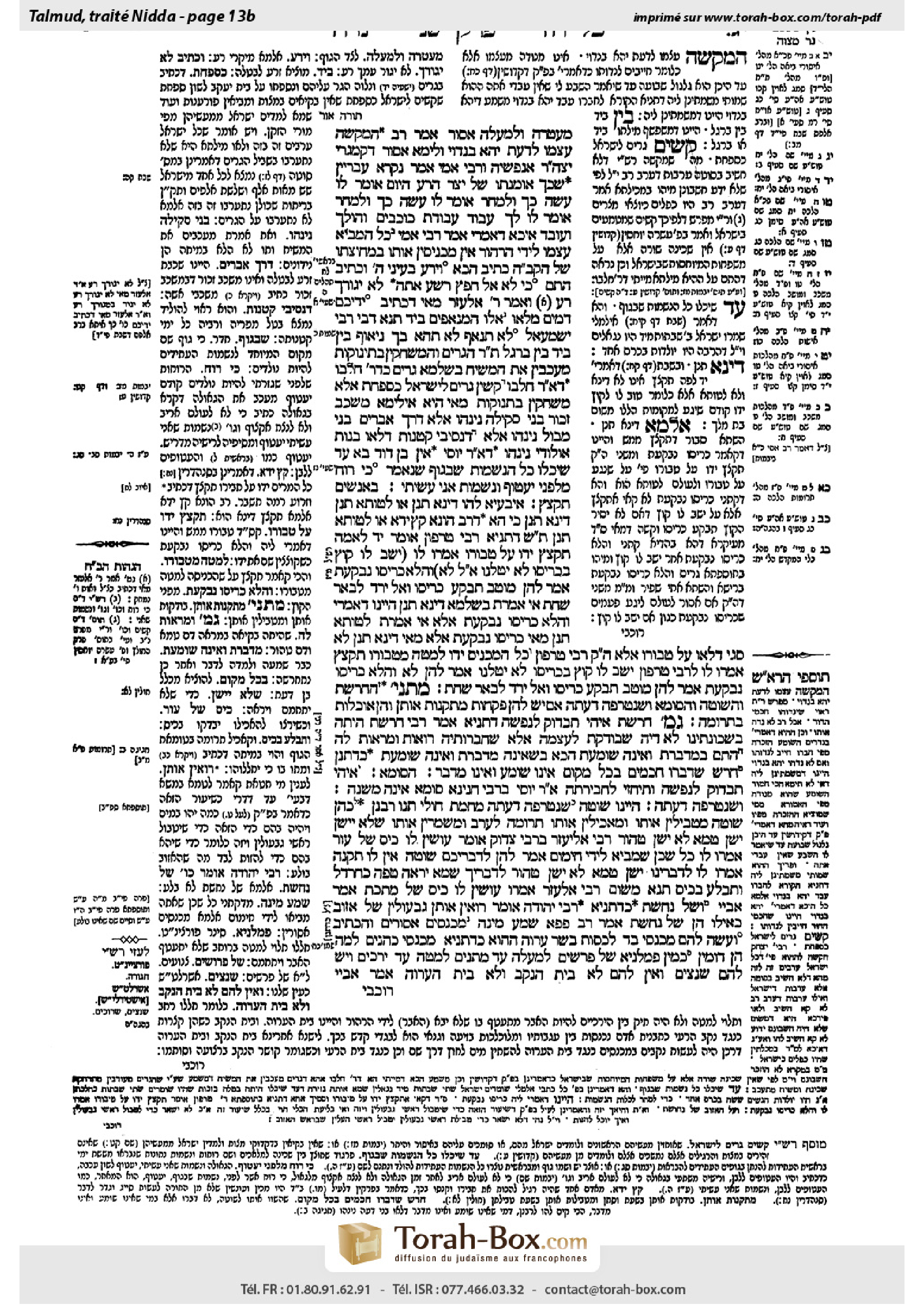
Niddah 13b: Talmud study for Daf Yomi
Daf Yomi is the daily study of one Talmud folio. Explore 37 tractates with scans, Hebrew text, Sefaria English and AI-generated French translations where annotated.
Passage selection and English or AI-generated French translation are available where the scan has annotations. Daf Study is independent of Torah-Box and Sefaria.
Browse Niddah · נידה · All tractatesNiddah 13b text and translations
This page of Niddah includes the Aramaic text, an English translation and an AI-generated French translation, alongside the scan above.
נידה י״ג ב · Aramaic and Hebrew text
מֵעֲטָרָה וּלְמַעְלָה — אָסוּר.
אָמַר רַב: הַמְקַשֶּׁה עַצְמוֹ לְדַעַת — יְהֵא בְּנִדּוּי. וְלֵימָא ״אָסוּר״! דְּקָמְגָרֵי יֵצֶר הָרַע אַנַּפְשֵׁיהּ. וְרַבִּי אַמֵּי אָמַר: נִקְרָא ״עֲבַרְיָין״, שֶׁכָּךְ אוּמָּנֻתוֹ שֶׁל יֵצֶר הָרַע: הַיּוֹם אוֹמֵר לוֹ ״עֲשֵׂה כָּךְ״, וּלְמָחָר אוֹמֵר לוֹ ״עֲשֵׂה כָּךְ״, וּלְמָחָר אוֹמֵר לוֹ ״לֵךְ עֲבוֹד עֲבוֹדָה זָרָה״ — וְהוֹלֵךְ וְעוֹבֵד.
אִיכָּא דְאָמְרִי, אָמַר רַבִּי אַמֵּי: כׇּל הַמֵּבִיא עַצְמוֹ לִידֵי הִרְהוּר — אֵין מַכְנִיסִין אוֹתוֹ בִּמְחִיצָתוֹ שֶׁל הַקָּדוֹשׁ בָּרוּךְ הוּא. כְּתִיב הָכָא: ״וַיֵּרַע בְּעֵינֵי ה׳״, וּכְתִיב הָתָם: ״כִּי לֹא אֵל חָפֵץ רֶשַׁע אָתָּה לֹא יְגוּרְךָ רָע״.
וְאָמַר רַבִּי אֶלְעָזָר: מַאי דִכְתִיב ״יְדֵיכֶם דָּמִים מָלֵאוּ״? אֵלּוּ הַמְנָאֲפִים בַּיָּד. תָּנָא דְּבֵי רַבִּי יִשְׁמָעֵאל: ״לֹא תִנְאָף״ — לֹא תְּהֵא (בְּךָ נִיאוּף) [נוֹאֵף], בֵּין בַּיָּד בֵּין בָּרֶגֶל.
תָּנוּ רַבָּנַן: הַגֵּרִים וְהַמְשַׂחֲקִין בְּתִינוֹקוֹת — מְעַכְּבִין אֶת הַמָּשִׁיחַ. בִּשְׁלָמָא גֵּרִים — כִּדְרַבִּי חֶלְבּוֹ, דְּאָמַר רַבִּי חֶלְבּוֹ: ״קָשִׁין גֵּרִים לְיִשְׂרָאֵל כְּסַפַּחַת״, אֶלָּא מְשַׂחֲקִין בַּתִּינוֹקוֹת מַאי הִיא?
אִילֵימָא מִשְׁכַּב זְכוּר — בְּנֵי סְקִילָה נִינְהוּ! אֶלָּא דֶּרֶךְ אֵבָרִים — בְּנֵי מַבּוּל נִינְהוּ!
אֶלָּא דְּנָסְיבִי קְטַנּוֹת, דְּלָאו בְּנוֹת אוֹלוֹדֵי נִינְהוּ, דְּאָמַר רַבִּי יוֹסֵי: אֵין בֶּן דָּוִד בָּא עַד שֶׁיִּכְלוּ כׇּל הַנְּשָׁמוֹת שֶׁבַּגּוּף, שֶׁנֶּאֱמַר: ״כִּי רוּחַ מִלְּפָנַי יַעֲטוֹף וּנְשָׁמוֹת אֲנִי עָשִׂיתִי״.
בָּאֲנָשִׁים תִּקָּצֵץ. אִיבַּעְיָא לְהוּ: דִּינָא תְּנַן אוֹ לָטוּתָא תְּנַן? דִּינָא תְּנַן, כִּי הָא דְּרַב הוּנָא קַץ יְדָא, אוֹ לָטוּתָא תְּנַן?
תָּא שְׁמַע, דְּתַנְיָא: רַבִּי טַרְפוֹן אוֹמֵר: יָד לָאַמָּה — תִּקָּצֵץ יָדוֹ עַל טַבּוּרוֹ. אָמְרוּ לוֹ: יָשַׁב לוֹ קוֹץ בִּכְרֵיסוֹ, לֹא יִטְּלֶנּוּ?! אָמַר לָהֶן: לֹא. וַהֲלֹא כְּרֵיסוֹ נִבְקַעַת! אָמַר לָהֶן: מוּטָב תִּבָּקַע כְּרֵיסוֹ, וְאַל יֵרֵד לִבְאֵר שַׁחַת.
אִי אָמְרַתְּ בִּשְׁלָמָא דִּינָא תְּנַן, הַיְינוּ דְּאָמְרִי: ״וַהֲלֹא כְּרֵיסוֹ נִבְקַעַת״, אֶלָּא אִי אָמְרַתְּ לָטוּתָא תְּנַן, מַאי ״כְּרֵיסוֹ נִבְקַעַת״? אֶלָּא מַאי דִּינָא תְּנַן, לָא סַגִּי דְּלָאו עַל טַבּוּרוֹ?
אֶלָּא הָכִי קָאָמַר רַבִּי טַרְפוֹן: כׇּל הַמַּכְנִיס יָדוֹ לְמַטָּה מִטַּבּוּרוֹ — תִּקָּצֵץ. אָמְרוּ לוֹ לְרַבִּי טַרְפוֹן: יָשַׁב לוֹ קוֹץ בִּכְרֵיסוֹ לֹא יִטְּלֶנּוּ?! אָמַר לָהֶן: לֹא. וַהֲלֹא כְּרֵיסוֹ נִבְקַעַת! אָמַר לָהֶן: מוּטָב תִּבָּקַע כְּרֵיסוֹ, וְאַל יֵרֵד לִבְאֵר שַׁחַת.
מַתְנִי' הַחֵרֶשֶׁת, וְהַשּׁוֹטָה, וְהַסּוֹמָא, וְשֶׁנִּטְרְפָה דַּעְתָּהּ — אִם יֵשׁ לָהֶם פִּקְּחוֹת, מְתַקְּנוֹת אוֹתָן, וְהֵן אוֹכְלוֹת בִּתְרוּמָה.
גְּמָ' חֵרֶשֶׁת — אִיהִי תִּבְדּוֹק לְנַפְשַׁהּ! דְּתַנְיָא, אָמַר רַבִּי: חֵרֶשֶׁת הָיְתָה בִּשְׁכוּנָתֵינוּ, לֹא דַּיָּה שֶׁבּוֹדֶקֶת לְעַצְמָהּ, אֶלָּא שֶׁחַבְרוֹתֶיהָ רוֹאוֹת וּמַרְאוֹת לָהּ!
הָתָם — בִּמְדַבֶּרֶת וְאֵינָהּ שׁוֹמַעַת, הָכָא — בְּשֶׁאֵינָהּ מְדַבֶּרֶת וְאֵינָהּ שׁוֹמַעַת, כְּדִתְנַן: חֵרֵשׁ שֶׁדִּבְּרוּ חֲכָמִים בְּכׇל מָקוֹם — אֵינוֹ שׁוֹמֵעַ וְאֵינוֹ מְדַבֵּר.
הַסּוֹמָא — אִיהִי תִּבְדּוֹק לְנַפְשַׁהּ, וְתַיחְזֵי לַחֲבִירְתַּהּ! אָמַר רַבִּי יוֹסֵי בְּרַבִּי חֲנִינָא: סוֹמָא אֵינָהּ מִשְׁנָה.
וְשֶׁנִּטְרְפָה דַּעְתָּהּ — הַיְינוּ שׁוֹטָה! שֶׁנִּטְרְפָה דַּעְתָּהּ מֵחֲמַת חוֹלִי.
תָּנוּ רַבָּנַן: כֹּהֵן שׁוֹטֶה — מַטְבִּילִין אוֹתוֹ, וּמַאֲכִילִין אוֹתוֹ תְּרוּמָה לָעֶרֶב, וּמְשַׁמְּרִין אוֹתוֹ שֶׁלֹּא יִישַׁן. יָשַׁן — טָמֵא, לֹא יָשַׁן — טָהוֹר.
רַבִּי אֱלִיעֶזֶר בְּרַבִּי צָדוֹק אוֹמֵר: עוֹשִׂין לוֹ כִּיס שֶׁל עוֹר. אָמְרוּ לוֹ: כׇּל שֶׁכֵּן שֶׁמֵּבִיא לִידֵי חִימּוּם! אָמַר לָהֶן: לְדִבְרֵיכֶם, שׁוֹטֶה אֵין לוֹ תַּקָּנָה.
אָמְרוּ לוֹ: לִדְבָרֵינוּ — יָשַׁן טָמֵא, לֹא יָשַׁן טָהוֹר; לִדְבָרֶיךָ — שֶׁמָּא יִרְאֶה טִפָּה כְּחַרְדָּל, וְתִבָּלַע בַּכִּיס!
תָּנָא מִשּׁוּם רַבִּי אֶלְעָזָר אָמְרוּ: עוֹשִׂין לוֹ כִּיס שֶׁל מַתֶּכֶת.
אָמַר אַבָּיֵי: וְשֶׁל נְחֹשֶׁת, כִּדְתַנְיָא: רַבִּי יְהוּדָה אוֹמֵר: רוֹאִין אוֹתָן גִּבְעוֹלִין שֶׁל אֵזוֹב כְּאִילּוּ הֵן שֶׁל נְחֹשֶׁת.
אָמַר רַב פָּפָּא: שְׁמַע מִינַּהּ מִכְנָסַיִם אֲסוּרִים, וְהָכְתִיב: ״וַעֲשֵׂה לָהֶם מִכְנְסֵי בָד לְכַסּוֹת בְּשַׂר עֶרְוָה״!
הָהוּא, כִּדְתַנְיָא: מִכְנְסֵי כֹהֲנִים לְמָה הֵן דּוֹמִין? כְּמִין פְּמָלַנְיָא שֶׁל פָּרָשִׁים, לְמַעְלָה — עַד מׇתְנַיִם, לְמַטָּה — עַד יְרֵכַיִם, וְיֵשׁ לָהֶם שְׁנָצִים, וְאֵין לָהֶם לֹא בֵּית הַנֶּקֶב וְלֹא בֵּית הָעֶרְוָה.
אָמַר אַבָּיֵי:
Niddah 13b · English translation
From the corona and above, toward the body, it is prohibited.
§ Rav says: One who intentionally causes himself an erection shall be ostracized. The Gemara suggests: And let Rav say simply that it is prohibited. The Gemara explains that it is proper to ostracize such a man, as he arouses the evil inclination upon himself. And Rabbi Ami says: He is called a habitual transgressor, as this is the craft of the evil inclination. Today he says to a person: Do this sin, and when the individual obeys his inclination, on the following day the evil inclination says to him: Do that sin, and on the following day he says to him: Go and worship idols, and he goes and worships idols.
Some say that Rabbi Ami says: With regard to anyone who brings himself into a state of arousal, they do not bring him within the boundary of the Holy One, Blessed be He. The proof is that it is written here, with regard to Onan, son of Judah: “And the thing that he did was evil in the eyes of the Lord, and He slew him also” (Genesis 38:10), and it is written there: “For You are not a God who has pleasure in wickedness; evil shall not sojourn with You. The boasters shall not stand in Your sight…But as for me, in the abundance of Your kindness will I come into Your house; I will bow down toward Your holy Temple in fear of You” (Psalms 5:5–8). This demonstrates that whoever does evil, like Onan, shall not sojourn with God.
And Rabbi Elazar says, with regard to the severity of this transgression: What is the meaning of that which is written: “And when you spread forth your hands, I will hide My eyes from you; even when you make many prayers, I will not hear; your hands are full of blood” (Isaiah 1:15)? These are those men who commit adultery with the hand, by masturbating. Likewise, the school of Rabbi Yishmael taught: When it is stated in the Ten Commandments: “You shall not commit adultery” (Exodus 20:13), this means that there shall not be adultery among you, whether you masturbate by hand or whether with one’s foot.
§ The Sages taught in a baraita: Converts and those who play with children delay the coming of the Messiah. The Gemara asks: Granted with regard to converts, this is in accordance with the opinion of Rabbi Ḥelbo, as Rabbi Ḥelbo says: Converts are as harmful to the Jewish people as a leprous scab on the skin, as they are not proficient in the performance of the mitzvot and born Jews learn from them. But with regard to the category of those who play with children, to what is it referring?
If we say that this is referring to homosexuality, such men are liable to be executed by stoning, and their behavior is criticized not simply because they delay the Messiah. Rather, one might suggest that this is referring to those who emit semen by way of other limbs, i.e., without engaging in intercourse; if so, they are considered as though they are bringing a flood, and are therefore liable to be punished themselves with a flood.
Rather, the baraita means that they marry minor girls who are not yet capable of bearing children, consequently emitting semen for naught. As Rabbi Yosei said: The Messiah, son of David, will not come until all the souls of the body have been finished, i.e., until all souls that are destined to inhabit physical bodies do so. As it is stated: “For the spirit that enwraps itself is from Me, and the souls that I have made” (Isaiah 57:16). The verse is interpreted as follows: The spirit, i.e., the souls about which it has been decreed by Me that they are to be born, if they are not born, they enwrap the Messiah and prevent him from coming.
§ The mishna teaches that with regard to any hand that is diligent to examine bodily emissions, among men, such a hand should be severed. A dilemma was raised before the Sages: Do we learn this statement as a practical halakha, i.e., that the court should actually sever his hand, or do we learn it as a mere curse, but not as an actual instruction to punish him in that manner? The Gemara elaborates: Do we learn it as a practical halakha like that prohibition against striking another, in which the same expression is used: With regard to anyone who raises his hand upon another, his hand should be severed, and Rav Huna indeed acted accordingly and severed the hand of an offender? Or perhaps do we learn it as a mere curse?
The Gemara suggests: Come and hear, as it is taught in a baraita that Rabbi Tarfon says: If one’s hand goes to his penis, his hand should be severed upon his navel. The Rabbis said to him: If so, in a case where a thorn was stuck in one’s belly, should he not remove it? Rabbi Tarfon said to them: Indeed, he should not remove it, and if he does so his hand should be severed. The Rabbis replied: But if his hand is severed while it is upon his navel, won’t his belly be split open? Rabbi Tarfon said to them: It is preferable that the belly of one who acts in this manner should be split open, and he should not descend into the pit of destruction.
The Gemara analyzes this discussion: Granted, if you say that we learn the statement in the mishna as a practical halakha, this is the meaning of that which the Rabbis said: But if his hand is severed upon his navel, won’t his belly be split open? But if you say that we learn the statement in the mishna as a mere curse, what is the meaning of the phrase: Won’t his belly be split open? The Gemara responds: Rather, what explanation is the alternative? That we learn the mishna as stating a practical halakha? That would not explain the exchange between the Rabbis to Rabbi Tarfon, because is it not sufficient that the hand be severed not upon his navel? In other words, even if the hand must actually be severed, it is not clear why it should be severed while it is upon his navel.
Rather, this is what Rabbi Tarfon is saying: With regard to anyone who inserts his hand below his navel, his hand should be severed. The Rabbis said to Rabbi Tarfon: If a thorn was stuck in one’s belly, should he not remove it? Rabbi Tarfon said to them: He should not. They responded: But won’t his belly be split open due to the thorn? Rabbi Tarfon said to them: It is preferable that his belly be split open, and he should not descend into the pit of destruction.
MISHNA: In the case of a woman who is deaf [haḥereshet], or an imbecile, or blind, or who went insane, and is therefore unable to examine herself reliably, if such women have competent friends, those friends prepare them by examining them and immersing them in a ritual bath. And on that basis the incompetent women may partake of teruma after the sun sets.
GEMARA: The mishna states that competent women must assist a deaf woman. The Gemara asks: Let her examine herself; as it is taught in a baraita that Rabbi Yehuda HaNasi said: There was a deaf woman in our neighborhood who was so proficient in these matters that not only did she examine herself, but when her friends would see stains similar to blood and were unsure whether or not the stains were ritually impure, they would show her the stains.
The Gemara answers: There, Rabbi Yehuda HaNasi is referring to a woman who can speak but cannot hear. It is possible for such a woman to be an expert in examining blood. But here, the mishna is dealing with a woman who can neither speak nor hear, and she is therefore considered incompetent and incapable of examining herself. As we learned in a mishna (Terumot 1:2): The deaf person of whom the Sages spoke everywhere is one who can neither hear nor speak, i.e., a deaf-mute.
§ The mishna further teaches that competent women must assist a blind woman. The Gemara similarly asks: Let her examine herself and show the cloth to her friend. Rabbi Yosei, son of Rabbi Ḥanina, says: The correct version of the mishna does not mention a blind woman.
§ The mishna also states that competent women must assist a woman who went insane. The Gemara asks: With regard to her ability to examine herself, isn’t this the same as an imbecile, who is already mentioned in the mishna? The Gemara answers: Here, the mishna is referring to a woman who went insane due to illness, which is a different category than that of an imbecile.
The Gemara further discusses halakhot pertaining to an imbecile. The Sages taught in a baraita: With regard to an imbecile priest who was ritually impure, competent men deal with his purification: They immerse him, and then enable him to partake of teruma in the evening, like any other priest who was impure. And those taking care of him must watch over him to ensure that he does not sleep before he partakes of teruma, in case he experiences a seminal emission, which would render him impure. If he slept, he is once again impure, and may not partake of teruma; if he did not sleep he is pure.
Rabbi Eliezer, son of Rabbi Tzadok, says that there is another method of allowing an imbecile priest to partake of teruma: One prepares for him a leather pouch, which is wrapped around his penis, and before giving him teruma to partake of one checks this pouch to see if he has emitted semen. The other Sages said to him: It is improper to do this, as all the more so he will be prevented from partaking of teruma; this pouch warms him and increases the likelihood of a seminal emission. Rabbi Eliezer, son of Rabbi Tzadok, said to them: According to your statement, an imbecile priest has no remedy that will enable him to partake of teruma.
They said to him: According to our statement there is a way he can partake of teruma, as stated above: If he slept, he is impure; if he did not sleep he is pure. But according to your statement, that one wraps a pouch around his penis, this is not a reliable method, as perhaps he will see, i.e., experience the emission of, a drop of semen as small as a mustard seed, and it will be absorbed in the pouch and will not be noticed, which would mean that he is eating teruma in a state of ritual impurity.
The Gemara continues to discuss the methods by which an imbecile priest can partake of teruma. It was taught in a baraita that the Sages said in the name of Rabbi Elazar: One prepares for him a metal pouch, which is placed on his penis and does not warm it.
In explanation of this statement, Abaye says: And when this tanna speaks of metal, he means that the pouch should be made of copper, which does not absorb liquid, and therefore any drop of semen would be visible. This is as it is taught in a mishna (Para 12:5), with regard to the amount of water of purification that must be sprinkled on an individual who is impure due to impurity imparted by a corpse, that Rabbi Yehuda says: One considers those hyssop stems, with which the waters of purification are sprinkled, as though they are made of copper, which does not absorb any of the water.
Rav Pappa says: One can learn from the statement of the Rabbis that a pouch wrapped around one’s penis can warm it enough to cause a seminal emission, that trousers are prohibited to be worn, as they too warm the penis, by being placed so they are tight against it. The Gemara asks: But isn’t it written with regard to the priestly garments: “And you shall make them linen trousers to cover the flesh of their nakedness, from the loins even to the thighs they shall reach” (Exodus 28:42)?
The Gemara explains: That garment, the trousers worn by priests, was different, as it is taught in a baraita: The trousers of priests, to what are they comparable? They are similar to riding trousers [pamalanya] of horsemen, and this is what they look like: Above, they reach up to the loins; below, they go down to the thighs, and they have straps, and they have no opening, neither at the back nor at the front.
Abaye says:
Niddah 13b · Traduction française (IA)
Depuis la couronne et au-dessus, vers le corps, c'est interdit.
§ Rav dit : Celui qui provoque intentionnellement une érection doit être ostracisé. La Guemara suggère : Et que Rav dise simplement que c'est interdit. La Guemara explique qu'il est approprié d'ostraciser un tel homme, car il éveille en lui l'inclination au mal. Et Rabbi Ami dit : Il est appelé un transgresseur habituel, car c'est le métier de l'inclination au mal. Aujourd'hui, il dit à une personne : Commets ce péché, et lorsque l'individu obéit à son inclination, le lendemain l'inclination au mal lui dit : Commets ce péché-là, et le jour suivant il lui dit : Va et adore des idoles, et il va et adore des idoles.
Certains disent que Rabbi Ami dit : Concernant quiconque se met dans un état d'excitation, on ne l'admet pas dans la proximité du Saint, béni soit-Il. La preuve est qu'il est écrit ici, à propos d'Onan, fils de Juda : « Et la chose qu'il fit était mauvaise aux yeux de l'Éternel, et Il le tua aussi » (Genèse 38:10), et il est écrit là : « Car Tu n'es pas un Dieu qui prends plaisir à la méchanceté ; le mal ne séjournera pas avec Toi. Les fanfarons ne se tiendront pas devant Tes yeux… Mais quant à moi, dans l'abondance de Ta bonté, j'entrerai dans Ta maison ; je me prosternerai vers Ton saint Temple dans la crainte de Toi » (Psaumes 5:5–8). Cela démontre que quiconque fait le mal, comme Onan, ne séjournera pas avec Dieu.
Et Rabbi Elazar dit, quant à la gravité de cette transgression : Quelle est la signification de ce qui est écrit : « Et quand vous étendrez vos mains, Je détournerai Mes yeux de vous ; même si vous multipliez les prières, Je n'écouterai pas ; vos mains sont pleines de sang » (Ésaïe 1:15) ? Ce sont ces hommes qui commettent l'adultère avec la main, par la masturbation. De même, l'école de Rabbi Yishmael a enseigné : Lorsque les Dix Commandements énoncent : « Tu ne commettras pas d'adultère » (Exode 20:13), cela signifie qu'il n'y aura pas d'adultère parmi vous, que ce soit par masturbation avec la main ou avec le pied.
§ Les Sages ont enseigné dans une baraïta : Les convertis et ceux qui jouent avec les enfants retardent la venue du Messie. La Guemara demande : Admettons que, concernant les convertis, cela soit conforme à l'opinion de Rabbi Ḥelbo, car Rabbi Ḥelbo dit : Les convertis sont aussi nuisibles au peuple juif qu'une croûte de lèpre sur la peau, car ils ne sont pas habiles dans l'accomplissement des mitsvot et les Juifs de naissance apprennent d'eux. Mais concernant la catégorie de ceux qui jouent avec les enfants, à quoi cela fait-il référence ?
Si nous disons que cela fait référence à l'homosexualité, de tels hommes sont passibles de la peine de mort par lapidation, et leur comportement est critiqué non simplement parce qu'ils retardent le Messie. Plutôt, on pourrait suggérer que cela fait référence à ceux qui émettent du sperme par d'autres membres, c'est-à-dire sans avoir de rapports sexuels ; dans ce cas, ils sont considérés comme s'ils apportaient un déluge, et sont donc passibles d'être punis eux-mêmes par un déluge.
Plutôt, la baraïta signifie qu'ils épousent des filles mineures qui ne sont pas encore capables de procréer, émettant ainsi leur semence pour rien. Comme Rabbi Yosei l'a dit : Le Messie, fils de David, ne viendra pas tant que toutes les âmes du corps n'auront pas été accomplies, c'est-à-dire tant que toutes les âmes destinées à habiter des corps physiques ne l'auront pas fait. Comme il est écrit : « Car l'esprit qui s'enveloppe est de Moi, et les âmes que J'ai faites » (Ésaïe 57:16). Le verset est interprété comme suit : L'esprit, c'est-à-dire les âmes au sujet desquelles il a été décrété par Moi qu'elles doivent naître, si elles ne naissent pas, elles enveloppent le Messie et l'empêchent de venir.
§ La Michna enseigne que, concernant toute main qui est diligente à examiner les émissions corporelles, chez les hommes, cette main doit être tranchée. Un dilemme a été soulevé devant les Sages : Apprenons-nous cette déclaration comme une halakha pratique, c'est-à-dire que le tribunal doit effectivement trancher sa main, ou l'apprenons-nous comme une simple malédiction, mais non comme une instruction réelle de le punir de cette manière ? La Guemara développe : Apprenons-nous cela comme une halakha pratique, comme cette interdiction de frapper un autre, dans laquelle la même expression est utilisée : Concernant quiconque lève sa main sur un autre, sa main doit être tranchée, et Rav Huna a effectivement agi en conséquence et a tranché la main d'un transgresseur ? Ou peut-être l'apprenons-nous comme une simple malédiction ?
La Guemara propose : Venez et écoutez, car il est enseigné dans une baraïta que Rabbi Tarfon dit : Si la main d'un homme va vers son pénis, sa main doit être tranchée sur son nombril. Les Rabbins lui dirent : Si c'est ainsi, dans un cas où une épine est coincée dans le ventre d'un homme, ne devrait-il pas la retirer ? Rabbi Tarfon leur dit : En effet, il ne devrait pas la retirer, et s'il le fait, sa main doit être tranchée. Les Rabbins répondirent : Mais si sa main est tranchée alors qu'elle est sur son nombril, son ventre ne sera-t-il pas ouvert ? Rabbi Tarfon leur dit : Il est préférable que le ventre de celui qui agit de cette manière soit ouvert, et qu'il ne descende pas dans la fosse de destruction.
La Guemara analyse cette discussion : Admettons que, si vous dites que nous apprenons la déclaration de la Michna comme une halakha pratique, c'est le sens de ce que les Rabbins ont dit : Mais si sa main est tranchée sur son nombril, son ventre ne sera-t-il pas ouvert ? Mais si vous dites que nous apprenons la déclaration de la Michna comme une simple malédiction, quel est le sens de la phrase : Son ventre ne sera-t-il pas ouvert ? La Guemara répond : Plutôt, quelle explication est l'alternative ? Que nous apprenions la Michna comme énonçant une halakha pratique ? Cela n'expliquerait pas l'échange entre les Rabbins et Rabbi Tarfon, car n'est-il pas suffisant que la main soit tranchée non sur son nombril ? En d'autres termes, même si la main doit effectivement être tranchée, il n'est pas clair pourquoi elle devrait être tranchée alors qu'elle est sur son nombril.
Plutôt, voici ce que Rabbi Tarfon dit : Quiconque enfonce sa main sous son nombril, sa main devrait être tranchée. Les Sages dirent à Rabbi Tarfon : Si une épine est plantée dans le ventre d'une personne, ne devrait-elle pas l'extraire ? Rabbi Tarfon leur répondit : Non. Ils répliquèrent : Mais son ventre ne sera-t-il pas déchiré à cause de l'épine ? Rabbi Tarfon leur dit : Il est préférable que son ventre soit déchiré, et qu'il ne descende pas dans la fosse de destruction.
MICHNA : Dans le cas d'une femme sourde [haḥereshet], ou d'une idiote, ou d'une aveugle, ou d'une femme qui est devenue folle, et qui est donc incapable de s'examiner de manière fiable, si de telles femmes ont des amies compétentes, ces amies les préparent en les examinant et en les immergeant dans un bain rituel. Et sur cette base, les femmes incompétentes peuvent consommer la terouma après le coucher du soleil.
GUEMARA : La Michna indique que des femmes compétentes doivent assister une femme sourde. La Guemara demande : Qu'elle s'examine elle-même ; car il est enseigné dans une baraïta que Rabbi Yehuda HaNasi a dit : Il y avait une femme sourde dans notre quartier qui était si habile dans ces matières que non seulement elle s'examinait elle-même, mais lorsque ses amies voyaient des taches semblables au sang et étaient incertaines de savoir si les taches étaient rituellement impures ou non, elles lui montraient les taches.
La Guemara répond : Là, Rabbi Yehuda HaNasi fait référence à une femme qui peut parler mais qui n'entend pas. Il est possible pour une telle femme d'être une experte dans l'examen du sang. Mais ici, la Michna traite d'une femme qui ne peut ni parler ni entendre, et elle est donc considérée comme incompétente et incapable de s'examiner elle-même. Comme nous l'avons appris dans une Michna (Terumot 1:2) : La personne sourde dont les Sages ont parlé partout est celle qui ne peut ni entendre ni parler, c'est-à-dire une sourde-muette.
§ La Michna enseigne également que des femmes compétentes doivent assister une femme aveugle. La Guemara demande de même : Qu'elle s'examine elle-même et montre le tissu à son amie. Rabbi Yose, fils de Rabbi Ḥanina, dit : La version correcte de la Michna ne mentionne pas une femme aveugle.
§ La Michna indique également que des femmes compétentes doivent assister une femme qui est devenue folle. La Guemara demande : En ce qui concerne sa capacité à s'examiner elle-même, n'est-ce pas la même chose qu'une idiote, qui est déjà mentionnée dans la Michna ? La Guemara répond : Ici, la Michna fait référence à une femme qui est devenue folle à cause d'une maladie, ce qui est une catégorie différente de celle d'une idiote.
La Guemara discute également des halakhot concernant une idiote. Les Sages ont enseigné dans une baraïta : En ce qui concerne un prêtre idiot qui était rituellement impur, des hommes compétents s'occupent de sa purification : Ils l'immergent, puis lui permettent de consommer la terouma le soir, comme tout autre prêtre qui était impur. Et ceux qui s'occupent de lui doivent veiller sur lui pour s'assurer qu'il ne s'endorme pas avant de consommer la terouma, au cas où il aurait une émission séminale, ce qui le rendrait impur. S'il s'est endormi, il est à nouveau impur et ne peut pas consommer la terouma ; s'il ne s'est pas endormi, il est pur.
Rabbi Eliezer, fils de Rabbi Tzadok, déclare qu'il existe une autre méthode permettant à un prêtre imbecille de consommer la terouma : on lui prépare une poche en cuir, qu'on enroule autour de son pénis, et avant de lui donner la terouma à consommer, on examine cette poche pour vérifier s'il a émis du sperme. Les autres Sages lui dirent : Il est inapproprié de procéder ainsi, car cela l'empêchera d'autant plus de consommer la terouma ; cette poche le réchauffe et augmente la probabilité d'une émission séminale. Rabbi Eliezer, fils de Rabbi Tzadok, leur répondit : Selon votre opinion, un prêtre imbecille n'a aucun remède qui lui permette de consommer la terouma.
Ils lui dirent : Selon notre opinion, il existe un moyen pour lui de consommer la terouma, comme indiqué ci-dessus : s'il s'est endormi, il est impur ; s'il ne s'est pas endormi, il est pur. Mais selon votre opinion, selon laquelle on enroule une poche autour de son pénis, ce n'est pas une méthode fiable, car il se peut qu'il émette une goutte de sperme aussi petite qu'une graine de moutarde, et que celle-ci soit absorbée par la poche et ne soit pas remarquée, ce qui signifierait qu'il consomme la terouma dans un état d'impureté rituelle.
La Guemara continue d'examiner les méthodes par lesquelles un prêtre imbecille peut consommer la terouma. Il est enseigné dans une baraïta que les Sages ont dit au nom de Rabbi Elazar : on lui prépare une poche en métal, qu'on place sur son pénis et qui ne le réchauffe pas.
Pour expliquer cette déclaration, Abaye dit : Et lorsque ce tanna parle de métal, il signifie que la poche doit être faite de cuivre, qui n'absorbe pas le liquide, et par conséquent toute goutte de sperme serait visible. C'est comme il est enseigné dans une Michna (Para 12:5), en ce qui concerne la quantité d'eau de purification qui doit être aspergée sur une personne qui est impure en raison de l'impureté transmise par un cadavre, que Rabbi Yehuda dit : On considère ces tiges d'hysope, avec lesquelles les eaux de purification sont aspergées, comme si elles étaient faites de cuivre, qui n'absorbe aucune de l'eau.
Rav Pappa dit : On peut apprendre de la déclaration des Sages qu'une poche enroulée autour du pénis d'une personne peut le réchauffer suffisamment pour causer une émission séminale, que les pantalons sont interdits à porter, car eux aussi réchauffent le pénis, en étant placés de manière à être serrés contre lui. La Guemara demande : Mais n'est-il pas écrit à propos des vêtements sacerdotaux : « Et vous ferez des pantalons de lin pour couvrir la chair de leur nudité, des reins jusqu'aux cuisses ils iront » (Exode 28:42) ?
La Guemara explique : Ce vêtement, les pantalons portés par les prêtres, était différent, car il est enseigné dans une baraïta : Les pantalons des prêtres, à quoi sont-ils comparables ? Ils sont similaires aux pantalons de cavaliers [pamalanya] des cavaliers, et voici à quoi ils ressemblent : En haut, ils montent jusqu'aux reins ; en bas, ils descendent jusqu'aux cuisses, et ils ont des sangles, et ils n'ont pas d'ouverture, ni à l'arrière ni à l'avant.
Abaye dit :
Traduction française générée par IA à partir de l’édition anglaise de Sefaria. Vérifie toujours un passage avec le texte source.
Text from Sefaria: William Davidson Edition - Vocalized Aramaic (CC BY NC); William Davidson Edition - English (CC BY NC).