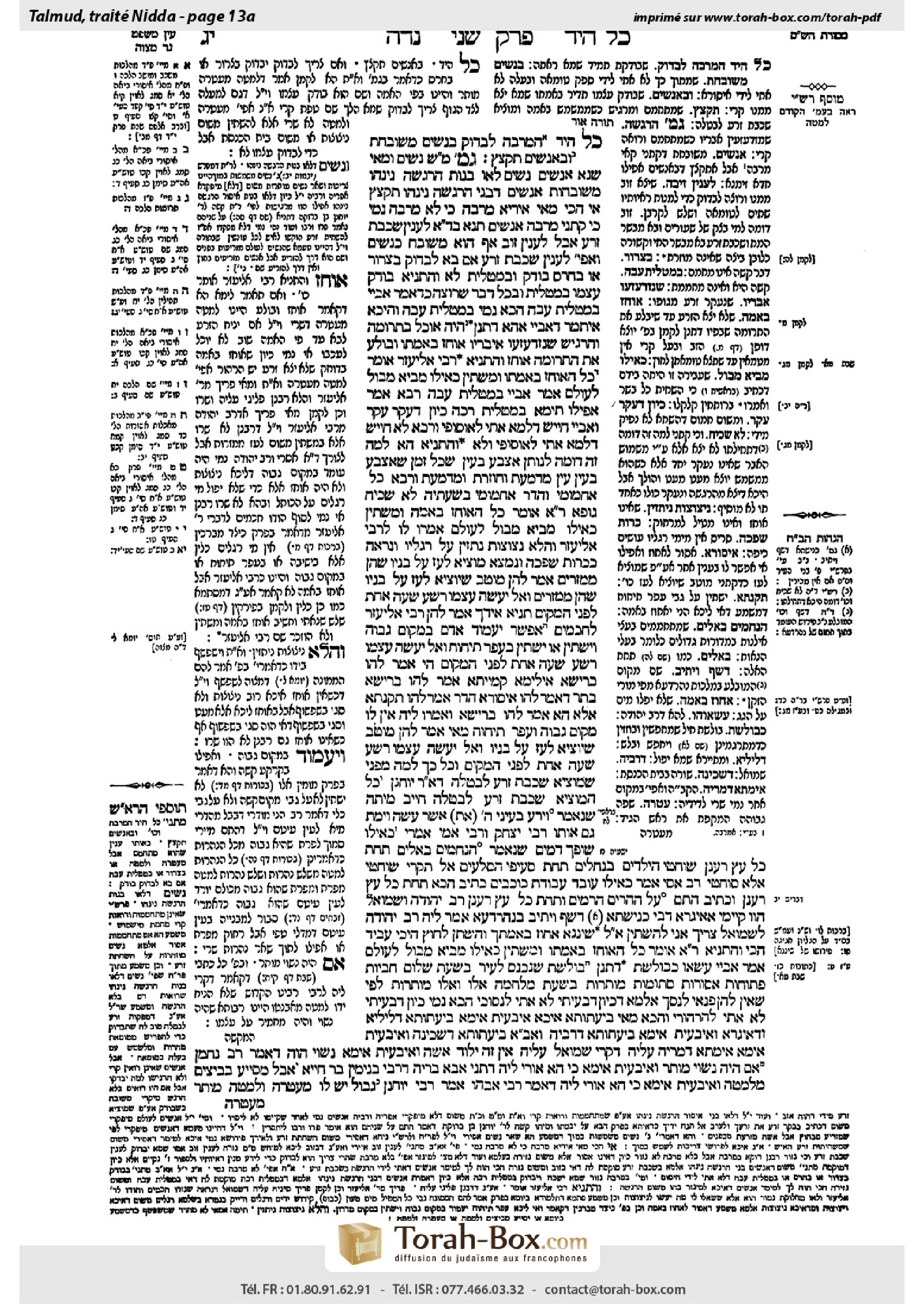
Niddah 13a: Talmud study for Daf Yomi
Daf Yomi is the daily study of one Talmud folio. Explore 37 tractates with scans, Hebrew text, Sefaria English and AI-generated French translations where annotated.
Passage selection and English or AI-generated French translation are available where the scan has annotations. Daf Study is independent of Torah-Box and Sefaria.
Browse Niddah · נידה · All tractatesNiddah 13a text and translations
This page of Niddah includes the Aramaic text, an English translation and an AI-generated French translation, alongside the scan above.
נידה י״ג א · Aramaic and Hebrew text
מַתְנִי' כׇּל הַיָּד הַמַּרְבָּה לִבְדּוֹק בַּנָּשִׁים — מְשׁוּבַּחַת, וּבָאֲנָשִׁים — תִּקָּצֵץ.
גְּמָ' מַאי שְׁנָא נָשִׁים, וּמַאי שְׁנָא אֲנָשִׁים? נָשִׁים לָאו בְּנוֹת הַרְגָּשָׁה נִינְהוּ — מְשׁוּבָּחוֹת, אֲנָשִׁים דִּבְנֵי הַרְגָּשָׁה נִינְהוּ — תִּקָּצֵץ.
אִי הָכִי מַאי אִירְיָא מַרְבָּה? כִּי לֹא מַרְבָּה נָמֵי! כִּי קָתָנֵי ״מַרְבָּה״ — אֲנָשִׁים.
תָּנָא: בַּמֶּה דְבָרִים אֲמוּרִים? לְעִנְיַן שִׁכְבַת זֶרַע, אֲבָל לְעִנְיַן זוֹב — אַף הוּא מְשׁוּבָּח כַּנָּשִׁים.
וַאֲפִילּוּ לְעִנְיַן שִׁכְבַת זֶרַע, אִם בָּא לִבְדּוֹק בִּצְרוֹר אוֹ בְּחֶרֶס — בּוֹדֵק.
וּבְמַטְלֵית לָא? וְהָתַנְיָא: בּוֹדֵק עַצְמוֹ בְּמַטְלֵית וּבְכׇל דָּבָר שֶׁרוֹצֶה! כִּדְאָמַר אַבָּיֵי: בְּמַטְלֵית עָבָה, הָכָא נָמֵי בְּמַטְלֵית עָבָה.
וְהֵיכָא אִיתְּמַר דְּאַבָּיֵי? אַהָא דִּתְנַן: הָיָה אוֹכֵל בִּתְרוּמָה, וְהִרְגִּישׁ שֶׁנִּזְדַּעְזְעוּ אֵיבָרָיו — אוֹחֵז בְּאַמָּתוֹ, וּבוֹלֵעַ אֶת הַתְּרוּמָה.
אוֹחֵז? וְהָתַנְיָא: רַבִּי אֱלִיעֶזֶר אוֹמֵר: כׇּל הָאוֹחֵז בְּאַמָּתוֹ וּמַשְׁתִּין — כְּאִילּוּ מֵבִיא מַבּוּל לָעוֹלָם! אָמַר אַבָּיֵי: בְּמַטְלֵית עָבָה.
רָבָא אָמַר: אֲפִילּוּ תֵּימָא בְּמַטְלֵית רַכָּה, כֵּיוָן דַּעֲקַר — עֲקַר, וְאַבָּיֵי חָיֵישׁ דִּלְמָא אָתֵי לְאוֹסוֹפֵי, וְרָבָא לָא חָיֵישׁ דִּלְמָא אָתֵי לְאוֹסוֹפֵי.
וְלָא? וְהָתַנְיָא: הָא לְמָה זֶה דּוֹמֶה? לְנוֹתֵן אֶצְבַּע בָּעַיִן, שֶׁכׇּל זְמַן שֶׁאֶצְבַּע בָּעַיִן — עַיִן מַדְמַעַת וְחוֹזֶרֶת וּמַדְמַעַת!
וְרָבָא, כֹּל אִחַמּוֹמֵי וַהֲדַר אִחַמּוֹמֵי בְּשַׁעְתֵּיהּ — לָא שְׁכִיחַ.
גּוּפָא, רַבִּי אֱלִיעֶזֶר אוֹמֵר: כׇּל הָאוֹחֵז בָּאַמָּה וּמַשְׁתִּין כְּאִילּוּ מֵבִיא מַבּוּל לָעוֹלָם. אָמְרוּ לוֹ לְרַבִּי אֱלִיעֶזֶר: וַהֲלֹא נִצּוֹצוֹת נִתָּזִין עַל רַגְלָיו, וְנִרְאֶה כִּכְרוּת שׇׁפְכָה, וְנִמְצָא מוֹצִיא לַעַז עַל בָּנָיו שֶׁהֵן מַמְזֵרִים!
אָמַר לָהֶן: מוּטָב שֶׁיּוֹצִיא לַעַז עַל בָּנָיו שֶׁהֵן מַמְזֵרִים, וְאַל יַעֲשֶׂה עַצְמוֹ רָשָׁע שָׁעָה אַחַת לִפְנֵי הַמָּקוֹם.
תַּנְיָא אִידַּךְ: אָמַר לָהֶן רַבִּי אֱלִיעֶזֶר לַחֲכָמִים, אֶפְשָׁר יַעֲמוֹד אָדָם בְּמָקוֹם גָּבוֹהַּ וְיַשְׁתִּין, אוֹ יַשְׁתִּין בְּעָפָר תִּיחוּחַ, וְאַל יַעֲשֶׂה עַצְמוֹ רָשָׁע שָׁעָה אַחַת לִפְנֵי הַמָּקוֹם.
הֵי אֲמַר לְהוּ בְּרֵישָׁא? אִילֵּימָא קַמַּיְיתָא אֲמַר לְהוּ בְּרֵישָׁא, בָּתַר דְּאָמַר לְהוּ אִיסּוּרָא הֲדַר אֲמַר לְהוּ תַּקַּנְתָּא?!
אֶלָּא, הָא אֲמַר לְהוּ בְּרֵישָׁא, וַאֲמַרוּ לֵיהּ: אֵין לוֹ מָקוֹם גָּבוֹהַּ וְעָפָר תִּיחוּחַ, מַאי? אָמַר לָהֶן: מוּטָב שֶׁיּוֹצִיא לַעַז עַל בָּנָיו, וְאַל יַעֲשֶׂה עַצְמוֹ רָשָׁע שָׁעָה אַחַת לִפְנֵי הַמָּקוֹם.
וְכׇל כָּךְ לָמָּה? מִפְּנֵי שֶׁמּוֹצִיא שִׁכְבַת זֶרַע לְבַטָּלָה, דְּאָמַר רַבִּי יוֹחָנָן: כׇּל הַמּוֹצִיא שִׁכְבַת זֶרַע לְבַטָּלָה חַיָּיב מִיתָה, שֶׁנֶּאֱמַר: ״וַיֵּרַע בְּעֵינֵי ה׳ (אֶת) אֲשֶׁר עָשָׂה וַיָּמֶת גַּם אוֹתוֹ״.
רַבִּי יִצְחָק וְרַבִּי אַמֵּי אָמְרִי: כְּאִילּוּ שׁוֹפֵךְ דָּמִים, שֶׁנֶּאֱמַר: ״הַנֵּחָמִים בָּאֵלִים תַּחַת כׇּל עֵץ רַעֲנָן שׁוֹחֲטֵי הַיְלָדִים בַּנְּחָלִים תַּחַת סְעִיפֵי הַסְּלָעִים״, אַל תִּקְרֵי ״שׁוֹחֲטֵי״ אֶלָּא ״סוֹחֲטֵי״.
רַב אַסִּי אָמַר: כְּאִילּוּ עוֹבֵד עֲבוֹדָה זָרָה, כְּתִיב הָכָא ״תַּחַת כׇּל עֵץ רַעֲנָן״, וּכְתִיב הָתָם ״עַל הֶהָרִים הָרָמִים וְתַחַת כׇּל עֵץ רַעֲנָן״.
רַב יְהוּדָה וּשְׁמוּאֵל הֲווֹ קָיְימִי אַאִיגָּרָא דְּבֵי כְּנִישְׁתָּא דְּשָׁף וִיתֵיב בִּנְהַרְדְּעָא. אֲמַר לֵיהּ רַב יְהוּדָה לִשְׁמוּאֵל: צָרִיךְ אֲנִי לְהַשְׁתִּין. אֲמַר לֵיהּ: שִׁינָּנָא, אֱחוֹז בַּאֲמָתְךָ וְהַשְׁתֵּן לַחוּץ.
הֵיכִי עָבֵיד הָכִי? וְהָתַנְיָא: רַבִּי אֱלִיעֶזֶר אוֹמֵר: כׇּל הָאוֹחֵז בְּאַמָּתוֹ וּמַשְׁתִּין — כְּאִילּוּ מֵבִיא מַבּוּל לָעוֹלָם!
אָמַר אַבָּיֵי: עֲשָׂאוֹ כְּבוֹלֶשֶׁת, דִּתְנַן: בּוֹלֶשֶׁת (שנכנס) [שֶׁנִּכְנְסָה] לָעִיר, בִּשְׁעַת שָׁלוֹם — חָבִיּוֹת פְּתוּחוֹת אֲסוּרוֹת, סְתוּמוֹת מוּתָּרוֹת, בִּשְׁעַת מִלְחָמָה — אֵלּוּ וְאֵלּוּ מוּתָּרוֹת, לְפִי שֶׁאֵין לָהֶן פְּנַאי לְנַסֵּךְ. אַלְמָא: דְּכֵיוָן דִּבְעִיתִי לָא אָתֵי לְנַסּוֹכֵי, הָכָא נָמֵי: כֵּיוָן דִּבְעִיתִי לָא אָתֵי לְהַרְהוֹרֵי.
וְהָכָא מַאי בְּעִיתוּתָא אִיכָּא? אִיבָּעֵית אֵימָא: בִּיעֲתוּתָא דְּלֵילְיָא וּדְאִיגָּרָא, וְאִיבָּעֵית אֵימָא: בִּיעֲתוּתָא דְּרַבֵּיהּ, וְאִיבָּעֵית אֵימָא: בִּיעֲתוּתָא דִּשְׁכִינָה, וְאִיבָּעֵית אֵימָא: אֵימְתָא דְּמָרֵיהּ עֲלֵיהּ, דְּקָרֵי שְׁמוּאֵל עֲלֵיהּ: ״אֵין זֶה יְלוּד אִשָּׁה״.
וְאִיבָּעֵית אֵימָא: נָשׂוּי הֲוָה, דְּאָמַר רַב נַחְמָן: אִם הָיָה נָשׂוּי — מוּתָּר.
וְאִיבָּעֵית אֵימָא, כִּי הָא אוֹרִי לֵיהּ, דְּתָנֵי אַבָּא בְּרֵיהּ דְּרַבִּי בִּנְיָמִין בַּר חִיָּיא: אֲבָל מְסַיֵּיעַ בַּבֵּיצִים מִלְּמַטָּה. וְאִיבָּעֵית אֵימָא, כִּי הָא אוֹרִי לֵיהּ, דְּאָמַר רַבִּי אֲבָהוּ אָמַר רַבִּי יוֹחָנָן: גְּבוּל יֵשׁ לוֹ, מֵעֲטָרָה וּלְמַטָּה – מוּתָּר,
Niddah 13a · English translation
MISHNA: With regard to any hand that is diligent to examine bodily emissions to ascertain ritual impurity, among women such a hand is praiseworthy. But among men such a hand should be severed, as this action is apt to lead to a seminal emission for naught.
GEMARA: The Gemara asks: What is different about women and what is different about men, that women are praised for examining for bodily emissions while men are castigated for the same? The Gemara answers: Women are not susceptible to sexual arousal by this action, and therefore when a woman is diligent to examine herself she is considered praiseworthy; whereas men, who are susceptible to sexual arousal and may experience a seminal emission as a result of this contact, may not do so, and the hand of a man who conducts frequent examinations for emissions should be severed.
The Gemara asks: If so, why does the mishna state specifically among men that only the hand that is diligent to examine, i.e., that does so often, should be severed? Even when a man is not diligent to examine, but does so occasionally, this action is also apt to cause a seminal emission. The Gemara answers: When the mishna teaches: Any hand that is diligent to examine, it states this only with regard to women, as men should not examine even occasionally.
The Gemara continues to discuss the examination of men for seminal emissions. It is taught in a baraita: In what case is this statement, that men should not examine themselves, said? It is said with regard to an examination for semen. But with regard to a man who examines himself for gonorrhea-like discharge [zov], he too is praiseworthy for examining diligently, as women are. The reason is that a man who experiences two such discharges is ritually impure but is not obligated to bring an offering, whereas one who experiences three such emissions must bring an offering as a zav. Therefore, it is important for a man who experiences a gonorrhea-like discharge to examine and count his emissions carefully.
The baraita adds: And even with regard to semen, if one wants to examine himself with a rock or with a piece of earthenware, which are hard and will not warm the body, he may examine himself in this manner.
The Gemara asks: And may a man not examine himself with a linen cloth? But isn’t it taught in a baraita: A man may examine himself with a cloth, to see if he has emitted semen, or with any similar item that he wants? The Gemara answers: Just as Abaye said, with regard to a different issue, that it is referring to a coarse cloth, which will not warm one’s body, here too, the baraita is referring to a coarse cloth, which will not lead to a seminal emission.
The Gemara asks: And where was this statement of Abaye stated? It was stated with regard to that which we learned in a mishna (40a): If a priest was eating teruma and he sensed that his limbs quaked, indicating that a seminal emission was imminent, he should firmly hold his penis to prevent the emission from leaving his body, and swallow the teruma while ritually pure.
A difficulty was raised with regard to this mishna: May he actually hold his penis? But isn’t it taught in a baraita that Rabbi Eliezer says: With regard to anyone who holds his penis and urinates, it is considered as though he is bringing a flood to the world, as masturbation was one of the sins that led to the flood (Sanhedrin 108b)? Abaye says in resolution of this difficulty that the mishna is referring to one who holds his penis with a coarse cloth.
Rava says with regard to that mishna: You may even say that it is referring to a priest who holds his penis with a soft cloth, and the reason it is permitted is that once the semen has already been uprooted from his body, it is uprooted, and his subsequent holding of the penis, even with a soft cloth, does not increase the emission of semen. And Abaye prohibits the use of a soft cloth even here, as he is concerned that perhaps due to the contact of this cloth one might come to increase the emission of semen. But Rava is not concerned that perhaps one might come to increase the emission.
The Gemara asks: And is Rava not concerned for this possibility? But isn’t it taught in a baraita: To what is this repeated examination of a man comparable? To one who places a finger in his eye, for as long as the finger is in the eye, the eye will tear and continue to tear. Here too, the priest’s action will lead to an increased emission of semen.
The Gemara answers: And Rava would claim that if the priest’s limbs were not quaking and the semen was coming out in drops, there is indeed a concern that an examination might increase the emission. But when he feels his limbs quaking, this concern does not apply. The reason is that with regard to any warming of the body that leads to a seminal emission and that is then followed by another warming at the time when the semen is being uprooted, it is uncommon for the latter warming to increase the emission. Consequently, in this case the priest may hold his penis even with a soft cloth.
The Gemara discusses the matter itself. Rabbi Eliezer says: With regard to anyone who holds his penis and urinates, it is considered as though he is bringing a flood to the world. The Rabbis said to Rabbi Eliezer: But if one does not hold his penis, small drops are sprayed on his legs, and he appears as one whose penis has been severed. A man with that affliction is incapable of fathering children. People who see urine on his legs might suspect that he is suffering from that condition and as a result they will cast aspersions about his children and say that they are children born from a forbidden relationship [mamzerim].
Rabbi Eliezer said to them: It is preferable that people cast aspersions about his children that they are mamzerim, and he should not render himself wicked even one moment before the Omnipresent.
With regard to the same issue, it is taught in another baraita that Rabbi Eliezer said to the other Rabbis in response: It is possible for one to avoid spraying urine on his legs. How so? Let a person stand on an elevated place and urinate downward, or urinate into an area where there is loose soil, which absorbs the urine, so that it does not ricochet upward, and he should not render himself wicked even one moment before the Omnipresent.
The Gemara asks: Which of these replies did Rabbi Eliezer say to the Rabbis first? If we say that it was the first statement, i.e., that one should not hold his penis even if people might cast aspersions about his children, that he said to the Rabbis first, and subsequently he told them that there was a way to avoid urine being sprayed on his legs, this is difficult; after saying to them that it is a prohibition, would he then say to them a practical remedy? By saying that one can avoid urine being sprayed on his legs, Rabbi Eliezer indicated that if one cannot do so he may hold his penis, which contradicts his other statement.
Rather, clearly he said this practical solution to the Rabbis first, and they then said to him: If one does not have an elevated place or loose earth upon which he can urinate, what should he do? In response to this question, he said to them: It is preferable that people cast aspersions about his children that they are mamzerim, and he should not render himself wicked even one moment before the Omnipresent.
The Gemara asks: And why must one refrain to that extent from holding his penis? Because as the result of holding his penis he might emit semen for naught. As Rabbi Yoḥanan says: Anyone who emits semen for naught is liable to receive the punishment of death at the hand of Heaven, as it is stated with regard to Onan, son of Judah: “And it came to pass, when he engaged in intercourse with his brother’s wife, that he spilled it on the ground, lest he should give seed to his brother. And the thing that he did was evil in the eyes of the Lord, and He slew him also” (Genesis 38:9–10).
Rabbi Yitzḥak and Rabbi Ami say: One who emits semen for naught is considered as though he sheds blood, as it is stated: “But draw near here, you sons of the sorceress, the seed of the adulterer and the harlot…Are you not children of transgression, a seed of falsehood, you that inflame yourselves among the terebinths, under every leafy tree, that slay [shoḥatei] the children in the valleys, under the clefts of the rocks?” (Isaiah 57:3–5). Do not read this word as shoḥatei; rather, read it as soḥatei, i.e., one who squeezes out [soḥet] semen is considered to have shed the blood of the children who could have been born from that seed.
Rav Asi says: It is considered as though he worships idols, as it is written here: “Under every leafy tree,” and it is written there, with regard to the mitzva of eradicating idols from Eretz Yisrael: “You shall destroy all the places, where the nations that you are to dispossess worshipped their gods, upon the high mountains, and upon the hills, and under every leafy tree” (Deuteronomy 12:2).
§ With regard to the issue of holding one’s penis for the purpose of urinating, the Gemara relates that Rav Yehuda and Shmuel were standing on the roof of the synagogue that was destroyed and rebuilt in Neharde’a. Rav Yehuda said to Shmuel: What can I do? I need to urinate. Shmuel said to him: Shinnana, hold your penis, so that the water does not fall onto the synagogue roof, and urinate outward, away from the synagogue.
The Gemara asks: How could Rav Yehuda do so? But isn’t it taught in a baraita that Rabbi Eliezer says: With regard to anyone who holds his penis and urinates, it is considered as though he is bringing a flood to the world?
Abaye says: The Sages rendered the halakhic status of this situation like that of a troop of marauders, as we learned in a mishna (Avoda Zara 70b): With regard to a troop of marauders that entered a town, if they did so in a time of peace, open casks of wine are forbidden, in case the marauders used the wine for libations in idol worship, whereas sealed casks are permitted. In a time of war, both these and those are permitted, because the marauders do not have leisure to pour libations. Evidently, since these marauders are afraid, they will not come to pour libations. Here too, in this incident involving Rav Yehuda, since he is afraid he will not come to have sexual thoughts.
The Gemara asks: And what fear is there here, in the case of Rav Yehuda? The Gemara explains: If you wish, say that there is the fear of the night and of the roof, i.e., that he might fall. And if you wish, say that the awe of his teacher, Shmuel, is upon him. And if you wish, say that the awe of the Divine Presence that dwells in the synagogue is upon Rav Yehuda. And if you wish, say that the awe of his Master, God, is upon him. Rav Yehuda was renowned for his fear of Heaven, as Shmuel declared about him: This one is not born of a woman, but is like an angel.
And if you wish, say a different answer, that Rav Yehuda was allowed to hold his penis while urinating because he was married; as Rav Naḥman said: If one is married, it is permitted for him to hold his penis while urinating, as his improper sexual urges are not as strong.
And if you wish, say that Shmuel ruled for Rav Yehuda in accordance with this baraita, which Abba, son of Rabbi Binyamin bar Ḥiyya, teaches: One may not hold the penis itself while urinating, but a man who wishes to urinate may assist the process by holding the testicles from below. Shmuel instructed Rav Yehuda to act in this manner. And if you wish, say that Shmuel ruled for Rav Yehuda in accordance with that which Rabbi Abbahu said that Rabbi Yoḥanan says: There is a clear demarcation in the prohibition against holding one’s penis while urinating: From the corona and below, toward the tip of the penis, it is permitted to hold, as this will not lead to arousal.
Niddah 13a · Traduction française (IA)
Michna : S'agissant de toute main qui s'attache à examiner les écoulements corporels afin de déterminer la pureté rituelle, parmi les femmes, une telle main est louable. Mais parmi les hommes, une telle main devrait être tranchée, car cette action est susceptible de provoquer une émission séminale vaine.
Guemara : La Guemara demande : Qu'est-ce qui distingue les femmes des hommes, si bien que les femmes sont louées pour l'examen des écoulements corporels tandis que les hommes sont blâmés pour la même action ? La Guemara répond : Les femmes ne sont pas sujettes à l'excitation sexuelle par cette action, et par conséquent, lorsqu'une femme s'attache à s'examiner, elle est considérée comme louable ; tandis que les hommes, qui sont sujets à l'excitation sexuelle et peuvent éprouver une émission séminale en raison de ce contact, ne doivent pas le faire, et la main d'un homme qui procède à des examens fréquents pour les écoulements devrait être tranchée.
La Guemara demande : Si c'est le cas, pourquoi la Michna précise-t-elle, s'agissant des hommes, que seule la main qui s'attache à examiner, c'est-à-dire qui le fait souvent, devrait être tranchée ? Même lorsqu'un homme ne s'attache pas à examiner, mais le fait occasionnellement, cette action est également susceptible de provoquer une émission séminale. La Guemara répond : Lorsque la Michna enseigne : Toute main qui s'attache à examiner, elle ne l'énonce qu'à l'égard des femmes, car les hommes ne doivent pas s'examiner, même occasionnellement.
La Guemara poursuit la discussion sur l'examen des hommes en cas d'émission séminale. Il est enseigné dans une baraïta : Dans quel cas cette déclaration, selon laquelle les hommes ne doivent pas s'examiner, est-elle formulée ? Elle est formulée à l'égard d'un examen pour le sperme. Mais s'agissant d'un homme qui s'examine pour un écoulement de type gonorrhée [zov], lui aussi est louable de s'examiner avec diligence, tout comme les femmes. La raison en est qu'un homme qui présente deux tels écoulements est rituellement impur, mais n'est pas obligé d'apporter une offrande, tandis que celui qui en présente trois doit apporter une offrande en tant que zav. Par conséquent, il est important pour un homme qui présente un écoulement de type gonorrhée d'examiner et de compter ses émissions avec soin.
La baraïta ajoute : Et même s'agissant du sperme, si l'on veut s'examiner avec une pierre ou avec un morceau de poterie, qui sont durs et ne réchaufferont pas le corps, il peut s'examiner de cette manière.
La Guemara demande : Et un homme ne peut-il pas s'examiner avec un linge de lin ? Mais n'est-il pas enseigné dans une baraïta : Un homme peut s'examiner avec un tissu, pour voir s'il a émis du sperme, ou avec tout objet similaire qu'il souhaite ? La Guemara répond : Tout comme Abaye a dit, à propos d'une autre question, qu'il s'agit d'un tissu grossier, qui ne réchauffera pas le corps, ici aussi, la baraïta fait référence à un tissu grossier, qui ne conduira pas à une émission séminale.
La Guemara demande : Et où cette déclaration d'Abaye a-t-elle été énoncée ? Elle a été énoncée à propos de ce que nous avons appris dans une Michna (40a) : Si un prêtre mangeait de la terouma et sentait que ses membres tremblaient, indiquant qu'une émission séminale était imminente, il devait tenir fermement son pénis pour empêcher l'émission de quitter son corps, et avaler la terouma alors qu'il est rituellement pur.
Une difficulté a été soulevée à l'égard de cette Michna : Peut-il réellement tenir son pénis ? Mais n'est-il pas enseigné dans une baraïta que Rabbi Eliezer dit : S'agissant de quiconque tient son pénis et urine, cela est considéré comme s'il apportait un déluge au monde, car la masturbation était l'un des péchés qui ont conduit au déluge (Sanhédrin 108b) ? Abaye dit, en résolution de cette difficulté, que la Michna fait référence à celui qui tient son pénis avec un tissu grossier.
Rava dit à propos de cette Michna : Vous pouvez même dire qu'elle fait référence à un prêtre qui tient son pénis avec un tissu doux, et la raison pour laquelle c'est permis est que, une fois que le sperme a déjà été déraciné de son corps, il est déraciné, et sa tenue subséquente du pénis, même avec un tissu doux, n'augmente pas l'émission de sperme. Et Abaye interdit l'utilisation d'un tissu doux même ici, car il craint que, peut-être en raison du contact de ce tissu, on vienne à augmenter l'émission de sperme. Mais Rava ne craint pas que l'on vienne à augmenter l'émission.
La Guemara demande : Et Rava n'est-il pas préoccupé par cette possibilité ? Mais n'est-il pas enseigné dans une baraïta : À quoi est comparable cette réitération de l'examen d'un homme ? À celui qui place un doigt dans son œil, car tant que le doigt est dans l'œil, l'œil pleure et continue à pleurer. De même ici, l'action du prêtre entraînera une émission de sperme accrue.
La Guemara répond : Et Rava soutient que si les membres du prêtre ne tremblaient pas et que le sperme sortait en gouttes, il y a effectivement une crainte que l'examen n'augmente l'émission. Mais lorsqu'il sent ses membres trembler, cette crainte ne s'applique pas. La raison est que, s'agissant de tout réchauffement du corps qui conduit à une émission de sperme et qui est ensuite suivi d'un autre réchauffement au moment où le sperme est déraciné, il est inhabituel que ce dernier réchauffement augmente l'émission. Par conséquent, dans ce cas, le prêtre peut tenir son pénis même avec un tissu doux.
La Guemara discute de la question elle-même. Rabbi Eliezer dit : S'agissant de quiconque tient son pénis et urine, cela est considéré comme s'il apportait un déluge au monde. Les Sages dirent à Rabbi Eliezer : Mais si l'on ne tient pas son pénis, de petites gouttes sont projetées sur ses jambes, et il apparaît comme celui dont le pénis a été tranché. Un homme atteint de cette affection est incapable de procréer. Les gens qui voient de l'urine sur ses jambes pourraient soupçonner qu'il souffre de cette condition et, par conséquent, ils jetteraient le discrédit sur ses enfants et diraient qu'ils sont des enfants nés d'une relation interdite [mamzerim].
Rabbi Eliezer leur dit : Il est préférable que les gens jettent le discrédit sur ses enfants en disant qu'ils sont des mamzerim, et qu'il ne se rende pas méchant, même un instant, devant le Tout-Puissant.
Concernant la même question, il est enseigné dans une autre baraïta que Rabbi Eliezer a dit aux autres Sages en réponse : Il est possible d'éviter que l'urine ne se projette sur ses jambes. Comment ? Qu'une personne se tienne sur un lieu élevé et urine vers le bas, ou urine dans un endroit où il y a de la terre meuble, qui absorbe l'urine, afin qu'elle ne rebondisse pas vers le haut, et qu'il ne se rende pas coupable, même un instant, devant le Tout-Puissant.
La Guemara demande : Laquelle de ces réponses Rabbi Eliezer a-t-il dite aux Sages en premier ? Si nous disons que c'était la première déclaration, à savoir qu'il ne faut pas retenir son pénis même si les gens pourraient jeter le discrédit sur ses enfants, qu'il l'a dite aux Sages en premier, et qu'ensuite il leur a dit qu'il y avait un moyen d'éviter que l'urine ne se projette sur ses jambes, cela pose problème ; après leur avoir dit que c'est une interdiction, leur dirait-il ensuite un remède pratique ? En disant qu'on peut éviter que l'urine ne se projette sur ses jambes, Rabbi Eliezer a indiqué que si on ne peut pas le faire, on peut retenir son pénis, ce qui contredit son autre déclaration.
Au contraire, il a clairement proposé cette solution pratique aux Sages en premier, et ils lui ont alors dit : Si l'on ne dispose pas d'un lieu élevé ou de terre meuble sur laquelle on peut uriner, que doit-on faire ? En réponse à cette question, il leur a dit : Il est préférable que les gens jettent le discrédit sur ses enfants en disant qu'ils sont des mamzerim, plutôt que de se rendre coupable, même un instant, devant le Tout-Puissant.
La Guemara demande : Et pourquoi faut-il s'abstenir à ce point de retenir son pénis ? Parce que, en conséquence de retenir son pénis, il pourrait émettre du sperme pour rien. Comme Rabbi Yoḥanan le dit : Quiconque émet du sperme pour rien est passible de la peine de mort par la main du Ciel, comme il est écrit à propos d'Onan, fils de Juda : « Et il arriva, quand il eut eu des rapports avec la femme de son frère, qu'il le répandit sur la terre, de peur de donner une postérité à son frère. Et la chose qu'il fit était mauvaise aux yeux de l'Éternel, et Il le tua aussi » (Genèse 38:9-10).
Rabbi Yitzḥak et Rabbi Ami disent : Celui qui émet du sperme pour rien est considéré comme s'il répandait du sang, comme il est écrit : « Mais approchez-vous ici, vous, fils de la sorcière, semence de l'adultère et de la prostituée… N'êtes-vous pas des enfants de transgression, une semence de mensonge, vous qui vous enflammez parmi les térébinthes, sous tout arbre verdoyant, qui égorgez [shoḥatei] les enfants dans les vallées, sous les fentes des rochers ? » (Ésaïe 57:3-5). Ne lisez pas ce mot comme shoḥatei ; plutôt, lisez-le comme soḥatei, c'est-à-dire que celui qui presse [soḥet] le sperme est considéré comme ayant répandu le sang des enfants qui auraient pu naître de cette semence.
Rav Asi dit : Cela est considéré comme s'il adorait des idoles, car il est écrit ici : « Sous tout arbre verdoyant », et il est écrit là, à propos de la mitsva d'éradiquer les idoles d'Eretz Yisrael : « Vous détruirez tous les lieux où les nations que vous allez chasser ont adoré leurs dieux, sur les montagnes élevées, et sur les collines, et sous tout arbre verdoyant » (Deutéronome 12:2).
§ Concernant la question de retenir son pénis pour uriner, la Guemara rapporte que Rav Yehuda et Shmuel se tenaient sur le toit de la synagogue qui avait été détruite et reconstruite à Neharde'a. Rav Yehuda dit à Shmuel : Que puis-je faire ? J'ai besoin d'uriner. Shmuel lui dit : Shinnana, retiens ton pénis, afin que l'eau ne tombe pas sur le toit de la synagogue, et urine vers l'extérieur, loin de la synagogue.
La Guemara demande : Comment Rav Yehuda a-t-il pu le faire ? Mais n'est-il pas enseigné dans une baraïta que Rabbi Eliezer dit : Quiconque retient son pénis et urine, cela est considéré comme s'il apportait un déluge dans le monde ?
Abaye dit : Les Sages ont assimilé le statut halakhique de cette situation à celui d'une troupe de pillards, comme nous l'avons appris dans une Michna (Avoda Zara 70b) : Concernant une troupe de pillards qui est entrée dans une ville, si c'est en temps de paix, les tonneaux de vin ouverts sont interdits, au cas où les pillards auraient utilisé le vin pour des libations dans le culte des idoles, tandis que les tonneaux scellés sont permis. En temps de guerre, ceux-ci et ceux-là sont permis, car les pillards n'ont pas le loisir de verser des libations. Évidemment, comme ces pillards ont peur, ils ne viendront pas verser des libations. Ici aussi, dans cet incident impliquant Rav Yehuda, comme il a peur, il ne viendra pas avoir de pensées sexuelles.
La Guemara demande : Et quelle peur y a-t-il ici, dans le cas de Rav Yehuda ? La Guemara explique : Si vous le souhaitez, dites qu'il y a la peur de la nuit et du toit, c'est-à-dire qu'il pourrait tomber. Et si vous le souhaitez, dites que la crainte de son maître, Shmuel, est sur lui. Et si vous le souhaitez, dites que la crainte de la Présence Divine qui réside dans la synagogue est sur Rav Yehuda. Et si vous le souhaitez, dites que la crainte de son Maître, Dieu, est sur lui. Rav Yehuda était renommé pour sa crainte du Ciel, comme Shmuel l'a déclaré à son sujet : Celui-ci n'est pas né d'une femme, mais est comme un ange.
Et si vous le souhaitez, dites une réponse différente, que Rav Yehuda était autorisé à retenir son pénis en urinant parce qu'il était marié ; comme Rav Naḥman l'a dit : Si une personne est mariée, il lui est permis de retenir son pénis en urinant, car ses pulsions sexuelles impropres ne sont pas aussi fortes.
Et si vous le souhaitez, dites que Shmuel a tranché pour Rav Yehuda conformément à cette baraïta, que Abba, fils de Rabbi Binyamin bar Ḥiyya, enseigne : On ne doit pas saisir le pénis lui-même en urinant, mais un homme qui souhaite uriner peut faciliter le processus en soutenant les testicules par en dessous. Shmuel a instruit Rav Yehuda d'agir de cette manière. Et si vous le souhaitez, dites que Shmuel a tranché pour Rav Yehuda conformément à ce que Rabbi Abbahu a dit que Rabbi Yoḥanan dit : Il y a une limite claire dans l'interdiction de saisir son pénis en urinant : De la couronne et en dessous, vers le bout du pénis, il est permis de saisir, car cela ne conduira pas à l'excitation.
Traduction française générée par IA à partir de l’édition anglaise de Sefaria. Vérifie toujours un passage avec le texte source.
Text from Sefaria: William Davidson Edition - Vocalized Aramaic (CC BY NC); William Davidson Edition - English (CC BY NC).