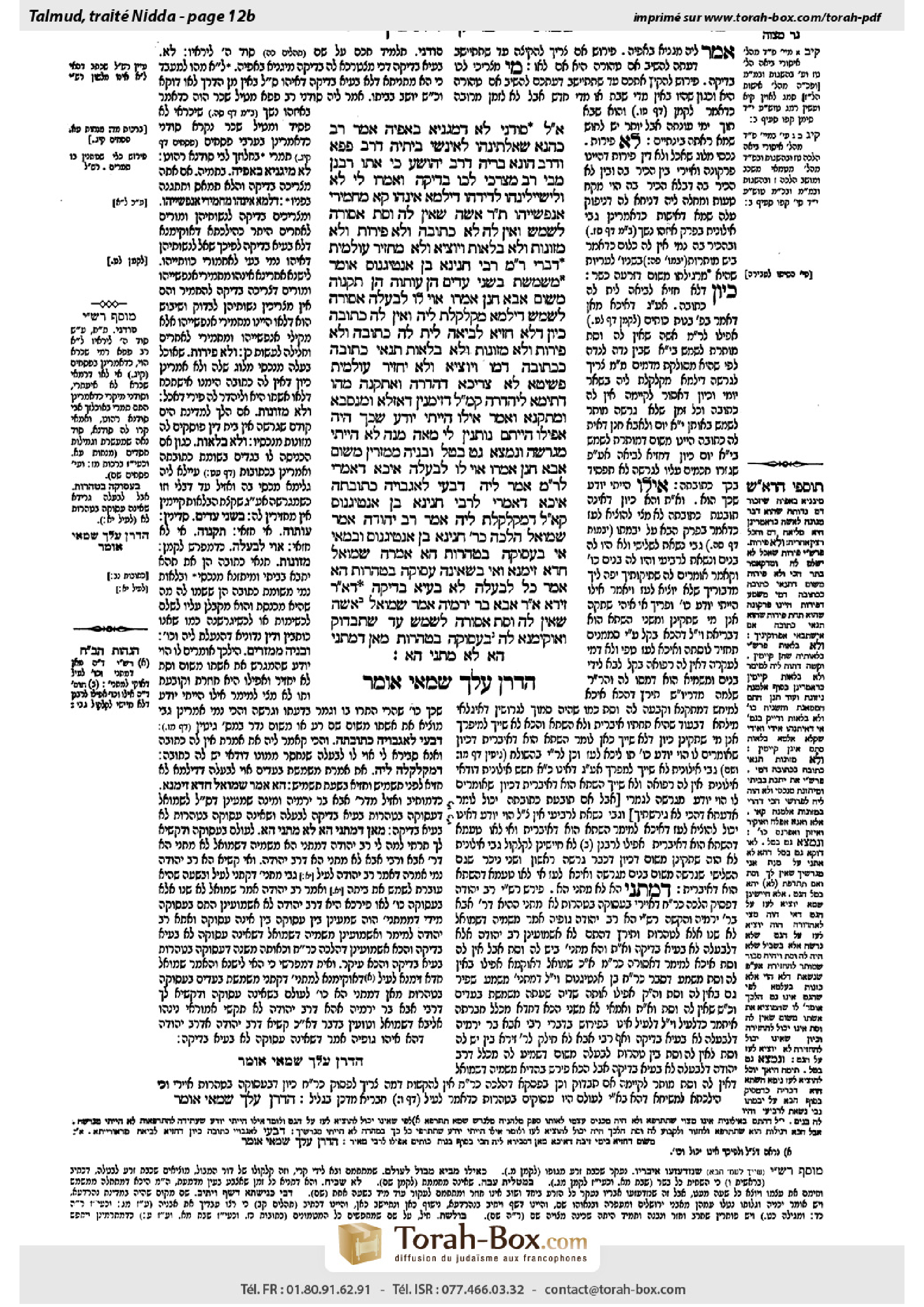
Niddah 12b: Talmud study for Daf Yomi
Daf Yomi is the daily study of one Talmud folio. Explore 37 tractates with scans, Hebrew text, Sefaria English and AI-generated French translations where annotated.
Passage selection and English or AI-generated French translation are available where the scan has annotations. Daf Study is independent of Torah-Box and Sefaria.
Browse Niddah · נידה · All tractatesNiddah 12b text and translations
This page of Niddah includes the Aramaic text, an English translation and an AI-generated French translation, alongside the scan above.
נידה י״ב ב · Aramaic and Hebrew text
אֲמַר לֵיהּ: סוּדָנִי, לָא, דְּמִגַּנְיָא בְּאַפֵּיהּ. אָמַר רַב כָּהֲנָא: שְׁאֵלְתִּינְהוּ לְאִינָשֵׁי בֵּיתֵיהּ דְּרַב פָּפָּא וּדְרַב הוּנָא בְּרֵיהּ דְּרַב יְהוֹשֻׁעַ, כִּי אֲתוֹ רַבָּנַן מִבֵּי רַב מַצְרְכִי לְכוּ בְּדִיקָה? וַאֲמַרוּ לִי: לָא. וְלִישַׁיְּילִינְהוּ לְדִידְהוּ! דִּילְמָא אִינְהוּ קָא מַחְמְירִי אַנַּפְשַׁיְיהוּ.
תָּנוּ רַבָּנַן: אִשָּׁה שֶׁאֵין לָהּ וֶסֶת — אֲסוּרָה לְשַׁמֵּשׁ, וְאֵין לָהּ לֹא כְּתוּבָּה, וְלֹא פֵּירוֹת, וְלֹא מְזוֹנוֹת, וְלֹא בְּלָאוֹת, וּמוֹצִיא וְלֹא מַחְזִיר עוֹלָמִית, דִּבְרֵי רַבִּי מֵאִיר.
רַבִּי חֲנִינָא בֶּן אַנְטִיגְנוֹס אוֹמֵר: מְשַׁמֶּשֶׁת בִּשְׁנֵי עִדִּים, הֵן עִוְּתוּהָ, הֵן תִּקְּנוּהָ. מִשּׁוּם אַבָּא חָנָן אָמְרוּ: אוֹי לוֹ לְבַעְלָהּ.
אֲסוּרָה לְשַׁמֵּשׁ — דִּילְמָא מְקַלְקְלָה לֵיהּ. וְאֵין לָהּ כְּתוּבָּה — כֵּיוָן דְּלָא חַזְיָא לְבִיאָה, לֵית לַהּ כְּתוּבָּה.
וְלֹא פֵּירוֹת, וְלֹא מְזוֹנוֹת, וְלֹא בְּלָאוֹת — תְּנָאֵי כְּתוּבָּה כִּכְתוּבָּה דָּמוּ.
וְיוֹצִיא, וְלֹא יַחְזִיר עוֹלָמִית. פְּשִׁיטָא! לָא צְרִיכָא — דַּהֲדַרָה וְאִתַּקַּנָה. מַהוּ דְּתֵימָא לַיהְדְּרַהּ? קָא מַשְׁמַע לַן, דְּזִימְנִין דְּאָזְלָא וּמִנַּסְבָא וּמִתַּקְנָא.
וְאָמַר: ״אִילּוּ הָיִיתִי יוֹדֵעַ שֶׁכָּךְ הָיָה, אֲפִילּוּ הֱיִיתֶם נוֹתְנִין לִי מֵאָה מָנֶה — לֹא הָיִיתִי מְגָרְשָׁהּ!״, וְנִמְצָא גֵּט בָּטֵל, וּבָנֶיהָ מַמְזֵרִין.
מִשּׁוּם אַבָּא חָנָן אָמְרוּ: ״אוֹי לוֹ לְבַעְלָהּ״. אִיכָּא דְאָמְרִי לְרַבִּי מֵאִיר אֲמַר לֵיהּ, דְּבָעֵי לְאַגְבּוֹיַהּ כְּתוּבְּתַהּ. אִיכָּא דְאָמְרִי לְרַבִּי חֲנִינָא בֶּן אַנְטִיגְנוֹס קָאָמַר לֵיהּ, דִּמְקַלְקְלָה לֵיהּ.
אָמַר רַב יְהוּדָה אָמַר שְׁמוּאֵל: הֲלָכָה כְּרַבִּי חֲנִינָא בֶּן אַנְטִיגְנוֹס. וּבְמַאי? אִי בַּעֲסוּקָה בִּטְהָרוֹת, הָא אַמְרַהּ שְׁמוּאֵל חֲדָא זִימְנָא!
וְאִי בְּשֶׁאֵינָהּ עֲסוּקָה בִּטְהָרוֹת, הָא אָמַר כֹּל לְבַעְלַהּ לָא בָּעֲיָא בְּדִיקָה, דְּאָמַר רַבִּי זֵירָא אָמַר רַבִּי אַבָּא בַּר יִרְמְיָה אָמַר שְׁמוּאֵל: ״אִשָּׁה שֶׁאֵין לָהּ וֶסֶת אֲסוּרָה לְשַׁמֵּשׁ עַד שֶׁתִּבְדּוֹק״, וְאוֹקִימְנָא לָהּ בַּעֲסוּקָה בִּטְהָרוֹת! מַאן דְּמַתְנֵי הָא לָא מַתְנֵי הָא.
הֲדַרַן עֲלָךְ שַׁמַּאי אוֹמֵר.
Niddah 12b · English translation
Rava said to Rav Pappa: Wise one [sudani]! No, won’t she be demeaned before him? It is embarrassing for her if she is awoken and has to think about whether or not she is pure. Rav Kahana says: I asked the members of the households, i.e., the wives, of Rav Pappa and of Rav Huna, son of Rav Yehoshua: When the Sages, your husbands, came home from the study hall, did they require you to perform an examination prior to intercourse? And they said to me: No. The Gemara asks: But why ask their wives? Why not ask those Sages themselves? The Gemara answers: Perhaps they might rule leniently for others, while acting stringently with themselves. Therefore, their wives were asked, to determine how the Sages conducted themselves in their personal lives.
§ The Sages taught in a baraita: With regard to a woman who does not have a fixed menstrual cycle, she is forbidden to engage in intercourse, and she does not have the right to receive payment of her marriage contract if divorced or widowed, nor is she entitled to payment from her husband for the produce of her property that he consumed, nor is she entitled to provisions for her sustenance from his estate, nor does she get back her worn clothes or other items she brought with her to her marriage as part of her dowry. And furthermore, her husband must divorce her and he may never remarry her. This is the statement of Rabbi Meir.
Rabbi Ḥanina ben Antigonus says: She is permitted to engage in intercourse with her husband, but she must examine herself with two examination cloths, one prior to intercourse and one afterward. They may be to her detriment if she finds blood on the cloths, or they may lead to her betterment, since if she finds no blood she is permitted to her husband. They said in the name of Abba Ḥanan: Woe to her husband!
The Gemara explains each clause of the baraita: She is forbidden to engage in intercourse, as perhaps she will ruin her husband if she emits blood during intercourse. And with regard to the halakha that she does not have the right to receive payment of her marriage contract, the reason is that since she is not fit for intercourse, she is not entitled to payment of her marriage contract.
The Gemara continues its explanation: And she is not entitled to payment for the produce of her property, nor is she entitled to provisions for her sustenance from his estate, nor does she get back her worn clothes. The reason for all these is because stipulations in the marriage contract are considered like the marriage contract itself. Since she is not entitled to a marriage contract, she is likewise not entitled to these additional provisions that are stipulated in the marriage contract.
The Gemara analyzes the next clause in the baraita: Her husband must divorce her and he may never remarry her. The Gemara asks: Isn’t that obvious? The Gemara answers: No, it is necessary to teach this in a case where her situation was subsequently amended, i.e., she established a fixed menstrual cycle. Lest you say that he may remarry her, the baraita teaches us that this is not permitted, as sometimes such a woman might go and marry someone else and her status is subsequently amended.
And the problem in this scenario is that her first husband might say: If I would have known that it is like this, that she would be cured, even if you would have given me one hundred times one hundred dinars to divorce her I would not have divorced her. And if so, the bill of divorce will be found to be void, and her children from her second husband will be considered mamzerim. Therefore it must be made clear to him from the outset that this divorce is final.
The Gemara analyzes the final clause of the baraita: They said in the name of Abba Ḥanan: Woe to her husband! Some say that he said this to Rabbi Meir, as Abba Ḥanan maintains that the husband is required to settle her payment of her marriage contract upon their divorce. And some say that he said this to Rabbi Ḥanina ben Antigonus, since Abba Ḥanan disagrees with his opinion and holds that it is forbidden to engage in intercourse with her, as perhaps she will ruin him if they engage in intercourse when she is menstruating.
Rav Yehuda says that Shmuel says: The halakha is in accordance with the opinion of Rabbi Ḥanina ben Antigonus. The Gemara asks: And with regard to what case did Shmuel issue this ruling of halakha? The Gemara elaborates: If it is referring to a woman who is engaged in handling ritually pure items, didn’t Shmuel already say on another occasion that a woman without a fixed menstrual cycle must examine herself prior to intercourse?
And if it is referring to a woman who is not engaged in handling ritually pure items, doesn’t Shmuel say that in any case where an examination is only for the purpose of intercourse with her husband, not for handling pure items, she is not required to perform an examination? As Rabbi Zeira said that Rabbi Abba bar Yirmeya says that Shmuel says: A woman who does not have a fixed menstrual cycle is forbidden to engage in intercourse until she examines herself, and we interpreted this statement as referring to cases where she is engaged in handling ritually pure items. The Gemara answers: He who teaches this does not teach that, i.e., Shmuel’s ruling is in fact referring to a woman engaged in handling pure items, and the two rulings were cited in his name by different Sages.
Niddah 12b · Traduction française (IA)
Rava dit à Rav Pappa : « Sage [sudani] ! Non, ne serait-elle pas humiliée devant lui ? Il serait gênant pour elle d’être réveillée et de devoir se demander si elle est pure ou non. » Rav Kahana dit : « J’ai interrogé les membres des foyers, c’est-à-dire les épouses, de Rav Pappa et de Rav Huna, fils de Rav Yehoshua : “Lorsque vos maris, les Sages, rentraient de la maison d’étude, vous demandaient-ils de procéder à un examen avant les rapports sexuels ?” Elles m’ont répondu : “Non.” » La Guemara demande : pourquoi interroger leurs épouses ? Pourquoi ne pas interroger directement ces Sages ? La Guemara répond : peut-être se montreraient-ils indulgents envers les autres, tout en étant stricts avec eux-mêmes. On interrogea donc leurs épouses pour savoir comment les Sages se conduisaient dans leur vie personnelle.
§ Les Sages ont enseigné dans une baraïta : une femme qui n’a pas de cycle menstruel fixe n’a pas le droit d’avoir des rapports sexuels ; si elle est divorcée ou veuve, elle n’a pas droit au paiement de sa ketouba, ni à une compensation de la part de son mari pour les fruits de ses biens qu’il a consommés, ni à une pension alimentaire prélevée sur sa succession ; elle ne récupère pas non plus ses vêtements usés ni les autres effets qu’elle avait apportés au mariage dans le cadre de sa dot. De plus, son mari doit divorcer d’elle et ne pourra jamais la reprendre. Telle est l’opinion de Rabbi Meïr.
Rabbi Ḥanina ben Antigonus dit : elle est autorisée à avoir des rapports sexuels avec son mari, mais elle doit procéder à un examen à l’aide de deux linges d’examen, l’un avant les rapports et l’autre après. Ces examens peuvent lui être défavorables si elle trouve du sang sur les linges, ou lui être favorables, car si elle n’y trouve pas de sang, elle est autorisée à son mari. On a dit au nom d’Abba Ḥanan : « Malheur à son mari ! »
La Guemara explique chacune des clauses de la baraïta : elle n’a pas le droit d’avoir des rapports sexuels, car elle pourrait causer la ruine de son mari si elle perd du sang pendant les rapports. Quant à la halakha selon laquelle elle n’a pas droit au paiement de sa ketouba, cela s’explique par le fait que, puisqu’elle n’est pas apte aux rapports sexuels, elle n’a pas droit au paiement de sa ketouba.
La Guemara poursuit son explication : elle n’a pas droit à une compensation pour les fruits de ses biens, ni à une pension alimentaire prélevée sur sa succession, et elle ne récupère pas ses vêtements usés. La raison de toutes ces dispositions est que les clauses de la ketouba sont considérées comme faisant partie de la ketouba elle-même. Puisqu’elle n’a pas droit à la ketouba, elle n’a pas non plus droit aux avantages supplémentaires stipulés dans celle-ci.
La Guemara analyse la clause suivante de la baraïta : son mari doit divorcer d’elle et ne pourra jamais la reprendre. La Guemara demande : n’est-ce pas évident ? La Guemara répond : cette précision est nécessaire dans le cas où sa situation s’est ensuite améliorée, c’est-à-dire où elle a établi un cycle menstruel fixe. De peur que tu ne dises qu’il peut la reprendre, la baraïta nous enseigne que cela est interdit, car il arrive qu’une telle femme épouse quelqu’un d’autre et que sa situation s’améliore par la suite.
Le problème, dans ce cas, est que son premier mari pourrait dire : « Si j’avais su qu’il en serait ainsi, qu’elle guérirait, même si l’on m’avait donné cent fois cent dinars pour divorcer d’elle, je ne l’aurais pas fait. » L’acte de divorce serait alors considéré comme nul, et ses enfants issus de son second mari seraient des mamzerim. Il faut donc lui préciser dès le départ que ce divorce est définitif.
La Guemara analyse la dernière clause de la baraïta : on a dit au nom d’Abba Ḥanan : « Malheur à son mari ! » Certains disent qu’il adressait ces paroles à Rabbi Meïr, car Abba Ḥanan estime que le mari doit lui verser le paiement de sa ketouba au moment du divorce. D’autres disent qu’il s’adressait à Rabbi Ḥanina ben Antigonus, car Abba Ḥanan conteste son opinion et estime qu’il est interdit d’avoir des rapports sexuels avec elle, puisqu’elle pourrait causer la ruine de son mari s’ils ont des rapports alors qu’elle est menstruée.
Rav Yehuda dit au nom de Shmuel : la halakha suit l’opinion de Rabbi Ḥanina ben Antigonus. La Guemara demande : à quel cas Shmuel applique-t-il cette halakha ? La Guemara précise : s’il s’agit d’une femme qui s’occupe d’objets rituellement purs, Shmuel n’a-t-il pas déjà dit ailleurs qu’une femme sans cycle menstruel fixe doit procéder à un examen avant les rapports sexuels ?
Et s’il s’agit d’une femme qui ne s’occupe pas d’objets rituellement purs, Shmuel ne dit-il pas que, dans tous les cas où l’examen a pour seul but les rapports avec son mari, et non la manipulation d’objets purs, elle n’est pas tenue de procéder à un examen ? Car Rabbi Zeira a dit que Rabbi Abba bar Yirmeya dit au nom de Shmuel : une femme qui n’a pas de cycle menstruel fixe n’a pas le droit d’avoir des rapports sexuels tant qu’elle ne s’est pas examinée. Nous avons interprété cette déclaration comme portant sur les cas où elle s’occupe d’objets rituellement purs. La Guemara répond : celui qui enseigne ceci n’enseigne pas cela, c’est-à-dire que la décision de Shmuel concerne en réalité une femme qui s’occupe d’objets rituellement purs, et que deux Sages différents ont rapporté ces deux décisions en son nom.
Traduction française générée par IA à partir de l’édition anglaise de Sefaria. Vérifie toujours un passage avec le texte source.
Text from Sefaria: William Davidson Edition - Vocalized Aramaic (CC BY NC); William Davidson Edition - English (CC BY NC).