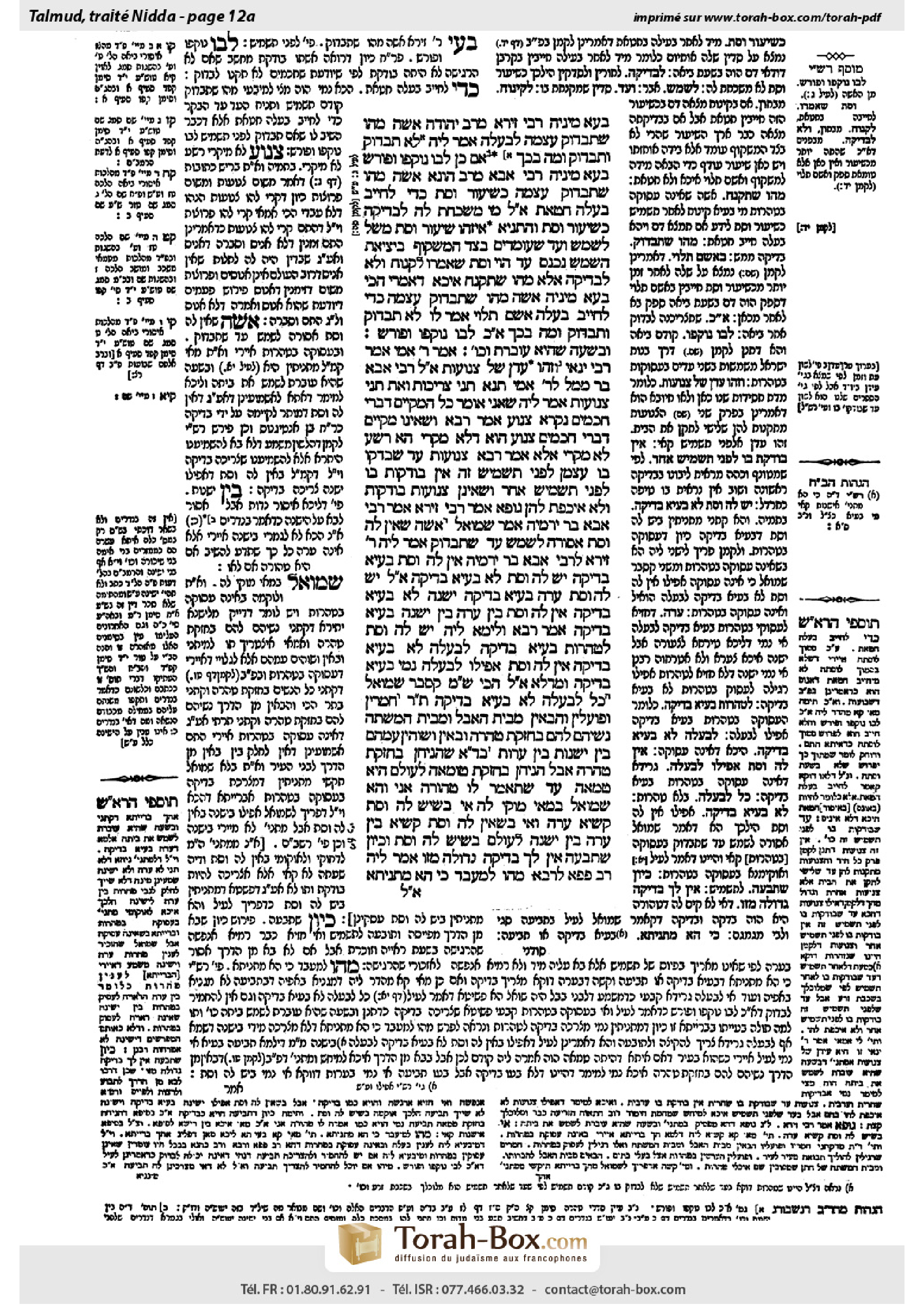
Niddah 12a: Talmud study for Daf Yomi
Daf Yomi is the daily study of one Talmud folio. Explore 37 tractates with scans, Hebrew text, Sefaria English and AI-generated French translations where annotated.
Passage selection and English or AI-generated French translation are available where the scan has annotations. Daf Study is independent of Torah-Box and Sefaria.
Browse Niddah · נידה · All tractatesNiddah 12a text and translations
This page of Niddah includes the Aramaic text, an English translation and an AI-generated French translation, alongside the scan above.
נידה י״ב א · Aramaic and Hebrew text
בְּעָא מִינֵּיהּ רַבִּי זֵירָא מֵרַב יְהוּדָה: אִשָּׁה מַהוּ שֶׁתִּבְדּוֹק עַצְמָהּ לְבַעְלָהּ? אֲמַר לֵיהּ: לֹא תִּבְדּוֹק. וְתִבְדּוֹק — וּמָה בְּכָךְ? אִם כֵּן — לִבּוֹ נוֹקְפוֹ וּפוֹרֵשׁ.
בְּעָא מִינֵּיהּ רַבִּי אַבָּא מֵרַב הוּנָא: אִשָּׁה מַהוּ שֶׁתִּבְדּוֹק עַצְמָהּ כְּשִׁיעוּר וֶסֶת, כְּדֵי לְחַיֵּיב בַּעְלָהּ חַטָּאת?
אֲמַר לֵיהּ: מִי מַשְׁכַּחַתְּ לַהּ לִבְדִיקָה כְּשִׁיעוּר וֶסֶת? וְהָתַנְיָא: אֵיזֶהוּ שִׁיעוּר וֶסֶת? מָשָׁל לְשַׁמָּשׁ וָעֵד שֶׁעוֹמְדִים בְּצַד הַמַּשְׁקוֹף, בִּיצִיאַת הַשַּׁמָּשׁ נִכְנַס עֵד.
הֱוֵי: וֶסֶת שֶׁאָמְרוּ — לְקִנּוּחַ, וְלֹא לִבְדִיקָה. אֶלָּא מַהוּ שֶׁתְּקַנֵּחַ?
אִיכָּא דְאָמְרִי, הָכִי בְּעָא מִינֵּיהּ: אִשָּׁה מַהוּ שֶׁתִּבְדּוֹק עַצְמָהּ כְּדֵי לְחַיֵּיב בַּעְלָהּ אָשָׁם תָּלוּי? אָמַר לוֹ: לֹא תִּבְדּוֹק. וְתִבְדּוֹק, וּמָה בְּכָךְ? אִם כֵּן, לִבּוֹ נוֹקְפוֹ וּפוֹרֵשׁ.
וּבְשָׁעָה שֶׁהִיא עוֹבֶרֶת וְכוּ׳. אָמַר רַבִּי אַמֵּי אָמַר רַבִּי יַנַּאי: וְזֶהוּ עִדָּן שֶׁל צְנוּעוֹת. אֲמַר לֵיהּ רַבִּי אַבָּא בַּר מֶמֶל לְרַבִּי אַמֵּי: תַּנָּא תָּנֵי ״צְרִיכוֹת״, וְאַתְּ תָּנֵי ״צְנוּעוֹת״! אֲמַר לֵיהּ: שֶׁאֲנִי אוֹמֵר כׇּל הַמְקַיֵּים דִּבְרֵי חֲכָמִים נִקְרָא ״צָנוּעַ״.
אָמַר רָבָא: וְשֶׁאֵינוֹ מְקַיֵּים דִּבְרֵי חֲכָמִים — ״צָנוּעַ״ הוּא דְּלָא מִקְּרֵי, הָא ״רָשָׁע״ לָא מִקְּרֵי? אֶלָּא אָמַר רָבָא: צְנוּעוֹת — עַד שֶׁבָּדְקוּ בּוֹ עַצְמָן לִפְנֵי תַּשְׁמִישׁ זֶה, אֵין בּוֹדְקוֹת בּוֹ לִפְנֵי תַּשְׁמִישׁ אַחֵר, וְשֶׁאֵינָן צְנוּעוֹת — בּוֹדְקוֹת וְלֹא אִיכְפַּת לָהֶן.
גּוּפָא, אָמַר רַבִּי זֵירָא, אָמַר רַבִּי אַבָּא בַּר יִרְמְיָה, אָמַר שְׁמוּאֵל: אִשָּׁה שֶׁאֵין לָהּ וֶסֶת אֲסוּרָה לְשַׁמֵּשׁ עַד שֶׁתִּבְדּוֹק. אֲמַר לֵיהּ רַבִּי זֵירָא לְרַבִּי אַבָּא בַּר יִרְמְיָה: אֵין לָהּ וֶסֶת — בָּעֲיָא בְּדִיקָה, יֵשׁ לָהּ וֶסֶת — לָא בָּעֲיָא בְּדִיקָה?
אֲמַר לֵיהּ: יֵשׁ לָהּ וֶסֶת — עֵרָה בָּעֲיָא בְּדִיקָה, יְשֵׁנָה לָא בָּעֲיָא בְּדִיקָה; אֵין לָהּ וֶסֶת — בֵּין עֵרָה בֵּין יְשֵׁנָה בָּעֲיָא בְּדִיקָה.
אָמַר רָבָא: וְלֵימָא לֵיהּ — יֵשׁ לָהּ וֶסֶת, לִטְהָרוֹת בָּעֲיָא בְּדִיקָה, לְבַעְלָהּ לָא בָּעֲיָא בְּדִיקָה; אֵין לָהּ וֶסֶת, אֲפִילּוּ לְבַעְלָהּ נָמֵי בָּעֲיָא בְּדִיקָה. וּמִדְּלָא אֲמַר לֵיהּ הָכִי, שְׁמַע מִינַּהּ קָסָבַר שְׁמוּאֵל: כֹּל לְבַעְלַהּ לָא בָּעֲיָא בְּדִיקָה.
תָּנוּ רַבָּנַן: חַמָּרִין וּפוֹעֲלִין, וְהַבָּאִין מִבֵּית הָאֵבֶל וּמִבֵּית הַמִּשְׁתֶּה — נְשֵׁיהֶם לָהֶם בְּחֶזְקַת טׇהֳרָה, וּבָאִין וְשׁוֹהִין עִמָּהֶם, בֵּין יְשֵׁנוֹת בֵּין עֵרוֹת. בַּמֶּה דְבָרִים אֲמוּרִים? שֶׁהִנִּיחָן בְּחֶזְקַת טׇהֳרָה, אֲבָל הִנִּיחָן בְּחֶזְקַת טוּמְאָה — לְעוֹלָם הִיא טְמֵאָה, עַד שֶׁתֹּאמַר לוֹ ״טְהוֹרָה אָנִי״.
וְהָא שְׁמוּאֵל בְּמַאי מוֹקֵי לַהּ? אִי בְּשֶׁיֵּשׁ לָהּ וֶסֶת — קַשְׁיָא עֵרָה, וְאִי בְּשֶׁאֵין לָהּ וֶסֶת — קַשְׁיָא בֵּין עֵרָה בֵּין יְשֵׁנָה!
לְעוֹלָם בְּשֶׁיֵּשׁ לָהּ וֶסֶת, וְכֵיוָן שֶׁתְּבָעָהּ — אֵין לְךָ בְּדִיקָה גְּדוֹלָה מִזּוֹ. אֲמַר לֵיהּ רַב פָּפָּא לְרָבָא: מַהוּ לְמֶעְבַּד כִּי הָא מַתְנִיתָא?
Niddah 12a · English translation
§ Rabbi Zeira raised a dilemma before Rav Yehuda: What is the halakha as to whether a woman should examine herself before engaging in intercourse with her husband? Rav Yehuda said to him: She should not examine herself. Rabbi Zeira asked: And let her examine herself; what would be the problem with that? Rav Yehuda answered: If so, the heart of a scrupulous husband might strike him with pangs of conscience over sins that he could transgress, and he will separate from his wife out of fear that she is impure.
Rabbi Abba raised a similar dilemma before Rav Huna: What is the halakha as to whether a woman should examine herself immediately after engaging in intercourse, within the minimum period of time needed for the onset of menstruation, in order to render her husband liable to bring a sin offering for engaging in intercourse with a menstruating woman?
Rav Huna said to him: Can you find a case where it is physically possible to perform a full examination after intercourse within the period of time needed for the onset of menstruation? But isn’t it taught in a baraita: What is the period of time needed for the onset of menstruation? This is comparable to a male organ and an examination cloth that are standing alongside the doorpost, i.e., at the entrance to the vagina; upon the exit of the organ the examination cloth immediately enters.
The Gemara explains: It is apparent that the period of time that they stated is the time required for an external wipe, and not for a full internal examination. Therefore, if she did an internal examination and found blood, one cannot be certain that she was already menstruating during intercourse and thereby render the husband liable to bring a sin offering. Rather, this is Rabbi Abba’s dilemma: What is the halakha as to whether a woman should wipe herself immediately after engaging in intercourse? Since this action can be performed quickly, if she were to find blood her husband would be liable to bring a sin offering.
Some say that this is the dilemma that Rabbi Abba raised before Rav Huna: What is the halakha as to whether a woman should examine herself immediately after engaging in intercourse, in order to render her husband liable to bring a provisional guilt offering brought by one who is uncertain as to whether he committed a sin that requires a sin offering? Rav Huna said to him: She should not examine herself. Rabbi Abba asked: And let her examine herself; what would be the problem with that? Rav Huna answered: If so, the heart of a scrupulous husband might strike him with pangs of conscience over sins that he could transgress, and he will separate from his wife out of fear that she is impure.
§ The mishna teaches: And she is also required to examine herself at a time that she is about to engage in intercourse with her husband. Rabbi Ami says that Rabbi Yannai says: And this examination performed before intercourse is known as: The examination cloth of virtuous women, as this examination is not strictly required. Rabbi Abba bar Memel said to Rabbi Ami: The tanna teaches that women are required to perform this examination, and yet you teach that only virtuous women perform it. Rabbi Ami said to him: Yes, as I say that anyone who fulfills the statements of the Sages is called virtuous. Rabbi Ami did not mean that this examination is beyond the letter of the law. He was simply praising those who abide by the established halakha.
With regard to Rabbi Ami’s claim, Rava says: And according to your opinion, with regard to one who does not fulfill the statements of the Sages, he is not called virtuous. But this indicates that he is not called wicked either. This cannot be correct, as one who does not heed the instructions of the Sages is certainly wicked. Rather, Rava said: Virtuous women are those who do not reuse the examination cloth that they used to examine themselves before this intercourse. Even if no blood was found on it, they do not examine themselves with it prior to another act of intercourse, as once it was used once, it is not as clean as before. And those who are not virtuous women reuse the same examination cloths and examine themselves with them and they are not particular about this matter.
§ The Gemara returns to the matter itself: Rabbi Zeira says that Rabbi Abba bar Yirmeya says that Shmuel says: With regard to a woman who does not have a fixed menstrual cycle, it is forbidden for her to engage in intercourse until she examines herself. Rabbi Zeira said to Rabbi Abba bar Yirmeya: Does Shmuel mean that if she does not have a fixed menstrual cycle she is required to perform an examination, but if she has a fixed menstrual cycle she is not required to perform an examination? This is difficult, as the mishna teaches that even a woman with a fixed menstrual cycle is required to perform an examination before she engages in intercourse.
Rabbi Abba bar Yirmeya said to him: The mishna means that if she has a fixed menstrual cycle and she is awake, she is required to perform an examination; if she is sleeping she is not required to perform an examination before intercourse, as this would involve much effort. If she does not have a fixed menstrual cycle, then whether she is awake or sleeping, she is required to perform an examination.
Rava says: And let Rabbi Abba bar Yirmeya say a different answer to Rabbi Zeira: Shmuel means that if she has a fixed menstrual cycle, then in the case of a woman who handles pure items, she is required to perform an examination for the sake of intercourse as well. If she does not handle pure items, then for the sake of intercourse with her husband alone she is not required to perform an examination. By contrast, if she does not have a fixed menstrual cycle, then she is required to perform an examination even for the sake of intercourse with her husband. Rava concludes: And from the fact that Rabbi Abba bar Yirmeya did not say this answer, one can learn from it that Shmuel holds that in any case where an examination is only for the purpose of intercourse with her husband, she is not required to perform an examination.
§ The Sages taught in a baraita: With regard to donkey drivers and laborers who return home, and those who come home from the house of mourning or from the house of feasting for a wedding, their wives remain in a presumptive status of purity. And therefore they may come and remain with them, i.e., engage in intercourse with them, whether they are sleeping or awake. The baraita clarifies: In what case is this statement said? When the husbands left their wives in a presumptive state of purity. But if the husbands left them in a presumptive state of impurity, she remains forever in a status of impurity, until she says to him: I am ritually pure.
The Gemara asks: But according to Rabbi Abba bar Yirmeya, with regard to what case does Shmuel interpret this baraita? If the baraita is dealing with a woman who has a fixed menstrual cycle, it is difficult, as Shmuel holds that such a woman who is awake is required to perform an examination, whereas the baraita indicates that no examination is necessary. And if the baraita is referring to a woman who does not have a fixed menstrual cycle, it is also difficult, as Shmuel holds that she always is required to perform an examination, whether she is awake or sleeping.
The Gemara answers: Actually, the baraita is referring to a case where she has a fixed menstrual cycle, and since her husband came home from his travels and requested of her that they engage in intercourse, there is no greater examination than this. Since she had time to consider the matter while he was asking her, she would have remembered had she sensed the onset of her menstrual cycle, whereas under regular circumstances she might not have time to recall. Based upon this explanation, Rav Pappa said to Rava: What is the halakha with regard to acting in accordance with this baraita? Perhaps it is necessary to wake her and ask her whether she is ritually pure.
Niddah 12a · Traduction française (IA)
§ Rabbi Zeira posa une question à Rav Yehuda : quelle est la halakha concernant l’examen que la femme devrait effectuer avant d’avoir des relations avec son mari ? Rav Yehuda lui répondit : Elle ne doit pas s’examiner. Rabbi Zeira demanda : Pourquoi ne s’examinerait-elle pas ? Quel serait le problème ? Rav Yehuda répondit : Dans ce cas, un mari scrupuleux pourrait être tourmenté par des remords au sujet des péchés qu’il risque de commettre et s’abstenir d’avoir des relations avec sa femme, de crainte qu’elle ne soit impure.
Rabbi Abba posa une question semblable à Rav Huna : quelle est la halakha concernant l’examen que la femme devrait effectuer immédiatement après avoir eu des relations, dans le délai minimal nécessaire à l’apparition des règles, afin de rendre son mari passible d’apporter un sacrifice expiatoire pour avoir eu des relations avec une femme menstruée ?
Rav Huna lui répondit : Peux-tu imaginer un cas où il serait matériellement possible d’effectuer un examen complet après les relations, dans le délai nécessaire à l’apparition des règles ? N’est-il pas enseigné dans une baraïta : « Quel est le délai nécessaire à l’apparition des règles ? Il est comparable à un organe masculin et à un tissu d’examen placés côte à côte contre le montant de la porte », c’est-à-dire à l’entrée du vagin ; dès que l’organe se retire, le tissu d’examen y est immédiatement introduit.
La Guemara explique : Il ressort de là que le délai dont ils ont parlé est celui qui suffit pour un essuyage externe, et non pour un examen interne complet. Par conséquent, si elle a effectué un examen interne et trouvé du sang, on ne peut pas être certain qu’elle avait déjà ses règles pendant les relations, ce qui rendrait son mari passible d’apporter un sacrifice expiatoire. La question de Rabbi Abba est plutôt la suivante : quelle est la halakha concernant le fait que la femme s’essuie immédiatement après avoir eu des relations ? Comme cet acte peut être accompli rapidement, si elle trouve du sang, son mari serait passible d’apporter un sacrifice expiatoire.
Certains disent que la question que Rabbi Abba posa à Rav Huna est la suivante : quelle est la halakha concernant l’examen que la femme devrait effectuer immédiatement après avoir eu des relations, afin de rendre son mari passible d’apporter un sacrifice de culpabilité provisoire, que doit apporter celui qui ignore s’il a commis un péché exigeant un sacrifice expiatoire ? Rav Huna lui répondit : Elle ne doit pas s’examiner. Rabbi Abba demanda : Pourquoi ne s’examinerait-elle pas ? Quel serait le problème ? Rav Huna répondit : Dans ce cas, un mari scrupuleux pourrait être tourmenté par des remords au sujet des péchés qu’il risque de commettre et s’abstenir d’avoir des relations avec sa femme, de crainte qu’elle ne soit impure.
§ La Michna enseigne : Elle doit également s’examiner au moment où elle est sur le point d’avoir des relations avec son mari. Rabbi Ami dit au nom de Rabbi Yannai : Cet examen effectué avant les relations est appelé « l’examen au tissu des femmes vertueuses », car cet examen n’est pas strictement obligatoire. Rabbi Abba bar Memel dit à Rabbi Ami : Le tanna enseigne que les femmes doivent effectuer cet examen, alors que toi, tu enseignes que seules les femmes vertueuses le font. Rabbi Ami lui répondit : Oui, car je dis que quiconque se conforme aux paroles des Sages est appelé vertueux. Rabbi Ami ne voulait pas dire que cet examen dépasse les exigences de la halakha. Il faisait simplement l’éloge de celles qui respectent la halakha établie.
À propos de l’affirmation de Rabbi Ami, Rava dit : Selon toi, celui qui ne se conforme pas aux paroles des Sages n’est pas appelé vertueux. Cela implique toutefois qu’il n’est pas non plus appelé méchant. Or, cela ne saurait être juste, car celui qui ne tient pas compte des instructions des Sages est certainement méchant. Rava dit plutôt : Les femmes vertueuses sont celles qui ne réutilisent pas le tissu d’examen dont elles se sont servies pour s’examiner avant ces relations. Même si elles n’y ont trouvé aucun sang, elles ne s’en servent pas pour s’examiner avant une autre relation, car après un premier usage, il n’est plus aussi propre qu’avant. Les femmes qui ne sont pas vertueuses réutilisent le même tissu d’examen pour s’examiner et ne prêtent pas attention à cette question.
§ La Guemara revient au sujet lui-même : Rabbi Zeira dit que Rabbi Abba bar Yirmeya dit que Shmuel dit : Une femme qui n’a pas de cycle menstruel régulier ne peut pas avoir de relations avant de s’être examinée. Rabbi Zeira dit à Rabbi Abba bar Yirmeya : Shmuel veut-il dire qu’une femme qui n’a pas de cycle menstruel régulier doit s’examiner, mais que celle qui en a un n’est pas tenue de le faire ? Cela pose difficulté, car la Michna enseigne que même une femme ayant un cycle menstruel régulier doit s’examiner avant d’avoir des relations.
Rabbi Abba bar Yirmeya lui dit : La Michna signifie que si elle a un cycle menstruel régulier et qu’elle est éveillée, elle doit s’examiner ; si elle dort, elle n’est pas tenue de s’examiner avant les relations, car cela demanderait un grand effort. Si elle n’a pas de cycle menstruel régulier, elle doit s’examiner, qu’elle soit éveillée ou endormie.
Rava dit : Rabbi Abba bar Yirmeya aurait aussi pu donner une autre réponse à Rabbi Zeira : Shmuel veut dire que si elle a un cycle menstruel régulier et qu’elle manipule des objets purs, elle doit également s’examiner en vue des relations. Si elle ne manipule pas d’objets purs, elle n’est pas tenue de s’examiner en vue des seules relations avec son mari. En revanche, si elle n’a pas de cycle menstruel régulier, elle doit s’examiner même en vue des seules relations avec son mari. Rava conclut : Puisque Rabbi Abba bar Yirmeya n’a pas donné cette réponse, on peut en déduire que, selon Shmuel, dans tous les cas où l’examen n’a pour but que les relations avec son mari, elle n’est pas tenue de s’examiner.
§ Les Sages ont enseigné dans une baraïta : Les épouses des conducteurs d’ânes et des ouvriers qui rentrent chez eux, ainsi que celles des hommes qui reviennent de la maison d’un endeuillé ou d’une maison où l’on festoyait à l’occasion d’un mariage, conservent leur présomption de pureté. Leurs maris peuvent donc venir auprès d’elles et avoir des relations avec elles, qu’elles soient endormies ou éveillées. La baraïta précise : Dans quel cas cette règle s’applique-t-elle ? Lorsque les maris avaient laissé leurs épouses dans un état présumé pur. Mais si les maris les avaient laissées dans un état présumé impur, elle demeure dans cet état d’impureté pour toujours, jusqu’à ce qu’elle lui dise : « Je suis rituellement pure. »
La Guemara demande : Mais, selon Rabbi Abba bar Yirmeya, à quel cas Shmuel applique-t-il cette interprétation de la baraïta ? Si la baraïta concerne une femme ayant un cycle menstruel régulier, cela pose difficulté, car Shmuel considère qu’une telle femme, lorsqu’elle est éveillée, doit s’examiner, alors que la baraïta indique qu’aucun examen n’est nécessaire. Et si la baraïta concerne une femme qui n’a pas de cycle menstruel régulier, cela pose également difficulté, car selon Shmuel elle doit toujours s’examiner, qu’elle soit éveillée ou endormie.
La Guemara répond : En réalité, la baraïta concerne un cas où elle a un cycle menstruel régulier. Puisque son mari est rentré de voyage et lui a demandé d’avoir des relations avec lui, rien ne saurait constituer un examen plus probant que cela. Comme elle a eu le temps de réfléchir pendant qu’il le lui demandait, elle se serait souvenue si elle avait senti le début de ses règles, alors qu’en temps ordinaire elle n’aurait peut-être pas le temps de s’en souvenir. Sur la base de cette explication, Rav Pappa demanda à Rava : Quelle est la halakha concernant le fait d’agir conformément à cette baraïta ? Peut-être faut-il la réveiller et lui demander si elle est rituellement pure.
Traduction française générée par IA à partir de l’édition anglaise de Sefaria. Vérifie toujours un passage avec le texte source.
Text from Sefaria: William Davidson Edition - Vocalized Aramaic (CC BY NC); William Davidson Edition - English (CC BY NC).