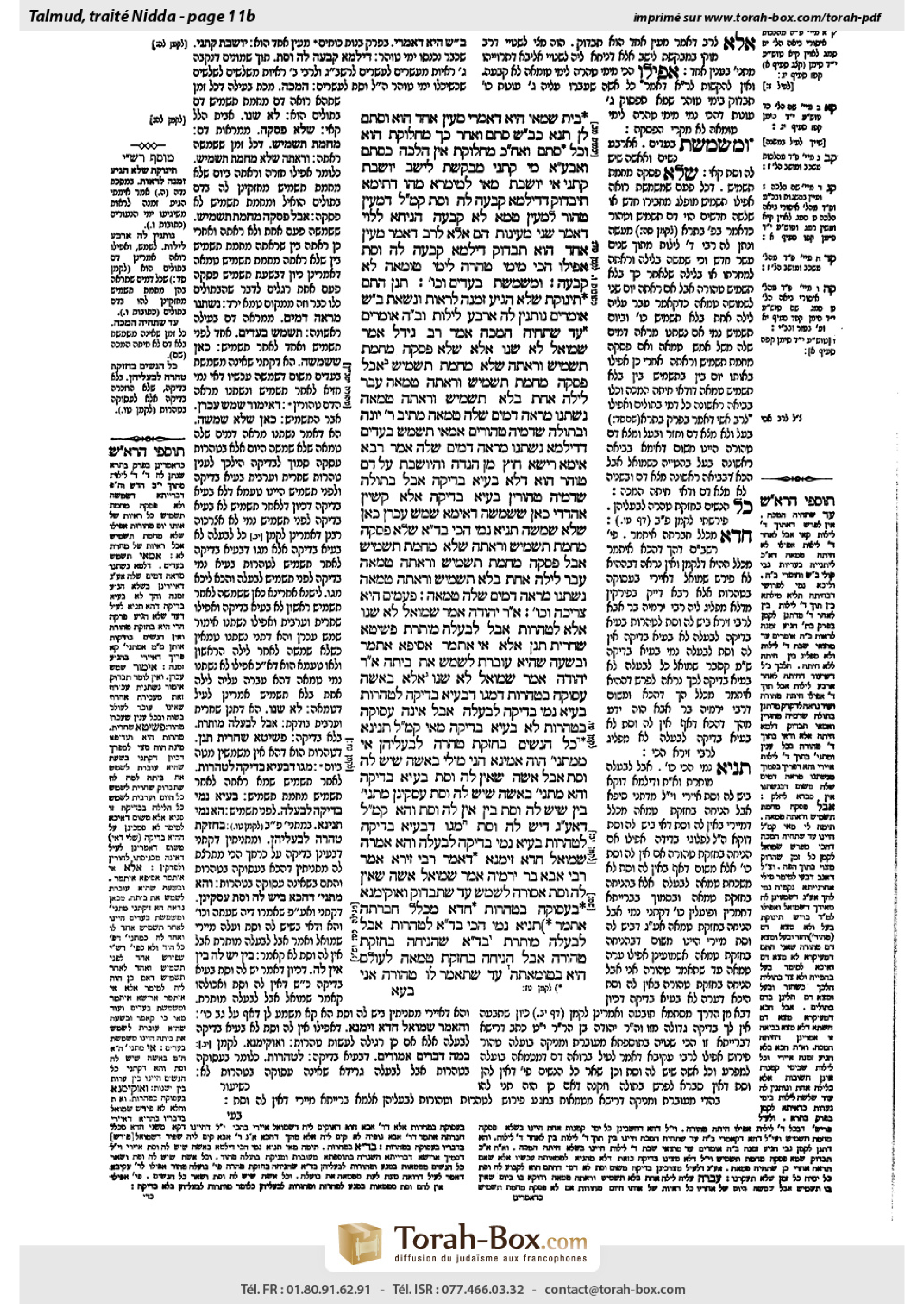
Niddah 11b: Talmud study for Daf Yomi
Daf Yomi is the daily study of one Talmud folio. Explore 37 tractates with scans, Hebrew text, Sefaria English and AI-generated French translations where annotated.
Passage selection and English or AI-generated French translation are available where the scan has annotations. Daf Study is independent of Torah-Box and Sefaria.
Browse Niddah · נידה · All tractatesNiddah 11b text and translations
This page of Niddah includes the Aramaic text, an English translation and an AI-generated French translation, alongside the scan above.
נידה י״א ב · Aramaic and Hebrew text
בֵּית שַׁמַּאי הִיא, דְּאָמְרִי: מַעְיָן אֶחָד הוּא. וּסְתַם לַן תַּנָּא כְּבֵית שַׁמַּאי?! סְתָם וְאַחַר כָּךְ מַחְלוֹקֶת הוּא, וְכׇל סְתָם וְאַחַר כָּךְ מַחְלוֹקֶת אֵין הֲלָכָה כִּסְתָם.
וְאִי בָּעֵית אֵימָא: מִי קָתָנֵי ״מְבַקֶּשֶׁת לֵישֵׁב״? ״יוֹשֶׁבֶת״ קָתָנֵי! אִי יוֹשֶׁבֶת, מַאי לְמֵימְרָא? מַהוּ דְּתֵימָא תִּיבְדּוֹק, דְּדִילְמָא קָבְעָה לַהּ וֶסֶת — קָא מַשְׁמַע לַן דְּמַעְיָן טָהוֹר לְמַעְיָן טָמֵא לָא קָבְעָה.
הָנִיחָא לְלֵוִי, דְּאָמַר: שְׁנֵי מַעְיָנוֹת הֵם, אֶלָּא לְרַב דְּאָמַר: מַעְיָן אֶחָד הוּא — תִּבְדּוֹק, דִּילְמָא קָבְעָה לַהּ וֶסֶת! אֲפִילּוּ הָכִי, מִימֵי טׇהֳרָה לִימֵי טוּמְאָה לָא קָבְעָה.
וּמְשַׁמֶּשֶׁת בְּעֵדִים וְכוּ׳. תְּנַן הָתָם: תִּינוֹקֶת שֶׁלֹּא הִגִּיעַ זְמַנָּהּ לִרְאוֹת וְנִשֵּׂאת, בֵּית שַׁמַּאי אוֹמְרִים: נוֹתְנִין לָהּ אַרְבַּע לֵילוֹת, וּבֵית הִלֵּל אוֹמְרִים: עַד שֶׁתִּחְיֶה הַמַּכָּה.
אָמַר רַב גִּידֵּל, אָמַר שְׁמוּאֵל: לֹא שָׁנוּ אֶלָּא שֶׁלֹּא פָּסְקָה מֵחֲמַת תַּשְׁמִישׁ וְרָאֲתָה שֶׁלֹּא מֵחֲמַת תַּשְׁמִישׁ, אֲבָל פָּסְקָה מֵחֲמַת תַּשְׁמִישׁ וְרָאֲתָה — טְמֵאָה.
עָבַר לַיְלָה אַחַת בְּלֹא תַּשְׁמִישׁ וְרָאֲתָה — טְמֵאָה. נִשְׁתַּנּוּ מַרְאֵה דָמִים שֶׁלָּהּ — טְמֵאָה. מֵתִיב רַבִּי יוֹנָה: ״וּבְתוּלָה שֶׁדָּמֶיהָ טְהוֹרִים״, אַמַּאי? תְּשַׁמֵּשׁ בְּעֵדִים, דְּדִילְמָא נִשְׁתַּנּוּ מַרְאֵה דָמִים שֶׁלָּהּ!
אָמַר רָבָא: אֵימָא רֵישָׁא ״חוּץ מִן הַנִּדָּה וְהַיּוֹשֶׁבֶת עַל דַּם טוֹהַר״, הוּא דְּלָא בָּעֲיָא בְּדִיקָה, אֲבָל בְּתוּלָה שֶׁדָּמֶיהָ טְהוֹרִין בָּעֲיָא בְּדִיקָה. אֶלָּא קַשְׁיָין אַהֲדָדֵי!
כָּאן — שֶׁשִּׁמְּשָׁה, דְּאֵימָא שַׁמָּשׁ עֲכָרָן; כָּאן — שֶׁלֹּא שִׁמְּשָׁה.
תַּנְיָא נָמֵי הָכִי: בַּמֶּה דְבָרִים אֲמוּרִים? שֶׁלֹּא פָּסְקָה מֵחֲמַת תַּשְׁמִישׁ, וְרָאֲתָה שֶׁלֹּא מֵחֲמַת תַּשְׁמִישׁ.
אֲבָל פָּסְקָה מֵחֲמַת תַּשְׁמִישׁ וְרָאֲתָה — טְמֵאָה, עָבַר לַיְלָה אַחַת בְּלֹא תַּשְׁמִישׁ וְרָאֲתָה — טְמֵאָה, נִשְׁתַּנּוּ מַרְאֵה דָמִים שֶׁלָּהּ — טְמֵאָה.
פַּעֲמַיִם הִיא צְרִיכָה וְכוּ׳. אָמַר רַב יְהוּדָה אָמַר שְׁמוּאֵל: לֹא שָׁנוּ אֶלָּא לִטְהָרוֹת, אֲבָל לְבַעְלָהּ מוּתֶּרֶת. פְּשִׁיטָא, ״שַׁחֲרִית״ תְּנַן!
אֶלָּא אִי אִתְּמַר אַסֵּיפָא אִתְּמַר: וּבְשָׁעָה שֶׁהִיא עוֹבֶרֶת לְשַׁמֵּשׁ אֶת בֵּיתָהּ. אָמַר רַב יְהוּדָה אָמַר שְׁמוּאֵל: לֹא שָׁנוּ אֶלָּא בְּאִשָּׁה עֲסוּקָה בִּטְהָרוֹת, דְּמִגּוֹ דְּבָעֲיָא בְּדִיקָה לִטְהָרוֹת — בָּעֲיָא נָמֵי בְּדִיקָה לְבַעְלָהּ, אֲבָל אֵינָהּ עֲסוּקָה בִּטְהָרוֹת — לָא בָּעֲיָא בְּדִיקָה.
מַאי קָא מַשְׁמַע לַן? תְּנֵינָא: כׇּל הַנָּשִׁים בְּחֶזְקַת טׇהֳרָה לְבַעֲלֵיהֶן! אִי מִמַּתְנִיתִין הֲוָה אָמֵינָא, הָנֵי מִילֵּי בְּאִשָּׁה שֶׁיֵּשׁ לָהּ וֶסֶת, אֲבָל אִשָּׁה שֶׁאֵין לָהּ וֶסֶת — בָּעֲיָא בְּדִיקָה.
וְהָא מַתְנִיתִין בְּאִשָּׁה שֶׁיֵּשׁ לָהּ וֶסֶת עָסְקִינַן! מַתְנִיתִין בֵּין שֶׁיֵּשׁ לָהּ וֶסֶת, בֵּין אֵין לָהּ וֶסֶת, וְהָא קָא מַשְׁמַע לַן: דְּאַף עַל גַּב דְּיֵשׁ לָהּ וֶסֶת, מִגּוֹ דְּבָעֲיָא בְּדִיקָה לִטְהָרוֹת, בָּעֲיָא נָמֵי בְּדִיקָה לְבַעְלָהּ.
וְהָא אַמְרַהּ שְׁמוּאֵל חֲדָא זִימְנָא! דְּאָמַר רַבִּי זֵירָא, אָמַר רַבִּי אַבָּא בַּר יִרְמְיָה, אָמַר שְׁמוּאֵל: אִשָּׁה שֶׁאֵין לָהּ וֶסֶת אֲסוּרָה לְשַׁמֵּשׁ עַד שֶׁתִּבְדּוֹק. וְאוֹקִימְנָא בַּעֲסוּקָה בִּטְהָרוֹת! חֲדָא מִכְּלַל חֲבֶרְתַּהּ אִתְּמַר.
תַּנְיָא נָמֵי הָכִי: בַּמֶּה דְבָרִים אֲמוּרִים — לִטְהָרוֹת, אֲבָל לְבַעְלָהּ מוּתֶּרֶת. בַּמֶּה דְבָרִים אֲמוּרִים — שֶׁהִנִּיחָהּ בְּחֶזְקַת טְהוֹרָה, אֲבָל הִנִּיחָהּ בְּחֶזְקַת טְמֵאָה — לְעוֹלָם הִיא בְּטוּמְאָתָהּ עַד שֶׁתֹּאמַר לוֹ ״טְהוֹרָה אֲנִי״.
Niddah 11b · English translation
It is the opinion of Beit Shammai, who say that there is only one source for the two types of blood (see 35b). The Gemara asks: But can it be that the tanna taught us an unattributed mishna, which is generally accepted as the halakha, in accordance with the opinion of Beit Shammai, whose opinion is usually not accepted as halakha? The Gemara answers: It is a case where the mishna first records an unattributed opinion and afterward it records a dispute with regard to the same matter. And there is a principle that any time the mishna first records an unattributed opinion and afterward it records that the ruling is subject to a dispute, then the halakha is not necessarily in accordance with the unattributed opinion.
And if you wish, say instead: Does the mishna teach: A woman is anticipating observing the period of the blood of purity? Rather, it teaches: Who is observing the period of the blood of purity. The Gemara asks: If the mishna is referring to a woman who is already observing the period of the blood of purity, what is the purpose of stating that she is exempt from performing examinations? Isn’t this obvious? The Gemara answers: Lest you say that she should examine herself, as perhaps she will find that she established a fixed menstrual cycle through blood found on her examination cloths, the mishna teaches us that a woman does not establish a cycle from sightings of blood that came from a pure source that transfers to the period when she sees blood from an impure source.
The Gemara raises a difficulty with regard to this answer: This answer works out well according to Levi, who said that there are two distinct sources, one for blood after birth and one for blood of purity; one can understand that she does not establish a cycle with regard to blood from one source, from a sighting of blood from a different source. But according to Rav, who said that blood after birth and blood of purity both come from one source, she should be required to examine herself during the period of the blood of purity, as perhaps she established a fixed menstrual cycle. The Gemara answers: Even so, i.e., that both types of blood come from the same source, nevertheless a woman does not establish a cycle from her days of purity that transfers to her days of impurity.
§ The mishna teaches: And even a woman with a fixed menstrual cycle engages in intercourse while using examination cloths to ascertain whether her menstrual flow began, except for a woman after childbirth who is observing the period of the blood of purity, and a virgin whose blood is ritually pure for four days after engaging in intercourse for the first time. In this connection, the Gemara notes that we learned in a mishna there (64b): With regard to a young girl whose time to see the flow of menstrual blood has not arrived, as she has not yet reached puberty, and she married, Beit Shammai say: The Sages give her four nights after intercourse during which the blood is attributed to her torn hymen and she is ritually pure. Thereafter, any blood is menstrual blood and she is impure. And Beit Hillel say: The blood is attributed to the torn hymen until the wound heals.
With regard to Beit Hillel’s statement, Rav Giddel says that Shmuel says: They taught this only in a case where she does not stop seeing blood due to intercourse. In other words, every time she engages in intercourse she experiences bleeding. In that case, even if she saw blood not due to intercourse, Beit Hillel still attribute the blood to the torn hymen. But if she stops seeing blood due to intercourse, and then she subsequently saw blood on another occasion, that blood renders her impure.
He continues: Similarly, if one night passed without them engaging in intercourse and she subsequently saw blood without connection to intercourse, this indicates that the blood is no longer from her torn hymen and therefore she is deemed impure. Likewise, if the appearance of her blood had changed since her initial blood from her torn hymen, she is impure. Rabbi Yona raises an objection to this last halakha from the mishna: And a virgin whose blood is ritually pure is not required to examine herself when she engages in intercourse. Why not? She should engage in intercourse while using examination cloths, as perhaps she will find that the appearance of her blood has changed, which would mean that her blood is no longer ritually pure blood from her torn hymen.
Rava says: Say the first clause: All women must engage in intercourse while using examination cloths, except for a menstruating woman whose impure status is certain and a woman after childbirth who is observing the period of the blood of purity. It can be inferred from here that these two exceptions are not required for women to examine themselves, but a virgin whose blood is pure is required to perform an examination. This ruling apparently supports Shmuel’s opinion that examination is required to determine if there is a change in the appearance of her blood. But if so, then the two clauses of the mishna are difficult, as they contradict each other.
The Gemara explains: Here, in the latter clause that indicates that a virgin requires no examination, it is referring to a case where she had engaged in intercourse. In such a situation an examination would be inconclusive, as even if the appearance of her blood had changed, one can say that it was because the man’s organ soiled it, i.e., perhaps the intercourse caused the change of appearance in her blood. By contrast, there, in the first clause, it is referring to a case where she had not engaged in intercourse, and therefore she is required to perform an examination to determine if there was a change in appearance in her blood, as any difference in appearance would indicate a change from pure blood to impure blood.
The Gemara notes that this halakha is also taught in a baraita. With regard to the opinion of Beit Hillel that blood is attributed to the torn hymen until the wound heals, the baraita asks: In what case is this statement said? In a case where she does not stop seeing blood due to intercourse, i.e., every time she engages in intercourse she experiences bleeding. If so, even when she sees blood not due to intercourse, it is deemed pure.
But if she stopped seeing blood due to intercourse, and she subsequently sees blood at a different time, that sighting renders her impure. Similarly, if one night passed without her engaging in intercourse and then she saw blood without connection to intercourse, she is deemed impure. Furthermore, if she sees blood and the appearance of her blood had changed from her initial blood from her torn hymen, she is impure.
§ The mishna teaches: And she is required to examine herself twice each day, in the morning and at twilight. Rav Yehuda says that Shmuel says: The mishna taught this halakha only with regard to touching ritually pure items. But with regard to her husband, she is permitted to him without any requirement to perform examinations. The Gemara asks: Isn’t this obvious, as we learn in the mishna that she must examine herself twice a day, and the first time is in the morning? This indicates that the mishna is concerned about the status of ritually pure items that she will handle during the day, but not about intercourse with her husband, as a couple usually engages in relations at night rather than during the day.
The Gemara answers: Rather, if the statement of Rav Yehuda citing Shmuel was stated, it was stated with regard to the latter clause of the mishna: And she is also required to examine herself at a time that she is about to engage in intercourse with her husband. Rav Yehuda says that Shmuel says: The mishna taught this halakha only with regard to a woman who is engaged in handling pure items. She alone is required to examine herself before intercourse. The reason is that since she is required to perform an examination in preparation for handling pure items, she also requires an examination in preparation for intercourse with her husband. But with regard to a woman who is not engaged in handling pure items, she is not required to perform an examination in preparation for intercourse with her husband.
The Gemara asks: What is Rav Yehuda teaching us? We already learn this from the mishna (15a): All women have the presumptive status of purity to their husbands, and therefore the husband does not need to ascertain whether she is ritually pure before engaging in intercourse. The Gemara answers: If this halakha is learned from the mishna alone, I would say that this statement applies only to a woman who has a fixed menstrual cycle. But in the case of a woman who does not have a fixed menstrual cycle, she is required to perform an examination before intercourse. Consequently, Rav Yehuda teaches us that even a woman who does not have a fixed menstrual cycle is not required to perform an examination before intercourse, unless she handles pure items.
The Gemara asks: But aren’t we are dealing in the mishna with a case of a woman who has a fixed menstrual cycle? The Gemara answers: The mishna is dealing both with a case where she has a fixed menstrual cycle and with a case where she does not have a fixed menstrual cycle. And this is what the mishna teaches us: That even though she has a fixed menstrual cycle, and therefore one might think that she is exempt from examination, nevertheless if she handles pure items, since she is required to perform an examination in preparation for handling those pure items, she is also required to perform an examination in preparation for intercourse with her husband.
The Gemara asks: But didn’t Shmuel already state this halakha on another occasion? As Rabbi Zeira said that Rabbi Abba bar Yirmeya says that Shmuel says: With regard to a woman who does not have a fixed menstrual cycle, it is forbidden for her to engage in intercourse with her husband until she examines herself and determines that she is pure. And we interpreted this halakha as referring to a case where she is engaged in handling pure items. The Gemara answers: Shmuel did not in fact issue two statements; rather, one was stated by inference from the other. In other words, Shmuel said one of these statements explicitly; the other was reported by his students in his name based on an inference from what he had said.
The Gemara adds: This is also taught in a baraita: In what case is this statement, that a woman requires an examination, said? It is said with regard to a woman who is preparing for handling pure items. But with regard to engaging in intercourse with her husband, she is permitted to do so without performing an examination. The baraita qualifies this ruling: And in what case is this statement, that she is not required to perform an examination, said? It is said when her husband traveled and left her with the presumptive status of ritual purity. If so, upon his return she does not need to perform an examination before they engage in intercourse. But if he left her with the presumptive status of ritual impurity, she remains forever in her status of impurity, until she says to him: I am ritually pure.
Niddah 11b · Traduction française (IA)
C’est l’opinion de Beit Shammaï, qui disent qu’il n’existe qu’une seule source pour les deux types de sang (voir 35b). La Guemara demande : Mais le tanna peut-il nous enseigner une Michna anonyme, généralement considérée comme faisant autorité pour la halakha, conformément à l’opinion de Beit Shammaï, qui n’est habituellement pas retenue comme halakha ? La Guemara répond : Il s’agit d’un cas où la Michna énonce d’abord une opinion anonyme, puis rapporte une controverse sur le même sujet. Or, il existe un principe selon lequel, chaque fois que la Michna énonce d’abord une opinion anonyme, puis indique que la décision fait l’objet d’une controverse, la halakha n’est pas nécessairement conforme à l’opinion anonyme.
Et si tu préfères, dis plutôt : La Michna enseigne-t-elle qu’une femme s’attend à observer la période du sang de pureté ? Elle enseigne plutôt : une femme qui observe la période du sang de pureté. La Guemara demande : Si la Michna parle d’une femme qui observe déjà la période du sang de pureté, pourquoi préciser qu’elle est dispensée de procéder à des vérifications ? N’est-ce pas évident ? La Guemara répond : De peur que tu ne dises qu’elle doit se vérifier, car elle pourrait avoir établi un cycle menstruel régulier à partir du sang trouvé sur ses linges de vérification, la Michna nous enseigne qu’une femme n’établit pas de cycle à partir d’observations de sang provenant d’une source pure et se prolongeant jusqu’à la période où elle voit du sang provenant d’une source impure.
La Guemara soulève une difficulté à propos de cette réponse : cela convient selon Levi, qui dit qu’il existe deux sources distinctes, l’une pour le sang après l’accouchement et l’autre pour le sang de pureté ; on peut comprendre qu’elle n’établit pas de cycle à partir d’une observation de sang provenant d’une source différente. Mais selon Rav, qui dit que le sang après l’accouchement et le sang de pureté proviennent tous deux d’une même source, elle devrait être tenue de se vérifier pendant la période du sang de pureté, car elle a peut-être établi un cycle menstruel régulier. La Guemara répond : Même ainsi, c’est-à-dire même si les deux types de sang proviennent de la même source, une femme n’établit pas de cycle à partir de ses jours de pureté qui se prolonge à ses jours d’impureté.
§ La Michna enseigne : Même une femme qui a un cycle menstruel régulier a des rapports en utilisant des linges de vérification pour déterminer si son écoulement menstruel a commencé, à l’exception d’une femme après l’accouchement qui observe la période du sang de pureté, et d’une vierge dont le sang est rituellement pur pendant quatre jours après ses premiers rapports. À ce propos, la Guemara relève qu’on a appris dans une Michna là-bas (64b) : Concernant une jeune fille qui n’a pas encore atteint l’âge des premières règles, puisqu’elle n’est pas encore pubère, et qui s’est mariée, Beit Shammaï disent : Les Sages lui accordent quatre nuits après les rapports, pendant lesquelles le sang est attribué à la déchirure de son hymen et elle est rituellement pure. Par la suite, tout sang est du sang menstruel et elle est impure. Et Beit Hillel disent : Le sang est attribué à la déchirure de l’hymen jusqu’à la guérison de la plaie.
À propos de la déclaration de Beit Hillel, Rav Giddel dit au nom de Shmuel : Ils n’ont enseigné cela que dans le cas où elle ne cesse pas de voir du sang à la suite des rapports. Autrement dit, chaque fois qu’elle a des rapports, elle saigne. Dans ce cas, même si elle voit du sang sans que cela soit dû aux rapports, Beit Hillel attribuent encore ce sang à la déchirure de l’hymen. Mais si elle cesse de voir du sang à la suite des rapports, puis voit du sang une autre fois, ce sang la rend impure.
Il poursuit : De même, si une nuit s’est écoulée sans qu’ils aient de rapports et qu’elle voit ensuite du sang sans lien avec les rapports, cela indique que le sang ne provient plus de la déchirure de son hymen ; elle est donc considérée comme impure. De même, si l’aspect de son sang a changé par rapport au sang initial provenant de la déchirure de son hymen, elle est impure. Rabbi Yona soulève une objection à propos de cette dernière halakha à partir de la Michna : Une vierge dont le sang est rituellement pur n’est pas tenue de se vérifier lorsqu’elle a des rapports. Pourquoi ? Elle devrait avoir des rapports en utilisant des linges de vérification, car elle pourrait constater que l’aspect de son sang a changé, ce qui signifierait que son sang n’est plus le sang rituellement pur provenant de la déchirure de son hymen.
Rava dit : Considère la première partie de la Michna : Toutes les femmes doivent avoir des rapports en utilisant des linges de vérification, à l’exception d’une femme niddah, dont le statut d’impureté est certain, et d’une femme après l’accouchement qui observe la période du sang de pureté. On peut en déduire que ces deux catégories de femmes ne sont pas tenues de se vérifier, mais qu’une vierge dont le sang est pur doit se soumettre à une vérification. Cette décision semble appuyer l’avis de Shmuel, selon lequel une vérification est requise pour déterminer si l’aspect de son sang a changé. Mais si tel est le cas, les deux parties de la Michna sont difficiles à concilier, car elles se contredisent.
La Guemara explique : Ici, dans la dernière partie, qui indique qu’une vierge n’a pas besoin de vérification, il s’agit d’un cas où elle a eu des rapports. Dans une telle situation, une vérification ne serait pas concluante, car même si l’aspect de son sang avait changé, on peut dire que l’organe de l’homme l’a souillé, c’est-à-dire que les rapports ont peut-être modifié l’aspect de son sang. En revanche, là, dans la première partie, il s’agit d’un cas où elle n’a pas eu de rapports ; elle doit donc se soumettre à une vérification pour déterminer si l’aspect de son sang a changé, car toute différence d’aspect indiquerait que son sang est passé de pur à impur.
La Guemara relève que cette halakha est également enseignée dans une baraïta. À propos de l’opinion de Beit Hillel, selon laquelle le sang est attribué à la déchirure de l’hymen jusqu’à la guérison de la plaie, la baraïta demande : Dans quel cas cette déclaration a-t-elle été formulée ? Dans le cas où elle ne cesse pas de voir du sang à la suite des rapports, c’est-à-dire qu’elle saigne chaque fois qu’elle a des rapports. Dans ce cas, même lorsqu’elle voit du sang sans que cela soit dû aux rapports, ce sang est considéré comme pur.
Mais si elle cesse de voir du sang à la suite des rapports, puis voit du sang à un autre moment, cette observation la rend impure. De même, si une nuit s’est écoulée sans qu’elle ait de rapports et qu’elle voit ensuite du sang sans lien avec les rapports, elle est considérée comme impure. En outre, si elle voit du sang dont l’aspect a changé par rapport au sang initial provenant de la déchirure de son hymen, elle est impure.
§ La Michna enseigne : Et elle doit se vérifier deux fois par jour, le matin et au crépuscule. Rav Yehouda dit au nom de Shmuel : La Michna n’a enseigné cette halakha qu’en ce qui concerne le fait de toucher des objets rituellement purs. Mais elle est permise à son mari sans avoir à se soumettre à des vérifications. La Guemara demande : N’est-ce pas évident ? Nous apprenons dans la Michna qu’elle doit se vérifier deux fois par jour, la première fois le matin. Cela indique que la Michna se préoccupe du statut des objets rituellement purs qu’elle manipulera durant la journée, mais pas des rapports avec son mari, puisqu’un couple a généralement des relations la nuit plutôt que le jour.
La Guemara répond : En réalité, si la déclaration de Rav Yehouda au nom de Shmuel a été formulée, c’était à propos de la dernière partie de la Michna : Et elle doit également se vérifier au moment où elle s’apprête à avoir des rapports avec son mari. Rav Yehouda dit au nom de Shmuel : La Michna n’a enseigné cette halakha qu’à propos d’une femme qui manipule des objets purs. Elle seule doit se vérifier avant les rapports. La raison en est que, puisqu’elle doit se soumettre à une vérification en vue de manipuler des objets purs, elle doit également se vérifier en vue d’avoir des rapports avec son mari. Mais une femme qui ne manipule pas d’objets purs n’est pas tenue de se vérifier en vue d’avoir des rapports avec son mari.
La Guemara demande : Que nous enseigne Rav Yehouda ? Nous l’apprenons déjà de la Michna (15a) : Toutes les femmes ont un statut présumé de pureté vis-à-vis de leur mari ; celui-ci n’a donc pas besoin de vérifier si elle est rituellement pure avant d’avoir des rapports avec elle. La Guemara répond : Si nous apprenions cette halakha de la seule Michna, je dirais que cette déclaration ne s’applique qu’à une femme qui a un cycle menstruel régulier. Mais une femme qui n’a pas de cycle menstruel régulier devrait se soumettre à une vérification avant les rapports. Par conséquent, Rav Yehouda nous enseigne que même une femme qui n’a pas de cycle menstruel régulier n’est pas tenue de se vérifier avant les rapports, à moins qu’elle ne manipule des objets purs.
La Guemara demande : Mais la Michna ne traite-t-elle pas d’une femme qui a un cycle menstruel régulier ? La Guemara répond : La Michna traite à la fois du cas où elle a un cycle menstruel régulier et de celui où elle n’en a pas. Voici ce que la Michna nous enseigne : bien qu’elle ait un cycle menstruel régulier et que l’on puisse donc penser qu’elle est dispensée de vérification, si elle manipule des objets purs, puisqu’elle doit se soumettre à une vérification en vue de les manipuler, elle doit également se vérifier en vue d’avoir des rapports avec son mari.
La Guemara demande : Mais Shmuel n’a-t-il pas déjà énoncé cette halakha à une autre occasion ? Rabbi Zeira dit en effet que Rabbi Abba bar Yirmeya dit au nom de Shmuel : Il est interdit à une femme qui n’a pas de cycle menstruel régulier d’avoir des rapports avec son mari avant de s’être vérifiée et d’avoir déterminé qu’elle est pure. Et nous avons interprété cette halakha comme se rapportant à une femme qui manipule des objets purs. La Guemara répond : En réalité, Shmuel n’a pas formulé deux déclarations ; l’une a plutôt été déduite de l’autre. Autrement dit, Shmuel a énoncé explicitement l’une de ces déclarations ; l’autre a été rapportée en son nom par ses élèves, à partir d’une déduction tirée de ses propos.
La Guemara ajoute : Cela est également enseigné dans une baraïta : Dans quel cas cette déclaration, selon laquelle une femme doit se soumettre à une vérification, a-t-elle été formulée ? À propos d’une femme qui se prépare à manipuler des objets purs. Mais pour avoir des rapports avec son mari, elle peut le faire sans se soumettre à une vérification. La baraïta précise cette décision : Dans quel cas cette déclaration, selon laquelle elle n’est pas tenue de se soumettre à une vérification, a-t-elle été formulée ? Lorsque son mari est parti en voyage en la laissant avec un statut présumé de pureté rituelle. À son retour, elle n’a donc pas besoin de se soumettre à une vérification avant qu’ils aient des rapports. Mais s’il l’a laissée avec un statut présumé d’impureté rituelle, elle reste dans cet état d’impureté indéfiniment, jusqu’à ce qu’elle lui dise : « Je suis rituellement pure. »
Traduction française générée par IA à partir de l’édition anglaise de Sefaria. Vérifie toujours un passage avec le texte source.
Text from Sefaria: William Davidson Edition - Vocalized Aramaic (CC BY NC); William Davidson Edition - English (CC BY NC).