Niddah 11a: Talmud study for Daf Yomi
Daf Yomi is the daily study of one Talmud folio. Explore 37 tractates with scans, Hebrew text, Sefaria English and AI-generated French translations where annotated.
Passage selection and English or AI-generated French translation are available where the scan has annotations. Daf Study is independent of Torah-Box and Sefaria.
Browse Niddah · נידה · All tractatesNiddah 11a text and translations
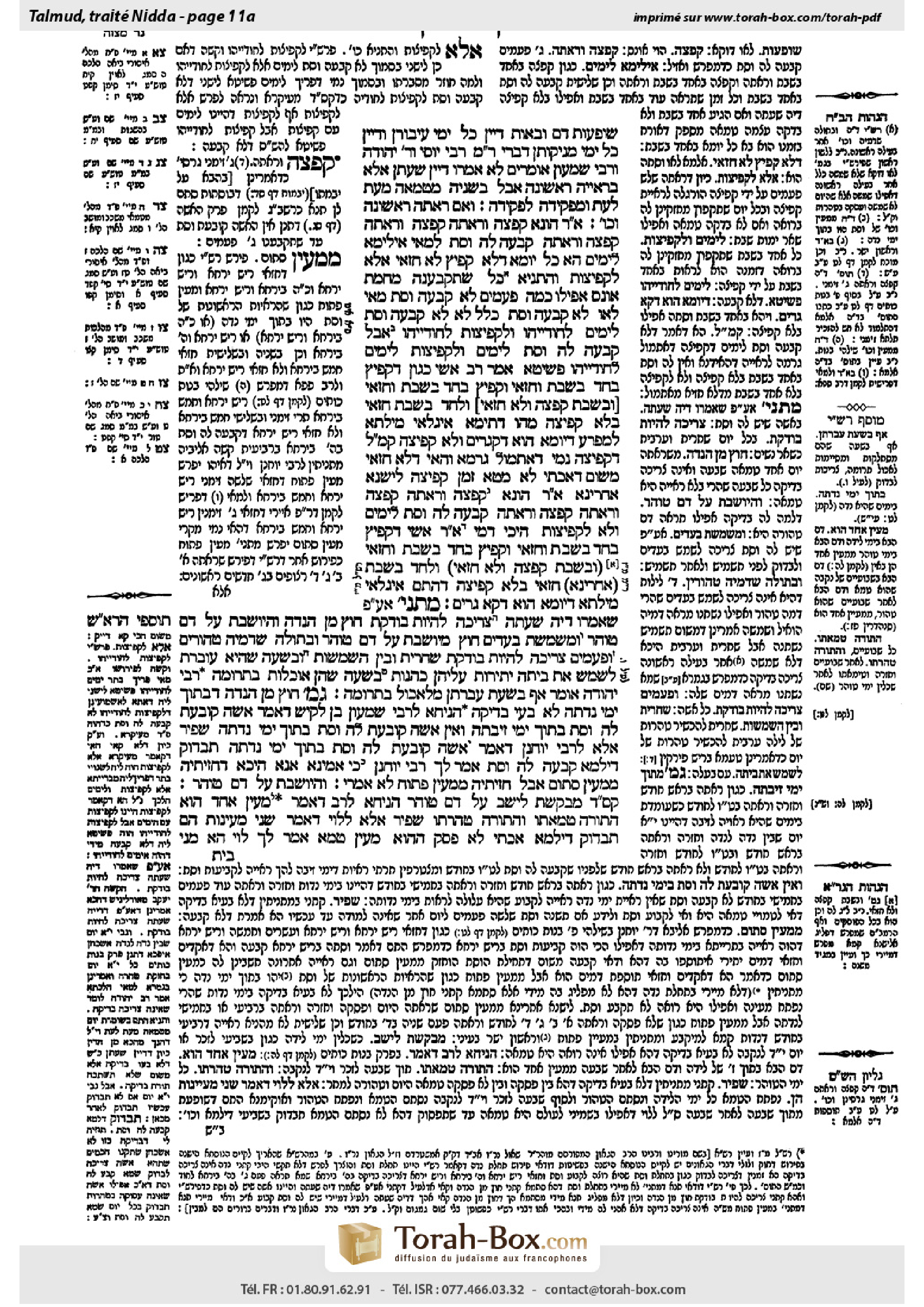
This page of Niddah includes the Aramaic text, an English translation and an AI-generated French translation, alongside the scan above.
נידה י״א א · Aramaic and Hebrew text
שׁוֹפְעוֹת דָּם וּבָאוֹת — דַּיָּין כׇּל יְמֵי עִיבּוּרָן וְדַיָּין כׇּל יְמֵי מְנִיקוּתָן, דִּבְרֵי רַבִּי מֵאִיר. רַבִּי יוֹסֵי וְרַבִּי יְהוּדָה וְרַבִּי שִׁמְעוֹן אוֹמְרִים: לֹא אָמְרוּ דַּיָּין שְׁעָתָן אֶלָּא בִּרְאִיָּיה רִאשׁוֹנָה, אֲבָל בַּשְּׁנִיָּה מְטַמְּאָה מֵעֵת לְעֵת וּמִפְּקִידָה לִפְקִידָה.
וְאִם רָאֲתָה רִאשׁוֹנָה וְכוּ׳. אָמַר רַב הוּנָא: קָפְצָה וְרָאֲתָה, קָפְצָה וְרָאֲתָה, קָפְצָה וְרָאֲתָה — קָבְעָה לָהּ וֶסֶת. לְמַאי? אִילֵימָא לְיָמִים, הָא כֹּל יוֹמָא דְּלָא קְפִיץ לָא חֲזַאי!
אֶלָּא לִקְפִיצוֹת, וְהָתַנְיָא: כֹּל שֶׁתִּקְבָּעֶנָּה מֵחֲמַת אוֹנֶס, אֲפִילּוּ כַּמָּה פְּעָמִים — לֹא קָבְעָה וֶסֶת! מַאי לַָאו — לֹא קָבְעָה וֶסֶת כְּלָל?
לָא, לֹא קָבְעָה וֶסֶת לְיָמִים לְחוֹדַיְיהוּ וְלִקְפִיצוֹת לְחוֹדַיְיהוּ, אֲבָל קָבְעָה לָהּ וֶסֶת לְיָמִים וְלִקְפִיצוֹת. לְיָמִים לְחוֹדַיְיהוּ פְּשִׁיטָא! אָמַר רַב אָשֵׁי: כְּגוֹן דִּקְפִיץ בְּחַד בְּשַׁבָּת וַחֲזַאי, וּקְפִיץ בְּחַד בְּשַׁבָּת וַחֲזַאי, וּבְשַׁבָּת קְפַצָה וְלָא חֲזַאי, וּלְחַד בְּשַׁבָּת חֲזַאי בְּלָא קְפִיצָה.
מַהוּ דְּתֵימָא: אִיגַּלַּאי מִילְּתָא לְמַפְרֵעַ, דְּיוֹמָא הוּא דְּקָגָרֵים וְלָא קְפִיצָה, קָא מַשְׁמַע לַן דִּקְפִיצָה נָמֵי דְּאֶתְמוֹל גְּרַמָא, וְהַאי דְּלָא חֲזַאי — מִשּׁוּם דְּאַכַּתִּי לָא מְטָא זְמַן קְפִיצָה.
לִישָּׁנָא אַחֲרִינָא, אָמַר רַב הוּנָא: קָפְצָה וְרָאֲתָה, קָפְצָה וְרָאֲתָה, קָפְצָה וְרָאֲתָה — קָבְעָה לָהּ וֶסֶת לְיָמִים וְלֹא לִקְפִיצוֹת. הֵיכִי דָּמֵי? אָמַר רַב אָשֵׁי: דִּקְפִיץ בְּחַד בְּשַׁבָּת וַחֲזַאי, וּקְפִיץ בְּחַד בְּשַׁבָּת וַחֲזַאי, וּבְשַׁבָּת קְפַצָה וְלָא חֲזַאי, וּלְחַד בְּשַׁבָּת (אַחֲרִינָא) חֲזַאי בְּלָא קְפִיצָה, דְּהָתָם אִיגַּלַּאי מִילְּתָא דְּיוֹמָא הוּא דְּקָא גָרֵים.
מַתְנִי' אַף עַל פִּי שֶׁאָמְרוּ דַּיָּהּ שְׁעָתָהּ, צְרִיכָה לִהְיוֹת בּוֹדֶקֶת, חוּץ מִן הַנִּדָּה וְהַיּוֹשֶׁבֶת עַל דַּם טוֹהַר.
וּמְשַׁמֶּשֶׁת בְּעֵדִים, חוּץ מִיּוֹשֶׁבֶת עַל דַּם טוֹהַר, וּבְתוּלָה שֶׁדָּמֶיהָ טְהוֹרִים.
וּפְעָמִים צְרִיכָה לִהְיוֹת בּוֹדֶקֶת: שַׁחֲרִית, וּבֵין הַשְּׁמָשׁוֹת, וּבְשָׁעָה שֶׁהִיא עוֹבֶרֶת לְשַׁמֵּשׁ אֶת בֵּיתָהּ. יְתֵירוֹת עֲלֵיהֶן כֹּהֲנוֹת, בְּשָׁעָה שֶׁהֵן אוֹכְלוֹת בִּתְרוּמָה. רַבִּי יְהוּדָה אוֹמֵר: אַף בִּשְׁעַת עֲבָרָתָן מִלֶּאֱכוֹל בִּתְרוּמָה.
גְּמָ' חוּץ מִן הַנִּדָּה. דִּבְתוֹךְ יְמֵי נִדָּתָהּ לָא בָּעֵי בְּדִיקָה.
הָנִיחָא לְרַבִּי שִׁמְעוֹן בֶּן לָקִישׁ, דְּאָמַר: אִשָּׁה קוֹבַעַת לָהּ וֶסֶת בְּתוֹךְ יְמֵי זִיבָתָהּ, וְאֵין אִשָּׁה קוֹבַעַת לָהּ וֶסֶת בְּתוֹךְ יְמֵי נִדָּתָהּ — שַׁפִּיר. אֶלָּא לְרַבִּי יוֹחָנָן, דְּאָמַר: אִשָּׁה קוֹבַעַת לָהּ וֶסֶת בְּתוֹךְ יְמֵי נִדָּתָהּ — תִּבְדּוֹק, דִּילְמָא קָבְעָה לַהּ וֶסֶת!
אָמַר לָךְ רַבִּי יוֹחָנָן: כִּי אָמֵינָא אֲנָא — הֵיכָא דַּחֲזֵיתֵיהּ מִמַּעְיָן סָתוּם, אֲבָל חֲזֵיתֵיהּ מִמַּעְיָן פָּתוּחַ — לָא אֲמַרִי.
וְהַיּוֹשֶׁבֶת עַל דַּם טוֹהַר, קָא סָלְקָא דַעְתָּךְ — מְבַקֶּשֶׁת לֵישֵׁב עַל דַּם טוֹהַר.
הָנִיחָא לְרַב, דְּאָמַר: מַעְיָן אֶחָד הוּא, הַתּוֹרָה טִמְּאַתּוּ וְהַתּוֹרָה טִהֲרַתּוּ — שַׁפִּיר.
אֶלָּא לְלֵוִי דְּאָמַר: שְׁנֵי מַעְיָנוֹת הֵם, תִּבְדּוֹק, דִּילְמָא אַכַּתִּי לָא פְּסַק הָהוּא מַעְיָן טָמֵא! אָמַר לָךְ לֵוִי: הָא מַנִּי?
Niddah 11a · English translation
continuously discharging menstrual blood, their time is sufficient for all their days of pregnancy and their time is sufficient for all their days of nursing. This is the statement of Rabbi Meir. Rabbi Yosei and Rabbi Yehuda and Rabbi Shimon all say: They said that her time is sufficient only with regard to the first sighting of blood, but with regard to the second sighting, her status is like that of any other woman, and she transmits impurity for a twenty-four-hour period or from examination to examination.
§ The mishna teaches: And if she saw the first sighting as a result of unnatural circumstances, then even with regard to the second sighting her time is sufficient. Rav Huna says: If she jumped and saw menstrual blood, and again she jumped and saw menstrual blood, and a third time she jumped and saw menstrual blood, she has established a fixed menstrual cycle. The Gemara asks: For what occurrence has she established a fixed cycle? If we say that it is a cycle of days alone, this cannot be correct, as every day that she did not jump, she also did not see menstrual blood. Therefore, her cycle cannot be a mere pattern of days.
The Gemara explains: Rather, the established menstrual cycle is caused by jumps, i.e., by observing a pattern of jumping and seeing blood three times, she has established that jumping causes the onset of her menstrual period. The Gemara raises a difficulty: But isn’t it taught in a baraita: Any woman who establishes a pattern of seeing menstrual blood due to a recurring accident, even if the pattern repeats, still has not established a fixed menstrual cycle? An accidental menstrual pattern brought about by external causes does not create a menstrual cycle. The Gemara explains the difficulty: What, is it not correct to say that the baraita means that she has not established a fixed menstrual cycle at all?
The Gemara answers: No, the baraita means that she has not established a fixed menstrual cycle of days alone, nor of jumps alone, but she has established a fixed menstrual cycle for a combination of days and of jumps. In other words, she has established a fixed menstrual cycle when she jumps on specific days. The Gemara asks: Isn’t it obvious that she does not establish a cycle for days alone? Why is it necessary to state this? Rav Ashi says: It is necessary to teach this in a case where she jumped on Sunday and saw menstrual blood, and again she jumped on Sunday and saw menstrual blood, and then on the following Shabbat she jumped and did not see blood, but on Sunday, the next day, she saw menstrual blood without jumping.
Rav Ashi explains: Lest you say that the matter is revealed retroactively that it was the day that caused her to experience menstruation and not the jumping, and therefore she has established a menstrual cycle of menstruating on Sundays, regardless of jumping, the baraita teaches us that it was also the jumping of yesterday, on Shabbat, that caused the menstruation today, on Sunday. And as for the fact that she did not see menstrual blood then, that was because the time when jumping causes menstruation had not yet arrived.
The Gemara presents another version of Rav Huna’s statement. Rav Huna says: If a woman jumped and saw menstrual blood, and again she jumped and saw menstrual blood, and a third time she jumped and saw menstrual blood, she has established a fixed menstrual cycle for a pattern of days and not for a pattern of jumps. The Gemara asks: What are the circumstances? Rav Ashi says: This is referring to a case where she jumped on Sunday and saw menstrual blood, and then again she jumped on Sunday and saw menstrual blood, and then on the following Shabbat she jumped and did not see blood, but on Sunday, the next day, she saw menstrual blood without jumping. In that case there, the matter is revealed retroactively that it is the day that causes her to menstruate, not the jumping.
MISHNA: Although the Rabbis said that for a woman with a fixed menstrual cycle her time is sufficient and she does not transmit impurity retroactively, she is required to examine herself each day to ensure that she is ritually pure and will not impurify pure items that she is handling. All women must examine themselves each day except for a menstruating woman, whose impure status is known, and a woman after childbirth who is observing the period of the blood of purity, whose ritually pure status is known even if she experiences bleeding.
And even a woman with a fixed menstrual cycle engages in intercourse while using examination cloths to ascertain whether her menstrual flow began, except for a woman after childbirth who is observing the period of the blood of purity, and a virgin whose blood is ritually pure for four days after engaging in intercourse for the first time.
And she is required to examine herself twice each day: In the morning, to ascertain if she menstruated during the night, and at twilight, to ascertain if she menstruated during the day. And she is also required to examine herself at a time that she is about to engage in intercourse with her husband. The obligation of women of priestly families is greater than that of other women, as they are also required to examine themselves when they seek to partake of teruma. Rabbi Yehuda says: Even when they conclude partaking of teruma they are required to examine themselves, in order to ascertain whether they experienced bleeding while partaking of teruma.
GEMARA: The mishna teaches: All women must examine themselves each day, except for a menstruating woman. The Gemara explains: Such a woman does not need to examine herself, as during the days of her menstruation she does not need examination.
The Gemara raises a difficulty: This works out well according to the opinion of Rabbi Shimon ben Lakish, who said that a woman can establish a fixed menstrual cycle even during the days that she has zava status, but a woman does not establish a fixed menstrual cycle during the days of her impurity due to menstruation, as any bleeding during these seven days is merely a continuation of her original menstruation. According to this opinion, it is well, and one can understand the mishna. But according to the opinion of Rabbi Yoḥanan, who said that a woman can establish a fixed menstrual cycle during the days of her menstruation, let her examine herself, as perhaps she will establish a fixed menstrual cycle.
The Gemara explains that Rabbi Yoḥanan could say to you: When I say that a woman can establish a fixed menstrual cycle during the days of her menstruation, that applies only in a case where the first two instances of her fixed cycle were established when she first saw blood from a stopped source, i.e., she saw blood on those particulars days at the outset of her period. But when she first saw blood from an open source, i.e., when the first two instances that she experienced bleeding on those particular days was in the middle of her menstrual period, I did not say that she establishes a fixed menstrual cycle, and therefore there is no need for her to examine herself.
§ The mishna teaches: All women must examine themselves each day, except for a menstruating woman, whose impure status is known, and a woman after childbirth who is observing the period of the blood of purity. The Gemara explains: It may enter your mind that when the mishna mentions a woman who is observing the period of the blood of purity, it is referring to one who is finishing the period of impurity following a birth and is anticipating observing the period of the blood of purity. In other words, her days of impurity are ending and she is about to start her days `of purity, and the mishna is stating that there is no need for an examination to conclude her days of impurity before starting her days of purity.
The Gemara analyzes the mishna in accordance with this interpretation. This works out well according to the opinion of Rav, who said that blood after birth and blood of purity both come from one source, and the Torah deemed blood after birth impure, and the Torah deemed blood of purity pure. According to this opinion, it is well, and one can understand the mishna, since even if she emits blood continuously through the end of her days of impurity into her days of purity, the blood during her days of purity is pure.
But according to the opinion of Levi, who said that there are two distinct sources, one for blood after birth and one for blood of purity, she should be required to examine herself at the end of the period following birth, as perhaps that impure source of blood after birth had not yet stopped flowing. The Gemara explains that Levi could say to you: In accordance with whose opinion is this ruling?
Niddah 11a · Traduction française (IA)
qui perdent continuellement du sang menstruel : leur délai suffit pendant toute la durée de leur grossesse et pendant toute la durée de leur allaitement. Telle est l’opinion de Rabbi Meïr. Rabbi Yosei, Rabbi Yehouda et Rabbi Shimon disent tous : Ils ont dit que son délai suffit uniquement pour la première apparition de sang ; mais, lors de la deuxième apparition, son statut est celui de toute autre femme, et elle transmet l’impureté rétroactivement pendant vingt-quatre heures ou depuis le dernier examen.
§ La Michna enseigne : Si elle a vu du sang pour la première fois à la suite de circonstances inhabituelles, son délai suffit même pour la deuxième apparition. Rav Houna dit : Si elle a sauté et a vu du sang menstruel, puis a de nouveau sauté et a vu du sang menstruel, et qu’une troisième fois elle a sauté et a vu du sang menstruel, elle a établi un cycle menstruel fixe. La Guemara demande : Pour quel phénomène a-t-elle établi un cycle fixe ? Si l’on dit qu’il s’agit d’un cycle fondé uniquement sur les jours, cela ne peut être exact, car chaque jour où elle n’a pas sauté, elle n’a pas non plus vu de sang menstruel. Son cycle ne peut donc pas être un simple rythme de jours.
La Guemara explique : Il s’agit plutôt d’un cycle menstruel fixe causé par les sauts ; autrement dit, en observant trois fois le schéma suivant — sauter et voir du sang —, elle a établi que le saut provoque le début de ses règles. La Guemara soulève une difficulté : Mais n’est-il pas enseigné dans une baraïta : Toute femme qui établit un schéma de pertes de sang menstruel dû à un accident récurrent, même si ce schéma se répète, n’a toujours pas établi de cycle menstruel fixe ? Un schéma menstruel accidentel provoqué par des causes extérieures ne crée pas de cycle menstruel. La Guemara précise la difficulté : N’est-il pas juste de dire que la baraïta signifie qu’elle n’a pas établi de cycle menstruel fixe du tout ?
La Guemara répond : Non, la baraïta signifie qu’elle n’a établi ni cycle menstruel fixe fondé uniquement sur les jours, ni cycle fondé uniquement sur les sauts ; elle a toutefois établi un cycle menstruel fixe associant jours et sauts. Autrement dit, elle a établi un cycle menstruel fixe lorsqu’elle saute certains jours précis. La Guemara demande : N’est-il pas évident qu’elle n’établit pas de cycle fondé uniquement sur les jours ? Pourquoi est-il nécessaire de le préciser ? Rav Ashi dit : Il est nécessaire de l’enseigner dans le cas où elle a sauté un dimanche et a vu du sang menstruel, puis a de nouveau sauté un dimanche et a vu du sang menstruel ; ensuite, le Chabbat suivant, elle a sauté sans voir de sang, mais le dimanche, le lendemain, elle a vu du sang menstruel sans sauter.
Rav Ashi explique : De peur que tu ne dises que l’on découvre rétroactivement que c’est le jour qui a provoqué ses règles, et non le saut, et qu’elle a donc établi un cycle menstruel consistant à avoir ses règles le dimanche, qu’elle saute ou non, la baraïta nous enseigne que c’est aussi le saut effectué la veille, le Chabbat, qui a provoqué les règles le lendemain, le dimanche. Quant au fait qu’elle n’ait pas vu de sang menstruel à ce moment-là, c’est parce que le moment où le saut provoque les règles n’était pas encore arrivé.
La Guemara présente une autre version de la déclaration de Rav Houna. Rav Houna dit : Si une femme a sauté et a vu du sang menstruel, puis a de nouveau sauté et a vu du sang menstruel, et qu’une troisième fois elle a sauté et a vu du sang menstruel, elle a établi un cycle menstruel fixe fondé sur un rythme de jours, et non sur un schéma de sauts. La Guemara demande : Dans quelles circonstances ? Rav Ashi dit : Il s’agit du cas où elle a sauté un dimanche et a vu du sang menstruel, puis a de nouveau sauté un dimanche et a vu du sang menstruel ; ensuite, le Chabbat suivant, elle a sauté sans voir de sang, mais le dimanche, le lendemain, elle a vu du sang menstruel sans sauter. Dans ce cas, on découvre rétroactivement que c’est le jour qui provoque ses règles, et non le saut.
MICHNA : Bien que les Sages aient dit que, pour une femme ayant un cycle menstruel fixe, son délai suffit et qu’elle ne transmet pas l’impureté rétroactivement, elle doit s’examiner chaque jour afin de s’assurer qu’elle est rituellement pure et qu’elle ne rendra pas impurs les objets purs qu’elle manipule. Toutes les femmes doivent s’examiner chaque jour, à l’exception d’une femme qui a ses règles, dont le statut d’impureté est connu, et d’une femme après l’accouchement qui observe la période du sang de pureté, dont le statut de pureté rituelle est connu même si elle saigne.
Même une femme ayant un cycle menstruel fixe doit avoir des rapports sexuels en utilisant des linges d’examen afin de vérifier si ses pertes menstruelles ont commencé. Font exception une femme après l’accouchement qui observe la période du sang de pureté, ainsi qu’une vierge dont le sang est rituellement pur pendant quatre jours après son premier rapport sexuel.
Elle doit s’examiner deux fois par jour : le matin, afin de vérifier si elle a eu ses règles pendant la nuit, et au crépuscule, afin de vérifier si elle a eu ses règles pendant la journée. Elle doit aussi s’examiner au moment où elle s’apprête à avoir des rapports sexuels avec son mari. Les femmes issues de familles sacerdotales ont une obligation plus grande que les autres femmes, car elles doivent également s’examiner lorsqu’elles s’apprêtent à consommer de la terouma. Rabbi Yehouda dit : Même après avoir fini de consommer de la terouma, elles doivent s’examiner, afin de vérifier si elles ont saigné pendant qu’elles en consommaient.
GUEMARA : La Michna enseigne : Toutes les femmes doivent s’examiner chaque jour, à l’exception d’une femme qui a ses règles. La Guemara explique : Une telle femme n’a pas besoin de s’examiner, car aucun examen n’est nécessaire pendant les jours de ses règles.
La Guemara soulève une difficulté : Cela convient selon l’opinion de Rabbi Shimon ben Lakish, qui a dit qu’une femme peut établir un cycle menstruel fixe même pendant les jours où elle a le statut de zavah, mais qu’elle ne peut pas en établir un pendant les jours d’impureté dus à ses règles, car tout saignement durant ces sept jours n’est que la continuation de ses règles initiales. Selon cette opinion, on comprend bien la Michna. Mais selon l’opinion de Rabbi Yoḥanan, qui a dit qu’une femme peut établir un cycle menstruel fixe pendant les jours de ses règles, qu’elle s’examine donc, car il se peut qu’elle établisse un cycle menstruel fixe.
La Guemara explique que Rabbi Yoḥanan pourrait te répondre : Lorsque je dis qu’une femme peut établir un cycle menstruel fixe pendant les jours de ses règles, cela ne s’applique que dans le cas où les deux premières occurrences de son cycle fixe ont été établies lorsqu’elle a vu du sang provenant d’une source fermée, c’est-à-dire lorsqu’elle a vu du sang ces jours précis, au début de ses règles. Mais lorsqu’elle a d’abord vu du sang provenant d’une source ouverte, c’est-à-dire lorsque les deux premières fois où elle a saigné ces jours précis se sont produites au milieu de ses règles, je n’ai pas dit qu’elle établissait un cycle menstruel fixe ; elle n’a donc pas besoin de s’examiner.
§ La Michna enseigne : Toutes les femmes doivent s’examiner chaque jour, à l’exception d’une femme qui a ses règles, dont le statut d’impureté est connu, et d’une femme après l’accouchement qui observe la période du sang de pureté. La Guemara explique : On pourrait penser que, lorsque la Michna mentionne une femme qui observe la période du sang de pureté, elle désigne celle qui achève la période d’impureté suivant l’accouchement et s’apprête à entrer dans la période du sang de pureté. Autrement dit, ses jours d’impureté s’achèvent et elle est sur le point d’entamer ses jours de pureté ; la Michna enseigne qu’il n’est pas nécessaire de procéder à un examen pour conclure ses jours d’impureté avant de commencer ses jours de pureté.
La Guemara analyse la Michna selon cette interprétation. Cela convient selon l’opinion de Rav, qui a dit que le sang après l’accouchement et le sang de pureté proviennent d’une seule source, et que la Torah a déclaré impur le sang après l’accouchement et pur le sang de pureté. Selon cette opinion, on comprend bien la Michna, car même si elle émet du sang sans interruption jusqu’à la fin de ses jours d’impureté et pendant ses jours de pureté, le sang émis pendant ses jours de pureté est pur.
Mais selon l’opinion de Levi, qui a dit qu’il existe deux sources distinctes, l’une pour le sang après l’accouchement et l’autre pour le sang de pureté, elle devrait être tenue de s’examiner à la fin de la période suivant l’accouchement, car il se peut que la source impure du sang après l’accouchement ne se soit pas encore arrêtée de couler. La Guemara explique que Levi pourrait te répondre : De l’avis de qui est cette décision ?
Traduction française générée par IA à partir de l’édition anglaise de Sefaria. Vérifie toujours un passage avec le texte source.
Text from Sefaria: William Davidson Edition - Vocalized Aramaic (CC BY NC); William Davidson Edition - English (CC BY NC).