Niddah 10b: Talmud study for Daf Yomi
Daf Yomi is the daily study of one Talmud folio. Explore 37 tractates with scans, Hebrew text, Sefaria English and AI-generated French translations where annotated.
Passage selection and English or AI-generated French translation are available where the scan has annotations. Daf Study is independent of Torah-Box and Sefaria.
Browse Niddah · נידה · All tractatesNiddah 10b text and translations
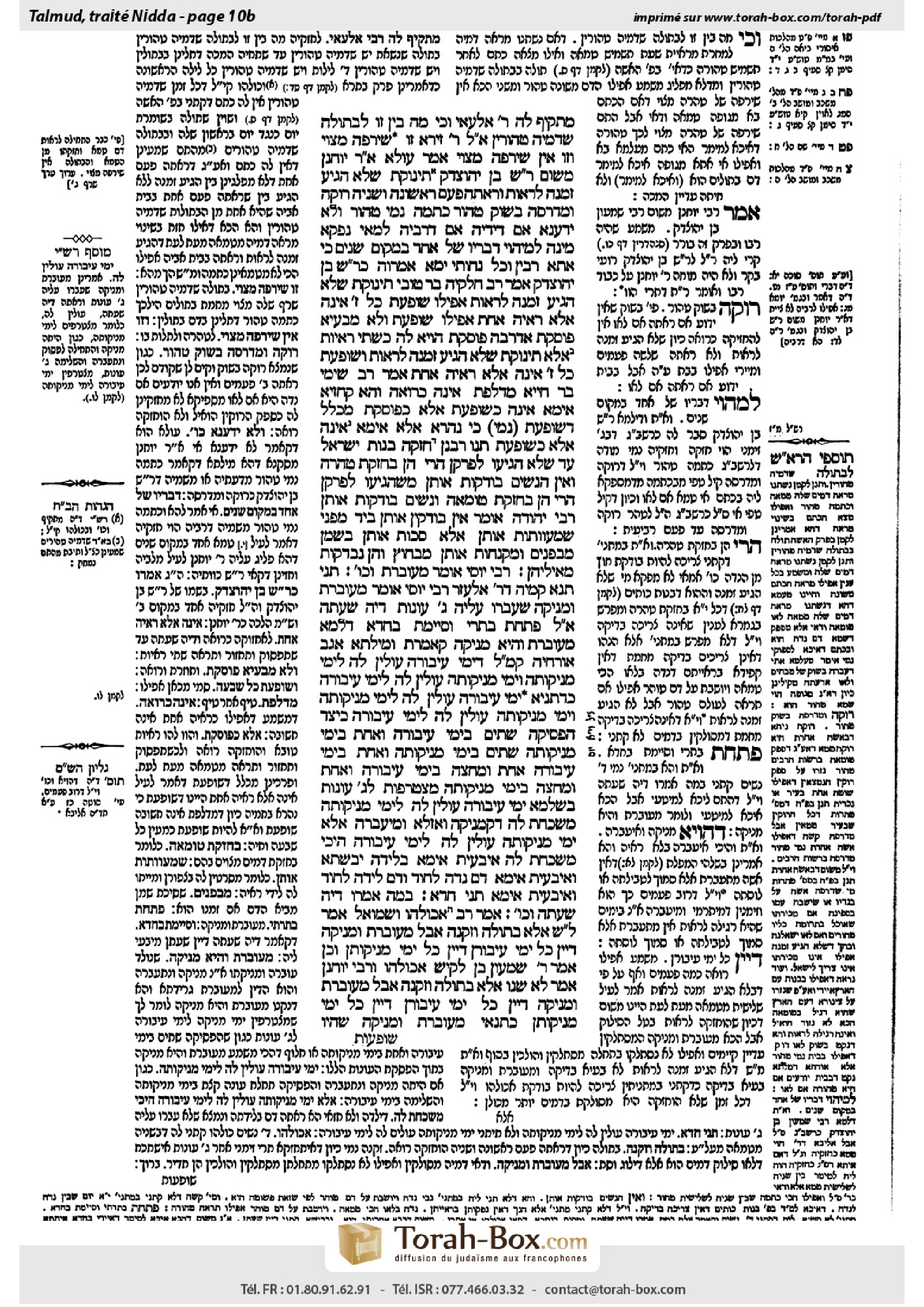
This page of Niddah includes the Aramaic text, an English translation and an AI-generated French translation, alongside the scan above.
נידה י׳ ב · Aramaic and Hebrew text
מַתְקֵיף לַהּ רַבִּי אִלְעַאי: וְכִי מָה בֵּין זוֹ לִבְתוּלָה שֶׁדָּמֶיהָ טְהוֹרִין? אֲמַר לֵיהּ רַבִּי זֵירָא: זוֹ שִׂירְפָהּ מָצוּי וְזוֹ אֵין שִׂירְפָהּ מָצוּי.
אָמַר עוּלָּא, אָמַר רַבִּי יוֹחָנָן מִשּׁוּם רַבִּי שִׁמְעוֹן בֶּן יְהוֹצָדָק: תִּינוֹקֶת שֶׁלֹּא הִגִּיעַ זְמַנָּהּ לִרְאוֹת, וְרָאֲתָה פַּעַם רִאשׁוֹנָה וּשְׁנִיָּה — רוּקָּהּ וּמִדְרָסָהּ בַּשּׁוּק טָהוֹר, כִּתְמָהּ נָמֵי טָהוֹר. וְלָא יָדַעְנָא אִם דִּידֵיהּ, אִם דְּרַבֵּיהּ.
לְמַאי נָפְקָא מִינָּה? לְמִיהְוֵי דְּבָרָיו שֶׁל אֶחָד בִּמְקוֹם שְׁנַיִם.
כִּי אֲתָא רָבִין וְכֹל נָחוֹתֵי יַמָּא, אַמְרוּהָ כְּרַבִּי שִׁמְעוֹן בֶּן יְהוֹצָדָק.
אֲמַר רַב חִלְקִיָּה בַּר טוֹבֵי: תִּינוֹקֶת שֶׁלֹּא הִגִּיעַ זְמַנָּהּ לִרְאוֹת, אֲפִילּוּ שׁוֹפַעַת כׇּל שִׁבְעָה — אֵינָהּ אֶלָּא רְאָיָה אַחַת. אֲפִילּוּ שׁוֹפַעַת, וְלָא מִבַּעְיָא פּוֹסֶקֶת? אַדְּרַבָּה, פּוֹסֶקֶת הָוְיָא לַהּ כִּשְׁתֵּי רְאִיּוֹת!
אֶלָּא, תִּינוֹקֶת שֶׁלֹּא הִגִּיעַ זְמַנָּהּ לִרְאוֹת, וְשׁוֹפַעַת כׇּל שִׁבְעָה — אֵינָהּ אֶלָּא רְאָיָה אַחַת.
אָמַר רַב שִׁימִי בַּר חִיָּיא: מַדְלֶפֶת אֵינָהּ כְּרוֹאָה, וְהָא קָחָזְיָא! אֵימָא: אֵינָהּ כְּשׁוֹפַעַת, אֶלָּא כְּפוֹסֶקֶת.
מִכְּלָל דְּשׁוֹפַעַת (נָמֵי) כִּי נַהֲרָא? אֶלָּא אֵימָא: אֵינָהּ אֶלָּא כְּשׁוֹפַעַת.
תָּנוּ רַבָּנַן: חֲזָקָה בְּנוֹת יִשְׂרָאֵל עַד שֶׁלֹּא הִגִּיעוּ לְפִרְקָן — הֲרֵי הֵן בְּחֶזְקַת טׇהֳרָה, וְאֵין הַנָּשִׁים בּוֹדְקוֹת אוֹתָן. מִשֶּׁהִגִּיעוּ לְפִרְקָן — הֲרֵי הֵן בְּחֶזְקַת טוּמְאָה, וְנָשִׁים בּוֹדְקוֹת אוֹתָן.
רַבִּי יְהוּדָה אוֹמֵר: אֵין בּוֹדְקִין אוֹתָן בַּיָּד, מִפְּנֵי שֶׁמְּעַוְּותוֹת אוֹתָן, אֶלָּא סָכוֹת אוֹתָן בְּשֶׁמֶן מִבִּפְנִים, וּמְקַנְּחוֹת אוֹתָן מִבַּחוּץ, וְהֵן נִבְדָּקוֹת מֵאֵילֵיהֶן.
רַבִּי יוֹסֵי אוֹמֵר: מְעוּבֶּרֶת וְכוּ׳. תָּנֵי תַּנָּא קַמֵּיהּ דְּרַבִּי אֶלְעָזָר: רַבִּי יוֹסֵי אוֹמֵר: מְעוּבֶּרֶת וּמְנִיקָה שֶׁעָבְרוּ עָלֶיהָ שָׁלֹשׁ עוֹנוֹת דַּיָּהּ שְׁעָתָהּ. אֲמַר לֵיהּ: פְּתַחְתְּ בִּ״תְרֵי״ וְסַיֵּימְתְּ בַּ״חֲדָא״!
דִּלְמָא מְעוּבֶּרֶת וְהִיא מְנִיקָה קָאָמְרַתְּ, וּמִילְּתָא אַגַּב אוֹרְחֵיהּ קָא מַשְׁמַע לַן — דִּימֵי עִיבּוּרָהּ עוֹלִין לָהּ לִימֵי מְנִיקוּתָהּ, וִימֵי מְנִיקוּתָהּ עוֹלִין לָהּ לִימֵי עִיבּוּרָהּ. כִּדְתַנְיָא: יְמֵי עִיבּוּרָהּ עוֹלִין לָהּ לִימֵי מְנִיקוּתָהּ, וִימֵי מְנִיקוּתָהּ עוֹלִין לָהּ לִימֵי עִיבּוּרָהּ.
כֵּיצַד? הִפְסִיקָה שְׁתַּיִם בִּימֵי עִיבּוּרָהּ, וְאַחַת בִּימֵי מְנִיקוּתָהּ; שְׁתַּיִם בִּימֵי מְנִיקוּתָהּ, וְאַחַת בִּימֵי עִיבּוּרָהּ; אַחַת וּמֶחֱצָה בִּימֵי עִיבּוּרָהּ, וְאַחַת וּמֶחֱצָה בִּימֵי מְנִיקוּתָהּ — מִצְטָרְפוֹת לְשָׁלֹשׁ עוֹנוֹת.
בִּשְׁלָמָא יְמֵי עִיבּוּרָהּ עוֹלִין לָהּ לִימֵי מְנִיקוּתָהּ, מַשְׁכַּחַתְּ לַהּ דְּקָמְנִיקָה וְאָזְלָא וּמִיעַבְּרָה, אֶלָּא יְמֵי מְנִיקוּתָהּ עוֹלִין לָהּ לִימֵי עִיבּוּרָהּ, הֵיכִי מַשְׁכַּחַתְּ לַהּ?
אִיבָּעֵית אֵימָא: בְּלֵידָה יַבִּשְׁתָּא, וְאִיבָּעֵית אֵימָא: דַּם נִדָּה לְחוֹד וְדַם לֵידָה לְחוֹד, וְאִיבָּעֵית אֵימָא: תְּנִי חֲדָא.
בַּמֶּה אָמְרוּ דַּיָּהּ שְׁעָתָהּ וְכוּ׳. אָמַר רַב: אַכּוּלְּהוּ.
וּשְׁמוּאֵל אָמַר: לֹא שָׁנוּ אֶלָּא בְּתוּלָה וּזְקֵנָה, אֲבָל מְעוּבֶּרֶת וּמְנִיקָה — דַּיָּין כׇּל יְמֵי עִיבּוּרָן, דַּיָּין כׇּל יְמֵי מְנִיקוּתָן.
וְכֵן אָמַר רַבִּי שִׁמְעוֹן בֶּן לָקִישׁ: אַכּוּלְּהוּ, וְרַבִּי יוֹחָנָן אָמַר: לֹא שָׁנוּ אֶלָּא בְּתוּלָה וּזְקֵנָה, אֲבָל מְעוּבֶּרֶת וּמְנִיקָה — דַּיָּין כׇּל יְמֵי עִיבּוּרָן, דַּיָּין כׇּל יְמֵי מְנִיקוּתָן. כְּתַנָּאֵי: מְעוּבֶּרֶת וּמְנִיקָה שֶׁהָיוּ
Niddah 10b · English translation
Rabbi Ilai objects to this ruling of Ḥizkiyya: And what is the difference between this case of a girl who has not yet started menstruating and a recently married menstrual virgin whose stain is deemed pure for as long as her blood is pure, since the stain is presumed to be from her torn hymen? Rabbi Zeira said to him: With regard to this menstrual virgin, her secretion [sirfah] is common, i.e., blood from her torn hymen is normally found during this period. Therefore, any blood stain that is found is also assumed to be from her hymen. But in the case of this young girl, her secretion is not common. Therefore, if a blood stain is found, it is assumed to be menstrual blood.
§ Ulla says that Rabbi Yoḥanan says in the name of Rabbi Shimon ben Yehotzadak: With regard to a young girl whose time to see the flow of menstrual blood has not arrived and she saw menstrual blood one time and then a second time, but not the third time that would render her a woman who regularly sees menstrual blood, her saliva and her garment that she treads upon that are found in the marketplace are pure if we do not know whether she has menstruated. Likewise, her blood stain is also pure. Ulla added: And I do not know if this ruling with regard to the stain is merely Rabbi Yoḥanan’s own conclusion or if that is also part of the opinion of his teacher.
The Gemara asks: What difference is there? That is, what does it matter who said it? The Gemara explains: It makes a difference for it to be considered the statement of one Sage in the place of two dissenting opinions. As stated above, Ḥizkiyya disagrees with this ruling and maintains that a young girl’s blood stain is impure after she sees menstrual blood twice. If this statement is both Rabbi Shimon ben Yehotzadak’s opinion and that of Rabbi Yoḥanan, then Ḥizkiyya’s ruling is opposed by two Sages, which means that his is a minority opinion. If it is Rabbi Yoḥanan’s opinion alone, then the two sides are equal, with one Sage maintaining each opinion.
When Ravin came from Eretz Yisrael to Babylonia along with all the seafarers [naḥotei yamma], they stated this ruling as the statement of Rabbi Shimon ben Yehotzadak. If so, Rabbi Yoḥanan was relating his own opinion, which echoed that of his teacher, Rabbi Shimon ben Yehotzadak, and therefore the halakha is in accordance with this majority opinion.
§ Rav Ḥilkiya bar Tovi says: With regard to a young girl whose time to see menstrual blood has not arrived, even if she continuously discharges menstrual blood for all seven days of a typical menstrual period, it is considered as only one sighting of blood and she remains in the category of one who lacks blood until she sees menstrual blood twice more. The Gemara asks: Why did Rav Ḥilkiya bar Tovi stress: Even if she continuously discharges menstrual blood, which indicates that it is not necessary to teach that this is the halakha if she stops seeing a discharge and then starts again? On the contrary, if she stops and restarts it is as though she has had two sightings of menstrual blood.
The Gemara answers: Rather, this is what Rav Ḥilkiya bar Tovi meant: With regard to a young girl whose time to see menstrual blood has not arrived, and she then continuously discharges menstrual blood for all seven days of a typical menstrual period, it is considered as only one sighting of blood. In other words, he did not state the word: Even.
Rav Shimi bar Ḥiyya says: The case of woman who constantly drips menstrual blood is not considered like a full sighting of blood. The Gemara expresses surprise at this claim: But she saw blood. The Gemara answers: Say that what Rav Shimi bar Ḥiyya meant was that she is not considered like one who continuously discharges blood, but rather like one who stops and starts again, even if she drips constantly.
The Gemara raises a difficulty: From the fact that Rav Shimi bar Ḥiyya claims that a different halakha applies to a woman who constantly drips menstrual blood, it can be inferred that the blood of one who continuously discharges menstrual blood streams like a river for seven days. But this is physically impossible. The Gemara explains: Rather, say that Rav Shimi bar Ḥiyya meant that the status of a woman who constantly drips menstrual blood is nothing other than the status of a woman who continuously discharges blood. In both cases, it is all considered as one sighting.
§ The Sages taught in a baraita: The presumption with regard to the daughters of Israel is that until they have reached their physical maturity they have the presumptive status of ritual purity, and adult women do not need to examine them to check if they are ritually pure before they handle consecrated items or teruma. Once they have reached their physical maturity, they have the presumptive status of ritual impurity, due to the possibility of an unnoticed menstrual discharge, and if they are still minors, adult women must examine them to check if they are ritually pure.
Rabbi Yehuda says: They should not examine them by hand, because that is likely to scratch them and ruin their status, as it will be assumed that they are ritually impure with menstrual blood. Rather, they should smear them with oil inside and wipe them off on the outside. And through this method they are automatically examined, i.e., if at that age they are ready to menstruate, the oil will cause the blood to flow.
§ The mishna teaches that Rabbi Yosei says: With regard to a pregnant woman and a nursing woman for whom three expected menstrual cycles passed during which they saw no menstrual blood, if she then saw blood, her time is sufficient. A tanna taught a baraita before Rabbi Elazar: Rabbi Yosei says: With regard to a pregnant woman and a nursing woman for whom three expected menstrual cycles passed during which they saw no menstrual blood, if she then experienced bleeding her time is sufficient. Rabbi Elazar said to him: The structure of your baraita is inconsistent. You opened with two categories of women: A pregnant woman and a nursing woman, and you ended your quote with one, as you concluded in the singular form: Her time is sufficient.
Rabbi Elazar continued: Perhaps you are saying that this is a case of a pregnant woman who was also nursing. And if so, the baraita teaches us a matter in passing, that with regard to tallying three menstrual cycles in which she saw no menstrual blood, her days of pregnancy count toward, i.e., combine with, her days of nursing and her days of nursing count toward her days of pregnancy. As it is taught in a baraita: Her days of pregnancy count toward her days of nursing and her days of nursing count toward her days of pregnancy.
The baraita continues: How so? If a woman stopped seeing menstrual blood for two expected menstrual cycles during her days of pregnancy and then for one more cycle during her days of nursing, or she passed two expected menstrual cycles during her days of nursing and one more during her days of pregnancy, or one and a half cycles during her days of pregnancy and one and a half cycles during her days of nursing, in all these cases the missed cycles spanning her pregnancy and nursing combine to a total of three missed cycles, and therefore her time is sufficient.
The Gemara asks: Granted, with regard to the claim that her days of pregnancy count toward her days of nursing, you can find it in a case where she was nursing continuously and then she became pregnant. But the scenario mentioned in the baraita where her days of nursing count toward her days of pregnancy, how can you find these circumstances? Since she certainly experienced bleeding when she gave birth, how can there be three consecutive menstrual cycles where she did not experience any discharge of blood?
The Gemara provides several answers: If you wish, say that it is referring to a case of a dry birth, i.e., one without any discharge of blood. Or, if you wish, say: The blood of a menstruating woman is discrete and the blood seen during birth is discrete. Blood seen during birth does not disrupt the count of menstrual cycles during which a woman does not see menstrual blood. Therefore, the cycles before and after the birth combine to form the requisite three cycles according to Rabbi Eliezer. Or, if you wish, say: Teach only one of these scenarios. In other words, teach only the case where the days of pregnancy count toward the days of nursing, but not the case where the days of nursing count toward the days of pregnancy.
§ The mishna teaches: And with regard to what did they say that her time is sufficient? It is with regard to the first sighting of blood. But with regard to the second sighting, her status is like that of any other woman and she transmits impurity for a twenty-four-hour period or from her last examination. The Gemara inquires concerning which case this clause is referring to. Rav says: This qualification is stated with regard to all of them, i.e., all four cases of the mishna: The menstrual virgin, the elderly woman, the pregnant woman, and the nursing woman.
And Shmuel says: They taught it only with regard to a menstrual virgin and an elderly woman. But in the case of a pregnant woman and a nursing woman, their time is sufficient for all their days of pregnancy and their time is sufficient for all their days of nursing.
The Gemara notes that another pair of Sages had the same dispute. And similarly, Rabbi Shimon ben Lakish says: This qualification applies to all of them; and Rabbi Yoḥanan says: They taught it only with regard to a menstrual virgin and an elderly woman. But in the case of a pregnant woman and a nursing woman, their time is sufficient for all their days of pregnancy and their time is sufficient for all their days of nursing. The Gemara suggests: This is like a dispute between tanna’im in the following baraita: With regard to a pregnant woman and a nursing woman who were
Niddah 10b · Traduction française (IA)
Rabbi Ilai objecte à cette décision de Ḥizkiyya : quelle différence y a-t-il entre le cas d’une jeune fille qui n’a pas encore commencé à avoir ses règles et celui d’une vierge récemment mariée, dont la tache est considérée comme pure tant que son sang est pur, puisque l’on présume que la tache provient de la déchirure de son hymen ? Rabbi Zeira lui répondit : chez cette vierge, la sécrétion [sirfah] est fréquente, c’est-à-dire que du sang provenant de la déchirure de son hymen apparaît normalement pendant cette période. Par conséquent, toute tache de sang découverte est également présumée provenir de son hymen. Mais dans le cas de cette jeune fille, cette sécrétion n’est pas fréquente. Par conséquent, si l’on trouve une tache de sang, on présume qu’il s’agit de sang menstruel.
§ Oulla rapporte au nom de Rabbi Yoḥanan, qui parle lui-même au nom de Rabbi Shimon ben Yehotzadak : s’agissant d’une jeune fille dont le moment d’avoir un écoulement de sang menstruel n’est pas encore arrivé, qui a vu du sang menstruel une première fois, puis une deuxième fois, mais pas une troisième fois — ce qui ferait d’elle une femme ayant des menstruations régulières —, sa salive et son vêtement sur lequel elle marche, s’ils sont trouvés sur le marché, sont purs si l’on ignore si elle a eu ses règles. De même, sa tache de sang est pure. Oulla ajouta : je ne sais pas si cette décision concernant la tache n’est que la conclusion de Rabbi Yoḥanan lui-même ou si elle fait aussi partie de l’opinion de son maître.
La Guemara demande : quelle différence cela fait-il ? Autrement dit, qu’importe qui l’a dit ? La Guemara explique : cela importe pour déterminer s’il faut considérer qu’il s’agit de l’avis d’un Sage ou de deux avis divergents. Comme indiqué plus haut, Ḥizkiyya est en désaccord avec cette décision et soutient que la tache de sang d’une jeune fille est impure après qu’elle a vu du sang menstruel deux fois. Si cette déclaration exprime à la fois l’opinion de Rabbi Shimon ben Yehotzadak et celle de Rabbi Yoḥanan, alors deux Sages s’opposent à la décision de Ḥizkiyya, ce qui signifie que son opinion est minoritaire. Si elle est seulement celle de Rabbi Yoḥanan, les deux positions sont à égalité, un Sage soutenant chacune d’elles.
Quand Ravin vint de la terre d’Israël en Babylonie avec tous les voyageurs maritimes [naḥotei yamma], ils rapportèrent cette décision comme étant celle de Rabbi Shimon ben Yehotzadak. Si tel est le cas, Rabbi Yoḥanan rapportait sa propre opinion, qui concordait avec celle de son maître, Rabbi Shimon ben Yehotzadak ; la halakha suit donc cette opinion majoritaire.
§ Rav Ḥilkiya bar Tovi dit : s’agissant d’une jeune fille dont le moment d’avoir ses règles n’est pas encore arrivé, même si elle perd continuellement du sang menstruel pendant les sept jours d’une période menstruelle habituelle, cela est considéré comme une seule émission de sang, et elle reste dans la catégorie de celles qui n’ont pas encore eu d’émission de sang, jusqu’à ce qu’elle ait encore deux émissions de sang menstruel. La Guemara demande : pourquoi Rav Ḥilkiya bar Tovi a-t-il insisté en disant : « même si elle perd continuellement du sang menstruel », ce qui implique qu’il n’était pas nécessaire d’enseigner que telle est la halakha si l’écoulement s’arrête puis reprend ? Au contraire, si elle s’arrête puis recommence, c’est comme si elle avait eu deux émissions de sang menstruel.
La Guemara répond : Rav Ḥilkiya bar Tovi voulait plutôt dire ceci : s’agissant d’une jeune fille dont le moment d’avoir ses règles n’est pas encore arrivé, si elle perd ensuite continuellement du sang menstruel pendant les sept jours d’une période menstruelle habituelle, cela est considéré comme une seule émission de sang. Autrement dit, il n’a pas prononcé le mot « même ».
Rav Shimi bar Ḥiyya dit : le cas d’une femme dont le sang menstruel goutte constamment n’est pas considéré comme une émission complète de sang. La Guemara s’étonne de cette affirmation : mais elle a vu du sang ! La Guemara répond : il faut comprendre que Rav Shimi bar Ḥiyya voulait dire qu’elle n’est pas considérée comme quelqu’un qui perd du sang de façon continue, mais plutôt comme quelqu’un dont l’écoulement s’arrête puis reprend, même si le sang goutte constamment.
La Guemara soulève une difficulté : puisque Rav Shimi bar Ḥiyya affirme qu’une halakha différente s’applique à une femme dont le sang menstruel goutte constamment, on peut en déduire que le sang d’une femme qui perd continuellement du sang menstruel coule comme un fleuve pendant sept jours. Mais cela est physiquement impossible. La Guemara explique : il faut plutôt comprendre que le statut d’une femme dont le sang menstruel goutte constamment n’est autre que celui d’une femme qui perd du sang de façon continue. Dans les deux cas, tout est considéré comme une seule émission.
§ Les Sages ont enseigné dans une baraïta : on présume que les filles d’Israël sont rituellement pures jusqu’à ce qu’elles aient atteint leur maturité physique ; les femmes adultes n’ont donc pas besoin de les examiner pour vérifier leur pureté rituelle avant qu’elles ne manipulent des objets consacrés ou de la terouma. Une fois qu’elles ont atteint leur maturité physique, on présume qu’elles sont rituellement impures, en raison de la possibilité d’un écoulement menstruel passé inaperçu ; si elles sont encore mineures, des femmes adultes doivent les examiner afin de vérifier qu’elles sont rituellement pures.
Rabbi Yehouda dit : il ne faut pas les examiner avec la main, car cela risque de les égratigner et de compromettre leur statut, puisqu’on présumera alors qu’elles sont rituellement impures de sang menstruel. Il faut plutôt les enduire d’huile à l’intérieur et les essuyer à l’extérieur. Cette méthode permet de les examiner automatiquement : si, à cet âge, elles sont prêtes à avoir leurs règles, l’huile fera couler le sang.
§ La Michna enseigne que Rabbi Yosei dit : s’agissant d’une femme enceinte ou d’une femme qui allaite, chez qui trois cycles menstruels attendus se sont écoulés sans qu’elles voient de sang menstruel, si elle voit ensuite du sang, son moment de référence suffit. Un tanna enseigna une baraïta devant Rabbi Elazar : Rabbi Yosei dit que, s’agissant d’une femme enceinte ou d’une femme qui allaite, chez qui trois cycles menstruels attendus se sont écoulés sans qu’elles voient de sang menstruel, si elle a ensuite un saignement, son moment de référence suffit. Rabbi Elazar lui dit : la formulation de ta baraïta est incohérente. Tu as commencé par deux catégories de femmes, une femme enceinte et une femme qui allaite, puis tu as terminé ta citation au singulier, en disant : « son moment de référence suffit ».
Rabbi Elazar poursuivit : peut-être veux-tu parler du cas d’une femme qui était enceinte et qui allaitait aussi. Si tel est le cas, la baraïta nous enseigne incidemment que, pour compter trois cycles menstruels sans sang, les jours de sa grossesse comptent avec ses jours d’allaitement, et ses jours d’allaitement comptent avec ses jours de grossesse. Car il est enseigné dans une baraïta : les jours de sa grossesse comptent avec ses jours d’allaitement, et ses jours d’allaitement comptent avec ses jours de grossesse.
La baraïta poursuit : comment cela ? Si une femme a cessé de voir du sang menstruel pendant deux cycles menstruels attendus au cours de sa grossesse, puis pendant un cycle supplémentaire au cours de son allaitement ; ou si deux cycles menstruels attendus se sont écoulés pendant son allaitement, puis un cycle supplémentaire pendant sa grossesse ; ou encore si un cycle et demi s’est écoulé pendant sa grossesse et un cycle et demi pendant son allaitement, dans tous ces cas, les cycles manqués pendant la grossesse et l’allaitement s’additionnent pour atteindre un total de trois cycles manqués ; son moment de référence suffit donc.
La Guemara demande : il est compréhensible que les jours de sa grossesse comptent avec ses jours d’allaitement, puisqu’on peut imaginer le cas où elle allaite sans interruption, puis devient enceinte. Mais comment imaginer le cas mentionné dans la baraïta où ses jours d’allaitement comptent avec ses jours de grossesse ? Puisqu’elle a certainement eu un saignement lorsqu’elle a accouché, comment peut-il y avoir trois cycles menstruels consécutifs sans aucun écoulement de sang ?
La Guemara propose plusieurs réponses : si tu le souhaites, dis qu’il s’agit d’un accouchement sans écoulement de sang. Ou, si tu le souhaites, dis que le sang menstruel est distinct du sang vu lors de l’accouchement. Le sang vu lors de l’accouchement n’interrompt pas le décompte des cycles menstruels pendant lesquels une femme ne voit pas de sang menstruel. Par conséquent, selon Rabbi Eliezer, les cycles qui précèdent et ceux qui suivent l’accouchement s’additionnent pour former les trois cycles requis. Ou, si tu le souhaites, dis qu’il faut enseigner un seul de ces cas. Autrement dit, il faut enseigner uniquement le cas où les jours de grossesse comptent avec les jours d’allaitement, et non celui où les jours d’allaitement comptent avec les jours de grossesse.
§ La Michna enseigne : et à propos de quoi ont-ils dit que son moment de référence suffit ? À propos de la première émission de sang. Mais à propos de la deuxième émission, son statut est celui de toute autre femme, et elle transmet l’impureté pendant une période de vingt-quatre heures ou à compter de son dernier examen. La Guemara s’interroge sur le cas visé par cette clause. Rav dit : cette réserve s’applique à toutes ces femmes, c’est-à-dire aux quatre cas de la Michna : la vierge menstruelle, la femme âgée, la femme enceinte et la femme qui allaite.
Et Shmuel dit : ils ne l’ont enseignée que pour une vierge menstruelle et une femme âgée. Mais dans le cas d’une femme enceinte et d’une femme qui allaite, leur moment de référence suffit pendant toute la durée de leur grossesse, et leur moment de référence suffit pendant toute la durée de leur allaitement.
La Guemara note qu’un autre couple de Sages est en désaccord de la même manière. De même, Rabbi Shimon ben Lakish dit : cette réserve s’applique à toutes ces femmes ; et Rabbi Yoḥanan dit : ils ne l’ont enseignée que pour une vierge menstruelle et une femme âgée. Mais dans le cas d’une femme enceinte et d’une femme qui allaite, leur moment de référence suffit pendant toute la durée de leur grossesse, et leur moment de référence suffit pendant toute la durée de leur allaitement. La Guemara propose : cela correspond à un désaccord entre des tannaïm dans la baraïta suivante : s’agissant d’une femme enceinte et d’une femme qui allaite qui étaient
Traduction française générée par IA à partir de l’édition anglaise de Sefaria. Vérifie toujours un passage avec le texte source.
Text from Sefaria: William Davidson Edition - Vocalized Aramaic (CC BY NC); William Davidson Edition - English (CC BY NC).