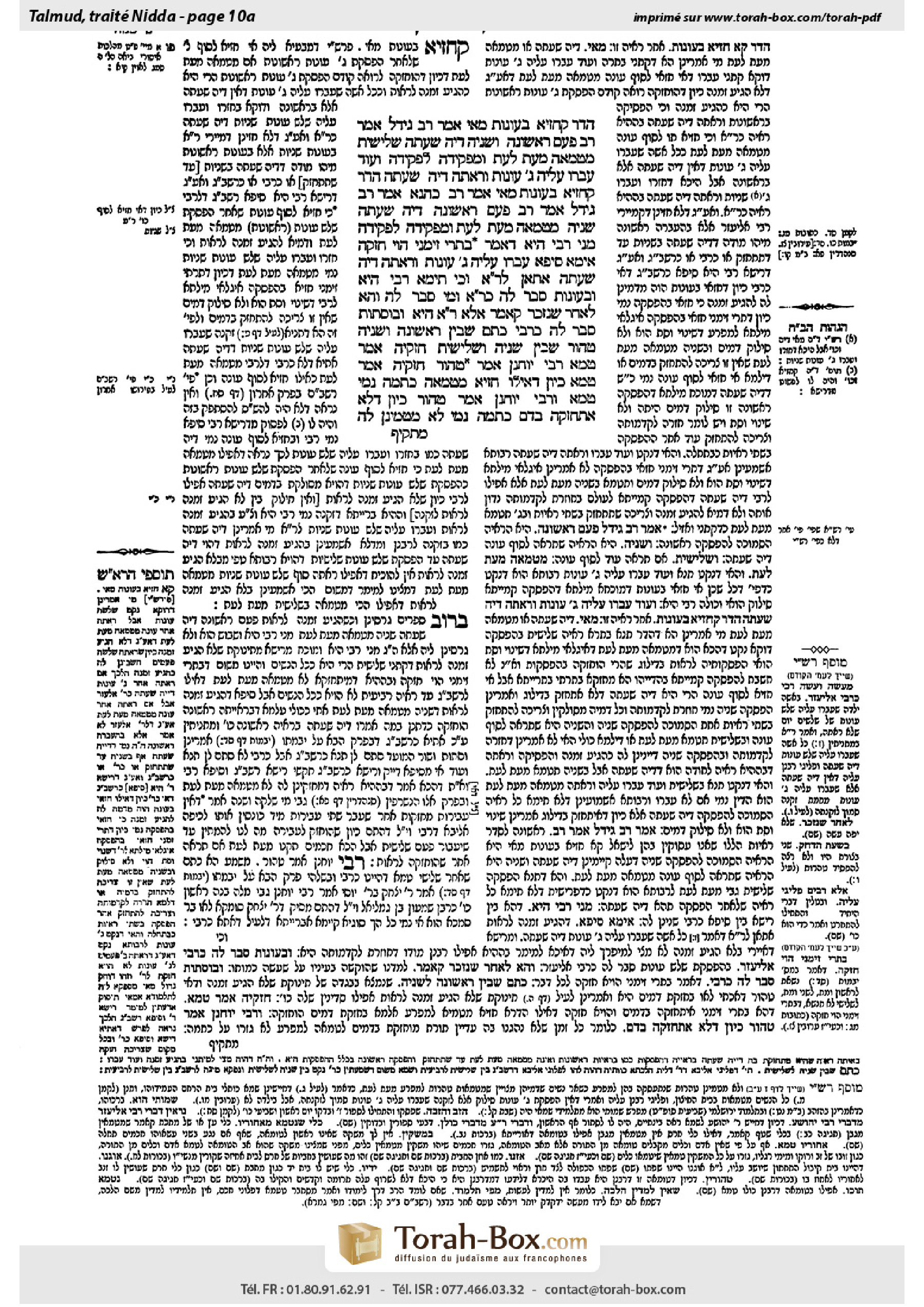
Niddah 10a: Talmud study for Daf Yomi
Daf Yomi is the daily study of one Talmud folio. Explore 37 tractates with scans, Hebrew text, Sefaria English and AI-generated French translations where annotated.
Passage selection and English or AI-generated French translation are available where the scan has annotations. Daf Study is independent of Torah-Box and Sefaria.
Browse Niddah · נידה · All tractatesNiddah 10a text and translations
This page of Niddah includes the Aramaic text, an English translation and an AI-generated French translation, alongside the scan above.
נידה י׳ א · Aramaic and Hebrew text
הֲדַר קָחָזְיָא בְּעוֹנוֹת, מַאי? אָמַר רַב גִּידֵּל אָמַר רַב: פַּעַם רִאשׁוֹנָה וּשְׁנִיָּה — דַּיָּהּ שְׁעָתָהּ, שְׁלִישִׁית — מְטַמְּאָה מֵעֵת לְעֵת וּמִפְּקִידָה לִפְקִידָה.
וְעוֹד עָבְרוּ עָלֶיהָ שָׁלֹשׁ עוֹנוֹת, וְרָאֲתָה — דַּיָּהּ שְׁעָתָהּ. הֲדַר קָחָזְיָא בְּעוֹנוֹת, מַאי?
אָמַר רַב כָּהֲנָא, אָמַר רַב גִּידֵּל, אָמַר רַב: פַּעַם רִאשׁוֹנָה — דַּיָּהּ שְׁעָתָהּ, שְׁנִיָּה — מְטַמְּאָה מֵעֵת לְעֵת וּמִפְּקִידָה לִפְקִידָה.
מַנִּי? רַבִּי הִיא, דְּאָמַר: בִּתְרֵי זִימְנֵי הָוֵי חֲזָקָה.
אֵימָא סֵיפָא: עָבְרוּ עָלֶיהָ שָׁלֹשׁ עוֹנוֹת וְרָאֲתָה — דַּיָּהּ שְׁעָתָהּ, אֲתָאן לְרַבִּי אֱלִיעֶזֶר!
וְכִי תֵימָא רַבִּי הִיא, וּבְעוֹנוֹת סָבַר לַהּ כְּרַבִּי אֱלִיעֶזֶר, וּמִי סָבַר לַהּ? וְהָא לְאַחַר שֶׁנִּזְכַּר קָאָמַר! אֶלָּא רַבִּי אֱלִיעֶזֶר הִיא, וּבִוְסָתוֹת סָבַר לַהּ כְּרַבִּי.
כֶּתֶם שֶׁבֵּין רִאשׁוֹנָה וּשְׁנִיָּה — טָהוֹר, שֶׁבֵּין שְׁנִיָּה וּשְׁלִישִׁית — חִזְקִיָּה אָמַר: טָמֵא, רַבִּי יוֹחָנָן אָמַר: טָהוֹר. חִזְקִיָּה אָמַר: טָמֵא, כֵּיוָן דְּאִילּוּ חָזְיָא מְטַמְּאָה — כִּתְמַהּ נָמֵי טָמֵא, וְרַבִּי יוֹחָנָן אָמַר: טָהוֹר, כֵּיוָן דְּלָא אִתַּחְזַקָה בְּדָם — כִּתְמַהּ נָמֵי לָא מְטַמֵּינַן לַהּ.
Niddah 10a · English translation
The Gemara asks: What is the halakha if she then sees menstrual blood at regular intervals of thirty-day cycles? Is her time sufficient, or does she transmit impurity retroactively? Rav Giddel says that Rav says: With regard to the first time and the second time that she sees menstrual blood, her time is sufficient. After the third time, she transmits impurity retroactively for a twenty-four-hour period or from examination to examination.
The baraita further teaches, with regard to a young girl who did not experience bleeding for three typical cycles and then saw blood, and three further expected menstrual cycles passed without her experiencing bleeding and then afterward she saw menstrual blood, that her time is sufficient. The Gemara asks: What is the halakha if she then sees menstrual blood at regular intervals of thirty-day cycles?
The Gemara answers: Rav Kahana says that Rav Giddel says that Rav says: The first time that she sees menstrual blood, her time is sufficient. After the second time, she transmits impurity retroactively for a twenty-four-hour period or from examination to examination.
The Gemara asks: Who is the tanna of the baraita? The Gemara answers: Since the baraita teaches that she attains the status of a regular adult woman upon the third sighting of menstrual blood, apparently it is Rabbi Yehuda HaNasi, who said that presumption is established by two occasions.
The Gemara raises a difficulty: Say the latter clause: If she then passed three expected menstrual cycles without experiencing bleeding, and then she saw menstrual blood, she returns to the status of a young girl and her time is sufficient. In this ruling we come to the opinion of Rabbi Eliezer, who holds that any woman who passed three expected menstrual cycles without experiencing bleeding is presumed not to be menstruating and her time is sufficient. Is the baraita in accordance with the opinion of Rabbi Yehuda HaNasi or Rabbi Eliezer?
And if you would say that the tanna of the baraita is Rabbi Yehuda HaNasi, and in the case of a woman who passes three menstrual cycles without experiencing bleeding, he holds in accordance with the opinion of Rabbi Eliezer, but does he really hold in accordance with this opinion? Doesn’t the baraita state that after Rabbi Yehuda HaNasi remembered that several authorities disagreed with the ruling of Rabbi Eliezer, he said: Rabbi Eliezer is worthy to rely upon in exigent circumstances, i.e., only in exigent circumstances. The Gemara concludes: Rather, the tanna of the baraita is Rabbi Eliezer, and with regard to menstrual cycles he holds in accordance with the opinion of Rabbi Yehuda HaNasi, that a presumptive cycle is established after two occasions of seeing menstrual blood.
§ With regard to a young girl who was just starting to menstruate, the Gemara states: If she finds a blood stain between the first and second time that she sees menstrual blood, she is pure. If it is between the second and the third time, Ḥizkiyya says: She is impure; Rabbi Yoḥanan says: She is pure. The Gemara explains the reasoning behind their respective opinions. Ḥizkiyya says: She is impure, since if she had seen menstrual blood it would render her impure. Consequently, her blood stain is also impure. And Rabbi Yoḥanan says: She is pure, since she has not yet attained the presumptive status of one who sees menstrual blood. Therefore, we also do not render her impure on account of her blood stain.
Niddah 10a · Traduction française (IA)
La Guemara demande : Quelle est la halakha si, par la suite, elle voit du sang menstruel à intervalles réguliers de trente jours ? Le délai écoulé suffit-il, ou transmet-elle l’impureté rétroactivement ? Rav Giddel rapporte que Rav dit : Lors de la première et de la deuxième fois où elle voit du sang menstruel, le délai écoulé suffit. Après la troisième fois, elle transmet l’impureté rétroactivement, soit sur une période de vingt-quatre heures, soit depuis le dernier examen.
La baraïta enseigne en outre, au sujet d’une jeune fille qui n’a pas eu de saignement pendant trois cycles habituels, puis a vu du sang, et qui a ensuite connu trois autres cycles menstruels attendus sans saignement avant de voir de nouveau du sang menstruel, que le délai écoulé suffit. La Guemara demande : Quelle est la halakha si, par la suite, elle voit du sang menstruel à intervalles réguliers de trente jours ?
La Guemara répond : Rav Kahana rapporte que Rav Giddel rapporte que Rav dit : La première fois où elle voit du sang menstruel, le délai écoulé suffit. Après la deuxième fois, elle transmet l’impureté rétroactivement, soit sur une période de vingt-quatre heures, soit depuis le dernier examen.
La Guemara demande : Qui est le tanna de la baraïta ? La Guemara répond : Puisque la baraïta enseigne qu’elle acquiert le statut d’une femme adulte ayant des règles régulières à la troisième apparition de sang menstruel, il semble qu’il s’agisse de Rabbi Yehouda HaNassi, qui a dit qu’une présomption s’établit après deux occurrences.
La Guemara soulève une difficulté : Considérons la dernière clause : si elle connaît ensuite trois cycles menstruels attendus sans saignement, puis voit du sang menstruel, elle retrouve le statut d’une jeune fille et le délai écoulé suffit. Cette décision correspond à l’opinion de Rabbi Eliezer, selon laquelle toute femme qui a connu trois cycles menstruels attendus sans saignement est présumée ne plus avoir ses règles, et le délai écoulé suffit. La baraïta est-elle conforme à l’opinion de Rabbi Yehouda HaNassi ou à celle de Rabbi Eliezer ?
Et si tu dis que le tanna de la baraïta est Rabbi Yehouda HaNassi et que, dans le cas d’une femme qui connaît trois cycles menstruels sans saignement, il suit l’opinion de Rabbi Eliezer, suit-il vraiment cette opinion ? La baraïta ne dit-elle pas qu’après s’être souvenu que plusieurs autorités étaient en désaccord avec la décision de Rabbi Eliezer, Rabbi Yehouda HaNassi a déclaré : « Rabbi Eliezer mérite que l’on s’appuie sur lui en cas de nécessité », c’est-à-dire uniquement en cas de nécessité ? La Guemara conclut : Il s’agit donc plutôt de Rabbi Eliezer, le tanna de la baraïta, qui, concernant les cycles menstruels, suit l’opinion de Rabbi Yehouda HaNassi : la présomption d’un cycle régulier s’établit après deux occurrences de sang menstruel.
§ Au sujet d’une jeune fille qui commence tout juste à avoir ses règles, la Guemara déclare : Si elle trouve une tache de sang entre la première et la deuxième fois où elle voit du sang menstruel, elle est pure. Si elle trouve une tache entre la deuxième et la troisième fois, Ḥizkiyya dit : Elle est impure ; Rabbi Yoḥanan dit : Elle est pure. La Guemara explique le raisonnement qui sous-tend leurs opinions respectives. Ḥizkiyya dit : Elle est impure, car si elle avait vu du sang menstruel, cela l’aurait rendue impure. Par conséquent, sa tache de sang est elle aussi impure. Rabbi Yoḥanan dit : Elle est pure, car elle n’a pas encore acquis le statut présumé d’une femme qui voit du sang menstruel. Par conséquent, nous ne la déclarons pas non plus impure à cause de sa tache de sang.
Traduction française générée par IA à partir de l’édition anglaise de Sefaria. Vérifie toujours un passage avec le texte source.
Text from Sefaria: William Davidson Edition - Vocalized Aramaic (CC BY NC); William Davidson Edition - English (CC BY NC).