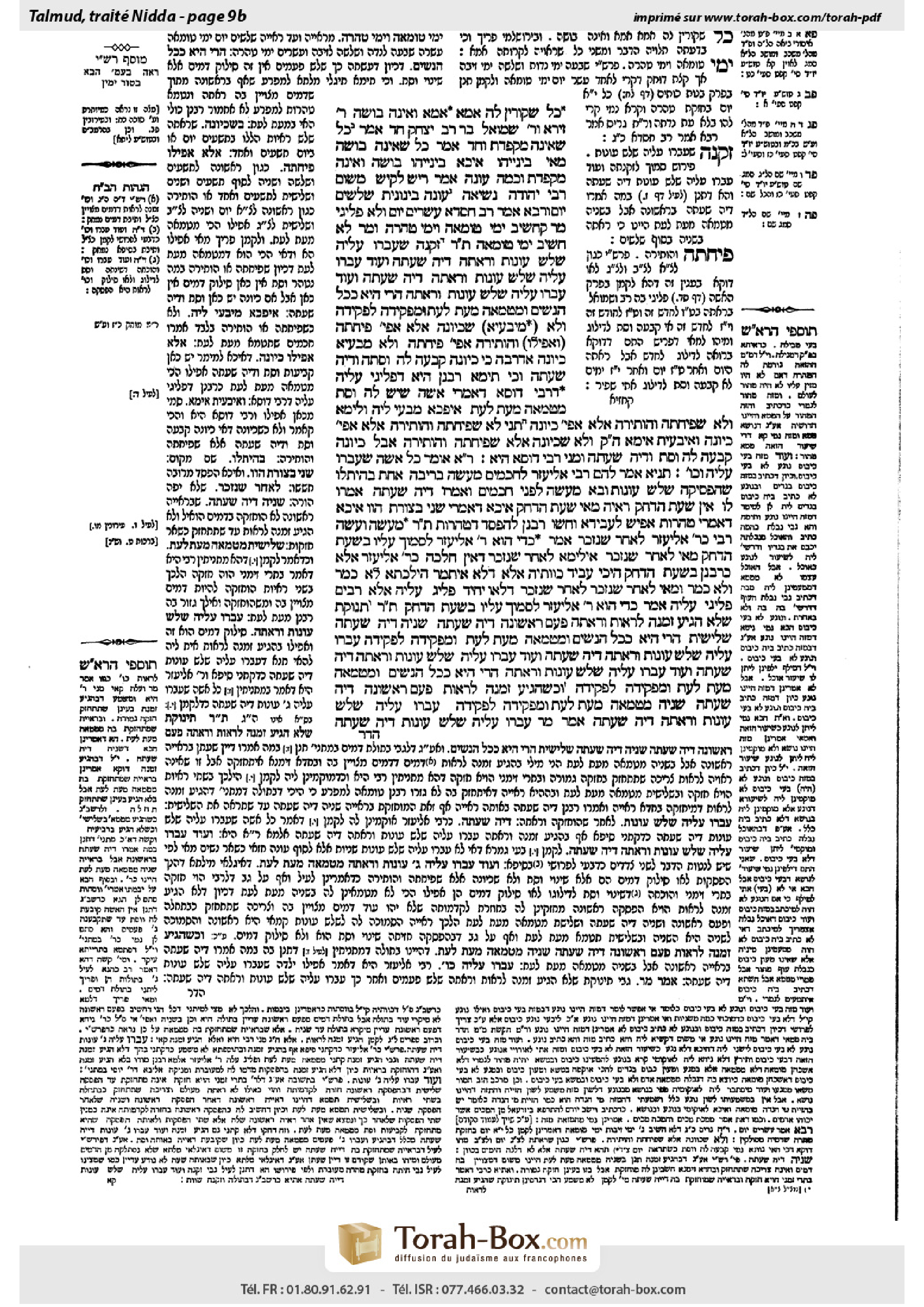
Niddah 9b: Talmud study for Daf Yomi
Daf Yomi is the daily study of one Talmud folio. Explore 37 tractates with scans, Hebrew text, Sefaria English and AI-generated French translations where annotated.
Passage selection and English or AI-generated French translation are available where the scan has annotations. Daf Study is independent of Torah-Box and Sefaria.
Browse Niddah · נידה · All tractatesNiddah 9b text and translations
This page of Niddah includes the Aramaic text, an English translation and an AI-generated French translation, alongside the scan above.
נידה ט׳ ב · Aramaic and Hebrew text
כֹּל שֶׁקּוֹרִין לָהּ ״אִמָּא אִמָּא״ וְאֵינָהּ בּוֹשָׁה. רַבִּי זֵירָא וְרַבִּי שְׁמוּאֵל בַּר רַב יִצְחָק — חַד אָמַר: כֹּל שֶׁאֵינָהּ מַקְפֶּדֶת, וְחַד אָמַר: כֹּל שֶׁאֵינָהּ בּוֹשָׁה. מַאי בֵינַיְיהוּ? אִיכָּא בֵינַיְיהוּ: בּוֹשָׁה וְאֵינָהּ מַקְפֶּדֶת.
וְכַמָּה עוֹנָה? אָמַר רֵישׁ לָקִישׁ מִשּׁוּם רַבִּי יְהוּדָה נְשִׂיאָה: עוֹנָה בֵּינוֹנִית שְׁלֹשִׁים יוֹם, וְרָבָא אָמַר רַב חִסְדָּא: עֶשְׂרִים יוֹם. וְלָא פְּלִיגִי, מָר קָחָשֵׁיב יְמֵי טוּמְאָה וִימֵי טׇהֳרָה, וּמָר לָא חָשֵׁיב יְמֵי טוּמְאָה.
תָּנוּ רַבָּנַן: זְקֵנָה שֶׁעָבְרוּ עָלֶיהָ שָׁלֹשׁ עוֹנוֹת, וְרָאֲתָה — דַּיָּהּ שְׁעָתָהּ. וְעוֹד עָבְרוּ עָלֶיהָ שָׁלֹשׁ עוֹנוֹת, וְרָאֲתָה — דַּיָּהּ שְׁעָתָהּ. וְעוֹד עָבְרוּ עָלֶיהָ שָׁלֹשׁ עוֹנוֹת, וְרָאֲתָה — הֲרֵי הִיא כְּכׇל הַנָּשִׁים, וּמְטַמְּאָה מֵעֵת לְעֵת וּמִפְּקִידָה לִפְקִידָה.
וְלָא (מִיבַּעְיָא) שֶׁכִּוְּונָה, אֶלָּא אֲפִילּוּ פִּיחֲתָה, וַאֲפִילּוּ הוֹתִירָה.
״אֲפִילּוּ פִּיחֲתָה״, וְלָא מִבָּעֲיָא כִּוְּונָה? אַדְּרַבָּה, כִּי כִּוְּונָה — קָבְעָה לָהּ וִסְתָּהּ, וְדַיָּה שְׁעָתָהּ!
וְכִי תֵּימָא, רַבָּנַן הִיא, דִּפְלִיגִי עֲלֵיהּ דְּרַבִּי דּוֹסָא, דְּאָמְרִי: אִשָּׁה שֶׁיֵּשׁ לָהּ וֶסֶת מְטַמְּאָה מֵעֵת לְעֵת, אִיפְּכָא מִבְּעֵי לֵיהּ, וְלֵימָא: וְלֹא שֶׁפִּיחֲתָה וְהוֹתִירָה, אֶלָּא אֲפִילּוּ כִּוְּונָה!
תְּנִי: לֹא שֶׁפִּיחֲתָה וְהוֹתִירָה, אֶלָּא אֲפִילּוּ כִּוְּונָה. וְאִיבָּעֵית אֵימָא, הָכִי קָאָמַר: וְלֹא שֶׁכִּוְּונָה, אֶלָּא שֶׁפִּיחֲתָה וְהוֹתִירָה, אֲבָל כִּוְּונָה — קָבְעָה לָהּ וֶסֶת, וְדַיָּה שְׁעָתָהּ. וּמַנִּי? רַבִּי דּוֹסָא הִיא.
רַבִּי אֱלִיעֶזֶר אוֹמֵר: כָּל אִשָּׁה שֶׁעָבְרוּ עָלֶיהָ וְכוּ׳. תַּנְיָא: אָמַר לָהֶם רַבִּי אֱלִיעֶזֶר לַחֲכָמִים: מַעֲשֶׂה בְּרִיבָה אַחַת בְּהַיְתָלוֹ, שֶׁהִפְסִיקָה שָׁלֹשׁ עוֹנוֹת, וּבָא מַעֲשֶׂה לִפְנֵי חֲכָמִים וְאָמְרוּ: דַּיָּהּ שְׁעָתָהּ.
אָמְרוּ לוֹ: אֵין שְׁעַת הַדְּחָק רְאָיָה. מַאי שְׁעַת הַדְּחָק? אִיכָּא דְאָמְרִי: שְׁנֵי בַצּוֹרֶת הֲווֹ, אִיכָּא דְאָמְרִי: טְהָרוֹת אַפֵּישׁ (לַעֲבִידָא) [וַעֲבַדָא], וְחַשּׁוּ רַבָּנַן לְהֶפְסֵד דִּטְהָרוֹת.
תָּנוּ רַבָּנַן: מַעֲשֶׂה, וְעָשָׂה רַבִּי כְּרַבִּי אֱלִיעֶזֶר. לְאַחַר שֶׁנִּזְכַּר, אָמַר: כְּדַי הוּא רַבִּי אֱלִיעֶזֶר לִסְמוֹךְ עָלָיו בִּשְׁעַת הַדְּחָק. מַאי ״לְאַחַר שֶׁנִּזְכַּר״? אִילֵּימָא לְאַחַר שֶׁנִּזְכַּר דְּאֵין הֲלָכָה כְּרַבִּי אֱלִיעֶזֶר אֶלָּא כְּרַבָּנַן, בִּשְׁעַת הַדְּחָק הֵיכִי עָבֵיד כְּוָותֵיהּ?
אֶלָּא, דְּלָא אִיתְּמַר הִילְכְתָא לָא כְּמָר וָלֹא כְּמָר, וּמַאי ״לְאַחַר שֶׁנִּזְכַּר״? לְאַחַר שֶׁנִּזְכַּר דְּלָאו יָחִיד פְּלִיג עֲלֵיהּ, אֶלָּא רַבִּים פְּלִיגִי עֲלֵיהּ, אֲמַר: כְּדַי הוּא רַבִּי אֱלִיעֶזֶר לִסְמוֹךְ עָלָיו בִּשְׁעַת הַדְּחָק.
תָּנוּ רַבָּנַן: תִּינוֹקֶת שֶׁלֹּא הִגִּיעַ זְמַנָּהּ לִרְאוֹת וְרָאֲתָה, פַּעַם רִאשׁוֹנָה — דַּיָּהּ שְׁעָתָהּ, שְׁנִיָּה — דַּיָּהּ שְׁעָתָהּ, שְׁלִישִׁית — הֲרֵי הִיא כְּכׇל הַנָּשִׁים, וּמְטַמְּאָה מֵעֵת לְעֵת וּמִפְּקִידָה לִפְקִידָה.
עָבְרוּ עָלֶיהָ שָׁלֹשׁ עוֹנוֹת וְרָאֲתָה — דַּיָּהּ שְׁעָתָהּ, וְעוֹד עָבְרוּ עָלֶיהָ שָׁלֹשׁ עוֹנוֹת וְרָאֲתָה — דַּיָּהּ שְׁעָתָהּ, וְעוֹד עָבְרוּ עָלֶיהָ שָׁלֹשׁ עוֹנוֹת וְרָאֲתָה — הֲרֵי הִיא כְּכׇל הַנָּשִׁים, וּמְטַמְּאָה מֵעֵת לְעֵת וּמִפְּקִידָה לִפְקִידָה.
וּכְשֶׁהִגִּיעַ זְמַנָּהּ לִרְאוֹת, פַּעַם רִאשׁוֹנָה — דַּיָּהּ שְׁעָתָהּ, שְׁנִיָּה — מְטַמְּאָה מֵעֵת לְעֵת וּמִפְּקִידָה לִפְקִידָה, עָבְרוּ עָלֶיהָ שָׁלֹשׁ עוֹנוֹת וְרָאֲתָה — דַּיָּהּ שְׁעָתָהּ.
אָמַר מָר: עָבְרוּ עָלֶיהָ שָׁלֹשׁ עוֹנוֹת — דַּיָּהּ שְׁעָתָהּ.
Niddah 9b · English translation
It is any woman who is old enough that people call her: Mother [Imma], Mother, and she is not embarrassed. Rabbi Zeira and Rabbi Shmuel bar Rav Yitzḥak disagree with regard to this matter. One says that the definition is any woman who does not take offense about being called: Mother, Mother. And the other one says that it is any woman who is not embarrassed by this. The Gemara asks: What is the difference between their definitions? The Gemara answers: The practical difference between them is in a case where a woman is embarrassed but she does not take offense when called: Mother.
The Gemara asks: And how long is a typical menstrual cycle? Reish Lakish says in the name of Rabbi Yehuda Nesia: The average menstrual cycle is thirty days long. And Rava says that Rav Ḥisda says: It is twenty days. The Gemara notes: And they do not disagree. One Sage, Rav Yehuda Nesia, counts all the days of her cycle, including the days of impurity and days of purity. And the other Sage, Rav Ḥisda, does not count the days of impurity, i.e., the seven days of impurity of a menstruating woman and the three days of the sighting of ziva.
§ The Sages taught in a baraita: With regard to an elderly woman for whom three typical menstrual cycles of thirty days passed and then she saw a discharge of menstrual blood, her time is sufficient. And if a further three typical menstrual cycles of thirty days passed for her and she subsequently saw a discharge of menstrual blood, her time is sufficient. And if yet a further three typical menstrual cycles of thirty days passed for her and then she saw a discharge of menstrual blood, after this third time she is now like all normal women, and she transmits impurity retroactively for a twenty-four-hour period or from examination to examination.
The baraita continues: And it is not necessary to teach this halakha in a case where she experienced the three sightings in even intervals of ninety days, as in such a case it is obvious that she assumes the status of a normal woman who transmits impurity retroactively. Rather, even if she had intervals where she decreased, i.e., experienced bleeding at intervals smaller than that, or even if she increased and experienced bleeding at greater intervals, she still assumes the status of a woman who transmits impurity retroactively.
The Gemara infers: The wording of the baraita: Even if she had intervals where she decreased, indicates that it is not necessary to teach the halakha in the case of a woman who experienced bleeding at even intervals. This is puzzling, as on the contrary, if she experienced bleeding at even intervals she thereby fixes her menstrual cycle as being every thirty days, and according to Rabbi Dosa (4b) the halakha is that her time is sufficient.
And if you would say that this is in accordance with the opinion of the Rabbis, who disagree with Rabbi Dosa, as they say that a woman who has a fixed menstrual cycle transmits impurity retroactively for a twenty-four-hour period, then the baraita should have been written in the opposite fashion: Let it say: And the halakha that an elderly woman who sees menstrual blood at intervals returns to the status of normal women and transmits impurity retroactively applies not only to a case where she had intervals where she decreased or increased, i.e., she experienced bleeding less or more than ninety days apart, but this halakha applies even if she experienced bleeding at even intervals.
The Gemara answers: Teach in the baraita in accordance with this altered version: And the halakha applies not only to a case where she had intervals where she decreased or increased, but this is the halakha even if she experienced bleeding at even intervals. And if you wish say instead that this is what the baraita is saying: The halakha that an elderly woman is retroactively impure does not apply to a case when she saw menstrual blood at even intervals. Rather, it applies only if she decreased or increased, i.e., she experienced bleeding at intervals less or more than ninety days apart. But if she saw blood at even intervals, she thereby fixes a set menstrual cycle of ninety days and her time is sufficient. The Gemara adds: And if so, in accordance with whose opinion is this baraita? It is in accordance with the opinion of Rabbi Dosa.
§ The mishna teaches that Rabbi Eliezer says: With regard to any woman for whom three typical menstrual cycles passed during which she saw no menstrual blood, if she experiences bleeding, her time is sufficient. Rabbi Yosei says: In the case of a pregnant woman and a nursing woman for whom three menstrual cycles passed during which they saw no menstrual blood, if she then saw blood her time is sufficient. Rabbi Eliezer cites a proof for his opinion. It is taught in a baraita: There was an incident involving a certain girl in the village of Hitlo who stopped menstruating for three typical menstrual cycles, after which she experienced menstruation. And the matter came before the Sages, and they said that her time is sufficient and she does not transmit impurity retroactively.
The other Sages said to Rabbi Eliezer: Decisions rendered in exigent circumstances are no proof. The Gemara asks: What were the exigent circumstances? Some say that it was during the years of famine, and some say that the girl had handled many ritually pure items and the Sages were concerned for the loss of those pure items if they were ruled retroactively impure.
The Sages taught in a baraita: There was an incident in which Rabbi Yehuda HaNasi acted by ruling that the halakha is in accordance with the opinion of Rabbi Eliezer. After he remembered that Rabbi Eliezer’s colleagues disagree with him on this matter and that he had apparently ruled incorrectly, he nevertheless said: Rabbi Eliezer is worthy to rely upon in exigent circumstances. The Gemara asks: What is the meaning of: After he remembered? If we say that this means after he remembered that the halakha is not in accordance with the opinion of Rabbi Eliezer, but in accordance with the opinion of the Rabbis, if so, how could he act in accordance with Rabbi Eliezer even in exigent circumstances, since the halakha has been decided against him?
Rather, one must say that the halakha had not been stated on this matter, neither in accordance with the opinion of this Sage, Rabbi Eliezer, nor in accordance with the opinion of that Sage, the Rabbis. And what is the meaning of: After he remembered? After Rabbi Yehuda HaNasi remembered that it was not a lone authority who disagrees with Rabbi Eliezer, but it was several Sages who disagreed with him, and there is a principle that the halakha is in accordance with the opinion of the many over the opinion of an individual, he nevertheless said: Rabbi Eliezer is worthy to rely upon in exigent circumstances.
The Gemara continues the discussion of a woman who fails to experience menstruation for three typical menstrual cycles. The Sages taught in a baraita: With regard to a young girl, less than twelve years old, whose time to see the flow of menstrual blood has not arrived and she saw menstrual blood, after the first time her time is sufficient. After the second time, again her time is sufficient. After the third time, she is like all normal adult women, and therefore she transmits impurity retroactively for a twenty-four-hour period or from examination to examination.
The baraita continues: If she then passed three expected menstrual cycles without experiencing bleeding, and then she saw menstrual blood, she returns to the status of a young girl and her time is sufficient. And if it further happens that she again passed three expected menstrual cycles without experiencing bleeding, and then she saw menstrual blood, her time is sufficient. And if she passed three further cycles without experiencing bleeding, and she subsequently saw menstrual blood, she is like all normal adult women. She is considered a woman who experiences regular menstruation at long intervals with breaks of ninety days. And therefore she transmits impurity retroactively for a twenty-four-hour period or from examination to examination.
The baraita concludes: And with regard to a girl whose time to see the flow of menstrual blood has arrived, i.e., she has reached the age of twelve, when she sees menstrual blood for the first time, her time is sufficient. After the second time, she transmits impurity retroactively for a twenty-four-hour period or from examination to examination. If three menstrual cycles then passed without her experiencing bleeding, and afterward she saw menstrual blood, her time is sufficient. This is in accordance with the opinion of Rabbi Eliezer, who holds that any woman who passed three expected menstrual cycles without experiencing bleeding is presumed not to be menstruating.
The Master said in the baraita: If the young girl who had started menstruating passed three expected menstrual cycles without experiencing bleeding and then saw menstrual blood, she returns to the status of a young girl and her time is sufficient.
Niddah 9b · Traduction française (IA)
Il s’agit de toute femme assez âgée pour que les gens l’appellent « Mère » [Imma], « Mère », sans qu’elle en soit gênée. Rabbi Zeira et Rabbi Shmuel bar Rav Yitzḥak sont en désaccord à ce sujet. Selon l’un, il s’agit de toute femme qui ne s’offusque pas qu’on l’appelle « Mère », « Mère » ; selon l’autre, de toute femme qui n’en est pas gênée. La Guemara demande : Quelle est la différence entre leurs définitions ? La Guemara répond : La différence pratique concerne le cas d’une femme qui est gênée, mais ne s’offusque pas qu’on l’appelle « Mère ».
La Guemara demande : Et quelle est la durée d’un cycle menstruel ordinaire ? Reish Lakish dit au nom de Rabbi Yehuda Nesia : Un cycle menstruel moyen dure trente jours. Rava dit que Rav Ḥisda dit qu’il dure vingt jours. La Guemara fait remarquer qu’ils ne sont pas en désaccord. L’un des Sages, Rav Yehuda Nesia, compte tous les jours du cycle, y compris les jours d’impureté et les jours de pureté. L’autre Sage, Rav Ḥisda, ne compte pas les jours d’impureté, c’est-à-dire les sept jours d’impureté d’une femme niddah et les trois jours de l’écoulement de ziva.
§ Les Sages ont enseigné dans une baraïta : Dans le cas d’une femme âgée pour laquelle trois cycles menstruels ordinaires de trente jours se sont écoulés, puis qui a vu un écoulement de sang menstruel, son temps lui suffit. Si trois autres cycles menstruels ordinaires de trente jours se sont écoulés pour elle, puis qu’elle a vu un écoulement de sang menstruel, son temps lui suffit. Si trois autres cycles menstruels ordinaires de trente jours se sont encore écoulés pour elle, puis qu’elle a vu un écoulement de sang menstruel, après cette troisième fois, elle est désormais comme toutes les femmes ordinaires et transmet l’impureté rétroactivement pour une période de vingt-quatre heures ou depuis un examen jusqu’au suivant.
La baraïta poursuit : Il n’est pas nécessaire d’enseigner cette halakha dans le cas où elle a eu ses trois écoulements à des intervalles réguliers de quatre-vingt-dix jours, car il est évident qu’elle acquiert alors le statut d’une femme ordinaire, qui transmet l’impureté rétroactivement. Même si les intervalles ont été plus courts, c’est-à-dire si elle a eu des saignements à des intervalles inférieurs à quatre-vingt-dix jours, ou s’ils ont été plus longs et qu’elle a eu des saignements à des intervalles supérieurs à quatre-vingt-dix jours, elle acquiert néanmoins le statut d’une femme qui transmet l’impureté rétroactivement.
La Guemara déduit : La formulation de la baraïta, « même si elle a eu des intervalles plus courts », indique qu’il n’est pas nécessaire d’enseigner cette halakha dans le cas d’une femme qui a eu des saignements à intervalles réguliers. Cela est étonnant, car, au contraire, si elle a eu des saignements à intervalles réguliers, elle fixe ainsi son cycle menstruel à trente jours et, selon Rabbi Dosa (4b), la halakha est que son temps lui suffit.
Et si tu dis que cela est conforme à l’avis des Rabbins, qui sont en désaccord avec Rabbi Dosa, puisqu’ils disent qu’une femme dont le cycle menstruel est fixé transmet l’impureté rétroactivement pour une période de vingt-quatre heures, alors la baraïta aurait dû être formulée en sens inverse : elle aurait dû dire que la halakha selon laquelle une femme âgée qui voit du sang menstruel à intervalles réguliers retrouve le statut des femmes ordinaires et transmet l’impureté rétroactivement s’applique non seulement au cas où ses intervalles ont été plus courts ou plus longs, c’est-à-dire où elle a eu des saignements à moins ou à plus de quatre-vingt-dix jours d’intervalle, mais aussi au cas où elle a eu des saignements à intervalles réguliers.
La Guemara répond : Il faut enseigner la baraïta selon cette version modifiée : la halakha s’applique non seulement au cas où ses intervalles ont été plus courts ou plus longs, mais aussi au cas où elle a eu des saignements à intervalles réguliers. Ou bien, si tu préfères, voici ce que dit la baraïta : La halakha selon laquelle une femme âgée transmet rétroactivement l’impureté ne s’applique pas au cas où elle a vu du sang menstruel à intervalles réguliers. Elle ne s’applique que si ses intervalles ont été plus courts ou plus longs, c’est-à-dire si elle a eu des saignements à moins ou à plus de quatre-vingt-dix jours d’intervalle. Mais si elle a vu du sang à intervalles réguliers, elle fixe ainsi un cycle menstruel de quatre-vingt-dix jours et son temps lui suffit. La Guemara ajoute : Si tel est le cas, selon l’avis de qui cette baraïta est-elle formulée ? Selon l’avis de Rabbi Dosa.
§ La Michna enseigne que Rabbi Eliezer dit : Pour toute femme dont trois cycles menstruels ordinaires se sont écoulés sans qu’elle voie de sang menstruel, si elle a un saignement, son temps lui suffit. Rabbi Yosei dit : Dans le cas d’une femme enceinte ou d’une femme qui allaite, pour lesquelles trois cycles menstruels se sont écoulés sans qu’elles voient de sang menstruel, si elles voient ensuite du sang, leur temps leur suffit. Rabbi Eliezer apporte une preuve à l’appui de son avis. Il est enseigné dans une baraïta : Un incident concerna une jeune fille du village de Hitlo qui cessa d’avoir ses règles pendant trois cycles menstruels ordinaires, puis eut ses règles. L’affaire fut portée devant les Sages, qui déclarèrent que son temps lui suffisait et qu’elle ne transmettait pas l’impureté rétroactivement.
Les autres Sages dirent à Rabbi Eliezer : Les décisions rendues dans des circonstances exceptionnelles ne constituent pas une preuve. La Guemara demande : Quelles étaient ces circonstances exceptionnelles ? Certains disent que c’était pendant des années de famine ; d’autres disent que la jeune fille avait manipulé de nombreux objets rituellement purs et que les Sages craignaient qu’ils ne soient perdus s’ils étaient déclarés impurs rétroactivement.
Les Sages ont enseigné dans une baraïta : Un incident eut lieu au cours duquel Rabbi Yehuda HaNasi statua que la halakha était conforme à l’avis de Rabbi Eliezer. Après s’être rappelé que les collègues de Rabbi Eliezer étaient en désaccord avec lui sur cette question et qu’il avait apparemment statué à tort, il dit néanmoins : On peut s’appuyer sur Rabbi Eliezer dans des circonstances exceptionnelles. La Guemara demande : Que signifie « après s’être rappelé » ? Si nous disons que cela signifie qu’il s’est rappelé que la halakha n’était pas conforme à l’avis de Rabbi Eliezer, mais à celui des Rabbins, alors comment a-t-il pu agir conformément à l’avis de Rabbi Eliezer, même dans des circonstances exceptionnelles, puisque la halakha avait été tranchée contre lui ?
Il faut plutôt dire que la halakha n’avait pas été énoncée sur cette question, ni conformément à l’avis de ce Sage, Rabbi Eliezer, ni conformément à celui de ces Sages, les Rabbins. Et que signifie « après s’être rappelé » ? Après que Rabbi Yehuda HaNasi se fut rappelé que Rabbi Eliezer n’était pas le seul à être en désaccord, mais que plusieurs Sages l’étaient, et qu’il existe un principe selon lequel la halakha suit l’avis de la majorité plutôt que celui d’un individu, il dit néanmoins : On peut s’appuyer sur Rabbi Eliezer dans des circonstances exceptionnelles.
La Guemara poursuit la discussion sur une femme qui n’a pas ses règles pendant trois cycles menstruels ordinaires. Les Sages ont enseigné dans une baraïta : Dans le cas d’une jeune fille de moins de douze ans, qui n’a pas encore atteint l’âge où elle est censée voir un écoulement de sang menstruel et qui voit du sang menstruel, la première fois, son temps lui suffit. La deuxième fois, son temps lui suffit également. La troisième fois, elle est comme toutes les femmes adultes ordinaires et transmet donc l’impureté rétroactivement pour une période de vingt-quatre heures ou depuis un examen jusqu’au suivant.
La baraïta poursuit : Si trois cycles menstruels prévus s’écoulent ensuite sans qu’elle ait de saignements, puis qu’elle voit du sang menstruel, elle retrouve le statut d’une jeune fille et son temps lui suffit. Si, de nouveau, trois cycles menstruels prévus s’écoulent pour elle sans qu’elle ait de saignements, puis qu’elle voit du sang menstruel, son temps lui suffit. Si trois autres cycles s’écoulent sans qu’elle ait de saignements, puis qu’elle voit du sang menstruel, elle est comme toutes les femmes adultes ordinaires. Elle est considérée comme une femme dont les règles surviennent régulièrement à de longs intervalles, séparés par des pauses de quatre-vingt-dix jours. Elle transmet donc l’impureté rétroactivement pour une période de vingt-quatre heures ou depuis un examen jusqu’au suivant.
La baraïta conclut : Quant à une jeune fille qui a atteint l’âge où elle est censée voir un écoulement de sang menstruel, c’est-à-dire l’âge de douze ans, lorsqu’elle voit du sang menstruel pour la première fois, son temps lui suffit. La deuxième fois, elle transmet l’impureté rétroactivement pour une période de vingt-quatre heures ou depuis un examen jusqu’au suivant. Si trois cycles menstruels s’écoulent ensuite sans qu’elle ait de saignements, puis qu’elle voit du sang menstruel, son temps lui suffit. Cela est conforme à l’avis de Rabbi Eliezer, selon lequel toute femme qui a passé trois cycles menstruels prévus sans avoir de saignements est présumée ne pas avoir ses règles.
Le Maître a dit dans la baraïta : Si la jeune fille qui avait commencé à avoir ses règles passe trois cycles menstruels prévus sans avoir de saignements, puis voit du sang menstruel, elle retrouve le statut d’une jeune fille et son temps lui suffit.
Traduction française générée par IA à partir de l’édition anglaise de Sefaria. Vérifie toujours un passage avec le texte source.
Text from Sefaria: William Davidson Edition - Vocalized Aramaic (CC BY NC); William Davidson Edition - English (CC BY NC).