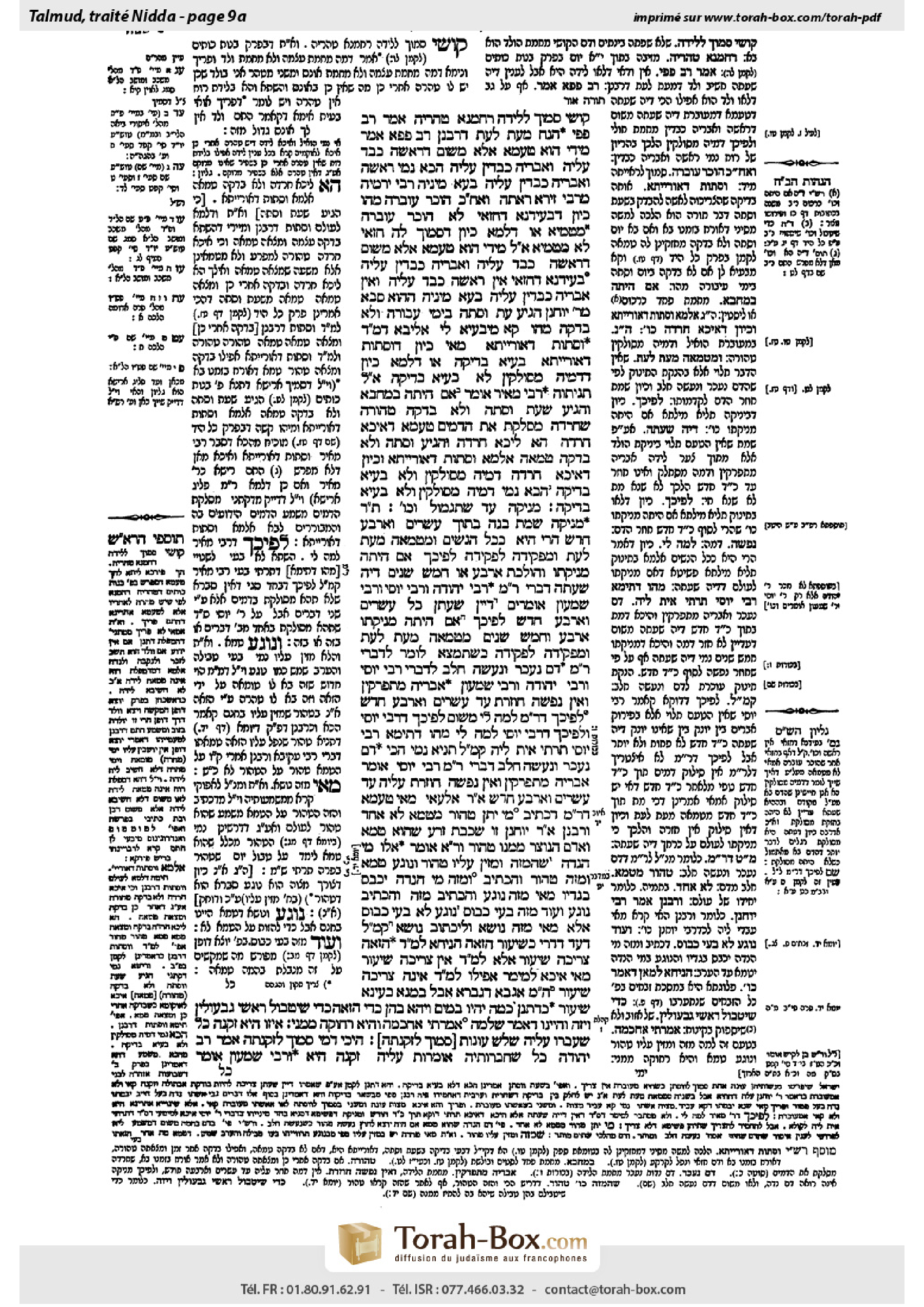
Niddah 9a: Talmud study for Daf Yomi
Daf Yomi is the daily study of one Talmud folio. Explore 37 tractates with scans, Hebrew text, Sefaria English and AI-generated French translations where annotated.
Passage selection and English or AI-generated French translation are available where the scan has annotations. Daf Study is independent of Torah-Box and Sefaria.
Browse Niddah · נידה · All tractatesNiddah 9a text and translations
This page of Niddah includes the Aramaic text, an English translation and an AI-generated French translation, alongside the scan above.
נידה ט׳ א · Aramaic and Hebrew text
קוֹשִׁי סָמוּךְ לַלֵּידָה רַחֲמָנָא טַהֲרֵיהּ! אָמַר רַב פַּפֵּי: הַנַּח מֵעֵת לְעֵת דְּרַבָּנַן.
רַב פָּפָּא אָמַר: מִידִּי הוּא טַעְמָא אֶלָּא מִשּׁוּם דְּרֹאשָׁהּ כָּבֵד עָלֶיהָ וְאֵבָרֶיהָ כְּבֵדִין עָלֶיהָ, הָכָא נָמֵי רֹאשָׁהּ וְאֵבָרֶיהָ כְּבֵדִין עָלֶיהָ.
בְּעָא מִינֵּיהּ רַבִּי יִרְמְיָה מֵרַבִּי זֵירָא: רָאֲתָה, וְאַחַר כָּךְ הוּכַּר עוּבָּרָהּ, מַהוּ? כֵּיוָן דִּבְעִידָּנָא דַּחֲזַאי לֹא הוּכַּר עוּבָּרָהּ — מְטַמְּיָא, אוֹ דִלְמָא, כֵּיוָן דִּסְמִוךְ לַהּ חֲזַאי — לָא מְטַמְּיָא?
אֲמַר לֵיהּ: מִידִּי הוּא טַעְמָא אֶלָּא מִשּׁוּם דְּרֹאשָׁהּ כָּבֵד עָלֶיהָ וְאֵבָרֶיהָ כְּבֵדִין עָלֶיהָ? בְּעִידָּנָא דַּחֲזַאי — אֵין רֹאשָׁהּ כָּבֵד עָלֶיהָ וְאֵין אֵבָרֶיהָ כְּבֵדִין עָלֶיהָ.
בְּעָא מִינֵּיהּ הָהוּא סָבָא מֵרַבִּי יוֹחָנָן: הִגִּיעַ עֵת וִסְתָּהּ בִּימֵי עִבּוּרָהּ וְלֹא בָּדְקָה, מַהוּ? קָא מִיבַּעְיָא לִי אַלִּיבָּא דְּמַאן דְּאָמַר וְסָתוֹת דְּאוֹרָיְיתָא. מַאי? כֵּיוָן דִּוְסָתוֹת דְּאוֹרָיְיתָא בָּעֲיָא בְּדִיקָה, אוֹ דִלְמָא כֵּיוָן דְּדָמֶיהָ מְסוּלָּקִין לָא בָּעֲיָא בְּדִיקָה?
אֲמַר לֵיהּ: תְּנֵיתוּהָ, רַבִּי מֵאִיר אוֹמֵר: אִם הָיְתָה בְּמַחֲבֵא וְהִגִּיעַ שְׁעַת וִסְתָּהּ וְלֹא בָּדְקָה — טְהוֹרָה, שֶׁחֲרָדָה מְסַלֶּקֶת אֶת הַדָּמִים. טַעְמָא דְּאִיכָּא חֲרָדָה, הָא לֵיכָּא חֲרָדָה וְהִגִּיעַ וִסְתָּהּ וְלֹא בָּדְקָה — טְמֵאָה.
אַלְמָא וְסָתוֹת דְּאוֹרָיְיתָא, וְכֵיוָן דְּאִיכָּא חֲרָדָה — דָּמֶיהָ מְסוּלָּקִין, וְלָא בָּעֲיָא בְּדִיקָה. הָכָא נָמֵי — דָּמֶיהָ מְסוּלָּקִין, וְלָא בָּעֲיָא בְּדִיקָה.
מְנִיקָה עַד שֶׁתִּגְמוֹל וְכוּ׳. תָּנוּ רַבָּנַן: מְנִיקָה שֶׁמֵּת בְּנָהּ בְּתוֹךְ עֶשְׂרִים וְאַרְבַּע חֹדֶשׁ — הֲרֵי הִיא כְּכׇל הַנָּשִׁים, וּמְטַמְּאָה מֵעֵת לְעֵת וּמִפְּקִידָה לִפְקִידָה. לְפִיכָךְ, אִם הָיְתָה מְנִיקָתוֹ וְהוֹלֶכֶת אַרְבַּע אוֹ חָמֵשׁ שָׁנִים — דַּיָּהּ שְׁעָתָהּ, דִּבְרֵי רַבִּי מֵאִיר.
רַבִּי יְהוּדָה וְרַבִּי יוֹסֵי וְרַבִּי שִׁמְעוֹן אוֹמְרִים: דַּיָּין שְׁעָתָן כׇּל עֶשְׂרִים וְאַרְבַּע חֹדֶשׁ, לְפִיכָךְ אִם הָיְתָה מְנִיקָתוֹ אַרְבַּע וְחָמֵשׁ שָׁנִים — מְטַמְּאָה מֵעֵת לְעֵת וּמִפְּקִידָה לִפְקִידָה.
כְּשֶׁתִּמָּצֵא לוֹמַר, לְדִבְרֵי רַבִּי מֵאִיר — דָּם נֶעְכָּר וְנַעֲשָׂה חָלָב, לְדִבְרֵי רַבִּי יוֹסֵי וְרַבִּי יְהוּדָה וְרַבִּי שִׁמְעוֹן — אֵבָרֶיהָ מִתְפָּרְקִין, וְאֵין נַפְשָׁהּ חוֹזֶרֶת עַד עֶשְׂרִים וְאַרְבַּע חֹדֶשׁ.
״לְפִיכָךְ״ דְּרַבִּי מֵאִיר לְמָה לִי? מִשּׁוּם ״לְפִיכָךְ״ דְּרַבִּי יוֹסֵי.
וּ״לְפִיכָךְ״ דְּרַבִּי יוֹסֵי לְמָה לִי? מַהוּ דְּתֵימָא רַבִּי יוֹסֵי תַּרְתֵּי אִית לֵיהּ, קָא מַשְׁמַע לַן.
תַּנְיָא נָמֵי הָכִי: דָּם נֶעְכָּר וְנַעֲשָׂה חָלָב, דִּבְרֵי רַבִּי מֵאִיר. רַבִּי יוֹסֵי אוֹמֵר: אֵבָרֶיהָ מִתְפָּרְקִין, וְאֵין נַפְשָׁהּ חוֹזֶרֶת עָלֶיהָ עַד עֶשְׂרִים וְאַרְבַּע חֹדֶשׁ. אָמַר רַבִּי אִלְעַאי: מַאי טַעְמָא דְּרַבִּי מֵאִיר? דִּכְתִיב: ״מִי יִתֵּן טָהוֹר מִטָּמֵא לֹא אֶחָד״.
וְרַבָּנַן? אָמַר רַבִּי יוֹחָנָן: זוֹ שִׁכְבַת זֶרַע, שֶׁהוּא — טָמֵא, וְאָדָם הַנּוֹצֵר מִמֶּנּוּ — טָהוֹר.
וְרַבִּי אֶלְעָזָר אוֹמֵר: אֵלּוּ מֵי הַנִּדָּה, שֶׁהַמַּזֶּה וּמַזִּין עָלָיו — טָהוֹר, וְנוֹגֵעַ — טָמֵא. וּמַזֶּה טָהוֹר? וְהָכְתִיב: ״וּמַזֵּה מֵי הַנִּדָּה יְכַבֵּס בְּגָדָיו״! מַאי ״מַזֶּה״? — נוֹגֵעַ.
וְהָכְתִיב ״מַזֶּה״, וְהָכְתִיב ״נוֹגֵעַ״! וְעוֹד, ״מַזֶּה״ בָּעֵי כִּבּוּס, ״נוֹגֵעַ״ לָא בָּעֵי כִּבּוּס! אֶלָּא, מַאי ״מַזֶּה״? נוֹשֵׂא.
וְלִיכְתּוֹב ״נוֹשֵׂא״! קָא מַשְׁמַע לַן דְּעַד דְּדָרֵי כְּשִׁיעוּר הַזָּאָה. הָנִיחָא לְמַאן דְּאָמַר הַזָּאָה צְרִיכָה שִׁיעוּר, אֶלָּא לְמַאן דְּאָמַר אֵין צְרִיכָה שִׁיעוּר, מַאי אִיכָּא לְמֵימַר?
אֲפִילּוּ לְמַאן דְּאָמַר אֵינָהּ צְרִיכָה שִׁיעוּר, הָנֵי מִילֵּי — אַגַּבָּא דְּגַבְרָא, אֲבָל בְּמָנָא — בָּעֵינַן שִׁיעוּר. כְּדִתְנַן: כַּמָּה יִהְיוּ בַּמַּיִם וִיהֵא בָּהֶן כְּדֵי הַזָּאָה? כְּדֵי שֶׁיִּטְבּוֹל רָאשֵׁי גִבְעוֹלִין וְיַזֶּה.
וְהַיְינוּ דְּאָמַר שְׁלֹמֹה: ״אָמַרְתִּי אֶחְכָּמָה וְהִיא רְחוֹקָה מִמֶּנִּי״.
אֵיזוֹ הִיא זְקֵנָה? כֹּל שֶׁעָבְרוּ עָלֶיהָ שָׁלֹשׁ עוֹנוֹת [סָמוּךְ לְזִקְנָתָהּ]. הֵיכִי דָמֵי סָמוּךְ לְזִקְנָתָהּ? אָמַר רַב יְהוּדָה: כֹּל שֶׁחַבְרוֹתֶיהָ אוֹמְרוֹת עָלֶיהָ ״זְקֵנָה הִיא״. וְרַבִּי שִׁמְעוֹן אוֹמֵר:
Niddah 9a · English translation
as with regard to blood emitted while experiencing labor pain close to the time of a proper birth, the Merciful One deems it pure, and it should not be treated as the blood of a zava. Rav Pappi says: The miscarriage is not considered a proper birth and therefore her blood is considered the blood of a zava. And leave aside the first baraita and do not raise a contradiction from it, as the halakha that a woman who sees menstrual blood is retroactively impure for a twenty-four-hour period, which is the topic under discussion in that baraita, applies by rabbinic law, and they did not impose this stringency in the case of a woman who miscarries.
Rav Pappa says: That reason for the halakha that a pregnant woman is not retroactively impure when she experiences bleeding is only because her head and limbs feel heavy to her. Her physical state is compromised, which also causes her regular menstrual cycle to cease. Here, too, in the case of a pregnancy that precedes a miscarriage, even if it is not considered a proper birth, her head and limbs felt heavy to her during her pregnancy, and therefore it can be assumed that she did not experience a prior menstrual flow.
With regard to the mishna’s ruling that the time of a pregnant woman is sufficient, Rabbi Yirmeya asked Rabbi Zeira: If she saw blood and only afterward her fetus became known to all who see her, what is the halakha? One can claim that since at the time when she saw the blood her fetus was not yet known, therefore she becomes impure; or perhaps, since she saw blood in close proximity to the time that her fetus became known, she does not become impure.
Rabbi Zeira said to him: That reason for the halakha that a pregnant woman’s time is sufficient is only because her head and limbs feel heavy to her. In this case, where she was yet unaware of her pregnancy at the time when she saw her menstrual flow, neither her head nor her limbs felt heavy to her. Therefore she is impure retroactively, like any other woman.
§ A certain elder asked Rabbi Yoḥanan: If the time of a woman’s fixed menstrual cycle arrived during her pregnancy and she did not perform an examination, what is the halakha? I raise this dilemma only according to the opinion of the one who said that the obligation for a woman to perform a self-examination during her fixed menstrual cycle applies by Torah law. What is the halakha? According to that opinion, one can claim that since the obligation of an examination during one’s fixed menstrual cycle is by Torah law, she is required to perform an examination even during her pregnancy. Or perhaps, since her blood has stopped, as a pregnant woman generally does not experience a flow of menstrual blood, she is not required to perform an examination.
Rabbi Yoḥanan said to him: You learned the answer to your dilemma from a mishna (39a): Rabbi Meir says: If a woman was in hiding from danger, and the time of her fixed menstrual cycle came and she did not examine herself, nevertheless she is ritually pure, as it may be assumed that she did not experience bleeding because fear dispels the flow of menstrual blood. Rabbi Yoḥanan explains the proof: The reason she is pure is that there is fear, from which it may be inferred that in a case where there is no fear and the time of her fixed menstrual cycle arrived and she did not examine herself, she would be impure.
Rabbi Yoḥanan concludes: Evidently, from the fact that Rabbi Meir rules that a woman is impure if the time of her period passed without a proper examination, he maintains that the obligation for a woman to perform an examination at the time of her fixed menstrual cycle applies by Torah law. And, nevertheless, since there is fear, her blood has stopped and she is not required to perform an examination. Here, too, in the case of a pregnant woman, her blood has stopped and therefore she is not required to perform an examination.
§ The mishna teaches: The time of a nursing woman is sufficient until she weans her child from nursing. The Sages taught in a baraita (see Tosefta 2:1): With regard to a nursing woman whose child dies within twenty-four months of his birth, she is like all other women with regard to her impurity status after seeing menstrual blood, and therefore she transmits ritual impurity retroactively for a twenty-four-hour period or from examination to examination. Therefore, if a woman continued to nurse her child for four or five years, her time is sufficient and she does not retroactively transmit impurity for the entire four or five years. This is the statement of Rabbi Meir.
Rabbi Yehuda and Rabbi Yosei and Rabbi Shimon all say: With regard to nursing women, their time is sufficient for an entire twenty-four months. Therefore, if she nursed him for four or five years, then after the first twenty-four months have passed, she transmits ritual impurity retroactively for a twenty-four-hour period or from examination to examination.
The Gemara discusses the reasoning of each opinion: When you analyze the matter you will find that one must say that according to the statement of Rabbi Meir the case is that menstrual blood spoils and becomes milk. Therefore, it follows that this status continues for as long as she is nursing. By contrast, according to the statement of Rabbi Yosei and Rabbi Yehuda and Rabbi Shimon, her limbs become dislocated and her spirit, i.e., her full strength and her regular menstrual cycle, does not return to her until twenty-four months have passed.
The Gemara asks: Why do I need the statement of Rabbi Meir: Therefore, if a woman continued to nurse her child for four or five years, her time is sufficient? Since his reasoning is that the menstrual blood of a nursing woman spoils and becomes milk, it is obvious that this applies as long as she continues to nurse him. The Gemara answers: This statement is indeed extraneous. It merely serves to form a parallel between the statement of Rabbi Meir and that of the other Sages. In other words, it was appended due to the statement: Therefore, if she was nursing him for four or five years, then after the first twenty-four months have passed, she transmits ritual impurity retroactively for a twenty-four-hour period or from examination to examination, which is referring to the opinion of Rabbi Yosei.
The Gemara further asks: And why do I need the statement: Therefore, if she was nursing him for four or five years, then after the first twenty-four months have passed, she transmits ritual impurity retroactively for a twenty-four-hour period or from examination to examination, which is referring to the opinion of Rabbi Yosei? The Gemara explains that this clause is necessary, lest you say that Rabbi Yosei holds that there are two reasons that a pregnant woman’s time is sufficient, both because her blood spoils and because her limbs become dislocated. Therefore, the additional clause teaches us that Rabbi Yosei maintains that the reason is only that her limbs become dislocated, and consequently she transmits retroactive impurity after twenty-four months.
That explanation is also taught in a baraita: Menstrual blood spoils and becomes milk; this is the statement of Rabbi Meir. Rabbi Yosei says: Her limbs become dislocated and her spirit does not return to her until twenty-four months have passed. The Gemara analyzes their respective reasons. Rabbi Ilai says: What is the reason of Rabbi Meir? It is based upon a verse, as it is written: “Who can bring a pure thing out of an impure? Is it not the One?” (Job 14:4). In other words, is it not true that the One, i.e., God, can bring a pure thing, such as milk, out of an impure thing, such as menstrual blood?
The Gemara asks: And the other Sages, i.e., Rabbi Yosei, Rabbi Yehuda, and Rabbi Shimon, how do they interpret this verse? Rabbi Yoḥanan says that according to those Sages this verse is referring to semen, which is impure, and yet the person that is formed from it is pure.
And Rabbi Elazar says: Those Sages maintain that this verse is referring to the water of sprinkling, i.e., the purification water mixed with the ashes of the red heifer. As the individual who sprinkles the water and the one upon whom the water is sprinkled are both pure, and yet one who touches the purification water is rendered impure. The Gemara asks: Is the one who sprinkles the water actually pure? But isn’t it written: “He who sprinkles the water of sprinkling will wash his clothes, and he who touches the water of sprinkling will be impure until evening” (Numbers 19:21)? The Gemara responds: What is the meaning of the term: “He who sprinkles”? It means: He who touches.
The Gemara asks: But it is written: “He who sprinkles,” and it is written in the same verse: “And he who touches.” How can these two terms be referring to the same individual? And furthermore, that verse states that one who sprinkles requires the washing of his clothes, indicating a severe level of impurity, whereas one who touches does not require the washing of his clothes. Evidently, the phrase “he who sprinkles” is not referring to one who touches. Rather, the Gemara explains: What is the meaning of: “He who sprinkles”? This is referring to one who carries the purification waters.
The Gemara asks: But if so, let the Torah write explicitly: One who carries. Why does it state “he who sprinkles” when it is referring to carrying? The Gemara answers: The use of the term sprinkling in reference to carrying teaches us that one becomes impure only by carrying the measure required for sprinkling. The Gemara asks: This works out well according to the one who said that sprinkling requires a minimum measure of water. But according to the one who said that sprinkling does not require a minimum measure of water, what can be said? According to this opinion, there is apparently no concept of a measure required for sprinkling.
The Gemara answers: Even according to the one who said that sprinkling does not require a minimum measure of water, that statement applies only to the measure of purification water that must be sprinkled onto the back, i.e., onto the body, of the impure man. In this regard, any amount will suffice. But with regard to the vessel into which one dips the hyssop in order to sprinkle the water, it requires a certain measure of water. As we learned in a mishna (Para 12:5): How much water must be in the vessel so that it will be enough for sprinkling? It must be enough to dip the tops of the stems of the hyssop branch, used in the rite of purification, into the water and sprinkle it.
The Gemara concludes the discussion of the purification waters with the following observation: And that is the meaning of that which King Solomon said: “I said I would become wise, but it eludes me” (Ecclesiastes 7:23). According to tradition, even Solomon in his great wisdom could not understand the contradictory nature of the sprinkling of purification water, as it renders an impure person pure, and a pure person impure.
§ The mishna teaches: Who is the woman characterized as an elderly woman in this context? It is any woman for whom three typical menstrual cycles of thirty days passed at a stage of her life close to her old age, during which she saw no menstrual blood. The Gemara asks: What is considered close to old age? Rav Yehuda says: Any woman about whom her friends say that she is an elderly woman. And Rabbi Shimon says:
Niddah 9a · Traduction française (IA)
comme pour le sang émis pendant les douleurs de l’enfantement, à l’approche du moment d’un accouchement normal, le Miséricordieux le considère comme pur ; il ne doit donc pas être traité comme du sang de zava. Rav Pappi dit : la fausse couche n’est pas considérée comme un accouchement normal ; son sang est donc considéré comme du sang de zava. Écartons la première baraïta et ne soulevons pas de contradiction à partir d’elle, car la halakha selon laquelle une femme qui voit du sang menstruel est rétroactivement impure pendant une période de vingt-quatre heures, sujet traité dans cette baraïta, relève du droit rabbinique ; les Sages n’ont pas imposé cette rigueur dans le cas d’une femme qui fait une fausse couche.
Rav Pappa dit : la raison pour laquelle une femme enceinte n’est pas rétroactivement impure lorsqu’elle a un saignement est uniquement que sa tête et ses membres lui paraissent lourds. Son état physique est altéré, ce qui entraîne également l’arrêt de son cycle menstruel habituel. Il en va de même ici, dans le cas d’une grossesse qui précède une fausse couche : même si celle-ci n’est pas considérée comme un accouchement normal, sa tête et ses membres lui paraissaient lourds pendant sa grossesse ; on peut donc supposer qu’elle n’a pas eu de flux menstruel auparavant.
À propos de la décision de la Michna selon laquelle le délai d’une femme enceinte suffit, Rabbi Yirmeya demanda à Rabbi Zeira : quelle est la halakha si elle a vu du sang et que ce n’est qu’ensuite que sa grossesse est devenue évidente pour tous ceux qui la voient ? On peut soutenir que, puisque sa grossesse n’était pas encore connue au moment où elle a vu le sang, elle devient impure ; ou peut-être que, comme elle a vu du sang peu avant que sa grossesse ne devienne évidente, elle ne devient pas impure.
Rabbi Zeira lui dit : la raison pour laquelle le délai d’une femme enceinte suffit est uniquement que sa tête et ses membres lui paraissent lourds. Dans ce cas, puisqu’elle ignorait encore sa grossesse au moment où elle a eu son flux menstruel, ni sa tête ni ses membres ne lui paraissaient lourds. Elle est donc rétroactivement impure, comme toute autre femme.
§ Un certain ancien demanda à Rabbi Yoḥanan : si le moment prévu de son cycle menstruel habituel est arrivé pendant sa grossesse et qu’elle ne s’est pas examinée, quelle est la halakha ? Je ne pose ce dilemme que selon l’opinion de celui qui dit que l’obligation pour une femme de procéder à un examen d’elle-même au moment de son cycle menstruel habituel relève de la Torah écrite. Quelle est la halakha ? Selon cette opinion, on peut soutenir que, puisque l’obligation de se faire examiner au moment de son cycle menstruel habituel relève de la Torah écrite, elle doit procéder à cet examen même pendant sa grossesse. Ou peut-être que, comme son sang s’est arrêté — une femme enceinte n’ayant généralement pas de flux menstruel —, elle n’est pas tenue de procéder à un examen.
Rabbi Yoḥanan lui dit : tu as appris la réponse à ton dilemme dans une Michna (39a) : Rabbi Meir dit que si une femme s’est cachée pour échapper à un danger et que le moment prévu de son cycle menstruel habituel est arrivé sans qu’elle se soit examinée, elle est néanmoins rituellement pure, car on peut supposer qu’elle n’a pas eu de saignement, la peur interrompant le flux menstruel. Rabbi Yoḥanan explique la preuve : si elle est pure, c’est en raison de la peur ; on peut en déduire que, dans un cas où il n’y a pas de peur, si le moment prévu de son cycle menstruel habituel est arrivé sans qu’elle se soit examinée, elle serait impure.
Rabbi Yoḥanan conclut : il apparaît que, puisque Rabbi Meir décide qu’une femme est impure si le moment de ses règles est passé sans examen adéquat, il estime que l’obligation pour une femme de se faire examiner au moment de son cycle menstruel habituel relève de la Torah écrite. Néanmoins, en raison de la peur, son sang s’est arrêté et elle n’est pas tenue de se faire examiner. Il en va de même ici, dans le cas d’une femme enceinte : son sang s’est arrêté et elle n’est donc pas tenue de se faire examiner.
§ La Michna enseigne : le délai d’une femme qui allaite suffit jusqu’à ce qu’elle sèvre son enfant. Les Sages ont enseigné dans une baraïta (voir Tosefta 2:1) : pour une femme qui allaite et dont l’enfant meurt dans les vingt-quatre mois suivant sa naissance, le statut d’impureté après avoir vu du sang menstruel est le même que celui de toutes les autres femmes ; elle transmet donc rétroactivement l’impureté pendant vingt-quatre heures ou depuis le dernier examen. Par conséquent, si une femme a continué à allaiter son enfant pendant quatre ou cinq ans, le délai suffit et elle ne transmet pas rétroactivement l’impureté pendant toute cette période de quatre ou cinq ans. Telle est la déclaration de Rabbi Meir.
Rabbi Yehuda, Rabbi Yosei et Rabbi Shimon disent tous : pour les femmes qui allaitent, le délai suffit pendant vingt-quatre mois entiers. Par conséquent, si elle l’a allaité pendant quatre ou cinq ans, une fois les vingt-quatre premiers mois écoulés, elle transmet rétroactivement l’impureté pendant vingt-quatre heures ou depuis le dernier examen.
La Guemara examine le raisonnement de chaque opinion : à l’analyse, il faut dire que, selon la déclaration de Rabbi Meir, le sang menstruel se détériore et devient du lait. Il s’ensuit que ce statut perdure tant qu’elle allaite. En revanche, selon la déclaration de Rabbi Yosei, Rabbi Yehuda et Rabbi Shimon, ses membres se disloquent et son énergie — c’est-à-dire toute sa vigueur et son cycle menstruel habituel — ne lui revient pas avant que vingt-quatre mois ne se soient écoulés.
La Guemara demande : pourquoi ai-je besoin de la déclaration de Rabbi Meir selon laquelle, si une femme a continué à allaiter son enfant pendant quatre ou cinq ans, le délai suffit ? Puisque son raisonnement est que le sang menstruel d’une femme qui allaite se détériore et devient du lait, il est évident que cela vaut aussi longtemps qu’elle continue à l’allaiter. La Guemara répond : cette déclaration est effectivement superflue. Elle ne sert qu’à établir un parallèle entre la déclaration de Rabbi Meir et celle des autres Sages. Autrement dit, elle a été ajoutée à cause de la déclaration suivante : si elle l’a allaité pendant quatre ou cinq ans, alors, une fois les vingt-quatre premiers mois écoulés, elle transmet rétroactivement l’impureté pendant vingt-quatre heures ou depuis le dernier examen ; cette déclaration se rapporte à l’opinion de Rabbi Yosei.
La Guemara demande encore : pourquoi ai-je besoin de la déclaration selon laquelle, si elle l’a allaité pendant quatre ou cinq ans, alors, une fois les vingt-quatre premiers mois écoulés, elle transmet rétroactivement l’impureté pendant vingt-quatre heures ou depuis le dernier examen, déclaration qui se rapporte à l’opinion de Rabbi Yosei ? La Guemara explique que cette clause est nécessaire, de peur que tu ne dises que Rabbi Yosei estime qu’il y a deux raisons pour lesquelles le délai d’une femme enceinte suffit : à la fois parce que son sang se détériore et parce que ses membres se disloquent. Cette clause supplémentaire nous enseigne donc que, pour Rabbi Yosei, la raison est uniquement que ses membres se disloquent ; par conséquent, elle transmet l’impureté rétroactive après vingt-quatre mois.
Cette explication est également enseignée dans une baraïta : le sang menstruel se détériore et devient du lait ; telle est la déclaration de Rabbi Meir. Rabbi Yosei dit : ses membres se disloquent et son énergie ne lui revient pas avant que vingt-quatre mois ne se soient écoulés. La Guemara examine les raisons respectives de leurs opinions. Rabbi Ilai dit : quelle est la raison de Rabbi Meir ? Elle se fonde sur un verset, comme il est écrit : « Qui peut faire sortir une chose pure d’une chose impure ? N’est-ce pas Lui ? » (Job 14:4). Autrement dit, n’est-il pas vrai que Lui, c’est-à-dire Dieu, peut faire sortir une chose pure, comme le lait, d’une chose impure, comme le sang menstruel ?
La Guemara demande : et les autres Sages, c’est-à-dire Rabbi Yosei, Rabbi Yehuda et Rabbi Shimon, comment interprètent-ils ce verset ? Rabbi Yoḥanan dit que, selon ces Sages, le verset parle du sperme, qui est impur, alors que la personne qui en est formée est pure.
Rabbi Elazar dit : ces Sages estiment que le verset parle de l’eau d’aspersion, c’est-à-dire de l’eau de purification mêlée aux cendres de la vache rousse. En effet, celui qui asperge l’eau et celui sur qui elle est aspergée sont tous deux purs, alors que celui qui touche l’eau de purification devient impur. La Guemara demande : celui qui asperge l’eau est-il réellement pur ? N’est-il pas écrit : « Celui qui asperge l’eau d’aspersion lavera ses vêtements, et celui qui touche l’eau d’aspersion sera impur jusqu’au soir » (Nombres 19:21) ? La Guemara répond : que signifie l’expression « celui qui asperge » ? Elle désigne celui qui touche.
La Guemara demande : mais il est écrit « celui qui asperge », puis, dans le même verset, « celui qui touche ». Comment ces deux expressions peuvent-elles désigner le même individu ? De plus, le verset indique que celui qui asperge doit laver ses vêtements, ce qui implique un degré élevé d’impureté, tandis que celui qui touche n’a pas à laver ses vêtements. Il est donc évident que l’expression « celui qui asperge » ne désigne pas celui qui touche. La Guemara explique plutôt : que signifie « celui qui asperge » ? Cela désigne celui qui porte les eaux de purification.
La Guemara demande : mais dans ce cas, que la Torah écrive explicitement « celui qui porte ». Pourquoi écrit-elle « celui qui asperge » alors qu’il s’agit de porter ? La Guemara répond : l’emploi du terme « asperger » à propos du portage nous enseigne qu’on ne devient impur qu’en portant la quantité requise pour l’aspersion. La Guemara demande : cela convient selon celui qui dit que l’aspersion requiert une quantité minimale d’eau. Mais que peut-on dire selon celui qui affirme que l’aspersion ne requiert aucune quantité minimale d’eau ? Selon cette opinion, il ne semble pas exister de quantité requise pour l’aspersion.
La Guemara répond : même selon celui qui dit que l’aspersion ne requiert aucune quantité minimale d’eau, cette déclaration ne concerne que la quantité d’eau de purification qui doit être aspergée sur le dos, c’est-à-dire sur le corps, de l’homme impur. À cet égard, n’importe quelle quantité suffit. Mais le récipient dans lequel on trempe l’hysope pour asperger l’eau doit contenir une certaine quantité d’eau. Comme nous l’avons appris dans une Michna (Para 12:5) : quelle quantité d’eau le récipient doit-il contenir pour qu’elle suffise à l’aspersion ? Il en faut assez pour tremper dans l’eau les extrémités des tiges de la branche d’hysope utilisée dans le rite de purification et asperger.
La Guemara conclut la discussion sur les eaux de purification par la remarque suivante : tel est le sens de ce que le roi Salomon a dit : « J’ai dit : je deviendrai sage, mais cela m’échappe » (Ecclésiaste 7:23). Selon la tradition, même Salomon, dans sa grande sagesse, ne pouvait comprendre le caractère contradictoire de l’aspersion de l’eau de purification : elle rend pur un homme impur et impur un homme pur.
§ La Michna enseigne : quelle femme est qualifiée ici de femme âgée ? Toute femme dont trois cycles menstruels habituels de trente jours se sont écoulés à une période de sa vie proche de la vieillesse sans qu’elle ait vu de sang menstruel. La Guemara demande : que considère-t-on comme étant proche de la vieillesse ? Rav Yehuda dit : toute femme dont les amies disent qu’elle est âgée. Et Rabbi Shimon dit :
Traduction française générée par IA à partir de l’édition anglaise de Sefaria. Vérifie toujours un passage avec le texte source.
Text from Sefaria: William Davidson Edition - Vocalized Aramaic (CC BY NC); William Davidson Edition - English (CC BY NC).