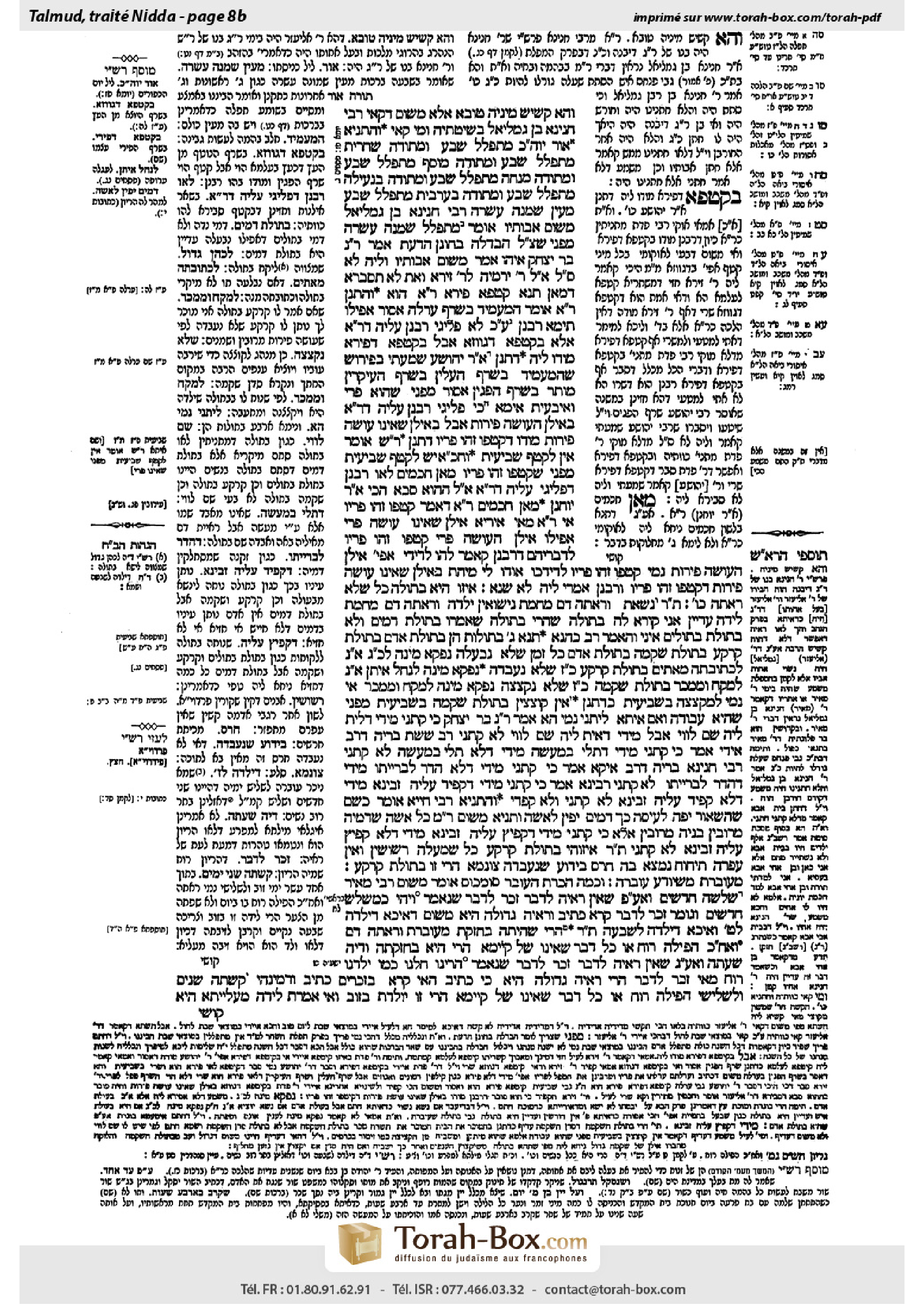
Niddah 8b: Talmud study for Daf Yomi
Daf Yomi is the daily study of one Talmud folio. Explore 37 tractates with scans, Hebrew text, Sefaria English and AI-generated French translations where annotated.
Passage selection and English or AI-generated French translation are available where the scan has annotations. Daf Study is independent of Torah-Box and Sefaria.
Browse Niddah · נידה · All tractatesNiddah 8b text and translations
This page of Niddah includes the Aramaic text, an English translation and an AI-generated French translation, alongside the scan above.
נידה ח׳ ב · Aramaic and Hebrew text
וְהָא קַשִּׁישׁ מִינֵּיהּ טוּבָא! אֶלָּא מִשּׁוּם דְּקָאֵי רַבִּי חֲנִינָא בֶּן גַּמְלִיאֵל בְּשִׁיטְתֵיהּ.
וּמִי קָאֵי? וְהָתַנְיָא: אוֹר יוֹם הַכִּפּוּרִים — מִתְפַּלֵּל שֶׁבַע וּמִתְוַדֶּה, שַׁחֲרִית — מִתְפַּלֵּל שֶׁבַע וּמִתְוַדֶּה, מוּסָף — מִתְפַּלֵּל שֶׁבַע וּמִתְוַדֶּה, מִנְחָה — מִתְפַּלֵּל שֶׁבַע וּמִתְוַדֶּה, בִּנְעִילָה — מִתְפַּלֵּל שֶׁבַע וּמִתְוַדֶּה, בְּעַרְבִית — מִתְפַּלֵּל שֶׁבַע מֵעֵין שְׁמֹנֶה עֶשְׂרֵה.
רַבִּי חֲנִינָא בֶּן גַּמְלִיאֵל מִשּׁוּם אֲבוֹתָיו אוֹמֵר: מִתְפַּלֵּל שְׁמֹנֶה עֶשְׂרֵה, מִפְּנֵי שֶׁצָּרִיךְ לוֹמַר הַבְדָּלָה בְּ״חוֹנֵן הַדָּעַת״. אָמַר רַב נַחְמָן בַּר יִצְחָק: אִיהוּ אָמַר מִשּׁוּם אֲבוֹתָיו, וְלֵיהּ לָא סְבִירָא לֵיהּ.
אֲמַר לֵיהּ רַבִּי יִרְמְיָה לְרַבִּי זֵירָא: וְאַתְּ לָא תִּסְבְּרַאּ דְּמַאן תְּנָא קִטְפָא פֵּירָא רַבִּי אֱלִיעֶזֶר הוּא? וְהָתְנַן: רַבִּי אֱלִיעֶזֶר אוֹמֵר: הַמַּעֲמִיד בִּשְׂרַף עָרְלָה אָסוּר!
אֲפִילּוּ תֵּימָא רַבָּנַן, עַד כָּאן לָא פְּלִיגִי רַבָּנַן עֲלֵיהּ דְּרַבִּי אֱלִיעֶזֶר אֶלָּא בְּקִטְפָא דִּגְוָוזָא, אֲבָל בְּקִטְפָא דְּפֵירָא מוֹדוּ לֵיהּ, דִּתְנַן: אָמַר רַבִּי יְהוֹשֻׁעַ: שָׁמַעְתִּי בְּפֵירוּשׁ שֶׁהַמַּעֲמִיד בִּשְׂרַף הֶעָלִין בִּשְׂרַף הָעִיקָּרִין מוּתָּר, בִּשְׂרַף הַפַּגִּין אָסוּר, מִפְּנֵי שֶׁהוּא פֶּרִי.
וְאִיבָּעֵית אֵימָא: כִּי פְּלִיגִי רַבָּנַן עֲלֵיהּ דְּרַבִּי אֱלִיעֶזֶר — בְּאִילָן הָעוֹשֶׂה פֵּירוֹת, אֲבָל בְּאִילָן שֶׁאֵינוֹ עוֹשֶׂה פֵּירוֹת — מוֹדוּ דִּקְטָפוֹ זֶהוּ פִּרְיוֹ. דִּתְנַן: רַבִּי שִׁמְעוֹן אוֹמֵר: אֵין לַקְּטָף שְׁבִיעִית, וַחֲכָמִים אוֹמְרִים: יֵשׁ לַקְּטָף שְׁבִיעִית, מִפְּנֵי שֶׁקְּטָפוֹ זֶהוּ פִּרְיוֹ.
מַאן חֲכָמִים? לָאו רַבָּנַן דִּפְלִיגִי עֲלֵיהּ דְּרַבִּי אֱלִיעֶזֶר? אֲמַר לֵיהּ הָהוּא סָבָא: הָכִי אָמַר רַבִּי יוֹחָנָן: מַאן חֲכָמִים? רַבִּי אֱלִיעֶזֶר, דְּאָמַר: קְטָפוֹ זֶהוּ פִּרְיוֹ.
אִי רַבִּי אֱלִיעֶזֶר, מַאי אִירְיָא אִילָן שֶׁאֵינוֹ עוֹשֶׂה פְּרִי? אֲפִילּוּ אִילָן הָעוֹשֶׂה פְּרִי — קְטָפוֹ זֶהוּ פִּרְיוֹ! לְדִבְרֵיהֶם דְּרַבָּנַן קָאָמַר לְהוּ: לְדִידִי, אֲפִילּוּ אִילָן הָעוֹשֶׂה פֵּירוֹת נָמֵי — קְטָפוֹ זֶהוּ פִּרְיוֹ. לְדִידְכוּ, אוֹדוֹ לִי מִיהַת בְּאִילָן שֶׁאֵינוֹ עוֹשֶׂה פֵּירוֹת דִּקְטָפוֹ זֶהוּ פִּרְיוֹ. וְרַבָּנַן אָמְרִי לֵיהּ: לָא שְׁנָא.
אֵיזוֹ הִיא בְּתוּלָה? כֹּל שֶׁלֹּא רָאֲתָה כּוּ׳. תָּנוּ רַבָּנַן: נִשֵּׂאת וְרָאֲתָה דָּם מֵחֲמַת נִישּׂוּאִין, יָלְדָה וְרָאֲתָה דָּם מֵחֲמַת לֵידָה — עֲדַיִין אֲנִי קוֹרֵא לָהּ ״בְּתוּלָה״, שֶׁהֲרֵי ״בְּתוּלָה״ שֶׁאָמְרוּ — בְּתוּלַת דָּמִים, וְלֹא בְּתוּלַת בְּתוּלִים.
אִינִי? וְהָאָמַר רַב כָּהֲנָא: תְּנָא, שָׁלֹשׁ בְּתוּלוֹת הֵן — בְּתוּלַת אָדָם, בְּתוּלַת קַרְקַע, בְּתוּלַת שִׁקְמָה. בְּתוּלַת אָדָם — כׇּל זְמַן שֶׁלֹּא נִבְעֲלָה, נָפְקָא מִינַּהּ לְכֹהֵן גָּדוֹל, אִי נָמֵי לִכְתוּבָּתָהּ מָאתַיִם.
בְּתוּלַת קַרְקַע — כׇּל זְמַן שֶׁלֹּא נֶעֶבְדָה. נָפְקָא מִינַּהּ לְנַחַל אֵיתָן, אִי נָמֵי לְמִקָּח וּמִמְכָּר.
בְּתוּלַת שִׁקְמָה — כׇּל זְמַן שֶׁלֹּא נִקְצְצָה. נָפְקָא מִינַּהּ לְמִקָּח וּמִמְכָּר, אִי נָמֵי לְמִקְצְצַהּ בִּשְׁבִיעִית, כְּדִתְנַן: אֵין קוֹצְצִין בְּתוּלַת שִׁקְמָה בַּשְּׁבִיעִית מִפְּנֵי שֶׁהִיא עֲבוֹדָה. וְאִם אִיתָא, לִיתְנֵי נָמֵי הָא!
אָמַר רַב נַחְמָן בַּר יִצְחָק: כִּי קָתָנֵי מִידֵּי דְּלֵית לֵיהּ שֵׁם לְוַוי, אֲבָל מִידֵּי דְּאִית לֵיהּ שֵׁם לְוַוי — לָא קָתָנֵי. רַב שֵׁשֶׁת בְּרֵיהּ דְּרַב אִידִי אָמַר: כִּי קָתָנֵי מִידֵּי דִּתְלֵי בְּמַעֲשֶׂה, מִידֵּי דְּלָא תְּלֵי בְּמַעֲשֶׂה — לָא קָתָנֵי.
רַבִּי חֲנִינָא בְּרֵיהּ דְּרַב אִיקָא אָמַר: כִּי קָתָנֵי מִידֵּי דְּלָא הָדַר לִבְרִיָּיתוֹ, מִידֵּי דְּהָדַר לִבְרִיָּיתוֹ לָא קָתָנֵי. רָבִינָא אָמַר: כִּי קָתָנֵי מִידֵּי דְּקָפֵיד עֲלֵיהּ זָבוֹנָא, מִידֵּי דְּלָא קָפֵיד עֲלֵיהּ זָבוֹנָא לָא קָתָנֵי.
וְלָא קָפְדִי? וְהָתַנְיָא: רַבִּי חִיָּיא אוֹמֵר: כְּשֵׁם שֶׁהַשְּׂאוֹר יָפֶה לָעִיסָּה, כָּךְ דָּמִים יָפִין לָאִשָּׁה. וְתַנְיָא מִשּׁוּם רַבִּי מֵאִיר: כׇּל אִשָּׁה שֶׁדָּמֶיהָ מְרוּבִּין — בָּנֶיהָ מְרוּבִּין! אֶלָּא, כִּי קָתָנֵי — מִידֵּי דְּקָפֵיץ עֲלֵיהּ זָבוֹנָא, מִידֵּי דְּלָא קָפֵיץ עֲלֵיהּ זָבוֹנָא — לָא קָתָנֵי.
תָּנוּ רַבָּנַן: אֵיזוֹהִי ״בְּתוּלַת קַרְקַע״? כֹּל שֶׁמַּעֲלָה רְשׁוּשִׁין, וְאֵין עֲפָרָהּ תִּיחוּחַ. נִמְצָא בָּהּ חֶרֶס — בְּיָדוּעַ שֶׁנֶּעֶבְדָה. צוּנְמָא — הֲרֵי זוֹ ״בְּתוּלַת קַרְקַע״.
מְעוּבֶּרֶת — מִשֶּׁיִּוָּדַע עוּבָּרָהּ. וְכַמָּה הַכָּרַת הָעוּבָּר? סוֹמְכוֹס אוֹמֵר מִשּׁוּם רַבִּי מֵאִיר: שְׁלֹשָׁה חֳדָשִׁים, וְאַף עַל פִּי שֶׁאֵין רְאָיָה לַדָּבָר, זֵכֶר לַדָּבָר, שֶׁנֶּאֱמַר: ״וַיְהִי כְּמִשְׁלֹשׁ חֳדָשִׁים וְגוֹמֵר״.
זֵכֶר לַדָּבָר? קְרָא כְּתִיב, וּרְאָיָה גְּדוֹלָה הִיא! מִשּׁוּם דְּאִיכָּא דְּיָלְדָה לְתִשְׁעָה, וְאִיכָּא דְּיָלְדָה לְשִׁבְעָה.
תָּנוּ רַבָּנַן: הֲרֵי שֶׁהָיְתָה בְּחֶזְקַת מְעוּבֶּרֶת, וְרָאֲתָה דָּם, וְאַחַר כָּךְ הִפִּילָה רוּחַ אוֹ כׇּל דָּבָר שֶׁאֵינוֹ שֶׁל קְיָימָא — הֲרֵי הִיא בְּחֶזְקָתָהּ, וְדַיָּה שְׁעָתָהּ.
וְאַף עַל גַּב שֶׁאֵין רְאָיָה לַדָּבָר, זֵכֶר לַדָּבָר, שֶׁנֶּאֱמַר: ״הָרִינוּ חַלְנוּ כְּמוֹ יָלַדְנוּ רוּחַ״. מַאי זֵכֶר לַדָּבָר? הֲרֵי רְאָיָה גְּדוֹלָה הִיא! כִּי כְּתִיב הַאי קְרָא, בִּזְכָרִים כְּתִיב.
וּרְמִינְהִי: קִשְּׁתָה שְׁנַיִם, וְלַשְּׁלִישִׁי הִפִּילָה רוּחַ אוֹ כׇּל דָּבָר שֶׁאֵינוֹ שֶׁל קְיָימָא — הֲרֵי זוֹ יוֹלֶדֶת בְּזוֹב, וְאִי אָמְרַתְּ לֵידָה מְעַלַּיְיתָא הִיא,
Niddah 8b · English translation
The Gemara asks: But wasn’t Rabbi Eliezer much older than Rabbi Ḥanina ben Gamliel? How could Rabbi Eliezer have cited the opinion of Rabbi Ḥanina ben Gamliel? The Gemara answers: Rather, the reason Rabbi Elazar ruled that the halakha is in accordance with the opinion of Rabbi Eliezer in that case was because Rabbi Ḥanina ben Gamliel held in accordance with his opinion.
And does Rabbi Ḥanina ben Gamliel really hold in accordance with Rabbi Eliezer’s opinion? But isn’t it taught in a baraita: On the night of Yom Kippur, one prays seven blessings in the Amida prayer and confesses; in the morning prayer, one prays seven blessings and confesses; in the additional prayer, one prays seven blessings and confesses; in the afternoon prayer, one prays seven blessings and confesses; and in the ne’ila prayer, one also prays seven blessings and confesses. For the evening prayer at the conclusion of Yom Kippur, one prays seven blessings in an abridged version of the eighteen blessings of the weekday Amida prayer. One recites the first three blessings, the final three, and a middle blessing that includes an abbreviated form of the other weekday blessings.
Rabbi Ḥanina ben Gamliel says in the name of his forefathers: One recites the complete eighteen blessings, due to the fact that he is required to recite havdala in the fourth blessing of the Amida: Who graciously grants knowledge. Havdala cannot be inserted into the abridged version. Evidently, Rabbi Ḥanina ben Gamliel does not agree with Rabbi Eliezer’s ruling that one recites havdala in the blessing of thanksgiving, one of the final three blessings of the Amida prayer. Rav Naḥman bar Yitzḥak says in explanation: Rabbi Ḥanina ben Gamliel said this opinion in the name of his forefathers, but he himself does not hold accordingly.
§ Earlier, Rabbi Zeira questioned the claim of Rabbi Pedat, son of Rabbi Eliezer, that the Sage who holds that balsam is considered to be fruit and therefore has the sanctity of the Sabbatical Year is Rabbi Eliezer. Rabbi Yirmeya said to Rabbi Zeira: And you? Do you not hold that the tanna who taught that balsam sap has the status of fruit is Rabbi Eliezer? As, didn’t we learn in a mishna (Orla 1:7) that Rabbi Eliezer says: With regard to one who curdles cheese in the sap of orla, the cheese is prohibited, as the sap is considered to be fruit of the tree.
The Gemara answers: You may even say that the mishna that deals with balsam is in accordance with the opinion of the Rabbis. As the Rabbis disagree with Rabbi Eliezer only with regard to the sap of the tree, but in the case of the sap of the fruit they agree with him. As we learned in a mishna (Orla 1:7) that Rabbi Yehoshua said: I heard explicitly that in the case of one who curdles cheese in the sap of the leaves or the sap of the roots of an orla tree, the cheese is permitted. But if it is curdled in the sap of unripe figs it is prohibited, because that sap is considered to be fruit.
And if you wish, say instead: When the Rabbis disagree with Rabbi Eliezer, it is with regard to a tree that bears fruit. But in the case of a tree that does not bear fruit, they agree that its sap is considered to be its fruit. As we learned in a mishna (Shevi’it 7:6) that Rabbi Shimon says: The sanctity of the Sabbatical Year does not apply to sap. And the Rabbis say: The sanctity of the Sabbatical Year does apply to sap, because its sap is its fruit.
The Gemara explains the proof: Who are these Rabbis? Are they not the Rabbis who disagree with Rabbi Eliezer? If so, this demonstrates that they agree in the case of a tree that does not bear fruit. The Gemara rejects this proof: A certain elder said to Rabbi Zeira that this is what Rabbi Yoḥanan says: Who are the Rabbis in this mishna? It is Rabbi Eliezer, who said that its sap is considered to be its fruit.
The Gemara asks: If it is the opinion of Rabbi Eliezer, why are they specifically discussing the case of a tree that does not bear fruit? Even in the case of a tree that does bear fruit, Rabbi Eliezer maintains that its sap is like its fruit. The Gemara answers: Rabbi Eliezer stated his opinion to them in accordance with the statement of the Rabbis themselves, as follows: According to my opinion, even with regard to a tree that bears fruit, its sap is also considered to be its fruit. But according to your opinion, you should at least agree with me in the case of a tree that does not bear fruit, that its sap is considered to be its fruit. And the Rabbis said in response to Rabbi Eliezer: It is no different. Sap is not considered fruit whether it comes from a fruit-bearing tree or a barren tree.
§ The mishna teaches: Who is the woman characterized as a virgin in this context? It is any woman who did not see the flow of menstrual blood in all her days, even if she was married and experienced bleeding resulting from intercourse consummating her marriage. The Sages taught: If she was married and she saw a flow of blood due to her marriage, i.e., blood resulting from the tearing of her hymen; or if she gave birth and saw blood due to the birth, I still call her a virgin in this context. The reason is that when they said: Virgin here, they meant a menstrual blood virgin, i.e., one who did not yet see a menstrual flow, and not a hymen-blood virgin, i.e., one who did not experience bleeding from a torn hymen.
The Gemara asks: Is that so? But didn’t Rav Kahana say that a Sage taught: There are three types of virgins: A virgin human, virgin ground, and a virgin sycamore. A virgin human is a woman for as long as she has not engaged in intercourse. The relevance of this designation is that only a virgin is permitted to marry a High Priest (see Leviticus 21:13–14). Alternatively, the relevance is that her marriage contract is two hundred dinars, instead of the one hundred dinars in the marriage contract of a non-virgin.
Virgin ground is ground for as long as it has not been worked. The relevance of this designation is with regard to the rough dried-up stream mentioned in the Torah. When the corpse of a murder victim is found between two towns and the murderer is unknown, the Torah states that a heifer’s neck is broken in a place that was not worked. Alternatively, the relevance is with regard to buying and selling. If one stipulates that he is buying virgin land, it is defined as land that has never been worked.
Finally, a virgin sycamore is a sycamore for as long as it has not been felled, i.e., cut to promote growth. The relevance of this designation is with regard to buying and selling. If one stipulates that he is buying virgin sycamore, it is defined as one that has never been felled. Alternatively, the relevance is with regard to the prohibition against felling it in the Sabbatical Year, as we learned in a mishna: (Shevi’it 4:5): One may not fell a virgin sycamore in the Sabbatical Year, because it is considered work, as this promotes the growth of the tree. The Gemara explains its question: And if it is so, that there is a concept of a virgin from menstrual blood, let the tanna of this baraita also teach this type of virgin.
The Gemara cites several answers. Rav Naḥman bar Yitzḥak says: When the Sage teaches the list of virgins, he includes only an item that does not have a modifier, but he does not teach an item that has a modifier. A virgin human, virgin land, and a virgin sycamore can be referred to without another modifier. Conversely, a virgin with regard to menstrual blood cannot be referred to simply by the unmodified term: Virgin. Rav Sheshet, son of Rav Idi, says: When the Sage teaches the list of virgins, he includes only an item that is dependent upon an outside action, e.g., intercourse in the case of a human virgin or felling in the case of a virgin sycamore. But he does not teach an item that is not dependent upon an outside action, such as a woman’s menstrual flow.
Rabbi Ḥanina, son of Rav Ika says: When the Sage teaches the list of virgins, he includes only an item that will not later revert to its original state. But he does not teach an item that will later revert to its original state, such as a woman’s menstrual flow that ceases when she reaches old age. Ravina says: When the Sage teaches the list of virgins, he includes only an item about which a buyer is particular, such as one who purchases a virgin sycamore tree. But he does not teach an item about which a buyer is not particular, e.g., a woman’s menstrual blood.
The Gemara asks: And is a buyer, i.e., a potential husband, not particular about her menstrual blood? But isn’t it taught in a baraita that Rabbi Ḥiyya says: Just as leaven is fortuitous for dough, so too, blood is fortuitous for a woman; and it is taught in another baraita in the name of Rabbi Meir: Any woman whose blood is plentiful, her children are plentiful? A potential husband would certainly be particular about this factor. The Gemara provides an alternative answer: Rather, when the Sage teaches the list of virgins, he includes only an item that buyers are eager to purchase. But he does not teach an item that buyers are not eager to purchase, e.g., a woman without menstrual blood.
The Sages taught in a baraita: What is virgin ground? It is any ground that raises up hard clumps of earth and whose dirt is not loose. If one finds a shard of earthenware in the earth, it is thereby known that it was once worked and is not virgin ground. If one finds hard rock, it is virgin ground.
§ The mishna teaches: The time of a pregnant woman is sufficient from the point in her pregnancy when the existence of her fetus is known to all who see her. The Gemara asks: And how much time must pass for the fetus to be known? Sumakhos says in the name of Rabbi Meir: Three months. And although there is no explicit proof for the matter, that a fetus is discernable after three months of pregnancy, there is an allusion to the matter, as it is stated: “And it came to pass about three months after, that it was told to Judah, saying: Tamar your daughter-in-law has played the harlot” (Genesis 38:24).
The Gemara asks: Why does Rabbi Meir call this a mere allusion to the matter? An explicit verse is written, and that is a significant proof. The Gemara answers: It is only an allusion because there are some women who give birth after nine months and there are others who give birth after seven months. Although the verse indicates that a fetus is known to all after three months, it is possible that this applies only to a nine-month pregnancy. Since in the case of a nine-month pregnancy the fetus is recognizable after a third of the full term, with regard to a seven-month pregnancy, the fetus would likewise be noticeable after a third of the full pregnancy, i.e., at two and one-third months. Therefore, Rabbi Meir teaches that in all cases the fetus is known only after three months.
The Sages taught in a baraita: With regard to a woman who had a presumptive status that she was pregnant and she saw blood, and afterward she miscarried air, or anything that is not a viable fetus, she retains her presumptive status, and therefore her time is sufficient from that flow of blood, i.e., it renders her impure only from then on, not retroactively, as even a non-viable fetus gives her full pregnancy status.
And even though there is no explicit proof for this matter, that even a pregnancy that ends in a miscarriage is like a full-fledged pregnancy, there is an allusion to the matter, as it is stated: “We have been with child, we have been in pain, we have as it were brought forth wind” (Isaiah 26:18). This verse indicates that even one who miscarries wind is considered as having been with child. The Gemara asks: What is the reason that this is called a mere allusion to the matter? This explicit verse is a significant proof. The Gemara answers: When that verse was written, it was written with regard to males as bearing children. The allusion to child-bearing in the verse is symbolic, so halakhic inferences may not be drawn from it.
And the Gemara raises a contradiction from a baraita: If a woman experienced labor pain for two days, during which she saw a discharge of blood, and on the third day she miscarried air or anything that is not a viable fetus, that woman gives birth as a zava, and the blood is treated as blood of a zava in all regards. The Gemara explains the contradiction: And if you say that miscarrying a non-viable fetus is considered a proper birth, this is problematic,
Niddah 8b · Traduction française (IA)
La Guemara demande : Mais Rabbi Eliezer n’était-il pas beaucoup plus âgé que Rabbi Ḥanina ben Gamliel ? Comment aurait-il pu citer l’opinion de Rabbi Ḥanina ben Gamliel ? La Guemara répond : En réalité, Rabbi Elazar a statué que la halakha suit l’opinion de Rabbi Eliezer dans ce cas parce que Rabbi Ḥanina ben Gamliel partageait son avis.
Or, Rabbi Ḥanina ben Gamliel est-il vraiment du même avis que Rabbi Eliezer ? N’est-il pas enseigné dans une baraïta : Le soir de Yom Kippour, on récite sept bénédictions dans la prière de la Amida et on se confesse ; à la prière du matin, on récite sept bénédictions et on se confesse ; à la prière supplémentaire, on récite sept bénédictions et on se confesse ; à la prière de l’après-midi, on récite sept bénédictions et on se confesse ; et à la prière de ne’ila, on récite également sept bénédictions et on se confesse. Pour la prière du soir à la fin de Yom Kippour, on récite sept bénédictions, sous la forme abrégée des dix-huit bénédictions de la Amida des jours de semaine. On récite les trois premières bénédictions, les trois dernières et une bénédiction intermédiaire qui résume les autres bénédictions des jours de semaine.
Rabbi Ḥanina ben Gamliel dit au nom de ses ancêtres : On récite les dix-huit bénédictions complètes, car on doit réciter la havdala dans la quatrième bénédiction de la Amida : « Toi qui accordes généreusement la connaissance ». La havdala ne peut pas être insérée dans la version abrégée. Il apparaît donc que Rabbi Ḥanina ben Gamliel ne partage pas la décision de Rabbi Eliezer, selon laquelle on récite la havdala dans la bénédiction d’action de grâce, l’une des trois dernières bénédictions de la Amida. Rav Naḥman bar Yitzḥak explique : Rabbi Ḥanina ben Gamliel a rapporté cette opinion au nom de ses ancêtres, mais lui-même ne la partage pas.
§ Plus haut, Rabbi Zeira a mis en doute l’affirmation de Rabbi Pedat, fils de Rabbi Eliezer, selon laquelle le Sage qui considère que le baume est un fruit et qu’il possède donc la sainteté de la septième année est Rabbi Eliezer. Rabbi Yirmeya dit à Rabbi Zeira : Et toi ? Ne considères-tu pas que le tanna qui a enseigné que la sève du baume a le statut d’un fruit est Rabbi Eliezer ? N’avons-nous pas appris dans une Michna (Orla 1:7) que Rabbi Eliezer dit : Si quelqu’un fait cailler du fromage avec la sève d’un arbre soumis à l’interdit d’orla, le fromage est interdit, car cette sève est considérée comme le fruit de l’arbre ?
La Guemara répond : On peut même dire que la Michna qui traite du baume suit l’opinion des Rabbins. En effet, les Rabbins ne sont en désaccord avec Rabbi Eliezer qu’au sujet de la sève de l’arbre ; dans le cas de la sève du fruit, ils sont d’accord avec lui. Car nous avons appris dans une Michna (Orla 1:7) que Rabbi Yehoshua a dit : J’ai entendu explicitement que, si quelqu’un fait cailler du fromage avec la sève des feuilles ou des racines d’un arbre soumis à l’interdit d’orla, le fromage est permis. Mais si le fromage est caillé avec la sève de figues non mûres, il est interdit, car cette sève est considérée comme un fruit.
Et si tu le souhaites, dis plutôt ceci : lorsque les Rabbins sont en désaccord avec Rabbi Eliezer, c’est au sujet d’un arbre qui porte des fruits. Mais, dans le cas d’un arbre qui n’en porte pas, ils admettent que sa sève est considérée comme son fruit. Car nous avons appris dans une Michna (Shevi’it 7:6) que Rabbi Shimon dit : La sainteté de la septième année ne s’applique pas à la sève. Et les Rabbins disent : La sainteté de la septième année s’applique à la sève, car celle-ci est le fruit de l’arbre.
La Guemara explique la preuve : Qui sont ces Rabbins ? Ne sont-ils pas les Rabbins en désaccord avec Rabbi Eliezer ? Si c’est le cas, cela démontre qu’ils sont d’accord dans le cas d’un arbre qui ne porte pas de fruits. La Guemara rejette cette preuve : Un certain ancien a dit à Rabbi Zeira que voici ce que dit Rabbi Yoḥanan : Qui sont les Rabbins de cette Michna ? C’est Rabbi Eliezer, qui a dit que la sève de l’arbre est considérée comme son fruit.
La Guemara demande : Si c’est l’opinion de Rabbi Eliezer, pourquoi parlent-ils précisément d’un arbre qui ne porte pas de fruits ? Même dans le cas d’un arbre qui en porte, Rabbi Eliezer soutient que sa sève est comme son fruit. La Guemara répond : Rabbi Eliezer leur a présenté son opinion en se plaçant du point de vue de la déclaration des Rabbins eux-mêmes, comme suit : Selon mon opinion, même la sève d’un arbre qui porte des fruits est considérée comme son fruit. Mais, selon votre opinion, vous devriez au moins être d’accord avec moi dans le cas d’un arbre qui ne porte pas de fruits : sa sève est considérée comme son fruit. Les Rabbins répondirent à Rabbi Eliezer : Cela ne fait aucune différence. La sève n’est pas considérée comme un fruit, qu’elle provienne d’un arbre fruitier ou d’un arbre stérile.
§ La Michna enseigne : Quelle femme est qualifiée de vierge dans ce contexte ? Toute femme qui n’a jamais vu d’écoulement de sang menstruel, même si elle a été mariée et a eu un saignement lors du rapport sexuel qui a consommé son mariage. Les Sages ont enseigné : Si elle a été mariée et a vu du sang à la suite de son mariage, c’est-à-dire du sang causé par la déchirure de son hymen ; ou si elle a accouché et a vu du sang à la suite de l’accouchement, je la qualifie tout de même de vierge dans ce contexte. En effet, lorsqu’ils ont dit « vierge » ici, ils entendaient une vierge du point de vue du sang menstruel, c’est-à-dire une femme qui n’a pas encore vu d’écoulement menstruel, et non une vierge du point de vue du sang de l’hymen, c’est-à-dire une femme qui n’a pas eu de saignement dû à la déchirure de l’hymen.
La Guemara demande : Est-ce vraiment le cas ? Rav Kahana n’a-t-il pas dit qu’un Sage enseignait : Il existe trois sortes de vierges : une vierge humaine, une terre vierge et un sycomore vierge. Une vierge humaine est une femme tant qu’elle n’a pas eu de rapports sexuels. Cette désignation est pertinente parce que seule une vierge a le droit d’épouser un grand prêtre (voir Lévitique 21:13–14). Elle est également pertinente parce que sa ketouba s’élève à deux cents dinars, au lieu des cent dinars prévus dans la ketouba d’une femme qui n’est pas vierge.
Une terre vierge est une terre qui n’a pas été travaillée. Cette désignation est pertinente à propos du cours d’eau rocailleux et asséché mentionné dans la Torah. Lorsque le corps d’une victime de meurtre est découvert entre deux villes et que le meurtrier est inconnu, la Torah prescrit de briser la nuque d’une génisse en un lieu qui n’a pas été travaillé. Elle est également pertinente pour les transactions commerciales : si quelqu’un stipule qu’il achète une terre vierge, il s’agit d’une terre qui n’a jamais été travaillée.
Enfin, un sycomore vierge est un sycomore qui n’a pas encore été élagué, c’est-à-dire coupé pour favoriser sa croissance. Cette désignation est pertinente pour les transactions commerciales : si quelqu’un stipule qu’il achète un sycomore vierge, il s’agit d’un sycomore qui n’a jamais été élagué. Elle est également pertinente au sujet de l’interdiction d’élaguer un sycomore pendant la septième année, comme nous l’avons appris dans une Michna (Shevi’it 4:5) : On ne peut pas élaguer un sycomore vierge pendant la septième année, car cela est considéré comme un travail, puisque cela favorise la croissance de l’arbre. La Guemara explique sa question : Et s’il existe une catégorie de vierge définie par l’absence de sang menstruel, que le tanna de cette baraïta enseigne également cette catégorie de vierge.
La Guemara rapporte plusieurs réponses. Rav Naḥman bar Yitzḥak dit : Lorsque le Sage enseigne la liste des vierges, il n’inclut que les cas qui ne requièrent pas de qualificatif, mais il n’enseigne pas ceux qui en requièrent un. Une vierge humaine, une terre vierge et un sycomore vierge peuvent être désignés sans autre qualificatif. À l’inverse, une vierge du point de vue du sang menstruel ne peut pas être désignée simplement par le terme « vierge », sans qualificatif. Rav Sheshet, fils de Rav Idi, dit : Lorsque le Sage enseigne la liste des vierges, il n’inclut que les cas qui dépendent d’une action extérieure, par exemple les rapports sexuels dans le cas d’une vierge humaine ou l’élagage dans celui d’un sycomore vierge. Mais il n’enseigne pas un cas qui ne dépend pas d’une action extérieure, comme l’écoulement menstruel d’une femme.
Rabbi Ḥanina, fils de Rav Ika, dit : Lorsque le Sage enseigne la liste des vierges, il n’inclut que les cas où l’état ne revient pas ultérieurement à son état initial. Mais il n’enseigne pas les cas où l’état revient ultérieurement à son état initial, comme l’écoulement menstruel d’une femme, qui cesse lorsqu’elle atteint un âge avancé. Ravina dit : Lorsque le Sage enseigne la liste des vierges, il n’inclut que les cas auxquels un acheteur attache de l’importance, comme lorsqu’il achète un sycomore vierge. Mais il n’enseigne pas les cas auxquels un acheteur n’attache pas d’importance, par exemple le sang menstruel d’une femme.
La Guemara demande : Un acheteur, c’est-à-dire un mari potentiel, n’attache-t-il pas d’importance à son sang menstruel ? Rabbi Ḥiyya ne dit-il pas dans une baraïta : De même que le levain est bénéfique pour la pâte, le sang est bénéfique pour une femme ? Et une autre baraïta n’enseigne-t-elle pas au nom de Rabbi Meir : Toute femme dont le sang est abondant a de nombreux enfants ? Un mari potentiel attacherait certainement de l’importance à ce facteur. La Guemara propose une autre réponse : En réalité, lorsque le Sage enseigne la liste des vierges, il n’inclut que les cas que les acheteurs sont désireux d’acquérir. Mais il n’enseigne pas les cas que les acheteurs ne sont pas désireux d’acquérir, par exemple une femme qui n’a pas de sang menstruel.
Les Sages ont enseigné dans une baraïta : Qu’est-ce qu’une terre vierge ? C’est toute terre qui forme des mottes dures et dont le sol n’est pas meuble. Si l’on trouve un tesson de poterie dans la terre, on sait alors qu’elle a déjà été travaillée et qu’elle n’est pas vierge. Si l’on trouve de la roche dure, la terre est vierge.
§ La Michna enseigne : Pour une femme enceinte, le délai suffisant commence au moment de sa grossesse où l’existence de son fœtus est connue de tous ceux qui la voient. La Guemara demande : Combien de temps faut-il pour que l’existence du fœtus soit connue ? Soumakhos dit au nom de Rabbi Meir : Trois mois. Et bien qu’il n’y ait pas de preuve explicite à ce sujet, à savoir qu’un fœtus est discernable après trois mois de grossesse, il existe une allusion à cela, comme il est dit : « Or, environ trois mois après, on informa Juda en disant : Tamar, ta belle-fille, s’est prostituée » (Genèse 38:24).
La Guemara demande : Pourquoi Rabbi Meir qualifie-t-il cela de simple allusion ? Un verset explicite est écrit, ce qui constitue une preuve importante. La Guemara répond : Ce n’est qu’une allusion, car certaines femmes accouchent après neuf mois et d’autres après sept mois. Bien que le verset indique qu’un fœtus est connu de tous après trois mois, il est possible que cela ne s’applique qu’à une grossesse de neuf mois. Puisque, dans le cas d’une grossesse de neuf mois, le fœtus est reconnaissable après un tiers de la durée totale, dans le cas d’une grossesse de sept mois, il serait également visible après un tiers de la grossesse, c’est-à-dire au bout de deux mois et un tiers. Rabbi Meir enseigne donc que, dans tous les cas, le fœtus n’est connu qu’au bout de trois mois.
Les Sages ont enseigné dans une baraïta : Si une femme était présumée enceinte, qu’elle a vu du sang, puis a expulsé de l’air ou tout autre élément qui n’est pas un fœtus viable, elle conserve son statut présumé ; par conséquent, le délai suffisant commence à cet écoulement de sang, c’est-à-dire que le sang ne la rend impure qu’à partir de ce moment-là, et non rétroactivement, car même un fœtus non viable lui confère pleinement le statut de femme enceinte.
Et bien qu’il n’y ait pas de preuve explicite à ce sujet, à savoir qu’une grossesse qui se termine par une fausse couche équivaut à une grossesse menée à terme, il existe une allusion à cela, comme il est dit : « Nous avons conçu, nous avons souffert, nous avons, pour ainsi dire, enfanté du vent » (Isaïe 26:18). Ce verset indique que même une femme qui expulse du vent lors d’une fausse couche est considérée comme ayant conçu. La Guemara demande : Pourquoi cela est-il qualifié de simple allusion ? Ce verset explicite constitue une preuve importante. La Guemara répond : Lorsque ce verset a été écrit, il l’a été à propos d’hommes qui enfantent. L’allusion à l’enfantement dans le verset est symbolique ; on ne peut donc pas en tirer d’inférences halakhiques.
La Guemara soulève une contradiction à partir d’une baraïta : Si une femme a éprouvé des douleurs de travail pendant deux jours, au cours desquels elle a vu un écoulement de sang, et que le troisième jour elle a expulsé de l’air ou tout autre élément qui n’est pas un fœtus viable, cette femme accouche en tant que zava, et le sang est considéré à tous égards comme du sang de zava. La Guemara explique la contradiction : Si tu dis que l’expulsion d’un fœtus non viable est considérée comme un véritable accouchement, cela pose problème,
Traduction française générée par IA à partir de l’édition anglaise de Sefaria. Vérifie toujours un passage avec le texte source.
Text from Sefaria: William Davidson Edition - Vocalized Aramaic (CC BY NC); William Davidson Edition - English (CC BY NC).