Niddah 8a: Talmud study for Daf Yomi
Daf Yomi is the daily study of one Talmud folio. Explore 37 tractates with scans, Hebrew text, Sefaria English and AI-generated French translations where annotated.
Passage selection and English or AI-generated French translation are available where the scan has annotations. Daf Study is independent of Torah-Box and Sefaria.
Browse Niddah · נידה · All tractatesNiddah 8a text and translations
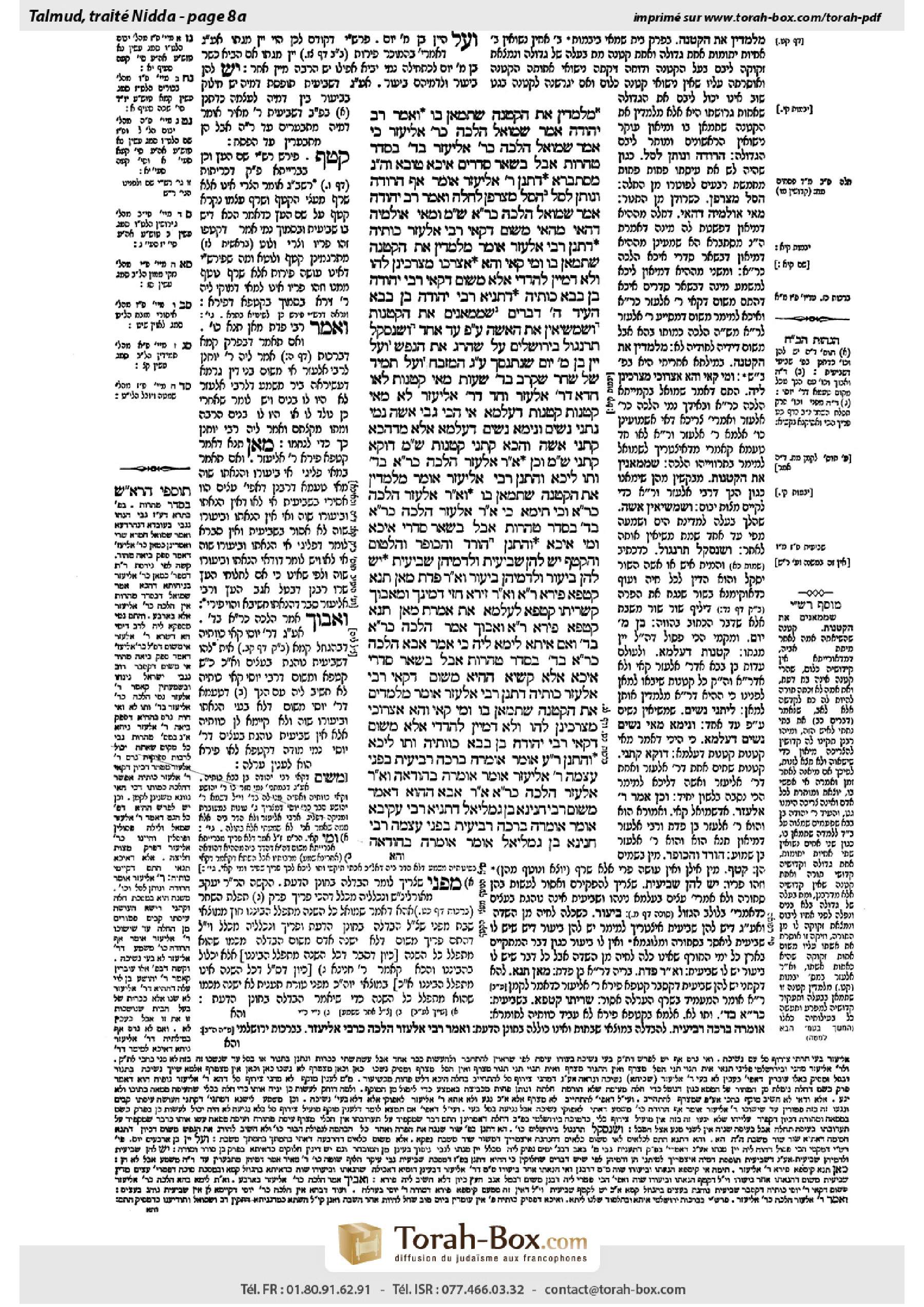
This page of Niddah includes the Aramaic text, an English translation and an AI-generated French translation, alongside the scan above.
נידה ח׳ א · Aramaic and Hebrew text
מְלַמְּדִין אֶת הַקְּטַנָּה שֶׁתְּמָאֵן בּוֹ, וְאָמַר רַב יְהוּדָה אָמַר שְׁמוּאֵל: הֲלָכָה כְּרַבִּי אֱלִיעֶזֶר! כִּי אָמַר שְׁמוּאֵל הֲלָכָה כְּרַבִּי אֱלִיעֶזֶר בְּאַרְבָּעָה בְּסֵדֶר טְהָרוֹת, אֲבָל בִּשְׁאָר סְדָרִים אִיכָּא טוּבָא.
וְהָכִי נָמֵי מִסְתַּבְּרָא, דִּתְנַן: רַבִּי אֱלִיעֶזֶר אוֹמֵר: אַף הָרוֹדֶה וְנוֹתֵן לַסַּל, הַסַּל מְצָרְפָן לַחַלָּה. וְאָמַר רַב יְהוּדָה אָמַר שְׁמוּאֵל: הֲלָכָה כְּרַבִּי אֱלִיעֶזֶר. שְׁמַע מִינַּהּ.
וּמַאי אוּלְמֵיהּ דְּהַאי מֵהַאי? מִשּׁוּם דְּקָאֵי רַבִּי אֶלְעָזָר כְּוָתֵיהּ.
דִּתְנַן: רַבִּי אֶלְעָזָר אוֹמֵר: מְלַמְּדִין אֶת הַקְּטַנָּה שֶׁתְּמָאֵן בּוֹ.
וּמִי קָאֵי? וְהָא אַצְרוֹכֵי מַצְרְכִינַן לְהוּ, וְלָא דָּמְיָין לַהֲדָדֵי! אֶלָּא, מִשּׁוּם דְּקָאֵי רַבִּי יְהוּדָה בֶּן בָּבָא כְּוָתֵיהּ.
דְּתַנְיָא, רַבִּי יְהוּדָה בֶּן בָּבָא הֵעִיד חֲמִשָּׁה דְּבָרִים: שֶׁמְּמָאֲנִים אֶת הַקְּטַנּוֹת.
וְשֶׁמַּשִּׂיאִין אֶת הָאִשָּׁה עַל פִּי עֵד אֶחָד, וְשֶׁנִּסְקַל תַּרְנְגוֹל בִּירוּשָׁלַיִם עַל שֶׁהָרַג אֶת הַנֶּפֶשׁ, וְעַל יַיִן בֶּן אַרְבָּעִים יוֹם שֶׁנִּתְנַסֵּךְ עַל גַּבֵּי הַמִּזְבֵּחַ, וְעַל תָּמִיד שֶׁל שַׁחַר שֶׁקָּרַב בְּאַרְבַּע שָׁעוֹת.
מַאי קְטַנּוֹת? לָאו חֲדָא דְּרַבִּי אֶלְעָזָר, וְחַד דְּרַבִּי אֱלִיעֶזֶר? לָא, מַאי קְטַנּוֹת? קְטַנּוֹת דְּעָלְמָא.
אִי הָכִי, גַּבֵּי אִשָּׁה נָמֵי, נִתְנֵי ״נָשִׁים״ וְנֵימָא נָשִׁים דְּעָלְמָא! אֶלָּא, מִדְּהָכָא קָתָנֵי ״אִשָּׁה״, וְהָכָא קָתָנֵי ״קְטַנּוֹת״, שְׁמַע מִינַּהּ דַּוְקָא קָתָנֵי. שְׁמַע מִינַּהּ.
וְכֵן אָמַר רַבִּי אֶלְעָזָר: הֲלָכָה כְּרַבִּי אֱלִיעֶזֶר בְּאַרְבָּעָה. וְתוּ לֵיכָּא? וְהָתְנַן: רַבִּי אֱלִיעֶזֶר אוֹמֵר מְלַמְּדִין אֶת הַקְּטַנָּה שֶׁתְּמָאֵן בּוֹ, וְאָמַר רַבִּי אֶלְעָזָר: הֲלָכָה כְּרַבִּי אֱלִיעֶזֶר! וְכִי תֵימָא: כִּי אָמַר רַבִּי אֶלְעָזָר הֲלָכָה כְּרַבִּי אֱלִיעֶזֶר בְּאַרְבָּעָה בְּסֵדֶר טְהָרוֹת, אֲבָל בִּשְׁאָר סִדְרֵי אִיכָּא. וּמִי אִיכָּא?
וְהָתְנַן: הַוֶּרֶד, וְהַכּוֹפֶר, וְהַלְּטוֹם, וְהַקְּטָף — יֵשׁ לָהֶן שְׁבִיעִית, וְלִדְמֵיהֶן שְׁבִיעִית, יֵשׁ לָהֶן בִּיעוּר, וְלִדְמֵיהֶן בִּיעוּר. וְאָמַר רַבִּי פְּדָת: מַאן תְּנָא קִטְפָא פֵּירָא? רַבִּי אֱלִיעֶזֶר.
וְאָמַר רַבִּי זֵירָא: חֲזִי דְּמִינָּךְ וּמֵאֲבוּךְ קָשָׁרֵיתוּ קִטְפָא לְעָלְמָא! אַתְּ אָמְרַתְּ: מַאן תַּנָּא קִטְפָא פֵּירָא? רַבִּי אֱלִיעֶזֶר, וַאֲבוּךְ אָמַר: הֲלָכָה כְּרַבִּי אֱלִיעֶזֶר בְּאַרְבָּעָה.
וְאִם אִיתָא, לֵימָא לֵיהּ: כִּי אָמַר אַבָּא הֲלָכָה כְּרַבִּי אֱלִיעֶזֶר בְּאַרְבָּעָה בְּסֵדֶר טְהָרוֹת, אֲבָל בִּשְׁאָר סִדְרֵי אִיכָּא.
אֶלָּא קַשְׁיָא הָהִיא! מִשּׁוּם דְּקָאֵי רַבִּי אֶלְעָזָר כְּוָתֵיהּ, דִּתְנַן: רַבִּי אֶלְעָזָר אוֹמֵר: מְלַמְּדִים אֶת הַקְּטַנָּה שֶׁתְּמָאֵן בּוֹ.
וּמִי קָאֵי, וְהָא אַצְרוֹכֵי מַצְרְכִינַן לְהוּ, וְלָא דָּמְיָין לַהֲדָדֵי! אֶלָּא מִשּׁוּם דְּקָאֵי רַבִּי יְהוּדָה בֶּן בָּבָא כְּוָותֵיהּ.
וְתוּ לֵיכָּא? וְהָתְנַן: רַבִּי עֲקִיבָא אוֹמֵר: אוֹמְרָהּ בְּרָכָה רְבִיעִית בִּפְנֵי עַצְמָהּ, רַבִּי אֱלִיעֶזֶר אוֹמֵר: אוֹמְרָהּ בַּהוֹדָאָה, וְאָמַר רַבִּי אֶלְעָזָר: הֲלָכָה כְּרַבִּי אֱלִיעֶזֶר!
אָמַר רַבִּי אַבָּא: הָהוּא דְּאָמַר מִשּׁוּם רַבִּי חֲנִינָא בֶּן גַּמְלִיאֵל, דְּתַנְיָא: רַבִּי עֲקִיבָא אוֹמֵר: אוֹמְרָהּ בְּרָכָה רְבִיעִית בִּפְנֵי עַצְמָהּ, רַבִּי חֲנִינָא בֶּן גַּמְלִיאֵל אוֹמֵר: אוֹמְרָהּ בַּהוֹדָאָה.
Niddah 8a · English translation
We instruct the minor, i.e., the surviving brother’s wife, to refuse to continue to stay married to him so that her marriage is dissolved, and he may then enter into levirate marriage with her adult sister, the widow of his childless brother. And Rav Yehuda says that Shmuel says: The halakha is in accordance with the opinion of Rabbi Eliezer. The Gemara explains: When Shmuel says that the halakha is in accordance with the opinion of Rabbi Eliezer in four cases, what he meant was four cases within Seder Teharot in the Mishna, the order that deals with ritual purity. But in the other orders, there are many instances where the halakha is in accordance with the opinion of Rabbi Eliezer.
The Gemara adds: This too stands to reason, as we learned in a mishna in the order of Zera’im (Ḥalla 2:4) that Rabbi Eliezer says: Even with regard to one who removes loaves of bread from an oven and places them in a basket, the basket serves to combine them to reach the quantity from which one is required to separate ḥalla, despite the fact that each of the loaves does not contain the necessary measure for ḥalla on its own. And Rav Yehuda says that Shmuel says: The halakha is in accordance with the opinion of Rabbi Eliezer. Conclude from this that Shmuel’s general statement applies only to Seder Teharot.
The Gemara raises a difficulty: The case of ḥalla was cited as proof that there is an exception to Shmuel’s principle that there are only four cases where the halakha is in accordance with the opinion of Rabbi Eliezer, after a difficulty was raised from the case of levirate marriage with the sister of one’s minor wife. But in what way is this case of ḥalla greater proof than that case of the levirate marriage? Neither case appears in Seder Teharot. The Gemara answers: The case of the levirate marriage is different, as there Rabbi Elazar holds in accordance with the opinion of Rabbi Eliezer.
As we learned in the mishna (Yevamot 111b): A yavam may perform levirate marriage with only one of his deceased brother’s wives. Once he does so, the other wives are forbidden to him, because they had been married to his brother. If a deceased brother had two wives, an adult and a minor, and the yavam engaged in sexual intercourse with the minor and then engaged in intercourse with the adult, the Rabbis maintain that he disqualifies the minor from staying married to him, as her levirate bond is uncertain, and the adult wife is also prohibited to him, because the levirate marriage with the minor is considered effective by rabbinic law. Rabbi Elazar says: The court instructs the minor to refuse him, thereby annulling her marriage retroactively, and he may then perform levirate marriage with the adult. Accordingly, the case of ḥalla is a stronger example, as there the halakha is in accordance with the opinion of Rabbi Eliezer exclusively, as his opinion is not supported by another tanna.
The Gemara asks: And does Rabbi Elazar in fact hold in accordance with the opinion of Rabbi Eliezer? But doesn’t the Gemara (Yevamot 111b) explain that both the opinions of Rabbi Eliezer and Rabbi Elazar are necessary, as they apply to different cases, and therefore they are not comparable to each other? The Gemara suggests a new answer: Rather, the ruling with regard to levirate marriage is a weaker example of a case where the halakha is in accordance with the opinion of Rabbi Eliezer because Rabbi Yehuda ben Bava holds in accordance with his opinion.
As it is taught in a baraita: Rabbi Yehuda ben Bava testified about five matters of halakha: Normally, marriage refusals of girls married off by their mother or brothers are discouraged. Yet, in specific instances where it is clear that if the marriage were to remain in effect it would engender problems related to levirate marriage and ḥalitza, the court persuades minor girls to refuse to continue living with their husbands, thereby resolving the complications involved in the case.
And he also testified that one may allow a woman who seeks to remarry after hearing of her husband’s death to marry based on the testimony of one witness, as opposed to the two witnesses required for other matters of testimony. And he further testified that a rooster was stoned to death in Jerusalem for killing a person, in order to teach that the Torah law requiring the stoning of an ox that killed a person (see Exodus 21:28) applies to other animals as well. And he testified about forty-day-old wine that was used for libation on the altar. And finally, he testified about the daily morning offering that was sacrificed at four hours of the day.
The Gemara concludes its proof: When the baraita teaches that Rabbi Yehuda ben Bava testified that the court persuades minor girls to refuse to continue living with their husbands, what is the significance of the reference to minor girls in the plural? Is this not referring to the one minor girl who is the subject of the ruling of Rabbi Elazar and the other one that is the subject of the ruling of Rabbi Eliezer? Apparently, Rabbi Yehuda ben Bava holds in accordance with the opinion of Rabbi Eliezer in the case of the minor’s refusal. If so, this ruling is a weaker proof that the halakha is in accordance with the opinion of Rabbi Eliezer in cases outside of Seder Teharot. The Gemara answers: No, what is meant by the plural: Minor girls? It means minor girls in general, i.e., all minor girls in such cases where the ruling of Rabbi Elazar applies.
The Gemara challenges: If so, with regard to the halakha listed in the baraita that one may allow a woman to marry based on the testimony of one witness, let it also teach: Women, in the plural, and we will say that it is referring to women in general. Rather, from the fact that here it teaches: A woman, and yet here it teaches: Minor girls, conclude from this discrepancy that Rabbi Yehuda ben Bava is teaching his ruling specifically about two minor girls: The one who is the subject of Rabbi Elazar’s ruling and the one who is the subject of Rabbi Eliezer’s ruling. The Gemara comments: Indeed, conclude from it that Rabbi Yehuda ben Bava holds in accordance with the opinion of Rabbi Eliezer.
§ And similarly, Rabbi Elazar says: The halakha is in accordance with the opinion of Rabbi Eliezer in four cases. The Gemara asks: And are there no more? But didn’t we learn in a mishna that Rabbi Eliezer says: The court instructs the minor to refuse to stay married to him, and Rabbi Elazar said: The halakha is in accordance with the opinion of Rabbi Eliezer? The Gemara adds: And if you would say that when Rabbi Elazar said that the halakha is in accordance with the opinion of Rabbi Eliezer in four cases, he meant four cases within Seder Teharot, but in the other orders of the Mishna there are many cases, are there really other such cases?
But didn’t we learn in a mishna (Shevi’it 7:6) that the halakha of the following fragrant plants: The rose, the henna, the rockrose, and the balsam, is that they have the sanctity of the Sabbatical Year, and money exchanged for them has the sanctity of the Sabbatical Year. Additionally, they have the halakha of eradication and money exchanged for them has the halakha of eradication. And with regard to this mishna, Rabbi Pedat said: Who is the tanna who taught that balsam has the status of a fruit, and is not merely sap, and therefore it has the sanctity of the Sabbatical Year? It is Rabbi Eliezer.
The Gemara continues: And Rabbi Zeira said to Rabbi Pedat: One can see that from you and from your father, i.e., between the two of you, you have permitted balsam to the world, since the ruling of Rabbi Eliezer is certainly not accepted. As you said: Who is the tanna who taught that balsam has the status of a fruit? It is Rabbi Eliezer. And your father, Rabbi Elazar, said that the halakha is in accordance with the opinion of Rabbi Eliezer in only four cases.
The Gemara explains the difficulty: And if it is so, that Rabbi Elazar was referring only to Seder Teharot, then let Rabbi Pedat say to Rabbi Zeira: When my father said that the halakha is in accordance with the opinion of Rabbi Eliezer in four cases, he meant only four cases within Seder Teharot, but in the other orders there are other such cases. From the fact that Rabbi Pedat did not reply in this manner, evidently there are no cases in the other orders of the Mishna where, according to Rabbi Elazar, the halakha is in accordance with the opinion of Rabbi Eliezer.
The Gemara asks: But that case, where the amora Rabbi Elazar said that the halakha is in accordance with the opinion of Rabbi Eliezer with regard to persuading a minor to refuse to stay married to her husband, is difficult. This apparently conflicts with the statement that there are only four cases in which Rabbi Elazar rules in accordance with the opinion of Rabbi Eliezer. The Gemara answers: There the halakha is in accordance with the opinion of Rabbi Eliezer only because the tanna Rabbi Elazar holds in accordance with his opinion. As we learned in a mishna that Rabbi Elazar says: The court instructs the minor to refuse to stay married to him, thereby annulling her marriage retroactively.
The Gemara asks: And does Rabbi Elazar hold in accordance with the opinion of Rabbi Eliezer in that case of the minor? But doesn’t the Gemara in Yevamot explain that both the opinions of Rabbi Eliezer and Rabbi Elazar are necessary, and therefore they are not comparable to each other? Rather, the halakha is in accordance with the opinion of Rabbi Eliezer in that case because Rabbi Yehuda ben Bava holds in accordance with his opinion, as explained earlier.
The Gemara asks: And are there no more cases in which Rabbi Elazar maintains that the halakha is in accordance with Rabbi Eliezer? But didn’t we learn in a mishna (Berakhot 33a): One recites the prayer of distinction between the holy and the profane [havdala], said in the evening prayer following Shabbat and festivals, in the fourth blessing of the Amida prayer: Who graciously grants knowledge. Rabbi Akiva says: One recites havdala as a fourth blessing by itself. Rabbi Eliezer says that one recites it in the blessing of thanksgiving. And with regard to this dispute, Rabbi Elazar says: The halakha is in accordance with the opinion of Rabbi Eliezer.
Rabbi Abba said, in explanation: That case is different, as that is not the opinion of Rabbi Eliezer himself. Rather, he stated that ruling in the name of Rabbi Ḥanina ben Gamliel, as it is taught in a baraita that Rabbi Akiva says: One recites havdala as a fourth blessing by itself; Rabbi Ḥanina ben Gamliel says: One recites it in the blessing of thanksgiving.
Niddah 8a · Traduction française (IA)
On instruit la mineure, c'est-à-dire l'épouse du frère survivant, à refuser de continuer à vivre en mariage avec lui, afin que son mariage soit dissous, et il puisse alors contracter un mariage lévirat avec sa sœur adulte, la veuve de son frère sans enfant. Et Rav Yehuda dit que Shmuel dit : La halakha suit l'opinion de Rabbi Eliezer. La Guemara explique : Lorsque Shmuel dit que la halakha suit l'opinion de Rabbi Eliezer dans quatre cas, il voulait dire quatre cas dans le Seder Teharot de la Michna, l'ordre qui traite de la pureté rituelle. Mais dans les autres ordres, il y a de nombreux cas où la halakha suit l'opinion de Rabbi Eliezer.
La Guemara ajoute : Cela aussi est logique, car nous avons appris dans une Michna de l'ordre de Zeraïm (Ḥalla 2:4) que Rabbi Eliezer dit : Même dans le cas d'une personne qui retire des pains du four et les place dans un panier, le panier sert à les combiner pour atteindre la quantité à partir de laquelle on est tenu de séparer la ḥalla, bien que chacun des pains ne contienne pas à lui seul la mesure nécessaire pour la ḥalla. Et Rav Yehuda dit que Shmuel dit : La halakha suit l'opinion de Rabbi Eliezer. Concluez de cela que la déclaration générale de Shmuel ne s'applique qu'au Seder Teharot.
La Guemara soulève une difficulté : Le cas de la ḥalla a été cité comme preuve qu'il existe une exception au principe de Shmuel selon lequel il n'y a que quatre cas où la halakha suit l'opinion de Rabbi Eliezer, après qu'une difficulté ait été soulevée à partir du cas du mariage lévirat avec la sœur de l'épouse mineure. Mais en quoi ce cas de la ḥalla est-il une preuve plus forte que ce cas de mariage lévirat ? Aucun des deux cas n'apparaît dans le Seder Teharot. La Guemara répond : Le cas du mariage lévirat est différent, car là, Rabbi Elazar est d'accord avec l'opinion de Rabbi Eliezer.
Comme nous l'avons appris dans la Michna (Yevamot 111b) : Un yavam ne peut contracter un mariage lévirat qu'avec l'une des épouses de son frère défunt. Une fois qu'il l'a fait, les autres épouses lui sont interdites, car elles avaient été mariées à son frère. Si un frère défunt avait deux épouses, une adulte et une mineure, et que le yavam a eu des rapports sexuels avec la mineure puis a eu des rapports avec l'adulte, les Sages maintiennent qu'il disqualifie la mineure pour rester mariée à lui, car son lien lévirat est incertain, et l'épouse adulte lui est également interdite, car le mariage lévirat avec la mineure est considéré comme effectif par la loi rabbinique. Rabbi Elazar dit : Le tribunal instruit la mineure de le refuser, annulant ainsi rétroactivement son mariage, et il peut alors contracter un mariage lévirat avec l'adulte. En conséquence, le cas de la ḥalla est un exemple plus fort, car là, la halakha suit exclusivement l'opinion de Rabbi Eliezer, car son opinion n'est pas soutenue par un autre tanna.
La Guemara demande : Et Rabbi Elazar est-il en fait d'accord avec l'opinion de Rabbi Eliezer ? Mais la Guemara (Yevamot 111b) n'explique-t-elle pas que les opinions de Rabbi Eliezer et de Rabbi Elazar sont toutes deux nécessaires, car elles s'appliquent à des cas différents, et qu'elles ne sont donc pas comparables entre elles ? La Guemara propose une nouvelle réponse : Plutôt, la décision concernant le mariage lévirat est un exemple plus faible d'un cas où la halakha suit l'opinion de Rabbi Eliezer, car Rabbi Yehouda ben Bava est d'accord avec son opinion.
Comme il est enseigné dans une baraïta : Rabbi Yehouda ben Bava a témoigné sur cinq questions de halakha : Normalement, les refus de mariage des filles mariées par leur mère ou leurs frères sont découragés. Pourtant, dans des cas spécifiques où il est clair que si le mariage restait en vigueur, cela engendrerait des problèmes liés au mariage lévirat et à la ḥalitza, le tribunal persuade les filles mineures de refuser de continuer à vivre avec leurs maris, résolvant ainsi les complications impliquées dans le cas.
Et il a également témoigné qu'on peut autoriser une femme qui cherche à se remarier après avoir entendu la mort de son mari à se marier sur la base du témoignage d'un seul témoin, contrairement aux deux témoins requis pour d'autres questions de témoignage. Et il a témoigné qu'un coq a été lapidé à Jérusalem pour avoir tué une personne, afin d'enseigner que la loi de la Torah exigeant le lapidement d'un bœuf qui a tué une personne (voir Exode 21:28) s'applique à d'autres animaux également. Et il a témoigné sur du vin de quarante jours qui a été utilisé pour la libation sur l'autel. Et enfin, il a témoigné sur l'offrande quotidienne du matin qui était sacrifiée à quatre heures de la journée.
La Guemara conclut sa démonstration : lorsque la baraïta enseigne que Rabbi Yehouda ben Bava a témoigné que le tribunal persuade les filles mineures de refuser de continuer à vivre avec leurs maris, quelle est la signification de la référence aux filles mineures au pluriel ? Ne s'agit-il pas de la fille mineure qui fait l'objet de la décision de Rabbi Elazar et de l'autre qui fait l'objet de la décision de Rabbi Eliezer ? Apparemment, Rabbi Yehouda ben Bava est d'accord avec l'opinion de Rabbi Eliezer dans le cas du refus de la mineure. Si tel est le cas, cette décision constitue une preuve plus faible que la halakha suit l'opinion de Rabbi Eliezer dans les cas en dehors du Seder Teharot. La Guemara répond : Non, ce que signifie le pluriel « filles mineures », c'est les filles mineures en général, c'est-à-dire toutes les filles mineures dans les cas où la décision de Rabbi Elazar s'applique.
La Guemara objecte : Si c'est le cas, concernant la halakha énumérée dans la baraïta selon laquelle on peut autoriser une femme à se marier sur la base du témoignage d'un seul témoin, qu'elle enseigne également : « Femmes », au pluriel, et nous dirons qu'il s'agit de femmes en général. Plutôt, du fait qu'ici il enseigne : « Une femme », et pourtant ici il enseigne : « Filles mineures », concluez de cette divergence que Rabbi Yehouda ben Bava enseigne sa décision spécifiquement au sujet de deux filles mineures : celle qui fait l'objet de la décision de Rabbi Elazar et celle qui fait l'objet de la décision de Rabbi Eliezer. La Guemara commente : En effet, concluez de cela que Rabbi Yehouda ben Bava est d'accord avec l'opinion de Rabbi Eliezer.
§ De même, Rabbi Elazar dit : La halakha suit l'avis de Rabbi Eliezer dans quatre cas. La Guemara demande : Et n'y en a-t-il pas davantage ? Mais n'avons-nous pas appris dans une Michna que Rabbi Eliezer dit : Le tribunal instruit la mineure de refuser de rester mariée à lui, et que Rabbi Elazar a dit : La halakha suit l'avis de Rabbi Eliezer ? La Guemara ajoute : Et si vous disiez que lorsque Rabbi Elazar a dit que la halakha suit l'avis de Rabbi Eliezer dans quatre cas, il entendait quatre cas dans le Seder Teharot, mais que dans les autres ordres de la Michna il y a de nombreux cas, y a-t-il vraiment d'autres cas de ce type ?
Mais n'avons-nous pas appris dans une Michna (Shevi'it 7:6) que la halakha concernant les plantes aromatiques suivantes : la rose, le henné, le ciste et le baume, est qu'elles ont la sainteté de l'année sabbatique, et que l'argent échangé contre elles a la sainteté de l'année sabbatique. De plus, elles ont la halakha de l'arrachage [bittoul] et l'argent échangé contre elles a la halakha de l'arrachage. Et concernant cette Michna, Rabbi Pedat a dit : Qui est le tanna qui a enseigné que le baume a le statut d'un fruit, et n'est pas simplement de la sève, et a donc la sainteté de l'année sabbatique ? C'est Rabbi Eliezer.
La Guemara continue : Et Rabbi Zeira a dit à Rabbi Pedat : On peut voir que, de vous et de votre père, c'est-à-dire entre vous deux, vous avez permis le baume au monde, puisque le jugement de Rabbi Eliezer n'est certainement pas accepté. Comme vous l'avez dit : Qui est le tanna qui a enseigné que le baume a le statut d'un fruit ? C'est Rabbi Eliezer. Et votre père, Rabbi Elazar, a dit que la halakha suit l'avis de Rabbi Eliezer dans seulement quatre cas.
La Guemara explique la difficulté : Et s'il en est ainsi, que Rabbi Elazar ne faisait référence qu'au Seder Teharot, alors que Rabbi Pedat dise à Rabbi Zeira : Lorsque mon père a dit que la halakha suit l'avis de Rabbi Eliezer dans quatre cas, il n'entendait que quatre cas dans le Seder Teharot, mais dans les autres ordres, il y a d'autres cas de ce type. Du fait que Rabbi Pedat n'a pas répondu de cette manière, il est évident qu'il n'y a pas de cas dans les autres ordres de la Michna où, selon Rabbi Elazar, la halakha suit l'avis de Rabbi Eliezer.
La Guemara demande : Mais ce cas, où l'amora Rabbi Elazar a dit que la halakha suit l'avis de Rabbi Eliezer concernant la persuasion d'une mineure de refuser de rester mariée à son mari, est difficile. Cela semble entrer en conflit avec l'affirmation qu'il n'y a que quatre cas dans lesquels Rabbi Elazar tranche selon l'avis de Rabbi Eliezer. La Guemara répond : Là, la halakha suit l'avis de Rabbi Eliezer seulement parce que le tanna Rabbi Elazar est d'accord avec son avis. Comme nous l'avons appris dans une Michna que Rabbi Elazar dit : Le tribunal instruit la mineure de refuser de rester mariée à lui, annulant ainsi son mariage rétroactivement.
La Guemara demande : Et Rabbi Elazar est-il d'accord avec l'avis de Rabbi Eliezer dans ce cas de la mineure ? Mais la Guemara dans Yevamot n'explique-t-elle pas que les avis de Rabbi Eliezer et de Rabbi Elazar sont tous deux nécessaires, et qu'ils ne sont donc pas comparables entre eux ? Plutôt, la halakha suit l'avis de Rabbi Eliezer dans ce cas parce que Rabbi Yehuda ben Bava est d'accord avec son avis, comme expliqué précédemment.
La Guemara demande : Et n'y a-t-il pas d'autres cas dans lesquels Rabbi Elazar soutient que la halakha est conforme à l'avis de Rabbi Eliezer ? Mais n'avons-nous pas appris dans une Michna (Berakhot 33a) : On récite la prière de distinction entre le saint et le profane [havdala], dite dans la prière du soir suivant le Chabbat et les fêtes, dans la quatrième bénédiction de la prière Amida : Qui accorde gracieusement la connaissance. Rabbi Akiva dit : On récite la havdala comme une quatrième bénédiction à part. Rabbi Eliezer dit qu'on la récite dans la bénédiction de gratitude. Et concernant ce différend, Rabbi Elazar dit : La halakha est conforme à l'avis de Rabbi Eliezer.
Rabbi Abba a dit, en explication : Ce cas est différent, car ce n'est pas l'avis de Rabbi Eliezer lui-même. Plutôt, il a énoncé cette décision au nom de Rabbi Ḥanina ben Gamliel, comme il est enseigné dans une baraïta que Rabbi Akiva dit : On récite la havdala comme une quatrième bénédiction à part ; Rabbi Ḥanina ben Gamliel dit : On la récite dans la bénédiction de gratitude.
Traduction française générée par IA à partir de l’édition anglaise de Sefaria. Vérifie toujours un passage avec le texte source.
Text from Sefaria: William Davidson Edition - Vocalized Aramaic (CC BY NC); William Davidson Edition - English (CC BY NC).