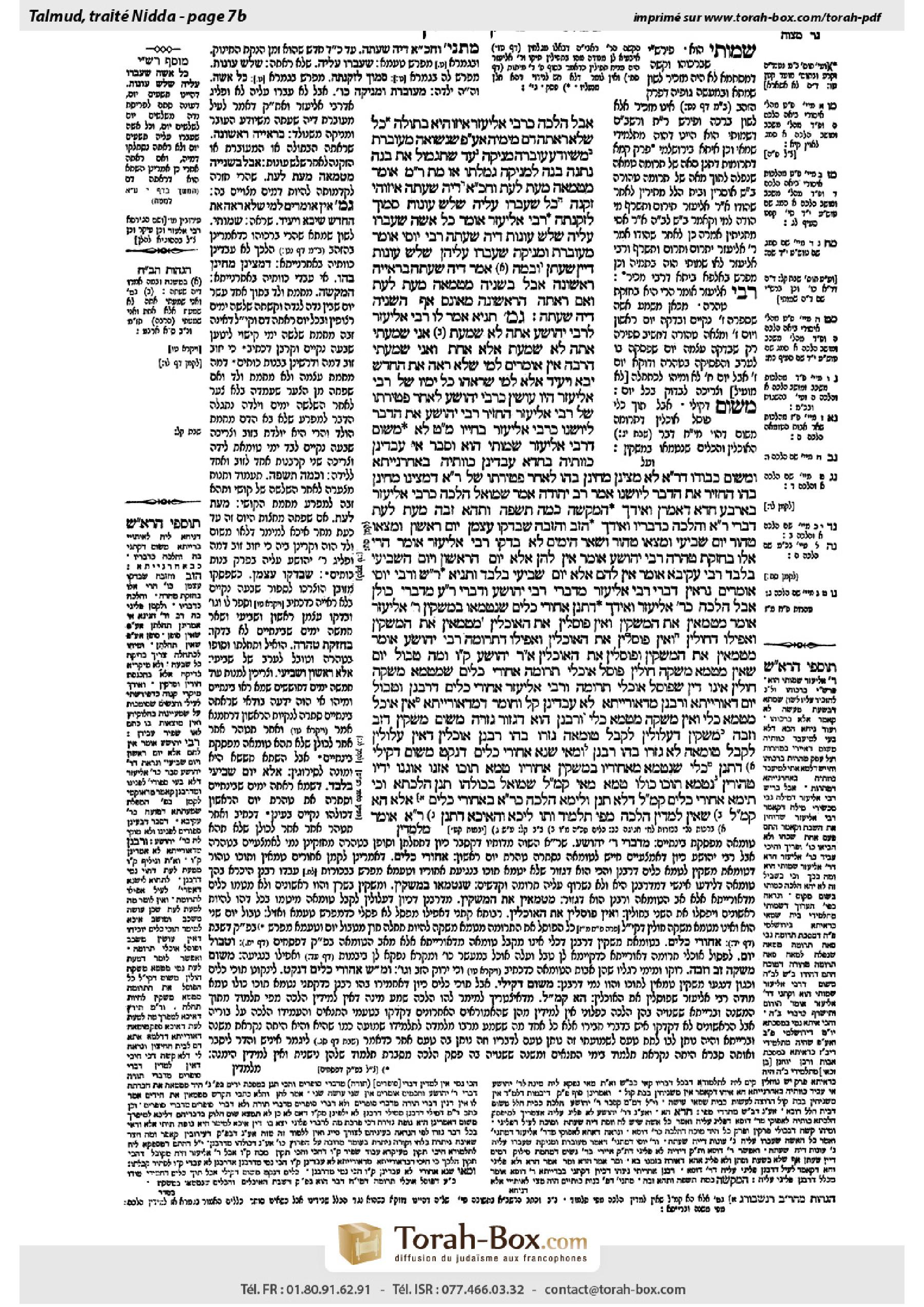
Niddah 7b: Talmud study for Daf Yomi
Daf Yomi is the daily study of one Talmud folio. Explore 37 tractates with scans, Hebrew text, Sefaria English and AI-generated French translations where annotated.
Passage selection and English or AI-generated French translation are available where the scan has annotations. Daf Study is independent of Torah-Box and Sefaria.
Browse Niddah · נידה · All tractatesNiddah 7b text and translations
This page of Niddah includes the Aramaic text, an English translation and an AI-generated French translation, alongside the scan above.
נידה ז׳ ב · Aramaic and Hebrew text
אֲבָל הֲלָכָה כְּרַבִּי אֱלִיעֶזֶר.
אֵיזוֹ הִיא בְּתוּלָה — כֹּל שֶׁלֹּא רָאֲתָה דָּם מִיָּמֶיהָ, אַף עַל פִּי שֶׁנְּשׂוּאָה. מְעוּבֶּרֶת — מִשֶּׁיִּוָּדַע עוּבָּרָהּ. מְנִיקָה — עַד שֶׁתִּגְמוֹל אֶת בְּנָהּ. נָתְנָה בְּנָהּ לִמְנִיקָה, גְּמָלַתּוּ, אוֹ מֵת — רַבִּי מֵאִיר אוֹמֵר: מְטַמְּאָה מֵעֵת לְעֵת, וַחֲכָמִים אוֹמְרִים: דַּיָּהּ שְׁעָתָהּ.
אֵיזוֹהִי זְקֵנָה — כֹּל שֶׁעָבְרוּ עָלֶיהָ שָׁלֹשׁ עוֹנוֹת סָמוּךְ לְזִקְנָתָהּ. רַבִּי אֱלִיעֶזֶר אוֹמֵר: כׇּל אִשָּׁה שֶׁעָבְרוּ עָלֶיהָ שָׁלֹשׁ עוֹנוֹת — דַּיָּהּ שְׁעָתָהּ. רַבִּי יוֹסֵי אוֹמֵר: מְעוּבֶּרֶת וּמְנִיקָה שֶׁעָבְרוּ עֲלֵיהֶן שָׁלֹשׁ עוֹנוֹת — דַּיָּין שְׁעָתָן.
וּבַמָּה אָמַר ״דַּיָּהּ שְׁעָתָהּ״ — בִּרְאִיָּיה רִאשׁוֹנָה, אֲבָל בַּשְּׁנִיָּה מְטַמְּאָה מֵעֵת לְעֵת, וְאִם רָאֲתָה הָרִאשׁוֹנָה מֵאוֹנֶס — אַף הַשְּׁנִיָּה דַּיָּהּ שְׁעָתָהּ.
גְּמָ' תַּנְיָא: אָמַר לוֹ רַבִּי אֱלִיעֶזֶר לְרַבִּי יְהוֹשֻׁעַ: אַתָּה לֹא שָׁמַעְתָּ, אֲנִי שָׁמַעְתִּי; אַתָּה לֹא שָׁמַעְתָּ אֶלָּא אַחַת, וַאֲנִי שָׁמַעְתִּי הַרְבֵּה.
אֵין אוֹמְרִים לְמִי שֶׁלֹּא רָאָה אֶת הַחֹדֶשׁ ״יָבֹא וְיָעִיד״, אֶלָּא לְמִי שֶׁרָאָהוּ. כׇּל יָמָיו שֶׁל רַבִּי אֱלִיעֶזֶר הָיוּ עוֹשִׂין כְּרַבִּי יְהוֹשֻׁעַ, לְאַחַר פְּטִירָתוֹ שֶׁל רַבִּי אֱלִיעֶזֶר הֶחְזִיר רַבִּי יְהוֹשֻׁעַ אֶת הַדָּבָר לְיוֹשְׁנוֹ.
כְּרַבִּי אֱלִיעֶזֶר, בְּחַיָּיו מַאי טַעְמָא לָא? מִשּׁוּם דְּרַבִּי אֱלִיעֶזֶר שַׁמּוּתִי הוּא, וְסָבַר: אִי עָבְדִינַן כְּוָותֵיהּ בַּחֲדָא, עָבְדִינַן כְּוָותֵיהּ בְּאַחְרָנְיָיתָא.
וּמִשּׁוּם כְּבוֹדוֹ דְּרַבִּי אֱלִיעֶזֶר, לָא מָצֵינַן מָחֵינַן בְּהוּ. לְאַחַר פְּטִירָתוֹ שֶׁל רַבִּי אֱלִיעֶזֶר (דְּמָצִינוּ) [דְּמָצֵינַן] מָחֵינַן בְּהוּ, הֶחְזִיר אֶת הַדָּבָר לְיוֹשְׁנוֹ.
אָמַר רַב יְהוּדָה, אָמַר שְׁמוּאֵל: הֲלָכָה כְּרַבִּי אֱלִיעֶזֶר בְּאַרְבַּע. חֲדָא: דַּאֲמַרַן.
וְאִידָּךְ: הַמְקַשָּׁה כַּמָּה תִּשְׁפֶּה וּתְהֵא זָבָה? מֵעֵת לְעֵת, דִּבְרֵי רַבִּי אֱלִיעֶזֶר, וַהֲלָכָה כִּדְבָרָיו.
וְאִידָּךְ: הַזָּב וְהַזָּבָה שֶׁבָּדְקוּ עַצְמָן יוֹם רִאשׁוֹן וּמָצְאוּ טָהוֹר, יוֹם שְׁבִיעִי וּמָצְאוּ טָהוֹר, וּשְׁאָר הַיָּמִים לֹא בָּדְקוּ — רַבִּי אֱלִיעֶזֶר אוֹמֵר: הֲרֵי אֵלּוּ בְּחֶזְקַת טׇהֳרָה. רַבִּי יְהוֹשֻׁעַ אוֹמֵר: אֵין לָהֶן אֶלָּא יוֹם הָרִאשׁוֹן וְיוֹם הַשְּׁבִיעִי בִּלְבָד.
רַבִּי עֲקִיבָא אוֹמֵר: אֵין לָהֶם אֶלָּא יוֹם שְׁבִיעִי בִּלְבָד. וְתַנְיָא: רַבִּי שִׁמְעוֹן וְרַבִּי יוֹסֵי אוֹמְרִים: נִרְאִין דִּבְרֵי רַבִּי אֱלִיעֶזֶר מִדִּבְרֵי רַבִּי יְהוֹשֻׁעַ, וְדִבְרֵי רַבִּי עֲקִיבָא מִדִּבְרֵי כוּלָּן, אֲבָל הֲלָכָה כְּרַבִּי אֱלִיעֶזֶר.
וְאִידַּךְ, דִּתְנַן: אֲחוֹרֵי כֵלִים שֶׁנִּטְמְאוּ בְּמַשְׁקִין, רַבִּי אֱלִיעֶזֶר אוֹמֵר: מְטַמְּאִין אֶת הַמַּשְׁקִין וְאֵין פּוֹסְלִין אֶת הָאֳוכָלִין. מְטַמְּאִין אֶת הַמַּשְׁקִין, וַאֲפִילּוּ דְּחוּלִּין, וְאֵין פּוֹסְלִין אֶת הָאֳוכָלִין, וַאֲפִילּוּ דִּתְרוּמָה. רַבִּי יְהוֹשֻׁעַ אוֹמֵר: מְטַמְּאִין אֶת הַמַּשְׁקִין וּפוֹסְלִין אֶת הָאֳוכָלִין.
אָמַר רַבִּי יְהוֹשֻׁעַ: קַל וָחוֹמֶר, וּמָה טְבוּל יוֹם שֶׁאֵין מְטַמֵּא מַשְׁקֵה חוּלִּין, פּוֹסֵל אוֹכְלֵי תְרוּמָה, אֲחוֹרֵי כֵלִים שֶׁמְּטַמֵּא מַשְׁקֵה חוּלִּין, אֵינוֹ דִּין שֶׁפּוֹסֵל אוֹכְלֵי תְרוּמָה?
וְרַבִּי אֱלִיעֶזֶר, אֲחוֹרֵי כֵלִים דְּרַבָּנַן, וּטְבוּל יוֹם דְּאוֹרָיְיתָא, וְרַבָּנַן מִדְּאוֹרָיְיתָא לָא עָבְדִינַן קַל וָחוֹמֶר, דְּמִדְּאוֹרָיְיתָא אֵין אוֹכֶל מְטַמֵּא כְּלִי, וְאֵין מַשְׁקֶה מְטַמֵּא כְּלִי.
וְרַבָּנַן הוּא דִּגְזוּר גְּזֵרָה, מִשּׁוּם מַשְׁקִין דְּזָב וְזָבָה, מַשְׁקִין דַּעֲלוּלִין לְקַבֵּל טוּמְאָה — גְּזַרוּ בְּהוּ רַבָּנַן, אֳוכָלִין דְּאֵין עֲלוּלִין לְקַבֵּל טוּמְאָה — לָא גְּזַרוּ בְּהוּ רַבָּנַן.
וּמַאי שְׁנָא אֲחוֹרֵי כֵלִים דְּנָקֵט? מִשּׁוּם דְּקִילִּי, דִּתְנַן: כְּלִי שֶׁנִּטְמָא מֵאֲחוֹרָיו בְּמַשְׁקִין — אֲחוֹרָיו טָמֵא, תּוֹכוֹ, אׇזְנוֹ, אוֹגְנוֹ, יָדָיו — טְהוֹרִין. נִטְמָא תּוֹכוֹ — כּוּלּוֹ טָמֵא.
מַאי קָא מַשְׁמַע לַן שְׁמוּאֵל? בְּכוּלְּהוּ תְּנַן הִלְכְתָא!
וְכִי תֵימָא, אֲחוֹרֵי כֵלִים קָא מַשְׁמַע לַן דְּלָא תְּנַן, וְלֵימָא הֲלָכָה כְּרַבִּי אֱלִיעֶזֶר בַּאֲחוֹרֵי כֵלִים! אֶלָּא הָא קָא מַשְׁמַע לַן, שֶׁאֵין לְמֵדִין הֲלָכָה מִפִּי תַלְמוּד.
וְתוּ לֵיכָּא? וְהָאִיכָּא דִּתְנַן: רַבִּי אֱלִיעֶזֶר אוֹמֵר:
Niddah 7b · English translation
but the halakha is in accordance with the opinion of Rabbi Eliezer.
Who is the woman characterized as a virgin in this context? It is any woman who has not seen the flow of menstrual blood in all her days, even if she was married and has experienced bleeding as a result of intercourse consummating her marriage. The time of a pregnant woman is from the point in her pregnancy when the existence of her fetus is known to all who see her. The time of a nursing woman is until she weans her child from nursing. If she stopped nursing, e.g., she gave her child to a wet nurse, weaned him from nursing, or her child died, and she saw menstrual blood, Rabbi Meir says: She transmits impurity for a twenty-four-hour period or from her most recent examination. And the Rabbis say: Even in those cases, her time is sufficient.
Who is the woman characterized as an elderly woman in this context? It is any woman for whom three typical menstrual cycles of thirty days passed during which she saw no menstrual blood, at a stage of her life close to her old age. Rabbi Eliezer says: In the case of any woman for whom three typical menstrual cycles passed during which she saw no menstrual blood, if she then experiences bleeding, her time is sufficient. Rabbi Yosei says: With regard to a pregnant woman and a nursing woman for whom three typical menstrual cycles passed during which they saw no menstrual blood, if they then saw blood, their time is sufficient.
And in the above cases, with regard to what did the tanna say her time is sufficient? It is with regard to the first sighting of blood, but with regard to the second sighting, her status is like that of any other woman, and she transmits impurity for a twenty-four-hour period or from her most recent examination. And if she saw the first sighting as a result of unnatural circumstances, even with regard to the second sighting, the halakha is that her time is sufficient.
GEMARA: Rabbi Eliezer teaches in the mishna that there are four women who transmit impurity only from the moment that they saw menstrual blood, not retroactively. Rabbi Yehoshua said: I heard this halakha from my teachers only with regard to a virgin. The Gemara notes that it is taught in a baraita that Rabbi Eliezer said to Rabbi Yehoshua: You did not hear, but I did hear it. In other words, you may not have received a tradition from your teachers with regard to any other woman, but I did receive such a tradition. Furthermore, you heard a halakhic ruling with regard to only one woman, and I heard rulings with regard to many women.
Rabbi Eliezer continued his rebuttal with a metaphor from the practice of sanctifying the new moon, which required the testimony of witnesses: We do not say to one who had not seen the new moon to come and testify. Rather we give such an instruction only to he who saw it. Similarly, my opinion is weightier with regard to this issue, as I heard many rulings about the matter, whereas you did not. The Gemara reports: All the days of the life of Rabbi Eliezer, they would practice in accordance with the opinion of Rabbi Yehoshua, i.e., only a virgin would be exempt from retroactive impurity. After Rabbi Eliezer’s passing, Rabbi Yehoshua returned the matter to its former custom, which was to follow the opinion of Rabbi Eliezer.
The Gemara asks: What is the reason that they did not act in accordance with the opinion of Rabbi Eliezer during his lifetime? The Gemara answers: Because Rabbi Eliezer was a Shammuti, i.e., a follower of the rulings of Beit Shammai, and the halakha is generally in accordance with the opinion of Beit Hillel in their disputes with Beit Shammai. And the Sages held that if we act in accordance with his opinion in one matter, people will act in accordance with his opinion in other matters.
And that would be a problem, as if so, then during his lifetime, due to the honor of Rabbi Eliezer, we will not be able to protest against them. But after Rabbi Eliezer’s passing, when we are able to protest against those who act in accordance with Rabbi Eliezer’s opinion in other matters, Rabbi Yehoshua returned the matter to its former custom of deciding the halakha in accordance with the opinion of Rabbi Eliezer in this matter.
§ The Gemara mentions other instances in which the halakha is in accordance with the opinion of Rabbi Eliezer. Rav Yehuda says that Shmuel says: The halakha is in accordance with the opinion of Rabbi Eliezer in four cases. One is the halakha that we just mentioned, of the four women who transmit ritual impurity only from the time of their sighting and onward.
And another is taught in a baraita with regard to a woman who experiences labor pain as a result of which she sees a flow of blood. Her discharge is attributed to childbirth rather than zava blood. The baraita asks: For how long must she be relieved from pain in order to be considered a zava due to her flow of uterine blood? She must have relief for a twenty-four-hour period. This is the statement of Rabbi Eliezer. And the halakha is in accordance with his statement.
And another case in which the halakha follows Rabbi Eliezer is taught in a mishna (68b): A zav and a zava must observe seven days without a discharge in order to attain ritual purity. With regard to a zav or a zava who examined themselves on the first day and found themselves to be pure, and they examined themselves on the seventh day and found themselves to be pure, but on the rest of the intervening days they did not examine themselves, Rabbi Eliezer says: The presumptive status of the zav and the zava is one of ritual purity. Rabbi Yehoshua says: In that case, the zav and the zava have counted only the first day and the seventh day, two of the seven clean days, and they must count another five days to complete the tally.
The mishna continues: Rabbi Akiva says: Since any impure discharge that they might have experienced in between the first and seventh days would negate their count and require them to restart the seven-day period, the zav and the zava have counted only the seventh day, and must count another six days to complete the tally. And with regard to this dispute, it is taught in a baraita that Rabbi Shimon and Rabbi Yosei say: The statement of Rabbi Eliezer appears more correct than the statement of Rabbi Yehoshua, and the statement of Rabbi Akiva appears more correct than the statement of all of them. But the halakha is in accordance with the opinion of Rabbi Eliezer.
And the other case in which the halakha is in accordance with the opinion of Rabbi Eliezer is as we learned in a mishna (Teharot 8:7): With regard to the exterior of vessels that contracted ritual impurity through contact with impure liquids, i.e., with liquids that had touched the carcass of a creeping animal, Rabbi Eliezer says, with regard to this impurity that applies by rabbinic law: These exteriors transmit impurity to liquids that come in contact with them, but they do not disqualify foods with which they come into contact. The mishna elaborates: They transmit impurity to other liquids, and even non-sacred liquids. And they do not disqualify foods, and even teruma. Rabbi Yehoshua says: These exteriors transmit impurity to liquids and they disqualify teruma foods, as well.
Rabbi Yehoshua says: I derived my ruling via an a fortiori inference from the halakha of one who was ritually impure, who immersed that day and is waiting for nightfall for the purification process to be completed. And if one who immersed that day, who has second-degree ritual impurity status and therefore he does not transmit impurity to non-sacred liquids, nevertheless disqualifies teruma foods with which he comes into contact, then with regard to the exteriors of vessels, which do transmit impurity to non-sacred liquids, is it not logical that they should render teruma food disqualified?
The Gemara asks: And Rabbi Eliezer, how does he refute this inference? The Gemara answers: He would counter that the halakha that the exterior of vessels are rendered impure through contact with impure foods or liquids is by rabbinic law, and the halakhot of one who immersed that day apply by Torah law. And there is a principle that one does not apply a fortiori inferences to derive conclusions by rabbinic law from cases that apply by Torah law. As by Torah law impure foods do not transmit impurity to vessels, and similarly, impure liquids do not transmit impurity to vessels.
The Gemara continues: And it was the Sages who issued a decree that the exterior of a vessel is rendered impure when it comes into contact with impure liquids, and they decreed that only liquids, not foods, are rendered impure when they come into contact with impure vessel exteriors. The reason for this is due to the liquids secreted by a zav or zava, e.g., their saliva and urine, which have a primary degree of ritual impurity and therefore transmit impurity to vessels. Consequently, with regard to liquids, which are apt to contract impurity, the Sages issued a decree that they contract impurity when they come in contact with these impure vessel exteriors. But with regard to foods, which are not as apt to contract impurity, as they must first be rendered susceptible to impurity through contact with a liquid, the Sages did not issue such a decree with regard to them.
The Gemara raises a difficulty: Rabbi Eliezer agrees that if the interior of a vessel is rendered impure by contact with impure liquids, it renders impure any teruma foods that come into contact with it. But what is different about the exterior of vessels, that Rabbi Eliezer cited them as having a more lenient status? The Gemara answers: This is due to the fact that their halakhot are more lenient than those of the other parts of the vessel. As we learned in a mishna (Kelim 25:6): With regard to a vessel whose exterior was rendered impure by contact with impure liquids, its exterior is impure, while its others parts, such as its interior, its ear, i.e., its looped handle, its rim, the edge of the vessel that protrudes outward, and its handles, are pure. But if its interior was rendered impure, it is all impure.
These are the four cases with regard to which Shmuel said that the halakha is in accordance with the opinion of Rabbi Eliezer. The Gemara asks: What is Shmuel teaching us? In all of these cases we learned explicitly that the halakha is in accordance with the opinion of Rabbi Eliezer.
And if you would say that he is teaching us the halakha with regard to the exterior of vessels, whose halakha we did not learn from the mishna, let Shmuel simply state that the halakha is in accordance with the opinion of Rabbi Eliezer with regard to the exterior of vessels. The Gemara explains: Rather, this is what Shmuel teaches us: That a final halakha may not be learned directly from the Talmud, i.e., from a statement of a mishna or baraita that the halakha is in accordance with a specific opinion, unless the ruling is confirmed by amora’im.
The Gemara asks: And is there nothing more that can be added to the list of cases in which the halakha is in accordance with the opinion of Rabbi Eliezer? But isn’t there another case that we learned in a mishna (Yevamot 109a): Two brothers married two sisters, one an adult and the other a minor. If the husband of the adult dies, the Torah obligation of levirate marriage applies to the other brother, which is not abrogated by the rabbinic prohibition of the yevama as the sister of his minor wife. In such a case, Rabbi Eliezer says:
Niddah 7b · Traduction française (IA)
mais la halakha suit l’opinion de Rabbi Eliezer.
Quelle femme est qualifiée ici de vierge ? Toute femme qui n’a jamais vu d’écoulement de sang menstruel, même si elle s’est mariée et a eu des saignements à la suite d’un rapport consommant son mariage. Pour une femme enceinte, cette période commence au moment où sa grossesse est devenue visible aux yeux de tous. Pour une femme qui allaite, elle dure jusqu’à ce qu’elle sèvre son enfant. Si elle a cessé d’allaiter — par exemple, si elle a confié son enfant à une nourrice, l’a sevré ou si son enfant est mort — et qu’elle a vu du sang menstruel, Rabbi Meir dit : elle transmet l’impureté pendant vingt-quatre heures ou depuis son dernier examen. Les Sages disent : même dans ces cas, son moment suffit.
Quelle femme est qualifiée ici de femme âgée ? Toute femme qui, à un stade de sa vie proche de la vieillesse, a traversé trois cycles menstruels habituels de trente jours sans voir de sang menstruel. Rabbi Eliezer dit : pour toute femme qui a traversé trois cycles menstruels habituels sans voir de sang menstruel, si elle a ensuite un saignement, son moment suffit. Rabbi Yosei dit : concernant une femme enceinte ou une femme qui allaite qui a traversé trois cycles menstruels habituels sans voir de sang menstruel, si elle voit ensuite du sang, son moment suffit.
Et dans les cas susmentionnés, à quoi le tanna fait-il référence lorsqu’il dit que son moment suffit ? À la première apparition de sang ; mais lors de la deuxième apparition, son statut est celui de toute autre femme, et elle transmet l’impureté pendant vingt-quatre heures ou depuis son dernier examen. Si la première apparition est survenue dans des circonstances inhabituelles, même lors de la deuxième apparition, la halakha est que son moment suffit.
GUEMARA : Dans la Michna, Rabbi Eliezer enseigne qu’il y a quatre femmes qui ne transmettent l’impureté qu’à partir du moment où elles voient du sang menstruel, et non rétroactivement. Rabbi Yehoshua dit : « Je n’ai entendu cette halakha de mes maîtres qu’au sujet d’une vierge. » La Guemara relève qu’une baraïta enseigne que Rabbi Eliezer dit à Rabbi Yehoshua : « Tu ne l’as pas entendue, mais moi, je l’ai entendue. » Autrement dit, tu n’as peut-être pas reçu de tes maîtres de tradition concernant une autre femme, mais moi, j’ai reçu une telle tradition. De plus, tu as entendu une décision halakhique concernant une seule femme, tandis que moi, j’en ai entendu concernant de nombreuses femmes.
Rabbi Eliezer poursuit sa réfutation au moyen d’une métaphore tirée de la sanctification de la nouvelle lune, qui nécessitait le témoignage de témoins : « On ne demande pas à quelqu’un qui n’a pas vu la nouvelle lune de venir témoigner. On ne donne cette instruction qu’à celui qui l’a vue. » De même, mon avis a plus de poids sur cette question, car j’ai entendu de nombreuses décisions à ce sujet, contrairement à toi. La Guemara rapporte : du vivant de Rabbi Eliezer, on agissait selon l’opinion de Rabbi Yehoshua, c’est-à-dire que seule une vierge était exemptée de l’impureté rétroactive. Après le décès de Rabbi Eliezer, Rabbi Yehoshua rétablit l’ancienne pratique, qui consistait à suivre l’opinion de Rabbi Eliezer.
La Guemara demande : pourquoi n’a-t-on pas agi selon l’opinion de Rabbi Eliezer de son vivant ? Elle répond : parce que Rabbi Eliezer était un Shammouti, c’est-à-dire un partisan des décisions de Beit Shammaï, et que, dans leurs différends avec Beit Shammaï, la halakha suit généralement l’opinion de Beit Hillel. Les Sages estimaient que, si l’on suivait son opinion sur une question, les gens la suivraient aussi sur d’autres questions.
Cela aurait posé problème, car, dans ce cas, de son vivant, par égard pour Rabbi Eliezer, nous n’aurions pas pu les réprimander. Mais après le décès de Rabbi Eliezer, lorsque nous sommes en mesure de réprimander ceux qui suivent son opinion sur d’autres questions, Rabbi Yehoshua rétablit l’ancienne pratique, qui consistait à statuer sur cette question selon l’opinion de Rabbi Eliezer.
§ La Guemara mentionne d’autres cas où la halakha suit l’opinion de Rabbi Eliezer. Rav Yehuda dit au nom de Shmuel : la halakha suit l’opinion de Rabbi Eliezer dans quatre cas. Le premier est celui que nous venons de mentionner : les quatre femmes qui ne transmettent l’impureté rituelle qu’à partir du moment où elles voient du sang et par la suite.
Un autre cas est enseigné dans une baraïta au sujet d’une femme qui ressent des douleurs de l’enfantement, à la suite desquelles elle voit un écoulement de sang. Son écoulement est attribué à l’accouchement plutôt qu’au sang de zava. La baraïta demande : combien de temps doit-elle être soulagée de ses douleurs pour être considérée comme zava en raison de son écoulement de sang utérin ? Elle doit en être soulagée pendant vingt-quatre heures. Telle est la déclaration de Rabbi Eliezer, et la halakha suit son avis.
Un autre cas où la halakha suit Rabbi Eliezer est enseigné dans une Michna (68b) : un zav et une zava doivent observer sept jours sans écoulement afin d’atteindre la pureté rituelle. Si un zav ou une zava s’est examiné le premier jour et s’est trouvé pur, puis s’est examiné le septième jour et s’est trouvé pur, mais ne s’est pas examiné pendant les autres jours intermédiaires, Rabbi Eliezer dit : le statut présumé du zav et de la zava est celui de la pureté rituelle. Rabbi Yehoshua dit : dans ce cas, le zav et la zava n’ont compté que le premier et le septième jour, soit deux des sept jours de pureté, et ils doivent en compter cinq autres pour achever le décompte.
La Michna poursuit : Rabbi Akiva dit : puisque tout écoulement impur qu’ils auraient pu avoir entre le premier et le septième jour aurait annulé leur décompte et les aurait obligés à recommencer la période de sept jours, le zav et la zava n’ont compté que le septième jour et doivent en compter six autres pour achever le décompte. À propos de ce différend, une baraïta enseigne que Rabbi Shimon et Rabbi Yosei disent : l’avis de Rabbi Eliezer semble plus juste que celui de Rabbi Yehoshua, et l’avis de Rabbi Akiva semble plus juste que celui de tous les autres. Mais la halakha suit l’opinion de Rabbi Eliezer.
L’autre cas où la halakha suit l’opinion de Rabbi Eliezer est celui que nous avons appris dans une Michna (Teharot 8:7) : à propos des faces extérieures de récipients devenues rituellement impures au contact de liquides impurs, c’est-à-dire de liquides ayant touché la carcasse d’un animal rampant, Rabbi Eliezer dit, à propos de cette impureté qui relève de la loi rabbinique : ces faces extérieures transmettent l’impureté aux liquides qui les touchent, mais elles ne disqualifient pas les aliments qu’elles touchent. La Michna précise : elles transmettent l’impureté à d’autres liquides, même non consacrés, mais ne disqualifient pas les aliments, même la terouma. Rabbi Yehoshua dit : ces faces extérieures transmettent l’impureté aux liquides et disqualifient également les aliments de terouma.
Rabbi Yehoshua dit : j’ai déduit ma décision par raisonnement a fortiori à partir de la halakha concernant celui qui était rituellement impur, s’est immergé ce jour-là et attend la tombée de la nuit pour que le processus de purification s’achève. Si celui qui s’est immergé ce jour-là, qui a le statut d’impureté de deuxième degré et ne transmet donc pas l’impureté aux liquides non consacrés, disqualifie néanmoins les aliments de terouma qu’il touche, à plus forte raison les faces extérieures des récipients, qui transmettent l’impureté aux liquides non consacrés, devraient-elles rendre les aliments de terouma impropres.
La Guemara demande : comment Rabbi Eliezer réfute-t-il cette déduction ? Elle répond : il objecterait que la halakha selon laquelle les faces extérieures des récipients deviennent impures au contact d’aliments ou de liquides impurs relève de la loi rabbinique, tandis que les halakhot concernant celui qui s’est immergé ce jour-là relèvent de la Torah. Or, un principe veut qu’on ne tire pas, par raisonnement a fortiori, de conclusions relevant de la loi rabbinique à partir de cas relevant de la Torah. En effet, selon la Torah, les aliments impurs ne transmettent pas l’impureté aux récipients, et de même, les liquides impurs ne transmettent pas l’impureté aux récipients.
La Guemara poursuit : ce sont les Sages qui ont décrété que la face extérieure d’un récipient devient impure lorsqu’elle entre en contact avec des liquides impurs, et ils ont décrété que seuls les liquides, et non les aliments, deviennent impurs lorsqu’ils entrent en contact avec les faces extérieures impures des récipients. Cela s’explique par les liquides sécrétés par un zav ou une zava, par exemple leur salive et leur urine, qui ont un premier degré d’impureté rituelle et transmettent donc l’impureté aux récipients. Par conséquent, les Sages ont décrété que les liquides, susceptibles de contracter l’impureté, la contractent lorsqu’ils entrent en contact avec ces faces extérieures impures. Mais ils n’ont pas pris un tel décret pour les aliments, moins susceptibles de contracter l’impureté puisqu’ils doivent d’abord être rendus aptes à la contracter par le contact avec un liquide.
La Guemara soulève une difficulté : Rabbi Eliezer reconnaît que si la face intérieure d’un récipient devient impure au contact de liquides impurs, elle rend impurs les aliments de terouma qui la touchent. Mais en quoi les faces extérieures des récipients diffèrent-elles pour que Rabbi Eliezer leur attribue un statut plus indulgent ? La Guemara répond : c’est parce que leur statut est plus indulgent que celui des autres parties du récipient. En effet, nous avons appris dans une Michna (Kelim 25:6) : si la face extérieure d’un récipient est devenue impure au contact de liquides impurs, sa face extérieure est impure, tandis que ses autres parties — sa face intérieure, son anse, c’est-à-dire sa poignée en boucle, son rebord, le bord du récipient qui fait saillie vers l’extérieur, et ses poignées — sont pures. Mais si sa face intérieure est devenue impure, tout le récipient est impur.
Tels sont les quatre cas au sujet desquels Shmuel a dit que la halakha suit l’opinion de Rabbi Eliezer. La Guemara demande : que nous enseigne Shmuel ? Dans tous ces cas, nous avons appris explicitement que la halakha suit l’opinion de Rabbi Eliezer.
Et si tu dis qu’il nous enseigne la halakha concernant les faces extérieures des récipients, sur laquelle nous n’avons rien appris dans la Michna, Shmuel aurait pu simplement dire que la halakha suit l’opinion de Rabbi Eliezer au sujet des faces extérieures des récipients. La Guemara explique : Shmuel nous enseigne plutôt ceci : on ne peut pas déduire directement du Talmud une halakha définitive — c’est-à-dire à partir d’une déclaration de la Michna ou d’une baraïta selon laquelle la halakha suit une opinion particulière — à moins que la décision ne soit confirmée par les amoraïm.
La Guemara demande : ne peut-on rien ajouter à la liste des cas où la halakha suit l’opinion de Rabbi Eliezer ? Pourtant, nous avons appris un autre cas dans une Michna (Yevamot 109a) : deux frères ont épousé deux sœurs, l’une adulte et l’autre mineure. Si le mari de l’adulte meurt, l’obligation toranique de mariage léviratique s’applique à l’autre frère, et l’interdiction rabbinique d’épouser la yevama parce qu’elle est la sœur de sa femme mineure ne l’annule pas. Dans un tel cas, Rabbi Eliezer dit :
Traduction française générée par IA à partir de l’édition anglaise de Sefaria. Vérifie toujours un passage avec le texte source.
Text from Sefaria: William Davidson Edition - Vocalized Aramaic (CC BY NC); William Davidson Edition - English (CC BY NC).