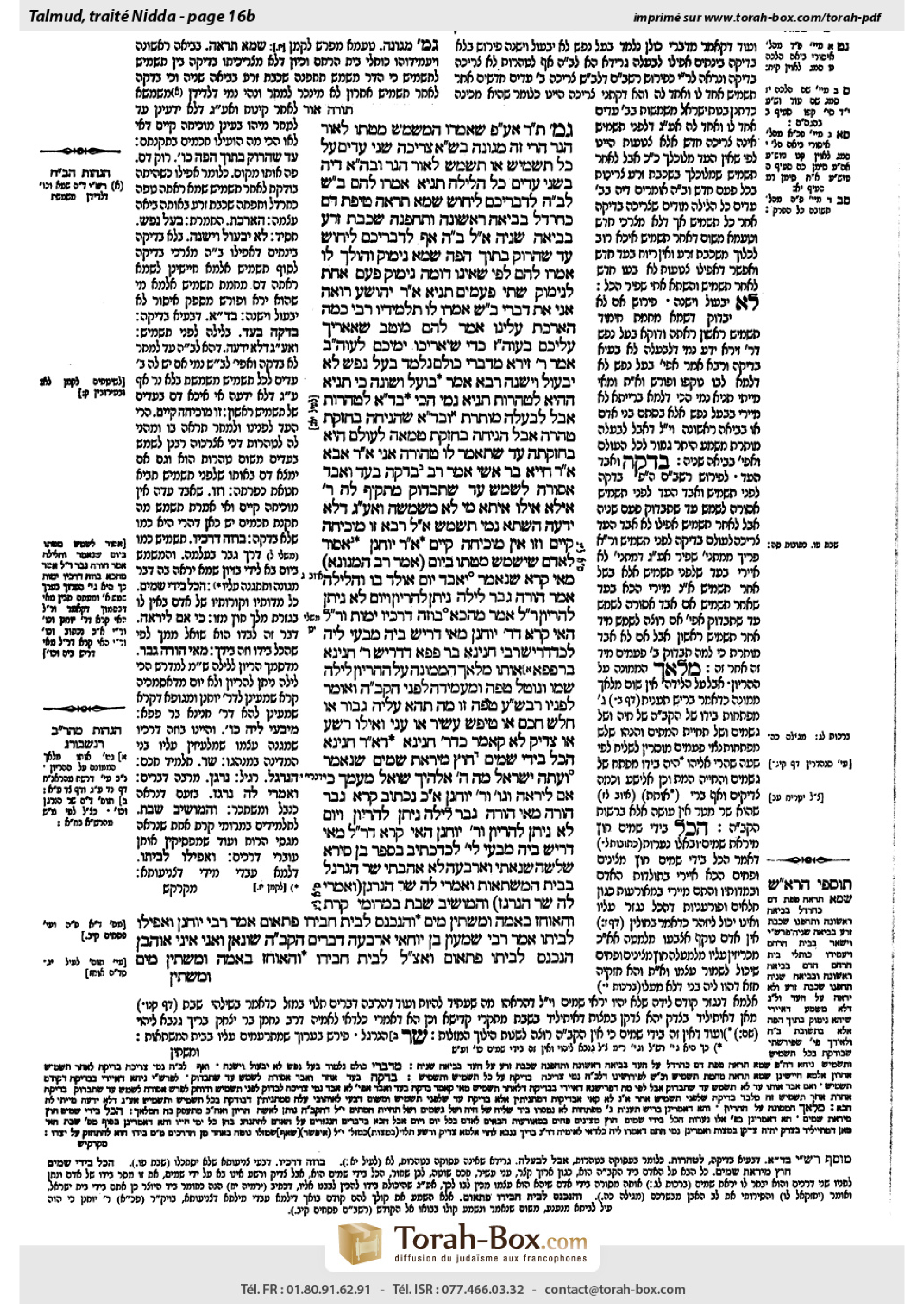
Niddah 16b: Talmud study for Daf Yomi
Daf Yomi is the daily study of one Talmud folio. Explore 37 tractates with scans, Hebrew text, Sefaria English and AI-generated French translations where annotated.
Passage selection and English or AI-generated French translation are available where the scan has annotations. Daf Study is independent of Torah-Box and Sefaria.
Browse Niddah · נידה · All tractatesNiddah 16b text and translations
This page of Niddah includes the Aramaic text, an English translation and an AI-generated French translation, alongside the scan above.
נידה י״ו ב · Aramaic and Hebrew text
גְּמָ' תָּנוּ רַבָּנַן: אַף עַל פִּי שֶׁאָמְרוּ הַמְשַׁמֵּשׁ מִטָּתוֹ לְאוֹר הַנֵּר הֲרֵי זֶה מְגוּנֶּה, בֵּית שַׁמַּאי אוֹמְרִים: צְרִיכָה שְׁנֵי עֵדִים עַל כׇּל תַּשְׁמִישׁ, אוֹ תְּשַׁמֵּשׁ לְאוֹר הַנֵּר. וּבֵית הִלֵּל אוֹמְרִים: דַּיָּהּ בִּשְׁנֵי עֵדִים כׇּל הַלַּיְלָה.
תַּנְיָא: אָמְרוּ לָהֶם בֵּית שַׁמַּאי לְבֵית הִלֵּל: לְדִבְרֵיכֶם, לֵיחוּשׁ שֶׁמָּא תִּרְאֶה טִיפַּת דָּם כְּחַרְדָּל בְּבִיאָה רִאשׁוֹנָה, וּתְחַפֶּנָּה שִׁכְבַת זֶרַע בְּבִיאָה שְׁנִיָּה.
אָמְרוּ לָהֶם בֵּית הִלֵּל: אַף לְדִבְרֵיכֶם, לֵיחוּשׁ עַד שֶׁהָרוֹק בְּתוֹךְ הַפֶּה, שֶׁמָּא נִימּוֹק וְהוֹלֵךְ לוֹ.
אָמְרוּ לָהֶם: לְפִי שֶׁאֵינוֹ דּוֹמֶה נִימּוֹק פַּעַם אַחַת, לְנִימּוֹק שְׁתֵּי פְּעָמִים.
תַּנְיָא, אָמַר רַבִּי יְהוֹשֻׁעַ: רוֹאֶה אֲנִי אֶת דִּבְרֵי בֵּית שַׁמַּאי. אָמְרוּ לוֹ תַּלְמִידָיו: רַבִּי, כַּמָּה הֶאֱרַכְתָּ עָלֵינוּ! אָמַר לָהֶם: מוּטָב שֶׁאַאֲרִיךְ עֲלֵיכֶם בָּעוֹלָם הַזֶּה, כְּדֵי שֶׁיַּאֲרִיכוּ יְמֵיכֶם לָעוֹלָם הַבָּא.
אָמַר רַבִּי זֵירָא: מִדִּבְרֵי כּוּלָּם נִלְמַד, בַּעַל נֶפֶשׁ — לֹא יִבְעוֹל וְיִשְׁנֶה.
רָבָא אָמַר: בּוֹעֵל וְשׁוֹנָה, כִּי תַנְיָא הַהִיא — לִטְהָרוֹת.
תַּנְיָא נָמֵי הָכִי: בַּמֶּה דְבָרִים אֲמוּרִים — לִטְהָרוֹת, אֲבָל לְבַעְלָהּ — מוּתֶּרֶת. וּבַמֶּה דְּבָרִים אֲמוּרִים — שֶׁהִנִּיחָהּ בְּחֶזְקַת טׇהֳרָה, אֲבָל הִנִּיחָהּ בְּחֶזְקַת טְמֵאָה — לְעוֹלָם הִיא בְּחֶזְקָתָהּ, עַד שֶׁתֹּאמַר לוֹ ״טְהוֹרָה אֲנִי״.
אָמַר רַבִּי אַבָּא, אָמַר רַבִּי חִיָּיא בַּר אָשֵׁי, אָמַר רַב: בָּדְקָה בְּעֵד וְאָבַד — אֲסוּרָה לְשַׁמֵּשׁ עַד שֶׁתִּבְדּוֹק. מַתְקֵיף לַהּ רַבִּי אִילָא: אִילּוּ אִיתֵאּ — מִי לָא מְשַׁמְּשָׁה, וְאַף עַל גַּב דְּלָא יָדְעָה? הַשְׁתָּא נָמֵי תְּשַׁמֵּשׁ!
אֲמַר לֵיהּ רָבָא: זוֹ מוֹכִיחָהּ קַיָּים, וְזוֹ אֵין מוֹכִיחָהּ קַיָּים.
אָמַר רַבִּי יוֹחָנָן: אָסוּר לָאָדָם שֶׁיְּשַׁמֵּשׁ מִטָּתוֹ בַּיּוֹם. אָמַר רַב הַמְנוּנָא: מַאי קְרָא? שֶׁנֶּאֱמַר: ״יֹאבַד יוֹם אִוָּלֶד בּוֹ וְהַלַּיְלָה אָמַר הוֹרָה גָבֶר״ — לַיְלָה נִיתַּן לְהֵרָיוֹן, וְיוֹם לֹא נִיתַּן לְהֵרָיוֹן. רֵישׁ לָקִישׁ אָמַר מֵהָכָא: ״בּוֹזֵה דְרָכָיו יָמוּת״.
וְרֵישׁ לָקִישׁ, הַאי קְרָא דְּרַבִּי יוֹחָנָן מַאי דָּרֵישׁ בֵּיהּ? מִבָּעֵי לֵיהּ לְכִדְדָרֵישׁ רַבִּי חֲנִינָא בַּר פָּפָּא, דְּדָרֵישׁ רַבִּי חֲנִינָא בַּר פָּפָּא: אוֹתוֹ מַלְאָךְ הַמְמוּנֶּה עַל הַהֵרָיוֹן ״לַיְלָה״ שְׁמוֹ, וְנוֹטֵל טִפָּה וּמַעֲמִידָהּ לִפְנֵי הַקָּדוֹשׁ בָּרוּךְ הוּא, וְאוֹמֵר לְפָנָיו: רִבּוֹנוֹ שֶׁל עוֹלָם, טִפָּה זוֹ מָה תְּהֵא עָלֶיהָ? גִּבּוֹר אוֹ חַלָּשׁ? חָכָם אוֹ טִיפֵּשׁ? עָשִׁיר אוֹ עָנִי?
וְאִילּוּ רָשָׁע אוֹ צַדִּיק לָא קָאָמַר, כִּדְרַבִּי חֲנִינָא. דְּאָמַר רַבִּי חֲנִינָא: הַכֹּל בִּידֵי שָׁמַיִם, חוּץ מִיִּרְאַת שָׁמַיִם, שֶׁנֶּאֱמַר: ״וְעַתָּה יִשְׂרָאֵל מָה ה׳ אֱלֹהֶיךָ שׁוֹאֵל מֵעִמָּךְ כִּי אִם לְיִרְאָה וְגוֹ׳״.
וְרַבִּי יוֹחָנָן, אִם כֵּן נִכְתּוֹב קְרָא ״גֶּבֶר הוֹרָה״, מַאי ״הוֹרָה גֶּבֶר״? לַיְלָה נִיתַּן לְהֵרָיוֹן, וְיוֹם לֹא נִיתַּן לְהֵרָיוֹן.
וְרַבִּי יוֹחָנָן, הַאי קְרָא דְּרֵישׁ לָקִישׁ מַאי דָּרֵישׁ בֵּיהּ? מִבְּעֵי לֵיהּ לִכְדִכְתִיב בְּסֵפֶר בֶּן סִירָא: שְׁלֹשָׁה שָׂנֵאתִי וְאַרְבָּעָה לֹא אָהַבְתִּי — שַׂר הַנִּרְגָּל בְּבֵית הַמִּשְׁתָּאוֹת, וְאָמְרִי לָהּ: ״שַׂר הַנִּרְגָּן״, וְאָמְרִי לַהּ: ״שַׂר הַנִּרְגָּז״.
וְהַמּוֹשִׁיב שַׁבָּת בִּמְרוֹמֵי קֶרֶת, וְהָאוֹחֵז בָּאַמָּה וּמַשְׁתִּין מַיִם, וְהַנִּכְנָס לְבֵית חֲבֵירוֹ פִּתְאוֹם. אָמַר רַבִּי יוֹחָנָן: וַאֲפִילּוּ לְבֵיתוֹ.
אָמַר רַבִּי שִׁמְעוֹן בֶּן יוֹחַאי: אַרְבָּעָה דְּבָרִים הַקָּדוֹשׁ בָּרוּךְ הוּא שׂוֹנְאָן, וַאֲנִי אֵינִי אוֹהֲבָן — הַנִּכְנָס לְבֵיתוֹ פִּתְאוֹם, וְאֵין צָרִיךְ לוֹמַר לְבֵית חֲבֵירוֹ, וְהָאוֹחֵז בָּאַמָּה וּמַשְׁתִּין מַיִם,
Niddah 16b · English translation
GEMARA: The mishna teaches that according to Beit Shammai it is permitted to engage in intercourse by the light of a lamp. In this regard, the Sages taught in a baraita: Even though the Sages said with regard to one who engages in intercourse by the light of a lamp, that this is disgraceful, Beit Shammai say: A woman is required to examine herself with two cloths, once before and once after each act of intercourse, or she must engage in intercourse by the light of a lamp. And Beit Hillel say: It is sufficient for her to examine herself with two cloths throughout the night, once before the first act of intercourse and once after the final act of intercourse.
It is taught in a baraita that Beit Shammai said to Beit Hillel: According to your statement that a woman may engage in intercourse several times in one night without an examination between each act of intercourse, let us be concerned lest she will see, i.e., emit, a drop of blood the size of a mustard seed during the first act of intercourse, and will thereby become impure, and semen from the second act of intercourse will cover it. Since the examination after the last act of intercourse will not reveal the drop of blood, the woman will erroneously think she is pure.
Beit Hillel said to them in response: Even according to your statement, let us be concerned that while the saliva was still in the mouth, i.e., while the blood was in her vagina, perhaps it was squashed and disappeared. Even if she examines herself after each act of intercourse, as mandated by Beit Shammai, it is possible that the semen of that act covered the blood, and it will not be revealed by the examination.
Beit Shammai said to Beit Hillel: One cannot compare the two situations, as a squashed drop of blood after the woman has engaged in intercourse once is not similar to a squashed drop of blood after the woman has engaged in intercourse twice, and therefore our concern is more reasonable.
It is taught in a baraita that Rabbi Yehoshua said: I see as correct the statement of Beit Shammai in this case. His students said to him: Our teacher, how you have weighed [he’erakhta] us down with this stringent ruling. Rabbi Yehoshua said to them: It is preferable that I weigh you down in this world, so that you do not sin by engaging in prohibited intercourse, i.e., so that your days in the World-to-Come will be lengthened [sheya’arikhu].
§ Rabbi Zeira says: From the statements of all of them, i.e., both Beit Shammai, who permit engaging in intercourse a second time only after an examination, and Beit Hillel, who rule that the second examination must be performed only after the final act of intercourse of the night, we can learn that their dispute relates only to that which is permitted after the fact. But a pious person [ba’al nefesh] should not engage in intercourse and repeat his act without an examination between each act.
Rava says: Even a pious person may engage in intercourse and repeat the act without an examination in between, as when that baraita is taught, it is referring to a woman who handles pure items. But with regard to intercourse with her husband, there is no cause for concern.
This opinion is also taught in a baraita: In what case is this statement said, i.e., that a woman must examine herself before and after every act of intercourse according to Beit Shammai, or before the first act and after the last act, according to Beit Hillel? It was said with regard to a woman who handles pure items; but a woman is permitted to her husband even without any examination, and he is not required to ask her if she is pure. But in what case is this lenient statement said? When her husband traveled and left her with the presumptive status of ritual purity. But if he left her with the presumptive status of ritual impurity, she remains forever in her presumptive status of impurity until she says to him: I am pure.
§ Rabbi Abba says that Rabbi Ḥiyya bar Ashi says that Rav says: If a woman examined herself at night with a cloth, and the cloth was then immediately lost, it is prohibited for her to engage in intercourse again until she examines herself with another cloth, as perhaps there was blood on the cloth that was lost. Rabbi Ila objects to this: If this cloth were intact, i.e., if it were not lost, couldn’t this woman engage in intercourse with her husband that night, on the basis that she will examine the cloth only the following day, and isn’t this the halakha even though she does not know at the time of intercourse whether there is blood on the cloth? Now too, although the cloth is lost, let her engage in intercourse with her husband.
Rava said to him: There is a difference between the two cases, as when the cloth is intact, this woman’s proof exists, and if she discovers on the following day that she was impure they will be obligated to bring sin offerings for engaging in intercourse in a state of ritual impurity. But with regard to that woman who lost her cloth, her proof does not exist, and therefore they will never know if they require atonement.
§ Rabbi Yoḥanan says: It is prohibited for a person to engage in intercourse by day. Rav Hamnuna says: What is the verse from which this is derived? As it is stated: “Let the day perish on which I was born, and the night on which it was said: Conceived is a man-child” (Job 3:3). It is derived from here that nighttime is meant for conception, but daytime is not meant for conception. Reish Lakish says that the proof is from here: “But he who despises his ways shall die” (Proverbs 19:16). One might see something unpleasing in his wife in the daylight and come to despise her.
The Gemara asks: And how does Reish Lakish interpret this verse cited by Rabbi Yoḥanan? The Gemara answers that he requires that verse for that which Rabbi Ḥanina bar Pappa taught. As Rabbi Ḥanina bar Pappa interpreted that verse in the following manner: That angel that is appointed over conception is called: Night. And that angel takes the drop of semen from which a person will be formed and presents it before the Holy One, Blessed be He, and says before Him: Master of the Universe, what will be of this drop? Will the person fashioned from it be mighty or weak? Will he be clever or stupid? Will he be wealthy or poor?
The Gemara notes: But this angel does not say: Will he be wicked or righteous? This is in accordance with a statement of Rabbi Ḥanina, as Rabbi Ḥanina said: Everything is in the hand of Heaven, except for fear of Heaven. People have free will to serve God or not, as it is stated: “And now, Israel, what does the Lord your God ask of you other than to fear the Lord your God” (Deuteronomy 10:12). The fact that God asks of the Jewish people to fear Him indicates that it is a person’s choice to do so.
The Gemara explains: And Rabbi Yoḥanan derives two halakhot from the verse “and the night on which it was said: Conceived is a man-child,” as he holds as follows: If so, i.e., if it is referring only to the statement of the angel, let the verse write: And the night that said: A man-child is conceived. What is the meaning of: “Conceived is a man-child”? It is derived from the juxtaposition of the word “night” and the word “conceived” that nighttime is meant for conception but daytime is not meant for conception.
The Gemara asks: And Rabbi Yoḥanan, how does he interpret that verse cited by Reish Lakish? The Gemara answers that Rabbi Yoḥanan requires that verse: “But he who despises his ways shall die,” to teach that which is written in the book of ben Sira: Three people I have hated, and a fourth I have not loved: A minister who frequents [hanirgal] drinking houses, as he disgraces himself and leads himself to ruin and death; and some say a different version of the text: A minister who chats [hanirgan] in drinking houses; and some say a third version: A minister who is short-tempered [hanirgaz] when in drinking houses.
That is the first that he hated. And the others are one who dwells at the highest point of the city, where everyone sees him; and one who holds his penis and urinates. And the fourth, whom he has not loved, is one who enters the house of another suddenly, without warning. Rabbi Yoḥanan says: And this includes even one who comes into his own house without prior warning, as the members of his household might be engaged in private activities.
The Gemara cites a similar saying. Rabbi Shimon ben Yoḥai says: Four matters the Holy One, Blessed be He, hates, and I do not love them, and they are: One who enters his house suddenly, and needless to say one who suddenly enters the house of another; and one who holds his penis and urinates;
Niddah 16b · Traduction française (IA)
GUEMARA : La Michna enseigne que, selon Beit Shammaï, il est permis d’avoir des rapports sexuels à la lumière d’une lampe. À ce sujet, les Sages ont enseigné dans une baraïta : Bien que les Sages aient dit que celui qui a des rapports sexuels à la lumière d’une lampe agit de manière inconvenante, Beit Shammaï disent : Une femme doit s’examiner à l’aide de deux linges, une fois avant et une fois après chaque rapport, ou bien elle doit avoir des rapports à la lumière d’une lampe. Beit Hillel disent : Il lui suffit de s’examiner à l’aide de deux linges au cours de la nuit, une fois avant le premier rapport et une fois après le dernier.
Il est enseigné dans une baraïta que Beit Shammaï dirent à Beit Hillel : Selon votre avis, une femme peut avoir plusieurs rapports au cours d’une même nuit sans s’examiner entre chacun d’eux ; craignons qu’elle ne voie, c’est-à-dire qu’elle n’émette, lors du premier rapport, une goutte de sang de la taille d’une graine de moutarde, et qu’elle ne devienne ainsi impure, puis que le sperme du deuxième rapport ne la recouvre. Comme l’examen effectué après le dernier rapport ne révélera pas la goutte de sang, la femme croira à tort qu’elle est pure.
Beit Hillel leur répondirent : Même selon votre avis, craignons que, tandis que la salive était encore dans la bouche, c’est-à-dire tant que le sang se trouvait dans son vagin, elle n’ait été écrasée et n’ait disparu. Même si elle s’examine après chaque rapport, comme l’exige Beit Shammaï, il est possible que le sperme de ce rapport ait recouvert le sang, qui ne sera alors pas révélé par l’examen.
Beit Shammaï dirent à Beit Hillel : On ne peut comparer les deux situations, car une goutte de sang écrasée après que la femme a eu un rapport n’est pas comparable à une goutte de sang écrasée après qu’elle a eu deux rapports ; notre crainte est donc plus fondée.
Il est enseigné dans une baraïta que Rabbi Yehoshua dit : Je considère que l’avis de Beit Shammaï est juste dans ce cas. Ses élèves lui dirent : Notre maître, comme vous nous avez accablés [he’erakhta] par cette décision rigoureuse ! Rabbi Yehoshua leur dit : Mieux vaut que je vous accable en ce monde, afin que vous ne péchiez pas en ayant des rapports interdits, c’est-à-dire afin que vos jours dans le Monde futur soient prolongés [sheya’arikhu].
§ Rabbi Zeïra dit : Des propos de tous ces Sages, c’est-à-dire tant de Beit Shammaï, qui n’autorisent un deuxième rapport qu’après un examen, que de Beit Hillel, selon qui le deuxième examen ne doit être effectué qu’après le dernier rapport de la nuit, nous apprenons que leur désaccord ne porte que sur ce qui est permis a posteriori. Mais un homme pieux [ba’al nefesh] ne devrait pas avoir de rapports et les répéter sans effectuer d’examen entre chacun d’eux.
Rava dit : Même un homme pieux peut avoir des rapports et les répéter sans examen entre chacun d’eux, car, lorsqu’on enseigne cette baraïta, elle concerne une femme qui manipule des objets purs. Mais, pour ce qui est des rapports avec son mari, il n’y a pas lieu de s’inquiéter.
Cet avis est également enseigné dans une baraïta : Dans quel cas cette déclaration a-t-elle été formulée, c’est-à-dire qu’une femme doit s’examiner avant et après chaque rapport selon Beit Shammaï, ou avant le premier rapport et après le dernier selon Beit Hillel ? Elle concerne une femme qui manipule des objets purs ; mais une femme peut avoir des rapports avec son mari sans aucun examen, et celui-ci n’a pas à lui demander si elle est pure. Mais dans quel cas cette déclaration indulgente a-t-elle été formulée ? Lorsque son mari est parti en la laissant avec le statut présumé de pureté rituelle. Mais s’il l’a laissée avec le statut présumé d’impureté rituelle, elle conserve indéfiniment ce statut jusqu’à ce qu’elle lui dise : « Je suis pure. »
§ Rabbi Abba dit au nom de Rabbi Ḥiyya bar Ashi, lui-même au nom de Rav : Si une femme s’est examinée la nuit avec un linge et que celui-ci a été perdu aussitôt après, il lui est interdit d’avoir de nouveau des rapports avant de s’examiner avec un autre linge, car il se peut qu’il y ait eu du sang sur le linge perdu. Rabbi Ila objecte : Si ce linge était intact, c’est-à-dire s’il n’avait pas été perdu, cette femme ne pourrait-elle pas avoir des rapports avec son mari cette nuit-là, sachant qu’elle n’examinerait le linge que le lendemain ? N’est-ce pas là la halakha, bien qu’au moment du rapport elle ignore s’il y a du sang sur le linge ? À présent aussi, bien que le linge ait été perdu, qu’elle ait des rapports avec son mari !
Rava lui dit : Il y a une différence entre les deux cas. Lorsque le linge est intact, cette femme dispose d’une preuve ; si elle découvre le lendemain qu’elle était impure, ils devront apporter des sacrifices expiatoires pour avoir eu des rapports alors qu’elle était en état d’impureté rituelle. Mais dans le cas de cette femme qui a perdu son linge, elle ne dispose plus de preuve ; ils ne sauront donc jamais s’ils doivent obtenir l’expiation.
§ Rabbi Yoḥanan dit : Il est interdit à une personne d’avoir des rapports sexuels pendant la journée. Rav Hamnouna dit : Quel verset permet de déduire cela ? Il est dit : « Que périsse le jour où je suis né, et la nuit où l’on a dit : Un enfant mâle a été conçu » (Job 3,3). On en déduit que la nuit est destinée à la conception, mais pas le jour. Reish Lakish dit que la preuve se trouve ici : « Mais celui qui méprise ses voies mourra » (Proverbes 19,16). Le jour, un homme pourrait voir quelque chose qui lui déplaît chez sa femme et en venir à la mépriser.
La Guemara demande : Et comment Reish Lakish interprète-t-il ce verset cité par Rabbi Yoḥanan ? La Guemara répond qu’il a besoin de ce verset pour l’enseignement de Rabbi Ḥanina bar Pappa. Rabbi Ḥanina bar Pappa interprète en effet ce verset ainsi : L’ange préposé à la conception est appelé « Nuit ». Cet ange prend la goutte de sperme à partir de laquelle une personne sera formée, la présente devant le Saint, béni soit-Il, et lui dit : « Maître de l’Univers, qu’adviendra-t-il de cette goutte ? La personne qui en sera formée sera-t-elle forte ou faible ? Intelligente ou stupide ? Riche ou pauvre ? »
La Guemara relève : Mais cet ange ne dit pas : « Sera-t-il méchant ou juste ? » Cela concorde avec l’enseignement de Rabbi Ḥanina, car Rabbi Ḥanina a dit : Tout est entre les mains du Ciel, sauf la crainte du Ciel. Les gens sont libres de servir Dieu ou non, comme il est dit : « Et maintenant, Israël, que te demande l’Éternel, ton Dieu, sinon de craindre l’Éternel, ton Dieu » (Deutéronome 10,12). Le fait que Dieu demande au peuple juif de Le craindre indique que ce choix appartient à chacun.
La Guemara explique : Rabbi Yoḥanan déduit deux halakhot du verset « et la nuit où l’on a dit : Un enfant mâle a été conçu », car il le comprend ainsi : Si le verset ne se rapportait qu’à la parole de l’ange, qu’il écrive : « Et la nuit qui a dit : Un enfant mâle est conçu. » Que signifie donc « Un enfant mâle a été conçu » ? Le rapprochement des mots « nuit » et « conçu » permet de déduire que la nuit est destinée à la conception, mais pas le jour.
La Guemara demande : Et comment Rabbi Yoḥanan interprète-t-il le verset cité par Reish Lakish ? La Guemara répond que Rabbi Yoḥanan a besoin du verset « Mais celui qui méprise ses voies mourra » pour enseigner ce qui est écrit dans le livre de Ben Sira : « Trois personnes, je les ai haïes, et une quatrième, je ne l’ai pas aimée : un ministre qui fréquente [hanirgal] les débits de boisson, car il se déshonore et se conduit à la ruine et à la mort. » Certains donnent une autre version du texte : « un ministre qui bavarde [hanirgan] dans les débits de boisson » ; d’autres donnent une troisième version : « un ministre qui est irascible [hanirgaz] lorsqu’il se trouve dans les débits de boisson ».
C’est le premier qu’il a haï. Les autres sont celui qui habite au point le plus élevé de la ville, où tout le monde le voit, et celui qui tient son pénis pour uriner. Quant au quatrième, qu’il n’a pas aimé, c’est celui qui entre à l’improviste dans la maison d’autrui, sans prévenir. Rabbi Yoḥanan dit : Cela inclut même celui qui rentre chez lui sans prévenir, car les membres de son foyer peuvent être occupés à des activités privées.
La Guemara cite un enseignement semblable. Rabbi Shimon ben Yoḥai dit : « Quatre choses, le Saint, béni soit-Il, déteste, et moi non plus je ne les aime pas ; ce sont : celui qui entre à l’improviste dans sa propre maison, et à plus forte raison celui qui entre soudainement dans la maison d’autrui ; et celui qui tient son pénis pour uriner ; »
Traduction française générée par IA à partir de l’édition anglaise de Sefaria. Vérifie toujours un passage avec le texte source.
Text from Sefaria: William Davidson Edition - Vocalized Aramaic (CC BY NC); William Davidson Edition - English (CC BY NC).