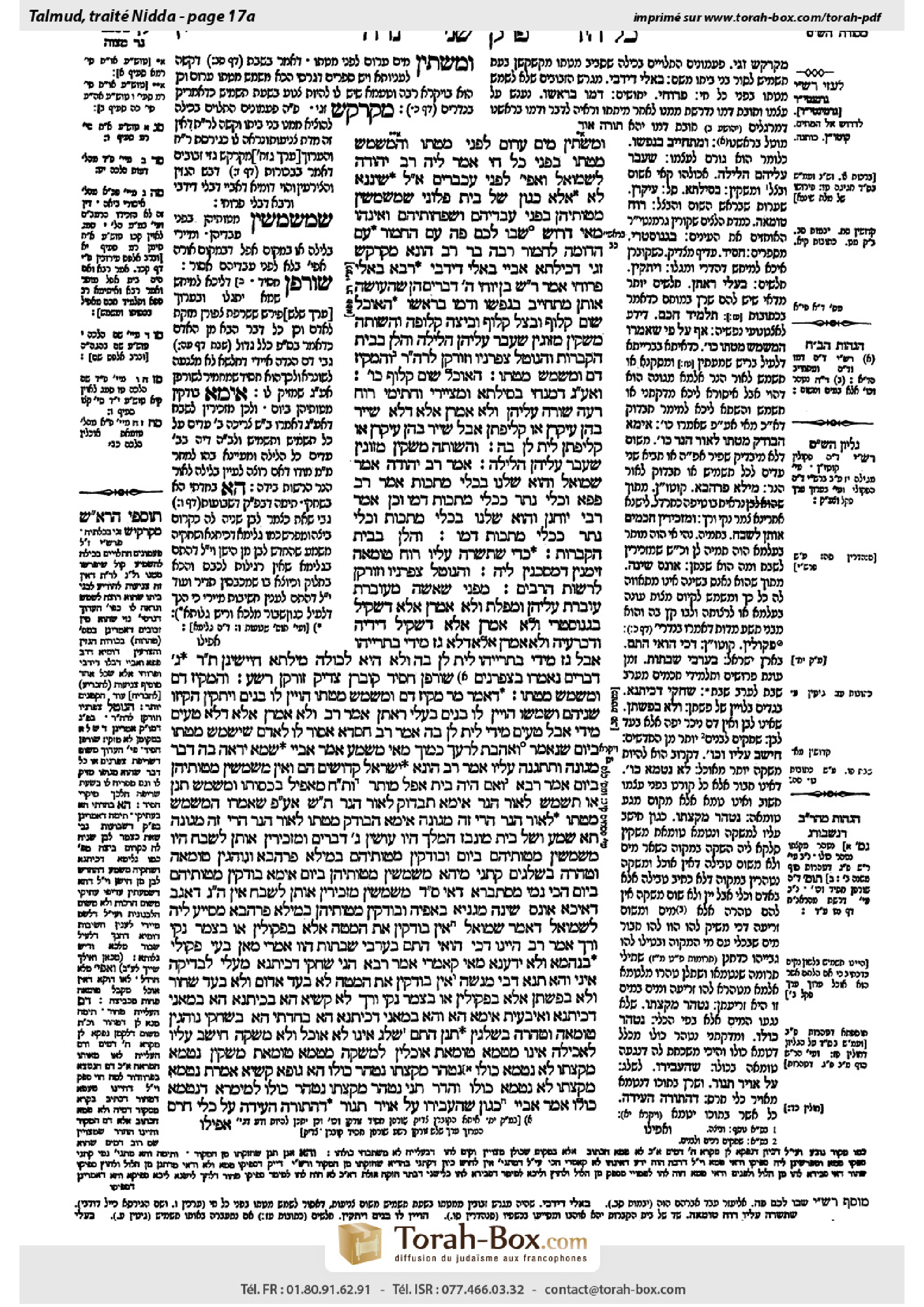
Niddah 17a: Talmud study for Daf Yomi
Daf Yomi is the daily study of one Talmud folio. Explore 37 tractates with scans, Hebrew text, Sefaria English and AI-generated French translations where annotated.
Passage selection and English or AI-generated French translation are available where the scan has annotations. Daf Study is independent of Torah-Box and Sefaria.
Browse Niddah · נידה · All tractatesNiddah 17a text and translations
This page of Niddah includes the Aramaic text, an English translation and an AI-generated French translation, alongside the scan above.
נידה י״ז א · Aramaic and Hebrew text
וּמַשְׁתִּין מַיִם עָרוּם לִפְנֵי מִטָּתוֹ, וְהַמְשַׁמֵּשׁ מִטָּתוֹ בִּפְנֵי כָּל חַי. אֲמַר לֵיהּ רַב יְהוּדָה לִשְׁמוּאֵל: וַאֲפִילּוּ לִפְנֵי עַכְבָּרִים? אֲמַר לֵיהּ: שִׁינָּנָא, לָא! אֶלָּא כְּגוֹן שֶׁל בֵּית פְּלוֹנִי שֶׁמְּשַׁמְּשִׁין מִטּוֹתֵיהֶן בִּפְנֵי עַבְדֵיהֶם וְשִׁפְחוֹתֵיהֶם.
וְאִינְהוּ מַאי דְּרוּשׁ? ״שְׁבוּ לָכֶם פֹּה עִם הַחֲמוֹר״ — עַם הַדּוֹמֶה לַחֲמוֹר.
רַבָּה בַּר רַב הוּנָא מְקַרְקֵשׁ זָגֵי דְּכִילְּתָא, אַבָּיֵי בָּאלֵי דִּידְבֵי, רָבָא בָּאלֵי פָּרוֹחֵי.
אָמַר רַבִּי שִׁמְעוֹן בֶּן יוֹחַי: חֲמִישָּׁה דְּבָרִים הֵן שֶׁהָעוֹשֶׂה אוֹתָן מִתְחַיֵּיב בְּנַפְשׁוֹ וְדָמוֹ בְּרֹאשׁוֹ — הָאוֹכֵל שׁוּם קָלוּף, וּבָצָל קָלוּף, וּבֵיצָה קְלוּפָה, וְהַשּׁוֹתֶה מַשְׁקִין מְזוּגִין שֶׁעָבַר עֲלֵיהֶן הַלַּיְלָה, וְהַלָּן בְּבֵית הַקְּבָרוֹת, וְהַנּוֹטֵל צִפׇּרְנָיו וְזוֹרְקָן לִרְשׁוּת הָרַבִּים, וְהַמַּקִּיז דָּם וּמְשַׁמֵּשׁ מִטָּתוֹ.
הָאוֹכֵל שׁוּם קָלוּף כּוּ׳. וְאַף עַל גַּב דְּמַנְּחִי בְּסִילְּתָא וּמְצַיְּירִי וַחֲתִימִי — רוּחַ רָעָה שׁוֹרָה עֲלֵיהֶן. וְלָא אֲמַרַן אֶלָּא דְּלָא שִׁיֵּיר בָּהֶן עִיקָּרָן אוֹ קְלִיפָּתָן, אֲבָל שִׁיֵּיר בָּהֶן עִיקָּרָן אוֹ קְלִיפָּתָן — לֵית לַן בַּהּ.
וְהַשּׁוֹתֶה מַשְׁקִין מְזוּגִין שֶׁעָבַר עֲלֵיהֶן הַלַּיְלָה. אָמַר רַב יְהוּדָה אָמַר שְׁמוּאֵל: וְהוּא שֶׁלָּנוּ בִּכְלֵי מַתָּכוֹת. אָמַר רַב פָּפָּא: וּכְלֵי נֶתֶר כִּכְלֵי מַתָּכוֹת דָּמוּ. וְכֵן אָמַר רַבִּי יוֹחָנָן: וְהוּא שֶׁלָּנוּ בִּכְלֵי מַתָּכוֹת, וּכְלֵי נֶתֶר כִּכְלֵי מַתָּכוֹת דָּמוּ.
וְהַלָּן בְּבֵית הַקְּבָרוֹת — כְּדֵי שֶׁתִּשְׁרֶה עָלָיו רוּחַ טוּמְאָה, זִימְנִין דִּמְסַכְּנִין לֵיהּ.
וְהַנּוֹטֵל צִפׇּרְנָיו וְזוֹרְקָן לִרְשׁוּת הָרַבִּים — מִפְּנֵי שֶׁאִשָּׁה מְעוּבֶּרֶת עוֹבֶרֶת עֲלֵיהֶן וּמַפֶּלֶת. וְלָא אֲמַרַן אֶלָּא דְּשָׁקֵיל בִּגְנוּסְטְרֵי, וְלָא אֲמַרַן אֶלָּא דְּשָׁקֵיל דִּידֵיהּ וּדְכַרְעֵיהּ, וְלָא אֲמַרַן אֶלָּא דְּלָא גַּז מִידֵּי בָּתְרַיְיהוּ, אֲבָל גַּז מִידֵּי בָּתְרַיְיהוּ — לֵית לַן בַּהּ. וְלָא הִיא, לְכוּלַּהּ מִילְּתָא חָיְישִׁינַן.
תָּנוּ רַבָּנַן: שְׁלֹשָׁה דְּבָרִים נֶאֶמְרוּ בַּצִּפׇּרְנַיִם: שׂוֹרְפָן — חָסִיד, קוֹבְרָן — צַדִּיק, זוֹרְקָן — רָשָׁע.
וְהַמַּקִּיז דָּם וּמְשַׁמֵּשׁ מִטָּתוֹ — דְּאָמַר מָר: מַקִּיז דָּם וּמְשַׁמֵּשׁ מִטָּתוֹ — הֹוִיין לוֹ בָּנִים וִיתְּקִין. הִקִּיזוּ שְׁנֵיהֶם וְשִׁמְּשׁוּ — הֹוִיין לוֹ בָּנִים בַּעֲלֵי רָאתָן. אָמַר רַב: וְלָא אֲמַרַן אֶלָּא דְּלָא טְעֵים מִידֵּי, אֲבָל טְעֵים מִידֵּי — לֵית לַן בַּהּ.
אָמַר רַב חִסְדָּא: אָסוּר לוֹ לָאָדָם שֶׁיְּשַׁמֵּשׁ מִטָּתוֹ בַּיּוֹם, שֶׁנֶּאֱמַר: ״וְאָהַבְתָּ לְרֵעֲךָ כָּמוֹךָ״. מַאי מַשְׁמַע? אָמַר אַבָּיֵי: שֶׁמָּא יִרְאֶה בָּהּ דָּבָר מְגוּנֶּה וְתִתְגַּנֶּה עָלָיו. אָמַר רַב הוּנָא: יִשְׂרָאֵל קְדוֹשִׁים הֵם, וְאֵין מְשַׁמְּשִׁין מִטּוֹתֵיהֶן בַּיּוֹם.
אָמַר רָבָא: וְאִם הָיָה בַּיִת אָפֵל — מוּתָּר, וְתַלְמִיד חָכָם — מַאֲפִיל בִּכְסוּתוֹ וּמְשַׁמֵּשׁ.
תְּנַן: אוֹ תְּשַׁמֵּשׁ לְאוֹר הַנֵּר! אֵימָא: תִּבְדּוֹק לְאוֹר הַנֵּר.
תָּא שְׁמַע: אַף עַל פִּי שֶׁאָמְרוּ: הַמְשַׁמֵּשׁ מִטָּתוֹ לְאוֹר הַנֵּר הֲרֵי זֶה מְגוּנֶּה! אֵימָא: הַבּוֹדֵק מִטָּתוֹ לְאוֹר הַנֵּר הֲרֵי זֶה מְגוּנֶּה.
תָּא שְׁמַע: וְשֶׁל בֵּית מוֹנְבַּז הַמֶּלֶךְ הָיוּ עוֹשִׂין שְׁלֹשָׁה דְּבָרִים, וּמַזְכִּירִין אוֹתָן לְשֶׁבַח — הָיוּ מְשַׁמְּשִׁין מִטּוֹתֵיהֶם בַּיּוֹם, וּבוֹדְקִין מִטּוֹתֵיהֶם בְּמֵילָא פַּרְהֲבָא, וְנוֹהֲגִין טוּמְאָה וְטׇהֳרָה בִּשְׁלָגִים. קָתָנֵי מִיהָא: מְשַׁמְּשִׁין מִטּוֹתֵיהֶן בַּיּוֹם!
אֵימָא: בּוֹדְקִין מִטּוֹתֵיהֶם בַּיּוֹם. הָכִי נָמֵי מִסְתַּבְּרָא, דְּאִי סָלְקָא דַעְתָּךְ ״מְשַׁמְּשִׁין״ — מַזְכִּירִין אוֹתָן לְשֶׁבַח? אִין הָכִי נָמֵי, דְּאַגַּב דְּאִיכָּא אוֹנֶס שֵׁינָה — מִגַּנְּיָא בְּאַפֵּיהּ.
וּבוֹדְקִין מִטּוֹתֵיהֶן בְּמֵילָא פַּרְהֲבָא — מְסַיַּיע לֵיהּ לִשְׁמוּאֵל, דְּאָמַר שְׁמוּאֵל: אֵין בּוֹדְקִין אֶת הַמִּטָּה אֶלָּא בְּפָקוֹלִין אוֹ בְּצֶמֶר נָקִי וְרַךְ. אָמַר רַב: הַיְינוּ דְּכִי הֲוַאי הָתָם בְּעַרְבֵי שַׁבָּתוֹת, הֲווֹ אָמְרִי: ״מַאן בָּעֵי פָּקוֹלֵי בְּנַהֲמָא״, וְלָא יָדַעְנָא מַאי קָאָמְרִי.
אָמַר רָבָא: הָנֵי שַׁחֲקֵי דְּכִיתָּנָא מְעַלּוּ לִבְדִיקָה. אִינִי? וְהָא תָּנָא דְּבֵי מְנַשֶּׁה: אֵין בּוֹדְקִין אֶת הַמִּטָּה לֹא בְּעֵד אֱדוֹם, וְלֹא בְּעֵד שָׁחוֹר, וְלֹא בְּפִשְׁתָּן, אֶלָּא בְּפָקוֹלִין אוֹ בְּצֶמֶר נָקִי וְרַךְ!
לָא קַשְׁיָא — הָא בְּכִיתָּנָא, הָא בְּמָאנֵי דְּכִיתָּנָא. וְאִיבָּעֵית אֵימָא: הָא וְהָא בְּמָאנֵי דְּכִיתָּנָא — הָא בְּחַדְתֵי, הָא בְּשַׁחֲקֵי.
נוֹהֲגִין טוּמְאָה וְטׇהֳרָה בִּשְׁלָגִין. תְּנַן הָתָם: שֶׁלֶג אֵינוֹ לֹא אוֹכֶל וְלֹא מַשְׁקֶה, חִישֵּׁב עָלָיו לַאֲכִילָה — אֵינוֹ מְטַמֵּא טוּמְאַת אֳוכָלִין, לְמַשְׁקֶה — מְטַמֵּא טוּמְאַת מַשְׁקִין.
נִטְמָא מִקְצָתוֹ — לֹא נִטְמָא כּוּלּוֹ, נִטְהַר מִקְצָתוֹ — נִטְהַר כּוּלּוֹ.
הָא גוּפַאּ קַשְׁיָא: אָמְרַתְּ ״נִטְמָא מִקְצָתוֹ — לֹא נִטְמָא כּוּלּוֹ״, וַהֲדַר (תָּנֵי) [אָמְרַתְּ] ״נִטְהַר מִקְצָתוֹ — נִטְהַר כּוּלּוֹ״, לְמֵימְרָא דְּנִטְמָא כּוּלּוֹ!
אָמַר אַבָּיֵי: כְּגוֹן שֶׁהֶעֱבִירוֹ עַל אֲוִיר תַּנּוּר, דְּהַתּוֹרָה הֵעִידָה עַל כְּלִי חֶרֶס
Niddah 17a · English translation
and a man who urinates naked next to his bed; and one who engages in intercourse in the presence of any living being. Rav Yehuda said to Shmuel: Does the phrase: In the presence of any living being, mean even in the presence of mice? Shmuel said to him: Shinnana, that is not the case. Rather, it is referring to a situation such as in so-and-so’s house, where they engage in intercourse in the presence of their Canaanite slaves and maidservants.
The Gemara asks: And those members of that household, who act in that manner, what verse do they interpret in a manner that allows them to do so? The Gemara answers: They reference the verse in which Abraham said to his two servants: “Remain here with [im] the donkey” (Genesis 22:5). This verse is interpreted as meaning that they are a nation [am] comparable to a donkey. The members of the aforementioned household thought that it is permitted to engage in intercourse in the presence of animals, and therefore one can do so in the presence of his Canaanite slaves and maidservants.
The Gemara cites practices of modesty observed by the Sages. Rabba bar Rav Huna would sound the bells [zagei] of the canopy above his bed when engaging in intercourse, so that people would know to keep away. Abaye would even drive away flies [didevei] from around his bed, so that he would not engage in intercourse in their presence, and Rava would drive away gnats [peruḥei].
Rabbi Shimon ben Yoḥai further says: There are five actions with regard to which one who performs them is held liable for his own life, and his blood is upon his own head, i.e., he bears responsibility for his own demise. They are as follows: One who eats peeled garlic or a peeled onion or a peeled egg, and one who drinks diluted drinks; all these are referring to items only when they were left overnight. And one who sleeps at night in a cemetery, and one who removes his nails and throws them into a public area, and one who lets blood and immediately afterward engages in intercourse.
The Gemara analyzes this statement of Rabbi Shimon ben Yoḥai, beginning with the case of one who eats peeled garlic, a peeled onion, or a peeled egg, when they were left overnight. The Gemara notes: And these peeled foods are dangerous even if they are placed in a basket and they are tied and sealed in that basket throughout the night, as an evil spirit rests upon them. And we said that eating them is dangerous only if one did not leave on them their roots or their shells. But if one left on them their roots or their shells, we have no problem with it.
Rabbi Shimon ben Yoḥai further mentions one who drinks diluted drinks that were left overnight. Rav Yehuda says that Shmuel says: And that is dangerous only when they were left overnight in metal vessels. Rav Pappa says: And natron vessels are considered like metal vessels in this regard. And Rabbi Yoḥanan likewise says: And that is dangerous only when they were left overnight in metal vessels, and natron vessels are considered like metal vessels in this regard.
Rabbi Shimon ben Yoḥai also says: And one who sleeps in a cemetery places himself in danger. The Gemara notes that this is the case if he does so in order that a spirit of impurity will rest upon him, as sometimes the evil spirits in the cemetery endanger the one who sleeps there.
The next case is one who removes his nails and throws them into a public area. The Gemara explains that this is dangerous because a pregnant woman might pass over them, and this can cause her to miscarry. And we said this halakha only when one removes his nails with scissors [bigenosteri]. And furthermore, we said this halakha only when one removes the nails of his hand and his foot together. And we said this halakha only when he did not cut anything else after his nails, but if he cut something else after them, we have no problem with it. The Gemara comments: And that is not so; rather, we are concerned with regard to the entire matter, i.e., in all cases.
With regard to removing one’s nails, the Sages taught: Three matters were stated with regard to removing nails: One who burns them is pious, as he eradicates them entirely; one who buries them is on the slightly lower level of a righteous individual, as they might be dug up; and one who simply throws them where a person might step upon them is wicked.
The Gemara discusses the final clause of Rabbi Shimon ben Yoḥai’s statement: And one who lets blood and immediately afterward engages in intercourse. This is as the Master said: With regard to one who lets blood and afterward engages in intercourse, he will have weak [vittakin] children conceived from this act of intercourse. If both of them, husband and wife, let blood and engaged in intercourse, he will have children afflicted with a disease known as ra’atan. Rav says: And we said this only in a case when he did not taste anything after letting blood, but if he tasted something then we have no problem with it.
§ Rav Ḥisda says: It is prohibited for a person to engage in intercourse by day, as it is stated: “And you shall love your fellow as yourself” (Leviticus 19:18). The Gemara asks: From where is this inferred? Abaye says: If one engages in intercourse by day, perhaps the husband will see some repulsive matter in his wife and she will become repugnant to him, which will cause him to hate her, and he will thereby violate this mitzva. Rav Huna says: Jews are holy, and they do not engage in intercourse by day.
Rava says: And if the house is dark, it is permitted to engage in intercourse by day there. And in the case of a Torah scholar, he may cause darkness with his garment and engage in intercourse even during the daytime, as he will certainly do so with modesty.
The Gemara challenges: We learned in the mishna: Or she must engage in intercourse by the light of a lamp. This indicates that one may engage in intercourse in the light. The Gemara answers: Say that the mishna reads: She must examine the cloth by the light of a lamp, but not engage in intercourse in this manner.
The Gemara cites a relevant source. Come and hear a baraita: Even though the Sages said that one who engages in intercourse by the light of a lamp is repulsive, nevertheless Beit Shammai say: Or she must engage in intercourse by the light of a lamp and inspect the cloths before and after each act of intercourse. The Gemara similarly explains: Say that the baraita reads: One who examines herself before or after intercourse by the light of a lamp is repulsive, as this examination would not be conducted properly, since the light of the lamp may not be sufficient. Nevertheless Beit Shammai say that a woman who engages in many acts of intercourse in one night must examine the cloth by the light of a lamp.
The Gemara further suggests: Come and hear a baraita: And the household of King Munbaz would perform three matters, and the Sages would mention them favorably for their behavior in this regard. They would engage in intercourse by day; and they would examine before and after intercourse with wool [bemeila] of Parhava, which is very white and would show any stain; and they would practice ritual impurity and purity with regard to snow. Regardless of the meaning of the last two matters, in any event this baraita teaches that they would engage in intercourse by day, which indicates that this practice is not prohibited.
The Gemara answers: Say that they would examine their beds, i.e., check the examination cloths, by day. The Gemara adds: So too, it is reasonable that this is the correct explanation, as if it should enter your mind that it means that they would engage in intercourse by day, even if it is permitted, would the Sages have mentioned them favorably for this practice? The Gemara refutes this proof: Yes, it is indeed so. There is a praiseworthy aspect to engaging in intercourse by day, as at night there is a risk of being overcome by sleep, because the husband might be too tired after the exertions of the day, and consequently his wife who desires sexual intercourse might be repulsive to him.
The Gemara further analyzes the baraita, which teaches: And the household of King Munbaz would examine before and after intercourse, with wool of Parhava. The Gemara notes: This statement supports the opinion of Shmuel, as Shmuel said: One may examine a bed, i.e., use an examination cloth for intercourse, only with a cloth made of linen [befakolin], or with one made of clean and soft wool. Rav says: This is the explanation of that which I heard when I was there, in Eretz Yisrael, on Shabbat evenings, which is the time when Torah scholars engage in intercourse with their wives; people would offer and say: Who needs linen cloths for eating bread [benahama], a euphemism for intercourse. And I did not know what they were saying until now.
Rava says: Those worn-out flax clothes are good for examination. The Gemara asks: Is that so? But didn’t the school of Menashe teach: One may not examine a bed with a red cloth, nor with a black cloth, nor with flax, but with a cloth made of linen, or with one made of clean and soft wool?
The Gemara answers that this is not difficult, as this statement that one may not examine with flax is referring to flax itself, whereas that statement of Rava, that flax is good for an examination, is referring to flax garments. And if you wish, say instead that both this statement and that statement are referring to flax garments, and the difference is that this ruling that one may not use flax is referring to new garments, whereas that ruling of Rava is referring specifically to worn-out garments, which are brighter.
It was further stated that the household of King Munbaz was praised by the Sages because its members would practice ritual impurity and purity with regard to snow. The Gemara comments: We learned in a baraita there (see Tosefta, Teharot 2:5): Snow is neither food nor drink with regard to ritual impurity. If one designated it for consumption, his intention is disregarded, and it does not impart the ritual impurity of food. But if one planned to use it as a drink, it imparts the ritual impurity of liquid.
If part of the snow became impure, it does not all become impure, but only the area that came into contact with the item of ritual impurity, as a pile of snow is not considered a single unit. If impure snow in a vessel is lowered into a ritual bath, even if the waters of the ritual bath touched only the snow on the mouth of the vessel, since part of the snow is purified, all of it is purified.
The Gemara analyzes the baraita: This baraita itself is difficult. You initially said that if part of the snow became impure, it does not all become impure, and then the baraita teaches that if part of the snow is purified, all of it is purified, which is to say that all of it became impure. In other words, the last clause of the baraita is dealing with a lump of snow all of which is ritually impure, whereas according to the previous clause this is impossible: How could the source of the impurity have touched all of the snow?
Abaye says: It is possible for all the snow to become impure, in a case where one passed the snow within the airspace of an earthenware vessel, such as an oven, in which the source of impurity was located. This renders the entire lump of snow impure, as the Torah testifies with regard to an earthenware vessel that contains a source of impurity that all items inside its airspace are rendered impure, as the verse states: “Whatever is in it shall be impure” (Leviticus 11:33).
Niddah 17a · Traduction française (IA)
et un homme qui urine nu à côté de son lit ; et celui qui a des rapports sexuels en présence de tout être vivant. Rav Yehuda dit à Shmuel : La phrase « en présence de tout être vivant » signifie-t-elle même en présence de souris ? Shmuel lui répondit : Shinnana, ce n'est pas le cas. Plutôt, cela fait référence à une situation telle que dans la maison de tel, où ils ont des rapports sexuels en présence de leurs esclaves cananéens et de leurs servantes.
La Guemara demande : Et ces membres de ce foyer, qui agissent de cette manière, quel verset interprètent-ils de manière à leur permettre de le faire ? La Guemara répond : Ils se réfèrent au verset dans lequel Abraham dit à ses deux serviteurs : « Restez ici avec [im] l'âne » (Genèse 22:5). Ce verset est interprété comme signifiant qu'ils sont une nation [am] comparable à un âne. Les membres du foyer susmentionné pensaient qu'il est permis d'avoir des rapports sexuels en présence d'animaux, et par conséquent, on peut le faire en présence de ses esclaves cananéens et de ses servantes.
La Guemara cite les pratiques de pudeur observées par les Sages. Rabba bar Rav Huna faisait sonner les clochettes [zagei] du baldaquin au-dessus de son lit lorsqu'il avait des rapports sexuels, afin que les gens sachent s'éloigner. Abaye chassait même les mouches [didevei] autour de son lit, afin de ne pas avoir de rapports sexuels en leur présence, et Rava chassait les moustiques [peruḥei].
Rabbi Shimon ben Yoḥai dit en outre : Il y a cinq actions pour lesquelles celui qui les commet est tenu responsable de sa propre vie, et son sang est sur sa propre tête, c'est-à-dire qu'il porte la responsabilité de sa propre perte. Elles sont les suivantes : Celui qui mange de l'ail pelé, un oignon pelé ou un œuf pelé, et celui qui boit des boissons diluées ; tout cela ne concerne ces aliments que lorsqu'ils ont été laissés toute la nuit. Et celui qui dort la nuit dans un cimetière, et celui qui se coupe les ongles et les jette dans un lieu public, et celui qui se saigne et a immédiatement après des rapports sexuels.
La Guemara analyse cette déclaration de Rabbi Shimon ben Yoḥai, en commençant par le cas de celui qui mange de l'ail pelé, un oignon pelé ou un œuf pelé, lorsqu'ils ont été laissés toute la nuit. La Guemara note : Et ces aliments pelés sont dangereux même s'ils sont placés dans un panier et qu'ils sont liés et scellés dans ce panier toute la nuit, car un esprit malin se repose sur eux. Et nous avons dit que les manger est dangereux seulement si l'on n'a pas laissé dessus leurs racines ou leurs coquilles. Mais si l'on a laissé dessus leurs racines ou leurs coquilles, nous n'avons pas de problème à ce sujet.
Rabbi Shimon ben Yoḥai mentionne en outre celui qui boit des boissons diluées qui ont été laissées toute la nuit. Rav Yehuda dit que Shmuel dit : Et cela est dangereux seulement lorsqu'elles ont été laissées toute la nuit dans des récipients en métal. Rav Pappa dit : Et les récipients en natron sont considérés comme des récipients en métal à cet égard. Et Rabbi Yoḥanan dit également : Et cela est dangereux seulement lorsqu'elles ont été laissées toute la nuit dans des récipients en métal, et les récipients en natron sont considérés comme des récipients en métal à cet égard.
Rabbi Shimon ben Yoḥai dit également : Celui qui dort dans un cimetière se met en danger. La Guemara précise que cela s'applique s'il le fait afin qu'un esprit d'impureté se repose sur lui, car parfois les esprits malins du cimetière mettent en danger celui qui y dort.
Le cas suivant est celui de celui qui se coupe les ongles et les jette dans un lieu public. La Guemara explique que c'est dangereux parce qu'une femme enceinte pourrait passer dessus, et cela peut provoquer une fausse couche. Et nous avons énoncé cette halakha seulement lorsqu'on se coupe les ongles avec des ciseaux [bigenosteri]. De plus, nous avons énoncé cette halakha seulement lorsqu'on se coupe les ongles de la main et du pied ensemble. Et nous avons énoncé cette halakha seulement lorsqu'il n'a pas coupé autre chose après ses ongles, mais s'il a coupé autre chose après eux, nous n'avons pas de problème à ce sujet. La Guemara commente : Et ce n'est pas ainsi ; plutôt, nous sommes préoccupés par l'ensemble de la question, c'est-à-dire dans tous les cas.
Concernant la coupe des ongles, les Sages ont enseigné : Trois choses ont été dites à propos de la coupe des ongles : Celui qui les brûle est pieux, car il les élimine entièrement ; celui qui les enterre est au niveau légèrement inférieur d'un homme juste, car elles pourraient être déterrées ; et celui qui les jette simplement là où une personne pourrait marcher dessus est méchant.
La Guemara examine la dernière clause de la déclaration de Rabbi Shimon ben Yoḥai : « Et celui qui se saigne et a immédiatement après des rapports sexuels. » C'est comme le Maître l'a dit : Concernant celui qui se saigne et a ensuite des rapports sexuels, il aura des enfants faibles [vittakin] conçus de cet acte. Si tous les deux, le mari et la femme, se sont saignés et ont eu des rapports sexuels, il aura des enfants atteints d'une maladie connue sous le nom de ra'atan. Rav dit : Et nous avons dit cela seulement dans le cas où il n'a pas goûté à quoi que ce soit après s'être saigné, mais s'il a goûté à quelque chose, alors nous n'avons pas de problème à ce sujet.
§ Rav Ḥisda dit : Il est interdit à une personne d'avoir des rapports sexuels en plein jour, car il est écrit : « Et tu aimeras ton prochain comme toi-même » (Lévitique 19:18). La Guemara demande : D'où cela est-il déduit ? Abaye dit : Si l'on a des rapports sexuels en plein jour, peut-être que le mari verra quelque chose de répugnant chez sa femme et elle lui deviendra répugnante, ce qui le fera la haïr, et il violera ainsi cette mitsva. Rav Huna dit : Les Juifs sont saints, et ils n'ont pas de rapports sexuels en plein jour.
Rava dit : Et si la maison est sombre, il est permis d'avoir des rapports sexuels en plein jour là-dedans. Et dans le cas d'un érudit de la Torah, il peut créer de l'obscurité avec son vêtement et avoir des rapports sexuels même en plein jour, car il le fera certainement avec pudeur.
La Guemara objecte : Nous avons appris dans la Michna : Ou bien elle doit avoir des rapports par la lumière d'une lampe. Cela indique qu'il est permis d'avoir des rapports dans la lumière. La Guemara répond : Dites que la Michna se lit ainsi : Elle doit examiner le linge par la lumière d'une lampe, mais ne pas avoir de rapports de cette manière.
La Guemara cite une source pertinente. Écoutez une baraïta : Bien que les Sages aient dit que celui qui a des rapports par la lumière d'une lampe est répugnant, Beit Chamaï disent : Ou bien elle doit avoir des rapports par la lumière d'une lampe et examiner les linges avant et après chaque acte de rapport. La Guemara explique de même : Dites que la baraïta se lit ainsi : Celui qui s'examine avant ou après les rapports par la lumière d'une lampe est répugnant, car cet examen ne serait pas effectué correctement, la lumière de la lampe pouvant ne pas être suffisante. Néanmoins, Beit Chamaï disent qu'une femme qui a de nombreux rapports dans une même nuit doit examiner le linge par la lumière d'une lampe.
La Guemara suggère encore : Écoutez une baraïta : Et la maison du roi Monbaz accomplissait trois choses, et les Sages les mentionnaient favorablement pour leur comportement à cet égard. Ils avaient des rapports en journée ; et ils examinaient avant et après les rapports avec de la laine [bemeila] de Parhava, qui est très blanche et qui ferait apparaître toute tache ; et ils observaient les règles de pureté et d'impureté rituelles concernant la neige. Quelle que soit la signification des deux dernières choses, en tout cas, cette baraïta enseigne qu'ils avaient des rapports en journée, ce qui indique que cette pratique n'est pas interdite.
La Guemara répond : Dites qu'ils examinaient leurs lits, c'est-à-dire qu'ils vérifiaient les linges d'examen, en journée. La Guemara ajoute : De même, il est raisonnable que ce soit l'explication correcte, car s'il devait vous venir à l'esprit que cela signifie qu'ils avaient des rapports en journée, même si c'est permis, les Sages les auraient-ils mentionnés favorablement pour cette pratique ? La Guemara réfute cette preuve : Oui, c'est bien ainsi. Il y a un aspect louable à avoir des rapports en journée, car la nuit il y a un risque d'être emporté par le sommeil, car le mari pourrait être trop fatigué après les efforts de la journée, et par conséquent son épouse qui désire des rapports sexuels pourrait lui être répugnante.
La Guemara analyse davantage la baraïta, qui enseigne : Et la maison du roi Monbaz examinait avant et après les rapports, avec de la laine de Parhava. La Guemara note : Cette déclaration soutient l'opinion de Chmouel, car Chmouel a dit : On ne peut examiner un lit, c'est-à-dire utiliser un linge d'examen pour les rapports, qu'avec un linge fait de lin [befakolin], ou avec un linge fait de laine propre et douce. Rav dit : C'est l'explication de ce que j'ai entendu quand j'étais là, en Terre d'Israël, les soirs de Chabbat, qui est le moment où les érudits de la Torah ont des rapports avec leurs épouses ; les gens proposaient et disaient : Qui a besoin de linges de lin pour manger du pain [benahama], un euphémisme pour les rapports. Et je ne savais pas ce qu'ils disaient jusqu'à maintenant.
Rava dit : Ces vêtements de lin usés sont bons pour l'examen. La Guemara demande : Est-ce ainsi ? Mais n'a-t-on pas enseigné dans l'école de Menaché : On ne peut pas examiner un lit avec un linge rouge, ni avec un linge noir, ni avec du lin, mais avec un linge fait de lin, ou avec un linge fait de laine propre et douce ?
La Guemara répond que cela ne pose pas de difficulté, car cette déclaration selon laquelle on ne peut pas examiner avec du lin fait référence au lin lui-même, tandis que cette déclaration de Rava, selon laquelle le lin est bon pour un examen, fait référence aux vêtements de lin. Et si vous le souhaitez, dites plutôt que cette déclaration et celle-là font toutes deux référence aux vêtements de lin, et la différence est que cette règle selon laquelle on ne peut pas utiliser du lin fait référence aux vêtements neufs, tandis que cette règle de Rava fait référence spécifiquement aux vêtements usés, qui sont plus clairs.
Il a été dit également que la maison du roi Monbaz était louée par les Sages parce que ses membres observaient les règles de pureté et d'impureté rituelles concernant la neige. La Guemara commente : Nous avons appris dans une baraïta là-bas (voir Tosefta, Teharot 2:5) : La neige n'est ni nourriture ni boisson au regard de l'impureté rituelle. Si on la désigne pour la consommation, son intention est ignorée, et elle ne transmet pas l'impureté rituelle de la nourriture. Mais si on prévoit de l'utiliser comme boisson, elle transmet l'impureté rituelle du liquide.
Si une partie de la neige devient impure, elle ne devient pas toute impure, mais seulement la zone qui a été en contact avec l'objet d'impureté rituelle, car un tas de neige n'est pas considéré comme une unité unique. Si de la neige impure dans un récipient est abaissée dans un bain rituel, même si les eaux du bain rituel n'ont touché que la neige sur la bouche du récipient, comme une partie de la neige est purifiée, toute est purifiée.
La Guemara analyse la baraïta : Cette baraïta elle-même pose un problème. Vous avez d'abord dit que si une partie de la neige devient impure, elle ne devient pas toute impure, puis la baraïta enseigne que si une partie de la neige est purifiée, toute est purifiée, ce qui signifie que toute est devenue impure. En d'autres termes, la dernière clause de la baraïta traite d'un bloc de neige entièrement rituellement impur, tandis que selon la clause précédente, cela est impossible : comment la source de l'impureté aurait-elle pu toucher toute la neige ?
Abaye dit : Il est possible que toute la neige devienne impure, dans le cas où l'on a fait passer la neige dans l'espace aérien d'un récipient en terre cuite, tel qu'un four, dans lequel se trouvait la source d'impureté. Cela rend tout le bloc de neige impur, car la Torah témoigne, à propos d'un récipient en terre cuite contenant une source d'impureté, que tous les objets situés dans son espace aérien sont rendus impurs, comme l'énonce le verset : « Tout ce qui est dedans sera impur » (Lévitique 11:33).
Traduction française générée par IA à partir de l’édition anglaise de Sefaria. Vérifie toujours un passage avec le texte source.
Text from Sefaria: William Davidson Edition - Vocalized Aramaic (CC BY NC); William Davidson Edition - English (CC BY NC).