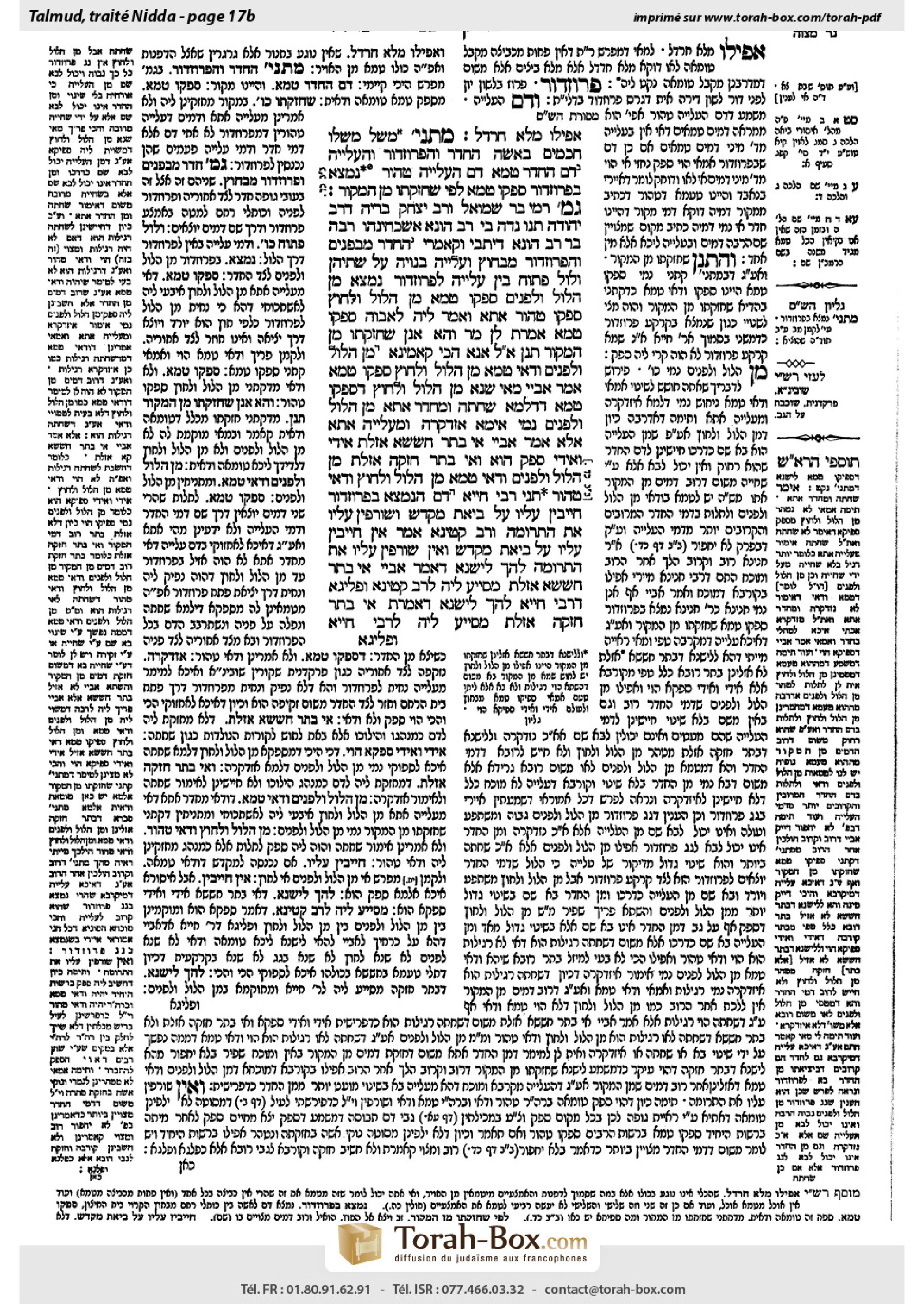
Niddah 17b: Talmud study for Daf Yomi
Daf Yomi is the daily study of one Talmud folio. Explore 37 tractates with scans, Hebrew text, Sefaria English and AI-generated French translations where annotated.
Passage selection and English or AI-generated French translation are available where the scan has annotations. Daf Study is independent of Torah-Box and Sefaria.
Browse Niddah · נידה · All tractatesNiddah 17b text and translations
This page of Niddah includes the Aramaic text, an English translation and an AI-generated French translation, alongside the scan above.
נידה י״ז ב · Aramaic and Hebrew text
אֲפִילּוּ מָלֵא חַרְדָּל.
מַתְנִי' מָשָׁל מָשְׁלוּ חֲכָמִים בָּאִשָּׁה: הַחֶדֶר, וְהַפְּרוֹזְדוֹר, וְהָעֲלִיָּיה.
דַּם הַחֶדֶר — טָמֵא, דַּם הָעֲלִיָּיה — טָהוֹר, נִמְצָא בַּפְּרוֹזְדוֹר — סְפֵקוֹ טָמֵא, לְפִי שֶׁחֶזְקָתוֹ מִן הַמָּקוֹר.
גְּמָ' רָמֵי בַּר שְׁמוּאֵל וְרַב יִצְחָק בְּרֵיהּ דְּרַב יְהוּדָה תְּנוֹ נִדָּה בֵּי רַב הוּנָא. אַשְׁכְּחִינְהוּ רַבָּה בַּר רַב הוּנָא דְּיָתְבִי וְקָאָמְרִי: הַחֶדֶר מִבִּפְנִים, וְהַפְּרוֹזְדוֹר מִבַּחוּץ, וַעֲלִיָּיה בְּנוּיָה עַל שְׁתֵּיהֶן, וְלוּל פָּתוּחַ בֵּין עֲלִיָּיה לַפְּרוֹזְדוֹר.
נִמְצָא מִן הַלּוּל וְלִפְנִים — סְפֵקוֹ טָמֵא, מִן הִלּוּל וְלַחוּץ — סְפֵקוֹ טָהוֹר.
אֲתָא וַאֲמַר לֵיהּ לַאֲבוּהּ: סְפֵקוֹ טָמֵא אֲמַרְתְּ לַן מָר? וְהָא אֲנַן ״שֶׁחֶזְקָתוֹ מִן הַמָּקוֹר״ תְּנַן!
אֲמַר לֵיהּ: אֲנָא הָכִי קָאָמֵינָא — מִן הַלּוּל וְלִפְנִים וַדַּאי טָמֵא, מִן הַלּוּל וְלַחוּץ סְפֵקוֹ טָמֵא.
אָמַר אַבָּיֵי: מַאי שְׁנָא מִן הַלּוּל וְלַחוּץ, דִּסְפֵקוֹ טָמֵא? דְּדִלְמָא שָׁחֲתָה, וּמֵחֶדֶר אֲתָא. מִן הַלּוּל וְלִפְנִים נָמֵי, אֵימָא: אִזְדְּקַרָה, וּמֵעֲלִיָּיה אֲתָא!
אֶלָּא אָמַר אַבָּיֵי: אִי בָּתַר חֲשָׁשָׁא אָזְלַתְּ — אִידֵּי וְאִידֵּי סָפֵק הוּא, וְאִי בָּתַר חֲזָקָה אָזְלַתְּ — מִן הַלּוּל וְלִפְנִים וַדַּאי טָמֵא, מִן הַלּוּל וְלַחוּץ וַדַּאי טָהוֹר.
תָּנֵי רַבִּי חִיָּיא: דָּם הַנִּמְצָא בַּפְּרוֹזְדוֹר — חַיָּיבִין עָלָיו עַל בִּיאַת מִקְדָּשׁ, וְשׂוֹרְפִין עָלָיו אֶת הַתְּרוּמָה. וְרַב קַטִּינָא אָמַר: אֵין חַיָּיבִין עָלָיו עַל בִּיאַת מִקְדָּשׁ, וְאֵין שׂוֹרְפִין עָלָיו אֶת הַתְּרוּמָה.
לְהָךְ לִישָּׁנָא דְּאָמַר אַבָּיֵי: ״אִי בָּתַר חֲשָׁשָׁא אָזְלַתְּ״ — מְסַיַּיע לֵיהּ לְרַב קַטִּינָא, וּפְלִיגָא דְּרַבִּי חִיָּיא.
לְהָךְ לִישָּׁנָא דְּאָמְרַתְּ: ״אִי בָּתַר חֲזָקָה אָזְלַתְּ״ — מְסַיַּיע לֵיהּ לְרַבִּי חִיָּיא,
Niddah 17b · English translation
Therefore, even if the earthenware vessel was full of items as small as mustard seeds, only a few of which touched the sides of the vessel or the impure item inside it, all the items inside the vessel are rendered ritually impure. Likewise, with regard to snow that passes through the vessel’s airspace, all of it becomes impure.
MISHNA: A woman’s reproductive organs are composed of different parts, and the halakhic status of blood that emerges from one part differs from the halakhic status of blood that emerges from another part. The Sages stated a parable with regard to the structure of the sexual organs of a woman, based on the structure of a house: The inner room represents the uterus, and the corridor [perozdor] leading to the inner room represents the vaginal canal, and the upper story represents the bladder.
Blood from the inner room is ritually impure. Blood from the upper story is ritually pure. If blood was found in the corridor, there is uncertainty whether it came from the uterus and is impure, or from the bladder and is pure. Despite its state of uncertainty, it is deemed definitely impure, due to the fact that its presumptive status is of blood that came from the source, i.e., the uterus, and not from the bladder.
GEMARA: Rami bar Shmuel and Rav Yitzḥak, son of Rav Yehuda, were learning tractate Nidda in the study hall of Rav Huna. Rabba bar Rav Huna found them sitting and saying an interpretation of this mishna: The room, i.e., the uterus, is the inner part of the reproductive organs, and the corridor is the outer part. And the upper story, the bladder, is built, i.e., found, above them both. And there is an open vestibule between the upper story and the corridor.
They continued: If blood is found from the opening of this vestibule and inward toward the uterus, i.e., inside the vagina, there is uncertainty whether it came from the uterus and is impure, or from the bladder and is pure, but its state of uncertainty renders it definitely impure. If it is found in the area from the opening of this vestibule and outward, on the outer surface of the vulva, the blood is more likely to have come from the bladder, through the urethra, and therefore its state of uncertainty renders it pure.
Rabba came and said to his father, Rav Huna: With regard to the halakha of blood that is found from the vestibule and inward, did the Master say to us that its state of uncertainty renders it impure, as I heard in the study hall, from which it may be inferred that this is a case of uncertain impurity? But didn’t we learn in the mishna: The blood is impure due to the fact that its presumptive status is of blood that came from the source, i.e., the uterus? This indicates that it is a case of definite impurity. If so, the mishna cannot be referring either to blood found from the vestibule and inward or from the vestibule and outward.
Rav Huna said to his son Rabba: This is what I said: If the blood was found from the vestibule inward it is definitely impure, as it is presumed to come from the uterus. This is the case mentioned in the mishna. If the blood was found from the vestibule outward its state of uncertainty renders it impure. Although it can be claimed that if this was blood from the uterus it would not have been found in this area, it is possible that when the woman bent over, the blood went from the uterus into this area. Consequently, she is impure due to the uncertainty.
Abaye says: What is different about a situation where the blood was found from the vestibule outward, where its state of uncertainty renders it impure? The reason for that halakha is that perhaps the woman bent over and leaned forward, and the blood came from the room, i.e., the uterus. If so, in the case where the blood was found from the vestibule inward, concerning which you ruled that she is definitely impure, you can also say that it is possible that the woman staggered backward and as a result the blood came from the upper story to the back of the canal. Accordingly, she should be impure merely out of uncertainty.
Rather, Abaye says: If you follow the concern, i.e., if your ruling of halakha is based on a concern that the blood might have moved due to the woman leaning forward or backward, then in both this case and that, whether the blood is found in the inner or outer section of the canal, the source of the blood is uncertain. And if you follow the presumption based on where the blood found in a particular place is usually from, then blood found from the vestibule inward is definitely impure, whereas blood found from the vestibule outward is definitely pure.
Rabbi Ḥiyya teaches: Blood that is found in the corridor is considered definite menstrual blood, and therefore if she engages in intercourse, both she and her partner would be liable as a result of this blood to receive karet for entering the Temple intentionally when ritually impure, or to bring an offering for entering unwittingly. And one burns teruma due to it, if the woman touches such produce. And Rav Ketina says: It is impure merely as a matter of uncertainty; therefore, the woman is not obligated, due to that blood, to bring an offering for entering the Temple when ritually impure, and one does not burn teruma on its account.
The Gemara discusses the relationship between this dispute and the previous statements of amora’im. According to this formulation, i.e., option, that Abaye stated: If you follow the concern that the blood might have moved due to the woman leaning forward or backward, there is uncertainty whether the blood was found in the inner or outer section of the canal, this supports the opinion of Rav Ketina, who likewise deems blood found in the canal impure due to uncertainty. And this option suggested by Abaye contradicts the opinion of Rabbi Ḥiyya, who deems the blood definitely impure.
According to that formulation that Abaye stated: If you follow the presumption that blood found in the inner section is definitely impure, while blood found in the outer section is definitely pure, this supports the opinion of Rabbi Ḥiyya, whose ruling that the blood is definitely impure is understood as referring to blood found in the inner section.
Niddah 17b · Traduction française (IA)
Par conséquent, même si le récipient en terre cuite était rempli d’objets aussi petits que des graines de moutarde, dont seuls quelques-uns touchaient les parois du récipient ou l’objet impur qui s’y trouvait, tous les objets contenus dans le récipient deviennent rituellement impurs. De même, toute la neige qui traverse l’espace intérieur du récipient devient impure.
MICHNA : Les organes reproducteurs de la femme sont composés de différentes parties, et le statut halakhique du sang qui provient de l’une diffère de celui du sang qui provient d’une autre. Les Sages ont proposé une parabole concernant la structure des organes sexuels de la femme, en la comparant à celle d’une maison : la pièce intérieure représente l’utérus, le couloir [perozdor] qui mène à cette pièce représente le canal vaginal, et l’étage supérieur représente la vessie.
Le sang provenant de la pièce intérieure est rituellement impur. Le sang provenant de l’étage supérieur est rituellement pur. Si du sang est trouvé dans le couloir, on ne sait pas s’il provient de l’utérus et est impur, ou de la vessie et est pur. Malgré cette incertitude, il est considéré comme certainement impur, car son statut présumé est celui d’un sang provenant de la source, c’est-à-dire de l’utérus, et non de la vessie.
GUEMARA : Rami bar Shmuel et Rav Yitzḥak, fils de Rav Yehuda, étudiaient le traité Nidda dans la maison d’étude de Rav Huna. Rabba bar Rav Huna les trouva assis et interprétant cette Michna : la pièce, c’est-à-dire l’utérus, est la partie intérieure des organes reproducteurs, tandis que le couloir en est la partie extérieure. Quant à l’étage supérieur, la vessie, il est construit, c’est-à-dire situé, au-dessus des deux. Un vestibule ouvert se trouve entre l’étage supérieur et le couloir.
Ils poursuivirent : si du sang est trouvé depuis l’ouverture de ce vestibule vers l’intérieur, en direction de l’utérus, c’est-à-dire à l’intérieur du vagin, on ne sait pas s’il provient de l’utérus et est impur, ou de la vessie et est pur ; mais cette incertitude le rend certainement impur. S’il est trouvé dans la zone située depuis l’ouverture de ce vestibule vers l’extérieur, sur la surface externe de la vulve, il est plus probable que le sang provienne de la vessie, en passant par l’urètre ; cette incertitude le rend donc pur.
Rabba vint trouver son père, Rav Huna, et lui dit : « Concernant la halakha du sang trouvé depuis le vestibule vers l’intérieur, le Maître nous a-t-il dit que son incertitude le rend impur, comme je l’ai entendu dans la maison d’étude, ce qui permettrait d’en déduire qu’il s’agit d’un cas d’impureté incertaine ? Mais n’avons-nous pas appris dans la Michna : le sang est impur parce que son statut présumé est celui d’un sang provenant de la source, c’est-à-dire de l’utérus ? Cela indique qu’il s’agit d’un cas d’impureté certaine. Dans ce cas, la Michna ne peut se référer ni au sang trouvé depuis le vestibule vers l’intérieur, ni à celui trouvé depuis le vestibule vers l’extérieur. »
Rav Huna dit à son fils Rabba : « Voici ce que j’ai dit : si le sang est trouvé depuis le vestibule vers l’intérieur, il est certainement impur, car on présume qu’il provient de l’utérus. C’est le cas mentionné dans la Michna. Si le sang est trouvé depuis le vestibule vers l’extérieur, son incertitude le rend impur. Bien que l’on puisse soutenir que, s’il provenait de l’utérus, il n’aurait pas été trouvé dans cette zone, il est possible que, lorsque la femme s’est penchée, le sang soit passé de l’utérus dans cette zone. Par conséquent, elle est impure en raison de l’incertitude. »
Abaye dit : « En quoi le cas où le sang a été trouvé depuis le vestibule vers l’extérieur diffère-t-il, pour que son incertitude le rende impur ? Cette halakha repose sur la possibilité que la femme se soit penchée en avant et que le sang provienne de la pièce, c’est-à-dire de l’utérus. Dans ce cas, pour le sang trouvé depuis le vestibule vers l’intérieur, au sujet duquel tu as statué qu’elle est certainement impure, tu peux également dire qu’il est possible que la femme ait basculé vers l’arrière et que, par conséquent, le sang soit passé de l’étage supérieur vers l’arrière du canal. Elle devrait donc être impure uniquement en raison de l’incertitude. »
Abaye dit plutôt : « Si tu te fondes sur cette possibilité, c’est-à-dire si ta décision halakhique repose sur la possibilité que le sang se soit déplacé parce que la femme s’est penchée en avant ou en arrière, alors, dans les deux cas, que le sang soit trouvé dans la partie intérieure ou extérieure du canal, sa provenance est incertaine. Mais si tu te fondes sur la présomption concernant la provenance habituelle du sang trouvé à un endroit donné, alors le sang trouvé depuis le vestibule vers l’intérieur est certainement impur, tandis que celui trouvé depuis le vestibule vers l’extérieur est certainement pur. »
Rabbi Ḥiyya enseigne : le sang trouvé dans le couloir est considéré comme du sang menstruel dont l’impureté est certaine. Par conséquent, si elle a des relations sexuelles, elle et son partenaire encourent, à cause de ce sang, le karet pour être entrés intentionnellement dans le Temple alors qu’ils étaient rituellement impurs, ou doivent apporter un sacrifice pour y être entrés par inadvertance. On brûle aussi la terouma à cause de ce sang si la femme touche une telle récolte. Rav Ketina dit : le sang est impur uniquement en raison de l’incertitude ; la femme n’est donc pas tenue, à cause de ce sang, d’apporter un sacrifice pour être entrée dans le Temple alors qu’elle était rituellement impure, et on ne brûle pas la terouma à cause de lui.
La Guemara examine le lien entre cette controverse et les déclarations précédentes des amoraïm. Selon cette formulation, c’est-à-dire l’option énoncée par Abaye — si l’on tient compte de la possibilité que le sang se soit déplacé parce que la femme s’est penchée en avant ou en arrière, sa provenance est incertaine, qu’il ait été trouvé dans la partie intérieure ou extérieure du canal —, cela appuie l’avis de Rav Ketina, qui considère lui aussi comme impur, en raison de l’incertitude, le sang trouvé dans le canal. Cette option avancée par Abaye contredit l’avis de Rabbi Ḥiyya, qui considère le sang comme certainement impur.
Selon l’autre formulation énoncée par Abaye — si l’on se fonde sur la présomption selon laquelle le sang trouvé dans la partie intérieure est certainement impur, tandis que celui trouvé dans la partie extérieure est certainement pur —, cela appuie l’avis de Rabbi Ḥiyya, dont la décision selon laquelle le sang est certainement impur s’entend du sang trouvé dans la partie intérieure.
Traduction française générée par IA à partir de l’édition anglaise de Sefaria. Vérifie toujours un passage avec le texte source.
Text from Sefaria: William Davidson Edition - Vocalized Aramaic (CC BY NC); William Davidson Edition - English (CC BY NC).