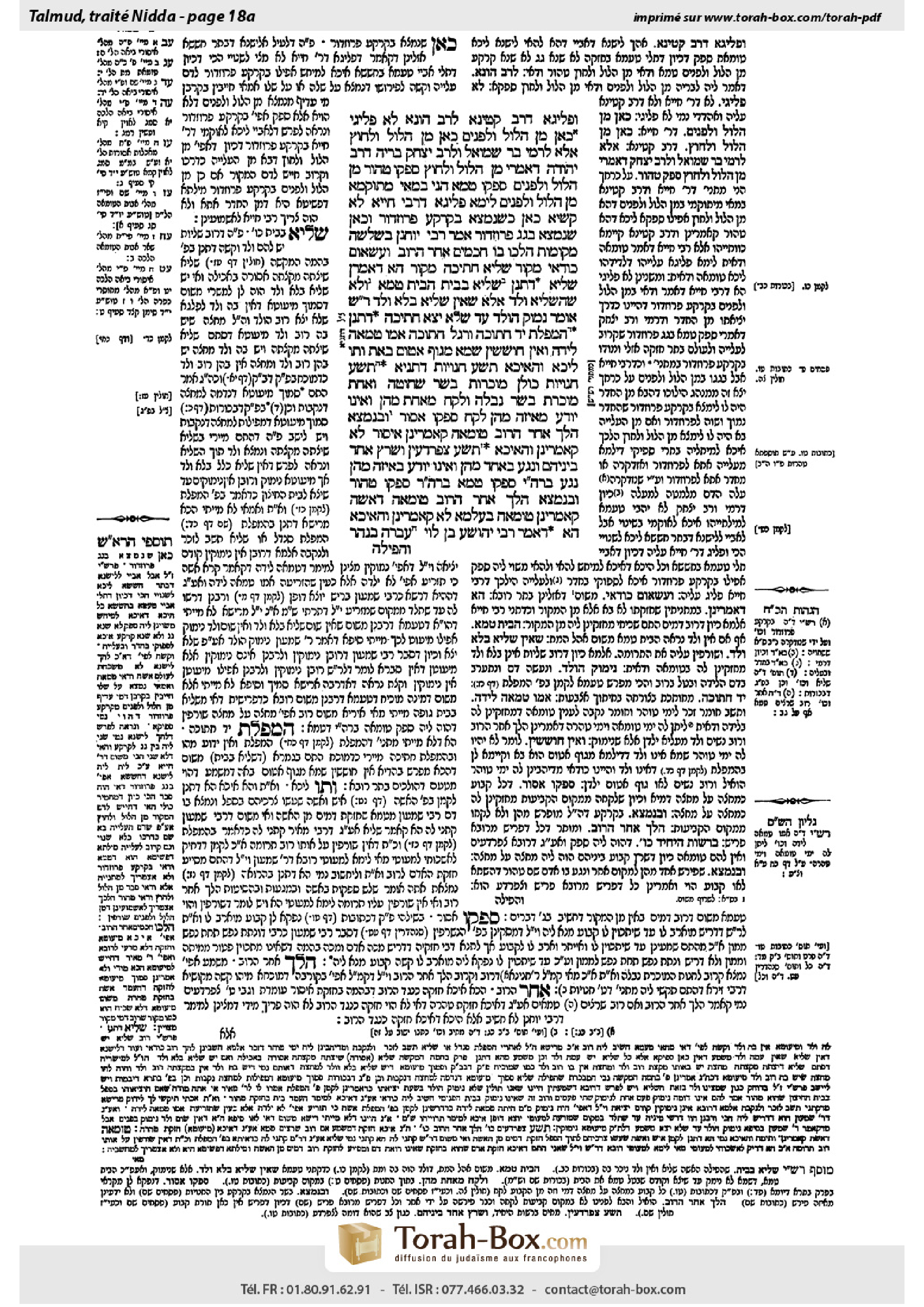
Niddah 18a: Talmud study for Daf Yomi
Daf Yomi is the daily study of one Talmud folio. Explore 37 tractates with scans, Hebrew text, Sefaria English and AI-generated French translations where annotated.
Passage selection and English or AI-generated French translation are available where the scan has annotations. Daf Study is independent of Torah-Box and Sefaria.
Browse Niddah · נידה · All tractatesNiddah 18a text and translations
This page of Niddah includes the Aramaic text, an English translation and an AI-generated French translation, alongside the scan above.
נידה י״ח א · Aramaic and Hebrew text
וּפְלִיגָא דְּרַב קַטִּינָא.
לְרַב הוּנָא, לָא פְּלִיגִי — כָּאן מִן הַלּוּל וְלִפְנִים, כָּאן מִן הַלּוּל וְלַחוּץ.
אֶלָּא לְרָמֵי בַּר שְׁמוּאֵל וּלְרַב יִצְחָק בְּרֵיהּ דְּרַב יְהוּדָה, דְּאָמְרִי: מִן הַלּוּל וְלַחוּץ — סְפֵקוֹ טָהוֹר, מִן הַלּוּל וְלִפְנִים — סְפֵקוֹ טָמֵא, הָנֵי בְּמַאי מִתּוֹקְמָא? מִן הַלּוּל וְלִפְנִים.
לֵימָא פְּלִיגָא דְּרַבִּי חִיָּיא!
לָא קַשְׁיָא, כָּאן — כְּשֶׁנִּמְצָא בַּקַּרְקַע פְּרוֹזְדוֹר, וְכָאן — שֶׁנִּמְצָא בְּגַג פְּרוֹזְדוֹר.
אָמַר רַבִּי יוֹחָנָן: בִּשְׁלֹשָׁה מְקוֹמוֹת הָלְכוּ בּוֹ חֲכָמִים אַחַר הָרוֹב, וַעֲשָׂאוּם כְּוַדַּאי: מָקוֹר, שִׁלְיָא, חֲתִיכָה. מָקוֹר — הָא דַּאֲמַרַן;
שִׁלְיָא — דִּתְנַן: שִׁלְיָא בְּבַיִת, הַבַּיִת טָמֵא, וְלֹא שֶׁהַשִּׁלְיָא וָלָד, אֶלָּא שֶׁאֵין שִׁלְיָא בְּלֹא וָלָד. רַבִּי שִׁמְעוֹן אוֹמֵר: נִמּוֹק הַוָּלָד עַד שֶׁלֹּא יָצָא;
חֲתִיכָה — דִּתְנַן: הַמַּפֶּלֶת יָד חֲתוּכָה וְרֶגֶל חֲתוּכָה, אִמּוֹ טְמֵאָה לֵידָה, וְאֵין חוֹשְׁשִׁין שֶׁמָּא מִגּוּף אָטוּם בָּאת.
וְתוּ לֵיכָּא? וְהָאִיכָּא תֵּשַׁע חֲנוּיוֹת!
דְּתַנְיָא: תֵּשַׁע חֲנוּיוֹת, כּוּלָּן מוֹכְרוֹת בְּשַׂר שְׁחוּטָה, וְאַחַת מוֹכֶרֶת בְּשַׂר נְבֵלָה, וְלָקַח מֵאַחַת מֵהֶן וְאֵינוֹ יוֹדֵעַ מֵאֵיזֶה מֵהֶן לָקַח — סְפֵקוֹ אָסוּר.
וּבַנִּמְצָא — הַלֵּךְ אַחַר הָרוֹב.
טוּמְאָה קָאָמְרִינַן, אִיסּוּר לָא קָאָמְרִינַן.
וְהָאִיכָּא תֵּשַׁע צְפַרְדְּעִין וְשֶׁרֶץ אֶחָד בֵּינֵיהֶם, וְנָגַע בְּאֶחָד מֵהֶן, וְאֵינוֹ יוֹדֵעַ בְּאֵיזֶה מֵהֶן נָגַע — בִּרְשׁוּת הַיָּחִיד סְפֵקוֹ טָמֵא, בִּרְשׁוּת הָרַבִּים סְפֵקוֹ טָהוֹר,
וּבַנִּמְצָא — הַלֵּךְ אַחַר הָרוֹב!
טוּמְאָה דְּאִשָּׁה קָאָמְרִינַן, טוּמְאָה בְּעָלְמָא לָא קָאָמְרִינַן.
וְהָאִיכָּא הָא דְּאָמַר רַבִּי יְהוֹשֻׁעַ בֶּן לֵוִי: עָבְרָה בַּנָּהָר
Niddah 18a · English translation
And this option contradicts the opinion of Rav Ketina, who deems the blood impure due to uncertainty.
And according to the opinion of Rav Huna, who said that if the blood was found in the inner section it is definitely impure, as it is presumed to come from the uterus, and if the blood was found in the outer section it is impure due to uncertainty, one can say that Rabbi Ḥiyya and Rav Ketina do not disagree, as they were referring to different cases. Here, where Rabbi Ḥiyya deems the blood definitely impure, he is speaking of blood found from the vestibule and inward, whereas there, Rav Ketina deems it impure due to uncertainty when it is found from the vestibule and outward.
But according to the opinion of Rami bar Shmuel and Rav Yitzḥak, son of Rav Yehuda, who say that if the blood is found from the vestibule and outward, its state of uncertainty renders it pure, whereas if it is found in the area from the vestibule and inward, its state of uncertainty renders it impure, with regard to what case can the dispute between these Sages, Rabbi Ḥiyya and Rav Ketina, be interpreted? It must be referring to a situation where the blood was found from the vestibule and inward, as according to Rami bar Shmuel and Rav Yitzḥak, son of Rav Yehuda, if the blood is found from the vestibule and outward it is pure.
If so, shall we say that Rami bar Shmuel and Rav Yitzḥak, son of Rav Yehuda, disagree with the opinion of Rabbi Ḥiyya, who deems the blood definitely impure, whereas they maintain that it is impure merely due to uncertainty?
The Gemara answers: This is not difficult. It is possible that Rami bar Shmuel and Rav Yitzḥak, son of Rav Yehuda, agree with the opinion of Rabbi Ḥiyya, as they maintain that there is no dispute between Rav Ketina and Rabbi Ḥiyya. Once again the reason is that Rav Ketina and Rabbi Ḥiyya might be referring to two different cases: Here, Rabbi Ḥiyya deems the blood definitely impure because he is speaking of a case where it is found on the floor of the corridor, in which case the blood is presumed to come from the uterus rather than the bladder. And there, Rav Ketina, who deems the blood impure due to uncertainty, is referring to blood that is found on the roof of the corridor, and therefore it is uncertain whether the blood came from the bladder or the uterus.
§ Rabbi Yoḥanan says: In three places where there is uncertainty the Sages followed the majority, and based on that majority they established the halakha in these cases as though they involved a certainty. The three cases are as follows: The source, the afterbirth [shilya], and a shaped limb. The Gemara elaborates: The source is that which we just said, i.e., that blood found in the corridor from the vestibule and inward it is ritually impure, because the majority of blood found there is from the uterus.
The afterbirth is as we learned in a mishna (26a): If a woman miscarried and the afterbirth is in the house, the house is ritually impure, in the sense that everything under the roof becomes impure due to impurity imparted by a corpse. And the reason is not that the afterbirth itself has the status of an offspring; rather, it is that there is no afterbirth without an offspring. It is clear that the afterbirth contained an offspring, which disintegrated after the miscarriage. That offspring renders the contents of the house impure. Rabbi Shimon says: The offspring was squashed before it emerged with the afterbirth. Consequently, the house is not rendered impure, because the squashed fetus is nullified by the majority of blood that accompanied the miscarriage.
The third case of an uncertainty where the Sages followed the majority is that of a shaped limb, as we learned in a baraita: In the case of a woman who miscarries a shaped hand, i.e., its fingers are discernible, or a shaped foot, its mother is impure with the impurity of a woman after childbirth, as it certainly came from a full-fledged fetus, and we are not concerned that perhaps it came from a fetus with a sealed, i.e., deficient body, in which case the miscarriage does not have the status of childbirth with regard to ritual impurity. The reason is that most pregnant women give birth to a fully formed fetus, and therefore it is presumed that the hand or foot came from a whole fetus that was squashed during childbirth. Once again the Sages established the impurity as a certainty, based on a majority.
The Gemara asks: And are there no more cases of uncertainty in which the Sages determined the halakha according to the status of the majority, treating the case as though it involved a certainty? But isn’t there the case of nine stores?
As it is taught in a baraita: With regard to nine stores in a city, all of which sell kosher meat from slaughtered animals, and one other store that sells meat from unslaughtered animal carcasses, and a person bought meat from one of the stores and he does not know from which store he bought the meat, in this case of uncertainty, the meat is prohibited. With regard to an item of uncertain status, if it separated from its fixed location it is presumed to have separated from the majority of items like it in that location, and has their halakhic status. But in the case of an item that remained in its fixed location, i.e., didn’t separate, it is viewed as an uncertainty that is equally balanced, and one does not follow the majority. This ruling is based on the principle: The halakhic status of uncertainty with regard to any item fixed in its place is that of an uncertainty that is equally balanced, and one does not follow the majority.In this case, when it comes to determining whether or not this meat comes from a kosher store, since the uncertainty stems from the act of buying the meat in the store, and the stores are fixed in their places, the two types of stores are regarded as though they were equal in number.
The baraita continues: And in the case of meat found in the street, outside the stores, follow the majority of stores. If most stores in the city sell kosher meat one can assume that the meat he found is kosher, based on the principle: Any item separated, i.e., not fixed in its place, is presumed to have been separated from the majority. Similar to the previous cases, this meat is treated as certainly kosher on the basis of a majority.
The Gemara answers: We say that this list of cases mentioned by Rabbi Yoḥanan is referring to matters of ritual impurity, whereas we do not say that the list includes cases that involve prohibitions, such as that of non-kosher meat.
The Gemara further asks: But isn’t there the case where there were nine dead frogs, which do not impart ritual impurity, and one carcass of a creeping animal among them, which does impart impurity, and someone touched one of these ten dead creatures, and he does not know which of them he touched? The halakha is as follows: If this occurred in the private domain the item’s uncertain impurity renders it impure, as it is derived from the Torah that in cases of uncertainty with regard to ritual impurity in the private domain, the item is deemed impure. If the contact occurred in the public domain, the item’s uncertainty leaves it pure.
The Gemara continues: And in a case where one of these creatures was separated from the rest and was found elsewhere, and the person touched it there, follow the majority. Since most of the animals do not impart ritual impurity, this individual remains pure. This is another case involving uncertain impurity where the Sages established the halakha as certain based on the majority.
The Gemara explains: We say that Rabbi Yoḥanan’s list is referring to matters of ritual impurity of a woman, whereas we do not say that the list includes cases that involve ritual impurity in general.
The Gemara further asks: But isn’t there that which Rabbi Yehoshua ben Levi said: With regard to a pregnant woman who passed across a river
Niddah 18a · Traduction française (IA)
Et cette possibilité contredit l’opinion de Rav Ketina, qui considère le sang comme impur en raison du doute.
Selon l’opinion de Rav Houna, qui dit que si le sang est trouvé dans la partie intérieure, il est certainement impur, car on présume qu’il provient de l’utérus, tandis que s’il est trouvé dans la partie extérieure, il est impur en raison du doute, on peut dire que Rabbi Ḥiyya et Rav Ketina ne sont pas en désaccord, puisqu’ils parlent de cas différents. Ici, lorsque Rabbi Ḥiyya considère le sang comme certainement impur, il parle d’un sang trouvé à partir du vestibule vers l’intérieur ; là, lorsque Rav Ketina le considère comme impur en raison du doute, il parle d’un sang trouvé à partir du vestibule vers l’extérieur.
Mais, selon l’opinion de Rami bar Shmuel et de Rav Yitzḥak, fils de Rav Yehouda, qui disent que si le sang est trouvé à partir du vestibule vers l’extérieur, le doute le rend pur, tandis que s’il est trouvé dans la zone allant du vestibule vers l’intérieur, le doute le rend impur, à quel cas peut-on appliquer le désaccord entre ces Sages, Rabbi Ḥiyya et Rav Ketina ? Il faut qu’il s’agisse d’une situation où le sang a été trouvé à partir du vestibule vers l’intérieur, car selon Rami bar Shmuel et Rav Yitzḥak, fils de Rav Yehouda, si le sang est trouvé à partir du vestibule vers l’extérieur, il est pur.
Si tel est le cas, faut-il dire que Rami bar Shmuel et Rav Yitzḥak, fils de Rav Yehouda, sont en désaccord avec l’opinion de Rabbi Ḥiyya, qui considère le sang comme certainement impur, tandis qu’eux soutiennent qu’il est impur uniquement en raison du doute ?
La Guemara répond : Cela n’est pas difficile. Il est possible que Rami bar Shmuel et Rav Yitzḥak, fils de Rav Yehouda, soient d’accord avec l’opinion de Rabbi Ḥiyya, car ils soutiennent qu’il n’y a pas de désaccord entre Rav Ketina et Rabbi Ḥiyya. Là encore, la raison est que Rav Ketina et Rabbi Ḥiyya peuvent parler de deux cas différents : ici, Rabbi Ḥiyya considère le sang comme certainement impur parce qu’il parle d’un cas où il est trouvé sur le sol du corridor, auquel cas on présume qu’il provient de l’utérus plutôt que de la vessie. Là, Rav Ketina, qui considère le sang comme impur en raison du doute, parle d’un sang trouvé sur le plafond du corridor ; on ne sait donc pas s’il provient de la vessie ou de l’utérus.
§ Rabbi Yoḥanan dit : Dans trois cas où il y a incertitude, les Sages ont suivi la majorité et, sur cette base, ont établi la halakha comme si ces cas étaient certains. Voici ces trois cas : la source, l’arrière-faix [shilya] et un membre formé. La Guemara précise : La source, c’est ce que nous venons de dire, à savoir que le sang trouvé dans le corridor, à partir du vestibule vers l’intérieur, est rituellement impur, car la majorité du sang trouvé là provient de l’utérus.
L’arrière-faix : comme nous l’avons appris dans une Michna (26a), si une femme fait une fausse couche et que l’arrière-faix se trouve dans la maison, la maison est rituellement impure, en ce sens que tout ce qui se trouve sous son toit devient impur à cause de l’impureté transmise par un cadavre. La raison n’est pas que l’arrière-faix lui-même ait le statut d’un fœtus, mais qu’il n’y a pas d’arrière-faix sans fœtus. Il est donc certain que l’arrière-faix contenait un fœtus, qui s’est désintégré après la fausse couche. Ce fœtus rend les objets de la maison impurs. Rabbi Shimon dit : Le fœtus a été écrasé avant de sortir avec l’arrière-faix. Par conséquent, la maison ne devient pas impure, car le fœtus écrasé est annulé par la majorité du sang qui a accompagné la fausse couche.
Le troisième cas d’incertitude où les Sages ont suivi la majorité est celui d’un membre formé, comme nous l’avons appris dans une baraïta : dans le cas d’une femme qui fait une fausse couche et expulse une main formée, c’est-à-dire dont les doigts sont distincts, ou un pied formé, la mère est impure de l’impureté d’une femme après l’accouchement, car le membre provient certainement d’un fœtus pleinement formé. On ne craint pas qu’il provienne d’un fœtus au corps fermé, c’est-à-dire incomplet, auquel cas la fausse couche n’aurait pas le statut d’un accouchement en matière d’impureté rituelle. La raison en est que la plupart des femmes enceintes mettent au monde un fœtus pleinement formé ; on présume donc que la main ou le pied provient d’un fœtus entier qui a été écrasé pendant l’accouchement. Une fois encore, les Sages ont établi l’impureté comme certaine sur la base de la majorité.
La Guemara demande : N’existe-t-il pas d’autres cas d’incertitude où les Sages ont fixé la halakha selon la majorité, traitant le cas comme s’il était certain ? Mais n’y a-t-il pas le cas des neuf magasins ?
Comme il est enseigné dans une baraïta : s’il y a neuf magasins dans une ville, qui vendent tous de la viande cachère provenant d’animaux abattus rituellement, et un autre magasin qui vend de la viande provenant de carcasses d’animaux non abattus rituellement, et qu’une personne achète de la viande dans l’un des magasins sans savoir dans lequel, dans ce cas d’incertitude, la viande est interdite. Lorsqu’un objet au statut incertain s’est détaché de son emplacement fixe, on présume qu’il provient de la majorité des objets semblables présents à cet emplacement, et il reçoit leur statut halakhique. Mais si l’objet est resté à son emplacement fixe, c’est-à-dire s’il ne s’en est pas détaché, l’incertitude est considérée comme également équilibrée, et l’on ne suit pas la majorité. Cette décision repose sur le principe suivant : le statut halakhique de tout objet fixé à sa place, lorsqu’il y a incertitude à son sujet, est celui d’une incertitude également équilibrée, et l’on ne suit pas la majorité. Dans ce cas, pour déterminer si cette viande provient ou non d’un magasin cachère, puisque l’incertitude découle de l’achat de la viande dans le magasin et que les magasins sont fixes, les deux types de magasins sont considérés comme égaux en nombre.
La baraïta poursuit : dans le cas de viande trouvée dans la rue, à l’extérieur des magasins, on suit la majorité des magasins. Si la plupart des magasins de la ville vendent de la viande cachère, on peut supposer que la viande trouvée est cachère, selon le principe suivant : tout objet qui s’est détaché, c’est-à-dire qui n’est pas fixé à sa place, est présumé provenir de la majorité. Comme dans les cas précédents, cette viande est considérée comme certainement cachère sur la base de la majorité.
La Guemara répond : cette liste de cas mentionnés par Rabbi Yoḥanan concerne des questions d’impureté rituelle ; nous ne disons pas qu’elle inclut des cas relevant des interdits, comme celui de la viande non cachère.
La Guemara demande encore : Mais n’y a-t-il pas le cas de neuf grenouilles mortes, qui ne transmettent pas l’impureté rituelle, et d’une carcasse d’animal rampant parmi elles, qui la transmet ? Si quelqu’un touche l’une de ces dix créatures mortes sans savoir laquelle il a touchée, la halakha est la suivante : si cela s’est produit dans le domaine privé, l’incertitude concernant l’impureté de l’objet le rend impur, car la Torah enseigne que, dans les cas d’incertitude concernant l’impureté rituelle dans le domaine privé, l’objet est considéré comme impur. Si le contact a eu lieu dans le domaine public, l’incertitude laisse l’objet pur.
La Guemara poursuit : si l’une de ces créatures s’est séparée des autres et a été trouvée ailleurs, et que la personne l’a touchée à cet endroit, on suit la majorité. Puisque la plupart de ces animaux ne transmettent pas l’impureté rituelle, cette personne reste pure. C’est un autre cas d’impureté incertaine où les Sages ont établi la halakha comme certaine sur la base de la majorité.
La Guemara explique : la liste de Rabbi Yoḥanan concerne les questions d’impureté rituelle propres à une femme ; nous ne disons pas qu’elle inclut les cas relevant de l’impureté rituelle en général.
La Guemara demande encore : Mais n’y a-t-il pas ce qu’a dit Rabbi Yehoshua ben Levi : à propos d’une femme enceinte qui a traversé une rivière
Traduction française générée par IA à partir de l’édition anglaise de Sefaria. Vérifie toujours un passage avec le texte source.
Text from Sefaria: William Davidson Edition - Vocalized Aramaic (CC BY NC); William Davidson Edition - English (CC BY NC).