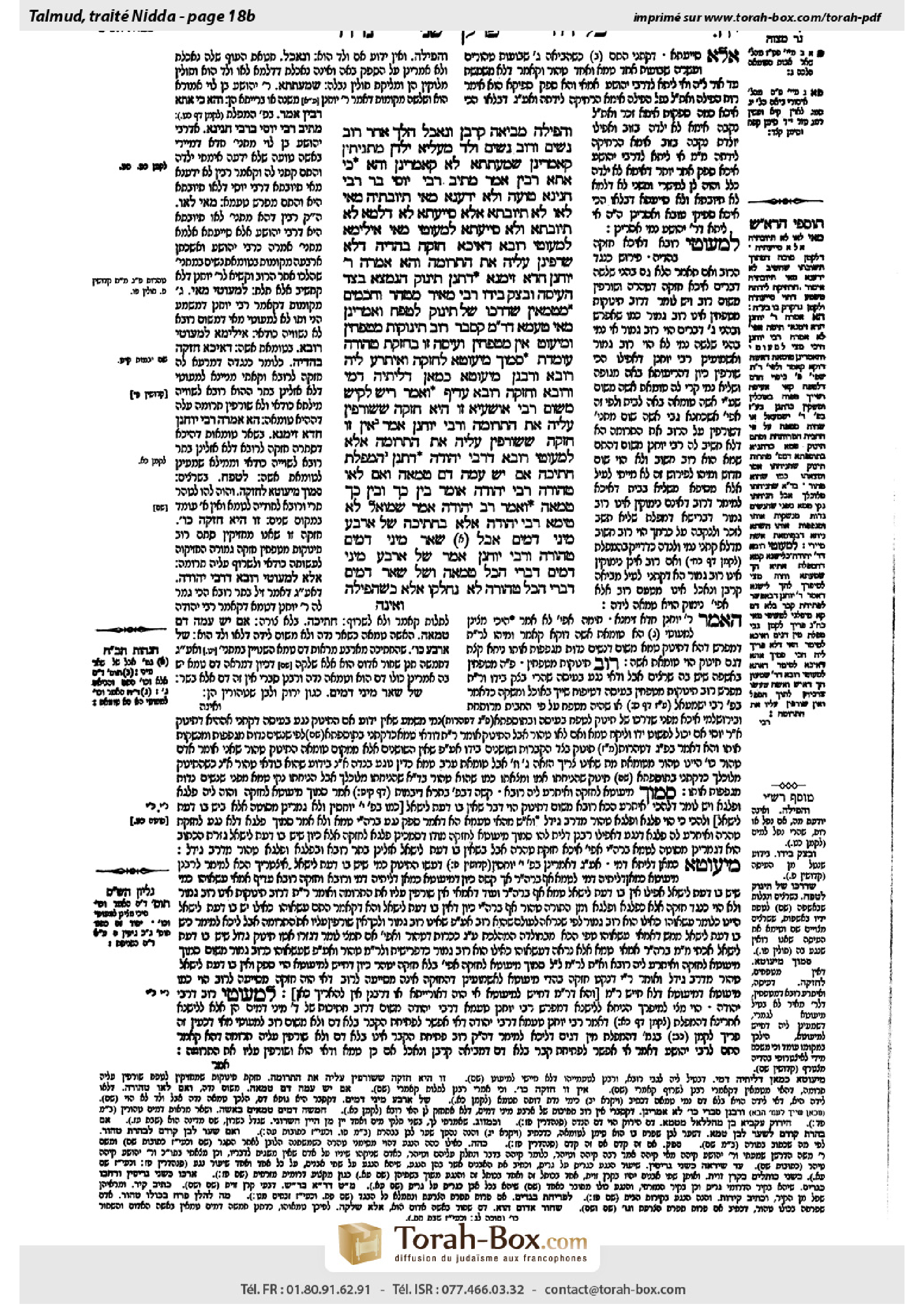
Niddah 18b: Talmud study for Daf Yomi
Daf Yomi is the daily study of one Talmud folio. Explore 37 tractates with scans, Hebrew text, Sefaria English and AI-generated French translations where annotated.
Passage selection and English or AI-generated French translation are available where the scan has annotations. Daf Study is independent of Torah-Box and Sefaria.
Browse Niddah · נידה · All tractatesNiddah 18b text and translations
This page of Niddah includes the Aramaic text, an English translation and an AI-generated French translation, alongside the scan above.
נידה י״ח ב · Aramaic and Hebrew text
וְהִפִּילָה — מְבִיאָה קׇרְבָּן וְנֶאֱכָל.
הַלֵּךְ אַחַר רוֹב נָשִׁים, וְרוֹב נָשִׁים — וָלָד מְעַלְּיָא יָלְדָן.
מַתְנִיתִין קָאָמְרִינַן, שְׁמַעְתָּתָא לָא קָאָמְרִינַן.
וְהָא כִּי אֲתָא רָבִין, אָמַר: מֵתִיב רַבִּי יוֹסֵי בַּר רַבִּי חֲנִינָא טוֹעָה, וְלָא יָדַעְנָא מַאי תְּיוּבְתֵּיהּ.
מַאי לָאו לָא תְּיוּבְתָּא, אֶלָּא סִיַּיעְתָּא?
לָא, דִּלְמָא לָא תְּיוּבְתָּא וְלֹא סִיַּיעְתָּא.
לְמַעוֹטֵי מַאי?
אִילֵּימָא לְמַעוֹטֵי רוּבָּא, דְּאִיכָּא חֲזָקָה בַּהֲדֵיהּ, דְּלָא שָׂרְפִינַן עֲלֵיהּ אֶת הַתְּרוּמָה — וְהָא אַמְרַהּ רַבִּי יוֹחָנָן חֲדָא זִימְנָא!
דִּתְנַן: תִּינוֹק הַנִּמְצָא בְּצַד הָעִיסָּה, וּבָצֵק בְּיָדוֹ — רַבִּי מֵאִיר מְטַהֵר, וַחֲכָמִים מְטַמְּאִין, שֶׁדַּרְכּוֹ שֶׁל תִּינוֹק לְטַפֵּחַ.
וְאָמְרִינַן: מַאי טַעְמָא דְּרַבִּי מֵאִיר? קָסָבַר: רוֹב תִּינוֹקוֹת מְטַפְּחִין, וּמִיעוּט אֵין מְטַפְּחִין, וְעִיסָּה זוֹ בְּחֶזְקַת טְהוֹרָה עוֹמֶדֶת, סְמוֹךְ מִיעוּטָא לַחֲזָקָה, וְאִיתְּרַע לֵיהּ רוּבָּא.
וְרַבָּנַן מִיעוּטָא ״כְּמַאן דְּלֵיתֵיהּ דָּמֵי״, וְרוּבָּא וַחֲזָקָה — רוּבָּא עֲדִיף.
וְאָמַר רֵישׁ לָקִישׁ מִשּׁוּם רַבִּי אוֹשַׁעְיָא: זוֹ הִיא חֲזָקָה שֶׁשּׂוֹרְפִין עָלֶיהָ אֶת הַתְּרוּמָה, וְרַבִּי יוֹחָנָן אָמַר: אֵין זוֹ חֲזָקָה שֶׁשּׂוֹרְפִין עָלֶיהָ אֶת הַתְּרוּמָה!
אֶלָּא לְמַעוֹטֵי רוּבָּא דְּרַבִּי יְהוּדָה, דִּתְנַן: הַמַּפֶּלֶת חֲתִיכָה — אִם יֵשׁ עִמָּהּ דָּם טְמֵאָה, וְאִם לָאו — טְהוֹרָה. רַבִּי יְהוּדָה אוֹמֵר: בֵּין כָּךְ וּבֵין כָּךְ טְמֵאָה.
וְאָמַר רַב יְהוּדָה אָמַר שְׁמוּאֵל: לֹא טִימֵּא רַבִּי יְהוּדָה אֶלָּא בַּחֲתִיכָה שֶׁל אַרְבַּע מִינֵי דָמִים, אֲבָל שְׁאָר מִינֵי דָמִים — טְהוֹרָה. וְרַבִּי יוֹחָנָן אָמַר: שֶׁל אַרְבַּע מִינֵי דָמִים — דִּבְרֵי הַכֹּל טְמֵאָה, וְשֶׁל שְׁאָר דָמִים — דִּבְרֵי הַכֹּל טְהוֹרָה. לֹא נֶחְלְקוּ אֶלָּא כְּשֶׁהִפִּילָה
Niddah 18b · English translation
and she miscarried her fetus into the river, but she does not know whether or not the fetus was fully formed, she brings the offering of a woman after childbirth, i.e., a burnt offering and a sin offering. And the sin offering, which is a bird, is eaten after the nape of its neck has been severed, in the manner of a regular bird sin offering. This is the halakha despite the uncertainty, i.e., this fetus might not have been fully formed, in which case the woman is not obligated to bring this offering, and a bird that is not an offering may not be eaten if its nape was severed.
Rabbi Yehoshua ben Levi explains the reasoning behind this ruling: One must follow the majority of pregnant women, and most pregnant women give birth to full-fledged offspring. If so, this is another case involving an uncertainty where the Sages established the halakha as a certainty based on the majority. Furthermore, this case involves the ritual impurity of a woman. Why then did Rabbi Yoḥanan list only three cases of this kind?
The Gemara answers: We say that only cases taught in the Mishna or a baraita are included in this list, whereas we do not say that those derived from an amoraic halakhic statement, e.g., the statement of Rabbi Yehoshua ben Levi, are included.
The Gemara raises a difficulty with regard to this explanation: But when Ravin came from Eretz Yisrael to Babylonia he said that Rabbi Yosei bar Rabbi Ḥanina raises an objection against the opinion of Rabbi Yehoshua ben Levi from a baraita that deals with an unsure woman, i.e., one who does not know when she gave birth. Ravin added: And I do not know what his objection was from that baraita.
The Gemara discusses Ravin’s statement: What, is it not correct to say that Ravin meant that this baraita is not a refutation of the opinion of Rabbi Yehoshua ben Levi but actually provides support for that opinion? If so, that would mean that Rabbi Yehoshua ben Levi’s opinion is effectively taught in a baraita as well, and therefore according to the above consideration Rabbi Yoḥanan should have included it in his list.
The Gemara answers: This is not necessarily the correct inference, as perhaps Ravin meant simply that the ruling of this baraita is neither a refutation nor a support for the opinion of Rabbi Yehoshua ben Levi.
§ When Rabbi Yoḥanan says that in three places where there is uncertainty the Sages followed the majority and established the halakha as though it involved a certainty, he is clearly indicating that some cases are excluded from this category. The Gemara asks: Rabbi Yoḥanan says this to exclude what?
If we say that he says this to exclude an uncertain case where on the one hand there is a majority that indicates the woman should be deemed ritually impure and on the other hand there is a presumptive status along with it that opposes that majority, which is why the uncertainty is not treated as a certainty, and therefore one does not burn teruma due to contact with that impurity, this cannot be the case. The reason is that Rabbi Yoḥanan already said it on another occasion, with regard to other cases of ritual impurity, that if the consideration of a majority indicates that an item should be impure while its presumptive status indicates that it should be pure, it is not considered definitely impure.
The Gemara cites the source for Rabbi Yoḥanan’s opinion in this regard. As we learned in a mishna (Teharot 3:8): If a ritually impure child is found alongside ritually pure started dough that has not yet risen, and he has risen dough in his hand that may have been removed from the larger portion of started dough, Rabbi Meir deems the started dough pure, since there is no proof the child touched it, as he might have been given the piece by someone else. And the Rabbis deem it impure, as they assume that he touched the started dough. The child is presumed to be impure, because it is the norm of a child to handle items.
And we say with regard to this dispute: What is the reason for the opinion of Rabbi Meir? He holds that a majority of children handle items that are within reach, in this case the dough, and a minority do not handle items within reach, and this dough retains a presumptive status of purity, since its impurity has not been definitively determined. Therefore, one should append the fact that the minority of children do not handle items within reach to the presumptive status of purity of the dough, and the force of the majority of children who handle items within reach is weakened. Therefore, the dough is considered pure.
And the Rabbis contend that in a case where the majority is followed, the minority is considered like it does not exist. And consequently, there is a conflict between the determining factors of the majority of impure children who handle items within reach and the presumptive status of purity of the dough. Therefore, the majority takes precedence.
And Reish Lakish says in the name of Rabbi Oshaya: This halakha of a child is an example of a presumption, that children handle items within reach, over which teruma is burned, as the Rabbis hold that it is sufficiently certain that the dough has become impure to allow it to be burned. And Rabbi Yoḥanan says: This is not a presumption over which teruma is burned. Rather, the dough is left aside, and can be neither eaten nor burned, due to the uncertainty whether it is impure. In this context, Rabbi Yoḥanan has already stated that when a majority is contradicted by a presumption, the status of uncertainty applies. Therefore, there was no need for him to specify the three cases he mentioned in order to exclude situations of this kind.
Rather, Rabbi Yoḥanan’s statement that there are only three cases in which uncertainty is treated as certainty is meant to exclude a specific situation involving a majority, as discussed by Rabbi Yehuda. As we learned in a mishna (21a): In the case of a woman who miscarries an amorphous piece of flesh, if there is blood that emerges with it, the woman is ritually impure with the impurity of a menstruating woman. And if not, she is pure, as she is neither a menstruating woman nor a woman after childbirth. Rabbi Yehuda says: In both this case, where blood emerged, and that case, where no blood emerged, the woman is impure with the impurity of a menstruating woman, as there was certainly undetected blood that emerged with the flesh.
And Rav Yehuda says that Shmuel says: Rabbi Yehuda deemed the woman impure, despite the fact that no blood emerged, only in the case of a piece of flesh that has the color of one of the four types of ritually impure blood, as stated in the mishna below (19a). But if it has the color of other types of blood, the woman is pure. And Rabbi Yoḥanan says: If a woman miscarries a piece of flesh that has the color of one of the four types of ritually impure blood, all, i.e., Rabbi Yehuda and the Rabbis, agree that she is impure. And likewise, if the piece has the color of other types of blood, all agree that she is pure. The Rabbis and Rabbi Yehuda disagree only with regard to a case where the woman miscarried an amorphous piece of flesh,
Niddah 18b · Traduction française (IA)
et elle a fait une fausse couche dans le fleuve, mais elle ne sait pas si le fœtus était ou non entièrement formé, elle apporte l’offrande d’une femme après l’accouchement, c’est-à-dire un holocauste et un sacrifice expiatoire. Le sacrifice expiatoire, qui est un oiseau, est consommé après qu’on lui a tranché la nuque, selon le rite habituel du sacrifice expiatoire d’oiseau. Telle est la halakha malgré l’incertitude : il se peut que ce fœtus n’ait pas été entièrement formé, auquel cas la femme n’est pas tenue d’apporter cette offrande ; or, un oiseau qui n’est pas offert en sacrifice ne peut pas être consommé si on lui a tranché la nuque.
Rabbi Yehoshua ben Levi explique la raison de cette décision : il faut s’en remettre à la majorité des femmes enceintes, et la plupart d’entre elles mettent au monde des fœtus entièrement formés. Il s’agit donc d’un autre cas d’incertitude où les Sages ont établi la halakha comme certaine en se fondant sur la majorité. De plus, ce cas concerne l’impureté rituelle d’une femme. Pourquoi Rabbi Yoḥanan n’a-t-il donc mentionné que trois cas de ce genre ?
La Guemara répond : seuls les cas enseignés dans la Michna ou dans une baraïta sont inclus dans cette liste ; nous n’y incluons pas ceux qui sont déduits d’une déclaration halakhique d’un amora, par exemple celle de Rabbi Yehoshua ben Levi.
La Guemara soulève une difficulté à propos de cette explication : lorsque Ravin vint d’Eretz Israël en Babylonie, ne dit-il pas que Rabbi Yosei bar Rabbi Ḥanina soulève une objection contre l’opinion de Rabbi Yehoshua ben Levi à partir d’une baraïta qui traite d’une femme en situation d’incertitude, c’est-à-dire qui ne sait pas quand elle a accouché ? Ravin ajouta : « Et je ne sais pas quelle objection il tirait de cette baraïta. »
La Guemara examine la déclaration de Ravin : n’est-il pas juste de dire que Ravin voulait dire que cette baraïta ne réfute pas l’opinion de Rabbi Yehoshua ben Levi, mais qu’elle l’étaye en réalité ? Si tel est le cas, cela signifierait que l’opinion de Rabbi Yehoshua ben Levi est également enseignée dans une baraïta et que, par conséquent, selon la considération exposée plus haut, Rabbi Yoḥanan aurait dû l’inclure dans sa liste.
La Guemara répond : cette déduction n’est pas nécessairement juste, car Ravin voulait peut-être simplement dire que la décision énoncée dans cette baraïta ne réfute ni ne soutient l’opinion de Rabbi Yehoshua ben Levi.
§ Lorsque Rabbi Yoḥanan dit que, dans trois cas d’incertitude, les Sages se sont fondés sur la majorité et ont établi la halakha comme s’il s’agissait d’une certitude, il indique clairement que certains cas sont exclus de cette catégorie. La Guemara demande : quels cas Rabbi Yoḥanan entend-il exclure par cette déclaration ?
Si l’on suppose qu’il entend exclure un cas d’incertitude où, d’un côté, la majorité indique que la femme doit être considérée comme rituellement impure et où, de l’autre, un statut présumé s’oppose à cette majorité, raison pour laquelle l’incertitude n’est pas traitée comme une certitude et qu’on ne brûle donc pas la terouma à la suite d’un contact avec cette impureté, cela ne peut pas être le cas. En effet, Rabbi Yoḥanan l’a déjà dit à une autre occasion, à propos d’autres cas d’impureté rituelle : si la majorité indique qu’un objet doit être impur tandis que son statut présumé indique qu’il doit être pur, il n’est pas considéré comme certainement impur.
La Guemara cite la source de l’opinion de Rabbi Yoḥanan à cet égard. Nous avons en effet appris dans une Michna (Teharot 3:8) : si un enfant rituellement impur se trouve près d’une pâte rituellement pure qui n’a pas encore levé, et qu’il tient à la main un morceau de pâte levée qui a peut-être été prélevé sur la plus grande portion de pâte en train de lever, Rabbi Meir considère cette pâte comme pure, car rien ne prouve que l’enfant l’ait touchée : quelqu’un d’autre a pu lui donner le morceau. Les Sages la considèrent comme impure, car ils supposent que l’enfant a touché la pâte en train de lever. L’enfant est présumé impur, car il est courant qu’un enfant manipule les objets.
À propos de cette controverse, nous demandons : quelle est la raison de l’opinion de Rabbi Meir ? Il considère que la majorité des enfants manipulent les objets à leur portée, en l’occurrence la pâte, tandis qu’une minorité ne manipule pas les objets à sa portée ; or, cette pâte conserve un statut présumé de pureté, puisque son impureté n’a pas été établie avec certitude. Il faut donc ajouter le fait qu’une minorité d’enfants ne manipule pas les objets à sa portée au statut présumé de pureté de la pâte, ce qui affaiblit le poids de la majorité des enfants qui manipulent les objets à leur portée. La pâte est donc considérée comme pure.
Les Sages soutiennent que, dans un cas où l’on se fonde sur la majorité, la minorité est considérée comme inexistante. Il y a donc un conflit entre la majorité des enfants impurs qui manipulent les objets à leur portée et le statut présumé de pureté de la pâte. La majorité l’emporte donc.
Reish Lakish dit au nom de Rabbi Oshaya : la règle concernant l’enfant illustre une présomption — les enfants manipulent les objets à leur portée — qui justifie de brûler la terouma, car les Sages considèrent que la pâte est suffisamment certainement devenue impure pour qu’on puisse la brûler. Rabbi Yoḥanan dit : cette présomption ne justifie pas de brûler la terouma. Au contraire, on laisse la pâte de côté et on ne peut ni la consommer ni la brûler, car on ne sait pas si elle est impure. Dans ce contexte, Rabbi Yoḥanan a déjà déclaré que lorsqu’une majorité est contredite par une présomption, la situation demeure incertaine. Il n’avait donc pas besoin de préciser les trois cas qu’il a mentionnés pour exclure des situations de ce genre.
Au contraire, la déclaration de Rabbi Yoḥanan selon laquelle il n’y a que trois cas où l’incertitude est traitée comme une certitude vise à exclure une situation précise impliquant une majorité, comme l’a exposé Rabbi Yehuda. Nous avons en effet appris dans une Michna (21a) : dans le cas d’une femme qui fait une fausse couche et expulse un morceau de chair informe, si du sang sort avec celui-ci, la femme est rituellement impure de l’impureté d’une femme menstruée. Sinon, elle est pure, car elle n’est ni une femme menstruée ni une femme après l’accouchement. Rabbi Yehuda dit : dans les deux cas, celui où du sang est sorti et celui où aucun sang n’est sorti, la femme est impure de l’impureté d’une femme menstruée, car du sang est certainement sorti avec la chair, sans qu’on le remarque.
Rav Yehuda dit au nom de Shmuel : Rabbi Yehuda n’a déclaré la femme impure, bien qu’aucun sang ne soit sorti, que dans le cas d’un morceau de chair ayant la couleur de l’un des quatre types de sang rituellement impur, comme l’indique la Michna plus loin (19a). Mais s’il a la couleur d’autres types de sang, la femme est pure. Rabbi Yoḥanan dit : si une femme fait une fausse couche et expulse un morceau de chair ayant la couleur de l’un des quatre types de sang rituellement impur, tous, c’est-à-dire Rabbi Yehuda et les Sages, conviennent qu’elle est impure. De même, si le morceau a la couleur d’autres types de sang, tous conviennent qu’elle est pure. Les Sages et Rabbi Yehuda ne sont en désaccord que dans le cas où la femme fait une fausse couche et expulse un morceau de chair informe,
Traduction française générée par IA à partir de l’édition anglaise de Sefaria. Vérifie toujours un passage avec le texte source.
Text from Sefaria: William Davidson Edition - Vocalized Aramaic (CC BY NC); William Davidson Edition - English (CC BY NC).