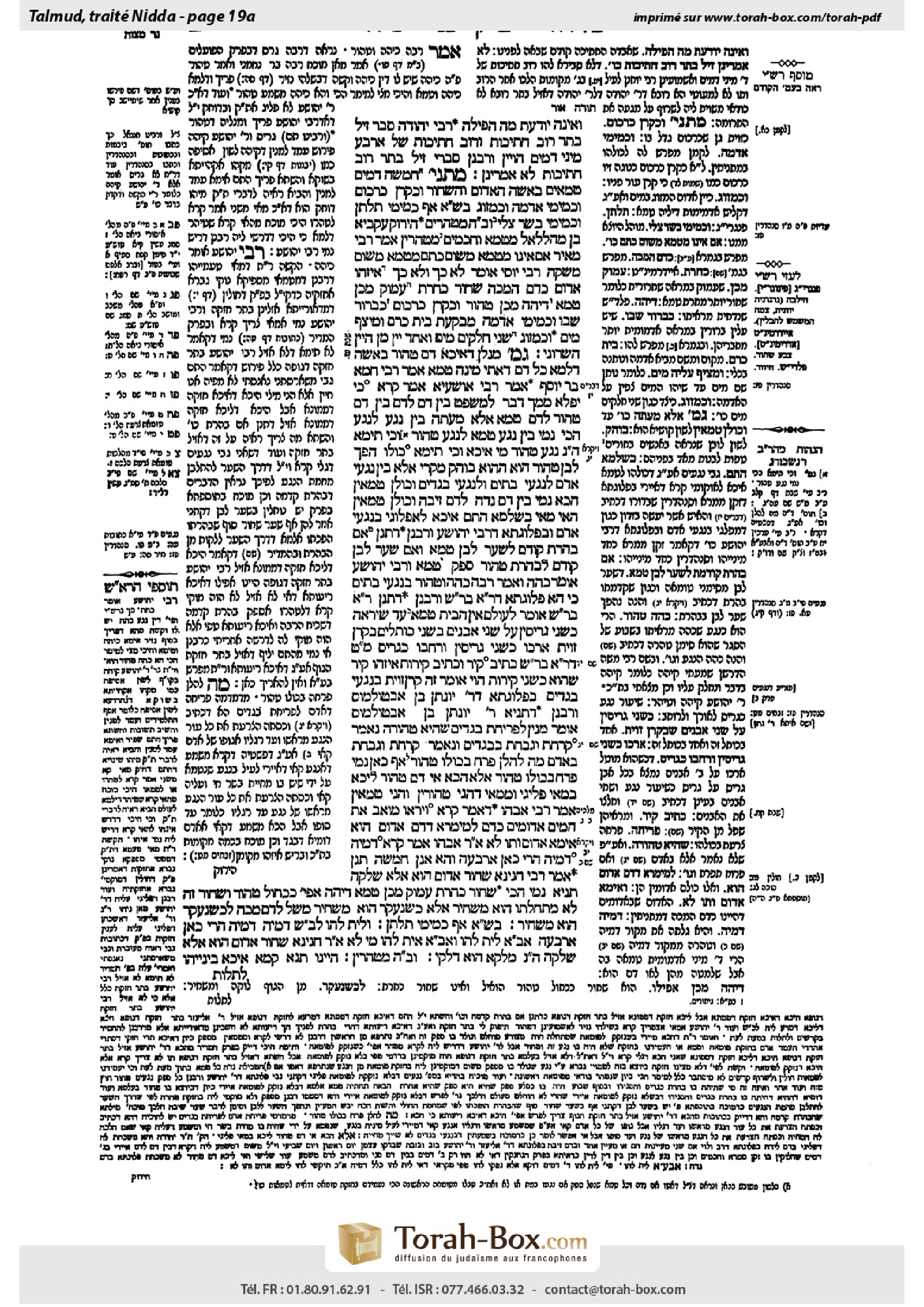
Niddah 19a: Talmud study for Daf Yomi
Daf Yomi is the daily study of one Talmud folio. Explore 37 tractates with scans, Hebrew text, Sefaria English and AI-generated French translations where annotated.
Passage selection and English or AI-generated French translation are available where the scan has annotations. Daf Study is independent of Torah-Box and Sefaria.
Browse Niddah · נידה · All tractatesNiddah 19a text and translations
This page of Niddah includes the Aramaic text, an English translation and an AI-generated French translation, alongside the scan above.
נידה י״ט א · Aramaic and Hebrew text
וְאֵינָהּ יוֹדַעַת מָה הִפִּילָה, רַבִּי יְהוּדָה סָבַר: זִיל בָּתַר רוֹב חֲתִיכוֹת, וְרוֹב חֲתִיכוֹת שֶׁל אַרְבַּע מִינֵי דָּמִים הָוְיָין. וְרַבָּנַן סָבְרִי: זִיל בָּתַר רוֹב חֲתִיכוֹת לָא אָמְרִינַן.
מַתְנִי' חֲמִשָּׁה דָּמִים טְמֵאִים בָּאִשָּׁה, הָאָדוֹם, וְהַשָּׁחוֹר, וּכְקֶרֶן כַּרְכּוֹם, וּכְמֵימֵי אֲדָמָה, וְכַמָּזוּג. בֵּית שַׁמַּאי אוֹמְרִים: אַף כְּמֵימֵי תִלְתָּן, וּכְמֵימֵי בָּשָׂר צָלִי, וּבֵית הִלֵּל מְטַהֲרִים. הַיָּרוֹק — עֲקַבְיָא בֶּן מַהֲלַלְאֵל מְטַמֵּא, וַחֲכָמִים מְטַהֲרִין.
אָמַר רַבִּי מֵאִיר: אִם אֵינוֹ מְטַמֵּא מִשּׁוּם כֶּתֶם, מְטַמֵּא מִשּׁוּם מַשְׁקֶה. רַבִּי יוֹסֵי אוֹמֵר: לֹא כָּךְ וְלֹא כָּךְ.
אֵיזֶהוּ אָדוֹם — כְּדַם הַמַּכָּה; שָׁחוֹר — כְּחֶרֶת; עָמוֹק מִכֵּן — טָמֵא, דֵּיהֶה מִכֵּן — טָהוֹר; וּכְקֶרֶן כַּרְכּוֹם — כַּבָּרוּר שֶׁבּוֹ;
וּכְמֵימֵי אֲדָמָה — מִבִּקְעַת בֵּית כֶּרֶם, וּמֵיצֵף מַיִם; וְכַמָּזוּג — שְׁנֵי חֲלָקִים מַיִם וְאֶחָד יַיִן מִן הַיַּיִן הַשָּׁרוֹנִי.
גְּמָ' מְנָלַן דְּאִיכָּא דָּם טָהוֹר בָּאִשָּׁה? דִּלְמָא כֹּל דָּם דְּאָתֵי מִינַּהּ טָמֵא!
אָמַר רַבִּי חָמָא בַּר יוֹסֵף, אָמַר רַבִּי אוֹשַׁעְיָא, אֲמַר קְרָא: ״כִּי יִפָּלֵא מִמְּךָ דָבָר לַמִּשְׁפָּט בֵּין דָּם לְדָם״, בֵּין דָּם טָהוֹר לְדָם טָמֵא.
אֶלָּא מֵעַתָּה, בֵּין נֶגַע לָנֶגַע, הָכִי נָמֵי בֵּין נֶגַע טָמֵא לְנֶגַע טָהוֹר? וְכִי תֵימָא הָכִי נָמֵי — נֶגַע טָהוֹר מִי אִיכָּא? וְכִי תֵימָא ״כֻּלּוֹ הָפַךְ לָבָן טָהוֹר הוּא״ — הָהוּא ״בּוֹהַק״ מִקְּרֵי!
אֶלָּא: בֵּין נִגְעֵי אָדָם לְנִגְעֵי בָתִּים וּלְנִגְעֵי בְגָדִים, וְכוּלָּן טְמֵאִין. הָכָא נָמֵי: בֵּין דַּם נִדָּה לְדַם זִיבָה, וְכוּלָּן טְמֵאִין!
הַאי מַאי? בִּשְׁלָמָא הָתָם, אִיכָּא לְאִפְּלוֹגֵי [זָקֵן מַמְרֵא וְרַבָּנַן] בְּנִגְעֵי אָדָם, וּבִפְלוּגְתָּא דְּרַבִּי יְהוֹשֻׁעַ וְרַבָּנַן.
דִּתְנַן: אִם בַּהֶרֶת קוֹדֵם לְשֵׂעָר לָבָן — טָמֵא, וְאִם שֵׂעָר לָבָן קוֹדֵם לַבַּהֶרֶת — טָהוֹר, סָפֵק — טָמֵא, וְרַבִּי יְהוֹשֻׁעַ אוֹמֵר: כֵּהָה. וְאָמַר רַבָּה: כֵּהָה וְטָהוֹר.
בְּנִגְעֵי בָתִּים — כִּי הָא פְּלוּגְתָּא דְּרַבִּי אֶלְעָזָר בְּרַבִּי שִׁמְעוֹן וְרַבָּנַן, דִּתְנַן: רַבִּי אֶלְעָזָר בְּרַבִּי שִׁמְעוֹן אוֹמֵר: לְעוֹלָם אֵין הַבַּיִת טָמֵא עַד שֶׁיֵּרָאֶה כִּשְׁנֵי גְרִיסִין עַל שְׁנֵי אֲבָנִים בִּשְׁנֵי כְּותָלִים בְּקֶרֶן זָוִית, אׇרְכּוֹ כִּשְׁנֵי גְרִיסִין וְרׇחְבּוֹ כִּגְרִיס.
מַאי טַעְמָא דְּרַבִּי אֶלְעָזָר בְּרַבִּי שִׁמְעוֹן? כְּתִיב ״קִיר״ וּכְתִיב ״קִירוֹת״ — אֵיזֶהוּ קִיר שֶׁהוּא כִּשְׁנֵי קִירוֹת? הֱוֵי אוֹמֵר: זֶה קֶרֶן זָוִית.
בְּנִגְעֵי בְגָדִים — בִּפְלוּגְתָּא דְּרַבִּי יוֹנָתָן בֶּן אַבְטוּלְמוֹס וְרַבָּנַן, דְּתַנְיָא: רַבִּי יוֹנָתָן בֶּן אַבְטוּלְמוֹס אוֹמֵר: מִנַּיִן לִפְרִיחַת בְּגָדִים שֶׁהִיא טְהוֹרָה?
נֶאֱמַר ״קָרַחַת״ וְ״גַבַּחַת״ בַּבְּגָדִים, וְנֶאֱמַר ״קֵרַחַת״ וְ״גַבַּחַת״ בָּאָדָם.
מָה לְהַלָּן פָּרַח בְּכוּלּוֹ טָהוֹר, אַף כָּאן נָמֵי פָּרַח בְּכוּלּוֹ טָהוֹר.
אֶלָּא הָכָא, אִי דָּם טָהוֹר לֵיכָּא, בְּמַאי פְּלִיגִי?
וּמִמַּאי דְּהָנֵי טְהוֹרִין, וְהָנֵי טְמֵאִין? אָמַר רַבִּי אֲבָהוּ: דְּאָמַר קְרָא: ״וַיִּרְאוּ מוֹאָב אֶת הַמַּיִם אֲדוּמִּים כַּדָּם״, לְמֵימְרָא דְּדָם אָדוֹם הוּא? אֵימָא אָדוֹם, וְתוּ לָא!
אָמַר רַבִּי אֲבָהוּ: אָמַר קְרָא ״דָּמֶיהָ״ ״דָּמֶיהָ״, הֲרֵי כָּאן אַרְבָּעָה.
וְהָא אֲנַן ״חֲמִשָּׁה״ תְּנַן! אָמַר רַבִּי חֲנִינָא: שָׁחוֹר — אָדוֹם הוּא, אֶלָּא שֶׁלָּקָה.
תַּנְיָא נָמֵי הָכִי: שָׁחוֹר — כְּחֶרֶת; עָמוֹק מִכֵּן — טָמֵא, דֵּיהֶה אֲפִילּוּ כִּכְחוֹל — טָהוֹר. וְשָׁחוֹר זֶה לֹא מִתְּחִלָּתוֹ הוּא מַשְׁחִיר, אֶלָּא כְּשֶׁנֶּעֱקָר הוּא מַשְׁחִיר. מָשָׁל לְדַם מַכָּה: לִכְשֶׁנֶּעֱקָר הוּא מַשְׁחִיר.
בֵּית שַׁמַּאי אוֹמְרִים: אַף כְּמֵימֵי תִלְתָּן. וְלֵית לְהוּ לְבֵית שַׁמַּאי ״דָּמֶיהָ״ ״דָּמֶיהָ״ — הֲרֵי כָּאן אַרְבָּעָה?
אִיבָּעֵית אֵימָא: לֵית לְהוּ, וְאִיבָּעֵית אֵימָא: אִית לְהוּ. מִי לָא אָמַר רַבִּי חֲנִינָא: שָׁחוֹר — אָדוֹם הוּא, אֶלָּא שֶׁלָּקָה? הָכִי נָמֵי, מִלְקָא הוּא דְּלָקֵי.
וּבֵית הִלֵּל מְטַהֲרִין. הַיְינוּ תַּנָּא קַמָּא!
אִיכָּא בֵינַיְיהוּ
Niddah 19a · English translation
and she herself does not know exactly what the appearance of the piece of flesh that she miscarried was, e.g., if it was lost. In this case Rabbi Yehuda holds: Follow the majority of miscarriages of amorphous pieces of flesh, and the majority of pieces of flesh have the appearance of one of the four types of impure blood. And the Rabbis hold: We do not say: Follow the majority of miscarriages of amorphous pieces of flesh. Therefore, Rabbi Yoḥanan’s mention of three cases is meant to exclude this statement of Rabbi Yehuda, who rules that the woman is definitely impure based on a majority.
MISHNA: There are five distinct colors of ritually impure blood in a woman: Red, and black, and like the bright color of the crocus [karkom] flower, and like water that inundates red earth, and like diluted wine. Beit Shammai say: Even blood like the water in which a fenugreek plant is soaked, and like the liquid that drips from roast meat, are ritually impure, and Beit Hillel deem blood of those colors ritually pure. With regard to blood that is green, Akavya ben Mahalalel deems it impure and the Rabbis deem it pure.
Rabbi Meir said: Even if the green blood does not transmit impurity due to the halakhot of a blood stain or the blood of a menstruating woman, it is blood in that it renders food susceptible to ritual impurity due to its status as one of the seven liquids that render food susceptible to impurity. Rabbi Yosei says: Neither in this sense, as the blood of a menstruating woman according to Akavya ben Mahalalel, nor in that sense, as a liquid that renders food susceptible to impurity according to Rabbi Meir, is green blood considered blood.
The mishna asks: What is the red color that is impure? It is as red as the blood that flows from a wound. What is the black color that is impure? It is blood as black as ḥeret. If the black is deeper than that, the blood is ritually impure; if the black is lighter than that, the blood is ritually pure. And what is the color that is like the bright color of the crocus flower that is impure? It is like the brightest part in the flower, which is harvested to produce the orange-colored spice saffron.
And what is the color that is like water that inundates red earth that is impure? It is specifically earth from the Beit Kerem Valley and specifically when one inundates the earth with enough water until it pools on the surface. And what is the color that is like diluted wine that is impure? It is specifically when the dilution consists of two parts water and one part wine, and specifically when it is from the wine of the Sharon region in Eretz Yisrael.
GEMARA: The fact that the mishna discusses the colors of ritually impure blood in a woman indicates that there is blood that is not impure. The Gemara asks: From where do we derive that there is pure blood in a woman? Perhaps any type of blood that emerges from a woman is impure?
Rabbi Ḥama bar Yosef says that Rabbi Oshaya says: The verse states with regard to those who come before the court: “If there arise a matter too hard for you in judgment, between blood and blood, between plea and plea, and between leprous mark and leprous mark, even matters of controversy within your gates, then you shall arise, and get up unto the place that the Lord your God shall choose” (Deuteronomy 17:8). When the verse states: “Between blood and blood,” it means between pure blood and impure blood, which demonstrates that there must be types of pure blood that are emitted by a woman.
The Gemara raises a difficulty: If that is so, then does the other expression in the verse: “Between leprous mark and leprous mark,” also mean: Between a pure leprous mark and an impure leprous mark? And if you would say that indeed, this is what it means, is there a type of pure leprous mark? And if you would say that there is in fact a pure leprous mark, according to the verse: “Then the priest shall look; and behold, if the leprosy has covered all his flesh, he shall pronounce pure the one that has the leprous mark; it is all turned white: He is pure” (Leviticus 13:13), that mark is not classified as a leprous mark; rather, it is called a paleness, as a leprous mark is by definition impure.
Rather, the phrase “between leprous mark and leprous mark” must mean the following: Between the leprous marks that afflict man (see Leviticus 13:1–46) and the leprous marks of houses (see Leviticus 14:33–53) and the leprous marks of garments (see Leviticus 13:47–59), as different halakhot pertain to these categories of leprous marks, and yet they are all ritually impure. Therefore, here too, when the verse states: “Between blood and blood,” it means: Between the blood of a menstruating woman and the blood of a discharge [ziva], and they are all ritually impure. If so, this verse cannot be cited as proof that there is a type of blood emitted by a woman that is pure.
The Gemara questions this interpretation: This verse serves as the source for the areas of halakha for which a rebellious elder is liable to receive the death penalty for publicly ruling in contradiction to a decision of the Sanhedrin, as it states: “And the man who does presumptuously, in not listening to the priest that stands to minister there before the Lord your God, or to the judge, that man shall die; and you shall exterminate the evil from Israel” (Deuteronomy 17:12). With this in mind, the Gemara asks: What is this explanation? Granted, there, with regard to leprous marks, even if all the leprous marks are impure, one can disagree with the Sanhedrin with regard to the leprous marks that afflict man, and therefore the rebellious elder could potentially disagree with the court with regard to the issue that is the subject of the dispute of Rabbi Yehoshua and the Rabbis.
As we learned in a mishna (Nega’im 4:11): If the snow-white leprous mark [baheret], which is one sign of leprosy, preceded the white hair, which is another sign, he is ritually impure, as stated in the Torah (see Leviticus 13:3). And if the white hair preceded the baheret he is pure, as this is not considered a sign of impurity. If there is uncertainty as to which came first, he is impure. And Rabbi Yehoshua says: It is dull [keha]. And Rabba says, explaining the statement of Rabbi Yehoshua: In the case of uncertainty, the leprous mark is deemed as though it is of a dull shade, and therefore the person is ritually pure.
Likewise, with regard to the leprous marks of houses one can find a case where the rebellious elder might dispute the ruling of the Sanhedrin, such as that dispute between Rabbi Elazar, son of Rabbi Shimon, and the Rabbis. As we learned in a mishna (Nega’im 12:3): Rabbi Elazar, son of Rabbi Shimon, says: A house is never deemed impure with leprosy unless the leprous mark will be seen to be the size of two split beans, and it is found on two stones on two walls in a corner between two walls. The length of the mark is that of two split beans, and its width is that of one split bean.
The Gemara explains: What is the reason for the opinion of Rabbi Elazar, son of Rabbi Shimon? The word “wall” is written in the verse, and the word “walls” is written in the same verse: “And he shall see the leprous mark…in the walls of the house with hollow streaks, greenish or reddish, and their appearance is lower than the wall” (Leviticus 14:37). Which is one wall that is like two walls? You must say: This is a corner between two walls.
Similarly, with regard to the leprous marks on garments, it is possible that the rebellious elder disputed the ruling of the Sanhedrin with regard to the issue that is the subject of the dispute between Rabbi Yonatan ben Avtolemos and the Rabbis. As it is taught in a baraita that Rabbi Yonatan ben Avtolemos says: From where is it derived with regard to a case where there is a spread of leprosy in garments that culminates with the garment’s being completely covered with leprous marks, that the garment is pure, just as the halakha is with regard to a leprous mark that fully covers a person?
It is derived via a verbal analogy: A bareness within [karaḥat] and a bareness without [gabbaḥat] are stated with regard to leprosy of garments: “And the priest shall look, after that the mark is washed; and, behold, if the mark has not changed its color, and the mark has not spread, it is impure; you shall burn it in the fire; it is a fret, whether the bareness be within or without” (Leviticus 13:55); and a bald head [karaḥat] and a bald forehead [gabbaḥat] are stated with regard to leprosy of a person: “But if there is in the bald head, or the bald forehead, a reddish-white mark, it is leprosy breaking out in his bald head, or his bald forehead” (Leviticus 13:42).
Just as there, with regard to a person, if the leprosy spread to his entire body he is pure, as the verse states: “Then the priest shall look; and behold, if the leprosy has covered all his flesh, he shall pronounce pure the one who has the leprous mark; it is all turned white: He is pure” (Leviticus 13:13), so too here, with regard to garments, if the leprosy spread to the entire garment it is pure.
The Gemara concludes: But here, concerning the phrase “between blood and blood,” if there is no type of pure blood at all, with regard to what issue could the rebellious elder disagree with the Sanhedrin? It must be that this verse is alluding to the fact that there is a type of blood of a woman that is pure.
§ Once it has been established that there are types of blood that are pure and other types that are impure, the Gemara asks: And from where is it derived that those types of blood that are not listed in the mishna are pure, and these ones that are mentioned in the mishna are impure? Rabbi Abbahu said that the verse states: “And the sun shone upon the water, and the Moabites saw the water some way off as red as blood” (II Kings 3:22), which indicates that blood is red. The Gemara asks: Is this to say that blood is red? If so, one can say that only blood that is red like the blood of a wound is ritually impure, and no more colors of blood are impure.
Rabbi Abbahu said in response: The verse states, with regard to a menstruating woman: “And she shall be purified from the source of her blood [dameha]” (Leviticus 12:7). The plural form of the word blood, dameha, indicates at least two types of blood. And another verse states: “And if a man shall lie with a woman having her sickness, and shall uncover her nakedness, he has made naked her source, and she has uncovered the source of her blood [dameha]; both of them shall be cut off from among their people” (Leviticus 20:18). The use of the plural form of blood once again indicates another two types, which means that there are four types of blood stated here.
The Gemara asks: But didn’t we learn in the mishna that there are five types of impure blood in a woman, whereas the verses indicate that there are only four? Rabbi Ḥanina says: The black blood mentioned in the mishna is actually red, but its color has faded, which is why it looks black. Therefore, although the mishna lists five kinds of blood, there are only four basic types.
This opinion, that black blood is actually red blood, is also taught in a baraita: The black color of blood that is impure is blood as black as ḥeret. If the black is deeper than that, the blood is ritually impure; if the black is lighter than that, even if it is still as dark as blue, the blood is ritually pure. And this black blood does not blacken from its outset, when it is inside the body; rather, it blackens only when it is removed from the body. This is comparable to the blood of a wound, which is initially red, but when it is removed from the body it blackens.
§ The mishna states that Beit Shammai say: Even blood like the water in which a fenugreek plant is soaked, and like the liquid that drips from roast meat, are ritually impure. The Gemara asks: But do Beit Shammai not accept the exposition of Rabbi Abbahu that the two mentions of the plural form of blood: “Dameha” (Leviticus 12:7), and “Dameha” (Leviticus 20:18), indicate that there are four types of blood here?
The Gemara answers: If you wish, say that Beit Shammai do not accept this opinion of Rabbi Abbahu, and they maintain that there are more than four types of blood in a woman. And if you wish, say instead that Beit Shammai do accept Rabbi Abbahu’s exposition, and the apparent contradiction can be resolved as follows: Didn’t Rabbi Ḥanina say with regard to the black blood mentioned in the mishna that it is not an additional type, as it is actually red but its color has faded? So too, with regard to the colors of blood mentioned by Beit Shammai, that of water in which a fenugreek plant is soaked, and that of the liquid that drips from roast meat, one can say that these are not additional types of blood. Rather, they too were initially red but their color faded.
§ The mishna states: And Beit Hillel deem blood of those colors, i.e., the color of water in which a fenugreek plant is soaked or of the liquid that drips from roast meat, ritually pure. The Gemara asks: Isn’t this opinion of Beit Hillel identical to the opinion of the first tanna?
The Gemara explains: There is a practical difference between them
Niddah 19a · Traduction française (IA)
et elle-même ne sait pas exactement quelle était l’apparence du morceau de chair qu’elle a expulsé, par exemple s’il a été perdu. Dans ce cas, Rabbi Yehuda soutient qu’il faut suivre la majorité des expulsions de morceaux de chair informes, et que la majorité de ces morceaux ont l’apparence de l’un des quatre types de sang impur. Les Sages, eux, soutiennent qu’on ne dit pas : « Il faut suivre la majorité des expulsions de morceaux de chair informes. » Par conséquent, lorsque Rabbi Yoḥanan mentionne trois cas, c’est pour exclure cette opinion de Rabbi Yehuda, qui statue que la femme est certainement impure en se fondant sur une majorité.
Michna : Il existe cinq couleurs distinctes de sang rituellement impur chez une femme : le rouge, le noir, la couleur éclatante de la fleur de crocus [karkom], celle de l’eau qui inonde une terre rouge, et celle du vin dilué. Beit Shammai disent : Même le sang de la couleur de l’eau dans laquelle on fait tremper une plante de fenugrec, ainsi que celui de la couleur du liquide qui s’écoule d’une viande rôtie, sont rituellement impurs ; Beit Hillel déclarent rituellement purs les sangs de ces couleurs. Quant au sang vert, Akavya ben Mahalalel le déclare impur, tandis que les Sages le déclarent pur.
Rabbi Meir a dit : Même si le sang vert ne transmet pas l’impureté selon les halakhot relatives à une tache de sang ou au sang d’une femme menstruée, il est bien du sang en ce qu’il rend les aliments susceptibles de contracter l’impureté rituelle, puisqu’il fait partie des sept liquides qui rendent les aliments susceptibles de contracter l’impureté. Rabbi Yosei dit : Ni en ce sens, en tant que sang d’une femme menstruée selon Akavya ben Mahalalel, ni en cet autre sens, en tant que liquide rendant les aliments susceptibles de contracter l’impureté selon Rabbi Meir, le sang vert n’est considéré comme du sang.
La Michna demande : Quelle est la couleur rouge qui est impure ? Elle est aussi rouge que le sang qui s’écoule d’une blessure. Quelle est la couleur noire qui est impure ? C’est un sang aussi noir que le ḥeret. Si le noir est plus intense, le sang est rituellement impur ; s’il est moins intense, le sang est rituellement pur. Et quelle est la couleur semblable à la couleur éclatante de la fleur de crocus qui est impure ? C’est celle de la partie la plus éclatante de la fleur, que l’on récolte pour produire le safran, une épice orange.
Et quelle est la couleur semblable à celle de l’eau qui inonde une terre rouge et qui est impure ? Il s’agit précisément de la terre de la vallée de Beit Kerem, et précisément lorsqu’on l’inonde avec assez d’eau pour que celle-ci s’accumule à la surface. Et quelle est la couleur semblable à celle du vin dilué qui est impure ? Il s’agit précisément d’un mélange composé de deux parts d’eau pour une part de vin, et précisément du vin de la région du Sharon, en Eretz Israël.
Guemara : Le fait que la Michna traite des couleurs de sang rituellement impur chez une femme indique qu’il existe du sang qui n’est pas impur. La Guemara demande : D’où déduit-on qu’il existe du sang pur chez une femme ? Peut-être tout type de sang qui sort d’une femme est-il impur ?
Rabbi Ḥama bar Yosef rapporte au nom de Rabbi Oshaya : Le verset dit, au sujet de ceux qui se présentent devant le tribunal : « Si une affaire est trop difficile pour toi à juger, entre sang et sang, entre contestation et contestation, et entre plaie de lèpre et plaie de lèpre, et qu’il y ait des différends dans tes portes, alors tu te lèveras et tu monteras au lieu que l’Éternel ton Dieu choisira » (Deutéronome 17:8). Lorsque le verset dit « entre sang et sang », cela signifie entre sang pur et sang impur, ce qui démontre qu’il existe des types de sang pur émis par une femme.
La Guemara soulève une difficulté : Si tel est le cas, l’autre expression du verset, « entre plaie de lèpre et plaie de lèpre », signifie-t-elle aussi : entre une plaie de lèpre pure et une plaie de lèpre impure ? Et si tu dis que c’est effectivement ce qu’elle signifie, existe-t-il un type de plaie de lèpre pure ? Et si tu dis qu’il existe effectivement une plaie de lèpre pure, conformément au verset : « Le prêtre regardera ; et voici, si la lèpre a couvert toute sa chair, il déclarera pur celui qui a la plaie de lèpre ; tout est devenu blanc : il est pur » (Lévitique 13:13), cette plaie n’est pas classée comme une plaie de lèpre ; elle est plutôt appelée une pâleur, car une plaie de lèpre est par définition impure.
Il faut plutôt comprendre l’expression « entre plaie de lèpre et plaie de lèpre » ainsi : entre les plaies de lèpre qui touchent l’être humain (voir Lévitique 13:1–46), celles des maisons (voir Lévitique 14:33–53) et celles des vêtements (voir Lévitique 13:47–59), car des halakhot différentes s’appliquent à ces catégories de plaies de lèpre, alors qu’elles sont toutes rituellement impures. Ici aussi, lorsque le verset dit « entre sang et sang », il signifie : entre le sang d’une femme menstruée et le sang d’un écoulement [ziva], et ils sont tous rituellement impurs. Dès lors, ce verset ne peut être cité comme preuve qu’il existe un type de sang émis par une femme qui soit pur.
La Guemara remet en question cette interprétation : Ce verset sert de source aux domaines de halakha dans lesquels un ancien rebelle encourt la peine de mort s’il statue publiquement à l’encontre d’une décision du Sanhédrin, comme il est dit : « L’homme qui agira présomptueusement, sans écouter le prêtre qui se tient là pour servir l’Éternel ton Dieu, ou le juge, cet homme mourra ; et tu élimineras le mal d’Israël » (Deutéronome 17:12). À la lumière de cela, la Guemara demande : Que signifie cette explication ? Certes, dans le cas des plaies de lèpre, même si toutes sont impures, on peut être en désaccord avec le Sanhédrin au sujet des plaies de lèpre qui touchent l’être humain. L’ancien rebelle pourrait donc contester le tribunal sur la question qui fait l’objet du désaccord entre Rabbi Yehoshua et les Sages.
Car nous avons appris dans une Michna (Negaïm 4:11) : Si la plaie de lèpre d’un blanc éclatant [baheret], qui est un signe de lèpre, a précédé le poil blanc, qui est un autre signe, l’homme est rituellement impur, comme l’indique la Torah écrite (voir Lévitique 13:3). Si le poil blanc a précédé la baheret, il est pur, car cela n’est pas considéré comme un signe d’impureté. Si l’on ne sait pas lequel des deux est apparu en premier, il est impur. Rabbi Yehoshua dit : Elle est terne [keha]. Rabba explique la déclaration de Rabbi Yehoshua : En cas de doute, la plaie de lèpre est considérée comme si elle était d’une nuance terne ; par conséquent, la personne est rituellement pure.
De même, au sujet des plaies de lèpre des maisons, on peut trouver un cas où l’ancien rebelle aurait pu contester la décision du Sanhédrin, par exemple dans le désaccord entre Rabbi Elazar, fils de Rabbi Shimon, et les Sages. Car nous avons appris dans une Michna (Negaïm 12:3) : Rabbi Elazar, fils de Rabbi Shimon, dit : Une maison n’est jamais déclarée impure en raison de la lèpre, à moins que la plaie de lèpre soit visible sur une surface de la taille de deux fèves fendues et se trouve sur deux pierres, sur deux murs, à l’angle formé par ces deux murs. La longueur de la plaie est celle de deux fèves fendues, et sa largeur celle d’une fève fendue.
La Guemara explique : Quelle est la raison de l’opinion de Rabbi Elazar, fils de Rabbi Shimon ? Le mot « mur » est écrit au singulier, et le mot « murs » est écrit dans le même verset : « Il regardera la plaie de lèpre… dans les murs de la maison, avec des stries creuses, verdâtres ou rougeâtres, et leur apparence est plus basse que le mur » (Lévitique 14:37). Qu’est-ce qui constitue un seul mur semblable à deux murs ? Il faut dire qu’il s’agit d’un angle entre deux murs.
De même, au sujet des plaies de lèpre sur les vêtements, il est possible que l’ancien rebelle ait contesté la décision du Sanhédrin sur la question qui fait l’objet du désaccord entre Rabbi Yonatan ben Avtolemos et les Sages. En effet, une baraïta enseigne que Rabbi Yonatan ben Avtolemos dit : D’où déduit-on que, dans le cas où une plaie de lèpre s’étend sur un vêtement jusqu’à le couvrir entièrement de plaies de lèpre, le vêtement est pur, comme c’est la halakha concernant une plaie de lèpre qui couvre entièrement une personne ?
On le déduit par une analogie verbale : une calvitie intérieure [karaḥat] et une calvitie extérieure [gabbaḥat] sont mentionnées à propos de la lèpre des vêtements : « Le prêtre regardera, après que la plaie a été lavée ; et voici, si la plaie n’a pas changé de couleur et ne s’est pas étendue, elle est impure ; tu la brûleras au feu ; c’est une déchirure, qu’il s’agisse d’une calvitie intérieure ou extérieure » (Lévitique 13:55). Une tête chauve [karaḥat] et un front chauve [gabbaḥat] sont également mentionnés à propos de la lèpre d’une personne : « Mais s’il y a sur la tête chauve ou sur le front chauve une plaie blanc rougeâtre, c’est la lèpre qui éclate sur sa tête chauve ou sur son front chauve » (Lévitique 13:42).
De même que là, au sujet d’une personne, si la lèpre s’étend à tout son corps, elle est pure, comme le dit le verset : « Le prêtre regardera ; et voici, si la lèpre a couvert toute sa chair, il déclarera pur celui qui a la plaie de lèpre ; tout est devenu blanc : il est pur » (Lévitique 13:13), de même ici, au sujet des vêtements, si la lèpre s’étend à tout le vêtement, celui-ci est pur.
La Guemara conclut : Mais ici, concernant l’expression « entre sang et sang », s’il n’existe aucun type de sang pur, sur quelle question l’ancien rebelle pourrait-il être en désaccord avec le Sanhédrin ? Il faut donc que ce verset fasse allusion au fait qu’il existe un type de sang féminin qui est pur.
§ Puisqu’il a été établi que certains types de sang sont purs et d’autres impurs, la Guemara demande : D’où déduit-on que les types de sang qui ne sont pas énumérés dans la Michna sont purs, tandis que ceux qui y sont mentionnés sont impurs ? Rabbi Abbahu dit que le verset énonce : « Le soleil brilla sur l’eau, et les Moabites virent l’eau au loin, rouge comme du sang » (II Rois 3:22), ce qui indique que le sang est rouge. La Guemara demande : Est-ce à dire que le sang est rouge ? Si tel est le cas, on pourrait dire que seul le sang rouge comme celui d’une blessure est rituellement impur, et qu’aucune autre couleur de sang n’est impure.
Rabbi Abbahu répond : Le verset dit, au sujet d’une femme menstruée : « Et elle sera purifiée de la source de son sang [dameha] » (Lévitique 12:7). La forme plurielle du mot « sang », dameha, indique au moins deux types de sang. Un autre verset dit : « Si un homme couche avec une femme qui a son écoulement et découvre sa nudité, il a mis à nu sa source, et elle a découvert la source de son sang [dameha] ; ils seront tous deux retranchés du milieu de leur peuple » (Lévitique 20:18). L’emploi de la forme plurielle du mot « sang » indique de nouveau deux types supplémentaires, ce qui signifie que quatre types de sang sont mentionnés ici.
La Guemara demande : Mais n’avons-nous pas appris dans la Michna qu’il existe cinq types de sang impur chez une femme, alors que les versets n’en indiquent que quatre ? Rabbi Ḥanina dit : Le sang noir mentionné dans la Michna est en réalité rouge, mais sa couleur s’est affadie, ce qui explique son apparence noire. Ainsi, bien que la Michna énumère cinq sortes de sang, il n’existe que quatre types fondamentaux.
Cette opinion, selon laquelle le sang noir est en réalité du sang rouge, est également enseignée dans une baraïta : La couleur du sang impur est celle du ḥeret. Si le noir est plus intense, le sang est rituellement impur ; s’il est moins intense, même s’il est encore aussi sombre que le bleu, le sang est rituellement pur. Ce sang ne noircit pas dès le départ, lorsqu’il est à l’intérieur du corps ; il ne noircit qu’une fois sorti du corps. Cela ressemble au sang d’une blessure, qui est d’abord rouge, mais noircit lorsqu’il sort du corps.
§ La Michna enseigne que Beit Shammai disent : Même le sang de la couleur de l’eau dans laquelle on fait tremper une plante de fenugrec, ainsi que celui de la couleur du liquide qui s’écoule d’une viande rôtie, sont rituellement impurs. La Guemara demande : Mais Beit Shammai n’acceptent-ils pas l’interprétation de Rabbi Abbahu, selon laquelle les deux occurrences de la forme plurielle du mot « sang », « dameha » (Lévitique 12:7) et « dameha » (Lévitique 20:18), indiquent qu’il existe ici quatre types de sang ?
La Guemara répond : Si tu veux, dis que Beit Shammai n’acceptent pas cette opinion de Rabbi Abbahu et soutiennent qu’il existe chez une femme plus de quatre types de sang. Si tu veux, dis plutôt que Beit Shammai acceptent l’interprétation de Rabbi Abbahu et que la contradiction apparente se résout ainsi : Rabbi Ḥanina n’a-t-il pas dit au sujet du sang noir mentionné dans la Michna qu’il ne s’agit pas d’un type supplémentaire, puisqu’il est en réalité rouge, mais que sa couleur s’est affadie ? De même, pour les couleurs de sang mentionnées par Beit Shammai — celle de l’eau dans laquelle on fait tremper une plante de fenugrec et celle du liquide qui s’écoule d’une viande rôtie —, on peut dire qu’il ne s’agit pas de types supplémentaires de sang. Au contraire, ces sangs étaient eux aussi rouges à l’origine, mais leur couleur s’est affadie.
§ La Michna enseigne : Beit Hillel déclarent rituellement purs les sangs de ces couleurs, c’est-à-dire de la couleur de l’eau dans laquelle on fait tremper une plante de fenugrec ou de celle du liquide qui s’écoule d’une viande rôtie. La Guemara demande : Cette opinion de Beit Hillel n’est-elle pas identique à celle du premier tanna ?
La Guemara explique : Il existe entre eux une différence pratique.
Traduction française générée par IA à partir de l’édition anglaise de Sefaria. Vérifie toujours un passage avec le texte source.
Text from Sefaria: William Davidson Edition - Vocalized Aramaic (CC BY NC); William Davidson Edition - English (CC BY NC).