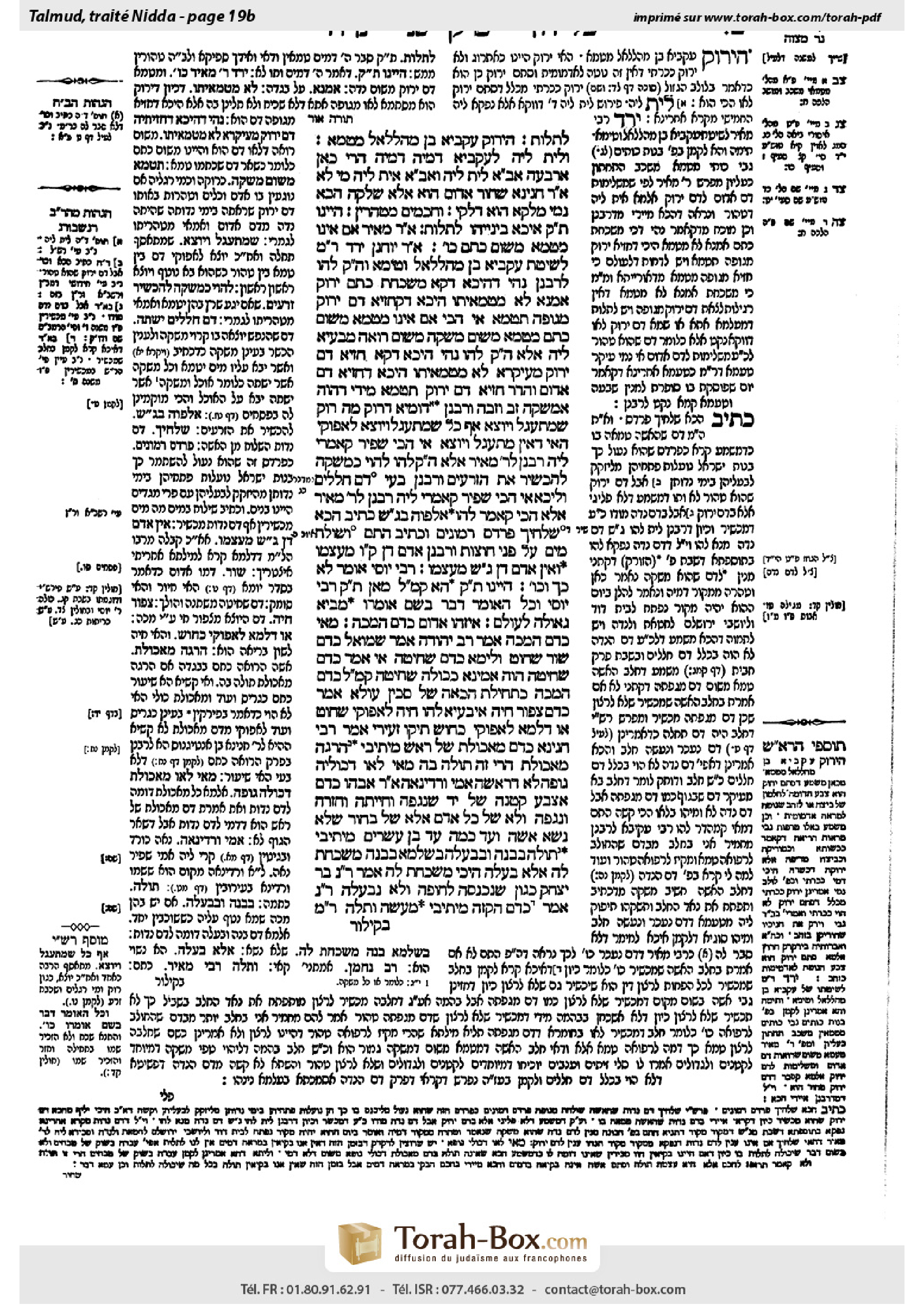
Niddah 19b: Talmud study for Daf Yomi
Daf Yomi is the daily study of one Talmud folio. Explore 37 tractates with scans, Hebrew text, Sefaria English and AI-generated French translations where annotated.
Passage selection and English or AI-generated French translation are available where the scan has annotations. Daf Study is independent of Torah-Box and Sefaria.
Browse Niddah · נידה · All tractatesNiddah 19b text and translations
This page of Niddah includes the Aramaic text, an English translation and an AI-generated French translation, alongside the scan above.
נידה י״ט ב · Aramaic and Hebrew text
לִתְלוֹת.
הַיָּרוֹק, עֲקַבְיָא בֶּן מַהֲלַלְאֵל מְטַמֵּא. וְלֵית לֵיהּ לַעֲקַבְיָא ״דָּמֶיהָ״ ״דָּמֶיהָ״ — הֲרֵי כָּאן אַרְבָּעָה?
אִיבָּעֵית אֵימָא: לֵית לֵיהּ, וְאִיבָּעֵית אֵימָא: אִית לֵיהּ, מִי לָא אָמַר רַבִּי חֲנִינָא: שָׁחוֹר — אָדוֹם הוּא, אֶלָּא שֶׁלָּקָה? הָכָא נָמֵי, מִלְקָא הוּא דְּלָקֵי.
וַחֲכָמִים מְטַהֲרִין. הַיְינוּ תַּנָּא קַמָּא! אִיכָּא בֵינַיְיהוּ לִתְלוֹת.
אָמַר רַבִּי מֵאִיר: ״אִם אֵינוֹ מְטַמֵּא מִשּׁוּם כֶּתֶם״ כּוּ׳.
אָמַר רַבִּי יוֹחָנָן: יָרַד רַבִּי מֵאִיר לְשִׁיטַת עֲקַבְיָא בֶּן מַהֲלַלְאֵל, וְטִימֵּא. וְהָכִי קָאָמַר לְהוּ לְרַבָּנַן: נְהִי דְּהֵיכָא דְּקָא מַשְׁכַּחַתְּ כֶּתֶם יָרוֹק אַמָּנָא לָא מְטַמְּאִיתוּ, הֵיכָא דְּקָחָזְיָא דַּם יָרוֹק מִגּוּפַהּ — תְּטַמֵּא.
אִי הָכִי, אִם אֵינוֹ מְטַמֵּא מִשּׁוּם כֶּתֶם, מְטַמֵּא מִשּׁוּם מַשְׁקֶה? מִשּׁוּם רוֹאָה מִבַּעְיָא לֵיהּ!
אֶלָּא הָכִי קָאָמַר לְהוּ: נְהִי הֵיכָא דְּקָא חָזְיָא דָּם יָרוֹק מֵעִיקָּרָא — לָא מְטַמְּאִיתוּ, הֵיכָא דְּחָזְיָא דַּם אָדוֹם וַהֲדַר חָזְיָא דָּם יָרוֹק — תְּטַמֵּא, מִידֵי דְּהָוֵה אַמַּשְׁקֶה זָב וְזָבָה.
וְרַבָּנַן, דּוּמְיָא דְּרוֹק: מָה רוֹק שֶׁמִּתְעַגֵּל וְיוֹצֵא, אַף כֹּל שֶׁמִּתְעַגֵּל וְיוֹצֵא, לְאַפּוֹקֵי הַאי דְּאֵין מִתְעַגֵּל וְיוֹצֵא. אִי הָכִי, שַׁפִּיר קָאָמְרִי לֵיהּ רַבָּנַן לְרַבִּי מֵאִיר.
אֶלָּא, הָכִי קָאָמַר לְהוּ: לֶהֱוֵי כְּמַשְׁקֶה לְהַכְשִׁיר אֶת הַזְּרָעִים. וְרַבָּנַן בָּעֵי ״דַּם חֲלָלִים״, וְלֵיכָּא. אִי הָכִי, שַׁפִּיר קָאָמְרִי לֵיהּ רַבָּנַן לְרַבִּי מֵאִיר!
אֶלָּא הָכִי קָאָמַר לְהוּ: אַלְּפוּהָ בִּגְזֵרָה שָׁוָה, כְּתִיב הָכָא ״שְׁלָחַיִךְ פַּרְדֵּס רִמּוֹנִים״, וּכְתִיב הָתָם: ״וְשֹׁלֵחַ מַיִם עַל פְּנֵי חוּצוֹת״.
וְרַבָּנַן? אָדָם דָּן קַל וָחוֹמֶר מֵעַצְמוֹ, וְאֵין אָדָם דָּן גְּזֵרָה שָׁוָה מֵעַצְמוֹ.
רַבִּי יוֹסֵי אוֹמֵר: לֹא כָּךְ וְכוּ׳. הַיְינוּ תַּנָּא קַמָּא! הָא קָא מַשְׁמַע לַן: מַאן תַּנָּא קַמָּא? רַבִּי יוֹסֵי, וְכׇל הָאוֹמֵר דָּבָר בְּשֵׁם אוֹמְרוֹ מֵבִיא גְּאוּלָּה לָעוֹלָם.
אֵיזֶהוּ אָדוֹם — כְּדַם הַמַּכָּה. מַאי ״כְּדַם הַמַּכָּה״? אָמַר רַב יְהוּדָה אָמַר שְׁמוּאֵל: כְּדַם שׁוֹר שָׁחוּט.
וְלֵימָא ״כְּדַם שְׁחִיטָה״! אִי אָמַר ״כְּדַם שְׁחִיטָה״ — הֲוָה אָמֵינָא כְּכוּלַּהּ שְׁחִיטָה, קָא מַשְׁמַע לַן ״כְּדַם הַמַּכָּה״ — כִּתְחִילַּת הַכָּאָה שֶׁל סַכִּין.
עוּלָּא אָמַר: כְּדַם צִפּוֹר חַיָּה. אִיבַּעְיָא לְהוּ: חַיָּה — לְאַפּוֹקֵי שָׁחוּט, אוֹ דִּלְמָא לְאַפּוֹקֵי כָּחוּשׁ? תֵּיקוּ.
זְעֵירִי אָמַר רַבִּי חֲנִינָא: כְּדַם מַאֲכוֹלֶת שֶׁל רֹאשׁ. מֵיתִיבִי: הָרְגָה מַאֲכוֹלֶת — הֲרֵי זֹה תּוֹלָה בָּהּ. מַאי לַָאו דְּכוּלֵּיהּ גּוּפַהּ? לָא, דְּרֵאשַׁהּ.
אַמֵּי וַרְדִּינָאָה, אָמַר רַבִּי אֲבָהוּ: כְּדַם אֶצְבַּע קְטַנָּה שֶׁל יָד, שֶׁנִּגְּפָה וְחָיְיתָה וְחָזְרָה וְנִגְּפָה. וְלֹא שֶׁל כׇּל אָדָם, אֶלָּא שֶׁל בָּחוּר שֶׁלֹּא נָשָׂא אִשָּׁה. וְעַד כַּמָּה? עַד בֶּן עֶשְׂרִים.
מֵיתִיבִי: תּוֹלֶה בִּבְנָהּ וּבְבַעְלָהּ? בִּשְׁלָמָא בִּבְנָהּ — מַשְׁכַּחַתְּ לַהּ, אֶלָּא בַּעְלָהּ — הֵיכִי מַשְׁכַּחַתְּ לַהּ?
אָמַר רַב נַחְמָן בַּר יִצְחָק: כְּגוֹן שֶׁנִּכְנְסָה לַחוּפָּה, וְלֹא נִבְעֲלָה.
רַב נַחְמָן אָמַר: כְּדַם הַקָּזָה. מֵיתִיבִי: מַעֲשֶׂה וְתָלָה רַבִּי מֵאִיר
Niddah 19b · English translation
with regard to whether to leave in abeyance, i.e., to treat as uncertain, blood the color of water in which a fenugreek plant is soaked, or the color of the liquid that drips from roast meat. According to the first tanna of the mishna there are five types of blood that are definitely impure, whereas other types, such as those mentioned by Beit Shammai, are deemed impure due to uncertainty. By contrast, Beit Hillel maintain that blood of these colors is entirely pure.
§ The mishna states: Blood that is green, Akavya ben Mahalalel deems it impure. The Gemara asks: But does Akavya ben Mahalalel not accept the exposition of Rabbi Abbahu that the two verses: “Dameha” (Leviticus 12:7), and: “Dameha” (Leviticus 20:18), indicate that there are four types of blood here?
The Gemara answers: If you wish, say that Akavya ben Mahalalel does not accept this opinion of Rabbi Abbahu, as he maintains that there are more than four types of blood in a woman. And if you wish, say instead that Akavya ben Mahalalel accepts Rabbi Abbahu’s exposition, and the apparent contradiction can be resolved as follows: Didn’t Rabbi Ḥanina say, with regard to the black blood mentioned in the mishna, that it is actually red but its color has faded? Here too, with regard to the green mentioned by Akavya ben Mahalalel, one can say that it was initially red but its color faded and turned green.
§ The mishna states with regard to blood that is green: And the Rabbis deem it pure. The Gemara asks: Isn’t this opinion of the Rabbis identical to the opinion of the first tanna? The Gemara answers: There is a practical difference between them with regard to whether to leave in abeyance blood that is green. According to the first tanna of the mishna there are five types of blood that are definitely impure, whereas other types, such as green, are impure due to uncertainty. By contrast, the Rabbis maintain that green blood is entirely pure.
§ The mishna states that Rabbi Meir said: Even if the green blood does not transmit impurity due to the halakhot of a blood stain or the blood of a menstruating woman, it is blood in that it renders food susceptible to ritual impurity due to its status as one of the seven liquids that render food susceptible.
Rabbi Yoḥanan says: Rabbi Meir accepted the opinion of Akavya ben Mahalalel and deemed green blood impure as blood of a menstruating woman. And as for his statement in the mishna, this is what Rabbi Meir was saying to the Rabbis: Granted that in a case where a woman finds a green stain on an article of clothing you do not deem her ritually impure, as its greenness is an indication that it did not come from her body. But in a case where she actually sees green blood come from her body, she shall be impure.
The Gemara raises a difficulty with this interpretation: If so, why did Rabbi Meir say: Even if it does not transmit impurity due to the halakhot of a blood stain, it renders food susceptible to ritual impurity due to its status as a liquid? According to the above explanation, he should have said: If the woman saw the emission of this blood, she is impure as a menstruating woman.
Rather, this is what Rabbi Meir was saying to the Rabbis: Granted that in a case where the woman sees green blood from the outset you do not deem her ritually impure, but in a case where she sees red blood and then sees green blood, she shall be impure. This is just as it is with regard to the halakha of the fluids of a man who experiences a gonorrhea-like discharge [zav] and a woman who experiences a discharge of uterine blood after her menstrual period [zava]. All fluids emitted by a zav or zava, such as saliva and urine, are impure. Likewise, green blood that is emitted by this woman who has already emitted red blood should be impure.
The Gemara asks: And how would the Rabbis respond to this? The Gemara answers: They maintain that the impure fluids of a menstruating woman are only those that are similar to saliva: Just as when saliva leaves one’s mouth it is first gathered together and then expelled from the body, so too, all impure fluids are those that are gathered together and then expelled. This definition serves to exclude this green blood, which is not gathered together and expelled. The Gemara asks: If so, the Rabbis spoke well to Rabbi Meir, i.e., their answer is convincing. Why does Rabbi Meir deem green blood impure?
Rather, this is what Rabbi Meir was saying to the Rabbis: Let green blood be at least like one of the seven liquids that render seeds upon which they fall susceptible to ritual impurity. Why is green blood deemed pure even with regard to this matter? And the Rabbis disagree because they require that every type of blood that renders food susceptible to ritual impurity be like that mentioned in the verse: “And drink the blood of the slain” (Numbers 23:24), i.e., the blood that flows at the time of death; and green blood is not the type that flows at the time of death. Therefore, it does not render food susceptible to ritual impurity. The Gemara again asks: If so, the Rabbis spoke well to Rabbi Meir. Why does he disagree with them?
Rather, this is what Rabbi Meir was saying to the Rabbis: Learn this halakha that green blood renders food susceptible to ritual impurity from the following verbal analogy: It is written here, in a description of the beloved woman that alludes to her menstrual blood: “Your shoots [shelaḥayikh] are an orchard of pomegranates” (Song of Songs 4:13), and it is written there: “Who gives rain upon the earth, and sends [veshole’aḥ] waters upon the fields” (Job 5:10). This verbal analogy indicates that menstrual blood is similar to water in that both render food susceptible to ritual impurity.
And the Rabbis disagree with Rabbi Meir, as they do not have a tradition that this is an accepted verbal analogy, and there is a principle that although a person may derive an a fortiori inference on his own, i.e., even though he was not taught that particular logical argument by his teachers, a person may not derive a verbal analogy on his own, but only if he received it by tradition.
§ The mishna states that Rabbi Yosei says: Neither in this sense, as the blood of a menstruating woman according to Akavya ben Mahalalel, nor in that sense, as a liquid that renders food susceptible according to Rabbi Meir, is green blood considered blood. The Gemara raises a difficulty: Isn’t this the same as the opinion of the first tanna? The Gemara answers that this is what the mishna is teaching us: Who is the first tanna? Rabbi Yosei. And the reason Rabbi Yosei’s name is mentioned is due to the principle that anyone who reports a statement in the name of the one who said it brings redemption to the world.
§ The mishna states: What is the red color of blood that is impure? It is as red as the blood that flows from a wound. The Gemara asks: What is the meaning of the phrase: As the blood that flows from a wound? Rav Yehuda says that Shmuel says: Like the blood of a slaughtered ox.
The Gemara inquires: But if so, let the tanna of the mishna say explicitly that it is as red as the blood of slaughter. The Gemara explains: If the tanna had said that it is as red as the blood of slaughter, I would say that it means as red as the blood that flows throughout the entire slaughter, and it would apply to the shades of all blood emitted during the process. Therefore, the tanna teaches us that it is as red as the blood that flows from a wound, i.e., as the blood that flows at the beginning of the slitting with the slaughtering knife.
The Gemara cites other definitions of the color described in the mishna as: Red as the blood that flows from a wound. Ulla says: It is red like the blood that flows from a living bird that was wounded. A dilemma was raised before the Sages: When Ulla specified that the bird is living, did he mean that it was not dead, to exclude the blood of a slaughtered bird? Or perhaps he meant that the bird was healthy, to exclude the blood of a weak bird. No answer was found, and therefore the Gemara concludes that the dilemma shall stand unresolved.
The Gemara cites another definition: Ze’eiri says that Rabbi Ḥanina says: It is red like the blood that comes from a squashed head louse. The Gemara raises an objection from a mishna that discusses a stain found on a woman’s garment (58b): If a woman killed a louse and subsequently found a blood stain on her garment or body, this woman may attribute the stain to that louse, and she remains pure. The Gemara explains the objection: What, is it not correct to say that this is referring to a louse from all parts of her body, not just the head, as claimed by Rabbi Ḥanina? If so, the color of impure blood is like the color of the blood of a louse from anywhere on the body. The Gemara answers: No; this halakha is referring specifically to a louse that was on her head.
The Gemara cites yet another definition of the color described in the mishna as: Red as the blood that flows from a wound. The Sage Ami of Vardina says that Rabbi Abbahu says: It is red as the blood that flows from the smallest finger of the hand, which was wounded and later healed and was subsequently wounded again. And this is not referring to the finger of any person, but specifically to the finger of a young man who has not yet married a woman. And furthermore, this does not mean any young man; rather, until what age must he be? Until twenty years old.
The Gemara raises an objection from the aforementioned mishna (58b): If the woman’s husband or son suffered an injury, she may attribute a blood stain she finds on her garment to her son or to her husband, and she remains pure. The Gemara analyzes this halakha: Granted, with regard to the ruling that she may attribute it to her son, you can find a case where this meets all the requirements specified by Rabbi Abbahu, i.e., he could be younger than twenty and unmarried. But with regard to the ruling that she may attribute it to her husband, how can you find a case where her husband is unmarried?
Rav Naḥman bar Yitzḥak says: It is possible in a case where this woman entered the marriage canopy but has not yet engaged in intercourse with her husband. In such a situation, although he is her husband he is physically akin to an unmarried young man. Therefore, she can attribute the blood stain to his wound.
Rav Naḥman says: This red is like the blood spilled in the process of bloodletting. The Gemara raises an objection from a baraita: An incident occurred involving a blood stain found on a woman’s garment, and Rabbi Meir attributed
Niddah 19b · Traduction française (IA)
Il s’agit de savoir s’il faut laisser en suspens, c’est-à-dire considérer comme incertain, le sang de la couleur de l’eau dans laquelle on a fait tremper du fenugrec ou de celle du liquide qui s’écoule d’une viande rôtie. Selon le premier tanna de la Michna, cinq types de sang sont certainement impurs, tandis que les autres, comme ceux mentionnés par Beit Shammaï, sont considérés comme impurs par doute. Beit Hillel, en revanche, soutiennent que le sang de ces couleurs est entièrement pur.
§ La Michna énonce : « Le sang vert, Akavya ben Mahalalel le considère comme impur. » La Guemara demande : Akavya ben Mahalalel n’accepte-t-il donc pas l’exégèse de Rabbi Abbahou, selon laquelle les deux versets « Dameha » (Lévitique 12, 7) et « Dameha » (Lévitique 20, 18) indiquent qu’il y a ici quatre types de sang ?
La Guemara répond : Si tu veux, dis qu’Akavya ben Mahalalel n’accepte pas cette opinion de Rabbi Abbahou, car il soutient qu’il existe plus de quatre types de sang chez une femme. Et si tu veux, dis plutôt qu’Akavya ben Mahalalel accepte l’exégèse de Rabbi Abbahou, et que la contradiction apparente se résout ainsi : Rabbi Ḥanina n’a-t-il pas dit, au sujet du sang noir mentionné dans la Michna, qu’il est en réalité rouge, mais que sa couleur s’est estompée ? De même, au sujet du sang vert mentionné par Akavya ben Mahalalel, on peut dire qu’il était rouge à l’origine, mais que sa couleur s’est estompée et qu’il est devenu vert.
§ La Michna énonce au sujet du sang vert : « Et les Rabbins le déclarent pur. » La Guemara demande : Cette opinion des Rabbins n’est-elle pas identique à celle du premier tanna ? La Guemara répond qu’il existe entre eux une différence pratique quant à savoir s’il faut laisser en suspens le sang vert. Selon le premier tanna de la Michna, cinq types de sang sont certainement impurs, tandis que les autres, comme le sang vert, sont impurs par doute. Les Rabbins, en revanche, soutiennent que le sang vert est entièrement pur.
§ La Michna rapporte que Rabbi Meïr a dit : Même si le sang vert ne transmet pas l’impureté selon les règles relatives à une tache de sang ou au sang d’une femme menstruée, il demeure du sang en ce qu’il rend les aliments susceptibles de contracter l’impureté rituelle, puisqu’il compte parmi les sept liquides qui rendent les aliments susceptibles de contracter cette impureté.
Rabbi Yoḥanan dit : Rabbi Meïr a accepté l’opinion d’Akavya ben Mahalalel et a considéré le sang vert comme impur, au même titre que le sang d’une femme menstruée. Quant à sa déclaration dans la Michna, voici ce que Rabbi Meïr disait aux Rabbins : Certes, lorsqu’une femme trouve une tache verte sur un vêtement, vous ne la déclarez pas rituellement impure, car cette couleur verte indique que la tache ne provient pas de son corps. Mais si elle voit effectivement du sang vert sortir de son corps, elle est impure.
La Guemara soulève une difficulté à l’encontre de cette interprétation : Dans ce cas, pourquoi Rabbi Meïr a-t-il dit : « Même s’il ne transmet pas l’impureté selon les règles relatives à une tache de sang, il rend les aliments susceptibles de contracter l’impureté rituelle en tant que liquide » ? Selon l’explication ci-dessus, il aurait dû dire : « Si la femme a vu ce sang s’écouler, elle est impure comme une femme menstruée. »
Mais voici ce que Rabbi Meïr disait aux Rabbins : Certes, lorsque la femme voit du sang vert dès le début, vous ne la déclarez pas rituellement impure ; mais lorsqu’elle voit du sang rouge, puis du sang vert, elle est impure. Il en va comme pour la halakha relative aux liquides émis par un homme qui souffre d’un écoulement semblable à la gonorrhée [zav] et par une femme qui connaît un écoulement de sang utérin après ses règles [zava]. Tous les liquides émis par un zav ou une zava, comme la salive et l’urine, sont impurs. De même, le sang vert émis par cette femme, qui a déjà émis du sang rouge, devrait être impur.
La Guemara demande : Et que répondraient les Rabbins à cela ? La Guemara répond : Ils soutiennent que, chez une femme menstruée, seuls sont impurs les liquides semblables à la salive. De même que la salive, en sortant de la bouche, s’accumule d’abord avant d’être expulsée du corps, de même, tous les liquides impurs sont ceux qui s’accumulent avant d’être expulsés. Cette définition exclut le sang vert, qui ne s’accumule pas avant d’être expulsé. La Guemara demande : Dans ce cas, les Rabbins ont bien répondu à Rabbi Meïr, c’est-à-dire que leur réponse est convaincante. Pourquoi Rabbi Meïr considère-t-il le sang vert comme impur ?
Mais voici ce que Rabbi Meïr disait aux Rabbins : Que le sang vert soit au moins considéré comme l’un des sept liquides qui rendent susceptibles de contracter l’impureté rituelle les graines sur lesquelles ils tombent. Pourquoi le sang vert est-il considéré comme pur même à cet égard ? Les Rabbins ne sont pas d’accord, car ils exigent que tout sang qui rend les aliments susceptibles de contracter l’impureté rituelle soit semblable à celui qui est mentionné dans le verset : « Et qu’ils boivent le sang des tués » (Nombres 23, 24), c’est-à-dire au sang qui coule au moment de la mort ; or le sang vert n’est pas du type de celui qui coule au moment de la mort. Il ne rend donc pas les aliments susceptibles de contracter l’impureté rituelle. La Guemara demande à nouveau : Dans ce cas, les Rabbins ont bien répondu à Rabbi Meïr. Pourquoi est-il en désaccord avec eux ?
Mais voici ce que Rabbi Meïr disait aux Rabbins : Déduisez cette halakha — selon laquelle le sang vert rend les aliments susceptibles de contracter l’impureté rituelle — au moyen de l’analogie verbale suivante : il est écrit ici, dans la description de la femme bien-aimée, qui fait allusion à son sang menstruel : « Tes pousses [shelaḥayikh] sont un verger de grenadiers » (Cantique des Cantiques 4, 13), et il est écrit là : « Lui qui donne la pluie sur la terre et envoie [veshole’aḥ] les eaux sur les champs » (Job 5, 10). Cette analogie verbale indique que le sang menstruel est semblable à l’eau, puisque tous deux rendent les aliments susceptibles de contracter l’impureté rituelle.
Les Rabbins ne sont pas d’accord avec Rabbi Meïr, car ils n’ont pas reçu de tradition selon laquelle cette analogie verbale est admise. Or, un principe veut qu’une personne puisse établir de son propre chef un raisonnement a fortiori — même si ses maîtres ne lui ont pas enseigné cet argument logique particulier —, mais qu’elle ne puisse établir de son propre chef une analogie verbale : elle doit l’avoir reçue par tradition.
§ La Michna rapporte que Rabbi Yossei dit : Ni dans ce sens, comme sang d’une femme menstruée selon Akavya ben Mahalalel, ni dans cet autre sens, comme liquide rendant les aliments susceptibles de contracter l’impureté selon Rabbi Meïr, le sang vert n’est considéré comme du sang. La Guemara soulève une difficulté : N’est-ce pas la même opinion que celle du premier tanna ? La Guemara répond que la Michna nous enseigne ceci : Qui est le premier tanna ? Rabbi Yossei. Et si le nom de Rabbi Yossei est mentionné, c’est en vertu du principe selon lequel quiconque rapporte une déclaration au nom de celui qui l’a prononcée apporte la délivrance au monde.
§ La Michna énonce : « Quelle est la couleur du sang impur ? Elle est aussi rouge que le sang qui coule d’une blessure. » La Guemara demande : Que signifie l’expression « aussi rouge que le sang qui coule d’une blessure » ? Rav Yehouda dit au nom de Shmouel : Comme le sang d’un bœuf égorgé.
La Guemara demande : Dans ce cas, que le tanna de la Michna dise explicitement que le sang est aussi rouge que le sang de l’abattage rituel. La Guemara explique : Si le tanna avait dit qu’il est aussi rouge que le sang de l’abattage rituel, j’aurais compris qu’il s’agit du sang qui coule pendant tout l’abattage, ce qui engloberait toutes les nuances du sang émis au cours du processus. Le tanna nous enseigne donc qu’il est aussi rouge que le sang qui coule d’une blessure, c’est-à-dire comme le sang qui coule au début de l’incision pratiquée avec le couteau d’abattage.
La Guemara cite d’autres définitions de la couleur décrite dans la Michna comme « rouge comme le sang qui coule d’une blessure ». Oulla dit : Elle est rouge comme le sang qui coule d’un oiseau vivant blessé. Les Sages soulevèrent une question : Quand Oulla a précisé que l’oiseau est vivant, voulait-il dire qu’il n’était pas mort, excluant ainsi le sang d’un oiseau abattu ? Ou peut-être voulait-il dire que l’oiseau était en bonne santé, excluant ainsi le sang d’un oiseau affaibli ? Aucune réponse ne fut trouvée ; la Guemara conclut donc que la question reste sans réponse.
La Guemara cite une autre définition : Ze’eiri dit au nom de Rabbi Ḥanina : Elle est rouge comme le sang qui provient d’un pou écrasé. La Guemara soulève une objection à partir d’une Michna qui traite d’une tache trouvée sur le vêtement d’une femme (58b) : Si une femme a tué un pou, puis a trouvé une tache de sang sur son vêtement ou sur son corps, elle peut attribuer la tache à ce pou et reste pure. La Guemara précise la difficulté : N’est-il pas juste de dire que cela concerne un pou provenant de n’importe quelle partie de son corps, et non seulement de la tête, contrairement à ce qu’affirme Rabbi Ḥanina ? Dans ce cas, la couleur du sang impur serait semblable à celle du sang d’un pou provenant de n’importe quelle partie du corps. La Guemara répond : Non, cette halakha concerne spécifiquement un pou qui se trouvait sur sa tête.
La Guemara cite encore une autre définition de la couleur décrite dans la Michna comme « rouge comme le sang qui coule d’une blessure ». Le Sage Ami de Vardina dit au nom de Rabbi Abbahou : Elle est rouge comme le sang qui coule du petit doigt, après que celui-ci a été blessé, a guéri, puis a été blessé de nouveau. Il ne s’agit pas du doigt de n’importe quelle personne, mais précisément de celui d’un jeune homme qui n’a pas encore épousé de femme. En outre, il ne s’agit pas de n’importe quel jeune homme : jusqu’à quel âge doit-il avoir ? Jusqu’à vingt ans.
La Guemara soulève une objection à partir de la Michna susmentionnée (58b) : Si le mari ou le fils de la femme a été blessé, elle peut attribuer à son fils ou à son mari une tache de sang trouvée sur son vêtement, et elle reste pure. La Guemara analyse cette halakha : Il est certes possible que la règle lui permettant d’attribuer la tache à son fils satisfasse à toutes les conditions énoncées par Rabbi Abbahou, c’est-à-dire que son fils puisse avoir moins de vingt ans et ne pas être marié. Mais, s’agissant de la règle lui permettant de l’attribuer à son mari, comment trouver un cas où son mari ne serait pas marié ?
Rav Naḥman bar Yitzḥak dit : C’est possible dans le cas où cette femme est entrée sous la houppa, mais n’a pas encore eu de rapports avec son mari. Dans une telle situation, bien qu’il soit son mari, il est physiquement semblable à un jeune homme non marié. Elle peut donc attribuer la tache de sang à sa blessure.
Rav Naḥman dit : Ce rouge est semblable au sang répandu au cours d’une saignée. La Guemara soulève une objection à partir d’une baraïta : Un incident s’est produit au sujet d’une tache de sang trouvée sur le vêtement d’une femme, et Rabbi Meïr l’attribua
Traduction française générée par IA à partir de l’édition anglaise de Sefaria. Vérifie toujours un passage avec le texte source.
Text from Sefaria: William Davidson Edition - Vocalized Aramaic (CC BY NC); William Davidson Edition - English (CC BY NC).