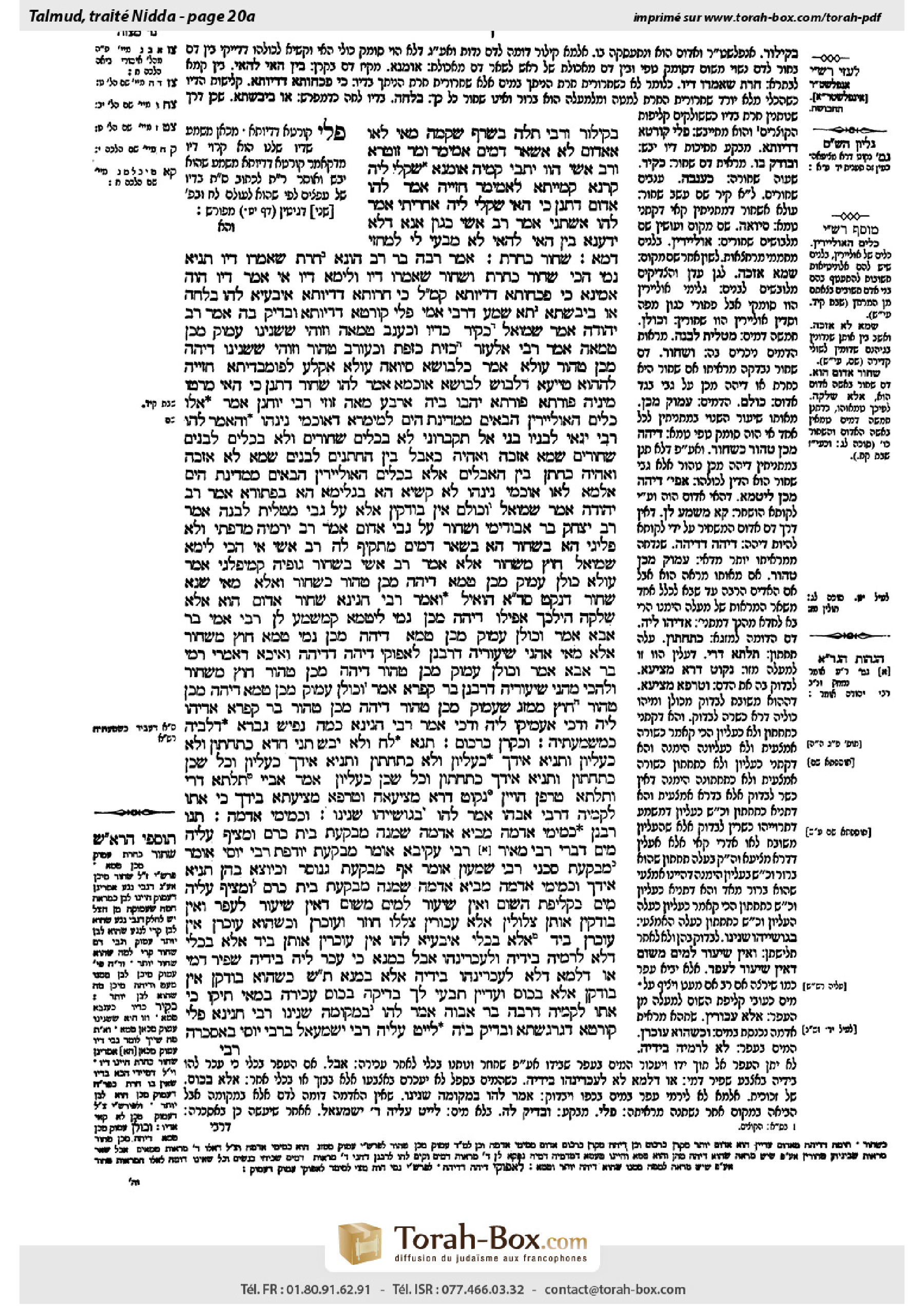
Niddah 20a: Talmud study for Daf Yomi
Daf Yomi is the daily study of one Talmud folio. Explore 37 tractates with scans, Hebrew text, Sefaria English and AI-generated French translations where annotated.
Passage selection and English or AI-generated French translation are available where the scan has annotations. Daf Study is independent of Torah-Box and Sefaria.
Browse Niddah · נידה · All tractatesNiddah 20a text and translations
This page of Niddah includes the Aramaic text, an English translation and an AI-generated French translation, alongside the scan above.
נידה כ׳ א · Aramaic and Hebrew text
בְּקִילוֹר, וְרַבִּי תָּלָה בִּשְׂרַף שִׁקְמָה. מַאי לַָאו אַאָדוֹם?
לָא, אַשְּׁאָר דָּמִים.
אַמֵּימָר וּמַר זוּטְרָא וְרַב אָשֵׁי הֲווֹ יָתְבִי קַמֵּיהּ אוּמָּנָא, שָׁקְלִי לֵיהּ קַרְנָא קַמַּיְיתָא לְאַמֵּימָר, חַזְיֵיהּ, אֲמַר לְהוּ: ״אָדוֹם״ דִּתְנַן כִּי הַאי, שָׁקְלִי לֵיהּ אַחֲרִיתִי, אֲמַר לְהוּ: אִשְׁתַּנִּי, אָמַר רַב אָשֵׁי: כְּגוֹן אֲנָא דְּלָא יָדַעְנָא בֵּין הַאי לְהַאי — לָא מִבְּעֵי לִי לְמִחְזֵי דְּמָא.
שָׁחוֹר — כְּחֶרֶת. אָמַר רַבָּה בַּר רַב הוּנָא: חֶרֶת שֶׁאָמְרוּ — דְּיוֹ. תַּנְיָא נָמֵי הָכִי: שָׁחוֹר כְּחֶרֶת, וְשָׁחוֹר שֶׁאָמְרוּ — דְּיוֹ. וְלֵימָא דְּיוֹ! אִי אָמַר דְּיוֹ — הֲוָה אָמֵינָא כִּי פִכְחוּתָא דִּדְיוֹתָא, קָא מַשְׁמַע לַן כִּי חֲרוּתָא דִּדְיוֹתָא.
אִיבַּעְיָא לְהוּ: בְּלַחָה אוֹ בְּיַבִּשְׁתָּא? תָּא שְׁמַע: דְּרַבִּי אַמֵּי פָּלֵי קוּרְטָא דִּדְיוֹתָא וּבָדֵיק בֵּהּ.
אָמַר רַב יְהוּדָה אָמַר שְׁמוּאֵל: כְּקִיר, כִּדְיוֹ וּכְעֵנָב — טְמֵאָה, וְזוֹהִי שֶׁשָּׁנִינוּ: ״עָמוֹק מִכֵּן — טְמֵאָה״. אָמַר רַבִּי אֶלְעָזָר: כְּזַיִת, כְּזֶפֶת וּכְעוֹרֵב — טָהוֹר, וְזוֹהִי שֶׁשָּׁנִינוּ: ״דֵּיהֶה מִכֵּן — טָהוֹר״.
עוּלָּא אָמַר: כִּלְבוּשָׁא סִיּוּאָה. עוּלָּא אִקְּלַע לְפוּמְבְּדִיתָא, חַזְיֵיהּ לְהָהוּא טַיָּיעָא דִּלְבִושׁ לְבוּשָׁא אוּכָּמָא. אָמַר לְהוּ: ״שָׁחוֹר״ דִּתְנַן כִּי הַאי. מְרַטוּ מִינֵּיהּ פּוּרְתָּא פּוּרְתָּא, יְהַבוּ בֵּיהּ אַרְבַּע מְאָה זוּזֵי.
רַבִּי יוֹחָנָן אָמַר: אֵלּוּ כֵּלִים הָאוֹלְיָירִין הַבָּאִים מִמְּדִינַת הַיָּם. לְמֵימְרָא דְּאוּכָּמֵי נִינְהוּ? וְהָאָמַר לְהוּ רַבִּי יַנַּאי לְבָנָיו: בָּנַי, אַל תִּקְבְּרוּנִי לֹא בְּכֵלִים שְׁחוֹרִים וְלֹא בְּכֵלִים לְבָנִים. שְׁחוֹרִים — שְׁמָא אֶזְכֶּה וְאֶהְיֶה כְּאָבֵל בֵּין הַחֲתָנִים, לְבָנִים — שֶׁמָּא לֹא אֶזְכֶּה וְאֶהְיֶה כְּחָתָן בֵּין הָאֲבֵלִים, אֶלָּא בְּכֵלִים הָאוֹלְיָירִין הַבָּאִים מִמְּדִינַת הַיָּם.
אַלְמָא לָאו אוּכָּמֵי נִינְהוּ! לָא קַשְׁיָא — הָא בִּגְלִימָא, הָא בְּפָתוּרָא.
אָמַר רַב יְהוּדָה אָמַר שְׁמוּאֵל: וְכוּלָּם, אֵין בּוֹדְקִין אֶלָּא עַל גַּבֵּי מַטְלֵית לְבָנָה. אָמַר רַב יִצְחָק בַּר אֲבוּדִימִי: וְשָׁחוֹר עַל גַּבֵּי אָדוֹם.
אָמַר רַב יִרְמְיָה מִדִּפְתִּי: וְלָא פְּלִיגִי — הָא בְּשָׁחוֹר, הָא בִּשְׁאָר דָּמִים. מַתְקֵיף לַהּ רַב אָשֵׁי: אִי הָכִי, לֵימָא שְׁמוּאֵל ״חוּץ מִשָּׁחוֹר״! אֶלָּא אָמַר רַב אָשֵׁי: בְּשָׁחוֹר גּוּפֵיהּ קָמִיפַּלְגִי.
אָמַר עוּלָּא: כּוּלָּן, עָמוֹק מִכֵּן — טָמֵא, דֵּיהֶה מִכֵּן — טָהוֹר, כַּשָּׁחוֹר.
וְאֶלָּא מַאי שְׁנָא שָׁחוֹר דְּנָקֵט? סָלְקָא דַעְתָּךְ אֲמִינָא: הוֹאִיל וְאָמַר רַבִּי חֲנִינָא ״שָׁחוֹר אָדוֹם הוּא אֶלָּא שֶׁלָּקָה״, הִילְכָּךְ אֲפִילּוּ דֵּיהֶה מִכֵּן נָמֵי לִיטַמֵּא? קָמַשְׁמַע לַן.
רַבִּי אַמֵּי בַּר אַבָּא אָמַר: וְכוּלָּן, עָמוֹק מִכֵּן — טָמֵא, דֵּיהֶה מִכֵּן — נָמֵי טָמֵא, חוּץ מִשָּׁחוֹר. אֶלָּא מַאי אַהֲנִי שִׁיעוּרֵיה דְרַבָּנַן? לְאַפּוֹקֵי דֵּיהֶה דְּדֵיהָה.
וְאִיכָּא דְאָמְרִי, רָמֵי בַּר אַבָּא אֲמַר: וְכוּלָּן, עָמוֹק מִכֵּן — טָהוֹר, דֵּיהֶה מִכֵּן — טָהוֹר, חוּץ מִשָּׁחוֹר, וּלְהָכִי מַהֲנֵי שִׁיעוּרֵיה דְרַבָּנַן.
בַּר קַפָּרָא אָמַר: וְכוּלָּן, עָמוֹק מִכֵּן — טָמֵא, דֵּיהֶה מִכֵּן — טָהוֹר. חוּץ מִמֶּזֶג, שֶׁעָמוֹק מִכֵּן — טָהוֹר, דֵּיהֶה מִכֵּן — טָהוֹר. בַּר קַפָּרָא אֲדִיהוּ לֵיהּ — וְדַכִּי, אַעֲמִיקוּ לֵיהּ — וְדַכִּי. אָמַר רַבִּי חֲנִינָא: כַּמָּה נְפִישׁ גַּבְרָא דְּלִבֵּיהּ (כמשמעתיה) [כִּשְׁמַעְתֵּיהּ]!
וּכְקֶרֶן כַּרְכּוֹם. תָּנָא: לַח, וְלֹא יָבֵשׁ.
תָּנֵי חֲדָא: כַּתַּחְתּוֹן, לֹא כָּעֶלְיוֹן. וְתַנְיָא אִידַּךְ: כָּעֶלְיוֹן, וְלֹא כַּתַּחְתּוֹן. וְתַנְיָא אִידַּךְ: כָּעֶלְיוֹן, וְכׇל שֶׁכֵּן כַּתַּחְתּוֹן. וְתַנְיָא אִידַּךְ: כַּתַּחְתּוֹן, וְכׇל שֶׁכֵּן כָּעֶלְיוֹן.
אָמַר אַבָּיֵי: תְּלָתָא דָּרֵי וּתְלָתָא טַרְפֵי הָוְיָין.
נְקוֹט דָּרָא מְצִיעָאָה, וְטַרְפָּא (מציעתא) [מְצִיעָא] בִּידָךְ.
כִּי אָתוּ לְקַמֵּיהּ דְּרַבִּי אֲבָהוּ, אָמַר לְהוּ: בְּגוּשַׁיְיהוּ שָׁנִינוּ.
וּכְמֵימֵי אֲדָמָה. תָּנוּ רַבָּנַן: כְּמֵימֵי אֲדָמָה — מֵבִיא אֲדָמָה שְׁמֵנָה מִבִּקְעַת בֵּית כֶּרֶם, וּמֵצִיף עָלֶיהָ מַיִם, דִּבְרֵי רַבִּי מֵאִיר. רַבִּי עֲקִיבָא אוֹמֵר: מִבִּקְעַת יוֹדְפַת. רַבִּי יוֹסֵי אוֹמֵר: מִבִּקְעַת סִכְנִי. רַבִּי שִׁמְעוֹן אוֹמֵר: אַף מִבִּקְעַת גִּנּוֹסַר וְכַיּוֹצֵא בָּהֶן.
תַּנְיָא אִידַּךְ: וּכְמֵימֵי אֲדָמָה — מֵבִיא אֲדָמָה שְׁמֵנָה מִבִּקְעַת בֵּית כֶּרֶם, וּמֵצִיף עָלֶיהָ מַיִם כִּקְלִיפַּת הַשּׁוּם, וְאֵין שִׁיעוּר לַמַּיִם, מִשּׁוּם דְּאֵין שִׁיעוּר לֶעָפָר, וְאֵין בּוֹדְקִין אוֹתָן צְלוּלִין, אֶלָּא עֲכוּרִין. צָלְלוּ — חוֹזֵר וְעוֹכְרָן, וּכְשֶׁהוּא עוֹכְרָן — אֵין עוֹכְרָן בַּיָּד אֶלָּא בִּכְלִי.
אִיבַּעְיָא לְהוּ: אֵין עוֹכְרִין אוֹתָן בַּיָּד אֶלָּא בִּכְלִי — דְּלָא לִרְמְיֵהּ בִּידֵיהּ וְלַעְכְּרִינְהוּ, אֲבָל בְּמָנָא כִּי עָכַר לֵיהּ בִּידֵיהּ — שַׁפִּיר דָּמֵי, אוֹ דִלְמָא דְּלָא לַעְכְּרִינְהוּ בִּידֵיהּ אֶלָּא בְּמָנָא?
תָּא שְׁמַע: כְּשֶׁהוּא בּוֹדְקָן, אֵין בּוֹדְקָן אֶלָּא בְּכוֹס. וַעֲדַיִין תִּבְּעֵי לָךְ: בְּדִיקָה בְּכוֹס, עֲכִירָה בְּמַאי? תֵּיקוּ.
כִּי אָתוּ לְקַמֵּיהּ דְּרַבָּה בַּר אֲבוּהּ, אָמַר לְהוּ: בִּמְקוֹמָהּ שָׁנִינוּ. רַבִּי חֲנִינָא פָּלֵי קוּרְטָא דְגַרְגִּשְׁתָּא וּבָדֵיק בֵּיהּ, לָיֵיט עֲלֵיהּ רַבִּי יִשְׁמָעֵאל בְּרַבִּי יוֹסֵי בְּאַסְכָּרָה.
Niddah 20a · English translation
it to an eye salve [bekilor], which the woman had previously handled. And likewise, Rabbi Yehuda HaNasi attributed a stain to the sap of a sycamore tree the woman had touched. The Gemara explains the objection: What, is it not the case that Rabbi Meir and Rabbi Yehuda HaNasi attributed red bloodstains to these causes because they are red, albeit not as red as blood? Evidently, the color of impure blood can be similar to such shades of red as well, which means that all these distinctions mentioned by the amora’im above are irrelevant.
The Gemara answers: No; Rabbi Meir and Rabbi Yehuda HaNasi attributed stains to an eye salve and the sap of a sycamore tree because those stains were like the other types of blood mentioned in the mishna.
The Gemara relates that Ameimar and Mar Zutra and Rav Ashi were sitting before a bloodletter, to receive treatment. The bloodletter removed blood in a bloodletter’s horn from Ameimar for his first treatment. Ameimar saw the blood and said to his colleagues: The red color that we learned about in the mishna is like this blood in the horn. The bloodletter again removed blood from Ameimar, this time using another horn. Upon seeing the blood in this horn, Ameimar said to them: The color of this blood has changed compared to the blood in the first horn. Rav Ashi, who saw both types of blood, said: Any Sage such as myself, as I do not know how to distinguish between this blood and that blood, should not see, i.e., examine, different types of blood to issue a ruling as to whether they are pure or impure.
§ The mishna teaches: What is the black color that is impure? It is blood as black as ḥeret. Rabba bar Rav Huna says: This ḥeret of which the Sages spoke is ink. The Gemara notes that this opinion is also taught in a baraita: This black color is like ḥeret, and the black of which the Sages spoke is ink. The Gemara asks: But if so, why does the tanna of this baraita mention both terms? Let him say simply: Ink. The Gemara explains: If the tanna had said only: Ink, I would say that he means that it is like the clear part of the ink, i.e., the upper portion of ink in an inkwell, which is very bright. Therefore, the tanna of the baraita teaches us that it is like the blackness [ḥaruta] of the ink, the lower part of the inkwell, which is darker.
A dilemma was raised before the Sages: To which type of ḥeret were the Sages referring? Were they referring to moist or dry ḥeret? Come and hear a resolution from a practical ruling, as when black blood was brought before Rabbi Ami he would break up pieces of dried ink and examine blood with it.
§ The mishna states that if the blackness of the blood is deeper than ink, it is impure, whereas if it is lighter it is pure. In this regard, Rav Yehuda says that Shmuel says: If a woman saw blood whose color was like black wax [kekir] or like black ink or like a black grape, she is ritually impure. And this is the meaning of that which we learned in the mishna: If the black is deeper than that, it is ritually impure. Rabbi Elazar says: If a woman saw blood whose color was like a black olive, or like black tar, or like a black raven, this blood is pure. And this is the meaning of that which we learned in the mishna: If the black is lighter than that, it is ritually pure.
Ulla says: When the mishna states that black blood is impure, it means like the garments of the inhabitants of Siva’a, which were extremely black. The Gemara relates that when Ulla happened to go to Pumbedita, he saw a certain Arab [tayya’a] who was dressed in a black garment. Ulla said to the Sages of Pumbedita: The black color that we learned about in the mishna is like this color. Since people wanted a sample of the shade of blood mentioned in the mishna, they tore the Arab’s garment from him bit by bit, and in recompense they gave him four hundred dinars.
Rabbi Yoḥanan says: The black blood that the mishna says is impure is like these cloths of the bath attendants [haolyarin] who come from overseas. The Gemara asks: Is that to say that these are black cloths? But didn’t Rabbi Yannai say to his sons: My sons, do not bury me in black cloths nor in white cloths. Not in black, lest I be acquitted in judgment and I will be among the righteous like a mourner among the grooms. And not in white, lest I not be acquitted in judgment and I will be among the wicked like a groom among the mourners. Rather, bury me in the cloths of the bath attendants who come from overseas, which are neither black nor white. Apparently, these cloths of the bath attendants are not black.
The Gemara answers: This is not difficult, as a distinction can be made. When Rabbi Yannai indicates that they are not black, that is referring to a regular garment, whereas with regard to the statement of Rabbi Yoḥanan that indicates that they are black, that is referring to a cloth placed on an item such as a table or a bed.
§ With regard to the examination of the five types of blood mentioned in the mishna, Rav Yehuda says that Shmuel says: And with regard to all of them, in their various shades, one examines them only when they are placed on a white linen cloth, as only in this fashion can one properly discern the precise color of the blood. Rav Yitzḥak bar Avudimi says: And in the case of black blood, one must place it on a red linen cloth.
Rav Yirmeya of Difti says: And Shmuel and Rav Yitzḥak bar Avudimi do not disagree, as this statement of Rav Yitzḥak bar Avudimi is referring specifically to black blood, whereas that ruling of Shmuel that one must use a white cloth is referring to the other four types of blood listed in the mishna. Rav Ashi objects to this interpretation: If so, let Shmuel say: With regard to all of them except for black, one examines them only when they are placed on a white linen cloth. Rather, Rav Ashi says: Shmuel and Rav Yitzḥak bar Avudimi disagree with regard to black blood itself, whether it should be examined against the background of a white or a red cloth.
Ulla says: With regard to all of these five types of blood enumerated in the mishna, if the color is deeper than that which is described in the mishna the blood is ritually impure; if it is lighter than it, the blood is ritually pure, as explicitly stated in the mishna with regard to black.
The Gemara asks: But if so, what is different about black, that the mishna mentions this halakha only with regard to that color? The Gemara answers: The reason is that it might enter your mind to say that since Rabbi Ḥanina says: The black blood mentioned in the mishna is actually red but its color has faded, therefore, even if it is lighter than that which is described in the mishna, it should also be impure. Consequently, the mishna teaches us that even with regard to black blood, if the color is lighter than the shade mentioned in the mishna, it is pure.
Rabbi Ami bar Abba says: And with regard to all of these five types of blood, if the color is deeper than that which is described in the mishna, the blood is ritually impure; if it is lighter than that which is described in the mishna, it is also ritually impure, except for black, which is pure if it is lighter. The Gemara asks: But if these types of blood, except for black, are impure whether they are deeper or lighter than the specific shade described in the mishna, what purpose do the measures specified by the Sages in the mishna serve? The Gemara answers that these descriptions are to the exclusion of a color that is lighter than lighter, i.e., the color is so faint that it does not qualify as impure blood.
And there are those who say a different version of the above statement. Rami bar Abba says: And with regard to all of these five types of blood, if the color is deeper than that which is described in the mishna, it is ritually pure; if it is lighter than that, it is also ritually pure, except for black, which is impure if it is deeper. And for this reason the measures, i.e., descriptions, of the Sages are effective, as any discrepancy from these descriptions means that the blood is pure.
Bar Kappara says: And with regard to all of them, if the color is deeper than that, the blood is impure; if it is lighter than that, it is pure, except for blood the color of diluted wine, with regard to which if the color is deeper than that, the blood is pure, and if it is lighter than that, it is also pure. The Gemara relates that in an effort to test bar Kappara, the Sages brought before him blood that had the appearance of diluted wine and they lightened it, and bar Kappara deemed it pure. On another occasion they deepened the color of blood that looked like diluted wine, and again bar Kappara deemed it pure. Rabbi Ḥanina says in astonishment: How great is this man whose heart, which is so sensitive it can distinguish between such similar shades of blood, is in accordance with his ruling of halakha.
§ The mishna teaches, with regard to the colors of impure blood: And what is the color that is like the bright color of the crocus flower that is impure? It is like the brightest part of the flower, which is used to produce the orange-colored spice saffron. The Sages taught: This is referring to the appearance of moist saffron that is still fresh and not to its dry counterpart.
With regard to this color, it is taught in one baraita that it is like the lower part of the crocus flower, not like its upper part; and it is taught in another baraita that it is like the upper part of the flower and not like its lower part; and it is taught in another baraita that it is like its upper part, and all the more so blood whose color is like its lower part is impure; and it is taught in yet another baraita that it is like its lower part, and all the more so blood whose color is like its upper part is impure.
Abaye says that these baraitot do not contradict one another, as the crocus has three layers of the brightly colored parts of the crocus flower harvested for saffron, one above the other, and in each layer there are three leaves, i.e., styles or stigmata.
In order to examine blood whose color is similar to saffron, you should grasp the middle leaf of the middle layer in your hand and compare it to the blood. If they are similar, the blood is impure. Consequently, the four baraitot do not contradict one another: The first two baraitot are referring to the layer of leaves that must be examined. The first baraita says that it is the lower one, as the middle layer is lower than the upper one, while the second baraita states the reverse because the middle layer is higher than the lower one. Meanwhile, the last two baraitot are dealing with the leaves within the middle layer. The baraita that states: Like its lower part, and all the more so like its upper part, means: Like the lowest of the three leaves and all the more so like the middle leaf, which is above that leaf, while the other baraita states a similar idea with regard to the upper and middle leaves. In any event, all four baraitot are referring to the part of the crocus flower that is called by the mishna its brightest part.
The Gemara relates: When people would come before Rabbi Abbahu for him to examine blood whose color was similar to saffron, he would say to them: We learned that the mishna is referring specifically to crocus flowers that are still in their clumps of earth in which they grew, as once they are detached from that earth their color changes.
§ The mishna states: And what is the color that is like water that inundates red earth that is impure? In this regard the Sages taught in a baraita: In order to examine blood that is like water that inundates red earth, one brings fertile earth from the Beit Kerem Valley and one inundates the earth with enough water until it pools on the surface; this is the statement of Rabbi Meir. Rabbi Akiva says: One brings earth from the Yodfat Valley. Rabbi Yosei says: From the Sikhnei Valley. Rabbi Shimon says: One can even bring earth from the Genosar Valley or from similar places.
It is taught in another baraita: And to test whether blood is like water that inundates red earth, one brings fertile earth from the Beit Kerem Valley and one inundates the earth with an amount of water that rises above the earth by the thickness of the husk of garlic. And there is no required measure for the water, because there is no required measure for the earth with which the examination must be performed; it is sufficient to use a small amount of earth with a small amount of water. And one does not examine it when the water is clear, as it does not have the color of the earth, but rather when it is muddy from the earth. And if the water became clear because the earth settled, one must muddy it again. And when one muddies it he does not muddy it by hand but rather with a vessel.
A dilemma was raised before the Sages: Does the statement that one does not muddy it by hand but rather with a vessel mean that one should not put the dirt into his hand and muddy the water with dirt in his hand, but in a case where the earth is in a vessel, when one muddies it by mixing the earth and water with his hand one may well do so? Or perhaps the baraita means that even when the earth is in a vessel one should not muddy the water by mixing it with earth with his hand, but rather with a vessel?
The Gemara suggests: Come and hear a baraita: When one examines this water, he examines it only with a cup. Evidently, it is necessary to use a vessel. The Gemara rejects this proof: But you still have a dilemma. This baraita merely states that the examination must be performed while the water is in a cup, but with what is the muddying performed? Must this be done by means of a vessel alone, or may one use his hand as well? The Gemara concludes: The dilemma shall stand unresolved.
§ The Gemara relates: When people would come before Rabba bar Avuh to examine blood that is similar to water that inundates red earth, he would say to them: We learned that the examination must be conducted in its place, i.e., the location the earth was taken from. But if the earth was transported elsewhere, the examination is no longer effective. The Gemara further relates that Rabbi Ḥanina would break up a clump of earth and examine with it, without mixing it in water. Rabbi Yishmael, son of Rabbi Yosei, would curse anyone who used this method that they should be punished with diphtheria.
Niddah 20a · Traduction française (IA)
… à un collyre [bekilor] que la femme avait auparavant manipulé. De même, Rabbi Yehuda HaNasi attribuait une tache à la sève d’un sycomore que la femme avait touché. La Guemara précise l’objection : Rabbi Meir et Rabbi Yehuda HaNasi attribuaient-ils les taches de sang rouge à ces causes parce qu’elles sont rouges, quoique moins rouges que le sang ? Il apparaît donc que la couleur du sang impur peut également ressembler à de telles nuances de rouge, ce qui signifie que toutes les distinctions mentionnées plus haut par les amoraïm sont sans pertinence.
La Guemara répond : Non ; Rabbi Meir et Rabbi Yehuda HaNasi attribuaient les taches au collyre et à la sève du sycomore parce qu’elles ressemblaient aux autres types de sang mentionnés dans la Michna.
La Guemara rapporte qu’Ameimar, Mar Zutra et Rav Ashi étaient assis devant un saigneur afin de recevoir un traitement. Pour sa première saignée, le saigneur préleva du sang d’Ameimar dans une corne de saignée. Ameimar vit le sang et dit à ses collègues : « La nuance de rouge dont nous avons parlé dans la Michna ressemble à ce sang dans la corne. » Le saigneur préleva de nouveau du sang d’Ameimar, cette fois à l’aide d’une autre corne. En voyant le sang dans cette corne, Ameimar leur dit : « La couleur de ce sang a changé par rapport à celle du sang dans la première corne. » Rav Ashi, qui avait vu les deux sortes de sang, dit : « Un Sage tel que moi, qui ne sait pas distinguer ce sang de cet autre sang, ne devrait pas examiner différentes sortes de sang afin de statuer si elles sont pures ou impures. »
§ La Michna enseigne : Quelle est la couleur noire qui est impure ? C’est un sang noir comme le ḥeret. Rabba bar Rav Huna dit : Le ḥeret dont les Sages ont parlé est de l’encre. La Guemara note que cet avis est également enseigné dans une baraïta : « Cette couleur noire ressemble au ḥeret, et le noir dont les Sages ont parlé est de l’encre. » La Guemara demande : Mais dans ce cas, pourquoi le tanna de cette baraïta mentionne-t-il les deux termes ? Qu’il dise simplement : « De l’encre. » La Guemara explique : Si le tanna avait dit seulement « de l’encre », j’aurais pensé qu’il entend qu’elle ressemble à la partie claire de l’encre, c’est-à-dire la partie supérieure de l’encre dans un encrier, qui est très brillante. Le tanna de la baraïta nous enseigne donc qu’elle ressemble au noir [ḥaruta] de l’encre, la partie inférieure de l’encrier, qui est plus foncée.
Une question fut soulevée devant les Sages : À quel type de ḥeret les Sages faisaient-ils référence ? Parlaient-ils de ḥeret humide ou sec ? Venons et entendons une réponse tirée d’une décision pratique : lorsqu’on apportait du sang noir devant Rabbi Ami, il brisait des morceaux d’encre sèche et examinait le sang à l’aide de ceux-ci.
§ La Michna enseigne que si le sang est plus noir que l’encre, il est impur, tandis que s’il est plus clair, il est pur. À ce sujet, Rav Yehuda dit au nom de Shmuel : Si une femme a vu du sang dont la couleur ressemble à de la cire noire [kekir], à de l’encre noire ou à un raisin noir, elle est rituellement impure. C’est le sens de ce que nous avons appris dans la Michna : Si le noir est plus foncé que cela, il est rituellement impur. Rabbi Elazar dit : Si une femme a vu du sang dont la couleur ressemble à une olive noire, à du goudron noir ou à un corbeau noir, ce sang est pur. C’est le sens de ce que nous avons appris dans la Michna : Si le noir est plus clair que cela, il est rituellement pur.
Ulla dit : Lorsque la Michna enseigne que le sang noir est impur, elle vise une couleur semblable à celle des vêtements des habitants de Siva’a, qui étaient extrêmement noirs. La Guemara rapporte qu’un jour, Ulla se rendit à Pumbedita et vit un certain Arabe [tayya’a] vêtu d’un vêtement noir. Ulla dit aux Sages de Pumbedita : « La couleur noire dont nous avons parlé dans la Michna ressemble à cette couleur. » Comme les gens voulaient avoir un échantillon de la nuance de sang mentionnée dans la Michna, ils déchirèrent peu à peu le vêtement de l’Arabe et lui donnèrent quatre cents dinars en compensation.
Rabbi Yoḥanan dit : Le sang noir que la Michna considère comme impur ressemble à ces tissus des préposés aux bains [haolyarin] qui viennent d’outre-mer. La Guemara demande : Cela signifie-t-il que ces tissus sont noirs ? Mais Rabbi Yannai n’a-t-il pas dit à ses fils : « Mes fils, ne m’enterrez ni dans des tissus noirs ni dans des tissus blancs. Pas dans des tissus noirs, de peur que je ne sois acquitté au jugement et que je me retrouve parmi les justes, comme un endeuillé parmi les mariés. Et pas dans des tissus blancs, de peur que je ne sois pas acquitté au jugement et que je me retrouve parmi les méchants, comme un marié parmi les endeuillés. Enterrez-moi plutôt dans les tissus des préposés aux bains qui viennent d’outre-mer, qui ne sont ni noirs ni blancs. » Il apparaît donc que ces tissus des préposés aux bains ne sont pas noirs.
La Guemara répond : Il n’y a pas de difficulté, car on peut établir une distinction. Lorsque Rabbi Yannai indique que ces tissus ne sont pas noirs, il parle d’un vêtement ordinaire ; tandis que la déclaration de Rabbi Yoḥanan, qui indique qu’ils sont noirs, concerne un tissu posé sur un objet tel qu’une table ou un lit.
§ À propos de l’examen des cinq types de sang mentionnés dans la Michna, Rav Yehuda dit au nom de Shmuel : Pour tous ces types, dans leurs différentes nuances, on ne les examine que lorsqu’ils sont placés sur un linge blanc, car c’est seulement ainsi que l’on peut discerner correctement la couleur exacte du sang. Rav Yitzḥak bar Avudimi dit : Dans le cas du sang noir, on doit le placer sur un linge rouge.
Rav Yirmeya de Difti dit : Shmuel et Rav Yitzḥak bar Avudimi ne sont pas en désaccord, car la déclaration de Rav Yitzḥak bar Avudimi concerne précisément le sang noir, tandis que la règle de Shmuel, selon laquelle il faut utiliser un linge blanc, concerne les quatre autres types de sang énumérés dans la Michna. Rav Ashi objecte à cette interprétation : Dans ce cas, que Shmuel dise : « Pour tous ces types, à l’exception du noir, on ne les examine que lorsqu’ils sont placés sur un linge blanc. » Rav Ashi dit plutôt : Shmuel et Rav Yitzḥak bar Avudimi sont en désaccord au sujet du sang noir lui-même : faut-il l’examiner sur fond de linge blanc ou rouge ?
Ulla dit : Pour chacun de ces cinq types de sang énumérés dans la Michna, si la couleur est plus foncée que celle décrite dans la Michna, le sang est rituellement impur ; si elle est plus claire, le sang est rituellement pur, comme la Michna l’énonce explicitement à propos du noir.
La Guemara demande : Mais dans ce cas, qu’est-ce qui distingue le noir, pour que la Michna ne mentionne cette halakha qu’à propos de cette couleur ? La Guemara répond : La raison est que l’on pourrait penser que, puisque Rabbi Ḥanina dit que le sang noir mentionné dans la Michna est en réalité rouge, mais que sa couleur s’est affadie, même s’il est plus clair que ce qui est décrit dans la Michna, il devrait également être impur. La Michna nous enseigne donc que même pour le sang noir, si sa couleur est plus claire que la nuance indiquée dans la Michna, il est pur.
Rabbi Ami bar Abba dit : Pour chacun de ces cinq types de sang, si la couleur est plus foncée que celle décrite dans la Michna, le sang est rituellement impur ; si elle est plus claire que celle qui y est décrite, il est également rituellement impur, à l’exception du noir, qui est pur s’il est plus clair. La Guemara demande : Mais si ces types de sang, à l’exception du noir, sont impurs qu’ils soient plus foncés ou plus clairs que la nuance précise décrite dans la Michna, à quoi servent les mesures spécifiées par les Sages dans la Michna ? La Guemara répond que ces descriptions excluent une couleur plus claire que la plus claire, c’est-à-dire une couleur si pâle qu’elle ne peut pas être considérée comme du sang impur.
Certains transmettent une autre version de la déclaration précédente. Rami bar Abba dit : Pour chacun de ces cinq types de sang, si la couleur est plus foncée que celle décrite dans la Michna, il est rituellement pur ; si elle est plus claire, il est également rituellement pur, à l’exception du noir, qui est impur s’il est plus foncé. C’est pourquoi les mesures, c’est-à-dire les descriptions, des Sages sont déterminantes : toute différence par rapport à ces descriptions signifie que le sang est pur.
Bar Kappara dit : Pour tous ces types de sang, si la couleur est plus foncée que cela, le sang est impur ; si elle est plus claire, il est pur, à l’exception du sang de la couleur du vin dilué, pour lequel un sang plus foncé que cela est pur et un sang plus clair que cela est également pur. La Guemara rapporte que, pour mettre Bar Kappara à l’épreuve, les Sages lui apportèrent du sang ayant l’apparence du vin dilué et en éclaircirent la couleur ; Bar Kappara le déclara pur. Une autre fois, ils foncèrent la couleur d’un sang qui ressemblait à du vin dilué, et Bar Kappara le déclara de nouveau pur. Rabbi Ḥanina dit avec étonnement : « Combien cet homme est grand ! Son cœur, si sensible qu’il peut distinguer des nuances de sang aussi semblables, est en accord avec sa décision de halakha. »
§ La Michna enseigne, au sujet des couleurs du sang impur : « Et quelle est la couleur semblable à la couleur éclatante de la fleur de crocus qui est impure ? » Elle ressemble à la partie la plus éclatante de la fleur, utilisée pour produire l’épice orange appelée safran. Les Sages ont enseigné : Cela désigne l’aspect du safran humide, encore frais, et non celui de sa forme sèche.
Au sujet de cette couleur, une baraïta enseigne qu’elle ressemble à la partie inférieure de la fleur de crocus, et non à sa partie supérieure ; une autre baraïta enseigne qu’elle ressemble à la partie supérieure de la fleur, et non à sa partie inférieure ; une autre baraïta enseigne qu’elle ressemble à sa partie supérieure, et, à plus forte raison, qu’un sang de la couleur de sa partie inférieure est impur ; et une autre baraïta encore enseigne qu’elle ressemble à sa partie inférieure, et, à plus forte raison, qu’un sang de la couleur de sa partie supérieure est impur.
Abaye dit que ces baraïtot ne se contredisent pas, car la fleur de crocus comporte trois couches de parties vivement colorées, récoltées pour produire le safran, l’une au-dessus de l’autre, et chaque couche compte trois filaments, c’est-à-dire des styles ou des stigmates.
Pour examiner un sang dont la couleur ressemble à celle du safran, on doit prendre dans sa main le filament du milieu de la couche du milieu et le comparer au sang. S’ils se ressemblent, le sang est impur. Ainsi, les quatre baraïtot ne se contredisent pas : les deux premières parlent de la couche de filaments qu’il faut examiner. La première baraïta dit qu’il s’agit de celle du bas, car la couche du milieu est plus basse que celle du haut, tandis que la deuxième baraïta affirme le contraire, parce que la couche du milieu est plus haute que celle du bas. Les deux dernières baraïtot traitent, quant à elles, des filaments à l’intérieur de la couche du milieu. La baraïta qui dit : « Comme sa partie inférieure, et à plus forte raison comme sa partie supérieure » signifie : comme le plus bas des trois filaments et, à plus forte raison, comme le filament du milieu, qui est au-dessus de celui-là ; l’autre baraïta exprime une idée similaire au sujet des filaments supérieur et médian. Quoi qu’il en soit, les quatre baraïtot font référence à la partie de la fleur de crocus que la Michna appelle sa partie la plus éclatante.
La Guemara rapporte : Lorsque des gens se présentaient devant Rabbi Abbahu pour qu’il examine un sang dont la couleur ressemblait à celle du safran, il leur disait : « Nous avons appris que la Michna parle précisément des fleurs de crocus encore dans les mottes de terre où elles ont poussé, car leur couleur change dès qu’on les en arrache. »
§ La Michna enseigne : « Et quelle est la couleur semblable à de l’eau qui inonde une terre rouge et qui est impure ? » À ce sujet, les Sages ont enseigné dans une baraïta : Pour examiner un sang semblable à de l’eau qui inonde une terre rouge, on prend de la terre fertile de la vallée de Beit Kerem et on l’inonde d’une quantité d’eau suffisante pour que l’eau s’accumule à la surface ; telle est la déclaration de Rabbi Meir. Rabbi Akiva dit : « On prend de la terre de la vallée de Yodfat. » Rabbi Yosei dit : « De la vallée de Sikhnei. » Rabbi Shimon dit : « On peut même prendre de la terre de la vallée de Genosar ou d’endroits semblables. »
Une autre baraïta enseigne : Pour vérifier si un sang ressemble à de l’eau qui inonde une terre rouge, on prend de la terre fertile de la vallée de Beit Kerem et on l’inonde d’une quantité d’eau qui dépasse le niveau de la terre de l’épaisseur d’une pelure d’ail. Il n’y a pas de mesure prescrite pour l’eau, car il n’y a pas de mesure prescrite pour la terre avec laquelle l’examen doit être effectué ; il suffit d’utiliser une petite quantité de terre avec une petite quantité d’eau. On ne procède pas à l’examen lorsque l’eau est limpide, car elle n’a pas la couleur de la terre ; on le fait plutôt lorsqu’elle est troublée par la terre. Si l’eau est devenue limpide parce que la terre s’est déposée, il faut la troubler de nouveau. Lorsqu’on la trouble, on ne le fait pas à la main, mais avec un ustensile.
Une question fut soulevée devant les Sages : La déclaration selon laquelle on ne trouble pas l’eau à la main, mais avec un ustensile, signifie-t-elle qu’on ne doit pas mettre la terre dans sa main et troubler l’eau avec la terre tenue dans sa main, mais que, lorsque la terre se trouve dans un ustensile, on peut la troubler en mélangeant la terre et l’eau à la main ? Ou bien la baraïta veut-elle dire que même lorsque la terre se trouve dans un ustensile, on ne doit pas troubler l’eau en y mélangeant la terre à la main, mais qu’il faut le faire avec un ustensile ?
La Guemara propose : Venons et entendons une baraïta : « Lorsqu’on examine cette eau, on ne l’examine qu’à l’aide d’une coupe. » Il apparaît donc qu’il faut utiliser un ustensile. La Guemara rejette cette preuve : Mais la question reste entière. Cette baraïta dit simplement que l’examen doit être effectué alors que l’eau se trouve dans une coupe ; mais avec quoi la trouble-t-on ? Cela doit-il nécessairement se faire au moyen d’un ustensile, ou peut-on aussi utiliser sa main ? La Guemara conclut : La question reste sans réponse.
§ La Guemara rapporte : Lorsque des gens se présentaient devant Rabba bar Avuh pour examiner un sang semblable à de l’eau qui inonde une terre rouge, il leur disait : « Nous avons appris que l’examen doit être effectué à l’endroit même, c’est-à-dire là où la terre a été prélevée. » Mais si la terre a été transportée ailleurs, l’examen n’est plus valable. La Guemara rapporte en outre que Rabbi Ḥanina brisait une motte de terre et s’en servait pour examiner le sang, sans la mélanger à de l’eau. Rabbi Yishmael, fils de Rabbi Yosei, maudissait quiconque procédait ainsi, souhaitant qu’il soit puni de diphtérie.
Traduction française générée par IA à partir de l’édition anglaise de Sefaria. Vérifie toujours un passage avec le texte source.
Text from Sefaria: William Davidson Edition - Vocalized Aramaic (CC BY NC); William Davidson Edition - English (CC BY NC).