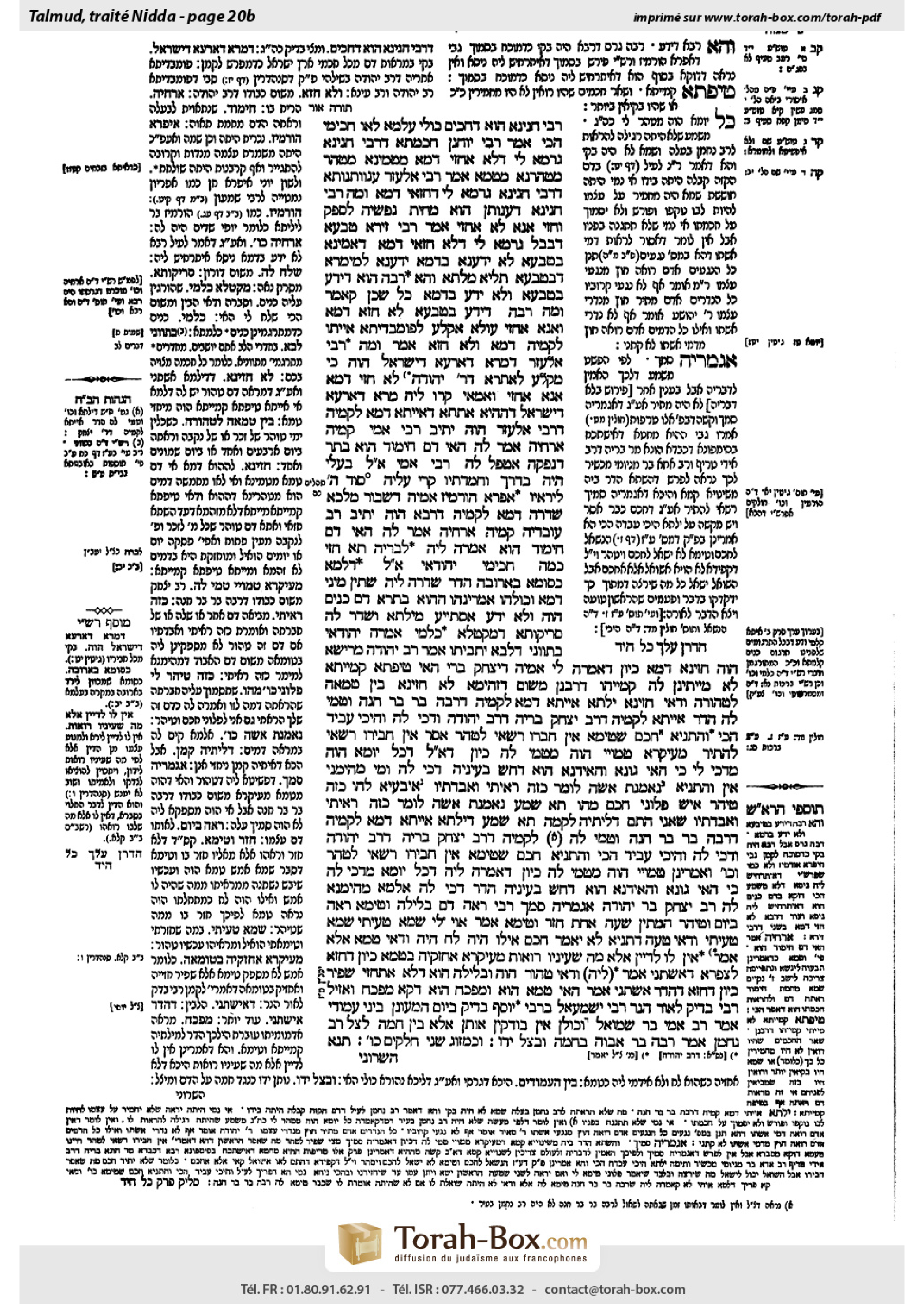
Niddah 20b: Talmud study for Daf Yomi
Daf Yomi is the daily study of one Talmud folio. Explore 37 tractates with scans, Hebrew text, Sefaria English and AI-generated French translations where annotated.
Passage selection and English or AI-generated French translation are available where the scan has annotations. Daf Study is independent of Torah-Box and Sefaria.
Browse Niddah · נידה · All tractatesNiddah 20b text and translations
This page of Niddah includes the Aramaic text, an English translation and an AI-generated French translation, alongside the scan above.
נידה כ׳ ב · Aramaic and Hebrew text
רַבִּי חֲנִינָא הוּא דְּחַכִּים, כּוּלֵּי עָלְמָא לָאו חַכִּימִי הָכִי.
אָמַר רַבִּי יוֹחָנָן: חֻכְמְתָא דְּרַבִּי חֲנִינָא גְּרַמָא לִי דְּלָא אֶחְזֵי דְּמָא, מְטַמֵּינָא — מְטַהַר, מְטַהַרְנָא — מְטַמֵּא. אָמַר רַבִּי אֶלְעָזָר: עִנְוְותָנוּתָא דְּרַבִּי חֲנִינָא גְּרַמָא לִי דַּחֲזַאי דְּמָא, וּמָה רַבִּי חֲנִינָא דְּעִנְוְתָן הוּא — מַחֵית נַפְשֵׁיהּ לְסָפֵק וְחָזֵי, אֲנָא לָא אֶחְזֵי?
אָמַר רַבִּי זֵירָא: טִבְעָא דְּבָבֶל גְּרַמָא לִי דְּלָא חֲזַאי דְּמָא, דְּאָמֵינָא: בְּטִבְעָא לָא יָדַעְנָא, בִּדְמָא יָדַעְנָא?!
לְמֵימְרָא דִּבְטִבְעָא תַּלְיָא מִלְּתָא? וְהָא רַבָּה הוּא דְּיָדַע בְּטִבְעָא, וְלָא יָדַע בִּדְמָא! כׇּל שֶׁכֵּן קָאָמַר: וּמָה רַבָּה דְּיָדַע בְּטִבְעָא — לָא חֲזָא דְּמָא, וַאֲנָא אֶחְזֵי?!
עוּלָּא אִקְּלַע לְפוּמְבְּדִיתָא, אַיְיתוֹ לְקַמֵּיהּ דְּמָא וְלָא חֲזָא. אֲמַר: וּמָה רַבִּי אֶלְעָזָר דְּמָרָא דְּאַרְעָא דְּיִשְׂרָאֵל הֲוָה, כִּי מִקְּלַע לְאַתְרָא דְּרַבִּי יְהוּדָה — לָא חָזֵי דְּמָא, אֲנָא אֶחְזֵי?!
וְאַמַּאי קָרוּ לֵיהּ ״מָרָא דְּאַרְעָא דְּיִשְׂרָאֵל״? דְּהַהִיא אִתְּתָא (דאייתא) [דְּאַיְיתַאי] דְּמָא לְקַמֵּיהּ דְּרַבִּי אֶלְעָזָר, הֲוָה יָתֵיב רַבִּי אַמֵּי קַמֵּיהּ. אַרְחֵיהּ, אֲמַר לַהּ: הַאי דַּם חִימּוּד הוּא. בָּתַר דְּנָפְקָה, אִטְּפַל לַהּ רַבִּי אַמֵּי. אֲמַרָה לֵיהּ: בַּעֲלִי הָיָה בַּדֶּרֶךְ וַחֲמַדְתִּיו. קָרֵי עֲלֵיהּ: ״סוֹד ה׳ לִירֵאָיו״.
אִפְרָא הוֹרְמִיז, אִמֵּיהּ דְּשַׁבּוּר מַלְכָּא, שַׁדַּרָה דְּמָא לְקַמֵּיהּ דְּרָבָא. הֲוָה יָתֵיב רַב עוֹבַדְיָה קַמֵּיהּ, אַרְחֵיהּ. אֲמַר לַהּ: הַאי דַּם חִימּוּד הוּא. אֲמַרָה לֵיהּ לִבְרֵיהּ: תָּא חֲזִי כַּמָּה חַכִּימֵי יְהוּדָאֵי! אֲמַר לַהּ: דִּלְמָא כְּסוֹמֵא בָּאֲרוּבָּה.
הֲדַר שַׁדַּרָה לֵיהּ שִׁתִּין מִינֵי דְּמָא, וְכוּלְּהוּ אַמְרִינְהוּ. הַהוּא בָּתְרָא דָּם כִּנִּים הֲוָה, וְלָא יְדַע. אִסְתַּיַּיע מִילְּתָא, וְשַׁדַּר לַהּ סְרִיקוּתָא דִּמְקַטְּלָא כַּלְמֵי. אֲמַרָה: יְהוּדָאֵי, בִּתְוָונֵי דְּלִבָּא יָתְבִיתוּ!
אָמַר רַב יְהוּדָה: מֵרֵישָׁא הֲוָה חָזֵינָא דְּמָא, כֵּיוָן דְּאָמְרָה לִי אִמֵּיהּ דְּיִצְחָק בְּרִי, הַאי טִיפְּתָא קַמַּיְיתָא לָא מַיְיתִינַן לַהּ קַמַּיְיהוּ דְּרַבָּנַן מִשּׁוּם דִּזְהִימָא — לָא חָזֵינָא.
בֵּין טְמֵאָה לִטְהוֹרָה — וַדַּאי חָזֵינָא.
יַלְתָּא (אייתא) [אַיְיתַאי] דְּמָא לְקַמֵּיהּ דְּרַבָּה בַּר בַּר חַנָּה, וְטַמִּי לַהּ. הֲדַר (אייתא) [אַיְיתַאי] לְקַמֵּיהּ דְּרַב יִצְחָק בְּרֵיהּ דְּרַב יְהוּדָה, וְדַכִּי לַהּ.
וְהֵיכִי עָבֵיד הָכִי? וְהָתַנְיָא: חָכָם שֶׁטִּימֵּא — אֵין חֲבֵרוֹ רַשַּׁאי לְטַהֵר, אָסַר — אֵין חֲבֵירוֹ רַשַּׁאי לְהַתִּיר!
מֵעִיקָּרָא טַמּוֹיֵי הֲוָה מְטַמֵּי לַהּ, כֵּיוָן דַּאֲמַרָה לֵיהּ דְּכֹל יוֹמָא הֲוָה מְדַכֵּי לִי כִּי הַאי גַוְנָא, וְהָאִידָּנָא הוּא דְּחַשׁ בְּעֵינֵיהּ — דַּכִּי לַהּ.
וּמִי מְהֵימְנָא? אִין, וְהָתַנְיָא: נֶאֱמֶנֶת אִשָּׁה לוֹמַר ״כָּזֶה רָאִיתִי וְאִבַּדְתִּיו״.
אִיבַּעְיָא לְהוּ: ״כָּזֶה טִיהֵר אִישׁ פְּלוֹנִי חָכָם״, מַהוּ?
תָּא שְׁמַע: נֶאֱמֶנֶת אִשָּׁה לוֹמַר ״כָּזֶה רָאִיתִי וְאִבַּדְתִּיו״, שָׁאנֵי הָתָם, דְּלֵיתֵיהּ לְקַמֵּהּ.
תָּא שְׁמַע: דְּיַלְתָּא (אייתא) [אַיְיתַאי] דְּמָא לְקַמֵּיהּ דְּרַבָּה בַּר בַּר חַנָּה — וְטַמִּי לַהּ. לְקַמֵּיהּ דְּרַב יִצְחָק בְּרֵיהּ דְּרַב יְהוּדָה — וְדַכִּי לַהּ. וְהֵיכִי עָבֵיד הָכִי? וְהָתַנְיָא: ״חָכָם שֶׁטִּימֵּא אֵין חֲבֵירוֹ רַשַּׁאי לְטַהֵר״ וְכוּ׳,
וְאָמְרִינַן: טַמּוֹיֵי הֲוָה מְטַמֵּי לַהּ, כֵּיוָן דַּאֲמַרָה לֵיהּ דְּכֹל יוֹמָא מְדַכֵּי לַהּ כִּי הַאי גַוְנָא, וְהָאִידָּנָא הוּא דְּחַשׁ בְּעֵינֵיהּ — הֲדַר דַּכִּי לַהּ, אַלְמָא מְהֵימְנָא לֵהּ!
רַב יִצְחָק בַּר יְהוּדָה אַגְּמָרֵיהּ סְמַךְ.
רַבִּי רָאָה דָּם בַּלַּיְלָה וְטִימֵּא, רָאָה בַּיּוֹם וְטִיהֵר, הִמְתִּין שָׁעָה אַחַת חָזַר וְטִימֵּא, אָמַר: אוֹי לִי שֶׁמָּא טָעִיתִי!
שֶׁמָּא טָעִיתִי? וַדַּאי טָעָה! דְּתַנְיָא: לֹא יֹאמַר חָכָם ״אִילּוּ הָיָה לַח — הָיָה וַדַּאי טָמֵא״.
אֶלָּא (אמר): אֵין לוֹ לַדַּיָּין אֶלָּא מַה שֶּׁעֵינָיו רוֹאוֹת. מֵעִיקָּרָא אַחְזְקֵיהּ בְּטָמֵא, כֵּיוָן דַּחֲזָא לְצַפְרָא דְּאִשְׁתַּנִּי אֲמַר (ליה): וַדַּאי טָהוֹר הֲוָה, וּבַלַּיְלָה הוּא דְּלָא אִתְחֲזִי שַׁפִּיר. כֵּיוָן דַּחֲזָא דַּהֲדַר אִשְׁתַּנִּי אָמַר: הַאי טָמֵא הוּא, וּמִפְכָּח הוּא דְּקָא (מפכח) [פָכַח] וְאָזֵיל.
רַבִּי בָּדֵיק לְאוֹר הַנֵּר. רַבִּי יִשְׁמָעֵאל בְּרַבִּי יוֹסֵף בָּדֵיק בְּיוֹם הַמְעוּנָּן בֵּינֵי עַמּוּדֵי. אָמַר רַב אַמֵּי בַּר שְׁמוּאֵל: וְכוּלָּן אֵין בּוֹדְקִין אוֹתָן אֶלָּא בֵּין חַמָּה לְצֵל. רַב נַחְמָן אָמַר רַבָּה בַּר אֲבוּהּ: בְּחַמָּה וּבְצֵל יָדוֹ.
וְכַמָּזוּג שְׁנֵי חֲלָקִים כּוּ׳. תָּנָא:
Niddah 20b · English translation
Rabbi Yishmael, son of Rabbi Yosei, explained: It is only Rabbi Ḥanina who is permitted to examine the blood in this fashion, as he is wise, but everyone else is not so wise that they can successfully perform the examination without water.
Rabbi Yoḥanan says: Rabbi Ḥanina’s wisdom causes me not to see blood for a halakhic examination. When I would examine blood and deem it impure, he would deem it pure, and when I would deem it pure, he would deem it impure. Conversely, Rabbi Elazar says: Rabbi Ḥanina’s humility causes me to see blood, as I reason to myself: If Rabbi Ḥanina, who is humble, places himself into a situation of uncertainty and sees various types of blood to determine their status, should I, who am not nearly as humble, not see blood for an examination?
Rabbi Zeira says: The complex nature of the residents of Babylonia causes me not to see blood for a halakhic examination, as I say to myself: Even matters involving the complex nature of people I do not know; can I then claim that I know about matters of blood?
The Gemara asks: Is this to say that the matter of the appearance of blood is dependent on the nature of people, i.e., that it changes in accordance with their nature? But Rabba is an example of someone who knew about the complex nature of the people of Babylonia, and yet he did not know how to distinguish between different types of blood. The Gemara answers: Rabbi Zeira took this factor into account and said to himself: All the more so; if Rabba, who knew about the complex nature of these people, nevertheless would not see blood, should I, who am unknowledgeable about the nature of these people, see blood for examination?
The Gemara relates that Ulla happened to come to Pumbedita, where they brought blood before him for an examination, but he would not see it, as he said: If Rabbi Elazar, who was the master of Eretz Yisrael in wisdom, when he would happen to come to the locale of Rabbi Yehuda, he would not see blood, shall I see blood here?
The Gemara asks: And why would they call Rabbi Elazar the master of Eretz Yisrael in wisdom? The Gemara explains that there was an incident involving a certain woman who brought blood before Rabbi Elazar for examination, and Rabbi Ami was sitting before him. Rabbi Ami observed that Rabbi Elazar smelled the blood and said to the woman: This is blood of desire, i.e., your desire for your husband caused you to emit this blood, and it is not the blood of menstruation. After the woman left Rabbi Elazar’s presence, Rabbi Ami caught up with her and inquired into the circumstances of her case. She said to him: My husband was absent on a journey, and I desired him. Rabbi Ami read the following verse about Rabbi Elazar: “The counsel of the Lord is with those who fear Him; and His covenant, to make them know it” (Psalms 25:14), i.e., God reveals secret matters to those who fear Him.
The Gemara further relates that Ifera Hurmiz, the mother of King Shapur, sent blood before Rava for examination, as she sought to convert and was practicing the halakhot of menstruation. At that time Rav Ovadya was sitting before Rava. Rav Ovadya observed that Rava smelled the blood and later said to the woman: This is blood of desire. She said to her son: Come and see how wise the Jews are, as Rava is correct. Her son said to her: Perhaps Rava was like a blind man who escapes from a chimney, i.e., it was a lucky guess.
Ifera Hurmiz then sent Rava sixty different types of blood, some impure and others pure, and with regard to all of them Rava accurately told her their origin. The Gemara adds: That last sample of blood sent by Ifera Hurmiz was blood of lice, and Rava did not know what it was. He received support in this matter in the form of heavenly guidance, as he unwittingly sent her as a gift a comb for killing lice. She said in exclamation: Jews, you must dwell in the chamber of people’s hearts.
§ The Gemara cites more statements of the Sages with regard to the examination of blood. Rav Yehuda says: At first I would see blood, i.e., perform examinations of blood, but I changed my conduct when the mother of my son Yitzḥak, i.e., my wife, said to me that she acts as follows: With regard to this first drop of blood that I see, I do not bring it before the Sages, because it is not pristine blood, i.e., other substances are mixed with it. After hearing this, I decided I would no longer see blood, as it is possible that the first drop, which I do not get to see, was impure.
Rav Yehuda continues: But with regard to the examination of blood that a woman who gave birth emitted after the completion of her days of purity, i.e., at least forty days after giving birth to a male, or eighty after giving birth to a female (see Leviticus, chapter 12), in order to determine whether she is ritually impure or pure, I certainly see this blood and determine her status based on its color. This blood is clean, as the woman has been bleeding for a long period of time.
§ The Gemara relates that Yalta, Rav Naḥman’s wife, brought blood before Rabba bar bar Ḥana, and he deemed her ritually impure. She then brought it before Rav Yitzḥak, son of Rav Yehuda, and he deemed her pure.
The Gemara asks: But how could Rav Yitzḥak, son of Rav Yehuda, act in this manner? But isn’t it taught in a baraita: In the case of a halakhic authority who deemed an item impure, another halakhic authority is not allowed to deem it pure; if one halakhic authority deemed a matter prohibited, another halakhic authority is not allowed to deem it permitted?
The Gemara explains that initially Rav Yitzḥak, son of Rav Yehuda, deemed her impure, but he changed his mind when Yalta said to him: Every day that I bring blood of this kind of color to Rabba bar bar Ḥana he deems me pure, and specifically now he issued a different ruling, as he feels pain in his eye. Upon hearing this, Rav Yitzḥak, son of Rav Yehuda, deemed her pure.
The Gemara asks: But are people deemed credible to present claims such as the one presented by Yalta? The Gemara answers: Yes; and likewise it is taught in a baraita: A woman is deemed credible if she says: I saw blood like this color, but I lost it before it could be examined.
A dilemma was raised before the Sages: If a woman states to her friend who showed her blood: My blood, which has an appearance like this, so-and-so, the halakhic authority, deemed it pure, what is the halakha? Is she deemed credible concerning its status?
The Gemara suggests: Come and hear a resolution to this dilemma from the baraita cited above: A woman is deemed credible if she says: I saw blood like this color, but I lost it. This demonstrates that a woman may issue claims of this kind. The Gemara rejects this proof: There it is different, as in that case the blood is not before her, and therefore the Sages were lenient. But here, the woman’s friend can take her blood to a halakhic authority for examination.
The Gemara further suggests: Come and hear the incident cited above, as Yalta brought blood before Rabba bar bar Ḥana, and he deemed her ritually impure; she then brought it before Rav Yitzḥak, son of Rav Yehuda, and he deemed her pure. And the Gemara asked: How could Rav Yitzḥak, son of Rav Yehuda, act in this manner? But isn’t it taught in a baraita: In the case of a halakhic authority who deemed an item impure, another halakhic authority is not allowed to deem it pure?
And we say in response that initially Rav Yitzḥak, son of Rav Yehuda, deemed her impure, but he changed his mind when she said to him that every day that she brings blood of this kind of color to Rabba bar bar Ḥana he deems her pure, and specifically now he issued a different ruling, as he feels pain in his eye. The Gemara summarizes: The conclusion of the story was that upon hearing this, Rav Yitzḥak, son of Rav Yehuda, then deemed her pure. Evidently, when a woman issues claims with regard to blood that is presented, we deem her claims credible.
The Gemara answers: That incident does not provide proof, as Rav Yitzḥak, son of Rav Yehuda, relied on his studies in his lenient ruling. At first, he was reluctant to issue his ruling, in deference to Rabba bar bar Ḥana, who had said the blood was impure. But when he heard Yalta’s explanation he deemed the blood pure, as he had originally thought. Therefore, there is no proof from there that a woman’s statements of this kind are accepted.
§ The Gemara further relates: Rabbi Yehuda HaNasi once saw a woman’s blood at night and deemed it impure. He again saw that blood in the day, after it had dried, and deemed it pure. He waited one hour and then deemed it impure again. It is assumed that Rabbi Yehuda HaNasi did not conduct another examination at this point; rather, he reasoned that the previous night’s examination had been correct, and the blood’s color should be deemed impure because of how it had looked when it was moist. Rabbi Yehuda HaNasi then said: Woe is me! Perhaps I erred by declaring the blood impure, as based on its color it should be pure.
The Gemara questions this statement: Perhaps I erred? He certainly erred, as it is taught in a baraita that a halakhic authority may not say: If the blood were moist it would certainly have been impure, and yet here, Rabbi Yehuda HaNasi deemed the blood impure based on that type of reasoning.
The Gemara explains that the incident did not unfold as initially assumed. Rather, Rabbi Yehuda HaNasi examined the blood three times, as he said: A judge has only what his eyes see as the basis for his ruling. Initially, Rabbi Yehuda HaNasi established the presumptive status of the blood as ritually impure, but when he saw in the morning that its color had changed, he said: It was definitely pure last night as well, and only because it was at night I thought that it was impure, because it could not be seen well. Subsequently, when he saw after a short while that its color again changed, Rabbi Yehuda HaNasi said: This blood is impure, and it is gradually becoming lighter as its color fades.
With regard to the manner in which the Sages would examine blood, the Gemara relates that Rabbi Yehuda HaNasi would examine blood by candlelight. Rabbi Yishmael, son of Rabbi Yosef, would examine blood between the pillars of the study hall even on a cloudy day, despite the fact that it was not very light there. Rav Ami bar Shmuel says: And in all these cases, one examines blood only between sunlight and shade. Rav Naḥman says that Rabba bar Avuh says: One stands in a place lit by the sun, and he conducts the examination under the shadow of his hand, i.e., he places his hand over the blood. In this manner the color of the blood can be best discerned.
§ The mishna states: And what is the color that is like diluted wine that is impure? It is specifically when the dilution consists of two parts water and one part wine, and specifically when it is from the wine of the Sharon region in Eretz Yisrael. The Sages taught in a baraita:
Niddah 20b · Traduction française (IA)
Rabbi Yishmael, fils de Rabbi Yosei, expliqua : Seul Rabbi Ḥanina est autorisé à examiner le sang de cette manière, car il est sage ; les autres ne le sont pas assez pour réussir cet examen sans eau.
Rabbi Yoḥanan dit : La sagesse de Rabbi Ḥanina fait que je n’examine pas le sang en vue d’une décision halakhique. Lorsque j’examinais du sang et le déclarais impur, lui le déclarait pur ; et lorsque je le déclarais pur, lui le déclarait impur. À l’inverse, Rabbi Elazar dit : L’humilité de Rabbi Ḥanina fait que j’examine le sang, car je me dis : Si Rabbi Ḥanina, qui est humble, se place dans une situation d’incertitude et examine différentes sortes de sang pour en déterminer le statut, moi qui suis loin d’être aussi humble, ne devrais-je pas examiner le sang ?
Rabbi Zeira dit : La complexité du caractère des habitants de Babylonie fait que je n’examine pas le sang en vue d’une décision halakhique, car je me dis : Je ne comprends même pas les questions liées à la complexité du caractère des gens ; puis-je alors prétendre connaître les questions relatives au sang ?
La Guemara demande : Cela signifie-t-il que l’apparence du sang dépend de la nature des gens, c’est-à-dire qu’elle varie selon leur nature ? Pourtant, Rabba est un exemple d’homme qui connaissait la complexité du caractère des habitants de Babylonie, mais qui ne savait pas distinguer les différentes sortes de sang. La Guemara répond : Rabbi Zeira prit ce facteur en considération et se dit : À plus forte raison ! Si Rabba, qui connaissait la complexité du caractère de ces gens, n’examinait pourtant pas le sang, moi qui ne connais pas leur nature, devrais-je l’examiner ?
La Guemara rapporte qu’Ulla arriva par hasard à Pumbedita. On lui apporta du sang pour qu’il l’examine, mais il refusa de le voir. Il dit : Si Rabbi Elazar, qui était le maître de la Terre d’Israël en matière de sagesse, n’examinait pas le sang lorsqu’il arrivait par hasard dans la localité de Rabbi Yehuda, devrais-je, moi, examiner le sang ici ?
La Guemara demande : Pourquoi appelait-on Rabbi Elazar le maître de la Terre d’Israël en matière de sagesse ? La Guemara explique qu’un jour, une femme apporta du sang à Rabbi Elazar pour qu’il l’examine, tandis que Rabbi Ami était assis devant lui. Rabbi Ami vit Rabbi Elazar sentir le sang, puis dire à la femme : « C’est du sang de désir, c’est-à-dire que votre désir pour votre mari vous a fait émettre ce sang ; ce n’est pas du sang menstruel. » Après que la femme eut quitté Rabbi Elazar, Rabbi Ami la rattrapa et l’interrogea sur les circonstances de son cas. Elle lui dit : « Mon mari était parti en voyage et je le désirais. » Rabbi Ami cita alors à propos de Rabbi Elazar le verset suivant : « Le conseil de l’Éternel est pour ceux qui le craignent, et son alliance leur fait connaître cela » (Psaumes 25,14), c’est-à-dire que Dieu révèle des secrets à ceux qui le craignent.
La Guemara rapporte encore qu’Ifera Hurmiz, la mère du roi Shapur, envoya du sang à Rava pour qu’il l’examine, car elle souhaitait se convertir et mettait en pratique les halakhot relatives aux menstruations. À ce moment-là, Rav Ovadya était assis devant Rava. Rav Ovadya vit Rava sentir le sang, puis dire à la femme : « C’est du sang de désir. » Elle dit à son fils : « Viens voir comme les Juifs sont sages : Rava a raison. » Son fils lui répondit : « Peut-être Rava a-t-il fait comme un aveugle qui sort d’une cheminée », c’est-à-dire qu’il a deviné par chance.
Ifera Hurmiz envoya alors à Rava soixante sortes différentes de sang, certaines impures et d’autres pures, et Rava lui indiqua correctement l’origine de chacune. La Guemara ajoute que le dernier échantillon envoyé par Ifera Hurmiz était du sang de poux, et que Rava ne sut pas ce que c’était. Il reçut à ce sujet une aide providentielle : sans le savoir, il lui envoya en cadeau un peigne à poux. Elle s’exclama : « Juifs, vous devez habiter dans le cœur des gens ! »
§ La Guemara cite d’autres déclarations des Sages au sujet de l’examen du sang. Rav Yehuda dit : « Au début, j’examinais le sang, mais j’ai changé de conduite lorsque la mère de mon fils Yitzḥak, c’est-à-dire mon épouse, m’a dit qu’elle agissait ainsi : Pour cette première goutte de sang que je vois, je ne l’apporte pas aux Sages, car ce n’est pas du sang pur, c’est-à-dire que d’autres substances y sont mêlées. » Après l’avoir entendue, j’ai décidé de ne plus examiner le sang, car il est possible que la première goutte, que je ne vois pas, ait été impure.
Rav Yehuda poursuit : « Toutefois, j’examine certainement le sang émis par une femme qui a accouché après la fin de ses jours de pureté, c’est-à-dire au moins quarante jours après avoir donné naissance à un garçon, ou quatre-vingts jours après avoir donné naissance à une fille (voir Lévitique, chapitre 12), afin de déterminer si elle est rituellement impure ou pure. Je détermine son statut d’après la couleur de ce sang. Ce sang est pur, car la femme saigne depuis longtemps. »
§ La Guemara rapporte que Yalta, l’épouse de Rav Naḥman, apporta du sang à Rabba bar bar Ḥana, qui la déclara rituellement impure. Elle l’apporta ensuite à Rav Yitzḥak, fils de Rav Yehuda, qui la déclara pure.
La Guemara demande : Mais comment Rav Yitzḥak, fils de Rav Yehuda, pouvait-il agir ainsi ? N’est-il pas enseigné dans une baraïta : lorsqu’une autorité halakhique a déclaré une chose impure, une autre autorité halakhique n’a pas le droit de la déclarer pure ; lorsqu’une autorité halakhique a déclaré une question interdite, une autre autorité halakhique n’a pas le droit de la déclarer permise ?
La Guemara explique qu’au départ, Rav Yitzḥak, fils de Rav Yehuda, la déclara impure, mais qu’il changea d’avis lorsque Yalta lui dit : « Chaque fois que j’apporte à Rabba bar bar Ḥana du sang de cette couleur, il me déclare pure ; c’est seulement maintenant qu’il a rendu une décision différente, parce qu’il a mal à l’œil. » Après avoir entendu cela, Rav Yitzḥak, fils de Rav Yehuda, la déclara pure.
La Guemara demande : Mais les femmes sont-elles considérées comme crédibles lorsqu’elles présentent des affirmations comme celle de Yalta ? La Guemara répond : Oui. De même, il est enseigné dans une baraïta : une femme est considérée comme crédible si elle dit : « J’ai vu du sang de cette couleur, mais je l’ai perdu avant qu’il puisse être examiné. »
Une question fut posée aux Sages : Si une femme dit à son amie qui lui a montré son sang : « Mon sang, qui a cette apparence, a été déclaré pur par tel ou tel sage », quelle est la halakha ? Est-elle considérée comme crédible quant au statut de ce sang ?
La Guemara propose : Écoute une réponse à cette question, tirée de la baraïta citée plus haut : une femme est considérée comme crédible si elle dit : « J’ai vu du sang de cette couleur, mais je l’ai perdu. » Cela montre qu’une femme peut faire ce genre d’affirmation. La Guemara rejette cette preuve : là, c’est différent, car le sang n’est pas devant elle, et les Sages se sont donc montrés indulgents. Mais ici, l’amie de la femme peut apporter son sang à une autorité halakhique pour qu’elle l’examine.
La Guemara propose encore : Écoute l’incident cité plus haut : Yalta apporta du sang à Rabba bar bar Ḥana, qui la déclara rituellement impure ; elle l’apporta ensuite à Rav Yitzḥak, fils de Rav Yehuda, qui la déclara pure. La Guemara demanda alors : Comment Rav Yitzḥak, fils de Rav Yehuda, pouvait-il agir ainsi ? N’est-il pas enseigné dans une baraïta : lorsqu’une autorité halakhique a déclaré une chose impure, une autre autorité halakhique n’a pas le droit de la déclarer pure ?
Nous répondons qu’au départ, Rav Yitzḥak, fils de Rav Yehuda, la déclara impure, mais qu’il changea d’avis lorsqu’elle lui dit que chaque fois qu’elle apporte à Rabba bar bar Ḥana du sang de cette couleur, il la déclare pure, et que c’est seulement maintenant qu’il a rendu une décision différente, parce qu’il a mal à l’œil. La Guemara résume : à la fin de l’incident, après avoir entendu cela, Rav Yitzḥak, fils de Rav Yehuda, la déclara pure. Il apparaît donc que lorsqu’une femme présente des affirmations au sujet d’un sang qui est devant elle, nous la considérons comme crédible.
La Guemara répond : Cet incident n’apporte pas de preuve, car Rav Yitzḥak, fils de Rav Yehuda, s’est appuyé sur ses études pour rendre une décision indulgente. Au début, il hésitait à rendre sa décision par égard pour Rabba bar bar Ḥana, qui avait déclaré le sang impur. Mais lorsqu’il entendit l’explication de Yalta, il déclara le sang pur, comme il l’avait pensé au départ. Cet incident ne prouve donc pas que les déclarations de ce genre faites par une femme soient acceptées.
§ La Guemara rapporte encore : Rabbi Yehuda HaNasi vit une fois le sang d’une femme la nuit et le déclara impur. Il revit ce sang pendant la journée, après qu’il eut séché, et le déclara pur. Il attendit une heure, puis le déclara de nouveau impur. On suppose que Rabbi Yehuda HaNasi ne procéda pas à un nouvel examen à ce moment-là ; il estima plutôt que l’examen de la veille au soir était correct et que le sang devait être déclaré impur en raison de son apparence lorsqu’il était humide. Rabbi Yehuda HaNasi dit alors : « Malheur à moi ! Peut-être ai-je commis une erreur en déclarant le sang impur, car, d’après sa couleur, il aurait dû être pur. »
La Guemara met cette déclaration en question : « Peut-être ai-je commis une erreur » ? Il a certainement commis une erreur, car il est enseigné dans une baraïta qu’une autorité halakhique ne peut pas dire : « Si le sang avait été humide, il aurait certainement été impur. » Or Rabbi Yehuda HaNasi a déclaré le sang impur en se fondant sur ce raisonnement.
La Guemara explique que l’incident ne s’est pas déroulé comme on l’avait d’abord supposé. En réalité, Rabbi Yehuda HaNasi examina le sang trois fois, car il dit : « Un juge ne peut fonder sa décision que sur ce que ses yeux voient. » Au début, Rabbi Yehuda HaNasi établit que le sang était présumé rituellement impur ; mais lorsqu’il vit le matin que sa couleur avait changé, il dit : « Il était certainement pur la veille au soir aussi ; c’est seulement parce qu’il faisait nuit que je l’ai cru impur, car on ne pouvait pas bien le voir. » Puis, lorsqu’il vit peu après que sa couleur avait de nouveau changé, Rabbi Yehuda HaNasi dit : « Ce sang est impur, et il s’éclaircit progressivement à mesure que sa couleur pâlit. »
À propos de la manière dont les Sages examinaient le sang, la Guemara rapporte que Rabbi Yehuda HaNasi l’examinait à la lumière d’une bougie. Rabbi Yishmael, fils de Rabbi Yosef, examinait le sang entre les piliers de la salle d’étude, même par temps nuageux, malgré le peu de lumière qui y pénétrait. Rav Ami bar Shmuel dit : « Dans tous ces cas, on n’examine le sang qu’à la limite entre le soleil et l’ombre. » Rav Naḥman dit au nom de Rabba bar Avuh : « On se tient dans un endroit ensoleillé et on procède à l’examen à l’ombre de sa main », c’est-à-dire qu’on place sa main au-dessus du sang. De cette manière, on peut le mieux discerner sa couleur.
§ La Michna énonce : « Et quelle est la couleur semblable à du vin dilué qui est impure ? » C’est précisément lorsque le mélange contient deux parts d’eau et une part de vin, et précisément lorsqu’il s’agit de vin de la région du Sharon, en Terre d’Israël. Les Sages ont enseigné dans une baraïta :
Traduction française générée par IA à partir de l’édition anglaise de Sefaria. Vérifie toujours un passage avec le texte source.
Text from Sefaria: William Davidson Edition - Vocalized Aramaic (CC BY NC); William Davidson Edition - English (CC BY NC).