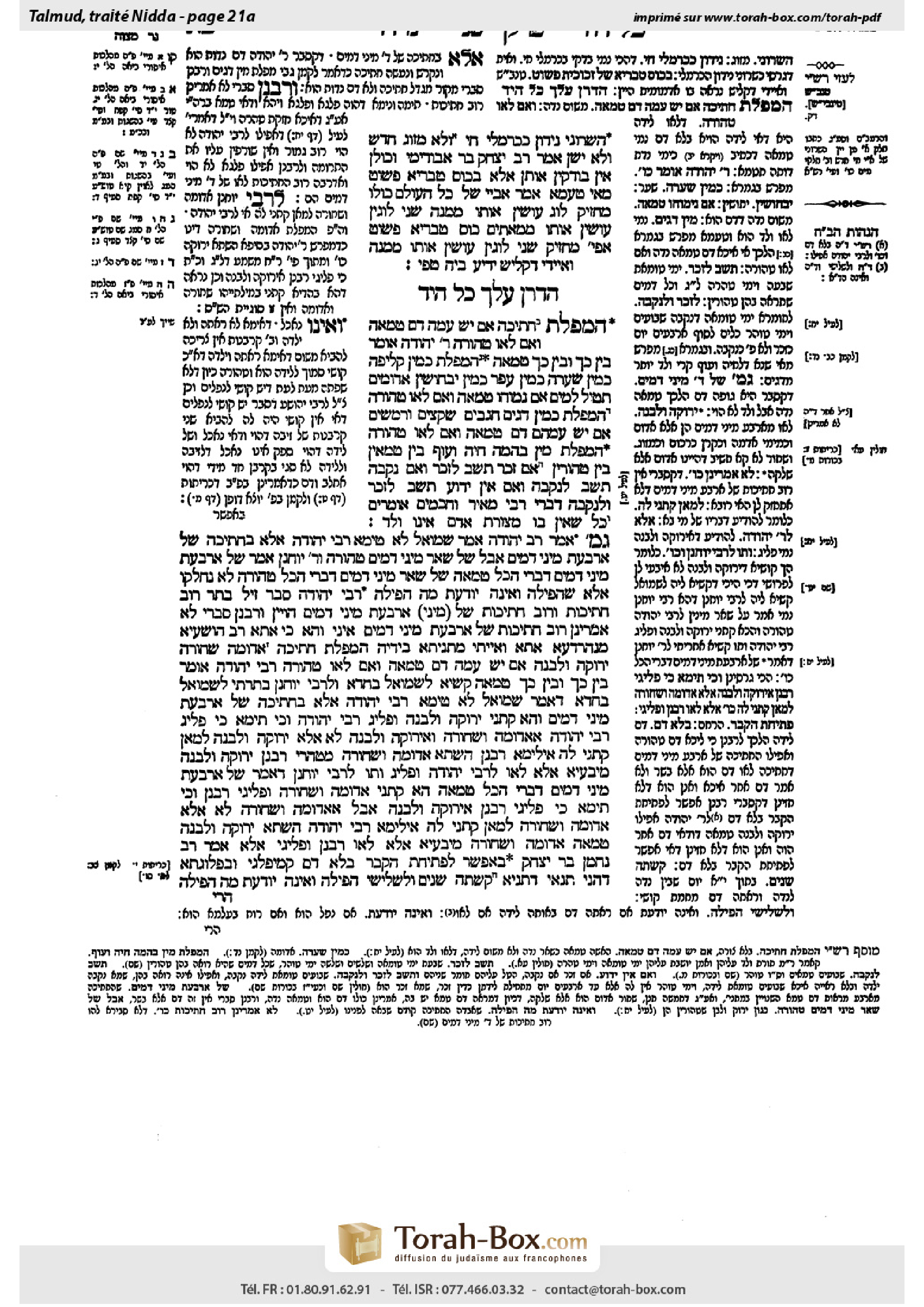
Niddah 21a: Talmud study for Daf Yomi
Daf Yomi is the daily study of one Talmud folio. Explore 37 tractates with scans, Hebrew text, Sefaria English and AI-generated French translations where annotated.
Passage selection and English or AI-generated French translation are available where the scan has annotations. Daf Study is independent of Torah-Box and Sefaria.
Browse Niddah · נידה · All tractatesNiddah 21a text and translations
This page of Niddah includes the Aramaic text, an English translation and an AI-generated French translation, alongside the scan above.
נידה כ״א א · Aramaic and Hebrew text
הַשָּׁרוֹנִי נִידּוֹן כַּכַּרְמְלִי, חַי וְלֹא מָזוּג, חָדָשׁ וְלֹא יָשָׁן.
אָמַר רַב יִצְחָק בַּר אֲבוּדִימִי: וְכוּלָּן, אֵין בּוֹדְקִין אוֹתָן אֶלָּא בְּכוֹס טְבֶרְיָא פָּשׁוּט. מַאי טַעְמָא? אָמַר אַבָּיֵי: שֶׁל כׇּל הָעוֹלָם כּוּלּוֹ מַחְזִיק לוֹג — עוֹשִׂין אוֹתוֹ מִמָּנֶה, שְׁנֵי לוּגִּין — עוֹשִׂין אוֹתוֹ מִמָּאתַיִם. כּוֹס טְבֶרְיָא פָּשׁוּט, אֲפִילּוּ מַחֲזִיק שְׁנֵי לוּגִּין — עוֹשִׂין אוֹתוֹ מִמָּנֶה, וְאַיְּידֵי דִּקְלִישׁ — יְדִיעַ בֵּיהּ טְפֵי.
הֲדַרַן עֲלָךְ כָּל הַיָּד.
מַתְנִי' הַמַּפֶּלֶת חֲתִיכָה, אִם יֵשׁ עִמָּהּ דָּם — טְמֵאָה, וְאִם לָאו — טְהוֹרָה. רַבִּי יְהוּדָה אוֹמֵר: בֵּין כָּךְ וּבֵין כָּךְ — טְמֵאָה.
הַמַּפֶּלֶת כְּמִין קְלִיפָּה, כְּמִין שַׂעֲרָה, כְּמִין עָפָר, כְּמִין יַבְחוּשִׁין אֲדוּמִּים — תָּטִיל לַמַּיִם: אִם נִמּוֹחוּ — טְמֵאָה, וְאִם לָאו — טְהוֹרָה.
הַמַּפֶּלֶת כְּמִין דָּגִים, חֲגָבִים, שְׁקָצִים וּרְמָשִׂים — אִם יֵשׁ עִמָּהֶם דָּם טְמֵאָה, וְאִם לָאו — טְהוֹרָה.
הַמַּפֶּלֶת מִין בְּהֵמָה, חַיָּה וָעוֹף, בֵּין טְמֵאִין בֵּין טְהוֹרִין — אִם זָכָר — תֵּשֵׁב לְזָכָר, וְאִם נְקֵבָה — תֵּשֵׁב לִנְקֵבָה.
וְאִם אֵין יָדוּעַ — תֵּשֵׁב לְזָכָר וְלַנְּקֵבָה, דִּבְרֵי רַבִּי מֵאִיר, וַחֲכָמִים אוֹמְרִים: כֹּל שֶׁאֵין בּוֹ מִצּוּרַת אָדָם אֵינוֹ וָלָד.
גְּמָ' אָמַר רַב יְהוּדָה, אָמַר שְׁמוּאֵל: לֹא טִימֵּא רַבִּי יְהוּדָה אֶלָּא בַּחֲתִיכָה שֶׁל אַרְבַּעַת מִינֵי דָמִים, אֲבָל שֶׁל שְׁאָר מִינֵי דָמִים — טְהוֹרָה.
וְרַבִּי יוֹחָנָן אָמַר: שֶׁל אַרְבַּעַת מִינֵי דָמִים — דִּבְרֵי הַכֹּל טְמֵאָה, שֶׁל שְׁאָר מִינֵי דָמִים — דִּבְרֵי הַכֹּל טְהוֹרָה.
לֹא נֶחְלְקוּ אֶלָּא שֶׁהִפִּילָה, וְאֵינָהּ יוֹדַעַת מָה הִפִּילָה. רַבִּי יְהוּדָה סָבַר: זִיל בָּתַר רוֹב חֲתִיכוֹת, וְרוֹב חֲתִיכוֹת שֶׁל (מִינֵי) אַרְבַּעַת מִינֵי דָמִים הָוְיָין. וְרַבָּנַן סָבְרִי: לָא אָמְרִינַן רוֹב חֲתִיכוֹת שֶׁל אַרְבַּעַת מִינֵי דָמִים.
אִינִי? וְהָא כִּי אֲתָא רַב הוֹשַׁעְיָא מִנְּהַרְדְּעָא, אֲתָא וְאַיְיתִי מַתְנִיתָא בִּידֵיהּ: הַמַּפֶּלֶת חֲתִיכָה אֲדוּמָּה, שְׁחוֹרָה, יְרוּקָּה, וּלְבָנָה — אִם יֵשׁ עִמָּהּ דָּם טְמֵאָה, וְאִם לָאו — טְהוֹרָה. רַבִּי יְהוּדָה אוֹמֵר: בֵּין כָּךְ וּבֵין כָּךְ טְמֵאָה. קַשְׁיָא לִשְׁמוּאֵל בַּחֲדָא, וּלְרַבִּי יוֹחָנָן בְּתַרְתֵּי.
לִשְׁמוּאֵל בַּחֲדָא, דְּאָמַר שְׁמוּאֵל: לֹא טִימֵּא רַבִּי יְהוּדָה אֶלָּא בַּחֲתִיכָה שֶׁל אַרְבַּעַת מִינֵי דָמִים, וְהָא קָתָנֵי ״יְרוּקָּה וּלְבָנָה״, וּפְלִיג רַבִּי יְהוּדָה!
וְכִי תֵימָא, כִּי פְּלִיג רַבִּי יְהוּדָה אַאֲדוּמָּה וּשְׁחוֹרָה, וְאַיְּרוּקָּה וּלְבָנָה לָא, אֶלָּא יְרוּקָּה וּלְבָנָה לְמַאן קָתָנֵי לַהּ?
אִילֵּימָא רַבָּנַן — הַשְׁתָּא אֲדוּמָּה וּשְׁחוֹרָה מְטַהֲרִי רַבָּנַן, יְרוּקָּה וּלְבָנָה מִיבַּעְיָא? אֶלָּא לָאו לְרַבִּי יְהוּדָה, וּפְלִיג!
וְתוּ, לְרַבִּי יוֹחָנָן דְּאָמַר: שֶׁל אַרְבַּעַת מִינֵי דָמִים — דִּבְרֵי הַכֹּל טְמֵאָה, הָא קָתָנֵי: אֲדוּמָּה וּשְׁחוֹרָה, וּפְלִיגִי רַבָּנַן!
וְכִי תֵּימָא, כִּי פְּלִיגִי רַבָּנַן אַיְּרוּקָּה וּלְבָנָה, אֲבָל אַאֲדוּמָּה וּשְׁחוֹרָה לָא, אֶלָּא אֲדוּמָּה וּשְׁחוֹרָה לְמַאן קָתָנֵי לַהּ?
אִילֵימָא רַבִּי יְהוּדָה — הַשְׁתָּא יְרוּקָּה וּלְבָנָה טְמֵאָה, אֲדוּמָּה וּשְׁחוֹרָה מִיבַּעְיָא? אֶלָּא לָאו רַבָּנַן, וּפְלִיגִי!
אֶלָּא אָמַר רַב נַחְמָן בַּר יִצְחָק: בְּאֶפְשָׁר לִפְתִיחַת הַקֶּבֶר בְּלֹא דָּם קָמִיפַּלְגִי, וּבִפְלוּגְתָּא דְהָנֵי תַנָּאֵי, דְּתַנְיָא: קִשְּׁתָה שְׁנַיִם, וְלַשְּׁלִישִׁי הִפִּילָה, וְאֵינָהּ יוֹדַעַת מָה הִפִּילָה,
Niddah 21a · English translation
For the purposes of the examination of blood, the wine of the Sharon region in Eretz Yisrael has the same status as undiluted Carmelite wine and not diluted Carmelite wine, new Carmelite wine and not old Carmelite wine.
Rav Yitzḥak bar Avudimi says: And in all cases of blood that has the color of diluted wine, one examines blood only with a simple Tiberian cup. The Gemara asks: What is the reason? Abaye says: Containers are designed according to a universal standard, such that a cup that can contain a log of wine, one fashions it from material weighing one hundred dinars, whereas a cup that can contain two log, one fashions it from material weighing two hundred dinars. By contrast, in the case of a simple Tiberian cup, even one that can contain two log, one fashions it from material weighing one hundred dinars. And since the material from which the cup is made is weak, it is more transparent and therefore the redness of the wine inside is more noticeable. Consequently, one must compare the blood to wine in a cup of this kind.
MISHNA: In the case of a woman who discharges an amorphous piece of tissue, if there is blood that emerges with it, the woman is ritually impure with the impurity of a menstruating woman. And if not, she is pure, as she is neither a menstruating woman nor a woman after childbirth. Rabbi Yehuda says: In both this case, where blood emerged, and that case, where no blood emerged, the woman is impure with the impurity of a menstruating woman, as there was certainly undetected blood that emerged with the flesh.
In the case of a woman who discharges an item similar to a shell, or similar to a hair, or similar to soil, or similar to mosquitoes, if such items are red, she should cast them into water to ascertain their nature: If they dissolved, it is blood, and the woman is impure with the impurity of a menstruating woman; and if not, she is pure.
In the case of a woman who discharges an item similar to fish or to grasshoppers, repugnant creatures, or creeping animals, if there is blood that emerges with them, the woman is impure with the impurity of a menstruating woman. And if not, she is pure.
With regard to a woman who discharges tissue in the form of a type of domesticated animal, undomesticated animal, or bird, whether it had the form of a non-kosher species or a kosher species, if it was a male fetus, then she observes the periods of impurity, seven days, and purity, thirty-three days, established in the Torah (see Leviticus 12:2–5) for a woman who gives birth to a male. And if the fetus was a female, the woman observes the periods of impurity, fourteen days, and purity, sixty-six days, established in the Torah for a woman who gives birth to a female.
And if the sex of the fetus is unknown, she observes the strictures that apply to a woman who gave birth both to a male and to a female. Accordingly, she is prohibited from engaging in intercourse for fourteen days, but after that, she will be permitted to engage in intercourse despite a discharge of uterine blood until thirty-three days pass after the seven days she would have been prohibited if the fetus were male. The prohibition to enter the Temple will continue until eighty days have passed from the discharge of the fetus. This is the statement of Rabbi Meir. And the Rabbis say: Any fetus that is not of human form is not regarded as an offspring with regard to observance of these periods, and she is permitted to engage in intercourse provided that she does not experience a discharge of uterine blood.
GEMARA: The mishna teaches that if a woman discharges an amorphous piece of tissue and no blood emerges with it, the Rabbis say that she is pure, whereas Rabbi Yehuda says that she is impure. Rav Yehuda says that Shmuel says: Rabbi Yehuda deemed the woman impure, despite the fact that no blood emerged, only in the case of a piece of tissue that has the appearance of one of the four types of ritually impure blood, as in such a case the piece has the status of blood. But if it has the appearance of other types of blood, the woman is pure.
And Rabbi Yoḥanan says there is a different explanation of the dispute: If a woman discharges a piece of tissue that has the appearance of one of the four types of ritually impure blood, everyone, i.e., Rabbi Yehuda and the Rabbis, agrees that she is impure. Likewise, if it has the appearance of other types of blood, everyone agrees that she is pure.
They disagree only with regard to a case where the woman discharged an amorphous piece of tissue, and she herself does not know exactly what was the appearance of the piece of tissue that she discharged, e.g., if it was lost. Rabbi Yehuda holds: Follow the majority of discharges of amorphous pieces of tissue, and the majority of pieces of tissue are of the appearance of one of the four types of impure blood. And the Rabbis hold: We do not say that the majority of pieces of flesh have the appearance of one of the four types of impure blood.
The Gemara asks: Is that so? But when Rav Hoshaya came from Neharde’a, he came and brought a baraita with him that states: In the case of a woman who discharges a piece of tissue that is red, black, green, or white, if there is blood that emerges with it, the woman is impure, and if not, she is pure. Rabbi Yehuda says: Both in this case, where blood emerged, and in that case, where no blood emerged, the woman is impure. This baraita poses a difficulty to the statement of Shmuel with regard to one aspect of his opinion, and it poses a difficulty to the statement of Rabbi Yoḥanan with regard to two aspects of his opinion.
The Gemara elaborates: It poses a difficulty to the statement of Shmuel with regard to one aspect of his opinion, as Shmuel said that Rabbi Yehuda deemed the woman impure only in the case of a piece of tissue that has the appearance of one of the four types of impure blood, and yet the baraita teaches that according to the Rabbis the woman is pure if the piece of tissue is green or white, which are not among the four colors of ritually impure blood, and that Rabbi Yehuda disagrees with their opinion.
And if you would say that when Rabbi Yehuda disagrees with the Rabbis, it is with regard to the case of a red or black piece of tissue, as these are among the four colors of ritually impure blood, but with regard to the case of a green or white piece he does not disagree with them, i.e., he concedes that the woman is pure, this cannot be correct. The Gemara explains why that explanation of the baraita is not possible: But if so, for the sake of clarifying whose opinion does the baraita teach the case of a green or white piece of tissue?
If we say that it comes to clarify the opinion of the Rabbis, that is unnecessary: Now that in a case of a red or black piece of tissue, which are among the four colors of ritually impure blood, the Rabbis deem the woman pure, is it necessary to state that they deem her pure in a case of a green or white piece? Rather, is it not coming to clarify the opinion of Rabbi Yehuda, teaching that the Rabbis deem the woman pure in this case, but Rabbi Yehuda disagrees with them and deems her impure? This contradicts the explanation of Shmuel.
And furthermore, the baraita poses an additional difficulty to the opinion of Rabbi Yoḥanan, in addition to the first difficulty explained above, as he said that if the piece of tissue has the appearance of one of the four types of ritually impure blood then everyone agrees that the woman is impure, and yet the baraita teaches the case of a red or black piece and states that the Rabbis disagree with Rabbi Yehuda and deem the woman pure.
And if you would say that when the Rabbis disagree with Rabbi Yehuda, it is with regard to the case of a green or white piece of tissue, but in the case of a red or black piece they do not disagree with him, as they concede that the woman is impure; but if that is so, then for the sake of clarifying whose opinion does the baraita teach the case of a red or black piece?
If we say that it comes to clarify the opinion of Rabbi Yehuda, this is unnecessary: Now that Rabbi Yehuda holds that in a case of a green or white piece the woman is impure, despite the fact that they are not among the four colors of ritually impure blood, is it necessary to state that she is impure in a case of a red or black piece? Rather, is it not coming to clarify the opinion of the Rabbis, teaching that Rabbi Yehuda deems the woman impure in this case, but the Rabbis disagree with him and maintain that she is pure?
Rather, Rav Naḥman bar Yitzḥak says there is a different explanation of the dispute between the Rabbis and Rabbi Yehuda: They disagree with regard to whether or not opening of the womb is possible without a discharge of blood. And they disagree with regard to the issue that is the subject of the dispute between these tanna’im, as it is taught in a baraita: If a woman experienced difficulty in labor during which blood emerged on two consecutive days, and on the third day she discharged, but she does not know what she discharged, i.e., whether it was a stillborn human fetus, and whether blood emerged during the miscarriage,
Niddah 21a · Traduction française (IA)
Pour l’examen du sang, le vin de la région du Sharon, en Eretz Israël, a le même statut que le vin carmélite non coupé, et non que le vin carmélite coupé, et que le vin carmélite nouveau, et non que le vin carmélite vieux.
Rav Yitzḥak bar Avudimi dit : Dans tous les cas où le sang a la couleur du vin coupé, on examine le sang uniquement à l’aide d’une coupe ordinaire de Tibériade. La Guemara demande : Quelle en est la raison ? Abaye dit : Les récipients sont fabriqués selon une norme universelle : une coupe pouvant contenir un log de vin est façonnée dans un matériau pesant cent dinars, tandis qu’une coupe pouvant contenir deux log est façonnée dans un matériau pesant deux cents dinars. En revanche, dans le cas d’une coupe ordinaire de Tibériade, même si elle peut contenir deux log, elle est façonnée dans un matériau pesant cent dinars. Comme le matériau dont la coupe est faite est moins épais, il est plus transparent et la rougeur du vin qu’elle contient se remarque donc davantage. Par conséquent, il faut comparer le sang au vin contenu dans une coupe de ce type.
MICHNA : Dans le cas d’une femme qui expulse un morceau de tissu informe, si du sang sort avec lui, elle est impure de l’impureté d’une femme nidda. Sinon, elle est pure, car elle n’est ni nidda ni en période post-partum. Rabbi Yehouda dit : Dans les deux cas, celui où du sang est sorti et celui où aucun sang n’est sorti, la femme est impure de l’impureté d’une femme nidda, car il est certain qu’un sang non décelé est sorti avec la chair.
Dans le cas d’une femme qui expulse un élément ressemblant à une coquille, à un cheveu, à de la terre ou à des moustiques, s’il est rouge, elle doit le jeter dans l’eau afin d’en déterminer la nature : s’il se dissout, c’est du sang et la femme est impure de l’impureté d’une femme nidda ; sinon, elle est pure.
Dans le cas d’une femme qui expulse un élément ressemblant à des poissons, à des sauterelles, à des créatures répugnantes ou à des animaux rampants, si du sang sort avec eux, la femme est impure de l’impureté d’une femme nidda. Sinon, elle est pure.
Dans le cas d’une femme qui expulse un morceau de tissu ayant la forme d’un animal domestique, d’un animal sauvage ou d’un oiseau, qu’il ait la forme d’une espèce non cachère ou d’une espèce cachère, si le fœtus était mâle, elle observe les périodes d’impureté — sept jours — et de pureté — trente-trois jours — fixées par la Torah (voir Lévitique 12, 2-5) pour une femme qui donne naissance à un garçon. Si le fœtus était femelle, la femme observe les périodes d’impureté — quatorze jours — et de pureté — soixante-six jours — fixées par la Torah pour une femme qui donne naissance à une fille.
Si le sexe du fœtus est inconnu, elle observe les rigueurs applicables à une femme ayant donné naissance aussi bien à un garçon qu’à une fille. Elle ne peut donc avoir de relations sexuelles pendant quatorze jours ; ensuite, elle pourra en avoir malgré un écoulement de sang utérin, jusqu’à ce que s’achèvent les trente-trois jours qui suivent les sept jours pendant lesquels elle aurait été interdite si le fœtus avait été mâle. L’interdiction d’entrer dans le Temple se poursuit jusqu’à ce que quatre-vingts jours se soient écoulés depuis l’expulsion du fœtus. Telle est la déclaration de Rabbi Meïr. Les Sages disent : Tout fœtus qui n’a pas une forme humaine n’est pas considéré comme une descendance pour l’observance de ces périodes, et la femme peut avoir des relations sexuelles, à condition de ne pas avoir d’écoulement de sang utérin.
GUEMARA : La Michna enseigne que si une femme expulse un morceau de tissu informe et qu’aucun sang ne sort avec lui, les Sages la déclarent pure, tandis que Rabbi Yehouda la déclare impure. Rav Yehouda dit au nom de Shmuel : Rabbi Yehouda n’a déclaré la femme impure, bien qu’aucun sang ne soit sorti, que dans le cas d’un morceau de tissu ayant l’apparence de l’une des quatre sortes de sang rituellement impur, car, dans ce cas, le morceau a le statut de sang. Mais s’il a l’apparence d’autres sortes de sang, la femme est pure.
Rabbi Yoḥanan donne une autre explication du désaccord : si une femme expulse un morceau de tissu ayant l’apparence de l’une des quatre sortes de sang rituellement impur, tous — c’est-à-dire Rabbi Yehouda et les Sages — conviennent qu’elle est impure. De même, s’il a l’apparence d’autres sortes de sang, tous conviennent qu’elle est pure.
Ils ne sont en désaccord que dans le cas où la femme a expulsé un morceau de tissu informe et ne sait pas exactement quelle apparence avait le morceau expulsé, par exemple parce qu’il a été perdu. Rabbi Yehouda estime qu’il faut suivre la majorité des morceaux de tissu informes expulsés, et que la majorité de ces morceaux ont l’apparence de l’une des quatre sortes de sang impur. Les Sages, eux, estiment qu’on ne peut pas dire que la majorité des morceaux de chair ont l’apparence de l’une des quatre sortes de sang impur.
La Guemara demande : En est-il ainsi ? Pourtant, lorsque Rav Hoshaya vint de Neharde’a, il apporta avec lui une baraïta qui enseigne : Dans le cas d’une femme qui expulse un morceau de tissu rouge, noir, vert ou blanc, si du sang sort avec lui, la femme est impure ; sinon, elle est pure. Rabbi Yehouda dit : Dans les deux cas, celui où du sang est sorti et celui où aucun sang n’est sorti, la femme est impure. Cette baraïta met en difficulté la déclaration de Shmuel sur un point de son opinion, et celle de Rabbi Yoḥanan sur deux points de son opinion.
La Guemara développe : la baraïta met en difficulté la déclaration de Shmuel sur un point de son opinion, car Shmuel a dit que Rabbi Yehouda ne déclarait la femme impure que dans le cas d’un morceau de tissu ayant l’apparence de l’une des quatre sortes de sang impur. Or, la baraïta enseigne que, selon les Sages, la femme est pure si le morceau de tissu est vert ou blanc, couleurs qui ne figurent pas parmi les quatre couleurs du sang rituellement impur, et que Rabbi Yehouda est en désaccord avec eux.
Et si tu disais que Rabbi Yehouda est en désaccord avec les Sages au sujet du morceau de tissu rouge ou noir, puisque ces couleurs figurent parmi les quatre couleurs du sang rituellement impur, mais qu’au sujet d’un morceau vert ou blanc, il ne s’oppose pas à eux, c’est-à-dire qu’il reconnaît que la femme est pure, cela ne peut être juste. La Guemara explique pourquoi cette interprétation de la baraïta est impossible : si tel était le cas, pour préciser l’opinion de qui la baraïta enseignerait-elle le cas d’un morceau de tissu vert ou blanc ?
Si l’on dit que ce cas vient préciser l’opinion des Sages, ce serait inutile : puisque, dans le cas d’un morceau de tissu rouge ou noir, couleurs qui figurent parmi les quatre couleurs du sang rituellement impur, les Sages déclarent la femme pure, est-il nécessaire de préciser qu’ils la déclarent pure dans le cas d’un morceau vert ou blanc ? N’est-ce pas plutôt pour préciser l’opinion de Rabbi Yehouda que ce cas est enseigné : les Sages déclarent la femme pure dans ce cas, mais Rabbi Yehouda est en désaccord avec eux et la déclare impure ? Cela contredit l’explication de Shmuel.
En outre, la baraïta met en difficulté l’opinion de Rabbi Yoḥanan sur un point supplémentaire, en plus de la première difficulté exposée ci-dessus : il a dit que si le morceau de tissu a l’apparence de l’une des quatre sortes de sang rituellement impur, tous conviennent que la femme est impure. Or, la baraïta enseigne le cas d’un morceau rouge ou noir et dit que les Sages sont en désaccord avec Rabbi Yehouda et déclarent la femme pure.
Et si tu disais que les Sages sont en désaccord avec Rabbi Yehouda au sujet d’un morceau de tissu vert ou blanc, mais qu’ils ne sont pas en désaccord avec lui au sujet d’un morceau rouge ou noir, car ils reconnaissent que la femme est impure, alors, pour préciser l’opinion de qui la baraïta enseignerait-elle le cas d’un morceau rouge ou noir ?
Si l’on dit que ce cas vient préciser l’opinion de Rabbi Yehouda, ce serait inutile : puisque Rabbi Yehouda estime que, dans le cas d’un morceau vert ou blanc, la femme est impure, bien que ces couleurs ne figurent pas parmi les quatre couleurs du sang rituellement impur, est-il nécessaire de préciser qu’elle est impure dans le cas d’un morceau rouge ou noir ? N’est-ce pas plutôt pour préciser l’opinion des Sages que ce cas est enseigné : Rabbi Yehouda déclare la femme impure dans ce cas, mais les Sages sont en désaccord avec lui et la tiennent pour pure ?
Rav Naḥman bar Yitzḥak donne plutôt une autre explication du désaccord entre les Sages et Rabbi Yehouda : ils sont en désaccord sur la question de savoir si l’ouverture de l’utérus peut se produire sans écoulement de sang. Leur désaccord porte sur la question qui fait l’objet du débat entre ces tannaïm, comme l’enseigne une baraïta : Si une femme a connu un travail difficile pendant lequel du sang est sorti deux jours consécutifs, puis, le troisième jour, elle a expulsé quelque chose sans savoir ce qu’elle avait expulsé — c’est-à-dire s’il s’agissait d’un fœtus humain mort-né — ni si du sang est sorti pendant la fausse couche,
Traduction française générée par IA à partir de l’édition anglaise de Sefaria. Vérifie toujours un passage avec le texte source.
Text from Sefaria: William Davidson Edition - Vocalized Aramaic (CC BY NC); William Davidson Edition - English (CC BY NC).