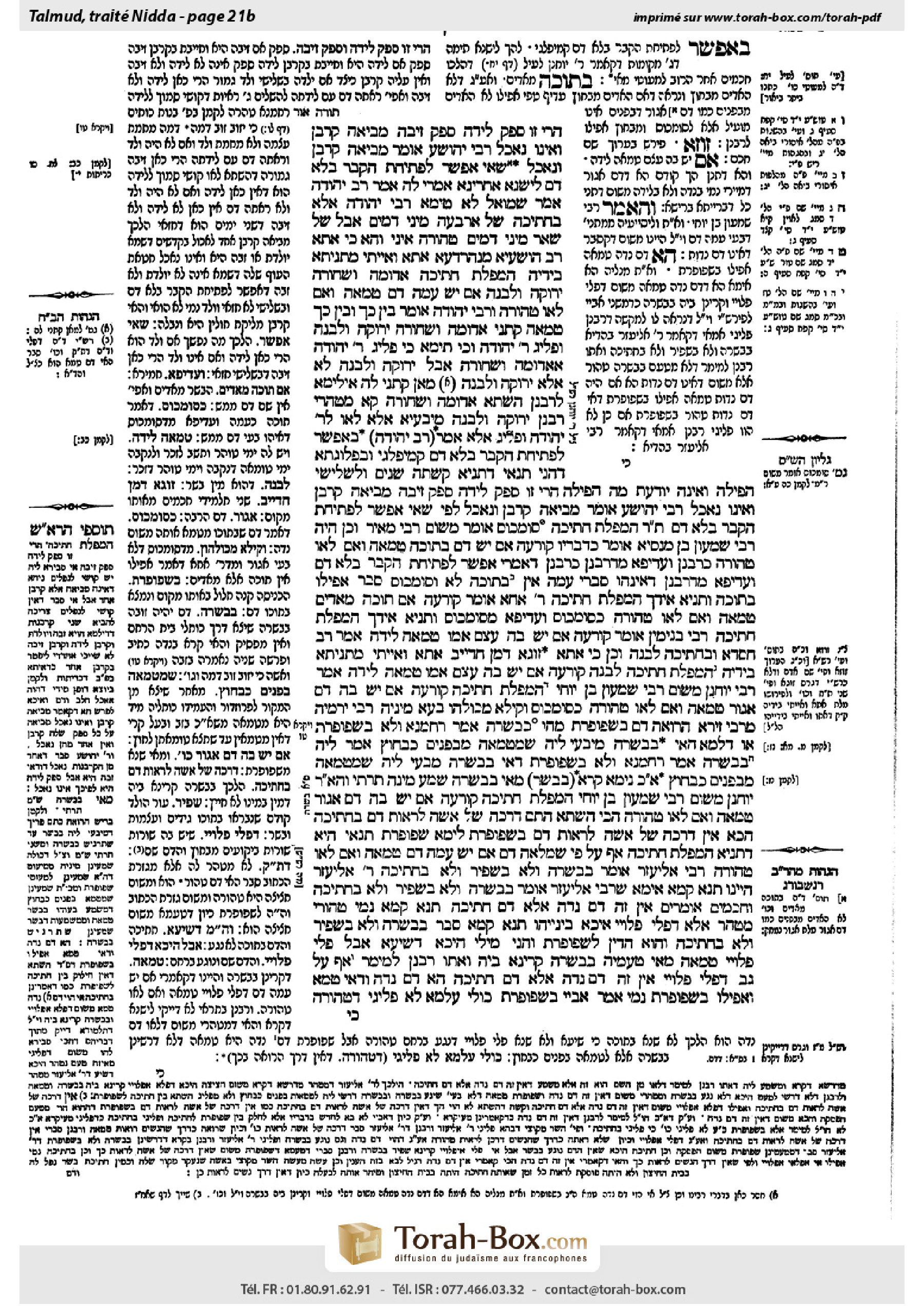
Niddah 21b: Talmud study for Daf Yomi
Daf Yomi is the daily study of one Talmud folio. Explore 37 tractates with scans, Hebrew text, Sefaria English and AI-generated French translations where annotated.
Passage selection and English or AI-generated French translation are available where the scan has annotations. Daf Study is independent of Torah-Box and Sefaria.
Browse Niddah · נידה · All tractatesNiddah 21b text and translations
This page of Niddah includes the Aramaic text, an English translation and an AI-generated French translation, alongside the scan above.
נידה כ״א ב · Aramaic and Hebrew text
הֲרֵי זוֹ סְפֵק לֵידָה סְפֵק זִיבָה, מְבִיאָה קׇרְבָּן וְאֵינוֹ נֶאֱכָל.
רַבִּי יְהוֹשֻׁעַ אוֹמֵר: מְבִיאָה קׇרְבָּן וְנֶאֱכָל, שֶׁאִי אֶפְשָׁר לִפְתִיחַת הַקֶּבֶר בְּלֹא דָּם.
לִישָּׁנָא אַחְרִינָא אָמְרִי לַהּ: אָמַר רַב יְהוּדָה אָמַר שְׁמוּאֵל: לֹא טִימֵּא רַבִּי יְהוּדָה אֶלָּא בַּחֲתִיכָה שֶׁל אַרְבָּעָה מִינֵי דָמִים, אֲבָל שֶׁל שְׁאָר מִינֵי דָמִים — טְהוֹרָה.
אִינִי? וְהָא כִּי אֲתָא רַב הוֹשַׁעְיָא מִנְּהַרְדְּעָא, אֲתָא וְאַיְיתִי מַתְנִיתָא בִּידֵיהּ: הַמַּפֶּלֶת חֲתִיכָה אֲדוּמָּה, וּשְׁחוֹרָה, יְרוּקָּה, וּלְבָנָה — אִם יֵשׁ עִמָּהּ דָּם — טְמֵאָה, וְאִם לָאו — טְהוֹרָה. וְרַבִּי יְהוּדָה אוֹמֵר: בֵּין כָּךְ וּבֵין כָּךְ טְמֵאָה.
קָתָנֵי ״אֲדוּמָּה וּשְׁחוֹרָה, יְרוּקָּה וּלְבָנָה״, וּפְלִיג רַבִּי יְהוּדָה!
וְכִי תֵימָא, כִּי פְּלִיג רַבִּי יְהוּדָה אַאֲדוּמָּה וּשְׁחוֹרָה, אֲבָל יְרוּקָּה וּלְבָנָה לָא, אֶלָּא יְרוּקָּה וּלְבָנָה מַאן קָתָנֵי לַהּ?
אִילֵּימָא לְרַבָּנַן — הַשְׁתָּא אֲדוּמָּה וּשְׁחוֹרָה קָא מְטַהֲרִי רַבָּנַן, יְרוּקָּה וּלְבָנָה מִיבַּעְיָא? אֶלָּא לָאו לְרַבִּי יְהוּדָה, וּפְלִיג!
אֶלָּא אָמַר רַב יְהוּדָה: בְּאֶפְשָׁר לִפְתִיחַת הַקֶּבֶר בְּלֹא דָּם קָמִיפַּלְגִי, וּבִפְלוּגְתָּא דְהָנֵי תַנָּאֵי, דְּתַנְיָא: קִשְּׁתָה שְׁנַיִם, וְלַשְּׁלִישִׁי הִפִּילָה, וְאֵינָהּ יוֹדַעַת מָה הִפִּילָה — הֲרֵי זוֹ סְפֵק לֵידָה סְפֵק זִיבָה, מְבִיאָה קׇרְבָּן וְאֵינוֹ נֶאֱכָל.
רַבִּי יְהוֹשֻׁעַ אוֹמֵר: מְבִיאָה קׇרְבָּן וְנֶאֱכָל, לְפִי שֶׁאִי אֶפְשָׁר לִפְתִיחַת הַקֶּבֶר בְּלֹא דָּם.
תָּנוּ רַבָּנַן: הַמַּפֶּלֶת חֲתִיכָה, סוֹמְכוֹס אוֹמֵר מִשּׁוּם רַבִּי מֵאִיר, וְכֵן הָיָה רַבִּי שִׁמְעוֹן בֶּן מְנַסְיָא אוֹמֵר כִּדְבָרָיו: קוֹרְעָהּ, אִם יֵשׁ דָּם בְּתוֹכָהּ — טְמֵאָה, וְאִם לָאו — טְהוֹרָה.
כְּרַבָּנַן, וַעֲדִיפָא מִדְּרַבָּנַן. כְּרַבָּנַן — דְּאָמְרִי: אֶפְשָׁר לִפְתִיחַת הַקֶּבֶר בְּלֹא דָּם. וַעֲדִיפָא מִדְּרַבָּנַן — דְּאִינְהוּ סָבְרִי: עִמָּהּ — אִין, בְּתוֹכָהּ — לָא, וְסוֹמְכוֹס סָבַר: אֲפִילּוּ בְּתוֹכָהּ.
וְתַנְיָא אִידַּךְ: הַמַּפֶּלֶת חֲתִיכָה, רַבִּי אַחָא אוֹמֵר: קוֹרְעָהּ, אִם תּוֹכָהּ מַאֲדִים — טְמֵאָה, וְאִם לָאו — טְהוֹרָה.
כְּסוֹמְכוֹס, וַעֲדִיפָא מִסּוֹמְכוֹס.
וְתַנְיָא אִידַּךְ: הַמַּפֶּלֶת חֲתִיכָה, רַבִּי בִּנְיָמִין אוֹמֵר: קוֹרְעָהּ, אִם יֵשׁ בָּהּ עֶצֶם — אִמּוֹ טְמֵאָה לֵידָה. אָמַר רַב חִסְדָּא: וּבַחֲתִיכָה לְבָנָה. וְכֵן כִּי אֲתָא זוּגָא דְּמִן חַדְיָיב, אֲתָא וְאַיְיתִי מַתְנִיתָא בִּידֵיהּ: הַמַּפֶּלֶת חֲתִיכָה לְבָנָה — קוֹרְעָהּ, אִם יֵשׁ בָּהּ עֶצֶם — אִמּוֹ טְמֵאָה לֵידָה.
אָמַר רַבִּי יוֹחָנָן מִשּׁוּם רַבִּי שִׁמְעוֹן בֶּן יוֹחַי: הַמַּפֶּלֶת חֲתִיכָה — קוֹרְעָהּ, אִם יֵשׁ בָּהּ דָּם אָגוּר — טְמֵאָה, וְאִם לָאו — טְהוֹרָה, כְּסוֹמְכוֹס, וְקִילָּא מִכּוּלְּהוּ.
בְּעָא מִינֵּיהּ רַבִּי יִרְמְיָה מֵרַבִּי זֵירָא: הָרוֹאָה דָּם בִּשְׁפוֹפֶרֶת מַהוּ? ״בִּבְשָׂרָהּ״ אֲמַר רַחֲמָנָא, וְלֹא בִּשְׁפוֹפֶרֶת, אוֹ דִלְמָא הַאי ״בִּבְשָׂרָהּ״ מִיבְּעֵי לֵיהּ שֶׁמְּטַמְּאָה מִבִּפְנִים כְּבַחוּץ?
אֲמַר לֵיהּ: ״בִּבְשָׂרָהּ״ אֲמַר רַחֲמָנָא וְלֹא בִּשְׁפוֹפֶרֶת, דְּאִי ״בִּבְשָׂרָהּ״ מִבָּעֵי לֵיהּ שֶׁמְּטַמְּאָה מִבִּפְנִים כְּבַחוּץ, אִם כֵּן נֵימָא קְרָא ״בַּבָּשָׂר״, מַאי ״בִּבְשָׂרָהּ״? שְׁמַע מִינָּה תַּרְתֵּי.
וְהָא אָמַר רַבִּי יוֹחָנָן מִשּׁוּם רַבִּי שִׁמְעוֹן בֶּן יוֹחַי: הַמַּפֶּלֶת חֲתִיכָה — קוֹרְעָהּ, אִם יֵשׁ בָּהּ דָּם אָגוּר — טְמֵאָה, וְאִם לָאו — טְהוֹרָה!
הָכִי הַשְׁתָּא? הָתָם דַּרְכָּהּ שֶׁל אִשָּׁה לִרְאוֹת דָּם בַּחֲתִיכָה, הָכָא אֵין דַּרְכָּהּ שֶׁל אִשָּׁה לִרְאוֹת דָּם בִּשְׁפוֹפֶרֶת.
לֵימָא שְׁפוֹפֶרֶת תַּנָּאֵי הִיא, דְּתַנְיָא: הַמַּפֶּלֶת חֲתִיכָה, אַף עַל פִּי שֶׁמְּלֵאָה דָּם, אִם יֵשׁ עִמָּהּ דָּם — טְמֵאָה, וְאִם לָאו — טְהוֹרָה. רַבִּי אֱלִיעֶזֶר אוֹמֵר: ״בִּבְשָׂרָהּ״ — וְלֹא בַּשָּׁפִיר וְלֹא בַּחֲתִיכָה.
רַבִּי אֱלִיעֶזֶר — הַיְינוּ תַּנָּא קַמָּא! אֵימָא: שֶׁרַבִּי אֱלִיעֶזֶר אוֹמֵר ״בִּבְשָׂרָהּ״ — וְלֹא בַּשָּׁפִיר וְלֹא בַּחֲתִיכָה.
וַחֲכָמִים אוֹמְרִים: אֵין זֶה דַּם נִדָּה אֶלָּא דַּם חֲתִיכָה. תַּנָּא קַמָּא נָמֵי טַהוֹרֵי מְטַהֵר, אֶלָּא דְּפַלַּי פַּלּוֹיֵי אִיכָּא בֵינַיְיהוּ.
תַּנָּא קַמָּא סָבַר ״בִּבְשָׂרָהּ״ — וְלֹא בַּשָּׁפִיר וְלֹא בַּחֲתִיכָה, וְהוּא הַדִּין לִשְׁפוֹפֶרֶת. וְהָנֵי מִילֵּי הֵיכָא דְּשִׁיעָא, אֲבָל פַּלַּי פַּלּוֹיֵי — טְמֵאָה. מַאי טַעְמֵיהּ? ״בִּבְשָׂרָהּ״ קָרֵינָא בֵּיהּ.
וְאָתוּ רַבָּנַן לְמֵימַר: אַף עַל גַּב דְּפַלַּי פַּלּוֹיֵי — אֵין זֶה דַּם נִדָּה אֶלָּא דַּם חֲתִיכָה. הָא דַּם נִדָּה וַדַּאי טָמֵא, וַאֲפִילּוּ בִּשְׁפוֹפֶרֶת נָמֵי!
אָמַר אַבָּיֵי: בִּשְׁפוֹפֶרֶת כּוּלֵּי עָלְמָא לָא פְּלִיגִי דִּטְהוֹרָה,
Niddah 21b · English translation
it is uncertain whether that woman has the status of one who gave birth, and it is uncertain whether she has the status of a woman who experiences an irregular discharge of blood from the uterus [ziva]. Therefore, she brings an offering, like any woman after childbirth or after ziva, but the offering is not eaten by the priests. The reason is that perhaps she neither gave birth nor experienced ziva, and is therefore exempt from bringing an offering. Consequently, her bird sin offering is disqualified, and is forbidden in consumption, as a bird offering is killed by pinching its neck, which is not the valid manner of slaughtering a non-sacred bird.
Rabbi Yehoshua says: The woman brings an offering, and it is eaten. The reason is that she is certainly either a woman after childbirth or a zava, as opening of the womb is not possible without a discharge of blood. The tanna’im in the baraita disagree about whether opening of the womb is possible without a discharge of blood. Rav Naḥman bar Yitzḥak maintains that this is also the issue in dispute between Rabbi Yehuda and the Rabbis in the mishna.
§ Some say another version of the above discussion. Rav Yehuda says that Shmuel says: Rabbi Yehuda deemed the woman impure, despite the fact that no blood emerged, only in the case of a piece of tissue that has the appearance of one of the four types of ritually impure blood, but if it has the appearance of other types of blood, the woman is pure.
The Gemara asks: Is that so? But when Rav Hoshaya came from Neharde’a, he came and brought a baraita with him that states: In the case of a woman who discharges a piece of tissue that is red, or black, green, or white, if there is blood that emerges with it, the woman is impure, and if not, she is pure. And Rabbi Yehuda says: In both this case, where blood emerged, and that case, where no blood emerged, the woman is impure.
The Gemara concludes its challenge: The baraita teaches both a case where the piece of tissue is red or black, and a case where it is not one of the four types of impure blood but it is green or white, i.e., in all of these cases the Rabbis hold that the woman is pure, and yet Rabbi Yehuda disagrees with their opinion.
And if you would say that when Rabbi Yehuda disagrees with the Rabbis, it is with regard to the case of a red or black piece of tissue, but with regard to the case of a green or white piece he does not disagree with them, as he concedes that the woman is pure; but if that is so, for the sake of clarifying whose opinion does the baraita teach the case of a green or white piece of tissue?
If we say that it comes to clarify the opinion of the Rabbis, that is unnecessary: Now that in the case of a red or black piece of tissue the Rabbis deem the woman pure, is it necessary to state that they deem her pure in a case of a green or white piece? Rather, is it not coming to clarify the opinion of Rabbi Yehuda, teaching that the Rabbis deem the woman pure in this case, but Rabbi Yehuda disagrees with them and deems her impure? This contradicts the explanation of Shmuel.
Rather, Rav Yehuda says there is a different explanation of the dispute between the Rabbis and Rabbi Yehuda: They disagree with regard to whether or not opening of the womb is possible without a discharge of blood. And they disagree with regard to the issue that is the subject of the dispute between these tanna’im, as it is taught in a baraita: If a woman experienced difficulty in labor during which blood emerged on two consecutive days, and on the third day she discharged, but she does not know what she discharged, it is uncertain whether she has the status of a woman who gave birth, and it is uncertain whether she has the status of a woman who experienced ziva. Therefore she brings an offering, but it is not eaten by the priests.
Rabbi Yehoshua says: The woman brings an offering, and it is eaten. The reason is that she is certainly either a woman after childbirth or a zava, as opening of the womb is not possible without a discharge of blood. This is also the matter in dispute between the Rabbis and Rabbi Yehuda.
§ The Sages taught in a baraita: In the case of a woman who discharges an amorphous piece of tissue, Sumakhos says in the name of Rabbi Meir, and likewise Rabbi Shimon ben Menasya would say in accordance with his statement: A Sage who is presented with this piece of tissue should tear it to examine it. If there is blood inside it, the woman is ritually impure, and if not, she is pure.
The Gemara compares this baraita to the ruling of the mishna: This statement is basically in accordance with the opinion of the Rabbis in the mishna, but it is more far-reaching, i.e., more stringent, than that ruling of the Rabbis. It is in accordance with the opinion of the Rabbis, as they say that opening of the womb is possible without a discharge of blood, whereas Rabbi Yehuda maintains that opening of the womb is impossible without a discharge of blood. But the ruling of the baraita is more far-reaching than that ruling of the Rabbis, as they hold that if blood emerges with the piece of tissue, then yes, the woman is impure, but if blood is found inside the piece of tissue, she is not impure; and Sumakhos holds that even if blood is found inside the piece, the woman is impure.
And it is taught in another baraita with regard to a woman who discharges an amorphous piece of tissue, that Rabbi Aḥa says: One tears it open, and if its interior looks red, even if it contains no blood, the woman is impure; and if it does not have a red appearance, she is pure.
The Gemara compares this baraita to the aforementioned opinion of Sumakhos: This ruling of Rabbi Aḥa is basically in accordance with the opinion of Sumakhos, as Rabbi Aḥa also requires that the interior of the piece of tissue must be examined to see if there is blood on the inside, but it is more far-reaching than the opinion of Sumakhos, as Rabbi Aḥa deems the woman impure even if the piece of tissue merely looks red on the inside but does not contain blood.
And it is taught in another baraita with regard to a woman who discharges an amorphous piece of tissue, that Rabbi Binyamin says one tears it open to examine it. If it contains a bone, it is considered a fetus, and its mother is impure with the impurity of a woman who gave birth. Rav Ḥisda says: And this applies in the case of a white piece of flesh; only in such a situation does the existence of a bone render it a fetus. And likewise, when a pair of Torah scholars came from Ḥadyab, they came and brought a baraita with them: In the case of a woman who discharges a white piece of tissue, one tears it open to examine it, and if it contains a bone, its mother is impure with the impurity of a woman who gave birth.
Rabbi Yoḥanan says in the name of Rabbi Shimon ben Yoḥai: With regard to a woman who discharges an amorphous piece of tissue, one tears it open to examine it. If it contains a quantity of accumulated blood, the woman is impure; and if not, she is pure. The Gemara comments: This is basically in accordance with the opinion of Sumakhos, that blood found inside the piece of tissue renders the woman impure, but it is more lenient than all the previous opinions, i.e., Sumakhos and Rabbi Aḥa, as according to Rabbi Shimon ben Yoḥai the woman is rendered impure only if there is a quantity of accumulated blood.
§ Rabbi Yirmeya asked Rabbi Zeira: In the case of a woman who inserted a tube into her vagina and sees blood, i.e., she found blood in the tube, what is the halakha? Rabbi Yirmeya clarified his question: Since it is stated: “And if a woman has an issue, and her issue in her flesh is blood, she shall be in her impurity seven days” (Leviticus 15:19), perhaps the Merciful One states in this verse that the woman is impure only if the blood is discharged through “her flesh” and not through a tube. Or perhaps this term: “In her flesh,” is necessary to teach the halakha that a woman becomes impure by finding blood inside her vagina just as she becomes impure by experiencing bleeding outside her vagina, i.e., once the blood enters the vaginal canal from the uterus the woman is ritually impure.
Rabbi Zeira said to Rabbi Yirmeya: The Merciful One states: “In her flesh,” meaning that the woman is impure only if the blood is discharged through “her flesh” and not through a tube. As, if the term “in her flesh” is necessary to teach that a woman becomes impure by finding blood inside her vagina just as by seeing blood outside her vagina, if so, let the verse say: In the flesh. What is the significance of the fact that the verse states: “In her flesh”? Conclude two conclusions from the term, both that a woman becomes impure by the presence of blood inside her vagina, and that a woman who experiences bleeding that emerged through a tube is ritually pure.
The Gemara asks: But doesn’t Rabbi Yoḥanan say in the name of Rabbi Shimon ben Yoḥai: With regard to a woman who discharges an amorphous piece of tissue, one tears it open to examine it; if it contains a quantity of accumulated blood, the woman is impure, and if not, she is pure? If a woman who sees blood that emerged inside a piece of tissue becomes impure, the same should apply to a woman who sees blood that emerged through a tube.
The Gemara responds: How can these cases be compared? There, with regard to a piece of tissue, the woman is impure, as it is the manner of a woman to see blood inside such a piece of tissue. Therefore, this blood fulfills the condition stated in the verse: “In her flesh.” By contrast, here, in the case of a tube, the woman should not be impure, as it is not the manner of a woman to see blood that emerged through a tube.
The Gemara suggests: Shall we say that the halakha in the case of a tube is subject to a dispute between tanna’im? As it is taught in a baraita: With regard to a woman who discharges an amorphous piece of tissue, even though the piece is full of blood, if there is blood on the outside that emerges with it, the woman is impure; and if not, she is pure. Rabbi Eliezer says: The term “in her flesh” teaches that a woman is rendered impure only by blood that emerges through direct contact with her flesh, and not by blood that emerges in a gestational sac, nor by blood that emerges in an amorphous piece of tissue.
The Gemara interrupts its citation of the baraita and asks: Isn’t the opinion of Rabbi Eliezer identical to that of the first tanna? The first tanna also says that a woman does not become impure due to blood found in a piece of tissue. Rather, the entire baraita is the opinion of Rabbi Eliezer, and one must say that the baraita should read as follows: Even if the piece of tissue is full of blood the woman is pure, as Rabbi Eliezer says that the term “in her flesh” teaches that a woman is rendered impure only by blood that emerges through direct contact with her flesh, and not by blood that emerges in a gestational sac, nor by blood that emerges in a piece of tissue.
The baraita continues: And the Rabbis say: If there is blood in the piece of tissue, this is not menstrual blood, but rather the blood of the piece of tissue. The Gemara asks: Doesn’t the first tanna also deem the woman pure? What is the difference between the opinion of the Rabbis and that of the first tanna? The Gemara answers: Rather, the difference between the opinion of the first tanna and that of the Rabbis is with regard to a case where the piece of tissue is cracked, and its blood comes in direct contact with the woman’s body.
The first tanna holds that the term “in her flesh” teaches that a woman is rendered impure only by blood that emerges through direct contact with her flesh, and not by blood that emerges in a gestational sac, nor by blood that emerges in a piece of tissue. And the same is true with regard to blood that emerges through a tube. But this statement applies only in a case where the piece of tissue is smooth, but if it is cracked, the woman is impure. What is the reason for this exception? Since the blood comes in direct contact with the woman’s flesh, we read the term “in her flesh” with regard to it, i.e., it fulfills that condition.
And the Rabbis come to say: Even though the piece of tissue is cracked, the woman is pure, as this is not menstrual blood but rather the blood of the piece of tissue. It can be inferred from here that if the blood is menstrual blood, the woman is certainly impure, and this is true even if the blood emerges through a tube. Accordingly, the halakha in the case of a tube is subject to a dispute between tanna’im.
Abaye says that this suggestion should be rejected: In the case of a tube, everyone agrees that the woman is pure, as derived from the term “in her flesh.”
Niddah 21b · Traduction française (IA)
Il est incertain que cette femme ait le statut d’une femme qui a accouché, et il est également incertain qu’elle ait celui d’une femme qui connaît un écoulement irrégulier de sang provenant de l’utérus [ziva]. Elle apporte donc une offrande, comme toute femme après un accouchement ou après une ziva, mais les prêtres ne la consomment pas. En effet, il se peut qu’elle n’ait ni accouché ni connu de ziva et qu’elle ne soit donc pas tenue d’apporter une offrande. Par conséquent, son sacrifice expiatoire d’oiseau est disqualifié et ne peut être consommé, car un oiseau offert en sacrifice est mis à mort par pincement de la nuque, ce qui n’est pas une manière valable d’abattre un oiseau non consacré.
Rabbi Yehoshua dit : La femme apporte une offrande, et celle-ci est consommée. En effet, elle est certainement soit une femme après un accouchement, soit une zava, car l’ouverture de l’utérus ne peut se produire sans écoulement de sang. Les tannaïm de la baraïta sont en désaccord sur la possibilité d’une ouverture de l’utérus sans écoulement de sang. Rav Naḥman bar Yitzḥak estime que c’est également là le sujet du désaccord entre Rabbi Yehuda et les Rabbins dans la Michna.
§ Certains rapportent une autre version de la discussion précédente. Rav Yehuda dit au nom de Shmuel : Rabbi Yehuda a déclaré la femme impure, bien qu’aucun sang ne soit sorti, uniquement dans le cas d’un morceau de tissu ayant l’apparence de l’un des quatre types de sang rituellement impur ; mais s’il a l’apparence d’autres types de sang, la femme est pure.
La Guemara demande : Est-ce vraiment le cas ? Lorsque Rav Hoshaya est venu de Neharde’a, il a apporté avec lui une baraïta qui enseigne : Dans le cas d’une femme qui expulse un morceau de tissu rouge, noir, vert ou blanc, si du sang sort avec lui, la femme est impure, et sinon, elle est pure. Rabbi Yehuda dit : Dans les deux cas, celui où du sang est sorti et celui où aucun sang n’est sorti, la femme est impure.
La Guemara achève son objection : La baraïta enseigne à la fois le cas où le morceau de tissu est rouge ou noir et celui où il n’est pas de l’un des quatre types de sang impur, mais est vert ou blanc ; autrement dit, dans tous ces cas, les Rabbins considèrent que la femme est pure, et pourtant Rabbi Yehuda est en désaccord avec eux.
Et si tu dis que le désaccord de Rabbi Yehuda avec les Rabbins porte sur le cas d’un morceau de tissu rouge ou noir, mais qu’il ne conteste pas leur avis dans le cas d’un morceau vert ou blanc, puisqu’il reconnaît alors que la femme est pure, si tel était le cas, dans quel but la baraïta enseigne-t-elle le cas d’un morceau de tissu vert ou blanc ?
Si l’on dit que c’est pour préciser l’avis des Rabbins, cela est inutile : puisqu’ils considèrent que la femme est pure dans le cas d’un morceau de tissu rouge ou noir, est-il nécessaire de préciser qu’ils la considèrent pure dans le cas d’un morceau vert ou blanc ? N’est-ce pas plutôt pour préciser l’avis de Rabbi Yehuda que la baraïta enseigne que les Rabbins considèrent la femme comme pure dans ce cas, tandis que Rabbi Yehuda est en désaccord avec eux et la considère comme impure ? Cela contredit l’explication de Shmuel.
Rav Yehuda donne plutôt une autre explication du désaccord entre les Rabbins et Rabbi Yehuda : ils sont en désaccord sur la possibilité d’une ouverture de l’utérus sans écoulement de sang. Leur désaccord porte sur la même question que celle qui oppose ces tannaïm, comme l’enseigne une baraïta : Si une femme a eu un accouchement difficile pendant lequel du sang est sorti deux jours consécutifs, puis a expulsé quelque chose le troisième jour sans savoir ce qu’elle avait expulsé, il est incertain qu’elle ait le statut d’une femme qui a accouché, et il est également incertain qu’elle ait celui d’une femme qui a connu une ziva. Elle apporte donc une offrande, mais les prêtres ne la consomment pas.
Rabbi Yehoshua dit : La femme apporte une offrande, et celle-ci est consommée. En effet, elle est certainement soit une femme après un accouchement, soit une zava, car l’ouverture de l’utérus ne peut se produire sans écoulement de sang. C’est également là le sujet du désaccord entre les Rabbins et Rabbi Yehuda.
§ Les Sages ont enseigné dans une baraïta : Dans le cas d’une femme qui expulse un morceau de tissu informe, Sumakhos dit au nom de Rabbi Meir, et Rabbi Shimon ben Menasya dirait de même, conformément à cet avis : Un Sage auquel on présente ce morceau de tissu doit le déchirer pour l’examiner. S’il y a du sang à l’intérieur, la femme est rituellement impure, et sinon, elle est pure.
La Guemara compare cette baraïta à la décision de la Michna : Cette affirmation correspond pour l’essentiel à l’avis des Rabbins dans la Michna, mais elle va plus loin, c’est-à-dire qu’elle est plus stricte, que leur décision. Elle correspond à leur avis, car ils disent que l’ouverture de l’utérus peut se produire sans écoulement de sang, tandis que Rabbi Yehuda estime qu’une ouverture de l’utérus est impossible sans écoulement de sang. Mais la décision de la baraïta va plus loin que celle des Rabbins : ceux-ci considèrent que si du sang sort avec le morceau de tissu, la femme est impure, mais que si du sang est trouvé à l’intérieur du morceau, elle ne l’est pas ; Sumakhos, lui, estime que même si du sang est trouvé à l’intérieur du morceau, la femme est impure.
Une autre baraïta enseigne au sujet d’une femme qui expulse un morceau de tissu informe que Rabbi Aḥa dit : On le déchire, et si son intérieur a une apparence rouge, la femme est impure, même s’il ne contient pas de sang ; et si son intérieur n’a pas une apparence rouge, elle est pure.
La Guemara compare cette baraïta à l’avis précité de Sumakhos : Cette décision de Rabbi Aḥa correspond pour l’essentiel à l’avis de Sumakhos, car Rabbi Aḥa exige lui aussi que l’intérieur du morceau de tissu soit examiné afin de voir s’il contient du sang ; mais elle va plus loin que l’avis de Sumakhos, puisque Rabbi Aḥa considère la femme comme impure même si le morceau a simplement une apparence rouge à l’intérieur, sans contenir de sang.
Une autre baraïta enseigne au sujet d’une femme qui expulse un morceau de tissu informe que Rabbi Binyamin dit qu’on le déchire pour l’examiner. S’il contient un os, il est considéré comme un fœtus et sa mère est impure de l’impureté d’une femme qui a accouché. Rav Ḥisda dit : Cela s’applique dans le cas d’un morceau de chair blanc ; c’est uniquement dans une telle situation que la présence d’un os permet de le considérer comme un fœtus. De même, lorsque deux érudits en Torah sont venus de Ḥadyab, ils ont apporté avec eux une baraïta : Dans le cas d’une femme qui expulse un morceau de tissu blanc, on le déchire pour l’examiner ; s’il contient un os, sa mère est impure de l’impureté d’une femme qui a accouché.
Rabbi Yoḥanan dit au nom de Rabbi Shimon ben Yoḥai : Au sujet d’une femme qui expulse un morceau de tissu informe, on le déchire pour l’examiner. S’il contient une quantité de sang accumulé, la femme est impure ; sinon, elle est pure. La Guemara commente : Cela correspond pour l’essentiel à l’avis de Sumakhos, selon lequel le sang trouvé à l’intérieur du morceau de tissu rend la femme impure, mais c’est plus indulgent que tous les avis précédents, c’est-à-dire ceux de Sumakhos et de Rabbi Aḥa, car selon Rabbi Shimon ben Yoḥai, la femme ne devient impure que s’il y a une quantité de sang accumulé.
§ Rabbi Yirmeya demanda à Rabbi Zeira : Dans le cas d’une femme qui a introduit un tube dans son vagin et qui voit du sang, c’est-à-dire qu’elle a trouvé du sang dans le tube, quelle est la halakha ? Rabbi Yirmeya précisa sa question : Puisqu’il est dit : « Si une femme a un écoulement, et que son écoulement dans sa chair est du sang, elle sera impure pendant sept jours » (Lévitique 15,19), peut-être le Miséricordieux enseigne-t-il dans ce verset que la femme n’est impure que si le sang sort « dans sa chair », et non par un tube. Ou peut-être l’expression « dans sa chair » est-elle nécessaire pour enseigner la halakha selon laquelle une femme devient impure en trouvant du sang à l’intérieur de son vagin, tout comme elle devient impure lorsqu’elle saigne à l’extérieur de son vagin, c’est-à-dire qu’une fois que le sang entre dans le canal vaginal depuis l’utérus, la femme est rituellement impure.
Rabbi Zeira dit à Rabbi Yirmeya : Le Miséricordieux dit « dans sa chair », ce qui signifie que la femme n’est impure que si le sang sort « dans sa chair », et non par un tube. En effet, si l’expression « dans sa chair » était nécessaire pour enseigner qu’une femme devient impure lorsqu’elle trouve du sang à l’intérieur de son vagin, tout comme lorsqu’elle voit du sang à l’extérieur de son vagin, alors le verset aurait pu dire : « Dans la chair ». Quelle est donc la signification du fait que le verset dit : « Dans sa chair » ? Déduis de cette expression deux conclusions : une femme devient impure par la présence de sang à l’intérieur de son vagin, et une femme qui saigne lorsque le sang sort par un tube est rituellement pure.
La Guemara demande : Mais Rabbi Yoḥanan ne dit-il pas au nom de Rabbi Shimon ben Yoḥai : Au sujet d’une femme qui expulse un morceau de tissu informe, on le déchire pour l’examiner ; s’il contient une quantité de sang accumulé, la femme est impure, et sinon, elle est pure ? Si une femme qui voit du sang sorti à l’intérieur d’un morceau de tissu devient impure, il devrait en être de même pour une femme qui voit du sang sorti par un tube.
La Guemara répond : Comment comparer ces cas ? Là, dans le cas d’un morceau de tissu, la femme est impure, car il est habituel qu’une femme voie du sang à l’intérieur d’un tel morceau de tissu. Ce sang satisfait donc à la condition énoncée dans le verset : « Dans sa chair ». En revanche, ici, dans le cas d’un tube, la femme ne devrait pas être impure, car il n’est pas habituel qu’une femme voie du sang sorti par un tube.
La Guemara suggère : Devons-nous dire que la halakha concernant un tube fait l’objet d’un désaccord entre tannaïm ? En effet, une baraïta enseigne : Au sujet d’une femme qui expulse un morceau de tissu informe, même si le morceau est rempli de sang, si du sang se trouve à l’extérieur et sort avec lui, la femme est impure ; sinon, elle est pure. Rabbi Eliezer dit : L’expression « dans sa chair » enseigne qu’une femme ne devient impure que par du sang qui sort au contact direct de sa chair, et non par du sang qui sort dans un sac gestationnel, ni par du sang qui sort à l’intérieur d’un morceau de tissu informe.
La Guemara interrompt la citation de la baraïta et demande : L’avis de Rabbi Eliezer n’est-il pas identique à celui du premier tanna ? Le premier tanna dit lui aussi qu’une femme ne devient pas impure à cause du sang trouvé dans un morceau de tissu. La baraïta entière exprime plutôt l’avis de Rabbi Eliezer, et il faut dire qu’elle devrait se lire ainsi : Même si le morceau de tissu est rempli de sang, la femme est pure, car Rabbi Eliezer dit que l’expression « dans sa chair » enseigne qu’une femme ne devient impure que par du sang qui sort au contact direct de sa chair, et non par du sang qui sort dans un sac gestationnel, ni par du sang qui sort à l’intérieur d’un morceau de tissu.
La baraïta poursuit : Et les Rabbins disent : S’il y a du sang dans le morceau de tissu, ce n’est pas du sang menstruel, mais le sang du morceau de tissu. La Guemara demande : Le premier tanna ne considère-t-il pas lui aussi la femme comme pure ? Quelle est la différence entre l’avis des Rabbins et celui du premier tanna ? La Guemara répond : La différence entre l’avis du premier tanna et celui des Rabbins porte plutôt sur le cas où le morceau de tissu est fissuré et où son sang entre en contact direct avec le corps de la femme.
Le premier tanna estime que l’expression « dans sa chair » enseigne qu’une femme ne devient impure que par du sang qui sort au contact direct de sa chair, et non par du sang qui sort dans un sac gestationnel, ni par du sang qui sort à l’intérieur d’un morceau de tissu. Il en va de même pour le sang qui sort par un tube. Mais cette affirmation ne s’applique qu’au cas où le morceau de tissu est lisse ; s’il est fissuré, la femme est impure. Pourquoi cette exception ? Puisque le sang entre en contact direct avec la chair de la femme, nous appliquons à son sujet l’expression « dans sa chair », c’est-à-dire qu’il satisfait à cette condition.
Les Rabbins viennent dire que, même si le morceau de tissu est fissuré, la femme est pure, car il ne s’agit pas de sang menstruel, mais du sang du morceau de tissu. On peut en déduire que si le sang est menstruel, la femme est certainement impure, même si le sang sort par un tube. Par conséquent, la halakha concernant un tube fait l’objet d’un désaccord entre tannaïm.
Abaye dit qu’il faut rejeter cette suggestion : dans le cas d’un tube, tous sont d’accord pour dire que la femme est pure, comme on le déduit de l’expression « dans sa chair ».
Traduction française générée par IA à partir de l’édition anglaise de Sefaria. Vérifie toujours un passage avec le texte source.
Text from Sefaria: William Davidson Edition - Vocalized Aramaic (CC BY NC); William Davidson Edition - English (CC BY NC).