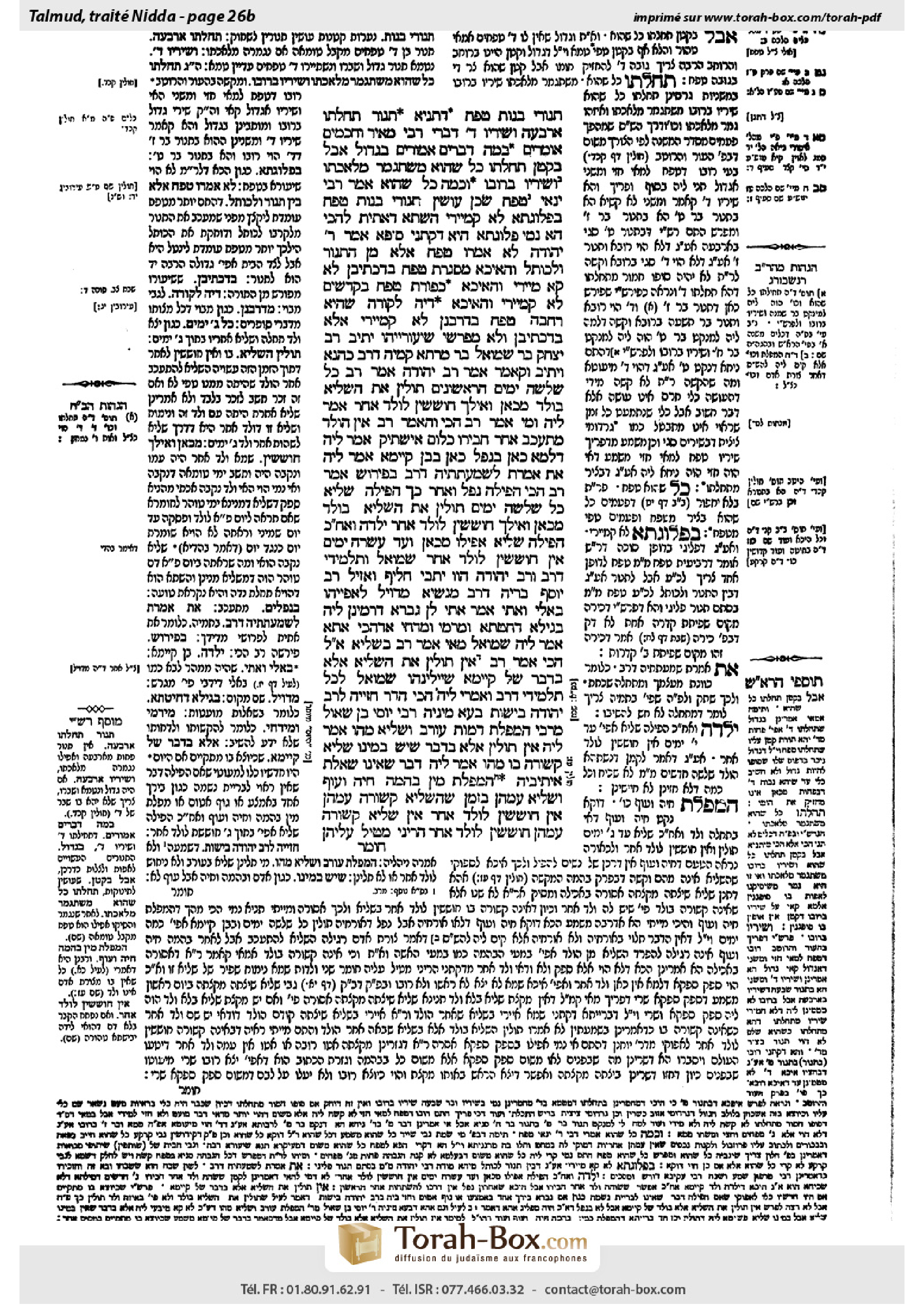
Niddah 26b: Talmud study for Daf Yomi
Daf Yomi is the daily study of one Talmud folio. Explore 37 tractates with scans, Hebrew text, Sefaria English and AI-generated French translations where annotated.
Passage selection and English or AI-generated French translation are available where the scan has annotations. Daf Study is independent of Torah-Box and Sefaria.
Browse Niddah · נידה · All tractatesNiddah 26b text and translations
This page of Niddah includes the Aramaic text, an English translation and an AI-generated French translation, alongside the scan above.
נידה כ״ו ב · Aramaic and Hebrew text
תַּנּוּרֵי בָּנוֹת טֶפַח! דְּתַנְיָא: תַּנּוּר תְּחִלָּתוֹ אַרְבָּעָה וּשְׁיָרָיו אַרְבָּעָה, דִּבְרֵי רַבִּי מֵאִיר.
וַחֲכָמִים אוֹמְרִים: בַּמֶּה דְבָרִים אֲמוּרִים? בְּגָדוֹל, אֲבָל בְּקָטָן — תְּחִלָּתוֹ כֹּל שֶׁהוּא מִשֶּׁתִּגָּמֵר מְלַאכְתּוֹ, וּשְׁיָרָיו בְּרוּבּוֹ.
וְכַמָּה ״כֹּל שֶׁהוּא״? אָמַר רַבִּי יַנַּאי: טֶפַח, שֶׁכֵּן עוֹשִׂין תַּנּוּרֵי בָּנוֹת טֶפַח. בִּפְלוּגְתָּא לָא קָמַיְירֵי.
הַשְׁתָּא דַאֲתֵית לְהָכִי, הָא נָמֵי פְּלוּגְתָּא הִיא. דְּקָתָנֵי סֵיפָא: אָמַר רַבִּי יְהוּדָה: לֹא אָמְרוּ טֶפַח אֶלָּא מִן הַתַּנּוּר וְלַכּוֹתֶל.
וְהָאִיכָּא מִסְגֶּרֶת טֶפַח! בְּדִכְתִיבָן לָא קָא מַיְירֵי, וְהָאִיכָּא כַּפּוֹרֶת טֶפַח, בְּקָדָשִׁים לָא קָמַיְירֵי.
וְהָאִיכָּא דַּיָּהּ לַקּוֹרָה שֶׁהִיא רְחָבָה טֶפַח! בִּדְרַבָּנַן לָא קָמַיְירֵי, אֶלָּא בְּדִכְתִיבָן וְלָא מְפָרְשִׁי שִׁיעוּרַיְיהוּ.
יָתֵיב רַב יִצְחָק בַּר שְׁמוּאֵל בַּר מָרְתָא קַמֵּיהּ דְּרַב כָּהֲנָא, וְיָתֵיב וְקָאָמַר: אָמַר רַב יְהוּדָה אָמַר רַב: כׇּל שְׁלֹשָׁה יָמִים הָרִאשׁוֹנִים תּוֹלִין אֶת הַשִּׁלְיָא בַּוָּלָד, מִכָּאן וְאֵילָךְ חוֹשְׁשִׁין לְוָלָד אַחֵר.
אֲמַר לֵיהּ: וּמִי אָמַר רַב הָכִי? וְהָאָמַר רַב: אֵין הַוָּלָד מִתְעַכֵּב אַחַר חֲבֵירוֹ כְּלוּם! אִישְׁתִּיק. אֲמַר לֵיהּ: דִּלְמָא כָּאן בְּנֵפֶל, כָּאן בְּבֶן קַיָּימָא?
אֲמַר לֵיהּ: אַתְּ אָמְרַתְּ לִשְׁמַעְתְּתֵיהּ דְּרַב בְּפֵירוּשׁ? אָמַר רַב הָכִי: הִפִּילָה נֵפֶל וְאַחַר כָּךְ הִפִּילָה שִׁלְיָא — כָּל שְׁלֹשָׁה יָמִים תּוֹלִין אֶת הַשִּׁלְיָא בַּוָּלָד, מִכָּאן וְאֵילָךְ חוֹשְׁשִׁין לְוָלָד אַחֵר. יָלְדָה וְאַחַר כָּךְ הִפִּילָה שִׁלְיָא — אֲפִילּוּ מִכָּאן וְעַד עֲשָׂרָה יָמִים אֵין חוֹשְׁשִׁין לְוָלָד אַחֵר.
שְׁמוּאֵל וְתַלְמִידִי דְּרַב וְרַב יְהוּדָה הֲווֹ יָתְבִי, חָלֵיף וְאָזֵיל רַב יוֹסֵף בְּרֵיהּ דְּרַב מְנַשְּׁיָא מִדְּוִיל לְאַפַּיְיהוּ, בָּאלַי וְאָתֵי. אֲמַר: אָתֵי לַן גַּבְרָא דְּרָמֵינַן לֵיהּ בְּגִילָא דְּחִטְּתָא וּמִרְמֵי וּמִדְחֵי.
אַדְּהָכִי אֲתָא, אֲמַר לֵיהּ שְׁמוּאֵל: מַאי אָמַר רַב בְּשִׁלְיָא? אֲמַר לֵיהּ: הָכִי אָמַר רַב: אֵין תּוֹלִין אֶת הַשִּׁלְיָא אֶלָּא בְּדָבָר שֶׁל קְיָימָא. שַׁיְילִינְהוּ שְׁמוּאֵל לְכׇל תַּלְמִידֵי דְּרַב, וְאָמְרִי לֵיהּ: הָכִי. הֲדַר חַזְיֵיהּ לְרַב יְהוּדָה בִּישׁוּת.
בְּעָא מִינֵּיהּ רַבִּי יוֹסֵי בֶּן שָׁאוּל מֵרַבִּי: הַמַּפֶּלֶת דְּמוּת עוֹרֵב וְשִׁלְיָא מַהוּ? אֲמַר לֵיהּ: אֵין תּוֹלִין אֶלָּא בְּדָבָר שֶׁיֵּשׁ בְּמִינוֹ שִׁלְיָא.
קְשׁוּרָה בּוֹ מַהוּ? אֲמַר לֵיהּ: דָּבָר שֶׁאֵינוֹ שָׁאַלְתָּ. אֵיתִיבֵיהּ: הַמַּפֶּלֶת מִין בְּהֵמָה חַיָּה וָעוֹף וְשִׁלְיָא עִמָּהֶן, בִּזְמַן שֶׁהַשִּׁלְיָא קְשׁוּרָה עִמָּהֶן — אֵין חוֹשְׁשִׁין לְוָלָד אַחֵר, אֵין שִׁלְיָא קְשׁוּרָה עִמָּהֶן — חוֹשְׁשִׁין לְוָלָד אַחֵר, הֲרֵינִי מֵטִיל עֲלֵיהֶן
Niddah 26b · English translation
toy ovens with which girls play, whose minimum measure with regard to ritual impurity is also one handbreadth? As it is taught in a mishna (Kelim 5:1): A clay oven in its original, unbroken, state is susceptible to ritual impurity if it is four handbreadths tall. And with regard to an oven that became impure and was subsequently broken, if its remains include a piece four handbreadths tall, that piece remains impure. This is the statement of Rabbi Meir.
And the Rabbis say: In what case is this statement said? It is said in the case of a large oven, made for regular use; but with regard to a small oven made for girls to play with, in its original state, any size is sufficient for it to be susceptible to contract impurity. Once its construction is completed, if the oven then becomes impure and is subsequently broken, if its remains include a piece that contains the majority of the oven, that piece remains impure.
The Gemara explains: And how small is the size defined by the mishna as any size? Rabbi Yannai says: One handbreadth, as people fashion toy ovens for girls one handbreadth high. This is another example of an item that has a minimum measure of one handbreadth, in addition to the five items listed by Rabbi Oshaya. The Gemara answers: Rabbi Oshaya is not speaking of matters that are subject to dispute, such as the minimum measure of an oven.
The Gemara adds: Now that you have arrived at this answer, the fact that Rabbi Oshaya does not mention a stone protruding from an oven can be explained in the same manner, since this halakha is also subject to a dispute. As the latter clause of that mishna (Kelim 5:2) teaches that Rabbi Yehuda said: When the Sages said that a stone protruding from an oven is considered a handle if it protrudes one handbreadth, they said so only with regard to a stone that protrudes from the oven and toward the wall. If the stone protrudes more than that, it is not considered a handle, as it is likely to be removed so that the oven can be moved closer to the wall. But if the stone protrudes toward the airspace of the house, it is considered an oven handle even if it protrudes more than one handbreadth.
The Gemara raises a difficulty: But isn’t there the frame of the Table in the Temple, which is one handbreadth wide, as stated in the Torah (Exodus 25:25)? The Gemara answers: Rabbi Oshaya is not dealing with matters that are written in the Torah. The Gemara further asks: But isn’t there the Ark Cover, which is one handbreadth thick, and its measure is not written explicitly in the Torah? The Gemara answers: Rabbi Oshaya is not dealing with consecrated items.
The Gemara asks: But isn’t there the halakha of a cross beam, which is placed over the entrance to an alleyway in order to permit carrying items in the alleyway on Shabbat, and the halakha is that it is enough for a cross beam to be one handbreadth wide? The Gemara answers: Rabbi Oshaya is not dealing with matters of rabbinic law. Rather, he is speaking only of matters that are written in the Torah but whose measure is not explicit in the Torah.
§ Rav Yitzḥak bar Shmuel bar Marta sat before Rav Kahana, and he sat and said that Rav Yehuda says that Rav says: For all of the first three days after a woman gives birth, if she discharges afterbirth, we attribute the afterbirth to the offspring. There is no concern that this afterbirth indicates the miscarriage of another offspring. From this point forward, once three days have passed since the birth, if the woman discharges an afterbirth, we are concerned that there might have been another offspring in the afterbirth, and the halakhot of a woman who discharged an offspring apply to her.
Rav Kahana said to Rav Yitzḥak bar Shmuel: And did Rav say this? But didn’t Rav say that an offspring does not remain in the womb at all after another offspring was born? Rav Yitzḥak bar Shmuel was silent. Rav Kahana said to him: Perhaps there is no contradiction between Rav’s two statements, as here, where he indicates that a second offspring can emerge even three days after the first, the reference is to a case where the first offspring is a non-viable newborn, whereas there, in the statement that a second offspring does not remain in the womb after the first offspring was born, he is referring to a case where the first offspring is a viable offspring.
Rav Yitzḥak bar Shmuel said to him: Are you the one who says this explanation of Rav’s halakha of your own accord? Indeed, Rav said this explicitly: If a woman discharged a non-viable newborn and subsequently discharged an afterbirth, for all of the first three days we attribute the afterbirth to the offspring. From this point forward, if she discharged an afterbirth we are concerned that it contained another offspring. If she gave birth to a viable offspring and subsequently discharged an afterbirth, even from now until ten days after the birth we are not concerned that the afterbirth contained another offspring.
The Gemara relates: Shmuel, Rav’s students, and Rav Yehuda were sitting together. Rav Yosef, son of Rav Menashya of D’vil, was passing by and walking toward them, i.e., he was walking in their direction, and he was hurrying and coming along. Shmuel said to his company: A man is coming toward us whom one can knock down with a straw of wheat, and he falls and stays down. In other words, he cannot refute even a minor challenge to his opinions.
In the meantime, Rav Yosef, son of Rav Menashya, arrived. Shmuel said to him: What did Rav say with regard to an afterbirth? Rav Yosef said to him that this is what Rav said: One attributes an afterbirth only to a viable item, i.e., a viable offspring. Shmuel subsequently asked all of Rav’s students who were present whether Rav actually said this, and they said to him that Rav indeed said so. Shmuel then looked at Rav Yehuda harshly, as Rav Yehuda was also a student of Rav, but he had not transmitted this halakha to Shmuel after Rav’s death.
§ Rabbi Yosei ben Shaul asked Rabbi Yehuda HaNasi: In the case of a woman who discharges an item in the form of a crow and there is also an afterbirth, what is the halakha? Is the afterbirth attributed to the discharged item, or is there concern that the afterbirth might have contained another offspring? Rabbi Yehuda HaNasi said to him: One attributes an afterbirth only to an item whose species has an afterbirth. Since crows do not have an afterbirth, the afterbirth cannot be associated with that discharged item.
Rabbi Yosei ben Shaul then asked Rabbi Yehuda HaNasi: If the afterbirth is tied to the item that has the form of a crow, what is the halakha? Rabbi Yehuda HaNasi said to him: You asked about a matter that does not exist. Rabbi Yosei ben Shaul raised an objection to this response from a baraita: With regard to a woman who discharges a type of domesticated animal, undomesticated animal, or bird, and she discharges an afterbirth with them, in an instance when the afterbirth is tied to them we are not concerned about the possibility of another offspring. If the afterbirth is not tied to them, we are concerned that the afterbirth contained another offspring. And I impose upon them
Niddah 26b · Traduction française (IA)
Des fours-jouets avec lesquels les petites filles jouent, dont la mesure minimale en matière d’impureté rituelle est également d’une palme ? Comme il est enseigné dans une Michna (Kelim 5:1) : Un four en terre cuite, dans son état initial, intact, est susceptible de contracter l’impureté rituelle s’il mesure quatre palmes de haut. Quant à un four qui est devenu impur puis a été brisé, si ses débris comprennent une pièce de quatre palmes de haut, cette pièce demeure impure. Telle est la déclaration de Rabbi Meïr.
Et les Sages disent : Dans quel cas cette déclaration a-t-elle été faite ? Elle concerne un grand four, destiné à un usage courant ; mais, pour un petit four avec lequel les petites filles jouent, dans son état initial, n’importe quelle taille suffit pour qu’il soit susceptible de contracter l’impureté. Une fois sa fabrication achevée, si le four devient impur puis est brisé, si ses débris comprennent une pièce qui constitue la majeure partie du four, cette pièce demeure impure.
La Guemara explique : Quelle est donc la taille que la Michna désigne par « n’importe quelle taille » ? Rabbi Yannai dit : une palme, car on fabrique pour les petites filles des fours-jouets d’une palme de haut. C’est un autre exemple d’un objet dont la mesure minimale est d’une palme, en plus des cinq objets énumérés par Rabbi Oshaya. La Guemara répond : Rabbi Oshaya ne parle pas de sujets faisant l’objet d’une controverse, comme la mesure minimale d’un four.
La Guemara ajoute : Maintenant que cette réponse a été donnée, on peut expliquer de la même manière pourquoi Rabbi Oshaya ne mentionne pas une pierre saillante d’un four : cette halakha fait elle aussi l’objet d’une controverse. En effet, la dernière clause de cette Michna (Kelim 5:2) enseigne que Rabbi Yehouda a dit : Lorsque les Sages ont déclaré qu’une pierre saillante d’un four est considérée comme une poignée si elle dépasse d’une palme, ils ne l’ont dit que pour une pierre qui dépasse du four en direction du mur. Si la pierre dépasse davantage, elle n’est pas considérée comme une poignée, car on risque de la retirer afin de pouvoir rapprocher le four du mur. Mais si la pierre dépasse en direction de l’espace libre de la maison, elle est considérée comme une poignée du four même si elle dépasse de plus d’une palme.
La Guemara soulève une difficulté : Mais n’y a-t-il pas le cadre de la Table dans le Temple, qui mesure une palme de large, comme cela est indiqué dans la Torah (Exode 25:25) ? La Guemara répond : Rabbi Oshaya ne traite pas des sujets qui sont écrits dans la Torah. La Guemara demande encore : Mais n’y a-t-il pas le propitiatoire, qui mesure une palme d’épaisseur, alors que sa mesure n’est pas explicitement indiquée dans la Torah ? La Guemara répond : Rabbi Oshaya ne traite pas des objets consacrés.
La Guemara demande : Mais n’y a-t-il pas la halakha de la poutre transversale, placée au-dessus de l’entrée d’une ruelle afin d’autoriser le transport d’objets dans la ruelle pendant Chabbat, selon laquelle une poutre transversale d’une palme de large suffit ? La Guemara répond : Rabbi Oshaya ne traite pas des règles rabbiniques. Il ne parle que de sujets qui sont écrits dans la Torah, mais dont la mesure n’est pas explicite dans la Torah.
§ Rav Yitzḥak bar Shmuel bar Marta était assis devant Rav Kahana, et il dit que Rav Yehouda rapporte au nom de Rav : Pendant les trois premiers jours suivant un accouchement, si une femme expulse un placenta, on attribue celui-ci au nouveau-né. On ne craint pas que ce placenta indique la fausse couche d’un autre nouveau-né. Passé ce délai de trois jours après l’accouchement, si la femme expulse un placenta, on craint qu’il ait pu contenir un autre nouveau-né, et les halakhot applicables à une femme qui a expulsé un nouveau-né s’appliquent à elle.
Rav Kahana dit à Rav Yitzḥak bar Shmuel : Rav a-t-il vraiment dit cela ? Mais Rav n’a-t-il pas dit qu’un nouveau-né ne peut pas du tout rester dans l’utérus après la naissance d’un autre nouveau-né ? Rav Yitzḥak bar Shmuel garda le silence. Rav Kahana lui dit : Peut-être n’y a-t-il aucune contradiction entre les deux déclarations de Rav : ici, lorsqu’il indique qu’un deuxième nouveau-né peut sortir même trois jours après le premier, il s’agit d’un cas où le premier nouveau-né n’est pas viable ; tandis que là, dans sa déclaration selon laquelle un deuxième nouveau-né ne reste pas dans l’utérus après la naissance du premier, il parle d’un cas où le premier nouveau-né est viable.
Rav Yitzḥak bar Shmuel lui dit : Est-ce toi qui avances de ton propre chef cette explication de la halakha de Rav ? En réalité, Rav l’a dit explicitement : Si une femme a expulsé un nouveau-né non viable puis un placenta, pendant les trois premiers jours, on attribue le placenta au nouveau-né. Passé ce délai, si elle expulse un placenta, on craint qu’il ait contenu un autre nouveau-né. Si elle a donné naissance à un nouveau-né viable puis a expulsé un placenta, même à partir de maintenant et jusqu’à dix jours après l’accouchement, on ne craint pas que le placenta ait contenu un autre nouveau-né.
La Guemara rapporte : Shmuel, les élèves de Rav et Rav Yehouda étaient assis ensemble. Rav Yosef, fils de Rav Menashya de D’vil, passait par là et se dirigeait vers eux ; il venait en hâte. Shmuel dit à ses compagnons : Un homme vient vers nous qu’on peut renverser avec un brin de paille de blé, et qui reste à terre. Autrement dit, il ne peut réfuter même une objection mineure à ses opinions.
Entre-temps, Rav Yosef, fils de Rav Menashya, arriva. Shmuel lui dit : Qu’a dit Rav au sujet d’un placenta ? Rav Yosef lui répondit que Rav avait dit ceci : On n’attribue un placenta qu’à un être viable, c’est-à-dire un nouveau-né viable. Par la suite, Shmuel demanda à tous les élèves de Rav qui étaient présents si Rav avait réellement dit cela, et ils lui répondirent que Rav l’avait effectivement dit. Shmuel lança alors un regard sévère à Rav Yehouda, qui était lui aussi un élève de Rav, mais ne lui avait pas transmis cette halakha après la mort de Rav.
§ Rabbi Yosei ben Shaul demanda à Rabbi Yehuda HaNasi : Dans le cas d’une femme qui expulse un élément ayant la forme d’un corbeau, ainsi qu’un placenta, quelle est la halakha ? Attribue-t-on le placenta à l’élément expulsé, ou craint-on qu’il ait pu contenir un autre nouveau-né ? Rabbi Yehuda HaNasi lui dit : On n’attribue un placenta qu’à un élément dont l’espèce possède un placenta. Puisque les corbeaux n’ont pas de placenta, celui-ci ne peut pas être associé à l’élément expulsé.
Rabbi Yosei ben Shaul demanda ensuite à Rabbi Yehuda HaNasi : Si le placenta est attaché à l’élément qui a la forme d’un corbeau, quelle est la halakha ? Rabbi Yehuda HaNasi lui dit : Tu as posé une question sur une chose qui n’existe pas. Rabbi Yosei ben Shaul souleva une objection à cette réponse à partir d’une baraïta : À propos d’une femme qui expulse un être appartenant à une espèce d’animal domestique, d’animal sauvage ou d’oiseau, et qui expulse un placenta avec lui, si le placenta lui est attaché, on ne craint pas qu’il s’agisse d’un autre nouveau-né. Si le placenta ne lui est pas attaché, on craint qu’il ait contenu un autre nouveau-né. Et je leur impose
Traduction française générée par IA à partir de l’édition anglaise de Sefaria. Vérifie toujours un passage avec le texte source.
Text from Sefaria: William Davidson Edition - Vocalized Aramaic (CC BY NC); William Davidson Edition - English (CC BY NC).