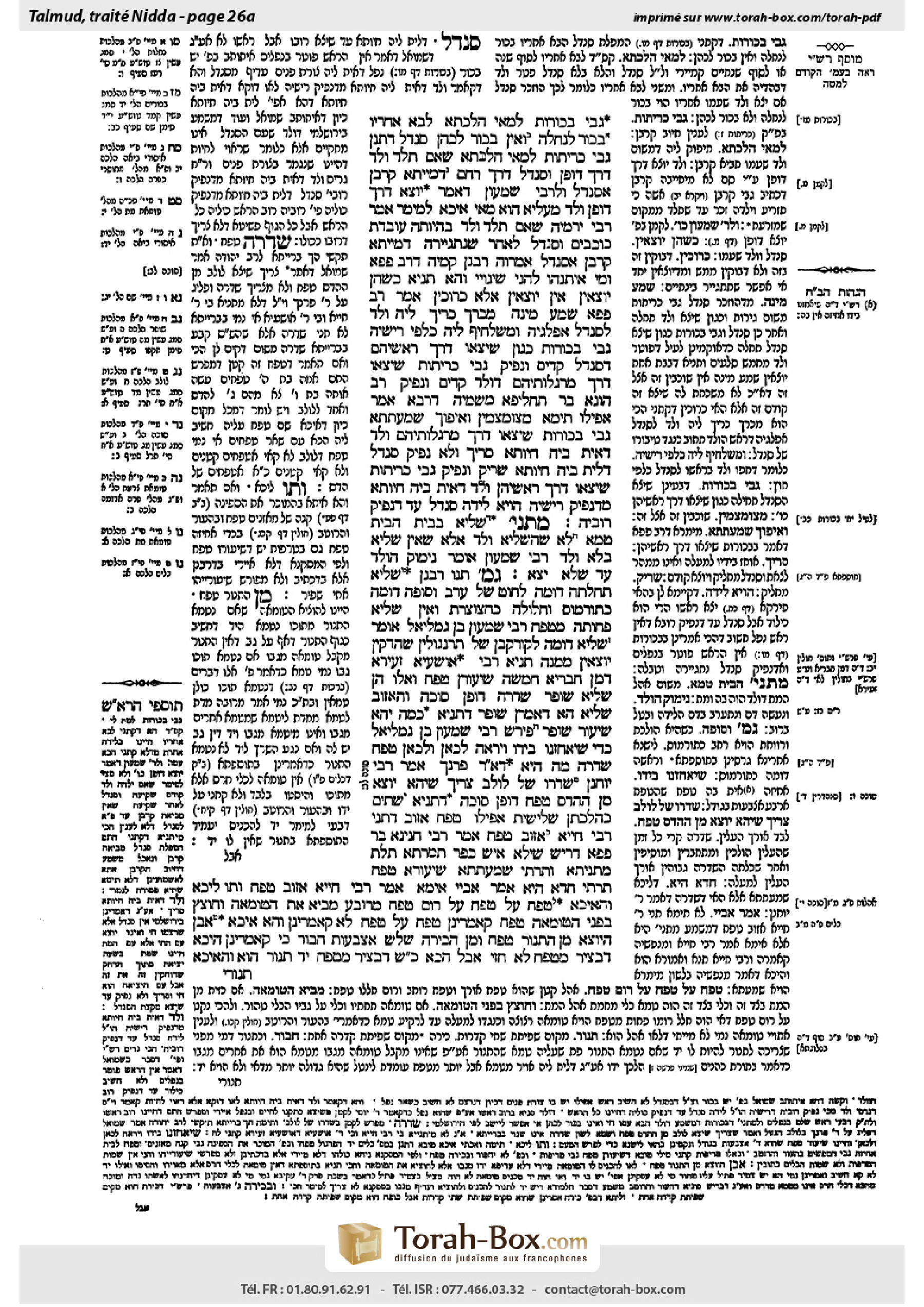
Niddah 26a: Talmud study for Daf Yomi
Daf Yomi is the daily study of one Talmud folio. Explore 37 tractates with scans, Hebrew text, Sefaria English and AI-generated French translations where annotated.
Passage selection and English or AI-generated French translation are available where the scan has annotations. Daf Study is independent of Torah-Box and Sefaria.
Browse Niddah · נידה · All tractatesNiddah 26a text and translations
This page of Niddah includes the Aramaic text, an English translation and an AI-generated French translation, alongside the scan above.
נידה כ״ו א · Aramaic and Hebrew text
גַּבֵּי בְּכוֹרוֹת, לְמַאי הִלְכְתָא?
לַבָּא אַחֲרָיו — בְּכוֹר לְנַחֲלָה, וְאֵין בְּכוֹר לְכֹהֵן.
סַנְדָּל דִּתְנַן גַּבֵּי כָּרֵיתוֹת, לְמַאי הִלְכְתָא?
שֶׁאִם תֵּלֵד וָלָד דֶּרֶךְ דּוֹפֶן, וְסַנְדָּל דֶּרֶךְ רֶחֶם — דְּמַיְיתָא קׇרְבָּן אַסַּנְדָּל.
וּלְרַבִּי שִׁמְעוֹן, דְּאָמַר: יוֹצֵא דֶּרֶךְ דּוֹפֶן וָלָד מְעַלְּיָא הוּא — מַאי אִיכָּא לְמֵימַר?
אָמַר רַבִּי יִרְמְיָה: שֶׁאִם תֵּלֵד וָלָד בְּגַיּוּתָהּ, וְסַנְדָּל לְאַחַר שֶׁנִּתְגַּיְּירָה — דְּמַיְיתָא קׇרְבָּן אַסַּנְדָּל.
אַמְרוּהָ רַבָּנַן קַמֵּיהּ דְּרַב פָּפָּא, וּמִי אִיתַנְהוּ לְהָנֵי שִׁינּוּיֵי? וְהָא תַנְיָא: כְּשֶׁהֵן יוֹצְאִין — אֵין יוֹצְאִין אֶלָּא כְּרוּכִין!
אָמַר רַב פָּפָּא: שְׁמַע מִינָּה, מִכְרַךְ כָּרֵיךְ לֵיהּ וָלָד לְסַנְדָּל אַפַּלְגֵיהּ, וּמְשַׁלְחֵיף לֵיהּ כְּלַפֵּי רֵישֵׁיהּ. גַּבֵּי בְּכוֹרוֹת, כְּגוֹן שֶׁיָּצְאוּ דֶּרֶךְ רָאשֵׁיהֶם, דְּסַנְדָּל קָדֵים וְנָפֵיק. גַּבֵּי כָּרֵיתוֹת, שֶׁיָּצְאוּ דֶּרֶךְ מַרְגְּלוֹתֵיהֶם, דְּוָלָד קָדֵים וְנָפֵיק.
רַב הוּנָא בַּר תַּחְלִיפָא מִשְּׁמֵיהּ דְּרָבָא אָמַר: אֲפִילּוּ תֵּימָא מְצוּמְצָמִין, וְאֵיפוֹךְ שְׁמַעְתָּתָא. גַּבֵּי בְּכוֹרוֹת — שֶׁיָּצְאוּ דֶּרֶךְ מַרְגְּלוֹתֵיהֶם, וָלָד דְּאִית בֵּיהּ חִיּוּתָא סָרֵיךְ וְלָא נָפֵיק, סַנְדָּל דְּלֵית בֵּיהּ חִיּוּתָא שָׁרֵיק וְנָפֵיק. גַּבֵּי כָּרֵיתוֹת — שֶׁיָּצְאוּ דֶּרֶךְ רָאשֵׁיהֶן, וָלָד דְּאִית בֵּיהּ חִיּוּתָא מִדְּנָפֵיק רֵישֵׁיהּ הָוְיָא לֵידָה, סַנְדָּל עַד דְּנָפֵיק רוּבֵּיהּ.
מַתְנִי' שִׁלְיָא בַּבַּיִת — הַבַּיִת טָמֵא, לֹא שֶׁהַשִּׁלְיָא וָלָד, אֶלָּא שֶׁאֵין שִׁלְיָא בְּלֹא וָלָד.
רַבִּי שִׁמְעוֹן אוֹמֵר: נִימּוֹק הַוָּלָד, עַד שֶׁלֹּא יָצָא.
גְּמָ' תָּנוּ רַבָּנַן: שִׁלְיָא — תְּחִלָּתָהּ דּוֹמָה לְחוּט שֶׁל עֵרֶב, וְסוֹפָהּ דּוֹמָה כְּתוֹרְמוֹס, וַחֲלוּלָה כַּחֲצוֹצֶרֶת, וְאֵין שִׁלְיָא פְּחוּתָה מִטֶּפַח. רַבִּי שִׁמְעוֹן בֶּן גַּמְלִיאֵל אוֹמֵר: שִׁלְיָא דּוֹמֶה לְקוּרְקְבָן שֶׁל תַּרְנְגוֹלִין, שֶׁהַדַּקִּין יוֹצְאִין מִמֶּנָּה.
תַּנְיָא: רַבִּי אוֹשַׁעְיָא זְעֵירָא דְמִן חַבְרַיָּא — חֲמִשָּׁה שִׁיעוּרָן טֶפַח, וְאֵלּוּ הֵן: שִׁלְיָא, שׁוֹפָר, שִׁדְרָה, דּוֹפֶן סוּכָּה, וְהָאֵזוֹב.
שִׁלְיָא — הָא דַּאֲמַרַן. שׁוֹפָר — דְּתַנְיָא: כַּמָּה יְהֵא שִׁיעוּר שׁוֹפָר? פֵּירֵשׁ רַבִּי שִׁמְעוֹן בֶּן גַּמְלִיאֵל: כְּדֵי שֶׁיֹּאחֲזֶנּוּ בְּיָדוֹ, וְיֵרָאֶה לְכָאן וּלְכָאן טֶפַח.
שִׁדְרָה מָה הִיא? דְּאָמַר רַבִּי פַּרְנָךְ אָמַר רַבִּי יוֹחָנָן: שִׁדְרוֹ שֶׁל לוּלָב צָרִיךְ שֶׁיְּהֵא יוֹצֵא מִן הַהֲדַס טֶפַח. דּוֹפֶן סוּכָּה — דְּתַנְיָא: שְׁתַּיִם כְּהִלְכָתָן, שְׁלִישִׁית אֲפִילּוּ טֶפַח. אֵזוֹב — דְּתָנֵי רַבִּי חִיָּיא: אֵזוֹב טֶפַח.
אָמַר רַבִּי חֲנִינָא בַּר פָּפָּא: דָּרֵישׁ שֵׁילָא אִישׁ כְּפַר תְּמַרְתָּא — תְּלָת מַתְנְיָתָא, וְתַרְתֵּי שְׁמַעְתָּתָא, שִׁיעוּרָא טֶפַח. תַּרְתֵּי? חֲדָא הִיא! אָמַר אַבָּיֵי: אֵימָא — אָמַר רַבִּי חִיָּיא: אֵזוֹב טֶפַח.
וְתוּ לֵיכָּא? וְהָאִיכָּא טֶפַח עַל טֶפַח עַל רוּם טֶפַח מְרוּבָּע — מֵבִיא אֶת הַטּוּמְאָה, וְחוֹצֵץ בִּפְנֵי הַטּוּמְאָה.
טֶפַח קָאָמְרִינַן, טֶפַח עַל טֶפַח לָא קָאָמְרִינַן.
וְהָא אִיכָּא אֶבֶן הַיּוֹצֵא מִן הַתַּנּוּר טֶפַח, וּמִן הַכִּירָה שָׁלֹשׁ אֶצְבָּעוֹת — חִבּוּר!
כִּי קָאָמְרִינַן הֵיכָא דִּבְצִיר מִטֶּפַח לָא חֲזֵי, אֲבָל הָכָא, כׇּל שֶׁכֵּן דִּבְצִיר מִטֶּפַח — יַד תַּנּוּר הוּא.
וְהָאִיכָּא
Niddah 26a · English translation
with regard to firstborns (Bekhorot 46a), which states that the son who is born after a sandal fetus has the status of a firstborn with regard to inheritance but not with regard to the obligation of redemption from a priest. The Gemara asks: For what matter is that halakha relevant? Since the sandal fetus has a twin that is born with it, the subsequent son is in any case exempt from redemption.
The Gemara answers: That halakha is relevant for a case where the sandal fetus’s twin comes out of the womb after it. The mishna teaches that as the sandal fetus was born first, its twin is considered a firstborn with regard to inheritance, but it is not a firstborn with regard to redemption from a priest.
The Gemara discusses the halakha with regard to a woman who discharged a sandal fetus that we learned in a mishna in tractate Karetot (7b), which states that such a woman brings the offering of a woman who gave birth. The Gemara asks: For what matter is that halakha relevant? In any case that woman is obligated to bring the offering of a woman who gave birth, due to the twin.
The Gemara answers: It is necessary for the mishna to state that if a woman gives birth to a full-fledged offspring by means of caesarean section, and to a sandal fetus in a regular manner through the womb, in such a case she brings an offering for giving birth to the sandal fetus, despite the fact that she does not bring an offering for the full-fledged offspring, as one does not bring an offering for a birth by caesarean section.
The Gemara asks: But according to Rabbi Shimon, who said that an offspring which is delivered by means of caesarean section is considered a full-fledged offspring, and its mother does bring an offering, what is there to say? Why is it necessary for the mishna to state this halakha if the woman must bring an offering regardless of the sandal fetus?
Rabbi Yirmeya says: It is necessary for the mishna to state that if a woman gives birth to the full-fledged offspring while she is a gentile, when the halakhot of a woman after childbirth do not apply to her, and she immediately converts to Judaism and gives birth to the sandal fetus after she converted and became obligated to observe the halakhot of a woman after childbirth, that she brings an offering for the sandal fetus.
The Sages said the answers to these questions before Rav Pappa, and they asked him: And are these answers correct? Can it be suggested that the sandal fetus was born before or after the twin fetus? But isn’t it taught in a baraita that when a sandal fetus and the full-fledged offspring exit the womb, they exit only wrapped around one another?
Rav Pappa said in response: Conclude from it that the sandal fetus and its twin do not lie side by side, but rather the full-fledged offspring encounters the sandal fetus at half its height, i.e., the head of the full-fledged offspring presses into the abdomen of the sandal fetus. And when they are born, the full-fledged offspring pushes the sandal fetus toward the direction its head is pointing, to the entrance of the womb, causing the sandal fetus to be born first. Therefore, the mishna with regard to firstborns can be explained as referring to a case where the fetuses exited the womb with their heads first, as in such a case the sandal fetus emerges first. By contrast, the mishna in tractate Karetot is referring to a case where they emerged with their feet first, as in such a case the full-fledged offspring emerges first.
Rav Huna bar Taḥlifa says in the name of Rava: You may even say that the two fetuses lie precisely side by side, and you should reverse Rav Pappa’s halakha so that it reads as follows: With regard to firstborns, the reference is to a case where the fetuses emerged with their feet first. In such a case, the full-fledged offspring, which has life, hangs on and does not emerge so quickly, whereas the sandal fetus, which does not have life, slides out and emerges first. In tractate Karetot, it is referring to a case where the fetuses came out with their heads first. In such an instance, with regard to the full-fledged offspring, which has life, once its head emerges it is considered a birth, whereas the sandal fetus is considered to have been born only when the majority of its body emerges.
MISHNA: If there is an afterbirth in the house, the house is ritually impure, in the sense that everything under the roof contracts impurity imparted by a corpse. The reason is not that the status of an afterbirth is that of an offspring; rather, it is that there is no afterbirth without an offspring. It is clear that the afterbirth contained an offspring that disintegrated after the miscarriage. That offspring rendered the contents of the house impure.
Rabbi Shimon says: The house does not become a tent over a corpse, as although there had been an offspring in the afterbirth, the offspring disintegrated, turning to blood, before it emerged from the womb, and it was negated by the majority of blood that accompanied the miscarriage.
GEMARA: The Sages taught in a baraita with regard to the appearance of the afterbirth: At the outset of the pregnancy, the afterbirth is so thin that it is similar to a string of the woof, and at the end of the pregnancy it is much wider, similar in width to a lupine. And the afterbirth is hollow like a trumpet, and there is no afterbirth whose length is less than a handbreadth. Rabbi Shimon ben Gamliel says: An afterbirth is similar to the craw of roosters, from which the small intestine emerges.
Since the baraita states that the minimum length of an afterbirth is a handbreadth, the Gemara cites another baraita that lists different items whose halakhic status is dependent on a minimum measure of a handbreadth. It is taught by Rabbi Oshaya, the youngest [ze’eira] of the company [demin ḥavrayya] of Sages: There are five items whose minimum measure is one handbreadth, and these are they: An afterbirth, the shofar for blowing on Rosh HaShana, the spine of a lulav that must be taken on Sukkot, the width of the wall of a sukka, and the hyssop [veha’ezov]. Hyssop is used for the purification of a leper and for the preparation of the ashes of a red heifer in order to sprinkle them with water on someone who is ritually impure due to impurity imparted by a corpse.
The Gemara elaborates: The halakha with regard to an afterbirth is that which we stated above. The halakha of a shofar is as it is taught in a baraita: How much is the measure of the length of a shofar for blowing on Rosh HaShana? Rabbi Shimon ben Gamliel explained: It must be long enough that when one holds it in his hand with four fingers, it can be seen protruding on one side of his hand and on the other side, i.e., at least one handbreadth.
What is the halakha with regard to a spine of a lulav? It is as Rabbi Parnakh said that Rabbi Yoḥanan says: The spine of a lulav must protrude at least one handbreadth beyond the myrtle branch that is tied together with it. The halakha of the wall of a sukka is as it is taught in a baraita: A sukka is valid only if it has two full-fledged partitions in the standard sense, completely closing each of those two sides and measuring at least seven handbreadths, and a third wall that measures even one handbreadth. If the third wall is less than a handbreadth long, the sukka is unfit. Finally, the halakha with regard to the hyssop is stated in a baraita that Rabbi Ḥiyya teaches: The hyssop used for the purification of a leper and for the preparation of the ashes of a red heifer must measure at least one handbreadth.
Rabbi Ḥanina bar Pappa says that Sheila of Kefar Temarta taught as a mnemonic: There are three baraitot, with regard to an afterbirth, a shofar, and the wall of a sukka, and there are two independent halakhot of amora’im, of the spine of a lulav and the hyssop, where the minimum measure of one handbreadth is required. The Gemara asks: Are there two halakhot of amora’im in this list? There is only one statement, with regard to the spine of a lulav. The halakha of the hyssop is taught in a baraita by Rabbi Ḥiyya. Abaye says: Revise the wording of that statement, so that it should not read that Rabbi Ḥiyya taught a baraita; rather, say that Rabbi Ḥiyya says himself that the hyssop must measure at least one handbreadth, i.e., that halakha is not taught in a baraita.
The Gemara asks: And are there no more cases where the minimum measure is one handbreadth, other than those five listed by Rabbi Oshaya? But isn’t there the following mishna (Oholot 3:7) that deals with the minimum size of a tent that transmits ritual impurity: A cubic space measuring one handbreadth by one handbreadth with a height of one handbreadth transmits ritual impurity. If a corpse is in that space, the impurity is transmitted to all people, vessels, and food in that space. And a space of that size serves as a barrier before, i.e., stops the spread of, ritual impurity beyond that space.
The Gemara answers: We said that there are five items whose minimum measure is one handbreadth; we did not say anything about a space whose measure is one handbreadth by one handbreadth.
The Gemara further asks: But isn’t there the following mishna (Kelim 5:2): A stone that protrudes from the oven by one handbreadth, which is used as a handle for lifting and carrying the oven, and similarly a stone that protrudes from the stove three fingerbreadths is considered as having a connection to the oven or stove with regard to ritual impurity. Consequently, if the oven or stove becomes impure, then the stone handle, which is classified as part of the oven, is likewise rendered impure. If the handle is longer than that, the additional length will be removed, so it is not considered to be part of the oven.
The Gemara answers: When we said that there are five items whose minimum measure is one handbreadth, we were referring to cases where if it less than one handbreadth it is unfit for the purpose of the item. But here, where a protruding stone one handbreadth long is considered a handle of the oven, it is all the more so the case that a protruding stone less than one handbreadth long is considered a handle of the oven.
The Gemara asks: But aren’t there
Niddah 26a · Traduction française (IA)
à propos des premiers-nés (Bekhorot 46a), qui enseigne que le fils né après un fœtus « sandale » a le statut de premier-né en matière d’héritage, mais non en matière d’obligation de rachat auprès d’un prêtre. La Guemara demande : À quoi cette halakha est-elle pertinente ? Puisque le fœtus « sandale » a un jumeau qui naît avec lui, le fils suivant est de toute façon exempt du rachat.
La Guemara répond : Cette halakha est pertinente dans le cas où le jumeau du fœtus « sandale » sort de l’utérus après lui. La Michna enseigne que, puisque le fœtus « sandale » est né le premier, son jumeau est considéré comme premier-né en matière d’héritage, mais non en matière de rachat auprès d’un prêtre.
La Guemara examine la halakha concernant une femme qui a expulsé un fœtus « sandale », enseignée dans une Michna du traité Keritot (7b), selon laquelle une telle femme apporte le sacrifice d’une femme qui a accouché. La Guemara demande : À quoi cette halakha est-elle pertinente ? De toute façon, cette femme est tenue d’apporter le sacrifice d’une femme qui a accouché en raison du jumeau.
La Guemara répond : Il est nécessaire que la Michna enseigne que si une femme met au monde un enfant à part entière par césarienne et un fœtus « sandale » par les voies naturelles, elle apporte un sacrifice pour avoir donné naissance au fœtus « sandale », bien qu’elle n’apporte pas de sacrifice pour l’enfant à part entière, car on n’apporte pas de sacrifice pour une naissance par césarienne.
La Guemara demande : Mais selon Rabbi Shimon, qui a dit qu’un enfant mis au monde par césarienne est considéré comme un enfant à part entière et que sa mère apporte bien un sacrifice, que peut-on répondre ? Pourquoi la Michna devait-elle enseigner cette halakha si la femme doit apporter un sacrifice indépendamment du fœtus « sandale » ?
Rabbi Yirmeya dit : Il est nécessaire que la Michna enseigne que si une femme met au monde l’enfant à part entière alors qu’elle est non juive, à une époque où les halakhot concernant la femme après l’accouchement ne s’appliquent pas à elle, puis se convertit immédiatement au judaïsme et met au monde le fœtus « sandale » après sa conversion, alors qu’elle est devenue tenue d’observer les halakhot concernant la femme après l’accouchement, elle apporte un sacrifice pour le fœtus « sandale ».
Les Sages présentèrent ces réponses à Rav Pappa et lui demandèrent : Ces réponses sont-elles exactes ? Peut-on suggérer que le fœtus « sandale » est né avant ou après le fœtus jumeau ? N’est-il pas enseigné dans une baraïta que, lorsque le fœtus « sandale » et l’enfant à part entière sortent de l’utérus, ils ne sortent qu’enlacés l’un à l’autre ?
Rav Pappa répondit : Déduis de cela que le fœtus « sandale » et son jumeau ne sont pas couchés côte à côte ; l’enfant à part entière se trouve plutôt à mi-hauteur du fœtus « sandale », c’est-à-dire que la tête de l’enfant à part entière s’enfonce dans l’abdomen du fœtus « sandale ». Lors de la naissance, l’enfant à part entière pousse le fœtus « sandale » vers l’entrée de l’utérus, dans la direction où sa tête est orientée, ce qui fait que le fœtus « sandale » naît le premier. Par conséquent, la Michna concernant les premiers-nés peut être comprise comme faisant référence à un cas où les fœtus sont sortis de l’utérus la tête la première, car dans ce cas le fœtus « sandale » sort le premier. En revanche, la Michna du traité Keritot fait référence à un cas où ils sont sortis les pieds en premier ; dans ce cas, c’est l’enfant à part entière qui sort le premier.
Rav Houna bar Taḥlifa dit au nom de Rava : On peut même dire que les deux fœtus sont couchés exactement côte à côte, et il faut inverser la halakha de Rav Pappa pour la formuler ainsi : concernant les premiers-nés, il s’agit d’un cas où les fœtus sont sortis les pieds en premier. Dans ce cas, l’enfant à part entière, qui est vivant, reste accroché et ne sort pas aussi rapidement, tandis que le fœtus « sandale », qui n’est pas vivant, glisse et sort le premier. Le traité Keritot, lui, traite d’un cas où les fœtus sont sortis la tête la première. Dans ce cas, pour l’enfant à part entière, qui est vivant, sa naissance est considérée comme ayant eu lieu dès que sa tête sort, tandis que le fœtus « sandale » n’est considéré comme né que lorsque la majeure partie de son corps est sortie.
MICHNA : S’il y a un placenta dans la maison, la maison est rituellement impure, en ce sens que tout ce qui se trouve sous son toit contracte l’impureté transmise par un cadavre. Ce n’est pas parce que le placenta a le statut d’un enfant, mais parce qu’il n’y a pas de placenta sans enfant. Il est clair que le placenta contenait un enfant qui s’est désagrégé après la fausse couche. Cet enfant a rendu impurs les objets se trouvant dans la maison.
Rabbi Shimon dit : La maison ne devient pas une tente au-dessus d’un cadavre, car, même s’il y avait eu un enfant dans le placenta, celui-ci s’est désagrégé et transformé en sang avant de sortir de l’utérus ; il a alors été annulé par la majorité du sang qui accompagnait la fausse couche.
GUEMARA : Les Sages ont enseigné dans une baraïta au sujet de l’aspect du placenta : au début de la grossesse, le placenta est si mince qu’il ressemble à un fil de trame ; vers la fin de la grossesse, il est beaucoup plus large, d’une largeur comparable à celle d’une lupine. Le placenta est creux comme une trompette et aucun placenta ne mesure moins d’une coudée. Rabbi Shimon ben Gamliel dit : Le placenta ressemble au jabot des coqs, d’où sort l’intestin grêle.
Puisque la baraïta indique que la longueur minimale d’un placenta est d’une coudée, la Guemara cite une autre baraïta qui énumère différents éléments dont le statut halakhique dépend d’une mesure minimale d’une coudée. Rabbi Oshaya, le plus jeune [ze’eira] du groupe [demin ḥavrayya] des Sages, enseigne : cinq éléments ont pour mesure minimale une coudée, les voici : un placenta, le chofar dont on sonne à Roch Hachana, la nervure centrale d’un loulav que l’on doit prendre à Souccot, la largeur du mur d’une soukka et l’hysope [veha’ezov]. L’hysope sert à la purification d’un lépreux et à la préparation des cendres d’une vache rousse, afin qu’on les mélange à de l’eau et qu’on en asperge une personne rituellement impure en raison de l’impureté transmise par un cadavre.
La Guemara détaille : la halakha concernant le placenta est celle que nous avons énoncée plus haut. La halakha du chofar est enseignée dans une baraïta : quelle doit être la longueur du chofar dont on sonne à Roch Hachana ? Rabbi Shimon ben Gamliel explique : il doit être assez long pour que, lorsqu’on le tient dans la main avec quatre doigts, il dépasse visiblement de chaque côté de la main, c’est-à-dire qu’il mesure au moins une coudée.
Quelle est la halakha concernant la nervure centrale d’un loulav ? Rabbi Parnakh rapporte au nom de Rabbi Yoḥanan que la nervure centrale d’un loulav doit dépasser d’au moins une coudée la branche de myrte qui y est attachée. La halakha concernant le mur d’une soukka est enseignée dans une baraïta : une soukka n’est valide que si elle comporte deux cloisons complètes au sens habituel, fermant entièrement chacun de ces deux côtés et mesurant au moins sept coudées, ainsi qu’un troisième mur mesurant au moins une coudée. Si le troisième mur mesure moins d’une coudée, la soukka est invalide. Enfin, la halakha concernant l’hysope est énoncée dans une baraïta enseignée par Rabbi Ḥiyya : l’hysope utilisée pour la purification d’un lépreux et pour la préparation des cendres d’une vache rousse doit mesurer au moins une coudée.
Rabbi Ḥanina bar Pappa rapporte que Sheila de Kefar Temarta enseignait un moyen mnémotechnique : il y a trois baraïtot concernant le placenta, le chofar et le mur d’une soukka, et deux halakhot indépendantes d’amoraïm, concernant la nervure centrale d’un loulav et l’hysope, pour lesquelles une mesure minimale d’une coudée est requise. La Guemara demande : Y a-t-il deux halakhot d’amoraïm dans cette liste ? Il n’y a qu’une seule déclaration, concernant la nervure centrale d’un loulav. La halakha de l’hysope est enseignée dans une baraïta par Rabbi Ḥiyya. Abaye dit : Corrige la formulation de cette déclaration : il ne faut pas lire que Rabbi Ḥiyya a enseigné une baraïta ; dis plutôt que Rabbi Ḥiyya dit lui-même que l’hysope doit mesurer au moins une coudée, c’est-à-dire que cette halakha n’est pas enseignée dans une baraïta.
La Guemara demande : N’existe-t-il pas d’autres cas où la mesure minimale est d’une coudée, en dehors des cinq éléments énumérés par Rabbi Oshaya ? N’y a-t-il pas la Michna suivante (Oholot 3:7), qui traite de la taille minimale d’un espace en forme de tente transmettant l’impureté rituelle : un espace cubique mesurant une coudée sur une coudée et une coudée de hauteur transmet l’impureté rituelle. Si un cadavre se trouve dans cet espace, l’impureté est transmise à toutes les personnes, à tous les objets et à tous les aliments qui s’y trouvent. Un espace de cette taille fait aussi office de barrière contre l’impureté, c’est-à-dire qu’il empêche sa propagation au-delà de cet espace.
La Guemara répond : Nous avons dit qu’il y avait cinq éléments dont la mesure minimale est d’une coudée ; nous n’avons rien dit concernant un espace mesurant une coudée sur une coudée.
La Guemara demande encore : N’y a-t-il pas la Michna suivante (Kelim 5:2) : une pierre qui dépasse du four d’une coudée et sert de poignée pour soulever et transporter le four, ainsi qu’une pierre qui dépasse du foyer de trois largeurs de doigt, est considérée comme rattachée au four ou au foyer en matière d’impureté rituelle. Par conséquent, si le four ou le foyer devient impur, la pierre servant de poignée, considérée comme faisant partie du four, devient elle aussi impure. Si la poignée est plus longue que cela, la longueur excédentaire est retirée ; elle n’est donc pas considérée comme faisant partie du four.
La Guemara répond : Lorsque nous avons dit qu’il y avait cinq éléments dont la mesure minimale est d’une coudée, nous parlions de cas où, si l’élément mesure moins d’une coudée, il est impropre à l’usage auquel il est destiné. Mais ici, puisqu’une pierre qui dépasse du four d’une coudée est considérée comme sa poignée, à plus forte raison une pierre qui dépasse du four de moins d’une coudée est-elle considérée comme sa poignée.
La Guemara demande : Mais n’y a-t-il pas
Traduction française générée par IA à partir de l’édition anglaise de Sefaria. Vérifie toujours un passage avec le texte source.
Text from Sefaria: William Davidson Edition - Vocalized Aramaic (CC BY NC); William Davidson Edition - English (CC BY NC).