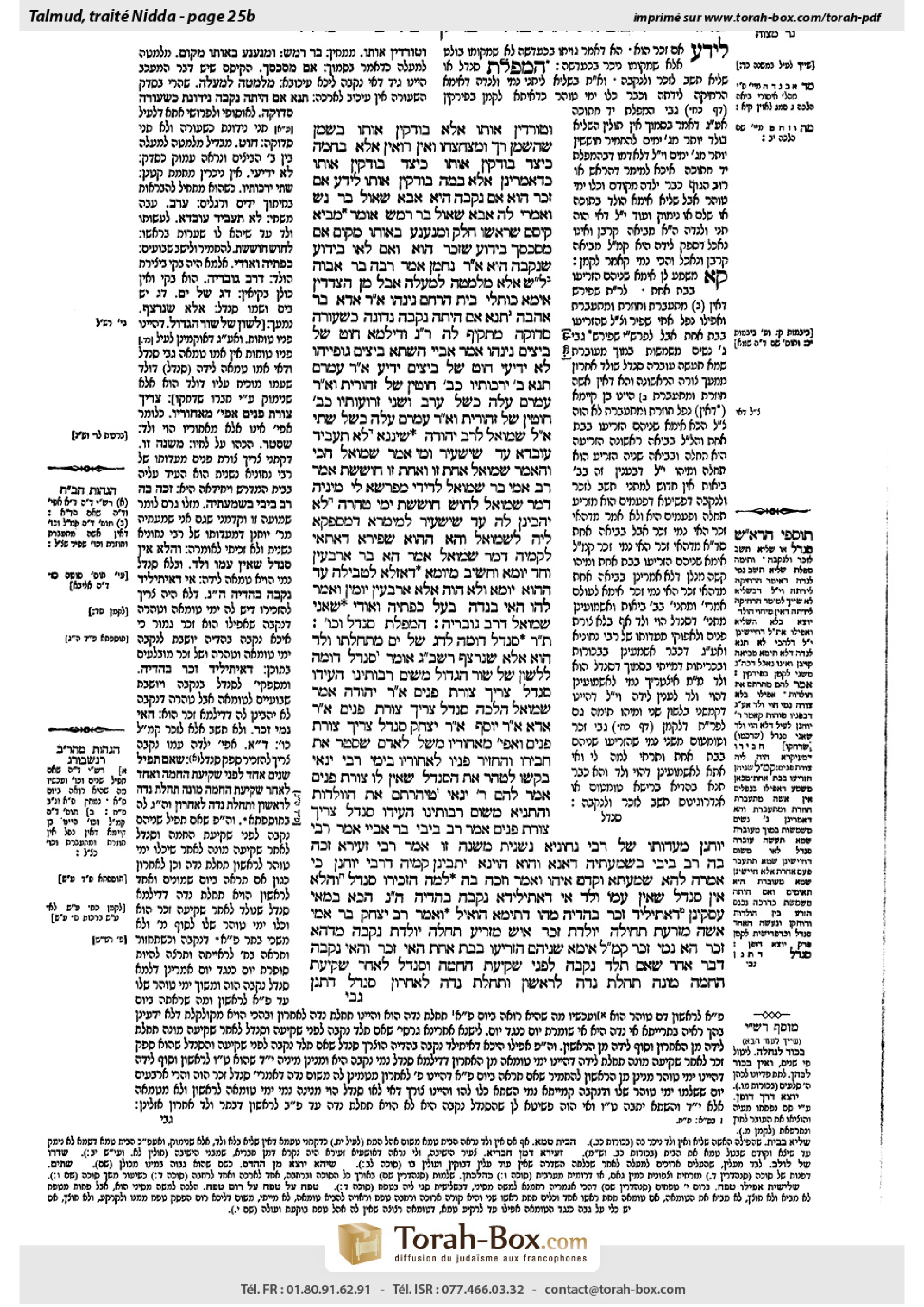
Niddah 25b: Talmud study for Daf Yomi
Daf Yomi is the daily study of one Talmud folio. Explore 37 tractates with scans, Hebrew text, Sefaria English and AI-generated French translations where annotated.
Passage selection and English or AI-generated French translation are available where the scan has annotations. Daf Study is independent of Torah-Box and Sefaria.
Browse Niddah · נידה · All tractatesNiddah 25b text and translations
This page of Niddah includes the Aramaic text, an English translation and an AI-generated French translation, alongside the scan above.
נידה כ״ה ב · Aramaic and Hebrew text
וְטוֹרְדִין אוֹתוֹ, אֶלָּא בּוֹדְקִין אוֹתוֹ בְּשֶׁמֶן — שֶׁהַשֶּׁמֶן רַךְ וּמְצַחְצְחוֹ, וְאֵין רוֹאִין אֶלָּא בַּחַמָּה.
כֵּיצַד בּוֹדְקִין אוֹתוֹ? כֵּיצַד בּוֹדְקִין אוֹתוֹ?! כִּדְאָמְרִינַן! אֶלָּא, בַּמֶּה בּוֹדְקִין אוֹתוֹ לֵידַע אִם זָכָר הוּא אִם נְקֵבָה הִיא?
אַבָּא שָׁאוּל בַּר נַשׁ, וְאָמְרִי לַהּ אַבָּא שָׁאוּל בַּר רֶמֶשׂ, אוֹמֵר: מֵבִיא קֵיסָם שֶׁרֹאשׁוֹ חָלָק, וּמְנַעְנֵעַ בְּאוֹתוֹ מָקוֹם, אִם מְסַכְסֵךְ — בְּיָדוּעַ שֶׁזָּכָר הוּא, וְאִם לָאו — בְּיָדוּעַ שֶׁנְּקֵבָה הִיא.
אָמַר רַב נַחְמָן אָמַר רַבָּה בַּר אֲבוּהּ: לֹא שָׁנוּ אֶלָּא מִלְּמַטָּה לְמַעְלָה, אֲבָל מִן הַצְּדָדִין — אֵימָא כּוֹתְלֵי בֵּית הָרֶחֶם נִינְהוּ.
אָמַר רַב אַדָּא בַּר אַהֲבָה: תָּנָא, ״אִם הָיְתָה נְקֵבָה — נְדוֹנָה כִּשְׂעוֹרָה סְדוּקָה״. מַתְקֵיף לַהּ רַב נַחְמָן: וְדִילְמָא חוּט שֶׁל בֵּיצִים נִינְהוּ? אָמַר אַבָּיֵי: הַשְׁתָּא בֵּיצִים גּוּפַיְיהוּ לָא יְדִיעִי, חוּט שֶׁל בֵּיצִים יְדִיעַ?
אָמַר רַבִּי עַמְרָם, תָּנָא: שְׁתֵּי יַרְכוֹתָיו כִּשְׁנֵי חוּטִין שֶׁל זְהוֹרִית. וְאָמַר רַבִּי עַמְרָם עֲלַהּ: כְּשֶׁל עֵרֶב. וּשְׁנֵי זְרוֹעוֹתָיו כִּשְׁנֵי חוּטִין שֶׁל זְהוֹרִית, וְאָמַר רַבִּי עַמְרָם עֲלַהּ: כְּשֶׁל שְׁתִי.
אֲמַר לֵיהּ שְׁמוּאֵל לְרַב יְהוּדָה: שִׁינָּנָא, לָא תַּעֲבֵיד עוֹבָדָא עַד שֶׁיַּשְׂעִיר. וּמִי אָמַר שְׁמוּאֵל הָכִי? וְהָאָמַר שְׁמוּאֵל: אַחַת זוֹ וְאַחַת זוֹ חוֹשֶׁשֶׁת!
אָמַר רַב אַמֵּי בַּר שְׁמוּאֵל: לְדִידִי מִפָּרְשָׁא לִי מִינֵּיהּ דְּמָר שְׁמוּאֵל — לָחוֹשׁ חוֹשֶׁשֶׁת, יְמֵי טׇהֳרָה לָא יָהֲבִינַן לַהּ עַד שֶׁיַּשְׂעִיר.
לְמֵימְרָא דִּמְסַפְּקָא לֵיהּ לִשְׁמוּאֵל? וְהָא הָהוּא שְׁפִירָא דַּאֲתָאי לְקַמֵּיהּ דְּמָר שְׁמוּאֵל, אֲמַר: ״הָא בַּר אַרְבְּעִין וְחַד יוֹמָא״, וְחַשֵּׁיב מִיּוֹמָא דְּאָזְלָא לִטְבִילָה עַד הָהוּא יוֹמָא, וְלָא הֲוָה אֶלָּא אַרְבְּעִין יוֹמִין,
וַאֲמַר לְהוּ: הַאי בְּנִדָּה בְּעַל; כַּפְתֵיהּ, וְאוֹדִי! שָׁאנֵי שְׁמוּאֵל, דְּרַב גּוּבְרֵיהּ.
הַמַּפֶּלֶת סַנְדָּל וְכוּ׳. תָּנוּ רַבָּנַן: סַנְדָּל דּוֹמֶה לַדָּג שֶׁל יָם, מִתְּחִלָּתוֹ וָלָד הוּא, אֶלָּא שֶׁנִּרְצַף. רַבָּן שִׁמְעוֹן בֶּן גַּמְלִיאֵל אוֹמֵר: סַנְדָּל דּוֹמֶה לַלָּשׁוֹן שֶׁל שׁוֹר הַגָּדוֹל. מִשּׁוּם רַבּוֹתֵינוּ הֵעִידוּ: סַנְדָּל צָרִיךְ צוּרַת פָּנִים.
אָמַר רַב יְהוּדָה, אָמַר שְׁמוּאֵל: הֲלָכָה, סַנְדָּל צָרִיךְ צוּרַת פָּנִים. אָמַר רַב אַדָּא, אָמַר רַב יוֹסֵף, אָמַר רַבִּי יִצְחָק: סַנְדָּל צָרִיךְ צוּרַת פָּנִים, וַאֲפִילּוּ מֵאֲחוֹרָיו. מָשָׁל לְאָדָם שֶׁסָּטַר אֶת חֲבֵירוֹ, וְהֶחְזִיר פָּנָיו לַאֲחוֹרָיו.
בִּימֵי רַבִּי יַנַּאי, בִּקְּשׁוּ לְטַהֵר אֶת הַסַּנְדָּל שֶׁאֵין לוֹ צוּרַת פָּנִים. אָמַר לָהֶם רַבִּי יַנַּאי: טִיהַרְתֶּם אֶת הַוְּולָדוֹת!
וְהָתַנְיָא: מִשּׁוּם רַבּוֹתֵינוּ הֵעִידוּ: סַנְדָּל צָרִיךְ צוּרַת פָּנִים! אָמַר רַב בִּיבִי בַּר אַבָּיֵי אָמַר רַבִּי יוֹחָנָן: מֵעֵדוּתוֹ שֶׁל רַבִּי נְחוּנְיָא נִשְׁנֵית מִשְׁנָה זוֹ. אָמַר רַבִּי זְעֵירָא: זְכָה בַּהּ רַב בִּיבִי בִּשְׁמַעְתֵּיהּ, דַּאֲנָא וְהוּא הֲוֵינָא יָתְבִין קַמֵּיהּ דְּרַבִּי יוֹחָנָן כִּי אַמְרַהּ לְהָא שְׁמַעְתָּא, וּקְדַם אִיהוּ וַאֲמַר וּזְכָה בַּהּ.
לָמָּה הִזְכִּירוּ סַנְדָּל, וַהֲלֹא אֵין סַנְדָּל שֶׁאֵין עִמּוֹ וָלָד?
אִי דְּאִתְיְלִידָא נְקֵבָה בַּהֲדֵיהּ — הָכִי נָמֵי, הָכָא בְּמַאי עָסְקִינַן — דְּאִתְיְלִיד זָכָר בַּהֲדֵיהּ.
מַהוּ דְּתֵימָא: הוֹאִיל וְאָמַר רַב יִצְחָק בַּר אַמֵּי, אִשָּׁה מַזְרַעַת תְּחִילָּה — יוֹלֶדֶת זָכָר, אִישׁ מַזְרִיעַ תְּחִלָּה — יוֹלֶדֶת נְקֵבָה, מִדְּהָא זָכָר — הָא נָמֵי זָכָר.
קָא מַשְׁמַע לַן: אֵימָא שְׁנֵיהֶם הִזְרִיעוּ בְּבַת אַחַת, הַאי זָכָר וְהַאי נְקֵבָה.
דָּבָר אַחֵר: שֶׁאִם תֵּלֵד נְקֵבָה לִפְנֵי שְׁקִיעַת הַחַמָּה, וְסַנְדָּל לְאַחַר שְׁקִיעַת הַחַמָּה —
מוֹנֶה תְּחִלַּת נִדָּה לָרִאשׁוֹן, וּתְחִלַּת נִדָּה לָאַחֲרוֹן.
סַנְדָּל דִּתְנַן
Niddah 25b · English translation
and dissolves it. Rather, one examines it with oil, as oil is soft and cleans the embryo so that its sex can be discerned. And one views it only in the light of the sun.
The baraita continues: How does one examine the embryo? The Gemara expresses surprise at this question: How does one examine it to determine whether it has the halakhic status of an offspring? Clearly, one examines it as we just said. Rather, the question is as follows: In what manner does one examine it to ascertain whether it is male or whether it is female?
Abba Shaul bar Nash, and some say Abba Shaul bar Remash, says: One brings a sliver of wood whose top is smooth, and he moves it along the embryo in that place, i.e., the sex organ. If the sliver is caught, i.e., its movement is not smooth, it is known that the embryo is male, as its member interfered with the movement of the sliver. And if the sliver is not caught, it is known that it is female.
Rav Naḥman says that Rabba bar Avuh says: They taught this halakha, that if the movement of the sliver is not smooth then the embryo is male, only if the sliver was moved along the sex organ of the embryo from below to above; but if it was moved from the sides, from one side to the other, the fact that it was not smooth does not prove that the embryo is male, as one can say that the sides of the womb interfered.
Rav Adda bar Ahava says: The complete version of the baraita is taught as follows: If it was female, its vagina can be discerned by the appearance of a line like a cracked grain of barley oriented along the length of its body. Rav Naḥman objects to this: But perhaps it is not the vagina but the recess between the testes, and the embryo is male. Abaye said to him: Now, at this stage of development, the testes of the embryo themselves are not discernible. Is it possible that the recess between the testes is discernible?
The baraita teaches that at this stage an embryo does not have the shape of arms and legs. Rabbi Amram says that it is taught in a baraita that when an embryo’s arms and legs start to take shape, its two thighs look like two strings of crimson thread [zehorit]. And Rabbi Amram says with regard to this matter that the thighs look like two strings of the woof, which are thicker than those of the warp. The baraita adds: And its two arms look like two strings of crimson thread. And Rabbi Amram says with regard to this matter that the arms look like two strings of the warp.
Shmuel said to Rav Yehuda: Shinnana, do not perform an action, i.e., do not issue a practical ruling deeming a woman who discharges an embryo at this stage of development impure, unless the embryo has grown hair. The Gemara asks: And did Shmuel actually say that? But doesn’t Shmuel say with regard to a woman who discharged a gestational sac that both in this case, where the amniotic fluid is turbid, and in that case, where the fluid is clear, the woman must be concerned that the discharged gestational sac might have the status of an offspring, which would mean that she is impure even without the growth of hair on the embryo?
Rav Ami bar Shmuel says: This matter was explained to me by Mar Shmuel: As for being concerned that perhaps she is impure, the woman must be concerned, due to the uncertainty whether she discharged an offspring. But we do not give her the days of purity that follow the period of impurity for a woman who gave birth, unless the embryo has grown hair.
The Gemara asks: Is that to say that Shmuel is uncertain whether a gestational sac has the halakhic status of an offspring? But there was an incident involving a certain gestational sac that was brought before Mar Shmuel, and Shmuel said: This embryo is forty-one days old. And Shmuel subsequently calculated the amount of time that had passed from the day that the woman went to perform immersion in a ritual bath until that day, and it was only forty days.
And he said to the local court: This husband engaged in intercourse with his wife when she was a menstruating woman. They bound the husband and he confessed. Since Shmuel was so proficient in embryology, why was he unsure about the halakhic status of a gestational sac? The Gemara answers: Shmuel himself is different, as his strength, i.e., his proficiency, was great. His general ruling that the halakhic status of a gestational sac is uncertain applies to people who are not as proficient as he is.
§ The mishna teaches that a woman who discharges a sandal fetus or one who discharges an afterbirth observes the strictures of a woman who gave birth both to a male and to a female. The Sages taught in a baraita: A sandal fetus has a similar appearance to a certain fish of the sea known as a sandal fish;it looks as though it is a full-fledged offspring from the outset, but it was mashed. Rabban Shimon ben Gamliel says: A sandal fetus has an appearance that is similar to the tongue of the large bull. Students testified in the name of our teachers that for a sandal fetus to have the halakhic status of an offspring, it requires the shape of a face.
Rav Yehuda says that Shmuel says: The halakha is that a sandal fetus requires the shape of a face for it to have the status of an offspring. Rav Adda says that Rav Yosef says that Rabbi Yitzḥak says: A sandal fetus requires the shape of a face, but the face does not need to be in its proper location; even if the face is on the back of its head, the fetus has the status of an offspring. A parable to which this situation can be compared is that of a person who slapped another in the face and pushed his face back. Here too, the face of the sandal fetus was pushed back due to external pressure.
The Gemara relates: In the days of Rabbi Yannai, the other Sages wished to deem pure a woman who discharges a sandal fetus that does not have the shape of a face. Rabbi Yannai said to them: You have deemed pure women who discharge offspring. Rabbi Yannai holds that even a sandal fetus that does not have the shape of a face is considered an offspring.
The Gemara asks: But isn’t it taught in a baraita that students testified in the name of our teachers that for a sandal fetus to have the halakhic status of an offspring it requires the shape of a face? Rav Beivai bar Abaye says that Rabbi Yoḥanan says in response: This mishna, i.e., the ruling to which the students testified, is taught from the testimony of Rabbi Neḥunya. In other words, this ruling is the opinion of an individual tanna, which is not accepted. Rabbi Zeira says: Rav Beivai merited that his ruling of halakha, which he transmitted in the name of Rabbi Yoḥanan, was accepted. As he and I were both sitting before Rabbi Yoḥanan when Rabbi Yoḥanan said this halakha, but Rav Beivai said it first to the other Sages, and thereby merited that it was ascribed to him.
§ The Gemara asks: Why does the mishna mention that if a woman discharged a sandal fetus she observes the strictures of a woman who gave birth both to a male and to a female? Since there is no such thing as a sandal fetus that does not have another offspring with it, which mashed it and gave it the form of a sandal fish, in any case the woman has the impurity of a woman after childbirth.
The Gemara answers: If it is a female offspring that is born with the sandal fetus, it is indeed unnecessary to mention the halakha of the sandal fetus, as the woman is in any case impure for two weeks. But here we are dealing with a case where a male is born with it, on account of which the woman would be impure for only seven days were it not for the sandal fetus.
In this case, it is necessary for the mishna to state that the woman observes the strictures of one who gave birth both to a male and to a female, lest you say that since Rav Yitzḥak bar Ami says that the sex of a fetus is determined at the moment of conception, as, if the woman emits seed first she gives birth to a male and if the man emits seed first she gives birth to a female, therefore, it can be concluded from the fact that this offspring that was born with the sandal fetus is male, that this sandal fetus is also male.
Lest this reasoning be accepted, the mishna teaches us that the woman must observe the strictures of a woman who gave birth to a female as well. This is because one can say that perhaps both the man and the woman emitted seed at the same time, and consequently this offspring is male and that sandal fetus is female.
Alternatively, it can be suggested that it is necessary for the mishna to state this halakha even with regard to a case where the twin of the sandal fetus is female, as, if the woman gives birth to the female before sunset and gives birth to the sandal fetus after sunset, which is considered the next day, the sex of the sandal fetus affects the count of the woman’s periods of impurity and purity.
If the sandal fetus is male, the woman’s status as a woman after childbirth ends after the eightieth day from the birth of the female offspring, and she counts the beginning of the period when seeing blood renders her impure as a menstruating woman from the birth of the first offspring, i.e., the female. But if the sandal fetus is female, the woman has the status of a woman after childbirth until after the eightieth day from its birth, which is the eighty-first day from the birth of the first offspring. If so, she counts the beginning of the period when seeing blood renders her impure as a menstruating woman from the birth of the last offspring, i.e., the sandal fetus.
The Gemara discusses why the case of a woman who discharged a sandal fetus is mentioned in other mishnayot, given that a sandal fetus always has a twin. First the Gemara discusses the halakha of a woman who discharged a sandal fetus that we learned in a mishna
Niddah 25b · Traduction française (IA)
et le dissout. On l’examine plutôt avec de l’huile, car l’huile est douce et nettoie l’embryon, de sorte que son sexe puisse être discerné. On ne l’observe qu’à la lumière du soleil.
La baraïta poursuit : Comment examine-t-on l’embryon ? La Guemara s’étonne de cette question : comment l’examine-t-on pour déterminer s’il a le statut halakhique d’un enfant ? De toute évidence, on l’examine comme nous venons de le dire. La question est plutôt la suivante : de quelle manière l’examine-t-on pour déterminer s’il est mâle ou femelle ?
Abba Shaul bar Nash — certains disent Abba Shaul bar Remash — dit : On prend une écharde de bois dont l’extrémité est lisse et on la fait glisser le long de l’embryon, à cet endroit, c’est-à-dire l’organe sexuel. Si l’écharde accroche, autrement dit si son mouvement n’est pas fluide, on sait que l’embryon est mâle, car son membre a gêné le mouvement de l’écharde. Si elle n’accroche pas, on sait qu’il est femelle.
Rav Naḥman dit au nom de Rabba bar Avuh : Cette halakha, selon laquelle l’embryon est mâle si le mouvement de l’écharde n’est pas fluide, n’a été enseignée que lorsque l’écharde a été déplacée le long de l’organe sexuel de l’embryon de bas en haut. Mais si elle a été déplacée latéralement, d’un côté à l’autre, le fait que son mouvement n’ait pas été fluide ne prouve pas que l’embryon est mâle, car on peut dire que ce sont les parois de l’utérus qui l’ont gênée.
Rav Adda bar Ahava dit : La version complète de la baraïta est enseignée ainsi : si l’embryon est femelle, on peut distinguer son vagin, qui apparaît comme une ligne semblable à un grain d’orge fendu, orientée dans le sens de la longueur de son corps. Rav Naḥman objecte : Mais peut-être ne s’agit-il pas du vagin, mais du creux entre les testicules, et l’embryon est mâle. Abaye lui dit : À ce stade du développement, les testicules de l’embryon eux-mêmes ne sont pas discernables. Est-il possible que le creux entre les testicules le soit ?
La baraïta enseigne qu’à ce stade l’embryon n’a pas encore la forme de bras et de jambes. Rabbi Amram dit qu’une baraïta enseigne que, lorsque les bras et les jambes de l’embryon commencent à prendre forme, ses deux cuisses ressemblent à deux fils de cramoisi [zehorit]. Rabbi Amram précise à ce sujet que les cuisses ressemblent à deux fils de trame, plus épais que ceux de la chaîne. La baraïta ajoute : ses deux bras ressemblent à deux fils de cramoisi. Rabbi Amram précise à ce sujet que les bras ressemblent à deux fils de chaîne.
Shmuel dit à Rav Yehuda : Shinnana, ne rends pas de décision pratique — ne statue pas qu’une femme qui expulse un embryon à ce stade de son développement est impure — tant que l’embryon n’a pas de cheveux. La Guemara demande : Shmuel a-t-il vraiment dit cela ? Pourtant, Shmuel dit, à propos d’une femme qui expulse un sac gestationnel, que, aussi bien dans le cas où le liquide amniotique est trouble que dans celui où il est clair, la femme doit tenir compte de la possibilité que le sac gestationnel expulsé ait le statut d’un enfant, ce qui signifie qu’elle est impure même si l’embryon n’a pas de cheveux.
Rav Ami bar Shmuel dit : Mar Shmuel m’a expliqué la chose ainsi : la femme doit tenir compte de la possibilité qu’elle soit impure, en raison de l’incertitude quant au fait qu’elle ait expulsé ou non un enfant. Mais on ne lui accorde pas les jours de pureté qui suivent la période d’impureté d’une femme ayant accouché, tant que l’embryon n’a pas de cheveux.
La Guemara demande : Cela signifie-t-il que Shmuel ne sait pas avec certitude si un sac gestationnel a le statut halakhique d’un enfant ? Pourtant, un jour, on amena devant Mar Shmuel un certain sac gestationnel, et Shmuel dit : « Cet embryon a quarante et un jours. » Puis Shmuel calcula le temps écoulé entre le jour où la femme était allée s’immerger dans un bain rituel et ce jour-là : il n’y avait que quarante jours.
Il dit alors au tribunal local : « Ce mari a eu des rapports avec sa femme alors qu’elle était nida. » On ligota le mari, qui avoua. Puisque Shmuel était si compétent en embryologie, pourquoi était-il incertain quant au statut halakhique d’un sac gestationnel ? La Guemara répond : Shmuel lui-même fait exception, car ses capacités, c’est-à-dire son expertise, étaient grandes. Sa décision générale selon laquelle le statut halakhique d’un sac gestationnel est incertain s’applique aux personnes qui ne sont pas aussi expertes que lui.
§ La Michna enseigne qu’une femme qui expulse un fœtus-sandale ou une délivrance observe les restrictions applicables à une femme ayant accouché aussi bien d’un mâle que d’une femelle. Les Sages ont enseigné dans une baraïta : le fœtus-sandale ressemble à un certain poisson de mer appelé poisson-sandale ; il semble être un enfant parfaitement formé dès le départ, mais il a été écrasé. Rabban Shimon ben Gamliel dit : le fœtus-sandale ressemble à la langue d’un grand taureau. Des élèves ont témoigné au nom de nos maîtres que, pour qu’un fœtus-sandale ait le statut halakhique d’un enfant, il doit avoir la forme d’un visage.
Rav Yehuda dit au nom de Shmuel : La halakha est qu’un fœtus-sandale doit avoir la forme d’un visage pour avoir le statut d’un enfant. Rav Adda dit au nom de Rav Yosef, qui le tient de Rabbi Yitzḥak : le fœtus-sandale doit avoir la forme d’un visage, mais celui-ci n’a pas besoin d’être à sa place habituelle ; même si le visage se trouve à l’arrière de sa tête, le fœtus a le statut d’un enfant. On peut comparer cette situation au cas d’une personne qui gifle une autre au visage et lui repousse le visage vers l’arrière. De même, le visage du fœtus-sandale a été repoussé sous l’effet d’une pression extérieure.
La Guemara rapporte : À l’époque de Rabbi Yannai, les autres Sages voulurent déclarer pure une femme qui expulsait un fœtus-sandale dépourvu de la forme d’un visage. Rabbi Yannai leur dit : « Vous avez déclaré pures des femmes qui expulsent des enfants ! » Rabbi Yannai considère qu’un fœtus-sandale est un enfant même s’il n’a pas la forme d’un visage.
La Guemara demande : Pourtant, n’est-il pas enseigné dans une baraïta que des élèves ont témoigné au nom de nos maîtres qu’un fœtus-sandale doit avoir la forme d’un visage pour avoir le statut halakhique d’un enfant ? Rav Beivai bar Abaye répond au nom de Rabbi Yoḥanan : Cette Michna, c’est-à-dire la décision rapportée par les élèves, est enseignée sur la base du témoignage de Rabbi Neḥunya. Autrement dit, cette décision est l’opinion d’un tanna isolé, qui n’a pas été retenue. Rabbi Zeira dit : Rav Beivai a eu le mérite que la halakha qu’il a transmise au nom de Rabbi Yoḥanan soit acceptée. En effet, lui et moi étions assis devant Rabbi Yoḥanan lorsque celui-ci a énoncé cette halakha, mais Rav Beivai l’a rapportée le premier aux autres Sages et a ainsi mérité qu’elle lui soit attribuée.
§ La Guemara demande : Pourquoi la Michna précise-t-elle que, si une femme a expulsé un fœtus-sandale, elle observe les restrictions applicables à une femme ayant accouché aussi bien d’un mâle que d’une femelle ? Puisqu’un fœtus-sandale ne peut exister sans un autre enfant avec lui, qui l’a écrasé et lui a donné la forme d’un poisson-sandale, la femme est de toute façon en état d’impureté après l’accouchement.
La Guemara répond : Si l’enfant qui naît avec le fœtus-sandale est une femelle, il est effectivement inutile de mentionner la halakha du fœtus-sandale, car la femme est de toute façon impure pendant deux semaines. Mais ici, nous parlons d’un cas où un mâle naît avec lui, si bien que, sans le fœtus-sandale, la femme ne serait impure que pendant sept jours.
Dans ce cas, il est nécessaire que la Michna précise que la femme observe les restrictions applicables à celle qui a accouché aussi bien d’un mâle que d’une femelle, de peur que tu ne dises que, puisque Rav Yitzḥak bar Ami dit que le sexe d’un fœtus est déterminé au moment de la conception — car si la femme émet sa semence la première, elle donne naissance à un mâle, et si l’homme émet sa semence le premier, elle donne naissance à une femelle —, on peut conclure du fait que l’enfant né avec le fœtus-sandale est mâle que ce fœtus-sandale est lui aussi mâle.
Pour éviter que l’on ne retienne ce raisonnement, la Michna nous enseigne que la femme doit également observer les restrictions applicables à une femme ayant accouché d’une femelle. En effet, on peut dire que l’homme et la femme ont peut-être émis leur semence en même temps ; cet enfant est donc mâle et le fœtus-sandale, femelle.
On peut proposer une autre explication : il est nécessaire que la Michna énonce cette halakha même dans le cas où le jumeau du fœtus-sandale est femelle, car si la femme donne naissance à la femelle avant le coucher du soleil et au fœtus-sandale après le coucher du soleil — ce qui est considéré comme le lendemain —, le sexe du fœtus-sandale influe sur le décompte des périodes d’impureté et de pureté de la femme.
Si le fœtus-sandale est mâle, le statut de femme après l’accouchement prend fin au terme du quatre-vingtième jour suivant la naissance de l’enfant femelle, et elle commence à compter la période durant laquelle la vue de sang la rend impure comme une nida à partir de la naissance du premier enfant, c’est-à-dire la femelle. Mais si le fœtus-sandale est femelle, la femme conserve le statut de femme après l’accouchement jusqu’au terme du quatre-vingtième jour suivant sa naissance, soit le quatre-vingt-unième jour après la naissance du premier enfant. Dans ce cas, elle commence à compter la période durant laquelle la vue de sang la rend impure comme une nida à partir de la naissance du dernier enfant, c’est-à-dire le fœtus-sandale.
La Guemara examine pourquoi le cas d’une femme qui a expulsé un fœtus-sandale est mentionné dans d’autres Michnayot, étant donné qu’un fœtus-sandale a toujours un jumeau. La Guemara examine d’abord la halakha concernant une femme qui a expulsé un fœtus-sandale, que nous avons apprise dans une Michna.
Traduction française générée par IA à partir de l’édition anglaise de Sefaria. Vérifie toujours un passage avec le texte source.
Text from Sefaria: William Davidson Edition - Vocalized Aramaic (CC BY NC); William Davidson Edition - English (CC BY NC).